Arrival at Disney’s Hollywood Hotel (Hong Kong)

The next day, after another breakfast at MacDonald’s along Nathan Rd., we checked out of Kimberley Hotel and were all picked up by airconditioned coach for the early morning, 1.5-hour drive to the 600-room Hollywood Hotel, one of two hotels at Hong Kong Disneyland (the other is the Hong Kong Disneyland Hotel), where we were to stay overnight.  We got 2 adjoining rooms (3737 and 3738).

Hollywood Hotel

The hotel was designed with an Art Deco exterior that features design motifs incorporating Disney’s world-famous mouse.  Its 21 acre, landscaped gardens appears like a map of Los Angeles and features details such as the famous Hollywood sign and vintage Californian cars.  We also availed of the complimentary shuttle service between the hotel and Hong Kong Disneyland.

Check out “Hotel and Inn Review: Hollywood Hotel

Disney’s Hollywood Hotel: Hong Kong Disneyland, Lantau Island, Hong Kong.  Tel: +852 3510-5000.  Fax: +852 3510-5333.

Ocean Park (Hong Kong)

From the Peak Tram, we all met up at the Ocean Park main entrance where we rode cable cars in 3 groups, ascending to the headland section (1,400 ft. above sea level), during which we had an unparalleled and spectacular view of Hong Kong Island, the sublime South China Sea beyond and the expanse of the park including Atoll Reef, Shark Aquarium, Ocean Theater, the 72-m. (236-ft.) high Ocean Park Tower (with its cabin which slowly revolves from ground to top) and its rides.

Cable Car

This marine park’s main draw is its marine attractions at Marine Land.  Mark,  Nenette and their kids Gelo and Matthew watched the thrilling theatrics of adorable Pacific bottlenose dolphins and Californian sea lions (the official mascot of Ocean Park is “Whiskers,” a waving sea lion) in a huge pond at the open-air Ocean Theater.

Atoll Reef

On the other hand, we visited the Shark Aquarium where 70 sharks from 35 species are displayed. At its underwater viewing tunnel (Asia’s first), we observed Black Tip Reef Sharks, Pygmy Swell Shark, Hammerhead Sharks and other kinds of sharks, looking at them eye to eye as they safely passed overhead.  Too bad we missed seeing divers feeding or playing with sharks.

Shark Aquarium

We next visited the expansive Atoll Reef where 2,000 fish in 250 species are displayed in a huge, coral-themed aquarium. Shaped like a 3 or 4-storey, elliptical fishbowl, here we viewed a variety of fish through 6-cm. (2.4-inch) thick glass windows. Atoll Reef is divided into the shadow and the deep levels, each exhibiting its characteristic aquatic life.

Marine Life at Atoll Reef

The collection includes sharks, tropical fish, nautilus, tiny Pomacentridae fish, a gigantic Zebra Shark, morays, groupers, turtles and over 400 kinds of maritime animals from the Pacific Islands or the South China Sea, plus some corals and cays.

Sea Jelly Spectacular

Another sensory wonder was the Sea Jelly Aquarium, Southeast Asia’s first.  Here, we were awed by over 1,000 sea jellies of all sizes, shapes and colors from all over the world.

The Dragon

The park’s other attractions are its numerous exciting rides.  Too bad the Dragon, a steel roller coaster (the longest one in Hong Kong) with 842 m. of track, was closed for servicing.  I, however, tried it (alone) on my second visit. My 2.5-min. ride, travelling at a maximum speed of 77 kms. (almost 48 miles) per hour, consisted of heart-stopping twists, turns and 360-degree loops with a brief but thrilling stint of being suspended upside down.

Abyss Turbo Drop

However, Cheska and I tried out the swinging Crazy Galleon, the Eagle and the thrilling Abyss Turbo Drop.  At the latter, we were slowly raised, on a platform, vertically up a 185-ft. tower (where we had an overall view of the ocean and park). The platform then stops briefly at the top before it drops abruptly straight down in free fall in 5 sec., surprising even us who were prepared.

Flying Swing

Jandy joined us in the Ferris Wheel and Flying Swing were we were swung in chairs as high as 7 m. (23 ft.) through a gyrating wave.  We missed out on the Zamperla Mine Train (a roller coaster), the Space Wheel and the Raging River, all at Adventureland.  Upon closing time, we all left the park the same way we came in – by cable car.

Ocean Park: Wong Chuk Hang, Hong Kong.  Tel: 3923 2323.  Open Mondays-Fridays, 9 AM–5 PM.

Clock Tower, Hong Kong Cultural Center, Hong Kong Museum of Art and Hong Kong Space Museum (Hong Kong)

From Kowloon Park, Jandy, Cheska and I walked along Canton Road until we reached the red brick and granite, 45-m. high Former Kowloon-Canton Railway Clock Tower, located near Victoria Harbor at the foot of Salisbury Road.  Topped by a 7-m. high lightning rod, it is the only remnant of the original site of the former Kowloon Station on the Kowloon-Canton Railway. Built in 1915, it marks the start of the scenic Waterfront Promenade and remains as a photogenic monument to Tsim Sha Tsui’s rail heritage. The tower can be reached by a wooden staircase located within. Another landmark, the Tsim Sha Tsui Ferry Pier, is located nearby.

Clock Tower

The Clock Tower reused the clock from the now demolished Pedder Street Clock Tower. However, only one side had a clock, and it was not until 1920 that the remaining three sides of the Clock Tower were installed. They began operation in the afternoon of March 22, 1921, and have run ever since except during the Japanese occupation of Hong Kong during World War II.  In 1975, the Kowloon Station was moved to the present-day Hung Hom Station, on the newly reclaimed Hung Hom Bay. The old building of the station was demolished in 1977 but the Clock Tower was preserved. Since July 13, 1990, the tower has been listed as a declared monument in Hong Kong.

Hong Kong Cultural Center

Today, the site of the historic railway station is now occupied by the multipurpose Hong Kong Cultural Center, its curving roof and futuristic features creating an unusual background to the Clock Tower. Home to the Hong Kong Philharmonic Orchestra, the center has an oval, 2-tiered 2,019-seat Concert Hall with adjustable acoustic canopy and curtains and finished with high-quality oak.  It also houses an 8,000-pipe pipe organ (Asia’s largest, built by the Austrian firm Rieger Orgelbau), a 1,734-seat, 3-tiered Grand Theater for large scale opera, ballet and musicals,  a 300-496-seat Studio Theater for smaller-scale theater and performance works, an  Exhibition Gallery, 4 foyer exhibition areas and 11 rehearsal and practice rooms.

Hong Kong Museum of Art

Flanking the Hong Kong Cultural Center are the Hong Kong Space Museum and the Hong Kong Museum of Art.  The Hong Kong Museum of Art, a museum for Chinese cultural heritage, and local and international art in Hong Kong, houses 14,000 art objects, mainly Chinese paintings of historical significance, sculpture and calligraphy works and antique Chinese treasures.  The museum also presents a great variety of thematic exhibitions drawn from local and overseas sources. It was first established in the City Hall in 1962 and moved to the present premises in 1991.

Hong Kong Space Museum

The 80,000-sq. m., dome-shaped Hong Kong Space Museum, built in 1980, has 3 sections: the Hall of Space Science, the Hall of Astronomy, and one of the world’s largest and most technical planetariums, the Space Theater, where thrilling wide-screen Omnimax and Skyshows are presented.

How to Get There: From MTR Tsim Sha Tsui Station Exit E, walk towards Salisbury Road, turn right, take pedestrian next to YMCA to Hong Kong Cultural Centre. Then turn right and walk straight ahead towards the waterfront.  Take Star Ferry from Central or Wan Chai and follow the signs. The Clock Tower is located next to the Tsim Sha Tsui Star Ferry Pier.

Kowloon Park (Hong Kong)

After checking in at Kimberley Hotel, all of us decided to have our lunch at a restaurant along Kimberley Road.  After lunch, we all returned to the hotel where Grace, Dad and Mom decided to catch up with lost sleep.  Not so with me, Jandy and Cheska, deciding, instead, to do some sightseeing of our own.

Kowloon Park Entrance

From the hotel, we all walked to the nearby 13.47-hectare (33-acre) Kowloon Park. The park was formerly a site of the Whitfield Camp Barracks for the British force with a battery (Kowloon West Battery II) on its west side. In 1970, the Urban Council redeveloped the site into the Kowloon Park and it was officially opened on June 24, 1970. From 1975- 1978, part of the site was occupied in the construction of the MTR.  In 1989, the park was redeveloped at a cost of $300 million, which was funded by the then Royal Hong Kong Jockey Club.

Due to topographical and other site constraints, the northern part of Kowloon Park is selected for active recreational area (Aquatics Center with 4 swimming pools, tennis courts, etc.) whereas the passive amenities area (children’s playground, aviary, Chinese Garden, Bird Lake and exhibition center) is mainly in the south. We were more interested in the latter.

Tai Chi Enthusiast at Chinese Garden

Behind the Kowloon Mosque and next to the Health Education, Exhibition and Information Centre, we came upon a bronze sculpture of 2 ribbons that intertwine to form a heart, inaugurated on December 1, 1997, World AIDS Day, crafted by Van Lau, an influential Hong Kong artist responsible for many of the city’s other sculptures.  It commemorates the victims and the fight against HIV/AIDS.

The Ribbon Symbol of AIDS

At the Pond Garden is the “Pool Pavilion” done by British sculptor David Watkins in 1989.  This is a fabulous piece of artwork, which gives a delightful touch to the park, consists of bent parallel steel tubes joined together, taking the shape of trees. The sculpture is placed at the center of a pond and people can get through it and become part of the work themselves. The witty shapes of the tubes radiate a festive mood and it takes you right in the middle of a carnival.

David Watkin’s “Pool Pavilion”

The park has lots trees, beautiful gardens, plenty of paved sidewalks for walking or jogging, and a large area for concerts and special events.  At the Chinese Garden, we watched various groups practicing martial arts and taichi.

The Park’s Aviary

It is also a haven for birdlife.  The park has a nice aviary composed of 7 planted enclosures accommodating over 140 birds of 38 species (parrots, pigeons, pheasants, etc.) plus plenty of shaded areas where visitors can sit and watch the antics of the birds. There’s also a rockery, a man-made waterfall and a decorative trellis. The park also has a Bird Lake with 200 finches of 20 species.

Greater Flamingos at Bird Lake

The park also has a pair of identical, 2-storey, colonial military barrack blocks, constructed in circa 1910. Linked by an extension block constructed in the 1980s to provide more space for the former Hong Kong Museum of History from 1983 to 1998, it now houses the Hong Kong Heritage Discovery Centre.

Hong Kong Heritage Discovery Center

Kowloon Park: 22 Austin Rd., Tsim Sha Tsui, Kowloon, Hong Kong. Admission is free except for Swimming Center and Sports Center.  Tel: 2724 3344. Fax: 2724 4197.  E-mail: kpqr@lcsd.gov.hk.

How to Get There:  By subway, take Subway Tsuen Wan Line and get off at Jordan or Tism Sha Tsui station and walk to the park.  By bus, take Bus No. 1, 1A, 2, 2C, 6, 6A, 7, 9, 13X, 26, 35A, 41A, 63X, 81C, 87D, 98D, 203, 208, 219X, 234X, 271, 281A, 296D or A2 and get off at Kowloon Park.

Chep Lap Kok International Airport to Kimberley Hotel (Hong Kong)

Summer was nearing its end and classes about to begin and we didn’t want to end it without a family vacation.  We decided on Hong Kong, a first for my children Jandy and Cheska. My in-laws, who just celebrated their golden wedding anniversary last May 25, was also joining us. So too with my brother-in-law Mark, his wife Nenette and their children Miguel and Matthew, 10 in all.

Arrival at Chek Lap KoK International Airport

We all departed Manila’s old NAIA I Terminal on the 6:30 AM (CX-905) Cathay Pacific flight, arriving at Chek Lap Kok International Airport by 8:30 AM.  After transferring to the Terminal 2 Building via MTR Airport Express, we were met by our guide Anthony from Ann Travel Agency. The 37-km. shuttle trip from the airport to the city took all of 45 mins.. We arrived at Kimberley Hotel by 10 AM.

Check out “Hotel and Inn Review: Kimberley Hotel

Transfer via MTR Airport Express

Stopovers at Sariaya (Quezon) and San Pablo City (Laguna)

After 4 days in Marinduque where we attended the Moriones Festival and did a lot of sightseeing, it was now time to return to Manila.  It being Easter Sunday, we wanted to avoid   the huge afternoon rush for tickets going home so we went to Balanacan Pier very early in the morning.  I was able to secure tickets for the 8:30 AM trip back to Dalahican Pier in Lucena City (Quezon) on board the Roll-On Roll-Off (RORO) ship MV Maria Rebecca of Montenegro Shipping Lines.

Disembarking the MV Maria Rebecca

The 2.5-hr. boat trip was uneventful and we arrived at Dalahican Port by 11:15 AM.  We promptly boarded my parked Toyota Revo and left the harbor for the return trip to Manila.  Upon reaching Sariaya, we stopped over at a local eatery for a much needed lunch.  As the others were still eating, I decided to burn some calories by making a quick tour of the town, especially the Rodriguez Ancestral House where Jandy and I once stayed in 8 years ago.

The Rodriguez Ancestral House

Together with the others, we dropped by the town’s Church of St. Francis of Assisi. At the back of the church, we visited the devotional park where life-size statues  re-enacting the Last Supper were set up.

We just had lunch but now we’re joining the Last Supper

We again boarded the Revo and continued on our way, exiting Quezon Province and entering Laguna Province at San Pablo City where we made a short stopover at the stone balustrade across the street where we had a panoramic view of the 105-hectare Sampaloc Lake, the largest, nearest and most accessible of the city’s 7 iconic lakes and, from afar, the hazy silhouette of Mt. Cristobal.

Lake Sampaloc


Poctoy White Sand Beach (Torrijos, Marinduque)

After lunch, we got dressed up, boarded our taxi and proceeded another 30 kms./1.5 hours to the town of Torrijos.  Upon entering the town, we made a short stopover at the nearby Pulang Lupa Battle Shrine, site of a Filipino victory during the Philippine-American War.

Vener and Jowel at the Pulang Lupa Shrine

Upon reaching Brgy. Poctoy, we dropped off at the 1-km. long, fine white sand Poctoy White Sand Beach.  Said to be Marinduque’s best, this postcard-pretty beach, with the dormant, 871-m. high Mt. Malindig as a backdrop, was surprisingly deserted it being a Good Friday. The only other people we saw roaming the beach were 2 missionaries from the Latter Day Saints.   It seems people here follow the long running rule of no bathing on Good Friday.

The deserted Poctoy White Beach
Bonding with Jandy and Cheska

From the beach, we hiked north to a nearby two-room homestay rented out to visiting tourists by Hans Peter Ulrich, a German national, and his Filipina wife Marilou.  The homestay was then being rented by 7 vacationing production staff (6 women and a man) of GMA 7’s Starstruck program.

Marilou’s Homestay

The homestay’s 2 rooms were both fan-cooled, had a wide bed with mosquito netting, a bathroom with running water and a common porch and cooking station with a working stove where they can do their own cooking.  As there is no refrigerator, they have to go to the market for provisions.  Once this need arises, they just call or text, via mobile phone, a tricycle driver (recommended by Hans) who can bring them there.

The homestay’s resident dog joins in
Starstruck in Marinduque

Fronting the cottage is a small, coconut palm-fringed private cove of sparkling white sand and the Good Friday rule did not stop us from frolicking the inviting waters of this beautiful beachfront.  Its reef drop-off, located 200 to 300 m. offshore, is ideal for snorkeling.  What more can you ask? Given the opportunity in the future, I would gladly return to this idyllic beach.

Cheska with Mr. Ulrich
Prior to our departure we made a short stopover at the residence of Hans Peter and Marilou Ulrich.

Marilou’s Homestay: Brgy. Poctoy, Torrijos, Marinduque.  Mobile number: (0921) 751-6930 and (0919) 485-0531.

A Tour Around Marinduque: Boac to Buenavista

On our second day in Marinduque (Good Friday), we hired  a Toyota Tamaraw FX, owned and driven by Mr. Herman Matre, for PhP1,200, to tour us around the island.  For food, we brought along packed lunches prepared for us by Ms. Laura Lahm, the owner of Barbarosa Restaurant (said to be the best place to eat in Marinduque).  We can actually drive around the island in 3 hours, as the main highway connects all 6 towns, but we opted to do this in a more leisurely pace.
 
Gaspar Island
Baltazar Island
Melchor Island

Traveling along the road, we espied, from afar, a  number of beautiful islands.  The 11-hectare, aptly named Elephant Island, has sheer cliffs, a half-kilometer long white sand beach and a soon-to-open, world-class resort (now Bellaroca Island Resort & Spa).  The Tres Reyes Islands consists of Baltazar (also called Pangikol Island), Gaspar (also called Manya Island) and Melchor (also called Polo Island) islands, all named after the Biblical Three Kings.  Uninhabited Baltazar and Melchor Islands have steep cliffs and underwater caves.  Gaspar Island has a small village, clear blue-green waters and a short, lovely white coral beach which offers fine snorkeling and diving.  In 1980, the wreck of a 15th century Chinese junk was discovered, in 38 m. of water, near Brgy. Pingan about 100 m. north of the island.  A large number of ceramic pieces were recovered including Swatow porcelain, stoneware jars and some iron skillets. All three Tres Reyes islands are ideal dive sites, having several good caves and walls and gorgeous sea fans.

Malbog Sulfur Springs

Our first stopover would be Malbog Sufur Spring (formerly known as Susana Hot Springs), located a few kilometers inland, at the foot of 1,157-m. (3,797-ft.) high, rarely climbed Mt. Malindig(with its 3 unique peaks), the highest mountain in the province.   Located 3 kms. from Buenavista and volcanic in origin, the spring has 5 main pools with hot therapeutic waters heated by Mt. Malindig and said to cure certain skin ailments, a welcome relief for us.  After paying a small entrance fee, we all took a dip in one of its tepid pools.  After this refreshing break, we all later partook of our packed lunches.

Marinduque National Museum Branch (Boac, Marinduque)

Marinduque National Museum Branch

We next proceeded to Boac Park, the execution site of Filipino revolutionaries and the surrender site of Col. Maximo Abad and his 300 Filipino soldiers during the Philippine-American War.  Within the park grounds is the Marinduque National Museum branch.  Housed in an old, historic building built in 1887, it was formerly used as a boy’s school, jailhouse, a library and the Municipal Trial Court Building. The museum, opened on February 22, 1995, showcases the province’s cultural and social heritage.

Cheska and Jandy at the museum’s staircase.

Luckily for us, the museum was open in spite of today being Holy Thursday.  Its displays include artifacts found in caves, shells, vintage photos, antiques, Moriones masks, costumes and pieces retrieved from galleons still buried under the waters between Pingan and Melchor Island.

Marinduque National Museum Branch: Boac Park, Poblacion, Boac, Marinduque. Open Mondays to Fridays.  Admission is free.

Cathedral of the Immaculate Conception ( Boac, Marinduque)

We first visited, via a short hike up a hill, the fortress-like Cathedral of the Immaculate Conception.  Built in 1656, this church houses the statue of the miraculous Ina ng Biglang-Awa (translated as “Mother of Instant Mercy”), the province’s patron saint (since 1792) to which is attributed deliverance from a 19th-century Moro attack. The revolution’s flag was brought here by Canuto Vargas to be blessed in 1899.

Cathedral of the Immaculate Conception

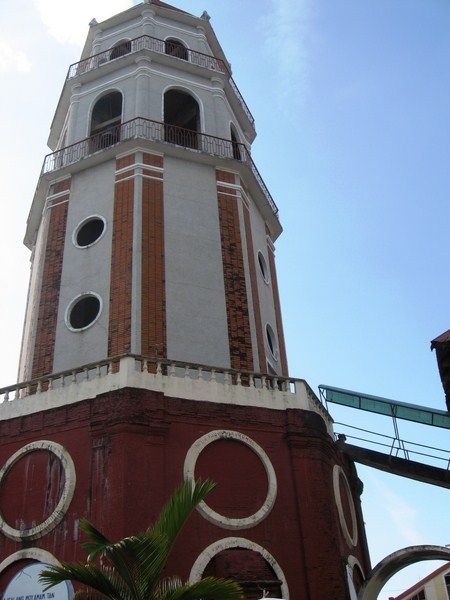
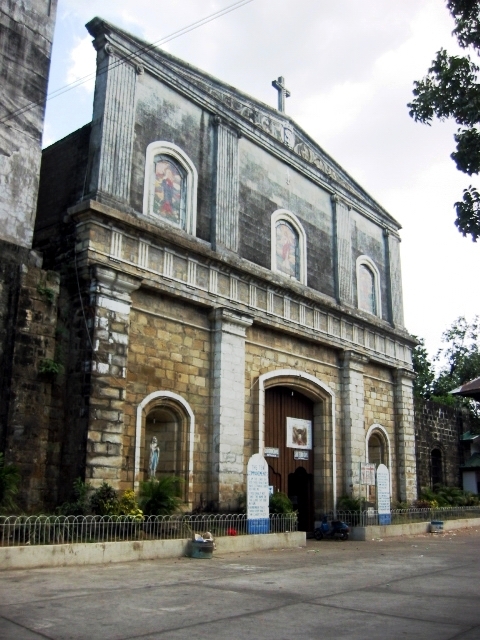
The cathedral has a simple brick facade and a 4-storey (square at the first 2 storeys and octagonal at the upper 2) bell tower on its left.  Its carved wooden portals are decorated with flora and fauna, cherubs and the images of the Four Evangelists: John, Luke, Mark and Matthew. Within the church grounds is an old, broken bell.

Cheska with the old, broken down church bell

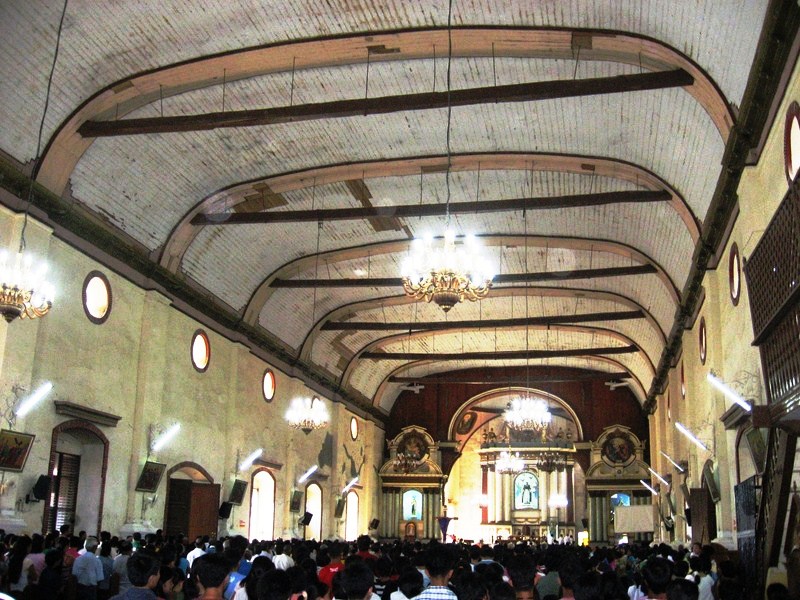
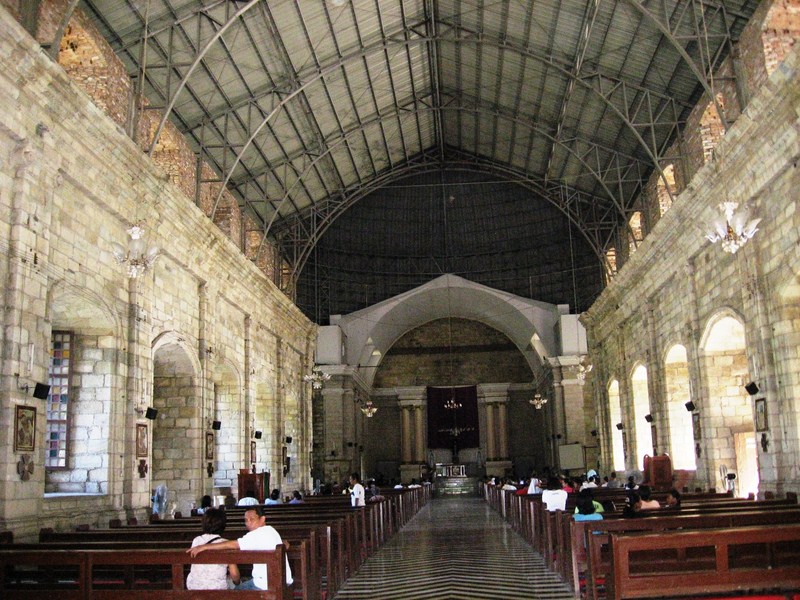
As the church doors were locked, we weren’t able to see the church’s well-maintained and faithfully restored interior said to have brick walls, wall-hung period lamps, a ceiling with designs of Muslim brass gongs, two sets of Stations of the Cross (in wood and stained-glass windows) and three richly decorated and intricate retablos (altar backdrops).