City Tour – Thian Hock Keng Temple (Singapore)

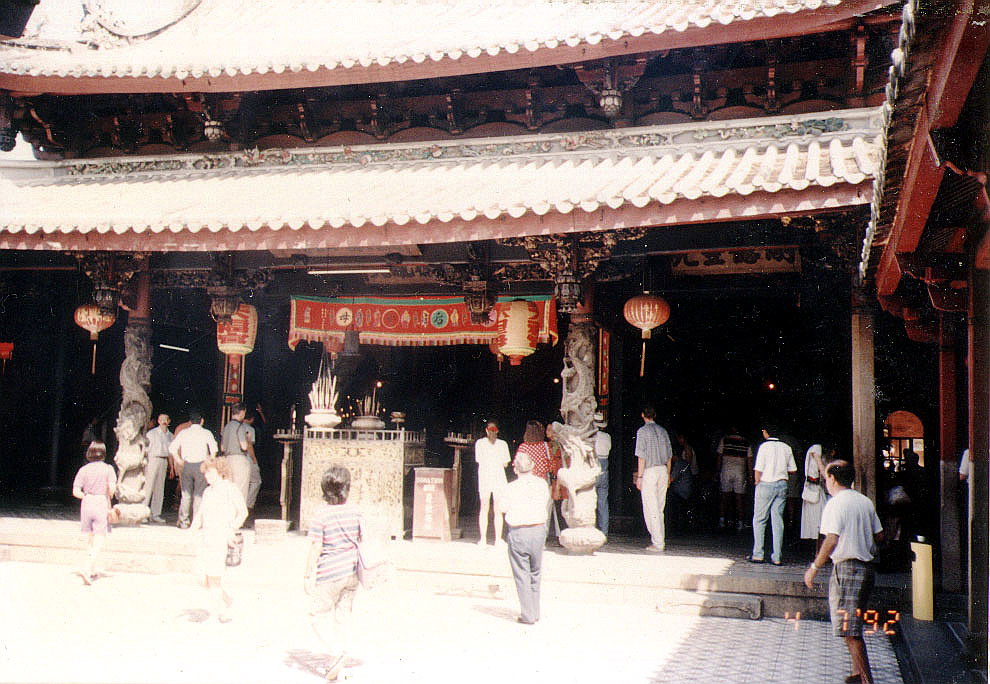
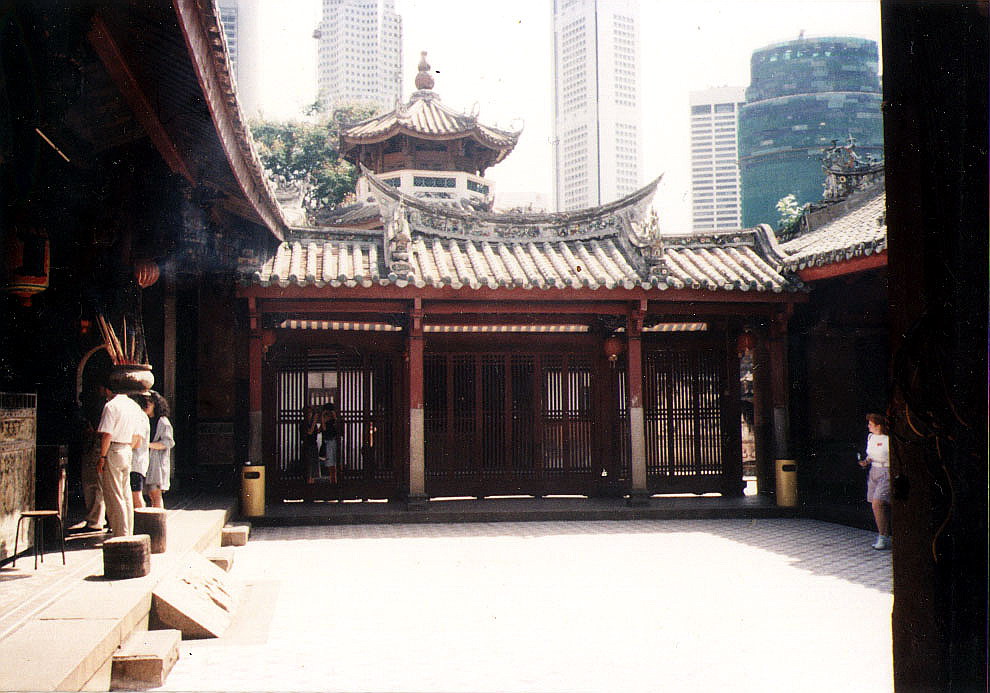
Thian Hock Keng Temple (Temple of Heavenly Happiness) – Entrance

From Merlion Park, we next moved on to the Chinatown area were we visited the Thian Hock Keng Temple (Temple of Heavenly Happiness), one of the oldest and most important Hokkien temples in Singapore.

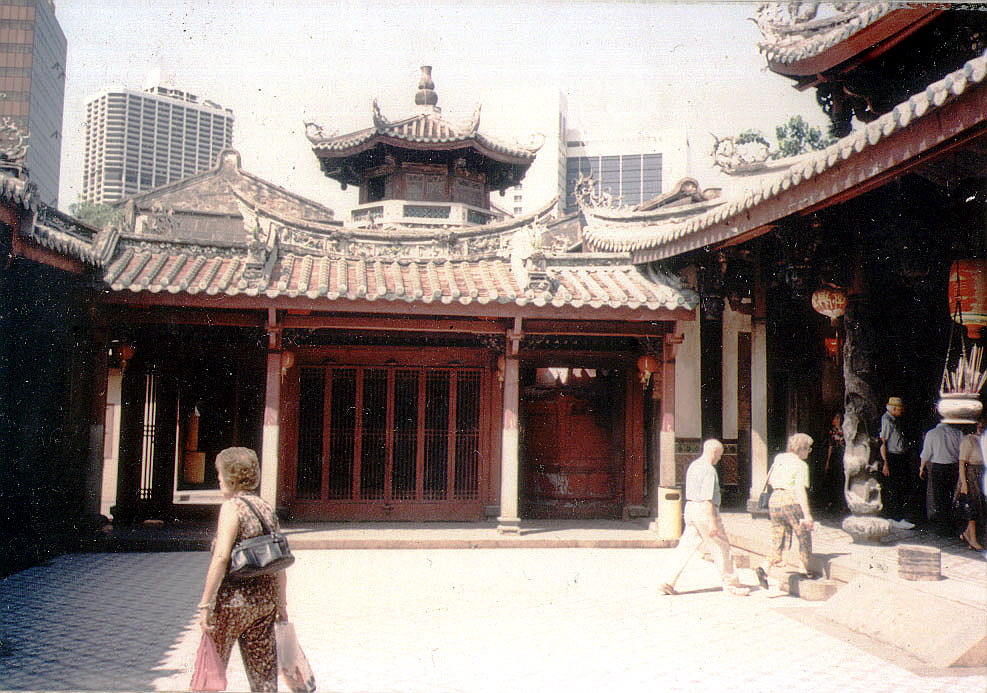
Thian Hock Keng Temple (Temple of Heavenly Happiness) – Courtyard

Built in traditional southern Chinese architectural style from 1839-1842 by Mr Tan Tock Seng and Mr Si Hoo Keh, it was visited by Chinese immigrants giving thanks to Ma Chu P’oh or Ma Zu (the Chinese Goddess of the Sea) for their safe voyage.  The temple replaced a humble joss house established here in 1821 by Hokkien immigrants from Amoy (China).  In 1973, it was gazetted as a National Monument.

Thian Hock Keng Temple (Temple of Heavenly Happiness) – Courtyard

This architectural masterpiece of stone, tiles and wood, assembled without nails, is embellished with dragons and phoenixes, amazing carvings, intricate sculptures and imposing columns.

Thian Hock Keng Temple (Temple of Heavenly Happiness) – Courtyard

Granite tablets on the wall inside the Entrance Hall record the details of the temple’s history.  There is also a plaque, presented by Qing Dynasty Emperor Guang Xu in 1907, inscribed with the words Bo Jing Nan Ming (Gentle Waves over the South Seas), evidence of the temple’s stature.

Thian Hock Kieng Temple: Telok Ayer St., Singapore.

Enroute to Finger Pier (Singapore)

After my Johor Bahru (Malaysia) tour, I returned to the Cockpit Hotel to pick up Mom for our Batam Island (Indonesia) tour.  Located 20 kms. from Singapore, this island of the Riau Archipelago is the closest Indonesian island to Singapore. To get there, we had to get a fast ferry from Finger Pier along Prince Edward Rd..

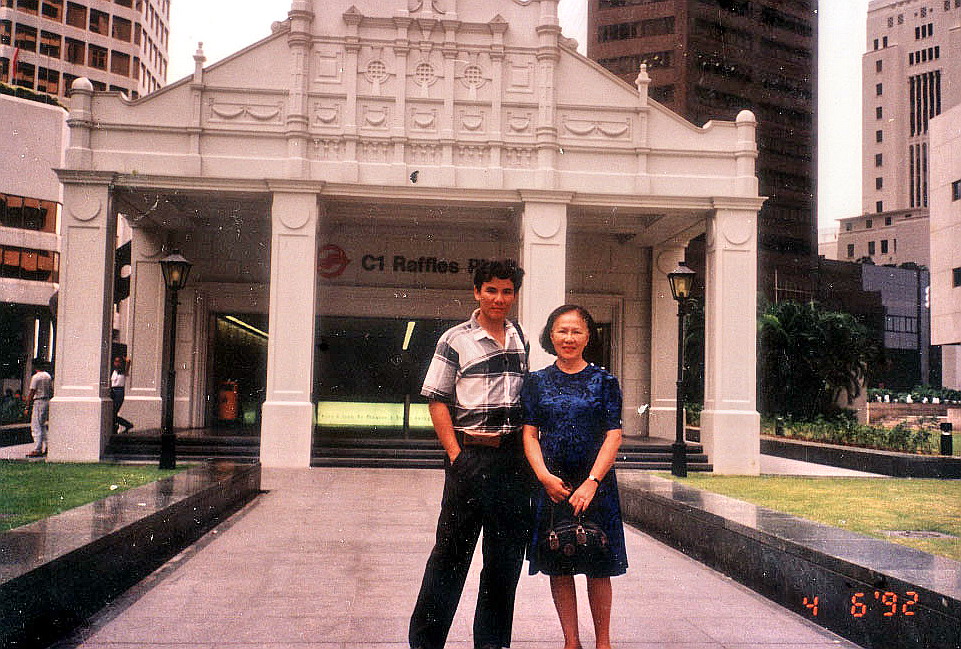
Raffles Place MRT Station

From the hotel, we had lunch at a Pizza Hut outlet then walked all the way to the Dhoby Ghaut Station where we took the MRT up to the Raffles Place Station.  From here, we walked all the way to the pier.  Along the way, we passed by a number of tourist attractions at the downtown area (the Dalhousie Obelisk, the Cavenagh Bridge, Victoria Theater, Empress Place) and the Padang (the Supreme Court and City Hall Buildings).

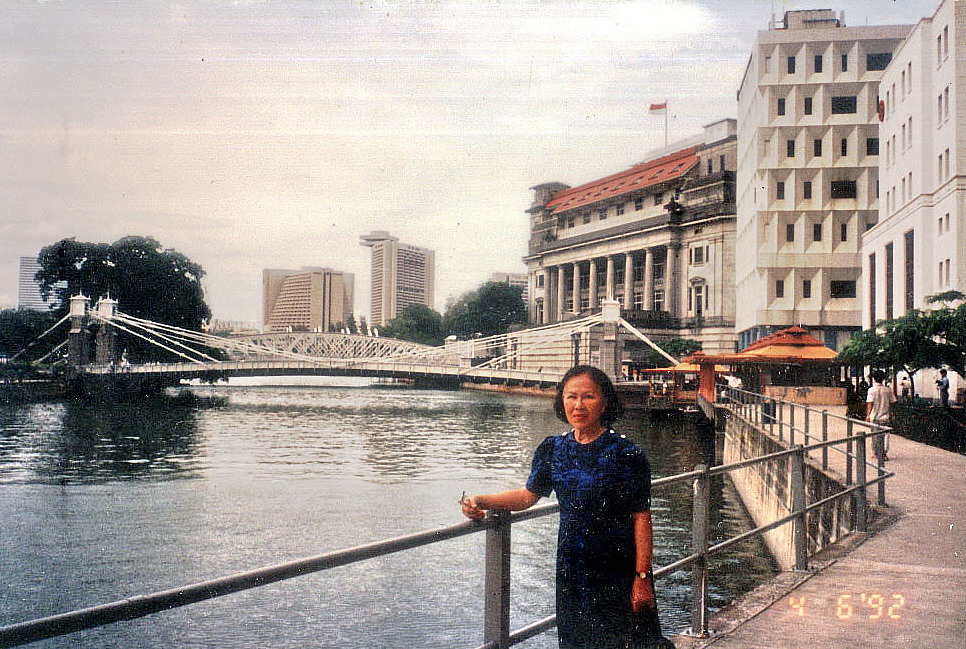
Singapore River and Cavenagh Bridge

Cavenagh Bridge, a suspension bridge (the only one in Singapore) spanning the lower reaches of the Singapore River, was opened in 1870 and is one of the oldest bridges in Singapore and the oldest bridge in Singapore that exists in its original form.

Dalhousie Obelisk

The Dalhousie Obelisk, located on the north bank of the Singapore River, is situated at Empress Place and near the Victoria Theater and Concert Hall. Designed by Government Surveyor John Turnbull Thompson, it commemorates the second visit of Marquis of Dalhousie, the Governor-General of India in February 1850.  It was originally located at Dalhousie Pier but was transferred to its present site in 1886.

Empress Place

Empress Place, built in 1834 as a courthouse, was later used as offices for the government departments until the late 1980s.  On April 7, 1989, it was converted to a museum after a 14-month, S$25 million renovation. On February 14, 1992, it was gazetted as a National Monument.  Its imposing Neo-Palladian facade has wooden louver windows and pitched, clay tile roof.

Subsequently, the Empress Place Building underwent renovations and, on March 2, 2003, it reopened as the second wing of the Asian Civilizations Museum exhibiting Southeast, South and West Asian collections.

Victoria Theater and Concert Hall

The Victoria Theater and Concert Hall, originally built in 1862 as Singapore’s town hall, is a complex of 2 buildings and a 54 m. high clock tower(completed in 1906) joined together by a common corridor.  The Victoria Memorial Hall, built in 1905, is the home of the Singapore Symphony Orchestra (SSO), transferred here in 1979.

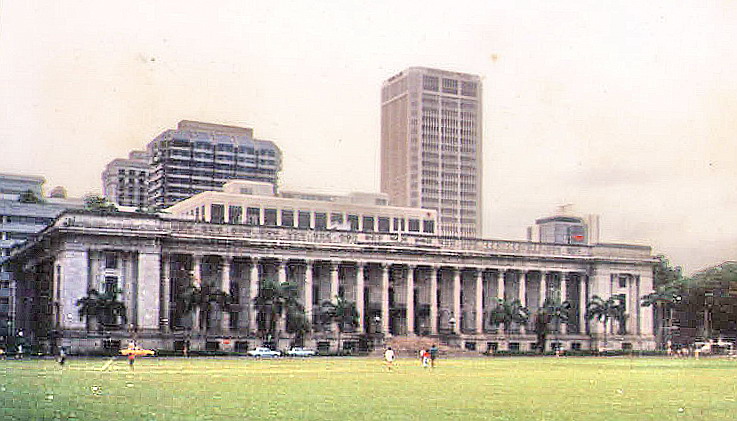
City Hall

The Neo-Classical-style Singapore City Hall and its sister building, the Supreme Court, both on St. Andrew’s Road and overlooking the Padang, are also some of my favorites and both are reminiscent of our own National Museum complex, designed in the Federal style of American architect Daniel H. Burnham, the planner of Baguio City.

The Singapore City Hall, formerly known as the Municipal Offices, was built in 1929. Its steps were the site of the formal surrender of Japanese armed forces, headed by Gen. Itagaki to Admiral Lord Louis Mountbatten, Supreme Allied Commander of Southeast Asia. In 1952 the building’s name was changed when Singapore was finally made into a city by a deed signed by Britain’s King George VI and conferred by the Duchess of Kent.

Supreme Court Building

The impressive Supreme Court Building, on the other hand, was designed by government architect F. Dorrington Ward and was completed in 1939. It is the last Classical building to be so completed. What’s more, the building’s murals were designed by Italian artist Cavaliere Rodolfo Nolli.

Victoria Concert Hall: 11 Empress Place, Victoria Memorial Hall, Singapore 179558.  Tel: 6338 6125.

Johor Bahru (Malaysia)

Upon reaching the Malaysian side, I cleared my entry to Johor Bahru at the Malaysia Customs and Immigration Office. Once past, I found myself along Jalan Tun Abdul Razak.  Here, a fenced historical marker with a plaque tells the story of the town.

Johor Bahru Historical Marker

Johor Bahru has a rich history that dates as early as the 16th century but its urbanization began in 1855. Sultan Abu Bakar (1862-1895), the 21st Sultan of Johor, transformed Johor Bahru from a fishing village into a thriving city.

Johor Bahru

Jalan Tun Abdul Razak and the adjoining  Jalan Trus has a number of shophouses, mostly built in the 1920’s,with great heritage value. Here, traders from Arab, India and China used to come to trade spices and tobacco. Also along Jalan Tun Abdul Razak is the Johor Bahru Railway Station.

On October 10, 2010, the spanking new JB Sentral railway station, along Jalan Tun Abdul Razak and Jalan Jim Quee, was opened. The old train station, located just 200 m. south of JB Sentral, has been decommissioned, its platform 2 and its tracks dismantled.  Only one track and platform remain.  There are plans for it to be preserved for a future Mini Railway Museum for the Southern Region.

Johor Bahru Railway Station

The relatively old Plaza Kotaraya shopping center, along Jalan Trus, is only 5 minutes walk from the Malaysia Customs and Immigration Office.  Across the street is the Arulmigu Sri Raja Mariamman Devasthanam Hindu Temple.  Built in 1922, it is one of the town’s oldest Hindu temples and has an impressive gopuram (entrance tower).

The Arulmigu Sri Raja Mariamman Devasthanam Hindu Temple was rebuilt and was officially reopened in 1996. In 2009, the temple was embellished with an impressive mosaic of 300,000 pieces of red, blue, yellow, green, purple and white glass (completed in October 2009) and, on May 12, 2010, the temple was listed in the Malaysian Book of Records as the first and only glass temple in the nation.

Arulmigu Sri Raja Mariamman Devasthanam Hindu Temple and Plaza Kotaraya Shopping Center

After this relatively short walking tour of Johor Bahru, I retraced my steps back to the Malaysia Customs and Immigration Office to clear my departure and, this time, took a bus back to the Queen Street Bus Terminal in Singapore.

Arulmigu Sri Raja Mariamman Devasthanam Hindu Temple: 22 Lorong 1, Jalan Tebrau, Johor Bahru, Malaysia.

Enroute to Queen Street Bus Terminal (Singapore)

On my second day in Singapore, I decided to make a tour, on my own, to the nearby Johor Bahru, the first Malaysian town (and the capital of the state of Johor), across the Causeway, from Singapore.  After breakfast at a MacDonald’s outlet, I traveled all the way to the Queen Street Bus Terminal (also known as the Ban San Bus Terminal), a centralized location for commuters traveling to Johor Bahru.

St. Joseph’s Church

Along the way to the terminal, I passed a couple of noteworthy Roman Catholic churches.  The attractive, Gothic-style St. Joseph’s Church was originally built  from 1851-1853 by Portuguese Rev. Vincente de Santo Catharina.  The present church, built from 1906-1912 by the notable firm Swan & MacLaren, has a portico supported by 4 columns; a central, octagonal tower capped by a dome and flanked by 2 smaller towers and beautifully crafted stained glass windows.

Cathedral of the Good Shepherd

The Renaissance-style, graceful and charming Cathedral of the Good Shepherd, the cathedral church of the Archdiocese of Singapore and the seat of its archbishop, was completed on June 6, 1847 with funds collected by French parish priest Fr. Jean-Marie Beurel. Designed by Denis Lesley McSwiney, it was elevated as a cathedral in on February 14, 1897. It has 6 entrances, Palladian-style porticos, a high timber ceiling and round arches. On June 28, 1973, the cathedral was gazetted as a National Monument.

St. Joseph’s Church:  143 Victoria St., Singapore 188020. Tel: (65) 6336 2664 and (65) 6338 3167.

Cathedral of the Good Shepherd: cor. Queen St. and Bras Basah Rd., Singapore 188533.  Tel: (65) 6337 2036.

Boracay Here We Come! (Malay, Aklan)

After breakfast at Dad’s ancestral home in Malay, we boarded the L-200 and were driven, along 6 kms. of dirt road, to the makeshift jetty port at Brgy. Caticlan.  Here, we boarded a big outrigger boat for Boracay Island.  Our 15-min. pumpboat ride to the island was smooth all the way and soon the crystal blue waters turned sparklingly clear as we approached the island’s famous White Beach.  It was just about noontime and the palm-fringed beach’s dazzlingly white sand was practically deserted and enchanting.

On our way

Our boat docked at Boat Station 2, actually just an open beach point without piers where boats land.  All passengers, including us, have to alight the boat via a narrow gangplank then wade a short distance through the shallow water to the beach.  Others, however, hired brawny porters to carry them to shore on their shoulders.  From the beach, we walked a short distance to a narrow alley.  From the alley entrance, we walked a further 100 m. to Lion’s Den Resort on our left.

This rustic resort, owned and managed by Lowell A. Talamisan, an apo (grandnephew) of my father-in-law and a nephew of my wife Grace, is conveniently located midway between the beach and Main Road.  Here, we stayed at one of the resort’s quaint and cozy nipa and bamboo cottages with private bath.  Our cottage also had a verandah with a nice hammock slung at the posts.

Jandy and his lola relaxing at the verandah

Boracay Island then was without electricity and our cottage was lit at night with gas lanterns.  Other high-end resorts were powered by generators.  This didn’t matter to us then, since food and accommodation were inexpensive and the people were friendly. Sometimes we would dine on grilled blue marlin at the resort or dine out at the restaurant of the nearby Red Coconut Resort.

White Beach circa 1990

The most exhilarating portion of our 3-day stay on the island was  the  feel of the sand of White Beach, snow white and fine as sifted confectionary sugar, top-grade cake flour or baby powder.   It was so white you can get a total suntan  due to the  sun’s  reflection on the sand.  The  aquamarine  water was shallow and clear and the sunset was always magnificent.

Sand, sea and sky at Boracay

Up north along White Beach, across Willy’s Beach Resort, is Willy’s Rock, the familiar and frequently photographed landmark that dominates the seascape.  This large, castle-like natural boulder rises 7 m. (23 ft.) from the sand.

Posing by the much photographed Willy’s Rock


Ocean Park (Hong Kong)

After our morning city tour and lunch, we all proceeded to Ocean Park, one of the most spectacular attractions in Hong Kong.  This huge complex, comprising an amusement park, oceanarium (Asia’s largest) and an aviary, is located at the valley between Wong Chuk Hang and Nam Long Shan Mountain along Deep Water Bay, on the south side of Hong Kong.

Ocean Park

Ocean Park

Beautifully set high on a hill overlooking the South China Sea and opened on January 1977 (at a cost of HK$150 million) by Hong Kong Gov. Sir Murray MacLehose, it was a perfect place to take a break from the hustle and bustle  of our Hong Kong holiday.

Cable car

Cable car

Access to the theme park’s headland area, 1,400 ft. above sea level, is either by a 1.5-km. long cable car system or around the other side of the hill at Tai Shue Wan by the longest outdoor covered escalator in the world which can carry 4,000 passengers an hour up a 30-degree slope. Both cable car and escalator offer fantastic views.  We chose to enter the park via the former.

Atoll Reef

Atoll Reef

Sea lions

Sea lions

Penguins

Penguins

The amusement park has a selection of thrill rides including the “Dragon,” one of the world’s longest and fastest roller coasters.  Perched on the edge of the mountain, it features a series of heart-stopping series of twists, turns and giant 360-degree loops.

Walking through the Aviary

Walking through the Aviary

Atoll Reef, a huge aquarium in Marineland, houses 500 different species of fish.  Wave Cove, an exhibition area, is where we saw sea lions, African fur seals, Stettler sea lions, dolphins, penguins, pelicans and Miss Hoi Wai (formerly named Peanuts and Susie), its signature female killer whale (Orsinus orca) captured on October 1977 in Ingolfshofdi, Iceland and moved to Ocean Park on January 27, 1979.

In early 2011, Atoll Reef was closed after 34 years of operation. Many of the fishes were moved to the new Grand Aquarium.  The killer whale Hoi Wai died on April 21, 1997, at the age of 22, due to severe blood loss.

Image-04

The free-flight, walk-through, 2,500 sq. m.  Aviary, at Bird Paradise in Tai Shue Wan, is one of the largest in the world. It houses about 3,000 birds of 150 different species.

Ocean Theater

Ocean Theater

High diving act at Ocean Theater

High diving act at Ocean Theater

The highlight of our visit to Ocean Park was the high altitude diving show at Ocean Theater.   On April 7, 1985, during a single show at the park, Americans Lucy Wardle and Randy Dickison set new world high dive records. Lucy’s dive of 120 ft. (36.8 m.) still stands today. Randy’s dive of 174 ft., 8 ins. surpassed Dana Kunzie’s 172 ft. dive in 1984. The current world high dive record of 177 ft. belongs to Oliver Favre of Switzerland, set in France in 1987.

Ocean Park: Wong Chuk Hang, Hong Kong.  Tel: 3923 2323.  Open Mondays-Fridays, 9 AM–5 PM.

Repulse Bay and Tin Hau Temple (Hong Kong)

Traveling along the main road between Aberdeen and Stanley, we could hardly believed that we were in a highly urbanized city such as Hong Kong as, along the way, we espied the resort-like setting of the wide, crescent-shaped beach of peaceful Repulse Bay at the southern part of Hong Kong Island.  The bay, once a haven for pirates intent on plundering foreign merchant ships trading with China, was so named after the British fleet repulsed the pirates in 1841.

Repulse Bay

Repulse Bay

Here, at the eastern end of the beach, we made a stopover at Tin Hau Temple, one of the oldest in Hong Kong and one of over 70 Tin Hau Temples throughout the colony.

Posing at the base of the statue of Tin Hau

Posing at the base of the statue of Tin Hau

This brightly-colored Taoist shrine has a pavilion, a small pier area and  two huge, more than 10 m. high statues – one for Tin Hau (the Goddess of the Sea) and the other for Kwun Yam (Guan Yin, the Goddess of Mercy).  Both goddesses hold a prominent place in traditional Chinese legends.

Posing in front of the statue of Kwan Yam

Posing in front of the statue of Kwun Yam

It also has a Chinese-style garden, leading down to the beach, and the Longevity Bridge, a little bridge with an inscription that says “Each time you cross this bridge, your life will be prolonged 3 days – Lau Hon-Wah.”

Posing in front of the Kwun Yam Shrine and Longevity Bridge

Posing in front of the Kwun Yam Shrine and Longevity Bridge

Hong Kong: My First International Trip

1989 was a landmark year for me and my wife Grace as we departed on our first overseas vacation, notably to the British colony of Hong Kong.  We weren’t traveling alone as we were joining Grace’s  E. Ganzon, Inc. office mates as well as their boss, Engr. Eulalio “Loi” Ganzon on a 3-day tour.  We all departed on Manila on board Philippine Airlines Flight PR-0300 and arrived at Hong Kong’s Kai Tak International Airport after a 1.5-hr. flight.

On board our PAL flight to Hong Kong

On board our PAL flight to Hong Kong

From the airport, we were all transported in a bus to our hotel located at Hong Kong’s Harbor City area – Omni Prince Hotel.  This hotel, overlooking Kowloon Park, is just a 20-min. drive from the airport.  Here, we stayed at some of the hotel’s 401 contemporary rooms  and suites.  Our visit to this British Crown colony was to last three days.

Check out “Hotel and Inn Review: Omni Prince Hotel


The author at Omni Prince Hotel

The author at Omni Prince Hotel

Omni Prince Hotel: Harbor City, Kowloon, Hong Kong. Tel: 3-7361888.

Puerto Azul Golf and Country Club (Ternate, Cavite)

From the  Palace in the Sky in Tagaytay City, we next motored, via the Naic-Indang Rd., to the town of Ternate where we  visited the 1,024-hectare Puerto Azul Golf & Country Club.  This 5-star resort, carved out of heavily forested valleys and towering mountains, was developed during the 1970s Marcos era.

Check out “Palace in the Sky

We first made a stopover at Paniman Beach along Paniman Bay, one of the resort’s 4 gray sand beaches (the others are Caysubic, Cayokno and Palicpican).  During its earlier days, this beach used to be covered with white sand said to have been brought over from Boracay, then unknown to the Filipinos.  The white sand is now gone, washed away by the tides.

Mel and Grace at one of Puerto Azul’s beaches

From the beach, we next negotiated a steep road to get to its lookout which has a view of the resort’s 100-hectare golf course, a private club open only to hotel guests.  One of the country’s most scenic courses, the golf here is surpassed only by views of Palicpican Beach.  Designed by world-renowned golfer Gary Player and Ron Kirby, this 18-hole, 6,556-yard, par 72 (adjustable to 71 for big events like the Philippine Open) golf course has a front 9 with rugged terrain punctuated with mountains, pristine rivers and streams while the back nine is close to the sea.

The scenic golf course

The course takes you through jungle, up and over mountains and finishes up on the beach.  An elevator takes you from the 6th green up to the 7th tee.  The last two tee shots on the back nine are probably the most dramatic. The par 3 17th Hole, the courses’ signature hole, is protected on its left by one of the deepest water hazards in Philippine golf – the South China Sea.  The 18th hole is across the beach.  Facilities include the nine-hole par-36 Camandag Executive Links, a driving range, tee house, clubhouse, restaurant, bars, locker and shower rooms swimming pool, sauna and massage.

L-R, Alex, Mel, Grace, Jandy and the author at the lookout

We can also see some of the 17 3 to 4-storey cluster buildings which houses 325 airconditioned rooms.  The resort is also home to restaurants, coffee shops, bars, 2 swimming pools, 300-pax ballrooms, 8 60-pax function rooms, business center, jacuzzi, sauna, 6 outdoor and 3 indoor tennis courts, 6-lane bowling center, volleyball/basketball court, two squash courts and 2 nature trails.

AUTHOR’S NOTES

Though still open, this resort, once dubbed as “Asia’s Paradise Resort” and the “World’s Golfing Capital,” seems to have been abandoned, reportedly due to lack of financial resources to maintain the site.  The hotel and cottages are worn out, the beach is dirty and only South Korean nationals use the not so well-maintained golf course.  However, Boulevard Holdings, the owner and operator of the site, plans to renovate the existing hotel and build an 8-room boutique hotel and 150-room grand convention hotel.

Puerto Azul Golf and Country Club: Brgy. Sapang,  Ternate, Cavite.  Tel:  524-0026 to 27.  Manila sales office: Tel: 844-8541.

AERA Memorial Museum (Villa Escudero Plantation & Resort, San Pablo, Laguna)

Part of day tour package of Villa Escudero Plantation & Resort included admission to the resort’s AERA Memorial Museum which houses the priceless collections of Arsenio and Rosario (nee Adap) Escudero.  Begun on June 29, 1923, it is run by the AERA (acronym of the founders’ names) Memorial Foundation.  It is housed in an exact replica of the beautiful San Francisco Church of Intramuros.  The original church was destroyed by heavy American artillery bombardment on February 3, 1945 during the liberation of Manila and the site is now occupied by Mapua Institute of Technology. 

The pink-colored  building took 10 years to build on a massive 7-ft. thick concrete foundation and has a high 200-sq. ft. ceiling with trompe l’ oeil paintings by Benny Cabezada.  Attached to the ceiling are ten chandeliers copied from an Arte Espanol original.  Its display arrangement was said to have taken 3 years to complete.  Ninety percent of the display is family-owned while the rest were donated or acquired by the foundation.

AERA Memorial Museum

The museum’s collection of religious art is its main attraction.   A wooden bas-relief of the Nuestra Senora de Augustia, donated by my late uncle and National Artist, Arch. Leandro V. Locsin, is located by the massive  ornate door made in 1768.  By the way, cameras and videocams are not allowed.   A kamagongSto. Entierro (glass bier of the Dead Christ, circa 1856) carriage fashioned by noted sculptor, Isabelo Tampingco, was formerly from the Sta. Cruz Church of Manila.  It is adorned with 24 batikuling (a local aromatic softwood) cherubs and was donated by Dona Maria Luisa Quiogue (of the funeral parlor chain).

Other displays include an ivory-headed statue of Virgen Dolorosa from a church in Marinduque, a Pieta by Ireneo Cristobal, rows of ivory-headed santos, a granite Chinese fu dog guarding the staircase, an ornate wrought iron pulpit (raised platform used by a preacher) on the right side of the nave, silver sanctuary lamps, statues of Christ with the Cross on his Second Fall, a statue of Christ embracing a molave Cross, silver main altar acquired from Quiapo parish in the 1960s and a massive retablo (altar backdrop) from Agno (Pangasinan).
       
Its non-religious collection includes a couple of 1,400-year old and 1.5-ft. high Chinese Tsu-Chao jars, 12th and 13th century celadon pottery, tear vials of early Roman aristocrats, gilded carrozas (Spanish carriages), life-size dioramas of ethnic tribes in authentic costumes, ethnic artifacts and clothing, antique furniture, paintings, a numismatic display of obsolete coins and money, U.S. astronaut suits, a Philippine and African beetle collection and an extensive freshwater, terrestrial and marine shell collection (including the rare “Golden Cowrie”). 
       
Next to it are a dioramas of stuffed rare and some already extinct Philippine fauna. The only foreign stuffed animal is a big leopard shot during the 1923 Manila Carnival for attacking and killing a dancer.  It was later bought by the Escuderos and mounted.   A properly identified 22,000-piece butterfly collection is at the ground floor gallery.  A walk through our country’s political history is revealed in the display of inaugural suits and gowns of all the past twelve Philippine presidents and their First Ladies, from Emilio Aguinaldo to Corazon Aquino.  There are also costumes of former beauty queens.  Outside are World War II weapons and relics including tanks and cannons.
       
For me, the most unusual (and grotesque) item in the collection is an amazingly preserved, fist-size shrunken head from the Upper Amazon River Indians of Ecuador.  A trophy of war and bravery, it was acquired from a Swedish collector.  Another unusual item is a pen-and-ink portrait of Christ which was donated by an American couple in 1970 and surrounded by cherubs.  I took a closer look with a magnifying glass and it revealed an actual text of the New Testament, from the first word to the last.  

Villa Escudero Plantation & Resort: San Pablo City, Laguna.  Manila booking office: 1059 Estrada St., Malate, Manila.  Tel: (632) 521-0830, 523-0392 and 523-2944. Website: www.villaescudero.com