Stopover – Church of St. Nicholas of Tolentino (Sinait, Ilocos Sur)

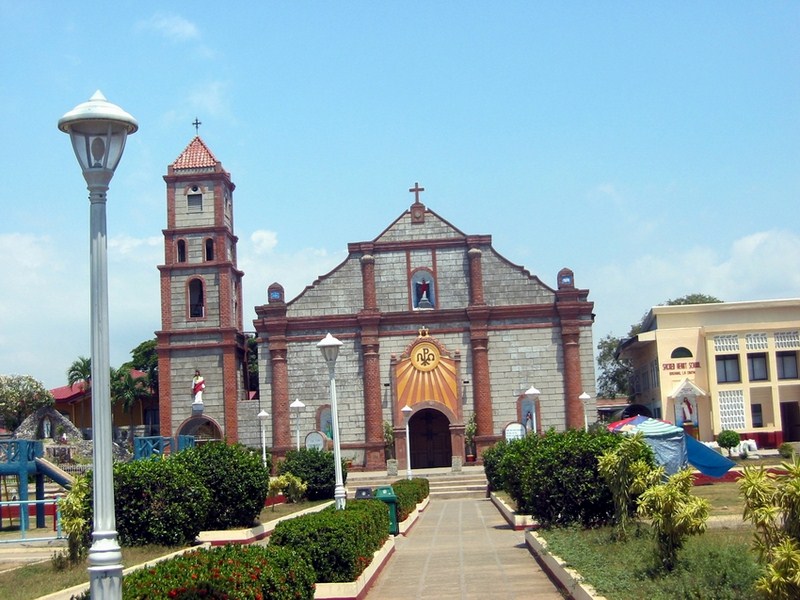
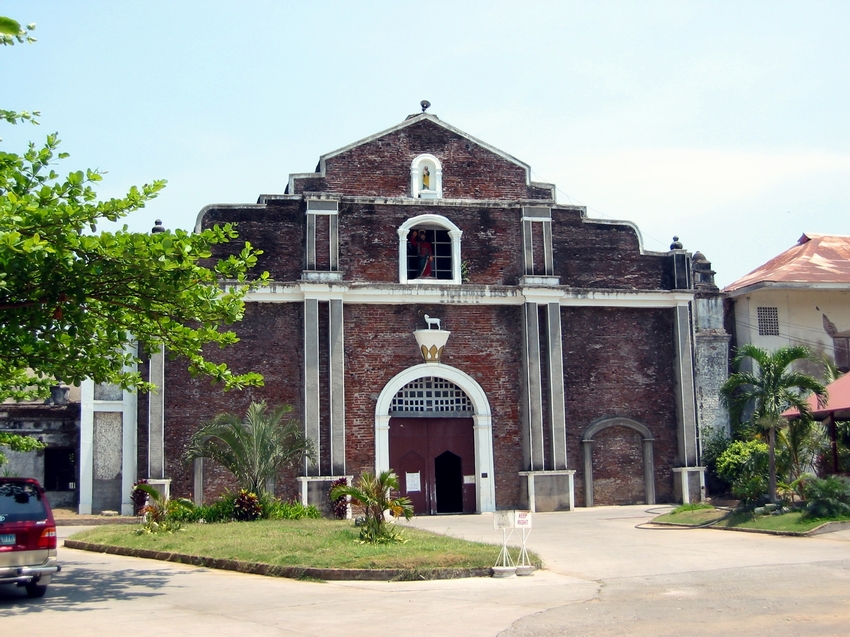
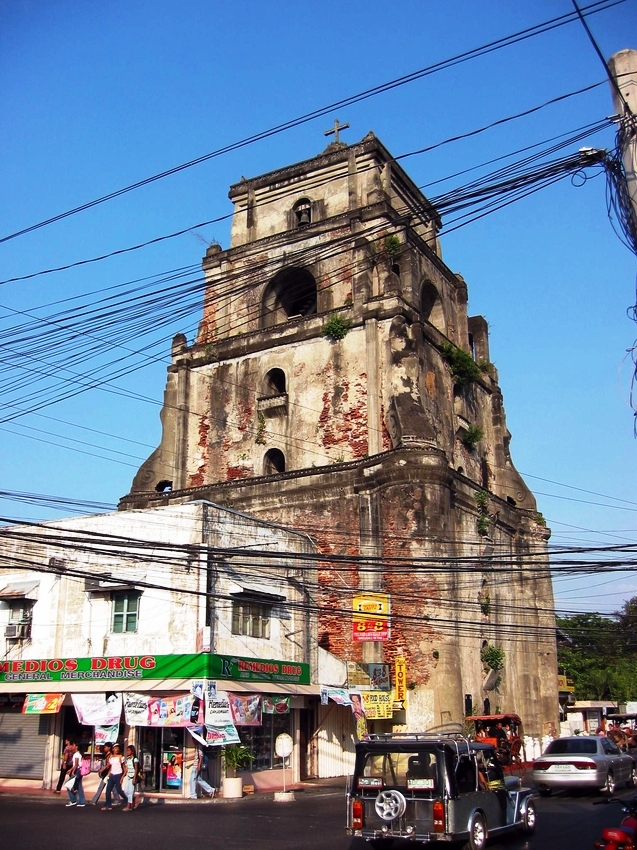
About 8 kms. after Cabugao, we entered the town of Sinait, the last Ilocos Sur town before entering the province of Ilocos Norte.  Here, we all made a longer stopover at the Church of St. Nicholas of Tolentino.  This church, damaged during the earthquake of 1620, was burned in 1760 and finished between 1760 and 1822.  It was restored by Fr. Celestino Paniagua (parish priest from 1889 to 1895).  Damaged by typhoon in 1953, the church was repaired in 1960 by Fr. Raymundo Garcia.

Church of St. Nicholas of Tolentino

The church has a massive, stucco-cement Neo-Classic and Baroque facade with no openings and flanked by 2 almost square twin bell towers.  The simple arched main entrance, flanked by two pilasters, has a rectangular window above it flanked by two small occoli decorated along the outer edges.  Above it is a small niche. A wooden tablet, carved with the Spanish coat-of-arms, is above the main door.  The quaint Moorish-inspired belfries have 2 levels, topped by balustrades, with one semicircular blind opening at the second level.

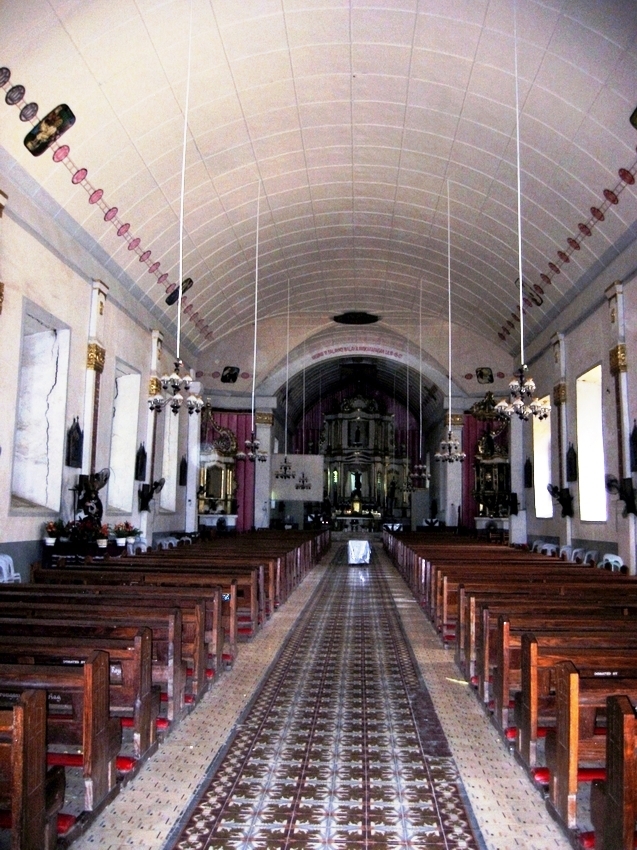
The church interior

The church houses the miraculous 17th century, life-size crucifix of the Black Nazarene or Santo Cristo de Sinait.

According to a long-lost manuscript, written between 1731 and 1734, this crucifix was found by some Sinait fishermen in 1620 floating along the coast of Sitio Lugao, Dadalaquitan Norte, in a casket together with the image of La Virgen Milagrosa de Badoc and was immediately placed inside the church.

Carved in hardwood and 18 feet long, it has a rich brown color and an impressive countenance. The sanctuary became famous throughout the Ilocos and devotion to the image was tirelessly spread in 1754 by Father Juan Dominguez.  It is believed to have aborted a plague that hit Vigan in 1756 and according to residents, still perspires sweet-scented oil.  A replica was recently installed by parish priest, Fr. Raymundo Garcia, at the spot where the statue was supposedly found

Church of St. Mark the Evangelist (Cabugao, Ilocos Sur)

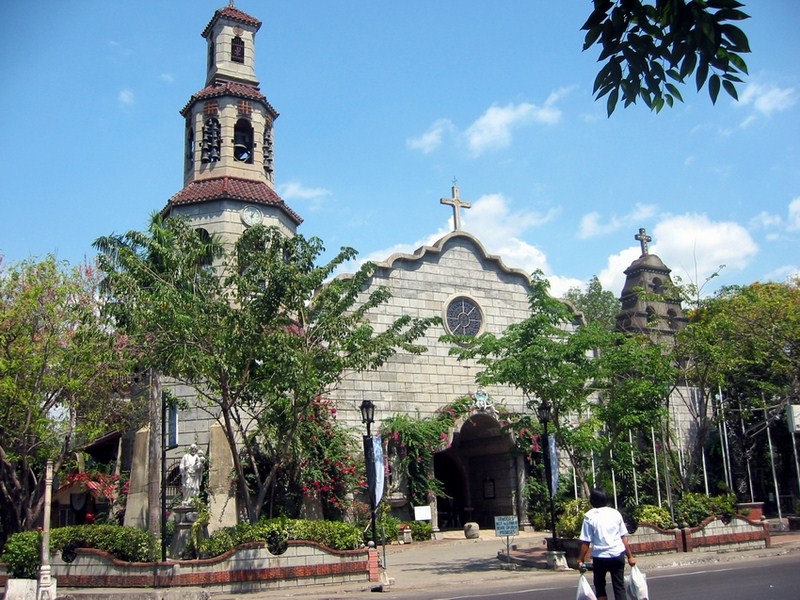
About 13 kms. past Magsingal, after the town of San Juan, I again made a short stopover at the town of Cabugao to photograph the roadside Church of St. Mark the Evangelist.  Built from 1695 to 1696 by Fr. Andres Canalejo, this church was reinforced in 1824, finished by Fr. Juan Zugasti between 1817 and 1834, seriously damaged in 1870, restored by Fr. Saturnino Pinto, damaged during the 1880 earthquake and restored by Fr. Juan Zallo.  It was damaged by a fire in 1965.

Church of St. Mark the Evangelist

This church’s scantily decorated Baroque facade, divided into 2 levels, has a semicircular arched main entrance flanked by paired Doric columns and blind segmented windows on the first level, semicircular arched windows on the second level.  Its broken  pediment,  with crestings on the raking cornice, is topped by a domed turret.  On its left is a 5-storey bell tower.

Magsingal Cultural Museum (Magsingal, Ilocos Sur)

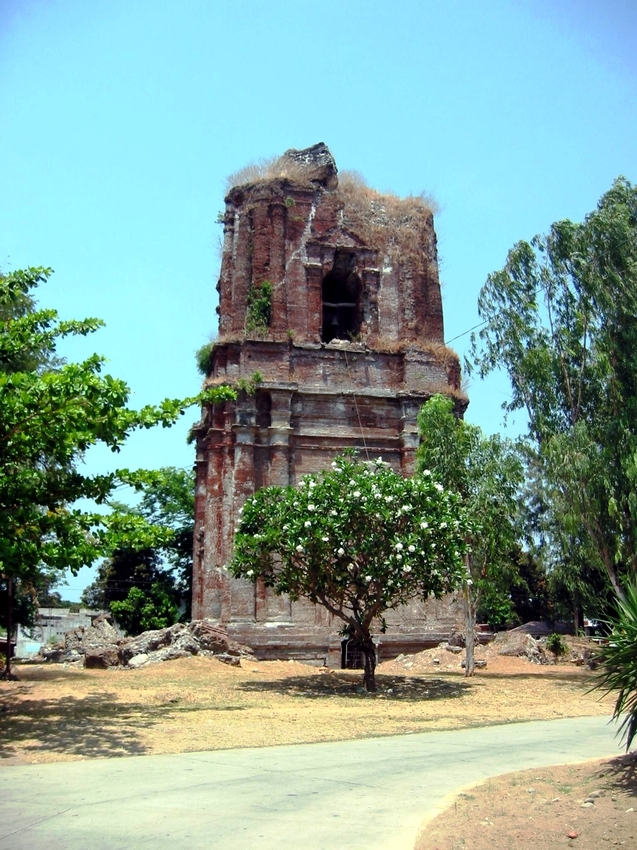
We finally left Vigan City by 1 PM and, 11.2 kms. out of the city, past the towns of San Ildelfonso and Sto. Domingo, we made a short stopover at the the Magsingal Cultural Museum, also called the Museum of Ilocano Culture and Artifacts.  Managed by the National Museum, parts of its displays are housed within the ruins of the town’s former Church of St. William.

The old church was started in 1662 by Fr. Alonso Cortes, finished in 1723, destroyed by earthquake soon after, rebuilt in 1730 and then burned by the rebel forces of Diego Silang.  Only the intact bell tower and part of the ruined walls remain.  On October 1982, it was restored and transformed into a museum housing the private collection of the late Mr. Angel Cortez (former curator of the Magsingal Museum).

It showcases the material culture of Northern Luzon.  The curator’s house across the street displays Neolithic tools, excavated porcelain and earthenware, antique santos, weapons and implements, baskets and headgear and old parish records.

Magsingal Cultural Museum: National Highway, Magsingal, Ilocos Sur. Open daily, 9-11:30 AM and 1:30-4:30 PM.  Visit is by appointment. Admission is free.

Archdiocesan Cathedral of the Conversion of St. Paul the Apostle (Vigan City, Ilocos Sur)

The next day,  I ate a late breakfast of Vigan longanisa (Ilocano pork sausages) with egg, watching out the window as Frank’s wife Cherry, my nieces Jaja and Sandy and nephew Gelo, as well as Tellie’s daughter Mandy (with her yayas) enjoyed a horse-drawn ride in a calesa, a truly unique way to tour the city.

Sandy and Jaja on board a calesa

After breakfast, we all made our way to the cream and white Vigan Cathedral, officially called the Archdiocesan Cathedral of the Conversion of St. Paul the Apostle, to hear the 10 AM mass, it being Palm Sunday.  Mena Crisologo, that early morning, was quite impressive as the diffused light transformed the buildings and street into a scene straight out of 18th century Vigan.

Vigan Cathedral

The Earthquake Baroque-style cathedral was started in 1790 and was completed in 1800.   Inside are 3 naves, 12 altars and a choir loft.  Chinese influence is seen in the baptistery, altar, brass communion handrails, a pair of Fu dogs and stylized moldings carved about the exterior doors.  Most of the original church paraphernalia and artifacts are still in place.  The main altar has beaten silver panels.  Its octagonal Italian Baroque bell tower, on a square base, was built from 1790 to 1800 and stands, separately, 15 m. south of the cathedral, in Plaza Burgos.

National Museum (Vigan City, Ilocos Sur)

It was now  late in the afternoon and I still had time for a visit to the 2-storey, 422-sq. m. National Museum, formerly the Ayala Museum and Library.  This house, built in 1788, was the former birthplace and colonial residence of martyred priest Fr. Jose A. Burgos.  At its ground floor is a Hall of Fame of Ilocano heroes and achievers, dioramas of local historical events (Tobacco Monopoly in 1782, Paoay Church Construction in 1704, Gomburza Execution, Battle of Tirad Pass, etc.), Filipiniana costumes, and Tingguian, looms for abel weaving, farming and fishing implements and Ilocano ethnic arts and crafts (burnay products, etc.).  There are also scaled models of two trading ships.  The first, a pichili trading junk, also called the Shantung junk, is regarded as the oldest type of Chinese sea junk used in fishing and trading.   Its actual length was 150 ft. and it stood 14 ft. high.  The second was that of a Japanese vessel that trade in Luzon from 1596 to 1615.  Around the models are trade ceramics.

National Museum
Upstairs are antique collections and memorabilia of the Burgos family such as Vienna furniture (beds, mirrors, divans, dining chairs, pianos, etc.) plus an old harp, gramophone, old telephones and other period pieces and heirlooms. On the walls are a priceless collection of 14 Esteban Villanueva canvasses. Esteban Villanueva was a businessman and unschooled painter from Vigan who depicted bloody events of the 1807 Basi Revolt in 14 36 by 36-inch frames.  At one time they were owned by Buenaventura Bello, a former president of the Ilocano Historical Association.  Until a few years ago, the paintings remained unrestored but a contemporary artist was commissioned to retouch them.  In spite of this, the painter’s original style is noticeable: details of costume and face, lack of perspective, the composition of the groups, ominous comets and even the little horse.  All were signed “E. Villanueva.”

I made it back to the inn before nightfall, joining Grace and Jandy for a sumptuous dinner of crispy okoy (flaky shrimp cakes) and pansit at the inn’s coffee shop.  Once filled, I finally decided to hit the sack for a well-deserved shuteye.

National Museum: cor. Plaza Singson Encarnacion and Burgos St., Vigan City, Ilocos Sur.       Open Tuesdays to Saturdays, 8:30 to 11:30 AM and 1:30 to 4:30 PM.  Weekend and holidays are by appointment.  Admission: PhP10 per adult and PhP5 for children (12 years and below).

Simbahan a Bassit Cemetery (Vigan City, Ilocos Sur)

From Plaza Saalcedo, I next drove to the Simbahan a Bassit (meaning “small church”) Cemetery, which contains the graves of the town’s eminent families.  It has a cemetery chapel, one of the interesting religious heritage structures in the country.  Located within a camposanto, very few of these remain in the country today and many are in a sad state of deterioration.   This well-preserved chapel, done in the Neo-Classical style, has a facade supported by rectangular columns and adorned with a pair of Baroque-style volutes and some floral details.

Simbahan a Bassit Chapel

Started in 1610, it was probably the first church built with permanent materials in the Ilocos. Blessed on November 9, 1852, it it also has an espadaña (a wall with holes in which bells are hung), the only one of its kind in the entire Ilocos region.  Its floors, made mostly of granite slabs, were mostly used as ballast by Chinese trading junks left behind on the return trip to China.  The chapel houses a statue of the Crucified Christ behind the main altar.  Almost as old as the church itself, the image is reverently called Apo Lakay (Ilocano for “old man”) and is renowned for its miracle cures.


Simbahan a Bassit Cemetery: Quezon Ave., Liberation Blvd., Vigan City, Ilocos Sur.

Arzobispado (Vigan City, Ilocos Sur)

From Bantay, I returned to Vigan and dropped by the Metropolitan Cathedral of St. Peter and St. Paul and its adjacent Arzobispado, the official residence of the Archbishop of Nueva Segovia.  The latter, the only surviving 18th century archbishop’s residence in the country, was built from 1783 to 1790.  In 1898, it served as the headquarters of Gen. Emilio Aguinaldo and, in 1899, as headquarters for American forces under Col. James Parker.  

The Arzobispado

The Arzobispado features sliding capiz windows and cut out decorations with floral motifs. The Museo San Pablo, beside the Arzobispado, showcases ecclesiastical artifacts, antique portraits of bishops, a throne room, archdiocesan archives and other religious paraphernalia gathered from various colonial churches all over the province.  

Museo San Pablo: Open Fridays-Wednesdays.  Admission is PhP5 for students and PhP10 for non-students.  Pre-arranged tours are allowed.


Our First Visit to Vigan City (Ilocos Sur)

I, together with my wife Grace and my kids Jandy and Cheska plus my brother Frank, sister Tellie and their families were planning to go on vacation at Pagudpud in Ilocos Norte.  However, we didn’t go all the way there, opting also to stay overnight at Vigan City.  We left Manila by 2 AM, April 3, the week prior to Holy Week (to avoid the traffic). By land, it is no easy feat getting to Vigan City and we made the 437-km. long haul drive in about 10 hrs., including breakfast and nature calls, with me and Grace taking turns driving.  The kids were mostly asleep the whole time.   Our arrival at the beautiful Quirino (Banaoang) Bridge heralded our entry into Bantay and Vigan City.

Quirino Bridge

Upon our arrival at Vigan City, we parked our Toyota Revo somewhere near the narrow Mena Crisologo St. as cars are now allowed along this street to protect the cobble stones and preserve the ambiance of the place.  This street, located south of Vigan Cathedral, was the Chinese mestizo quarter, popularly known, in the olden days, as Kasanglayan.  We checked in at Cordillera Inn, one of many ancestral homes in the city turned into cozy hotels and pension houses. Our group occupied 3 (out of 23) airconditioned family rooms with private bath and cable TV (PhP1,500).

Check out “Hotel and Inn Review: Cordillera Inn

Cordillera Inn

After settling in at Cordillera Inn, we all left to join the others for a late lunch at nearby Cafe Leona, walking along the length of cobblestoned Mena Crisologo Street to get there, passing some of the country’s best remaining colonial architecture.

Check out “Restaurant Review: Cafe Leona

Leona Florentino House

Café Leona, as well as the Provincial Tourism Center and the Vigan Heritage Commission, are housed at the Leona Florentino House.  Built in 1797, it is the former home to one of the country’s first woman playwrights and poets to gain international recognition.  One of her 5 children, Isabelo de los Reyes, would later become a writer like her as well as a champion of the Philippine labor movement and a senator.

Cordillera Inn: 29 Mena Crisologo cor. Gen. Luna Sts., Vigan City, Ilocos Sur. Tel: (077) 722-2526. Fax: (077) 722-2739 & 722-2727.  Mobile number: (0927) 313-5616.
Cafe Leona: Mena Crisologo St., Vigan City, Ilocos Sur. Tel: (077) 722-2212.  Fax: (077) 722-3089. Mobile number: (0920) 906-8144.  E-mail: cafeleona@yahoo.com.

Fontana Waterpark (Clark Special Economic Zone, Pampanga)

The next day, we all donned our bathing attire and visited the adjoining Fontana Water Park, the ultimate cool spot in Pampanga and the finest of its kind in the area. I brought along my 2 kids Jandy and Cheska.  Joining us were my balikbayan aunt Tita Cita, my brother Frank and his wife Ate Cherry.  This tropical jungle-themed park features a world-class wave pool that can electronically produce 6 types of simulated waves (ranging from mild to strong) up to 3 ft. high.

Tita Cita and Ate Cherry at the Wave Pool

We waited patiently for the waves which came every 30 mins.. When they did arrive, we kept on jumping about so that the waves, which last for 15 mins., won’t lash our faces.  This,  plus three giant aqua thrill slides, provided all the spills and thrills we wanted in a water amusement park. They also have kid-friendly pools with water level from 1 to 2 ft..  A replica of a pirate ship (the “Admiral”), with 4 mini water slides, continuously spouts streams of water into the shallow pool.  Lifeguards were everywhere, providing for a safe environment for adults and children alike.

Jandy tries out one of the Aqua Thrill water slides

A meandering  Lazy River swirls around the water park and one can ride around it in huge, animal-shaped (crocodile, snake, dinosaur, etc.) yellow life savers.  At the Mad Scientist Water Factory, so called because of the contraptions found in a horror movie, a wrong turn here will cause water to splash all over our face.  Adorning the water park are huge statues of elephants said to have been imported from Malaysia.  There are also statues of monkeys, an octopus, frog, dolphin and a swan.

L-R: Cheska, Kuya Frank, Tita Cita and Jandy

Fontana Water Park: Fontana Leisure Parks & Casino, C.M. Recto Highway, Clark Special Economic Zone, 2023 Pampanga.  Open Mondays to Thursdays, 8 AM-6 PM (entrance fee: PhP375) and Fridays to Sundays, 8 AM-6 PM (entrance fee:  PhP475). Tel: (045) 499-1179.

Fontana Leisure Park (Clark Special Economic Zone, Pampanga)

My brother Frank invited our balikbayan relatives (Tito Vit and Luz Mamawal, Tita Cita Reyes) to an overnight stay at a rented villa at Fontana Leisure Park, an early celebration of their upcoming silver wedding anniversary (December 17).  My family and I, as well as my siblings Tellie and Salve, were also invited to join them.  We left for Clark in the late after and arrived there in time for the anticipated mass officiated by my uncle Fr. Ben Mamawal.

The 3-bedroom villa we all stayed in

Fontana Leisure Park, operational since 1998,  has row upon row of duplex bungalows (called villas) with 2 to 3 bedrooms per unit.   We all stayed in a 3-bedroom unit. All units have all the amenities of upscale living such as centralized airconditioning and cable TV.  An “investment option” entitled one to membership and its attendant privileges such as 7 free tickets to the Water Park every month and an annual week’s stay at the villa in which you only pay the maintenance fee.

Tita Cita and Cheska dancing the “Otso-Otso”

The resort also has a 9-hole short golf course, a sprawling clubhouse complex with lobby lounge and coffee shop/restaurant; a convention center, and a Fun Park and Lagoon Area. The convention center has a 1,200-pax hall, a 600-pax ballroom a 150-pax theater plus meeting rooms and function rooms.