Sto. Nino Cold Spring (Catarman, Camiguin)

After our delightful lunch at Taguines Lagoon, we again boarded our hired jeepney and proceeded, along the west coast of the island, to Sto. Nino Cold Spring.  Also known as Kiyab Pool, it is located 4 kms. north and uphill of Catarman town proper.  From the main road, we made a turn into 2-km. long  dusty track.

Sto. Nino Cold Spring

The spring has 2 stone pools, the larger one measuring 25 m. by  40 m.  and its depth varies from one-half meter to 2 m.. The other is a kiddie pool.  The resort also has picnic huts, toilets, function hall and native stores for picnickers.  Being a holiday, the resort was packed with picnickers.  After paying an entrance fee, we swam its icy-cold, crystal-clear  spring water sprouting from its sandy bottom.  We shared the spring waters with some tiny fish.  After half an hour of swimming, we left the resort by 4 PM.  

Sto. Nino Cold Spring: Brgy. Mainit, Catarman, Camiguin.  Admission: PhP20/pax.

Taguines Lagoon (Mahinog, Camiguin)

We all left Katibawan Falls by 11 AM and proceeded on a 40-min. drive to Taguines Lagoon, near Benoni Port, for lunch.  This beautiful artificial lake has mantles of limpid water surrounded by craggy cliffs, huge boulders and gently rolling hills.  Truly, a relaxing break from a tiring tour around the island.

Taguines Lagoon

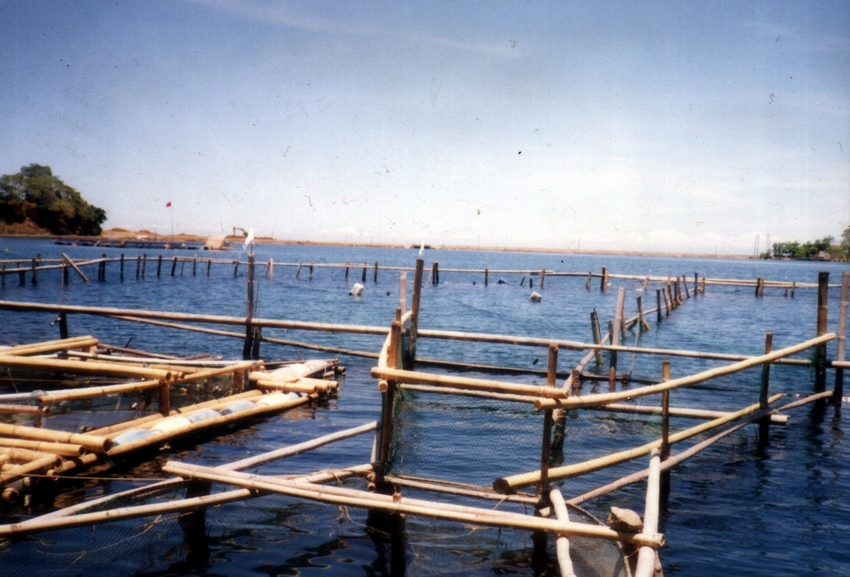
We stopped at J.A. Fishpen, a restaurant on stilts overlooking the lagoon.  Around it are fishpens where bangus (milkfish), mamsa (jack), lunab (surgeonfish), katambak (spadefish), danggit (seganid), maming (parrotfish), kitong and alimango (crabs) are bred.  Quite hungry, we feasted, kamayan-style, on fresh-caught and cooked alimango. kitong and bangus, plus fried chicken, pancit canton and halaan soup and washed it all down with buko and green mango shakes.

Image-03

J.A. Fishpen: Brgy. Benoni, Mahinog, Camiguin.  Tel:  (088) 387-4008.

Katibawasan Falls (Mambajao, Camiguin)

After an early-morning breakfast at the resort’s restaurant, we left at 8:30 AM for our island tour.  The day before, we contracted our jeepney drivers, Rico and Charlie, to give us a tour around the island for PhP1,500. The 5 towns of Camiguin (Catarman, Guinsiliban, Mahinog, Mambajao and Sagay) are all connected by a 64-km. long, almost all concreted  circumferential coastal road which can be circumnavigated in a 3-hr. drive.  While Jandy and I stayed inside the jeepney, the others sat on the roof, always on the lookout for trees while enjoying the cool breeze.  

Frolicking at the base of the falls

Our first stop was the 76.2-m. (250-ft. ) high Katibawasan Falls. Located 5 kms. southeast of Mambajao, on the 1,420-m. high Mt. Mambajao, a dormant volcano, it is one of the highest waterfalls in the country.  After paying the PhP10 entrance fee, we descended a 67-step concrete stairway, passed a view deck, and beheld one of the most beautiful waterfalls I have so far seen in the country.  The slim waterfall cascades precipitously down  to a rock pool teeming with fresh water shrimps and is surrounded by a massive granite mountain wall swathed with ground orchids, wild ferns, trees and boulders.  Eden reincarnated!

Tall and slim Katibawasan Falls

We were soon down to our swimming attire but hesitated upon finding out that the waters were icy-cold.  What the heck!  Lest I change my mind, I quickly jumped in, shivering for some time until my body temperature adjusted to the coldness.   Jandy and the others soon followed suit.  The rock pool was shallow except at the area were the falls hit the water.  We stationed ourselves at the boulders underneath the falls, feeling the cascading waters massage our backs.  Nature’s hydromassage.  Near the falls is a resthouse for changing and a cottage for overnight stays.

Katibawasan Fall: Brgy. Soro-Soro, Mambajao, Camiguin.

Dayon sa Cabuaan Beach Resort (Mambajao, Camiguin)

Our room at Dayon sa Cabuaan Beach Resort

Upon landing, we ask around and were able to hire a jeepney, pakyaw-style, to check on available accommodations at Mambajao.    We just about checked all the resorts and hotels and most were either fully booked or simply inadequate for our tastes and needs.  In the end, we all decided on Dayon sa Cabuaan Beach Resort along Cabuaan Beach.

Dayon sa Cabuaan Beach Resort (4)

Our group occupied 4 (Jandy and I occupied one) of  the resort’s 8 airconditioned cottages with bath and cable TV.  The resort also has five 5-pax airconditioned rooms with bath, a restaurant.

Dayon sa Cabuaan Beach Resort (5)

The resort was one of only two places (the other was Mt. Hibok-Hibok) where I could get a SMART signal for my mobile phone.  Camiguin was definitely GLOBE country.  Since it was already late in the afternoon, we decided to rest and explore the island the next day.

Dayon sa Cabuaan Beach Resort (6)

Dayon sa Cabua-an Beach Resort: Cabua-an Beach, Mambajao, Camiguin. Tel: (088) 387-2103.

Camiguin or Bust

The island province of Camiguin

I was still deciding on where to go with my son Jandy this Holy Week when my 2 companions from a previous climb up Mt. Makulot – Ms. Lourdes “Lulu” Siguenza, a Warner Bros. advertising executive, and free-lance artist Ms. Rosevie Sevilla – invited me to join them, with some other companions, on a week-long trip to the Northern Mindanao island province of Camiguin, an invitation I simply can’t refuse.  This would be my second trip to Mindanao, the first being in Zamboanga City way back in 1976.  I promptly secured plane tickets for me and Jandy.  

On board the ferry MV Royal Princess

We left Manila on April 8, Palm Sunday, on the 5:15 AM Cebu Pacific flight.  Joining us was Mr. Henry Chua, a Pizza Hut advertising executive and Lulu’s boyfriend.  Upon arrival at Cagayan de Oro City’s Lumbia Airport (Misamis Oriental), we waited an hour for our 8 other companions arriving on the incoming Philippine Airlines (PAL) flight.  On that flight were advertising executives Mr. Carl Allen and Begonia “Goni” Gonzalez of McCann Ericksson, Mr. Jake San Diego of Ace Saatchi, Ms. Tey Abonador of Harrison Communications, Ms. Rose Pantoja and Mr. Nubbin Beldia of Aviacom, Ms. Karen Rosel of Publicis-AMA and Mr. Randy Ypon, a balikbayan from Canada.  Carl and Randy brought along their own diving equipment minus the oxygen tanks which they intend to rent on the island.

Shuttling by jeepney

From the airport, we were picked up by a hired (for PhP2,000) Nissan Urvan to take our party on a 83-km. (1-hr.) trip to the Misamis Oriental ferry port town of Balingoan, the gateway to Camiguin.  Upon arrival, we all boarded the 11 AM ferry MV Royal Princess. Fare was PhP20 per pax  for the 45-min. crossing to Brgy. Benoni in Mahinog.   The boat was filled to the brim with passengers out on holiday, many crowding on the unshaded deck.  The trip was smooth all the way until we reached sight of Benoni. Or so we thought …. We heard a loud crash and were tossed about as the ship hit the pier head-on just when we were docking.  As if it were not enough, the crash was followed by a scraping sound as the ship sideswiped the dock ala Titanic.  What an exciting way to start a vacation!   

Lechon Festival (Pola, Mindoro Oriental)

During my June 3-6 2000 visit of Calapan City, I received and accepted a standing invitation from Jose Victor “Vic” E.M. Pascua, Senior Provincial Tourism Operations Officer, to attend the forthcoming June 24 town fiesta of Pola. The 14 other municipalities of Mindoro Oriental were then in the thick of preparations for the coming 50th foundation anniversary of the province on November 15 of that year. This would be a first for me as I have never attended a “real” town fiesta before.  I decided to bring along Jandy.

Beautiful Pola Bay

Jandy and I left very early in the morning of June 24 on a BLTB bus for the 3-hr./112-km. trip to Batangas City, the ferry port to Mindoro.   We arrived by 8 PM and took the  45-min. Aboitiz Supercat fast ferry to Calapan City.  We were picked up by Ms. Tess Gaeg of the Tourism Office and ushered into a van for the 70-km. trip to Pola.  Joining us was Ms. Mayette Sanchez, also of the Tourism Office. We drove at a fast clip, passing by beautiful Lake Naujan, the towns of Victoria and Socorro (where we made a left turn at the junction) and arrived at the town by 10 AM.

The fluvial parade

At the town, we were welcomed by Vic who arrived ahead of us.  We arrived just in time to witness the town’s morning fluvial parade where the statue of San Juan Bautista (St.  John the Baptist) was given a ritual spin around Pola Bay accompanied by a flotilla of outrigger boats. The fully-packed and gaily-decorated boat carrying the statue soon arrived at the wharf.  Every one aboard was drenched with sea water including the marching band and their instruments.   Once alighted, the statue was again paraded from the wharf back to the church on a carroza pulled by its drenched escorts.

Parada ng Lechon

We were invited to the home of Mr. Alfredo V. “Aljun” Rabulan,  Pola Mayor Jose V. Baldos Jr.’s private secretary.  Well-preserved, the house had high ceilings, decorative double eaves, ventanillasnarra plank flooring, capiz windows and period furniture and santos.  However, unlike the Rabulan house, other ancestral houses in the town were in a sorry state of disrepair due to age and the disintegrating effects of the tropical weather.  After refreshments, we were told to change into the more informal shorts and T-shirts as we were to catch up with the street dancing and lechon parade, the highlight of the celebrations. Joining me, Jandy, Vic, Tess and Mayette were our guides, the petite  Ms. Tiny Sanchez (I really thought she was just a child, actually she was married with kids) and the taller and more mature-looking Ms. Dimple Ocampo.

Everyone in the town seemed to be out on the streets, all dressed casually as we were and dancing to the beat of the competing marching bands.  The street dancing reached competition levels as many contingents from the different barangays and schools tried to outdo each other for the top prize.  However, nothing beats the spectacle of the Parada ng Lechon, the toast (and roast) of the fiesta. This unusual and tempting parade of dressed up lechons featured the crispy roasted pigs, golden brown and glistening in the sun in their spits, suitably attired as firemen, policemen, beauty queens and basketball players (complete with shades, rubber shoes and medals). One from the local cable company had a satellite disk for an umbrella.  The lechons delicious aroma was all over the air and truly, this fiesta highlights the Filipinos’ love for food.

The winning lechon

All these proceedings were done with the blessing of the great baptizer St. John the Baptist whose image was borne atop a fire truck.  To signify his approval, all amused onlookers within reach of the fire hoses were doused in a ritual buhusan reminiscent of Christ’s baptism in the River Jordan.  So far, I, as well as my other companions, have escaped being “baptized.”  All these changed as we neared the parade’s end as a substantial amount of water hit us squarely in our faces.  We all entered the town’s gym drenched as a newborn chick.  Our predicament became all the more noticeable, as our group (me, Tess and Mayette), being honored guests, were made judges in the lechon competition, all wet and unsuitably garbed.  All these proceedings were filmed and later shown in its entirety at the town’s cable channel television.  I looked like the dressed-up pig I was judging.  Who won?  The basketball player, who else.

What is a fiesta without food?  Not a fiesta of course!  In the true Filipino tradition, food takes center stage.  Right after the parade, the feasting and drinking began.  We were warned to just take a nip of everything that was offered as we had to make the rounds of different houses. Advise taken but never followed.  Anyway, who can resist the tasty temptations offered in every household?  The usual fare, to name a few: lechonrellenong bangus (stuffed milkfish), kare-kare (ox tail in peanut sauce), adobong manok (chicken stew), laing (taro leaves with shrimps in coconut cream), inihaw na baboy (barbecued pork), callos (ox tripe and knuckles in garlic tomato sauce), bulalo (beef shank in onion broth) and   pinakbet (vegetable stew).

For dessert, we had a choice of leche flan (custard), maja blanca (blancmange of corn and coconut cream), guinatan (fruit and yam stew), halo halo (melange of sweetened fruits and pulses) and gulaman at buko sa pandan (coconut jelly dessert). And don’t forget to wash it down with the Philippines’ unofficial national drink: San Miguel beer.  A truly Bacchanalian feast!  By the time we reached our third house, I couldn’t take any more.  After we have stuffed ourselves full, we now engaged in the country’s newest past-time: videoke singing.  No one was exempted as we sang our hearts out to the young and old tunes of Madonna or Frank Sinatra.

Filipinos appreciate beauty more than anything else and a town fiesta is never complete without a beauty contest.  In the afternoon, another procession (Parada ng Bayan) was held for Pola’s crop of beauty queens, all dressed in ornamented gowns of white, and led by Ms. Rosszen Yorkah Nueva Rivera, Miss  Pola 2000  as well as Miss Oriental Mindoro Tourism 2000.  Instead of carrozas, they were uniquely paraded around town on tricycles.   After the excitement and camaraderie of this whole-day affair, Vic and Aljun checked us in into one of the town’s homestays, another ancestral house. Although the town (and many others for that matter) don’t have any hotels or lodging houses, it does have a homestay program for visiting guests and tourists.

Our homestay

Fiestas continue all through the night up to the wee hours of the morning and that evening was no exception as a Barangay Night (disco dancing at the gym) was to be held with Gov. Rodolfo “RGV” G. Valencia and Mrs. Chalie P. Valencia as guests of honor.  Jandy and I were dead tired by now and I had to politely refuse the invitation to attend. After supper, we retired for the night and fell asleep with the sound of disco music and joyous revelry not far from our ears.

After breakfast, Vic toured us, past mangrove forests and a beach, to the Prayer Park of St. John the Baptist at Tungtong overlooking Pola Bay.  Here, I did some soul searching amidst the quiet and windy chapel surroundings.  After lunch, we packed our stuff as we had make another long 5-hr. land-sea-land trip back to Manila.  Before being dropped off at the Calapan City wharf, we made a short ocular visit to the 50-room Microtel hotel then being constructed by E. Ganzon, Inc., my wife Grace’s outfit.

Picnic at Digyo Island, Cuatro Islas (Inopacan, Leyte)

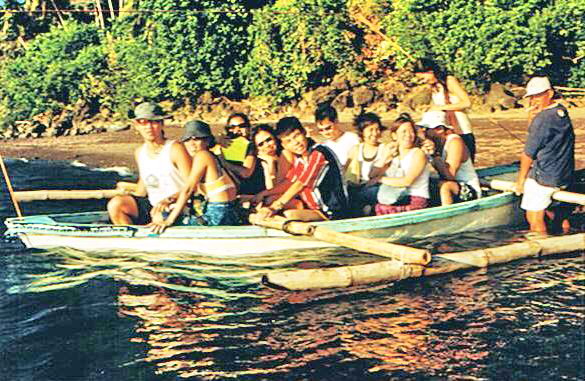
On our last whole day stay in Leyte, Jandy and I were invited by Mr. Roy Perez, a medical representative of Astra Zeneca who toured us around Ormoc City, to join him and his family and relatives on a picnic tour of the Cuatro Islas.  We were picked up by Roy after breakfast and, in his car, we traveled the 107-km. distance to Baybay in about 2 hrs.. At the town’s port, we boarded, together with the others, a large outrigger boat rented for our use.
  
On our way to Digyo Island

As the name implies, the Cuatro Islas consists of 4 lovely islands; Apid, Digyo, Himokilan and Mahaba, all of which are bordered by white sand beaches, rich fishing ground and unexplored coral reefs (a total of 287 species).   Though Baybay was our jump-off point, three of the four islands (Apid, Digyo and Mahaba) belong to the town of Inopacan while Himokilan Island is under the jurisdiction of Hindang.

Digyo Island’s beautiful sandbar.  Across is Himokilan Island

Digyo (pronounced as Dijo) Island, our destination, is the smallest,  prettiest and most popular tourist destination of the four.  After 30 mins., our outrigger boat made landfall at the island’s beautiful sandbar of fine, white sand. Good coral growth, ideal for snorkeling, are located at the western part of the island, facing Apid Island. The island is also a nesting site of sea turtles.  While there, I circled the island in about 20 mins.

Digyo’s white sand beach
Big, delicious coconut-cracking crabs called tatus are found in Himokilan Island, the largest of the four islands. Mahaba Island, serviced by outrigger boats, has a viewing deck, kiosks, sari-saristores and restrooms.  Diving and snorkeling equipment, as well as barutos(stiletto-shaped dugout canoes) and glass-bottom boats, can be rented here.

Marabut Marine Park (Marabut, Western Samar)

The resort’s beach and catamaran

On April 20, Holy Thursday, I decided to visit to Marabut Marine Park and Beach Resort in Marabut with my brother-in-law Manny and my son Jandy.  Marabut is the last town before the border with Eastern Samar, off the southern coast of Samar.  However, Manny’s car was trapped in the garage due street diggings along the street.  Mr. Victor Macasera, my Astra medical representative guide to Sohoton Caves, came to our rescue by offering to bring us there.  After our usual early morning breakfast and loaded with our usual picnic basket prepared by Paula, manny’s wife, we departed Tacloban City around 9 AM, crossed the San Juanico Bridge to Samar, turned right at the fork to Basey and proceeded, down a well-maintained road, to Marabut town.

Burial cave

Soon, we espied the beautiful stack of small limestone islands of the marine park just off the horizon.  Near the resort, we made a stopover at a small cave along the highway.  Inside, we saw a cross, an image of the Blessed Virgin and a net-covered concrete vault containing the mixed up bones of victims killed by the Japanese during World War II.  About a kilometer past the cave, we came upon the road sign and an  700-800 m. long access road leading to the resort.  Past an old, wooden loggers’ lodge was the entrance to the resort.  We parked our car and rented a picnic shed for our use.

The islands of the marine park

This 1-hectare resort, opened in 1997, sits on a 90-hectare land planted with rice and coconut trees.  It also has a reforestation area planted with mahogany and gmelina trees. The resort is owned by the Unimaster Conglomeration, Inc. of Mr. Wilson Chan, the same corporation that owns the Leyte Park Hotel in Tacloban City.  It has 5 nipa, bamboo and wood duplex cottages with bath, an open-air restaurant and a bar.  Being a holiday, the resort was full of Filipino-Chinese guests brought over from Leyte Park Hotel via a huge double-hulled catamaran moored along the beige sand beach.  Beyond that were the 15 dramatic limestone islands that constitute the marine park, all leased from the local government for the exclusive use of the resort.  Although filled with guests, the beach was surprisingly empty of swimmers.

All geared up and ready to go

As we were going around the resort, we came across a group of tourists milling around a dazed man pockmarked with red sores from head to foot.  He was just bitten by a jellyfish while swimming along the beach and was being administered with antibiotics.  It was jellyfish season. No wonder the beach was empty.  So much for the swimming.   Still the limestone islands beckoned.  As we were preparing the table and ourselves for lunch, I espied a number of brave sea kayakers heading towards the islands.  I immediately made a reservation for a 2-pax, sit-on sea kayak.  If I can’t swim along the beach, I could at least kayak.  The resort has 8 plastic kayaks – 3 single and 5 double; plus one outboard motor boat.   Kayak rental is PhP75 per hour, inclusive of life vests but with no helmets.

However, I was placed on a waiting list.  There was nothing to do at the moment except eat, and eat we did.  With food enough for double our party, we feasted on tipay (scallops baked in garlic), kilawinpansit canton, grilled tilapia and steamed rice, all washed down with bottled water or canned soft drinks.  We were too full to even touch the ripe mangoes for dessert. Pretty soon, the previous kayakers returned and as soon as the kayaks were parked, I immediately laid my claim to a kayak. Jandy and I quickly applied sun block lotion, packed our snorkels and camera in a dry plastic bag, donned our shades, rubber slippers and life jackets and were soon on our kayak.

Sea kayaking wasn’t a breeze as I first thought it would be.  Jandy was seated up front and it took some time for us novices to coordinate our paddling and maneuvering efforts.  For a time we seemed to be going nowhere, but soon we got the hang of our double oars and were soon on our way in a leisurely, exploratory pace.  Still wary of going very far, I decided first to visit some of the mainland’s inaccessible and scenic hidden coves just around the beach.  Going there only seemed to bring the islands closer to me and, with a little guts and a prayer, were soon paddling full speed ahead.

The nearest was a magnificent 3-peak island with a white sand beach tucked in between them.  Shooting straight up from the sea like natural skyscrapers, the islands’ towering limestone cliffs’ base were heavily undercut by wave action and were topped by dense jungle.  This scenery reminded me of similar islands (although more compact and much nearer) seen as I toured the equally beautiful Dimakya Island (Club Paradise, Coron in Palawan) and Gigantes Islands of Iloilo.

Pretty soon, after about 20 mins. of paddling, its white sand beach hove into view as the surrounding waters became clearer.  We had to maneuver around to avoid some large rocks visible under the water and soon hit dry land.  We were the only visitors there and we both felt like Robinson Crusoe (or is it Swiss Family Robinson?).  We donned our snorkels and explored its clear waters and coral garden of staghorn and brain coral.  No jellyfish in sight. Thank God.  This condition was soon broken by the arrival of 3 other kayaks from the resort, all paddled by Filipino-Chinese guests of the resort.  We gladly lent our snorkels (and rubber slippers) to the group.

I had my eye on visiting the next island’s white sand beach, and seeing a golden opportunity, suggested a joint kayaking safari with our new friends to the island.   Our next destination was similar to the first except that its peaks were not as rounded.  We reached it after 15 mins., but we were not the first arrivals as a large outrigger pumpboat loaded with tourists was already there even before we left the first island.  Snorkeling here was quite a disappointment and the only floating creature I espied was a jellyfish!  We quickly made a dash for the shore.  Instead, I tried to go around the islands’ heavily undercut girt but soon gave it up upon reaching waist-deep water.

From the island we could espy the third island’s white sand beach (only 3 of the 15 islands have white sand beaches).  In the distant horizon was the all too familiar Tooth Island, a bizarre, hourglass-shaped limestone outcrop (no beach) featured in a colored postcard.  My spirit was willing but I was already tired.  I decided to abandon the idea and instead started paddling, together with the others, back towards the mainland.  Although tired, our strokes were more fluid, just like professional kayakers.  After about 30 mins. we were back at the resort, having been gone for 2 hrs., dead tired and with aching muscles.

Jandy and I turned over our kayaks and life vests to Manny and Victor and they were soon kayaking to the nearest island.  While they were away, I decided to interview Mr. Angel Quiminales, the resort manager.  Angel gave me an overview of the resort’s beginnings, facilities and future plans including a future saltwater swimming pool and additional cottages. My heart sank when Angel told me of a hidden lagoon located just 400 m. from, and to the right, of the mainland beach.  It sank even deeper when he told me that the second island I visited had a beautiful cave with beautiful stalactites just around the beach.  It was a frequent destination for foreigners.  If only I knew.  After this 45-min. interview, we decided to call it a day, thanked Angel and paid our bills (picnic shed and kayak use).  We left Marabut by 4 PM and were back in Tacloban by 5 PM.  The next day, being Good Friday, I decided to rest.

Calbiga Caves System (Western Samar)

I have heard a lot about this relatively unknown, 900 sq. km. Calbiga Cave System in Western Samar, said to be the largest cave system in Asia, and Jandy and I opted to do some cave exploring there. Jandy and I woke up early, had a hearty breakfast, brought my camera, videocam, flashlight, spare batteries and a pack lunch (prepared by my sister-in-law, Paula) of corned beef sandwiches and bottled water, donned our media jackets (with its many convenient pockets) and proceeded, by jeepney, to the Tacloban City bus terminal by the pier.

The low cave entrance

We made the 59-km. (1 hr.) trip from the city to Calbiga via the 7:30 AM regular bus to Catbalogan, passing the same deplorable road conditions we encountered the day before. Upon our arrival at the town, we immediately registered our names at the municipal hall so that a mayor’s permit could be processed and secured.  A group of 9 had registered even earlier, having been in town since 7 AM.  Before we were issued permits, Municipal Administrator Mr. Mario Cabujat gave us a short talk on the past history of the caves and the dos & dont’s in exploring the cave.  After the briefing, we were all given our respective mayor’s permits.   The other group was kind enough to let us hitch with them in their AUV.

The initial 4-km. road going to Brgy. Panayuran was concrete-paved  up to a kilometer, becoming rough the remaining distance.  Our AUV arrived at the jump-off point by 10 PM and parked our vehicle.  We then negotiated with the residents for some guides and working Petromax lamps, settling on PhP250 per guide and PhP50 per Petromax lamp.  I got one guide and lamp while the others got another lamp and guide.  For additional lighting, some brought along some “Molotov cocktails” (actually kerosene-filled bottles with lighted rags as wicks).

A phallus-like stalagmite

Soon after, our group, now enlarged to 14 (another resident tagged along), started our trek along a well-marked trail passing through tall, 10-ft. high cogon grass.  Midway, the trek became steep and rocky as we entered a light forest.  We made a number of rest stops and the trail became narrower as we neared the cave. After an hour’s hike, we reached the dark, low cave opening, located below a limestone cliff studded with weathered stalactites. Going down from the main entrance (there are actually 5) was easy but going about this cave was a struggle as one had to hop from one rock to another with hardly any flat area.  Deciding on which rock to step on wasn’t easy as a lot were sharp and some were loose.  The cave floor was also littered with detached stalactites from previous illegal mining operations.  Some passageways were also narrow and low and one has to watch his (or her) head negotiating these areas.

Vakul

The first chamber, 5-km. long, 40-m. wide  Langun Cave, was huge.  Our flashlights could barely penetrate the darkness, much less reach the over 50-m. high ceiling.  Surprisingly, bats do not inhabit the caves.  The only flying things about are swallows (balinsasayaw).  We rested by a beautiful calcite formation with a small, clear reservoir of mineral water and refilled our water bottles and ate our packed corned beef sandwiches here, sharing some with the two guides.  Water was occasionally dripping from the ceiling, reminding me that it was seeping water that hollowed out these caves by dissolving the limestone and combining to precipitate  calcite over millions of years.  Also, the evaporation of water in places, leaves minute deposits of calcium carbonate that hang hollowly from the cave’s roof (stalactites) or rise solidly and more stumpily from the floor (stalagmites).  It is said that it takes a hundred years to make 1 cm. of pure white stalactite or stalagmite.

“Lady with the Lamp”

After our half-hour lunch, we resumed our exploration, taking my camera and videocam but leaving behind my backpack with my rubbish inside.  Every now and then we would come across beautiful, stalagmites of glittering snow-white calcium carbonate crystal, without a trace of other minerals, carved and combined to form beautiful shapes.  Unlike Sohoton Caves, none of them have yet been named. I therefore dubbed one with helictites (an occasional twisted, twiglike growth) as “The Lady with the Lamp” (in honor of Florence Nightingale, God bless her soul!), a beautiful, bullet-like,  snow-white stalagmite I dubbed as “The White Phallus” (I could think of no other description), another I dubbed  “The Inverted Shoe” (or bakya) and a huge calcite waterfall imbedded with tiny calcite crystals which glittered when lighted by our lamps, I dubbed as “Vakul,” because it reminded me of the Batanes headwear worn by Ivatan women.

“Casper the Friendly Ghost”

Our entry into 270 m. long, 160 m. wide Gobingob Hall, the second chamber, was no less easy and quite unglamorous.  We had to pass through a floor of soft and moist muck.  Our shoes sunk with every step and efforts to raise them was an ordeal.  Oftentimes they remained stuck in the mud.  One member of our party broke her slipper while others just took them off and walked barefoot.  After what seemed an eternity, we were ushered into a huge cathedral-like chamber with huge stalactites hanging from the ceiling. Unlike the previous chamber, the floor here was level, albeit muddy, with long-legged crickets, faded to a pale and sickly hue, hopping around. Inside, too, was an underground stream.  Italian spelunkers have found blind cavefish (the first in the country), crabs and other small shellfish here, true troglodytes wholly adapted to sightless existence in caves.  Try as I must, even with my flashlight, I could not espy a blind cave fish in the still waters.  Other members of the party were able to see one.  I was, however, able to observe, up close, a colorless blind crab caught by one of the group.  It was later released, unharmed.

“The Inverted Shoe”

Our visit to this chamber ended our cave tour. We retraced our steps back to where we left our backpack, proceeded on the cave entrance and emerged, dead tired, at 2:30 PM after 3 hrs. of exploration.  The thought of hiking the 3-km. uphill/downhill trail back to the village daunted me and after a few minutes hike, I asked my guide to carry my backpack the rest of the way.  We reached the village by 4 PM. After washing up, paying the guides (I paid my guide an extra PhP50 for carrying my backpack) and signing the required guestbook, we left the village at 4:30 PM for the trip back to Tacloban.  After 2 or 3 stops due to overheating plus a detour to Basey to drop off some passengers, we reached Tacloban by 8 PM.

The Calbiga River (Western Samar)

After lunch, Jandy and I took a jeepney to the Tacloban Bus Terminal, near the port, to get a Catbalogan-bound bus to Calbiga in the hope that we could still do some spelunking at Calbiga Caves.  The 59-km. bus trip took all of 1 hr., crossing the San Juanico Bridge, and on to the Maharlika Highway, passing the towns of Basey, Sta. Rita, Villareal and Pinabacdao before reaching Calbiga. Travel time would have been shorter where it not for the deplorable road conditions, with potholes everywhere and, in some places, half of the road had all but disappeared, creating one-way portions.  In Brgy. Lagayan, an alternate route has to be cleared to replace an irreparable portion of the highway.  Upon arrival at the town, we were informed at the municipal hall  that it was too late in the day to visit the caves.  Instead, we just had to console ourselves with a boat trip to Calbiga River’s Carewos Rapids.

Carewos Rapids

The 18-km. long and 10-m. deep Calbiga River, with some 60 challenging rapids, is reputed to be the country’s only navigable wild river suitable for white water rafting.  Docking near the rapids, we tried swimming but this was actually difficult as we had to battle the rapids.  A rope was thrown across both banks  of the river as a lifeline in case we do get swept away.

According to the International Scale of River Difficulty, these rapids are classified as Class III or Class IV, depending on weather conditions.   The river has long rapids with high waves and a lot of irregular rocks.  The Calbiga River requires mandatory scouting, a good quality boat (a smaller boat is recommended because of the width of the river) and equipment, an expert boatman and powerful and precise maneuvering.

Carewos Rapids: Brgy. San Mauricio, Calbiga, Western Samar