Archdiocesan Cathedral of the Conversion of St. Paul the Apostle (Vigan City, Ilocos Sur)

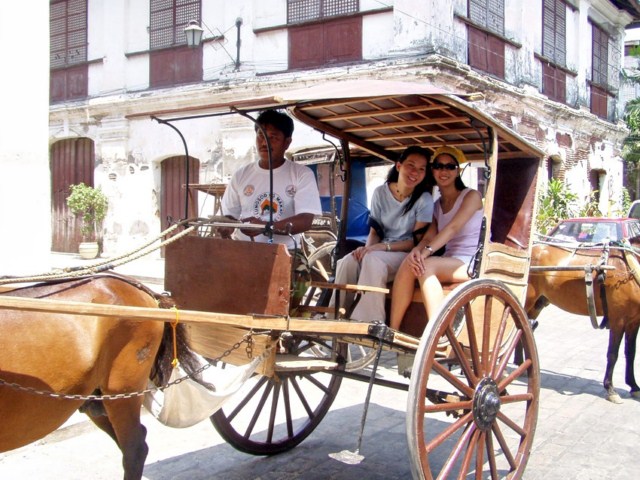
The next day,  I ate a late breakfast of Vigan longanisa (Ilocano pork sausages) with egg, watching out the window as Frank’s wife Cherry, my nieces Jaja and Sandy and nephew Gelo, as well as Tellie’s daughter Mandy (with her yayas) enjoyed a horse-drawn ride in a calesa, a truly unique way to tour the city.

Sandy and Jaja on board a calesa

After breakfast, we all made our way to the cream and white Vigan Cathedral, officially called the Archdiocesan Cathedral of the Conversion of St. Paul the Apostle, to hear the 10 AM mass, it being Palm Sunday.  Mena Crisologo, that early morning, was quite impressive as the diffused light transformed the buildings and street into a scene straight out of 18th century Vigan.

Vigan Cathedral

The Earthquake Baroque-style cathedral was started in 1790 and was completed in 1800.   Inside are 3 naves, 12 altars and a choir loft.  Chinese influence is seen in the baptistery, altar, brass communion handrails, a pair of Fu dogs and stylized moldings carved about the exterior doors.  Most of the original church paraphernalia and artifacts are still in place.  The main altar has beaten silver panels.  Its octagonal Italian Baroque bell tower, on a square base, was built from 1790 to 1800 and stands, separately, 15 m. south of the cathedral, in Plaza Burgos.

Loboc River Cruise (Bohol)

After our short bonding with the tarsiers and my church visit, we all returned to the dock where our double-hulled, flower-bedecked floating restaurant was now waiting for us.  The restaurant has 4 long tables, 8 benches, kitchen, mini-bar and comfort room and is pushed along the river by a motorized boat.   We started our cruise from Loay Bridge. Cruising along, we dined on grilled pork or fish, fried shrimps or steamed crabs, all with chopped tomatoes and onions on the side; pansit plus other native fare, all served with generous servings of pandan-scented rice on wooden plates lined with banana leaves.  We washed these all down with either ice-cold soft drinks or the much healthier buko juice.   

Loboc River Cruise

The idyllic rural scenery is also a visual treat.  Along the way we observed heartwarming daily activities like mothers washing clothes and children bathing nude or diving from coconut trees bent precariously close to the water.  We also passed returning floating restaurants and small native outriggers loaded with passengers.  The endpoint of our 2-km.  cruise was Busay (or Tontonan) Waterfalls.  The falls drops 15 m. in 2 stages and is used to generate electricity for the town.   Here, we dropped anchor and guests were given the option to go for a quick, cool swim or just continue chatting or dining.  We just did the latter.  After about 30 mins., the boat made the return trip back to Loboc.   

Busay Falls

Holy Week in Morong (Bataan)

Napot Point

After our Dambana ng Kagitingan pilgrimage, it was back to my car again for the final drive to Morong. Along the final 23-km. stretch from Bagac to Morong, we passed the controversial Bataan Nuclear Power Plant, situated 18 m. above sea level at Napot Point.  Morong was the chosen site for this “white elephant,” which was supposed to be the first nuclear power plant in the country.

Begun in 1977, it was constructed by Westinghouse (allegedly under a “conspiracy of corruption”) and was expected to generate 620 MW of electricity when completed.  After much delays (construction was stopped in June 1979 due to the Three Mile Island incident in the U.S.), it was finally completed in 1985 at a cost of US$1.95 billion (its initial budget was US$1.1 billion).  However, cause-oriented groups staged a number of “No Nukes” rallies.

They protested its potential to life and property, and its being built on a major earthquake fault line.  The Chernobyl nuclear plant accident in the former Soviet Union in 1986 was the final nail in its coffin as Pres. Corazon Aquino ordered it mothballed that same year.  To this day, it has not been decided what to do with this overpriced but unsafe complex and the sophisticated equipment already installed there.  In the meantime, the country is left with the problem and an incurred US$2.2 billion debt.

Sunset at Morong

We finally reached Morong late in the afternoon and stayed at Vener’s house, located near the town’s Spanish-era church and a few hundred meters from the beach.  A soothing and well-deserved cool afternoon dip at the beach, augmented by a beautiful fiery sunset, relaxed our tired bodies. Early morning of the next day, Good Friday, provided an opportunity to observe, up close, the countrywide Holy Week ritual of self-flagellation.  I first encountered this shocking and bloody ritual when I was still living in Malibay (Pasay City).  Here in Morong it is called pagbubulyos.   This is performed mostly by men, both young and old, who wish to fulfill a panata (vow) of public atonement for one’s sins.  This panata is done for a minimum of 10 successive years and is reflected in the bulyos, a whip consisting of bamboo strips tied to sturdy cord.   Each strip represents one year of atonement, its number being reduced every succeeding year until he completes his panata.  Each strip should be secured properly.  If one is detached during his rounds, another strip (and another year) is added to his bulyos.

Before the actual flagellation, the flagellant’s back is prepared by beating with stick and paddles until swollen and numb.  Numerous small cuts on the back are then made with razors, with vinegar or salt sometimes applied to the cuts.   Only then is the raw back whipped continuously by the bulyos.  The flagellants, most with heads covered, walk barefoot along the town’s streets, stopping by the church to pray, then continuing on until they reach the sea where a healing noontime dip awaits them.

Sto. Lucia Complex (Dolores, Quezon)

Lakbay Kalikasan, Southeast Asia’s first and premier outbound education outfitter, embarked on a series of outbound education demonstration tours for teachers from other schools willing to try out their outbound education programs and they invited me to cover one of these tours that promote appreciation of the living remnants of a pre-Hispanic tradition which is still being practiced today in Mt. Banahaw, that of worshiping nature (rivers, mountains, old trees and fields) in the belief that such natural objects were the habitats of spirits. Jesu-Mariae School, my son Jandy’s school, joined the tour and they were represented by Robert “Rob” V. Castañeda and Eleser “Ely” Borero.  

Hiking up Calvario

Our destination was Mt. Banahaw’s Brgy. Sta. Lucia Complex 1 in Dolores (Quezon), one of Banahaw’s 4 complexes – the others being Kinabuhayan (Resurrection), Durungawan (Window) and Ilalim (Crater), which lies at the foot of the 1,470-m. high Mt. Cristobal.  We left the EDSA Shrine (our assembly place) by 5:30 AM, April 9 (Bataan Day), on board one of two vans. Joining us were 16 other teachers from 6 Metro Manila schools (Augustinian Abbey School, Madre Pia, Miriam College, Olivarez College, St. Benedict and Santa Catalina High School).  Our Lakbay Kalikasan hosts were Mr. Ramon Jocson (Corps Director), Mr. Ronaldo Dalofin (Team Leader/Lecturer 2), Mr. Roger Quizol (Team Leader 2), Mr. Oscar Orbe (Team Leader 3) and Ms. Billy de la Cruz (Facilitator 3).   The trip to Dolores was to take all of 3 hours.

Upon arrival at Sta. Lucia, we visited the compound of the Suprema Iglesia del Ciudad Mystica del Dios, Inc.  (Supreme Church of the Mystic City of God), the largest of Banahaw’s 66 to 88 registered colorums, entering it via a huge 20-foot high stainless steel gate.   The word colorum is derived from the Latin Mass invocation in saecula saeculorum.  These esoteric folk Christian religious communities, varying in size from several thousand members to a few adherents, believed that Mt. Banahaw is the site of the Holy Land and that Christ walked in the area.  They also share an intense nationalism and reverence for National Hero Jose Rizal who is considered a demigod or the Tagalog Jesus Christ.  Many sects also believe in the ascendancy of the female (Ciudad Mystica included) and women, rather than men, perform the priestly functions. These religious sects around Dolores resent the kulto (cult) connotation insinuated by non-believers. 

Piedra Mental

Mt. Banahaw is full of sacred natural shrines locally called puwestos (places), all said to have been discovered by Katipunero Agripino Lontok, and one of our objectives was to undergo and relive the pre-Hispanic tradition of pamumuwesto (spiritual pilgrimage) by hiking, crossing rivers and entering caves, all sacred destinations with deep historical and symbolical meanings, communing with the spirits for paglilinaw (discernment) and paglilinis ng loob (inner cleansing) so that we may take the challenges ahead.  Along the way, lectures and meditations are intermittently given and, in all puwestos, candles are always lit.

My baptism

We descended, down a gorge, to Sta. Lucia Falls, fed by the cool Lagnas (or Kinabuhayan) River, and Piedra Mental, a stone altar where pilgrims pray for mental discernment as they go through the pamumuwesto. At the stream which courses down Banahaw (also called Ilog ng Jordan, alluding to John the Baptist’s baptism of Christ), we “cleansed” or “purified” (water is a universal archetype for cleansing) ourselves and drank the sulfuric waters of the falls 3 times (symbolic of the Triune God – the Father, the Son and the Holy Spirit) prior to our entering the sacred caves (kuweba), the pilgrim’s church.  After our ritual baptism, we we then climbed up the steep gorge. 

One of many caves in Sta. Lucia Complex

At the huge boulder of Kaban ni San Isidro, the gate to the entire complex of Sto. Kalbaryo, we lighted candles and said a short prayer for safety and guidance, while at the book-shaped boulder called Aklat ng Buhay (the Book of Life said to contain our names, date of birth and even date of death) at Prisintahan , we imaginatively “register” our names and those of our loved ones. A real hurdle was the 40-m. long Santong Husgado (Holy Judge), one of the caves at Ina ng Awa revered by the religious sects and given Biblical names.  Said to test the purity of those who enter, it is believed that when you get out of this cave, 7 years of your sins will be forgiven but, if you are not completely malinis (cleansed), you will be trapped inside. 

Santong Husgado

We had to hike, barefoot, from Ina ng Awa to the cave opening (with lit candles strategically placed along the cave), carrying just the clothes on our back.  The ladies,  with their small frames, decided to go in first.  I was the last to enter this “cave” which was more of a rabbit hole.  All the while, I was figuring out how to get my 5’-10,” 188-pound frame inside that hole. Ready and willing for this test of faith (pagsubok), I kept remembering the familiar Biblical proverb “I can do anything through Christ who strengthens me” (Philippians 4:13).  Crawling through it entailed a lot of body contorting as well as decision-making. “Should I enter head or feet first?”  “Should I do it on my stomach or on my back?” Finally, after what seemed like an eternity of struggle, I finally made it out to Ina ng Awa. Now I know how a worm feels.   I, together with the others, were all mud-splattered yet, surprisingly, our habit-cladded sister colleague from Madre Pia was still spotlessly clean.  Could it be divine intervention?  I wonder.   

Lakbay Kalikasan: G/F Balai Lakbay, 2 Alondras St., Mira-Nila Homes, Tandang Sora Ave., Quezon City, Metro Manila.  Tel: (632) 932-7818 to 19.  Mobile number: (0917) 500-4796. Website: www.lakbaykalikasan.com.

Kalanguya Festival (Sta. Fe, Nueva Vizcaya )

Northern Luzon is a prime tourist destination in the Philippines.  The Cagayan Valley, with its rich cultural heritage and stunning geographic diversity  of scenic mountain ranges and valleys, is one of the most beautiful and exciting of these destinations and Nueva Vizcaya offers both man-made and natural wonders (the legendary Salinas Salt Spring of Bambang, the amazing Alayan-Kapisaan Cave System of Kasibu, etc.).  Its many cultures is also worth immersing into.   One such cultural heritage, that of the Kalanguyas, is showcased in Sta. Fe’s Kalanguya Festival.

Street dancing parade

The National Commission on the Culture and Arts (NCCA), through its Committee on Northern Cultural Communities, strives to promote and revitalize traditional culture and arts through distinctive or unique festivals that continue to be part of the local population’s life and culture.  For the second time around, the NCCA has supported, with grants, this festival which showcases the Kalanguya’s rich cultural heritage.

L-R, David Greedy, Leah Luna, Gerry Gracio, Nonoy Froilan and me
Yours truly was tapped to write an article on this unique festival held on the second week of March.  Joining me were NCCA Project Development Officer Ms. Leah A. Luna; NCCA videographer Mr. Nonoy Froilan; Mr. David Greedy of Getty Images; free-lance writer Mr. Gerry Gracio and COLORS photographer Mr. Joseph “Jay” Agcaoili.   We all left Manila by 10 PM via a Nelbusco bus.  The 216.85-km. trip took all of 5 hrs. (including stopovers).  It was a chilling ride for me as I forgot to bring a jacket, a regret that was to stay with me even during my stay at the town.  The 399.82 sq. km., pleasantly cool, fifth-class municipality of Sta. Fe is the first town to be traversed when going to the Cagayan Valley.  We arrived at the Golden Rose Hotel by 3:30 AM, billeting ourselves at 3 of the hotel’s 9 non-airconditioned rooms.  After a short 2-hr. sleep and early breakfast, it was off to work.
Kalanguya dance

The town has a 2,001 population of 13,942, 75-80% of which are Kalanguyas which inhabit 13 of the town’s 16 barangays.  The rest are Ilocanos and Tagalogs.   The Kalanguyas  occupy the mountain ranges of the Caraballo Sur and belong to the Igorot tribe which include the Ibalois, Kankanai and Karaw.  They are also found in the area west of Sta. Fe, the eastern portion of Benguet plus some areas of Pangasinan, Ifugao and Nueva Ecija.

The Kalanguyas were formerly called Ikalahans (from a tree having broad leaves), an ethnolinguistic  name first coined  by American anthropologist  and missionary Delbert Rice.  Pastor Rice maintained that Kalanguya was a derogatory tribal name, it being a contraction of “kelan ngoy ya?” which is best translated as “What in the world is that?,” an expression commonly uttered to indicate contempt.  This was contradicted during the Kalanguya-Ikalahan Tribal Consultation (July 6-7, 1993) which confirmed that the Kalanguya name is not derogatory but a word of peace.

The indispensable pig

The hardworking Kalanguyas are kaingin (slash and burn) farmers.  The delicious kamote (sweet potato), raised in inum-an (upland farms or swiddens), is their staple food.  They also raise the indispensable pig, used in almost all occasions like the canao (socio-religious celebration), wedding celebrations and tongtongan (a traditional system of settling disputes). Kalanguyas in Brgy. Imugan (the  Kalanguya center), also produce jams and jellies made from guava, santol, bignay or wild berries and Ifugao handicrafts like bamboo baskets, woodcarvings and exotic and beautiful handwoven fabrics (used as tapis by women and g-strings by the men).

Kalanguya kiyad

The Kalanguya Festival, held in conjunction with the town’s fiesta, was started in 1996 during the first term of youthful Mayor Teodorico DP. Padilla (of Tagalog-Ilocano descent) and elderly Vice-Mayor Donior Tidang (a Kalanguya).  This lowlander-highlander tandem were instrumental in dissolving lowlander discrimination and the prevailing differences  between these two peoples by presenting the culture of the Kalanguyas to the lowlanders.   The first Kalanguya Festival was a step in the right direction with its theme “Nah-Nah Yaw Ni Puli, Hak-Hakay Ni Manhilbi” (Despite Cultural Diversity, In Service There is Unity). The festival aims to conserve, preserve and protect the almost-forgotten Kalanguya cultural heritage, especially to the younger generation, amidst modernization and high technology.  Slowly, the Kalanguyas are being recognized as a component for society’s progress and a feeling of brotherhood now exists between the two peoples.  The festival also brought enormous progress  and development in the town and its people’s lives.

Sacrifice of a carabao

This year, with the Padilla-Tidang tandem still in governance, the 8th staging of this festival proved to be just as successful as the first. The festival proper kicked off with an early  morning parade of floats from Consuelo to the plaza coupled with street dancing by participants in native attire (g-strings for men and tapis for women). At the gymnasium, we witnessed a showcase of the cultural heritage of the tribe through displays and exhibits, songs and dances, chants and rituals (kiyad), exhibit of traditional arts and crafts, indigenous games and sports and sacrifices of a pig and a carabao.   In the evening, a performance of the play Ibong Adarna, featuring Wowee de Guzman, was held at the town gymnasium.  At 9 AM the next day, March 16, we all left Sta. Fe for Manila  via a passing Victory Liner bus and arrived in Manila by 4:30 PM.

The Kawayanan Festival (Gloria, Mindoro Oriental)

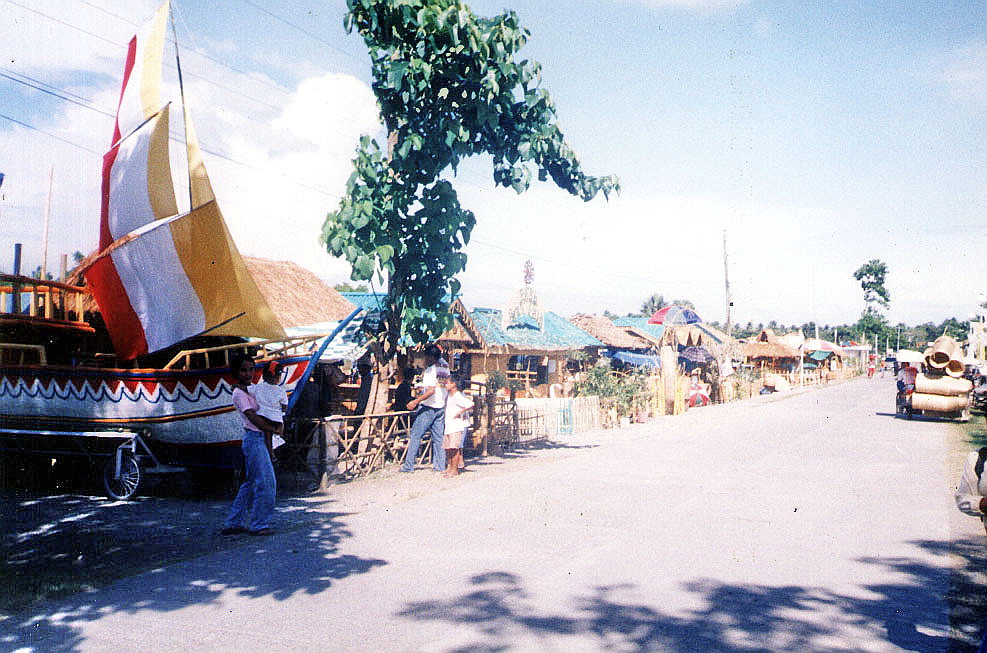
Kawayanan Festival

Throughout my 4-day stay in the town, I was kept busy by undertaking with gusto, the role of   judge for four of the festivals’ competitions: the Bamboo Booth competition (maybe because of my being an architect), the Cookfest (my favorite pastime: eating that is, not cooking), the Street Dancing Competition and the In-Place Dance Competition (held at the gym).  It seems that the only contest I didn’t judge was the Miss Gloria Tourism 2002 beauty contest.   On my second day, to save on time, I did my bamboo booth and cookfest assignment at the same time.  It was easier said than done.  Midway through my assignment, my complexion turned from fair to really brown (like roasted lechon).  However, the cookfest was a delight as I got to sample, mostly for the first time, the town’s labong cuisine, making it a point to sample each dish once in every booth.  Of the present 22 bamboo varieties in town, only two (the first-class tinikan and bolo) are used for labong.

The street dancing parade

In succession, I tried the atsarang labong (Brgy. A. Bonifacio), embutidong labong (Brgy. Kawit), apritadang manok with labong (Brgy. Mirayan), fried lumpiang labong (Brgy. San Antonio), fresh lumpiang labong (Barangay Lucio Laurel), tortilla con labong (Brgy.  Agsalin), guinataang labonglabong salad and bola-bolang labong.   I also enjoyed the buko pandan and cassava chips, washing it all down with buko juice. So much for lunch (and dinner).  I don’t recall what I sampled in Brgy. Guimbonan but she handily won the cookfest’s grand prize.  Brgy. Malayong won the booth competition.

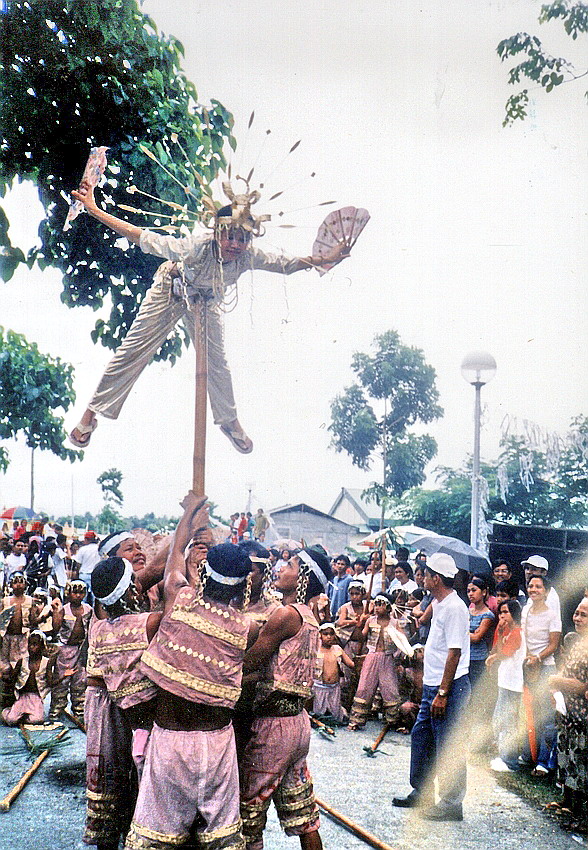
A daring bamboo stunt

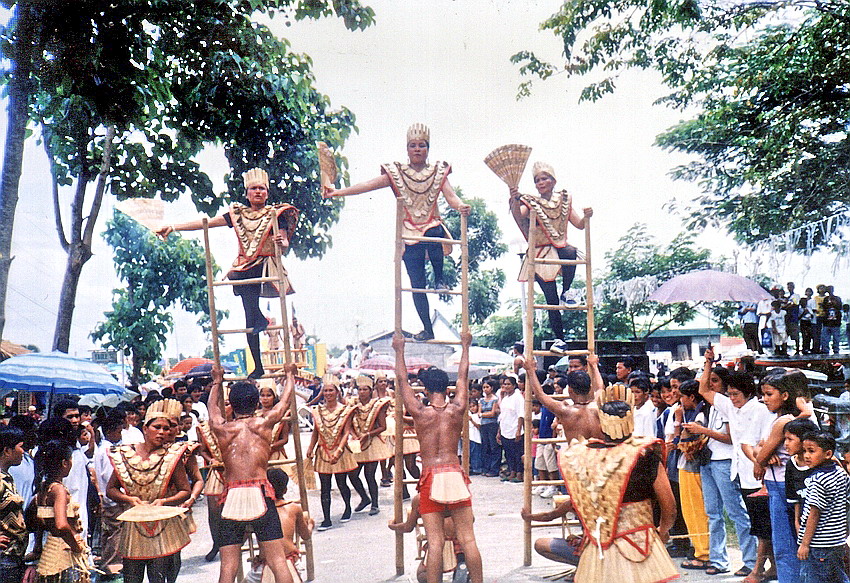
If the cookfest was a delight, the two dance competitions were spectacles by themselves.  Costumes, musical instruments and props (including the bamboo galleon of Brgy. Lucio Laurel) used were all bamboo-inspired.  What was truly spectacular was some of the choreography (to the beat of the latest dance music) which included some death defying stunts fit for a circus.  Try balancing spread eagle on the tip of a bamboo pole using the pit of your stomach or try dancing on the top rungs of 3 1-storey high bamboo ladders held vertically together. I wouldn’t dare but they did.   In the end, Brgy. Tambong won the Street Dancing Competition (with Narra second) and Brgy. Lucio-Laurel the In-Place Dancing Competition (with Maligaya second).

A bamboo galleon

Gloria is a coastal town and beautiful black sand beaches facing the Tablas Strait extend from Barangays Tambong to Agsalin.  Too bad there is no setting sun along this coast (Mindoro Oriental faces east).  Just the same, the municipality is making efforts to develop resorts along this beautiful coast.  Part of our itinerary was a visit to these resorts. They include El Primus Jose (Brgy. Tambong Punta), Villa Escober Beach Resort (Brgy. San Antonio) and Bighani Beach Resort and Mabuhay Beach Resort, both in Brgy. Giumbonan.

My first carabao ride

On our last day, we had breakfast at the dining pavilion of Prima Farm Resort in Brgy. Bulaklakan.  This rising star of a resort has so far finished 11 airconditioned cottages with bath and TV, all beautifully built with the town’s trademark bamboo in mind.  Each are also named after one of the town’s 27 barangays and built accordingly by the barangay’s artisans.  The resort intends to finish, in the near future, its complete roster of 27 cottages.

The Tubungan Ceremony (Gloria, Mindoro Oriental)

The next day, with the arrival of invited travel agents, we were all transported, come evening, to Dupong Freshwater Resort, a swimming and fishing resort situated in the middle of a rice field.  Here, we were welcomed by resort owner Mr. Romeo Castillo and his wife Clemencia.  The word dupong means “to set on fire.” The couple toured us around the resort’s facilities: a cool, clear swimming pool (fed by springs from Mt. Halcon); a fishing lagoon filled with with tilapiadalag (mudfish) and hito (catfish); and a huge native-style pavilion.  A pleasant surprise awaited us at the pavilion – the tubungan ceremony.

Tubungan dance

Also called putung, this ceremony for welcoming and honoring friends and visitors is originally from Marinduque.  A large proportion of Gloria’s population are migrants from this province and they brought this unique tradition with them.  As honorees, a unique crown made of bamboo was placed on each of our heads by mamummutongs who happened to be our trusty tourist guides (in my case Gorett).

Putong ceremony

We were then made to partake of tuba (coconut wine).  A troupe of women then serenaded us with native songs as well as danced before us to the accompaniment of a band.  As a final act, these well-wishers showered us with confetti made of colored paper as a sign of love and affection.   I, together with the others, was truly touched by all these.  The evening was capped by a native buffet dinner and a fellowship night.

Dupong Freshwater Resort: Sitio Dupong, Brgy. Kawit, Gloria, Mindoro Oriental.  Mobile number: (0916) 674-3968.

Bambusetum (Gloria, Mindoro Oriental)

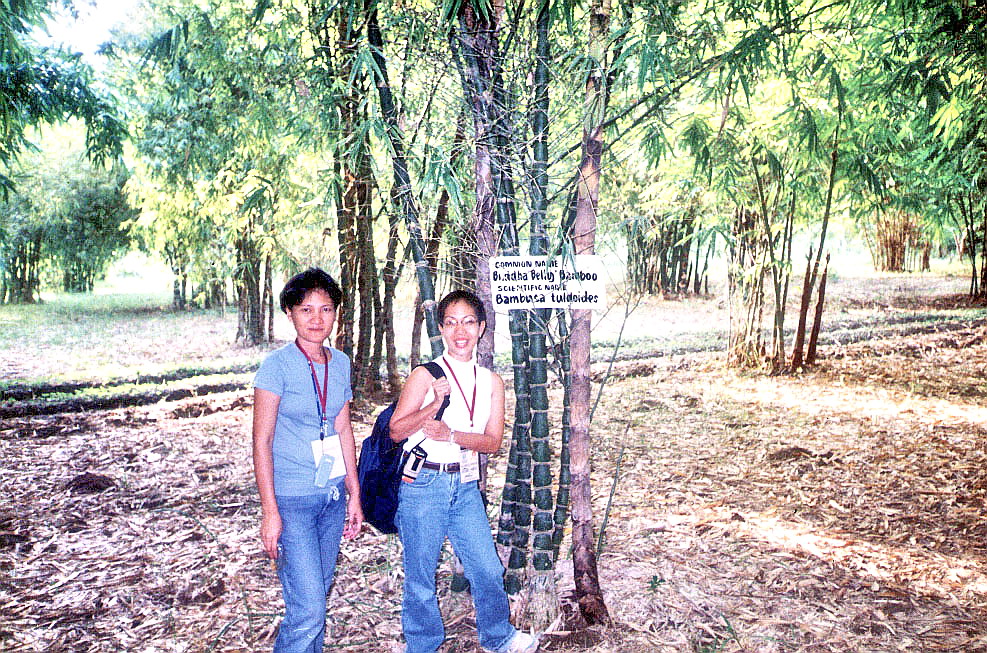
After lunch,  my guide Gorett and Tess Magdalita (with husband Efren as our driver) toured me to the town’s Bambusetum, a 1-hectare bamboo reforestation project.  Bamboo, locally called kawayan, has about 150 varieties worldwide and here, 22 of these varieties are propagated and cared for by the Department of Environment and National Resources (DENR) and the municipal government.   The complex aims to propagate new and improved varieties of bamboo.

Tess and Gorett at the Bambusetum

Under the energetic stewardship of town Mayor  Romeo Alvarez and, with the support of TESDA (Technical Education and Skills Development Authority), the versatility of bamboo was put to good use as a source of livelihood for the town’s 27 barangays. Started only January, these barangays have profited immensely from the manufacture of furniture, home decor and food products made with labong (bamboo shoots).  It was even made into artificial reefs.  As a tribute to the unheralded kawayan, the town has adopted it as the theme of its unique Kawayanan Festival, the only one in the country to do so.  They hope that  it will be included in the Calendar of Activities of the Department of Tourism.

Bambusetum: Sitio Balagbag, Brgy. Maligaya, Gloria, Mindoro Oriental

Arrival in Gloria (Mindoro Oriental)

I received a personal invitation from close friend Vic Pascua to attend the 38th founding anniversary (October 1-2) of the town of Gloria and the launch of its first Kawayanan Festival.  I was to be one of more than 40 from media and travel agencies to be so invited.  The town’s name may sound familiar and you may have guessed right. Gloria was, and truly is, named after Pres. Gloria Macapagal-Arroyo. The town was created on October 2, 1964, by virtue of Executive Order No. 117 issued by the late Pres. Diosdado Macapagal. In gratitude, the town was named after his young and only daughter.  Just last year, Gloria visited the town during its foundation day.

The day before the festival

I left Manila for Batangas City early in the morning (7 AM) of September 30, a Sunday, via a BLTB bus. The trip was uneventful and surprisingly traffic-free, reaching Batangas Port before 10 AM and booked myself on the 10:30 Aboitiz Supercat fast ferry.  I arrived at Calapan City port by 11:15 AM and was met by my guide Ms Maria Goretti “Gorett” S. Mercado.   We took a hired L-300 van for the 81-km. (1.5-hr.) drive to Gloria, passing the towns of Victoria, Socorro and Pinamalayan as well as lovely Lake Naujan.  We arrived in time for a late lunch at Biyahero Restaurant and were soon joined and welcomed by Vic and Mr. Robert Villavicencio, the restaurant owner and chairman of the town’s Tourism Council.  I later checked in at the nearby residence of Manny and Gloria Tan (a doctor) and it would be my home for 4 delightful days. Breakfast time was always a pleasure here as I would compare travel experiences with my gracious hosts.

Media participants and travel agents

Kaogma Festival (Naga City, Camarines Sur)

After our city tour, we all returned to Naga City proper for the highlight of our stay: the Kaogma Festival’s 27 May Grand Parade which caps the 423rd foundation anniversary of the province. The word kaogma is derived from the Bicolano word meaning “happy.”

The festival was first celebrated on May 15, 1989 to commemorate the Feast of San Isidro Labrador (St. Isidore the Farmer), the patron saint of farmers.  This was just a one-day celebration but, over the next two years, it was extended to three days. Gov. Luis R. Villafuerte then sent Prof. Danny Gerona to Spain to research the birth date of the province which was found to be May 27, 1589.  Since 1999, the festival has become a week-long celebration.

Street dancing parade

The Grand Parade featured well-choreographed street dancing contingents showcasing uniquely designed and colorful ethnic and native costumes using abaca and characters in fantasy costume.  The contingent from the capital town of Pili won.

The parade also featured marching bands, giant mascots, competing drum and lyre corps, a fancy drill competition and a grand display of the 37 flags of the province’s cities and towns.  The festivities were ended by a fireworks display and the release of hot-air balloons.

The winning Pili contingent
Float with winners of Miss Camarines Sur beauty contest