Lechon Festival (Pola, Mindoro Oriental)

During my June 3-6 2000 visit of Calapan City, I received and accepted a standing invitation from Jose Victor “Vic” E.M. Pascua, Senior Provincial Tourism Operations Officer, to attend the forthcoming June 24 town fiesta of Pola. The 14 other municipalities of Mindoro Oriental were then in the thick of preparations for the coming 50th foundation anniversary of the province on November 15 of that year. This would be a first for me as I have never attended a “real” town fiesta before.  I decided to bring along Jandy.

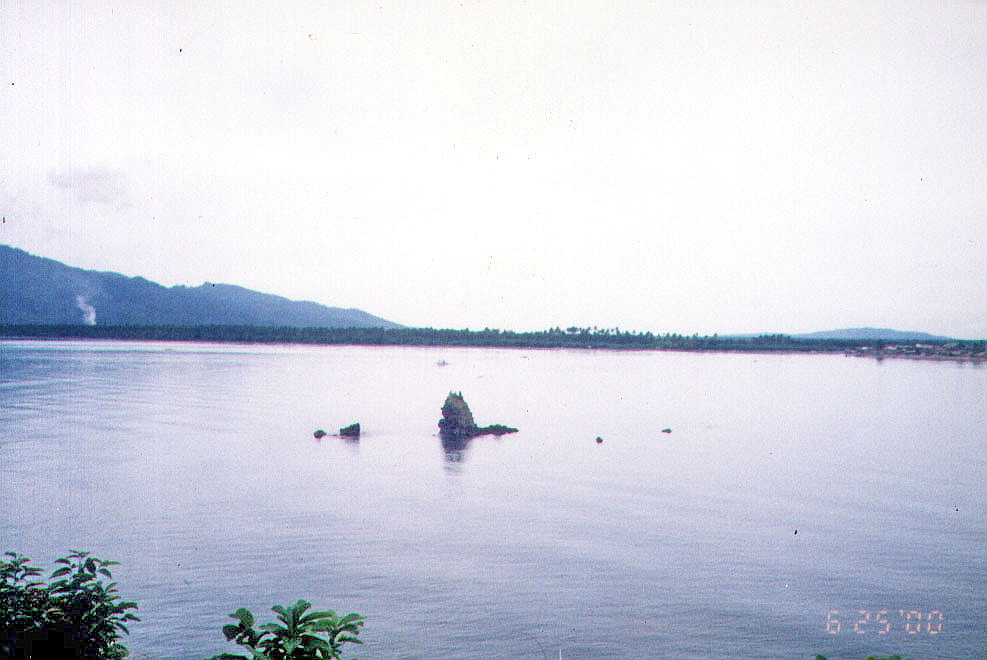
Beautiful Pola Bay

Jandy and I left very early in the morning of June 24 on a BLTB bus for the 3-hr./112-km. trip to Batangas City, the ferry port to Mindoro.   We arrived by 8 PM and took the  45-min. Aboitiz Supercat fast ferry to Calapan City.  We were picked up by Ms. Tess Gaeg of the Tourism Office and ushered into a van for the 70-km. trip to Pola.  Joining us was Ms. Mayette Sanchez, also of the Tourism Office. We drove at a fast clip, passing by beautiful Lake Naujan, the towns of Victoria and Socorro (where we made a left turn at the junction) and arrived at the town by 10 AM.

The fluvial parade

At the town, we were welcomed by Vic who arrived ahead of us.  We arrived just in time to witness the town’s morning fluvial parade where the statue of San Juan Bautista (St.  John the Baptist) was given a ritual spin around Pola Bay accompanied by a flotilla of outrigger boats. The fully-packed and gaily-decorated boat carrying the statue soon arrived at the wharf.  Every one aboard was drenched with sea water including the marching band and their instruments.   Once alighted, the statue was again paraded from the wharf back to the church on a carroza pulled by its drenched escorts.

Parada ng Lechon

We were invited to the home of Mr. Alfredo V. “Aljun” Rabulan,  Pola Mayor Jose V. Baldos Jr.’s private secretary.  Well-preserved, the house had high ceilings, decorative double eaves, ventanillasnarra plank flooring, capiz windows and period furniture and santos.  However, unlike the Rabulan house, other ancestral houses in the town were in a sorry state of disrepair due to age and the disintegrating effects of the tropical weather.  After refreshments, we were told to change into the more informal shorts and T-shirts as we were to catch up with the street dancing and lechon parade, the highlight of the celebrations. Joining me, Jandy, Vic, Tess and Mayette were our guides, the petite  Ms. Tiny Sanchez (I really thought she was just a child, actually she was married with kids) and the taller and more mature-looking Ms. Dimple Ocampo.

Everyone in the town seemed to be out on the streets, all dressed casually as we were and dancing to the beat of the competing marching bands.  The street dancing reached competition levels as many contingents from the different barangays and schools tried to outdo each other for the top prize.  However, nothing beats the spectacle of the Parada ng Lechon, the toast (and roast) of the fiesta. This unusual and tempting parade of dressed up lechons featured the crispy roasted pigs, golden brown and glistening in the sun in their spits, suitably attired as firemen, policemen, beauty queens and basketball players (complete with shades, rubber shoes and medals). One from the local cable company had a satellite disk for an umbrella.  The lechons delicious aroma was all over the air and truly, this fiesta highlights the Filipinos’ love for food.

The winning lechon

All these proceedings were done with the blessing of the great baptizer St. John the Baptist whose image was borne atop a fire truck.  To signify his approval, all amused onlookers within reach of the fire hoses were doused in a ritual buhusan reminiscent of Christ’s baptism in the River Jordan.  So far, I, as well as my other companions, have escaped being “baptized.”  All these changed as we neared the parade’s end as a substantial amount of water hit us squarely in our faces.  We all entered the town’s gym drenched as a newborn chick.  Our predicament became all the more noticeable, as our group (me, Tess and Mayette), being honored guests, were made judges in the lechon competition, all wet and unsuitably garbed.  All these proceedings were filmed and later shown in its entirety at the town’s cable channel television.  I looked like the dressed-up pig I was judging.  Who won?  The basketball player, who else.

What is a fiesta without food?  Not a fiesta of course!  In the true Filipino tradition, food takes center stage.  Right after the parade, the feasting and drinking began.  We were warned to just take a nip of everything that was offered as we had to make the rounds of different houses. Advise taken but never followed.  Anyway, who can resist the tasty temptations offered in every household?  The usual fare, to name a few: lechonrellenong bangus (stuffed milkfish), kare-kare (ox tail in peanut sauce), adobong manok (chicken stew), laing (taro leaves with shrimps in coconut cream), inihaw na baboy (barbecued pork), callos (ox tripe and knuckles in garlic tomato sauce), bulalo (beef shank in onion broth) and   pinakbet (vegetable stew).

For dessert, we had a choice of leche flan (custard), maja blanca (blancmange of corn and coconut cream), guinatan (fruit and yam stew), halo halo (melange of sweetened fruits and pulses) and gulaman at buko sa pandan (coconut jelly dessert). And don’t forget to wash it down with the Philippines’ unofficial national drink: San Miguel beer.  A truly Bacchanalian feast!  By the time we reached our third house, I couldn’t take any more.  After we have stuffed ourselves full, we now engaged in the country’s newest past-time: videoke singing.  No one was exempted as we sang our hearts out to the young and old tunes of Madonna or Frank Sinatra.

Filipinos appreciate beauty more than anything else and a town fiesta is never complete without a beauty contest.  In the afternoon, another procession (Parada ng Bayan) was held for Pola’s crop of beauty queens, all dressed in ornamented gowns of white, and led by Ms. Rosszen Yorkah Nueva Rivera, Miss  Pola 2000  as well as Miss Oriental Mindoro Tourism 2000.  Instead of carrozas, they were uniquely paraded around town on tricycles.   After the excitement and camaraderie of this whole-day affair, Vic and Aljun checked us in into one of the town’s homestays, another ancestral house. Although the town (and many others for that matter) don’t have any hotels or lodging houses, it does have a homestay program for visiting guests and tourists.

Our homestay

Fiestas continue all through the night up to the wee hours of the morning and that evening was no exception as a Barangay Night (disco dancing at the gym) was to be held with Gov. Rodolfo “RGV” G. Valencia and Mrs. Chalie P. Valencia as guests of honor.  Jandy and I were dead tired by now and I had to politely refuse the invitation to attend. After supper, we retired for the night and fell asleep with the sound of disco music and joyous revelry not far from our ears.

After breakfast, Vic toured us, past mangrove forests and a beach, to the Prayer Park of St. John the Baptist at Tungtong overlooking Pola Bay.  Here, I did some soul searching amidst the quiet and windy chapel surroundings.  After lunch, we packed our stuff as we had make another long 5-hr. land-sea-land trip back to Manila.  Before being dropped off at the Calapan City wharf, we made a short ocular visit to the 50-room Microtel hotel then being constructed by E. Ganzon, Inc., my wife Grace’s outfit.

The Pineapples of Kananga (Leyte)

The following day, Jandy and I woke up at 7 A.M..  Mr. Roy Perez, a medical representative of Astra Zeneca and an Ormoc resident,  picked us up at 9 A.M. and we traveled on board an open-sided AUV.  First item on our itinerary was a tour of Mr. Sabin Larrazabal’s 60-hectare pineapple plantation in Brgy. Toril in nearby Kananga town. 

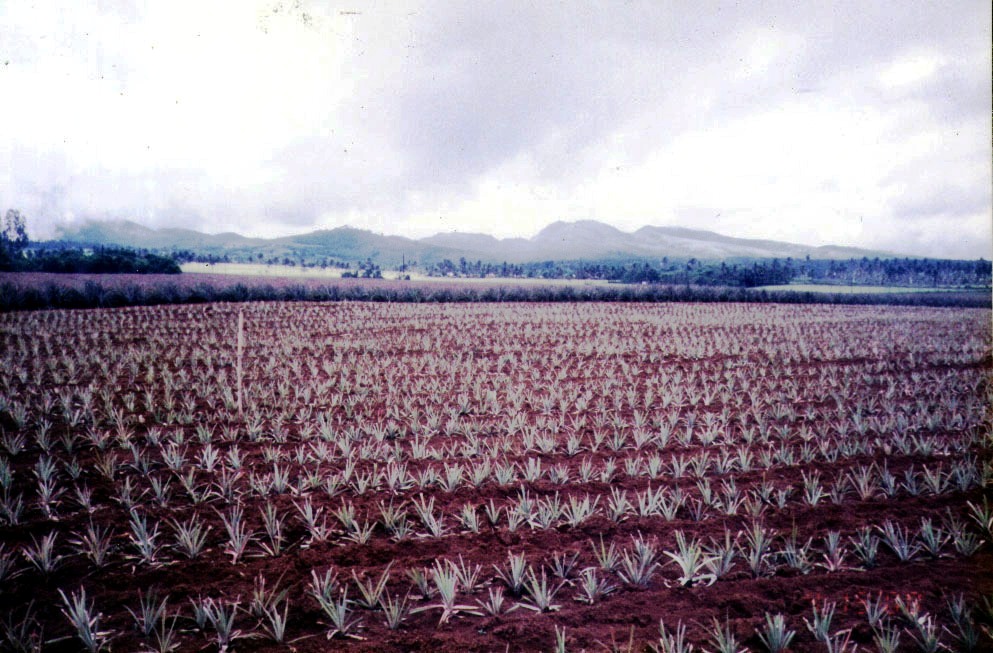
Rows of pineapples

Kananga, as well as Ormoc City, is famous for its pineapples, its leading fruit product.  Not just any pineapple, but the distinct queen or formosa variety, acclaimed as the sweetest pineapple in the land and grown only here and the Bicol province of Camarines Norte. Ranging from 0.45 to 1.3 kilograms in weight, it has deep eyes and a yellow to deep yellow flesh color.  The plantation grows one crop in 15 months and our arrival was timely as some of the pineapples were being harvested.

Roy, Jandy and I trying some pineapples
Our driver chose about five pieces for us to sample. After returning to the caretaker’s house, one fruit was pared and divided for me and Roy.  It was indeed sweet and succulent and so crispy that even the core could be eaten.  According to Roy, canning these pineapples is not feasible as less juice can be derived from one fruit unlike the other variety.  It is best eaten in its natural state, without preservatives.  Fruits here are sold around Leyte and Samar as well as shipped to nearby Cebu.

HME Embroidery Store (Taal, Batangas)

From the Leon Apacible Museum and Library, Jandy and I proceeded to the HME Embroidery Store, one of the town’s pioneers in the now dying art of fine needlework of hand-embroidered, semitransparent pina (made from pineapple fibers) cloth which is usually done by women in their homes and sundried around the market.    

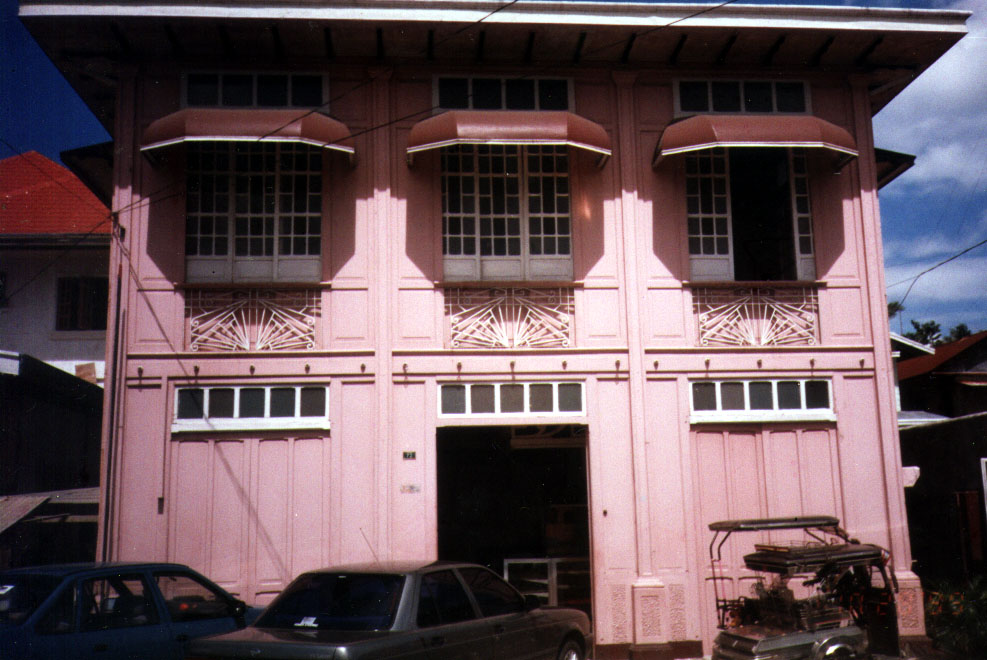
HME Embroidery Store

The store is located within the Art Deco-style ancestral house (also called the “Pink House”) of Ramon and Jovita Estacio, built in 1918 with narra and molave shipped all the way from Mindoro.  We were shown around the second floor by Mrs. Ofelia Estacio, the wife of Honesto Estacio, the current owners, where we appreciated its antique furniture. I bought barong cloth for PhP600 at the ground floor store.

HME Embroidery Store: J.P. Rizal St., Brgy. Poblacion 13, Taal, Batangas

Good Friday Parade of Carrozas (Sariaya, Quezon)

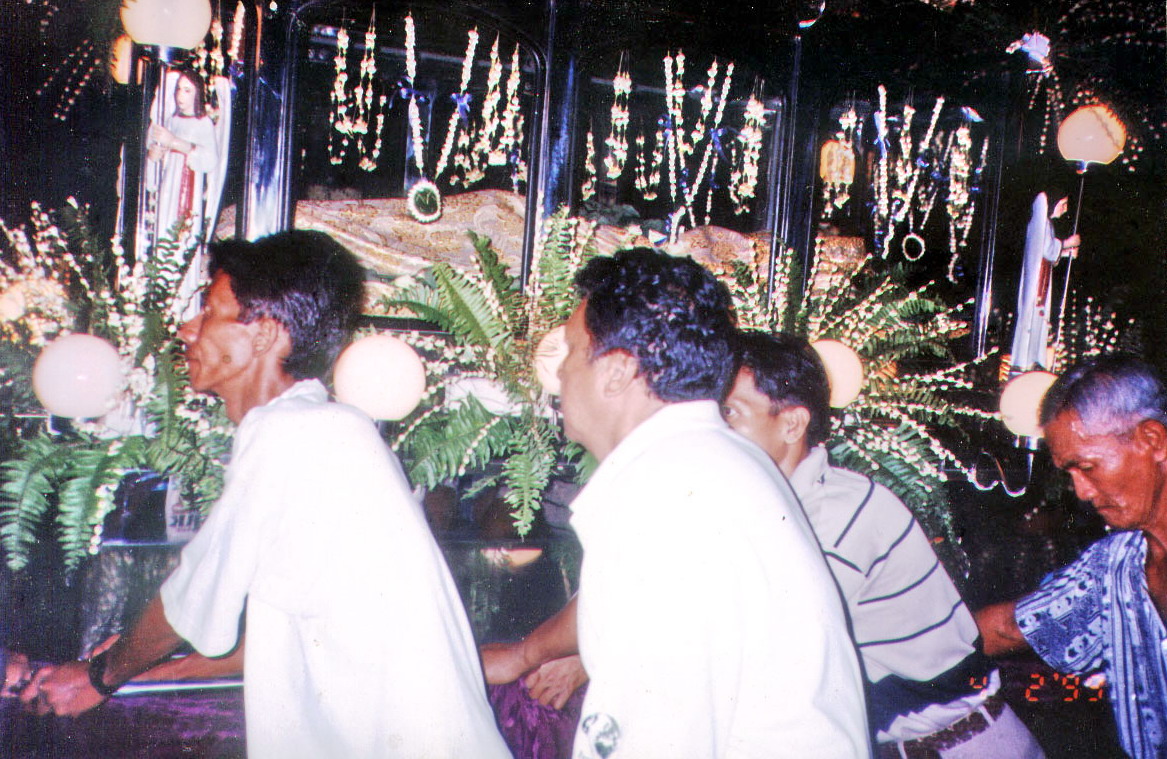
The Sto. Entierro
After our visita iglesia in Tayabas and Lucban, we drove back to Sariaya, in time for the traditional Good Friday parade of carrozas (carriage) at 5 P.M..  This parade, a tableaux from the ministry, passion and death of Christ, was accompanied by a huge crowd of devotees.
 
 
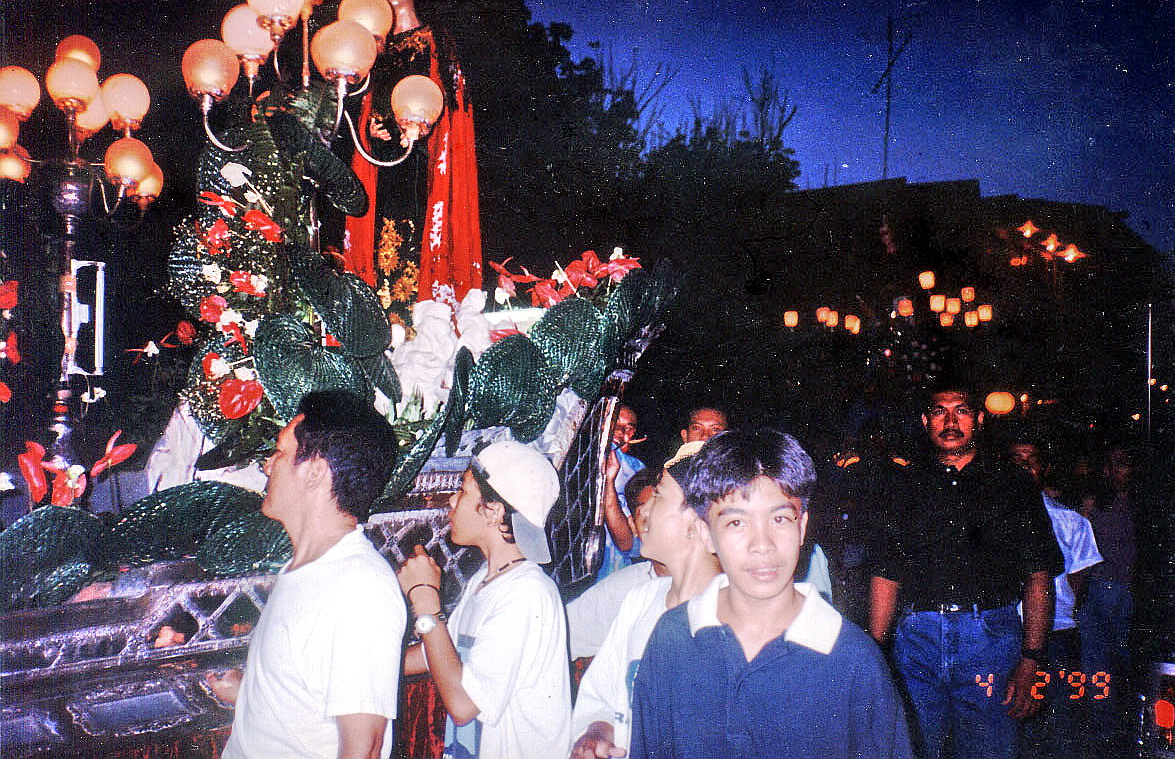
At the parade were about 15 tastefully-designed, silver-plated and antique carrozas (or andas) of different sizes, some grand and ostentatious beyond comprehension, and festooned with floral arrangements.  All are pulled by devotees as they navigated the streets of Sariaya in a long and winding procession after attending the late afternoon holy mass.  
 
 
Each carroza carried different images including colorfully decorated statues of heirloom santos (saints), the town’s patron saint Francis of Assisi among them, all resplendently attired with expensive finery, and the Sto. Entierro (meaning “holy burial”), glass case of the dead Jesus Christ in state.  According to Jun, one of the carrozaswas donated by his family.  The parade ended at the Church of St. Francis of Assisi.  After the procession, eager Sariayahins try their best to get the decorations and flowers (which they place in the altars of their homes) from the carrozas, especially those from the Sto. Entierro.

Visita Iglesia (Tayabas and Lucban, Quezon)

Today being Good Friday, Jandy and I also joined Jun and Jane’s relatives for the visita iglesia, the traditional visit to 7 churches.  We motored to the nearby town of Tayabas, just  23 kms. from Sariaya, and dropped by the St. Michael the Archangel Minor Basilica were we recited the 14 Stations of the Cross.  The longest Spanish colonial church in the country and also one of the oldest, this 103-m. long church was first built by the Franciscans in 1585, repaired in 1590 by Pedro Bautista, changed into brick in 1600, destroyed by an earthquake in 1743 and later rebuilt and enlarged in 1856 by building a transept and cupola. The church’s roof was changed to galvanized sheets in 1894 and its belfry contains an 18th century clock, the only one of its kind in the country, that chimes every 30 minutes.  It was made into a minor basilica on October 18, 1988 and has an antique organ, a balcony over the altar and a now unused tunnel from the altar. 

St. Michael the Archangel Minor Basilica
Our second and final stop of the visita iglesia was the town of Lucban, a quiet old Franciscan town of 35,128  people whose name was derived from a delicious fruit of the same name which looks like a small pomelo or suha. The “poor man’s Baguio,” Lucban lies 1,500 feet above sea level at the cool, damp shadow of Mt. Banahaw de Lucban whose clear, ice-cold waters flow through the little canals of the town.  It is almost as cool as  Baguio City in December.  There are also has numerous old and stately Spanish colonial houses.
 
Church of San Luis Obispo de Tolosa
Here, in front of the town’s shady plaza, is the moss and vine-covered Church of San Luis Obispo de Tolosa.  It was first built in 1593, ruined in 1629, reconstructed between 1630-1640, seriously damaged by fire in 1733 and reconstructed in 1738. Its convent was built in 1743.  It was partially destroyed in 1945 during World War II and finally reconstructed by the Philippine Historical Commission in 1966. However, it’s somewhat modern interior, which enshrines the venerated image of San Isidro Labrador, doesn’t blend in with its centuries-old exterior (my opinion).   The church is surrounded by gardens and grottos and fenced in by old stone walls called quince-quince.


Arrival in Banaue (Ifugao)

The 47-km. jeepney ride from Bontoc to Banaue, Ifugao province’s main tourism destination, was to take all of 2.5 hrs., the seemingly short distance made while climbing steep mountains via the dusty, narrow and bumpy Halsema Highway.  The discomfort was somehow alleviated by great views of some rice terraces that we passed.  By 4 PM, we arrived at the parking area for buses and jeepneys at the town’s Trade Center.   Banaue is the province’s transportation hub, being traversed by the one major highway leading south to Nueva Vizcaya and Manila and by a less-developed road going to Bontoc (Mountain Province), and from there, to Baguio City (Benguet).

Banaue town

This touristy area is the center of activity in the town and it has handicraft shops selling different kinds of traditional fabric like the woven bark cloth and dyed ikat cloth, wooden objets d’art  such as bowls, trays, oversized spoons and forks, antiques, entirely alien statues of American Indian chiefs and smiling, pot-bellied Chinese gods, and the traditional bul-ols (statues of rice gods).  Curio souvenirs include handwoven wall hangings, crocheted bedroom slippers and pfu-ong (traditional jewelry) representing good luck in hunting or prosperity of children.    At one end of it is the Municipal Hall and Post Office Sub-station.

Good Friday in Sagada (Mountain Province)

Good Friday, our last whole day in Sagada, was partly spent in prayer.  Together with my Danum Lake companions who were also staying in my inn, we made our way past the school gate and up some steps to the cemetery where Eduardo Masferre, the famous photographer (June 24, 1995), and William Henry Scott (1993), are buried.  It has a view of the northern valley.  Further up is Calvary, the highest point in the town cemetery which is marked with a huge cross.  Here, we visited and prayed at its 14 Stations of the Cross.

Sagada Cemetery

From the cemetery, a steep path took us to Echo Valley.  Halfway down, we viewed hanging coffins on large, gray limestone cliffs at the opposite side and some small burial caves.  There are still a few sangadil (“death chairs”) next to the hanging coffins, placed there for the spirits to rest on.

Hanging coffins

When a Sagadan nears old age, he is given the choice of cave burial or “hanging coffins.”  The deceased is cladded in special burial attire woven by a widow in the village.  This ensures that the spirit (anito) community would recognize them and admit them to the spirit world.

They are bound to a sangadil (death chair) and placed on the house porch for the duration of the long makibaya-o (wake period).  During the makibaya-o, pigs are sacrificed, dirges are sung and eulogies given during the all-night vigils.

The empty coffin is first taken to the burial site (cave or rock ledges).  The funeral procession follows later, preceded by torchbearers who make sure that no animals crosses its path.  When bad omens are encountered, the previously selected burial site could be changed at the last moment in the belief that the new arrival is not welcomed by the present occupants.

The deceased’s body is borne by young lads who vie with one another for the honor of carrying it the furthest distance.  In doing so, it is believed that he would gain much strength and wisdom from the deceased.  Today, these traditional rites are still being practiced, although on a smaller or revised scale, and still requested by some old people.

However, most are now buried on family land or at the Christian cemetery. The makibaya-o, whether traditional, Christian or in combination, is still significant in adult deaths.

The next day, Saturday, after breakfast at the inn, Jandy and I left Sagada on the 10 AM jeepney bound for Bontoc.

Hiking along Bontoc Road (Sagada, Mountain Province)

We spent the whole afternoon hiking along Bontoc Road. On both sides of the road is the 34-hectare Mission Compound.  It includes St. Theodore’s Hospital (established in 1926), the Rectory, the recently restored Doctor’s Residence, the Girl’s Dormitory (established in 1912) and residence  of American historian William Henry Scott. Across St. Theodore’s Hospital  is the DOT accredited and Episcopalian parish-operated St. Joseph’s Resthouse. Further out along Bontoc Road, on the left, is Sagada Weaving & Souvenir Shop.  Established  in 1978, it produces quality products hand-woven on backstrap looms and supervised by Mrs. Andrea Bondad and daughter Rhoda.  Finished products sold at reasonable prices include backpacks, shoulder bags, tapis (Igorot skirts), wallets and blankets.

Masferre Photographs

Further out along Bontoc Road, at the Bagaan Road Junction, is the Masferre Gallery.  Here, Mrs. Nena Masferre, wife of the late photographer Eduardo Masferre, welcomed us.  In the 1930s, 40s and 50s, through his pioneering skill and sensitivity as a photographer, Eduardo took photographs of the vanishing life and culture in the villages of Mountain Province. Mrs. Masferre showed us the black and white photographs taken by her husband and a few maps and artifacts.

Eduardo, a Spanish mestizo, was born on April 18, 1909, the second of eight children.  He was the son of Jaime P. Masferre, a retired Spanish soldier from Cataluna, who settled in Sagada at the turn of the century, became a coffee farmer, married an Kankanai woman (Mercedes Cunyap Langkew), joined the Episcopal Church and became a minister.  From 1914 to 1921, Eduardo first lived with his family in Spain where he began his education.  After completing his schooling in the Philippines, he became a missionary teacher like his father and then a missionary administrator.  In addition, he took up farming.

In the 1920s, he learned photography from U.S. missionaries.  Returning to photography in 1934, his artistic focus were the mountain people of the Cordilleras with whom he shares part of his heritage.  After World War II, he opened a photographic studio in Bontoc.  In 1951, he married Nena Ogues, a nurse from Kapangan.  The union produced six children.

His grainy, high contrast monochrome photos are displayed here and around the world.  His first exhibit was held in Manila in 1982.  After a second Manila exhibit the following year, his work traveled to Copenhagen (1984) and Tokyo (1986).  In 1988, his third Manila exhibit was mounted.  A book of his work, “E. Masferre: People of the Philippine Cordillera” was also produced.  Mobil Philippines funded the work, provided 1,500 copies to Philippine schools, museums and libraries, and funded the touring exhibit of his works to the cities of Baguio, Cebu, Cagayan de Oro, Davao and Bacolod.

In 1989, Masferre exhibited his works at Les Recontres International de la Photographie in Arles (France), the only Filipino to be accorded such an honor.  In 1990, again with Mobil support, the Smithsonian Institute of Washington D.C. purchased 120 of his impressive original photos and exhibited them for six months at the main rotunda of the American National Museum of Natural History.  They are now carefully archived in the same museum.  He died on June 24, 1995 at the age of 86.

Jandy with Ms. Nena Masferre

Plodding on, we reached a bend opposite the Rocky Valley Inn.  Here, a path lead down to the small Matangkib Burial Cave. However, it was closed due to the recent death of a hapless Irish tourist who slipped and broke his head.  Coffins here are carefully stacked. At  the lower end of the path, to the left of Matangkib burial cave, is the unmistakable mouth of the Latang Underground River.  We didn’t bring along a good flashlight and weren’t prepared for a 15-min./500-m. spelunking hike through  cold, knee-deep waters and a scramble over rocks.  It was late in the day and we made our way back to the inn.

Latang Underground River

The night was chilly and foggy.  Tourists from Manila were beginning to arrive, all looking for places to stay and most without any success.  Even St. Theodore’s hospital beds were rented out (barring any emergencies) for PhP45 per head.  Others camped out on the Mission grounds while others just slept in their vehicles.  Poor fellows.  Sagada has a reputation as a meeting place for travelers and I also made a number of friends during my stay.  Many were guests staying at the inn while the others I met were straying in the town’s  different coffee shops.

Arrival in Sagada (Mountain Province)

Sagada

We arrived at Sagada by 4 PM. Upon our arrival at the bus terminal near the municipal hall, Jandy and I checked in at one of the 5 double rooms with common bath at the second floor of nearby Ganduyan Inn, managed by Hanzel and Marina Biag. The inn was strategically located as it was just across the bus terminal and the municipal hall.  Rate was a very cheap PhP75 per person per day. The inn also had a restaurant.  According to Marina, her husband, as well as a significant portion of Sagada’s population, are descendants of Biag, a folk hero of the Igorots  and the most important figure in Sagada’s history.  Biag introduced new rites, prayers and customs.

Ganduyan Inn

As it was late in the afternoon, we decided to just visit the nearby Episcopal Church of St. Mary the Virgin.  Along the winding, pine needle-paved cement lane, to the  right of the basketball court, is this massive, gray stone Anglican church,  originally built under the direction of Reverend John Staunton and consecrated on December 8, 1921.  It was  badly damaged (especially the belfry) by U.S. bombing raids during World War II and later repaired.  The oldest church in the Cordilleras outside of Baguio City, its foreign architectural design is fused with indigenous motifs.  Further down is the 30-hectare St. Mary’s High School.  Founded in 1912, it was destroyed in World War II, rebuilt in 1950, destroyed by fire in 1975 and reopened in 1983.

Episcopal Church of St. Mary the Virgin

After this short tour we returned to the inn for supper at its coffee shop.   Food in Sagada is really cheap and the servings humongous.  Noteworthy is its tasty native red rice (kintuman), mountain tea and its aromatic and strong Arabian coffee, locally-grown, grounded and roasted.

Sagada Municipal Hall

San Juanico Bridge (Tacloban City, Leyte)

After breakfast at the Filamor Residence, Grace, Jandy, Cheska and I, together with Manny, Paula, Mark, Nenette, Daddy, Mommy and Cheska’s new friend Kookie Bal left for our tour of Tacloban City.  We secured the services of a guide and a van at the Department of Tourism Region 8 office.  Our first destination was to be the San Juanico Bridge, the longest bridge in the country as well as Southeast Asia.   At the foot of the San Juanico Bridge is the 15-hectare, Japanese-funded multi-million peso National Maritime Polytechnic, a  merchant marine training school and the most modern graduate institution for seamen in Asia.  

Posing along the San Juanico Bridge
 
We finally made our way midway up the bridge and made a short stopover.  Here, we had a panoramic view of the San Juanico Strait, located between the islands of Leyte and Samar.  It is considered the narrowest but most navigable strait in the world.   The strait has a number of beautiful islets.     The San Juanico Bridge, which crosses this strait, is also called the Marcos Bridge.  Inaugurated on July 2, 1973 and located 10 kms. from Tacloban City, it is a major link in the 3,000-km. Pan-Philippine Highway.  
 
San Juanico Strait
 
This impressive S-shaped bridge, said to be the most beautifully designed bridge in the country, is 2,162.4 m. (7,092 ft.) long, 10.62 m. wide with 43 spans and towers 41 m. above the sea at its highest point.    The S-shaped structure on the Samar side had to be adopted to make use of the importance of the existing islet, the Cabalauan islet that lies in the middle of the strait.  This islet serves as resting point and provides added support to the massive structure soaring over the swift currents of the strait.