La Paz Batchoy (Iloilo City, Iloilo)

Early in the morning of the next day, Easter Sunday, we departed Guimaras for Iloilo City, bringing along a memento of our Guimaras visit – a kaing (bamboo basket)  of delectable Guimaras mangoes.  We were dropped off at Plaza Libertad where we heard mass at the Church of St. Joseph.  

Dining on La Paz batchoy
Later, we were driven to SM Iloilo, in the city’s bustling commercial district, where we all had lunch at Teddy’s La Paz Batchoy. We each had a bowl of the famous La Paz batchoy, Iloilo City’s most popular dish  This soup is made with pork organs (liver, spleen, kidney and heart),  shrimp, vegetables, chicken stock, chicken breast, beef loin and round noodles with soy sauce added and topped crushed pork cracklings (chicharon) and leeks.   After this delicious repast, we still had time to visit the Amusement Center where Jandy and Cheska took a train ride.
Jandy and Cheska


The original SM Iloilo (opened on May 1979), located at the cor. of Delgado and Valeria St., was demolished on February 2, 2004 and a new building was build in the vicinity (inaugurated on December 8 that same year).  In 2007, an annex building was built to complete the shopping center’s redevelopment.

From SM Iloilo, we all left for our afternoon Philippine Airlines (PAL) flight back to Manila.

The Trappist Abbey (Jordan, Guimaras)

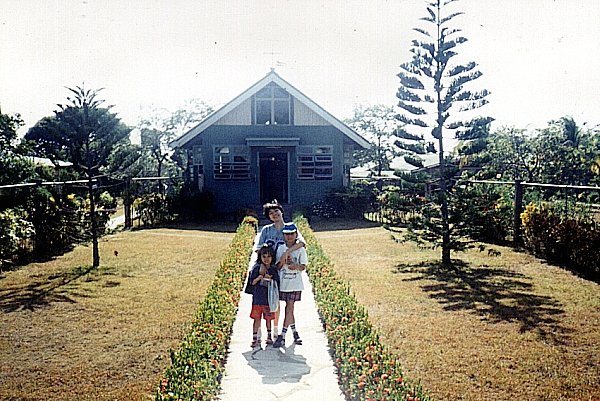
Trappist Monastery chapel

After lunch at the resort, we all availed of an afternoon sightseeing tour by jeepney.  Our first stop (2 PM) was the Trappist Abbey.  It was founded in 1972 and is the first and only one of its kind in the country and in the Orient.  The Trappist (or Cisterians of the Most Strict Observance) monks, who called Guimaras the “Island of a Happy Man,” follow the rules of St. Benedict and all adhere to a vow of silence. They take care of the Aeta community through the Contemplative Outreach Program, grow Philippine lemon (kalamansi) and pioneer fruit processing in the province.   

The Gift Shop

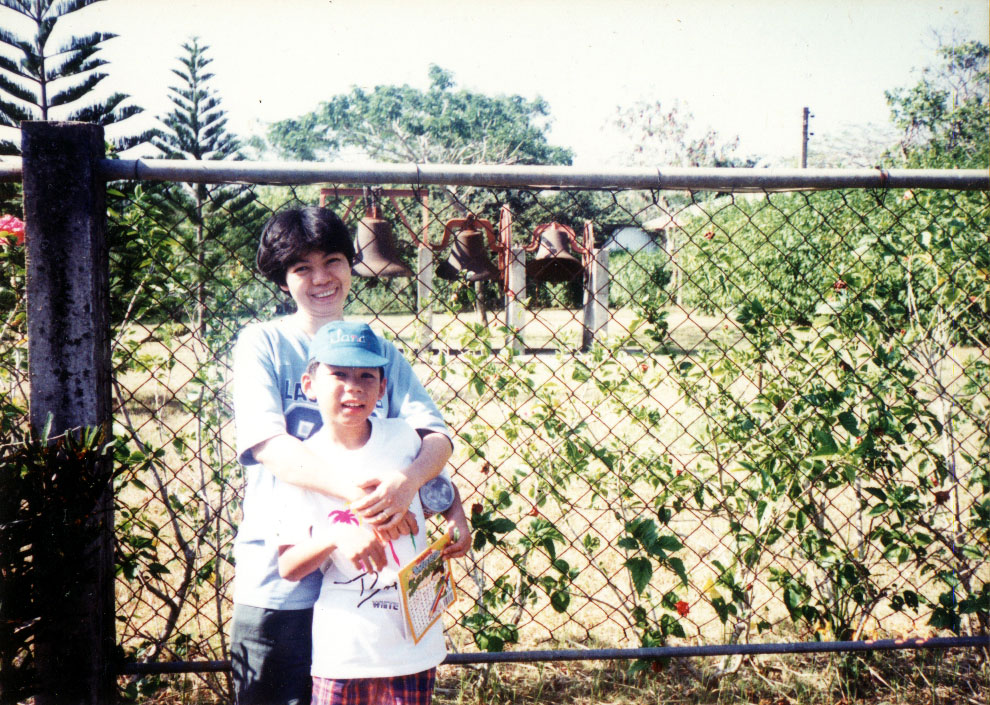
We dropped by the monastery’s Gift Shop where religious items (crucifixes, prayer books, rosaries, etc.) and excellent processed food products such  as jam, chutney, prunes, wines, marmalade, candies, ginger tea, cookies, piyaya and jelly (all made from mango, cashew, kamias, duhat, kalamansi and guava) are sold.  Grace bought a small crucifix.  We also bought some snacks and soft drinks.  Grace, Jandy, Cheska and I also visited its small but quaint chapel.  At the side of the walkway leading to the chapel are an array of 3 small bells.

An array of small bells

Trappist Abbey: Brgy.  San Miguel, Jordan, Guimaras. Fax: (033) 581-3468.

Enroute to Finger Pier (Singapore)

After my Johor Bahru (Malaysia) tour, I returned to the Cockpit Hotel to pick up Mom for our Batam Island (Indonesia) tour.  Located 20 kms. from Singapore, this island of the Riau Archipelago is the closest Indonesian island to Singapore. To get there, we had to get a fast ferry from Finger Pier along Prince Edward Rd..

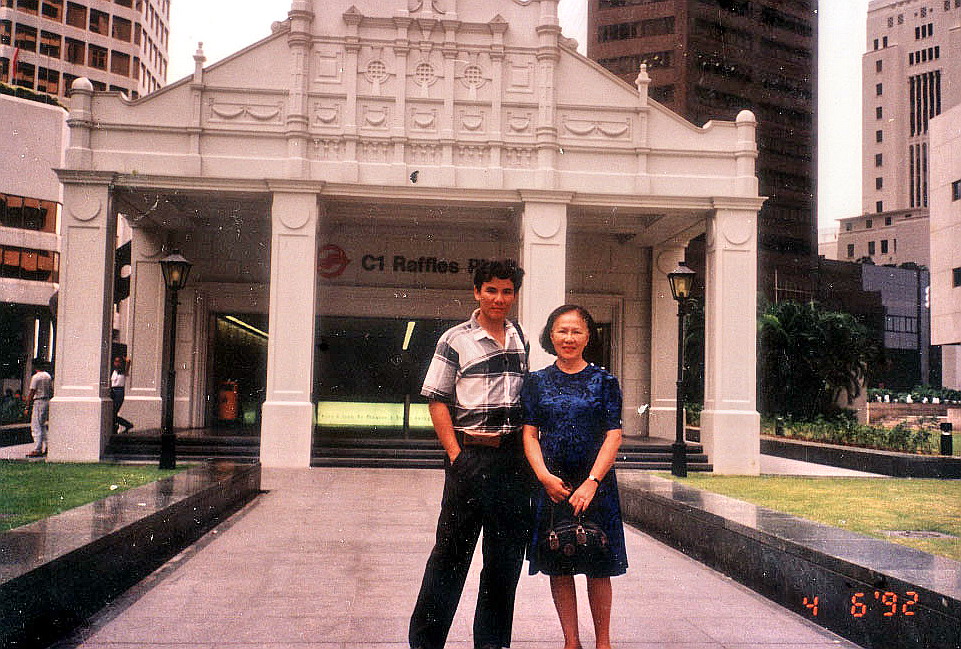
Raffles Place MRT Station

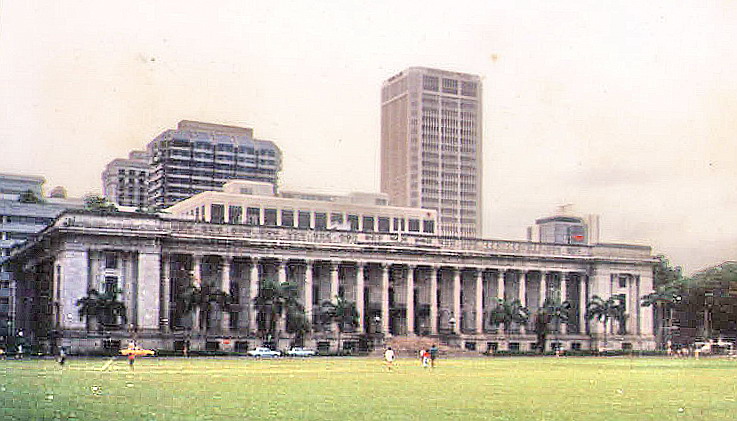
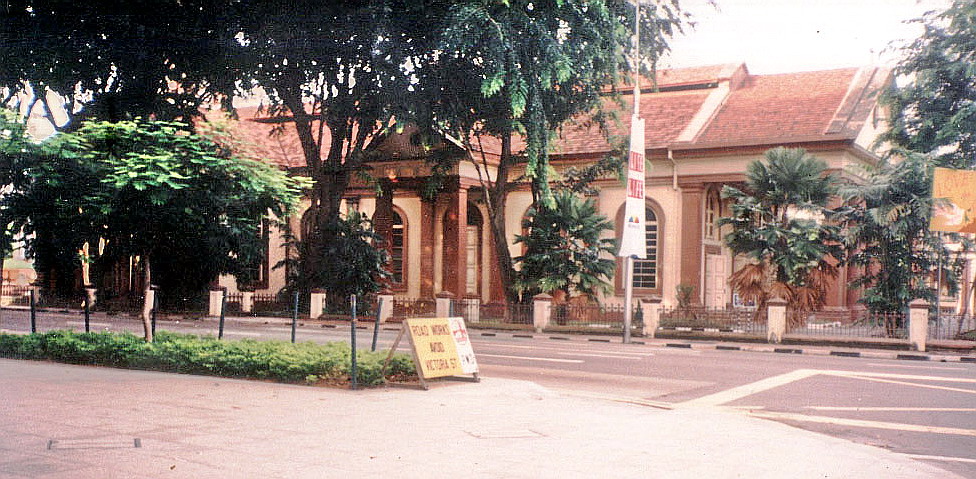
From the hotel, we had lunch at a Pizza Hut outlet then walked all the way to the Dhoby Ghaut Station where we took the MRT up to the Raffles Place Station.  From here, we walked all the way to the pier.  Along the way, we passed by a number of tourist attractions at the downtown area (the Dalhousie Obelisk, the Cavenagh Bridge, Victoria Theater, Empress Place) and the Padang (the Supreme Court and City Hall Buildings).

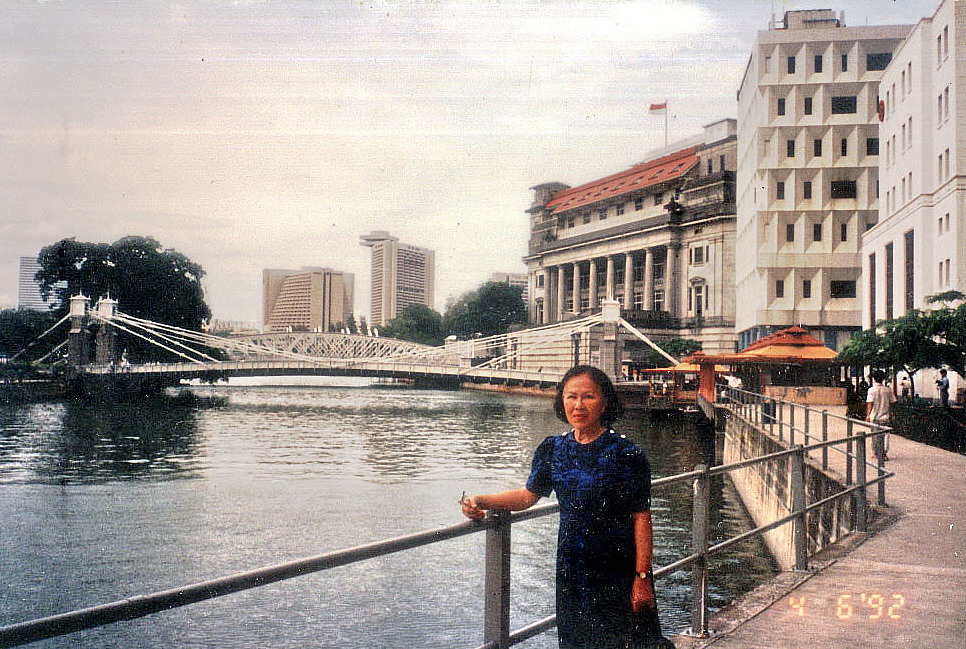
Singapore River and Cavenagh Bridge

Cavenagh Bridge, a suspension bridge (the only one in Singapore) spanning the lower reaches of the Singapore River, was opened in 1870 and is one of the oldest bridges in Singapore and the oldest bridge in Singapore that exists in its original form.

Dalhousie Obelisk

The Dalhousie Obelisk, located on the north bank of the Singapore River, is situated at Empress Place and near the Victoria Theater and Concert Hall. Designed by Government Surveyor John Turnbull Thompson, it commemorates the second visit of Marquis of Dalhousie, the Governor-General of India in February 1850.  It was originally located at Dalhousie Pier but was transferred to its present site in 1886.

Empress Place

Empress Place, built in 1834 as a courthouse, was later used as offices for the government departments until the late 1980s.  On April 7, 1989, it was converted to a museum after a 14-month, S$25 million renovation. On February 14, 1992, it was gazetted as a National Monument.  Its imposing Neo-Palladian facade has wooden louver windows and pitched, clay tile roof.

Subsequently, the Empress Place Building underwent renovations and, on March 2, 2003, it reopened as the second wing of the Asian Civilizations Museum exhibiting Southeast, South and West Asian collections.

Victoria Theater and Concert Hall

The Victoria Theater and Concert Hall, originally built in 1862 as Singapore’s town hall, is a complex of 2 buildings and a 54 m. high clock tower(completed in 1906) joined together by a common corridor.  The Victoria Memorial Hall, built in 1905, is the home of the Singapore Symphony Orchestra (SSO), transferred here in 1979.

City Hall

The Neo-Classical-style Singapore City Hall and its sister building, the Supreme Court, both on St. Andrew’s Road and overlooking the Padang, are also some of my favorites and both are reminiscent of our own National Museum complex, designed in the Federal style of American architect Daniel H. Burnham, the planner of Baguio City.

The Singapore City Hall, formerly known as the Municipal Offices, was built in 1929. Its steps were the site of the formal surrender of Japanese armed forces, headed by Gen. Itagaki to Admiral Lord Louis Mountbatten, Supreme Allied Commander of Southeast Asia. In 1952 the building’s name was changed when Singapore was finally made into a city by a deed signed by Britain’s King George VI and conferred by the Duchess of Kent.

Supreme Court Building

The impressive Supreme Court Building, on the other hand, was designed by government architect F. Dorrington Ward and was completed in 1939. It is the last Classical building to be so completed. What’s more, the building’s murals were designed by Italian artist Cavaliere Rodolfo Nolli.

Victoria Concert Hall: 11 Empress Place, Victoria Memorial Hall, Singapore 179558.  Tel: 6338 6125.

Enroute to Queen Street Bus Terminal (Singapore)

On my second day in Singapore, I decided to make a tour, on my own, to the nearby Johor Bahru, the first Malaysian town (and the capital of the state of Johor), across the Causeway, from Singapore.  After breakfast at a MacDonald’s outlet, I traveled all the way to the Queen Street Bus Terminal (also known as the Ban San Bus Terminal), a centralized location for commuters traveling to Johor Bahru.

St. Joseph’s Church

Along the way to the terminal, I passed a couple of noteworthy Roman Catholic churches.  The attractive, Gothic-style St. Joseph’s Church was originally built  from 1851-1853 by Portuguese Rev. Vincente de Santo Catharina.  The present church, built from 1906-1912 by the notable firm Swan & MacLaren, has a portico supported by 4 columns; a central, octagonal tower capped by a dome and flanked by 2 smaller towers and beautifully crafted stained glass windows.

Cathedral of the Good Shepherd

The Renaissance-style, graceful and charming Cathedral of the Good Shepherd, the cathedral church of the Archdiocese of Singapore and the seat of its archbishop, was completed on June 6, 1847 with funds collected by French parish priest Fr. Jean-Marie Beurel. Designed by Denis Lesley McSwiney, it was elevated as a cathedral in on February 14, 1897. It has 6 entrances, Palladian-style porticos, a high timber ceiling and round arches. On June 28, 1973, the cathedral was gazetted as a National Monument.

St. Joseph’s Church:  143 Victoria St., Singapore 188020. Tel: (65) 6336 2664 and (65) 6338 3167.

Cathedral of the Good Shepherd: cor. Queen St. and Bras Basah Rd., Singapore 188533.  Tel: (65) 6337 2036.

Mardi Gras in the Philippines (Kalibo, Aklan)

We were now in our second day at the Akelco (Aklan Electric Cooperative) guesthouse in Lezo (Aklan), having just arrived there yesterday afternoon upon the invitation of its general manager Job Y. Besana.  Today was to be a fun day as we were going to attend the extraordinary Ati-Atihan Festival, one of the most exciting and exuberant festivals in the country. The Ati-Atihan is invariably described by many as the “Mardi Gras of the Philippines” or the “country’s greatest party.”

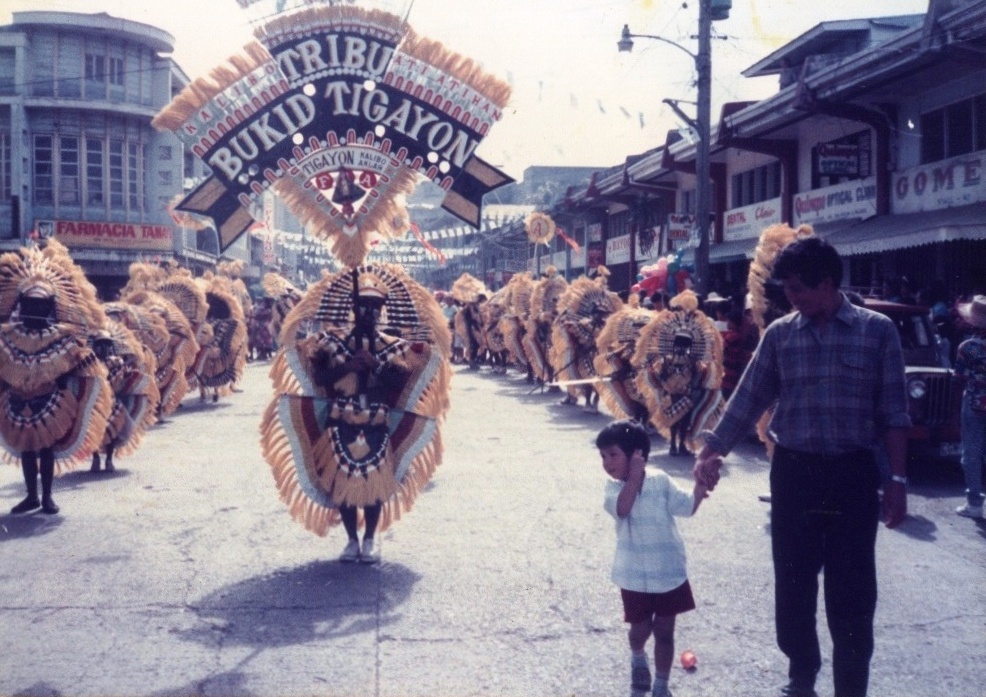
Parading with Tribu Bukid Tigayon

This spectacular, 300-year old celebration is held in honor of the Sto. Niño (Holy Child), Kalibo’s patron saint, who was said to have saved the town from Moro raiders.  A mixture of pagan and Christian elements, this exuberant festival usually attracts an estimated 50,000 local and foreign tourists yearly.  Flights to and from Kalibo, as well as the town’s hotels and pension houses, are usually fully booked at this time.

However, we arrived just a little over a month after the December 1-9, 1989 coup de etat attempt in Manila and, as a consequence, foreign tourist arrivals are down. However, there was a plus side to this as lesser crowds  means easier access to the festival action.   We left the Akelco guesthouse right after lunch and, although Kalibo was  just less than 10 kms. away, the going was slow as we approached the town as there were still lots of people gathered along the street to watch the parade.

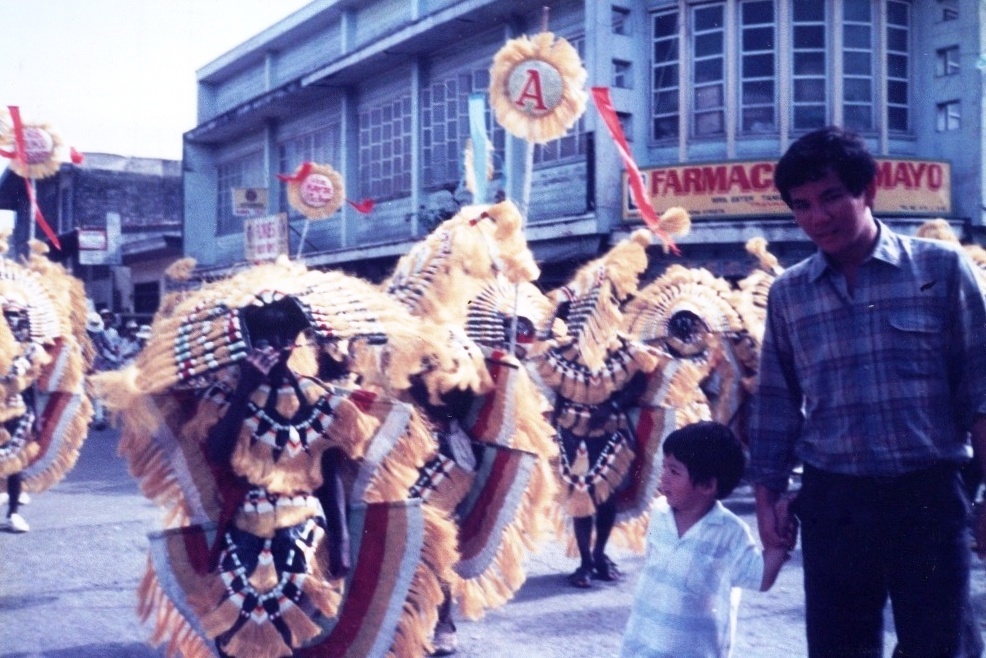
After parking our car, it was all footwork from hereon as we walked towards the parade route.  The parade was already underway when we arrived.   The parade featured tribus (“tribes”) composed of members of local barangays and organizations, each with its own striking costume made from local materials like coconut shells, feathers and fronds.  Participants also blacken their faces with soot and imitate the Atis, Aklan’s Negrito inhabitants, after whom the festival was named for.

Grace, Mommy, Jandy and I

The atmosphere was electrifying with its swirl of riotous color, reverberating drumbeats and cries of “Hala Bira!” and “Viva kay Señor Sto. Niño” (“Long Live the Holy Child”) as participants dance the Ati-Ati, a ritual dance with different movements.  Foreign, as well as, local visitors were also enticed to join in the dancing, drinking and the uninhibited revelry.   The festival also features a beauty pageant (Miss Kalibo Ati-Atihan), fireworks display, a Purchase of Panay re-enactment, a 9-day novena, field mass, pahilot (or paeappak, an old faith healing tradition), cockfight derbies, crafts fair and a torch parade and procession.    

Jandy admiring an Ati

Kalibo Tourism Office: Magsaysay Park, Kalibo, Aklan. Tel: (036) 262-1020, 268-4110, 262-3241 & 262-3079. Fax: (036)  268-4120 & 262-3241.