City Tour – Thian Hock Keng Temple (Singapore)

Thian Hock Keng Temple (Temple of Heavenly Happiness) – Entrance

From Merlion Park, we next moved on to the Chinatown area were we visited the Thian Hock Keng Temple (Temple of Heavenly Happiness), one of the oldest and most important Hokkien temples in Singapore.

Thian Hock Keng Temple (Temple of Heavenly Happiness) – Courtyard

Built in traditional southern Chinese architectural style from 1839-1842 by Mr Tan Tock Seng and Mr Si Hoo Keh, it was visited by Chinese immigrants giving thanks to Ma Chu P’oh or Ma Zu (the Chinese Goddess of the Sea) for their safe voyage.  The temple replaced a humble joss house established here in 1821 by Hokkien immigrants from Amoy (China).  In 1973, it was gazetted as a National Monument.

Thian Hock Keng Temple (Temple of Heavenly Happiness) – Courtyard

This architectural masterpiece of stone, tiles and wood, assembled without nails, is embellished with dragons and phoenixes, amazing carvings, intricate sculptures and imposing columns.

Thian Hock Keng Temple (Temple of Heavenly Happiness) – Courtyard

Granite tablets on the wall inside the Entrance Hall record the details of the temple’s history.  There is also a plaque, presented by Qing Dynasty Emperor Guang Xu in 1907, inscribed with the words Bo Jing Nan Ming (Gentle Waves over the South Seas), evidence of the temple’s stature.

Thian Hock Kieng Temple: Telok Ayer St., Singapore.

City Tour – Merlion (Singapore)

After breakfast at the hotel, we left on our city tour ( RMG Tours Pte. Ltd., S$21 each).  A surprise was our first destination – the bustling Serangoon Central Wet Market along Serangoon Rd. (Little India’s main thoroughfare), well stocked with the freshest vegetables, meat, fish, spices, etc.  and surprisingly fly-free.

Merlion Park

From Serangoon Rd. we made a short photo-op stopover at Merlion Park which houses the 8.6 m. high, 70-ton statue of the merlion, a mythical creature with the body of a fish and the head of a lion. The statue, made from November 1971 to August 1972 by the late Singapore sculptor Lim Nag Seng, was installed on September 15, 1972 at the mouth of the Singapore River, with the Anderson Bridge as its background.

In 1997, the completion of the Esplanade Bridge blocked the views of the Merlion from the Marina Bay waterfront.By then, its original location was also no longer the entrance of Singapore River. In 2002, the statue and its cub were relocated, from April 23-25, 2002, 120 m., to the current Merlion Park, fronting Marina Bay, where it stands on a newly reclaimed promontory in front of the Fullerton Hotel.

Indonesia: Batam Island

Mom and I finally arrived at Finger Pier, at the end of Prince Edward Rd., and I got us fast ferry tickets (S$28 round trip).  Ferries for Sekupang Pier, the main entry point in the 715 sq. km. Batam Island, leave every half hour.

Later in the year, the regional ferry operation at Finger Pier was relocated to the S$50 million International Passenger Terminal (IPT) at the Harbourfront Cruise Centre (formerly World Trade Center).

On Board the Fast Ferry Sea Flyte of Dino Shipping Pte. Ltd

We left on board Dino Shipping Pte. Ltd.’s streamlined and airconditioned  Sea Flyte, leaving the pier by 3:40 PM.  The trip took a little over 30 mins. and was uneventful. Along the way, we weaved through Singapore’s southern islands, most of which are small and uninhabited. We docked at Batam Island’s Sekupang Pier by 4:15PM.

Sekupang Pier, Batam Island

After securing our arrival clearance at the Batam Customs & Immigration Area, I hired the services of a local taxi driver to tour us around the island.  Batam Island, a duty-free island, is about two-thirds the size of Singapore and is an economic development zone of Indonesia with emphasis on tourist development. Nagoya City, formerly known as Lubuk Baja which means “Pirates Waterhole,” has shops that offer local handicrafts and Asian food delicacies.

Nagoya City

Beginning in the 1970s, the island underwent a major transformation, from a largely forested area, into a major harbor and industrial zone. During our tour, land was being cleared for new roads and many factories, many operated by Singaporean companies, were being built. Evidently, with its lower labor costs and special government incentives, the island’s economy benefits from being close to Singapore.

However, we weren’t shown any old government buildings, mosques, churches or temples as there didn’t seem to be any.  After our tour, our taxi driver brought us back to Sekupang Pier where we again boarded our fast ferry back to Finger Pier, arriving there by 10 PM. Upon arrival, we had a late dinner at a Burger King outlet before returning to our hotel.

Enroute to Finger Pier (Singapore)

After my Johor Bahru (Malaysia) tour, I returned to the Cockpit Hotel to pick up Mom for our Batam Island (Indonesia) tour.  Located 20 kms. from Singapore, this island of the Riau Archipelago is the closest Indonesian island to Singapore. To get there, we had to get a fast ferry from Finger Pier along Prince Edward Rd..

Raffles Place MRT Station

From the hotel, we had lunch at a Pizza Hut outlet then walked all the way to the Dhoby Ghaut Station where we took the MRT up to the Raffles Place Station.  From here, we walked all the way to the pier.  Along the way, we passed by a number of tourist attractions at the downtown area (the Dalhousie Obelisk, the Cavenagh Bridge, Victoria Theater, Empress Place) and the Padang (the Supreme Court and City Hall Buildings).

Singapore River and Cavenagh Bridge

Cavenagh Bridge, a suspension bridge (the only one in Singapore) spanning the lower reaches of the Singapore River, was opened in 1870 and is one of the oldest bridges in Singapore and the oldest bridge in Singapore that exists in its original form.

Dalhousie Obelisk

The Dalhousie Obelisk, located on the north bank of the Singapore River, is situated at Empress Place and near the Victoria Theater and Concert Hall. Designed by Government Surveyor John Turnbull Thompson, it commemorates the second visit of Marquis of Dalhousie, the Governor-General of India in February 1850.  It was originally located at Dalhousie Pier but was transferred to its present site in 1886.

Empress Place

Empress Place, built in 1834 as a courthouse, was later used as offices for the government departments until the late 1980s.  On April 7, 1989, it was converted to a museum after a 14-month, S$25 million renovation. On February 14, 1992, it was gazetted as a National Monument.  Its imposing Neo-Palladian facade has wooden louver windows and pitched, clay tile roof.

Subsequently, the Empress Place Building underwent renovations and, on March 2, 2003, it reopened as the second wing of the Asian Civilizations Museum exhibiting Southeast, South and West Asian collections.

Victoria Theater and Concert Hall

The Victoria Theater and Concert Hall, originally built in 1862 as Singapore’s town hall, is a complex of 2 buildings and a 54 m. high clock tower(completed in 1906) joined together by a common corridor.  The Victoria Memorial Hall, built in 1905, is the home of the Singapore Symphony Orchestra (SSO), transferred here in 1979.

City Hall

The Neo-Classical-style Singapore City Hall and its sister building, the Supreme Court, both on St. Andrew’s Road and overlooking the Padang, are also some of my favorites and both are reminiscent of our own National Museum complex, designed in the Federal style of American architect Daniel H. Burnham, the planner of Baguio City.

The Singapore City Hall, formerly known as the Municipal Offices, was built in 1929. Its steps were the site of the formal surrender of Japanese armed forces, headed by Gen. Itagaki to Admiral Lord Louis Mountbatten, Supreme Allied Commander of Southeast Asia. In 1952 the building’s name was changed when Singapore was finally made into a city by a deed signed by Britain’s King George VI and conferred by the Duchess of Kent.

Supreme Court Building

The impressive Supreme Court Building, on the other hand, was designed by government architect F. Dorrington Ward and was completed in 1939. It is the last Classical building to be so completed. What’s more, the building’s murals were designed by Italian artist Cavaliere Rodolfo Nolli.

Victoria Concert Hall: 11 Empress Place, Victoria Memorial Hall, Singapore 179558.  Tel: 6338 6125.

Johor Bahru (Malaysia)

Upon reaching the Malaysian side, I cleared my entry to Johor Bahru at the Malaysia Customs and Immigration Office. Once past, I found myself along Jalan Tun Abdul Razak.  Here, a fenced historical marker with a plaque tells the story of the town.

Johor Bahru Historical Marker

Johor Bahru has a rich history that dates as early as the 16th century but its urbanization began in 1855. Sultan Abu Bakar (1862-1895), the 21st Sultan of Johor, transformed Johor Bahru from a fishing village into a thriving city.

Johor Bahru

Jalan Tun Abdul Razak and the adjoining  Jalan Trus has a number of shophouses, mostly built in the 1920’s,with great heritage value. Here, traders from Arab, India and China used to come to trade spices and tobacco. Also along Jalan Tun Abdul Razak is the Johor Bahru Railway Station.

On October 10, 2010, the spanking new JB Sentral railway station, along Jalan Tun Abdul Razak and Jalan Jim Quee, was opened. The old train station, located just 200 m. south of JB Sentral, has been decommissioned, its platform 2 and its tracks dismantled.  Only one track and platform remain.  There are plans for it to be preserved for a future Mini Railway Museum for the Southern Region.

Johor Bahru Railway Station

The relatively old Plaza Kotaraya shopping center, along Jalan Trus, is only 5 minutes walk from the Malaysia Customs and Immigration Office.  Across the street is the Arulmigu Sri Raja Mariamman Devasthanam Hindu Temple.  Built in 1922, it is one of the town’s oldest Hindu temples and has an impressive gopuram (entrance tower).

The Arulmigu Sri Raja Mariamman Devasthanam Hindu Temple was rebuilt and was officially reopened in 1996. In 2009, the temple was embellished with an impressive mosaic of 300,000 pieces of red, blue, yellow, green, purple and white glass (completed in October 2009) and, on May 12, 2010, the temple was listed in the Malaysian Book of Records as the first and only glass temple in the nation.

Arulmigu Sri Raja Mariamman Devasthanam Hindu Temple and Plaza Kotaraya Shopping Center

After this relatively short walking tour of Johor Bahru, I retraced my steps back to the Malaysia Customs and Immigration Office to clear my departure and, this time, took a bus back to the Queen Street Bus Terminal in Singapore.

Arulmigu Sri Raja Mariamman Devasthanam Hindu Temple: 22 Lorong 1, Jalan Tebrau, Johor Bahru, Malaysia.

The Causeway (Singapore)

Singapore Customs and Immigration Office

Upon arrival at the Queen St. Bus Terminal, I took the SBS (Singapore Bus Service) Transit’s service 170.  These public buses provide one of the cheapest and most reliable form of transport directly into the heart of Johor Bahru, across the causeway over the Straits of Johor, from Singapore. The Johor-Singapore Causeway, completed in 1923 after 4 years of construction, was partially destroyed in 1942 during World War II, to prevent the Japanese army from invading Singapore. However, it was rebuilt once the Japanese had captured the island.

Huge Water Pipes, Railway Track as well as Roads Line the Johor-Singapore Causeway

Very popular but terminally congested, the causeway is crossed by buses, trains, taxis and cars and is normally jam-packed on Friday evenings (towards Malaysia) and Sunday evenings (towards Singapore).  However, it was the Qing Ning holiday (similar to our All Saints Day) and the bus queue was very long going to Johor. Seeing the traffic, I decided to alight from the bus and just walked towards the Singapore Customs & Immigration Office at Woodlands for the necessary departure clearance.

A second crossing, between Johor Bahru and western Singapore, was open on January 2, 1998. Known as the Tuas Second Link, it is much faster and less congested than the Causeway and  is used by some of the luxury bus services to Kuala Lumpur.

Traffic Along the Johor-Singapore Causeway

I also decided to just walk the whole 1 km. length of the Causeway to the Malaysian side.  It seems I was the only one doing so. Along the way, I noticed, aside from the huge traffic jam, the huge water pipes as well as the railway track between the two sides of the Causeway. I was dripping with sweat by the time I reached the other side.

In December 2008, immediately after the opening of the new Johor Bahru CIQ complex, crossing the Causeway, on foot, from Singapore to Johor Bahru was officially forbidden by the Singapore authorities. Once you have cleared Singapore immigration at the Woodlands Checkpoint, you have to take any of the public or private buses waiting at the bus bays downstairs to cross the Causeway. There is always a Singapore police officer stationed at the staircase entrance to the Causeway to prevent anyone from crossing the Causeway on foot.

Malaysia Customs and Immigration Office

Enroute to Queen Street Bus Terminal (Singapore)

On my second day in Singapore, I decided to make a tour, on my own, to the nearby Johor Bahru, the first Malaysian town (and the capital of the state of Johor), across the Causeway, from Singapore.  After breakfast at a MacDonald’s outlet, I traveled all the way to the Queen Street Bus Terminal (also known as the Ban San Bus Terminal), a centralized location for commuters traveling to Johor Bahru.

St. Joseph’s Church

Along the way to the terminal, I passed a couple of noteworthy Roman Catholic churches.  The attractive, Gothic-style St. Joseph’s Church was originally built  from 1851-1853 by Portuguese Rev. Vincente de Santo Catharina.  The present church, built from 1906-1912 by the notable firm Swan & MacLaren, has a portico supported by 4 columns; a central, octagonal tower capped by a dome and flanked by 2 smaller towers and beautifully crafted stained glass windows.

Cathedral of the Good Shepherd

The Renaissance-style, graceful and charming Cathedral of the Good Shepherd, the cathedral church of the Archdiocese of Singapore and the seat of its archbishop, was completed on June 6, 1847 with funds collected by French parish priest Fr. Jean-Marie Beurel. Designed by Denis Lesley McSwiney, it was elevated as a cathedral in on February 14, 1897. It has 6 entrances, Palladian-style porticos, a high timber ceiling and round arches. On June 28, 1973, the cathedral was gazetted as a National Monument.

St. Joseph’s Church:  143 Victoria St., Singapore 188020. Tel: (65) 6336 2664 and (65) 6338 3167.

Cathedral of the Good Shepherd: cor. Queen St. and Bras Basah Rd., Singapore 188533.  Tel: (65) 6337 2036.

Bad Trip at Singapore

After a month of planning, our 8-day Singapore and Thailand trip (4 days in Singapore, 3 days in Bangkok and 1 day in Pattaya, Thailand), arranged with Mondial Tours, was pushing through this April 5.  Joining me were my sisters Salve and Tellie and our mom Carol.  We were to leave Manila 8:30 AM, a Sunday, and we ll arrived at the NAIA Terminal I very early in the morning only to find out that our flight was cancelled due to a wildcat strike by the airport’s flight controllers.  We were told to await further announcements regarding our new departure time.

That being the case, I returned home to a very surprised Grace, heard the 10 AM Sunday mass at Merville and met up with friend Raymond Dayrit, all in the morning.  Later, we learned that our departure to Singapore was moved to 5:30 PM and we all returned to NAIA I.  We departed Manila on a Singapore Airlines Boeing 747 (my first time to ride such a huge plane), with former presidential daughter Imee Marcos also on board (she was in first class though).

Arrival at Changi International Airport

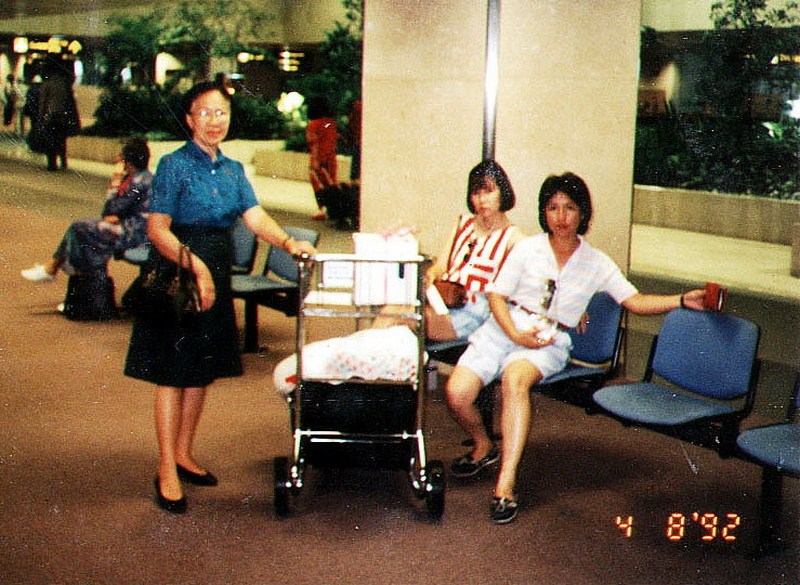
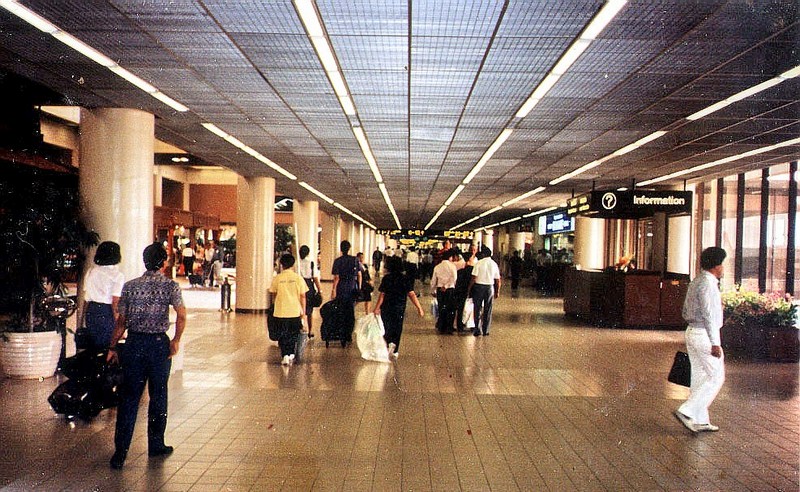
We arrived at Singapore’s Changi International Airport by 10 PM and waited an hour for our tour guide and pick up.  It never came.  We decided to take a taxi to Hotel Grand Central along Orchard Rd., our designated hotel.  The Front Desk Manager told us that our booking has been cancelled due to the strike and, even worst, there were no available rooms for us in the hotel, it being a holiday (Qing Ning).

However, the manager was king enough to check with the other hotels for available rooms.  The only room available, a penthouse suite, was at the nearby Cockpit Hotel.

Check out “Hotel Review: Cockpit Hotel

Tired and sleepy, we decided to take it.  It was a good thing that we brought some US dollars with us.  Thought near, walking to the hotel wasn’t easy as I was carrying my mom’s luggage as well as my own.  Aside from her Luggage, Salve was also toting a new bowling ball she bought at NAIA which she, unwisely, decided to bring with her to Singapore.

Thus, we were all dead tired and irritable when we arrived at the hotel and checked in at our suite.  What a way to start a vacation, losing precious time, energy and our booking at the hotel.

Mardi Gras in the Philippines (Kalibo, Aklan)

We were now in our second day at the Akelco (Aklan Electric Cooperative) guesthouse in Lezo (Aklan), having just arrived there yesterday afternoon upon the invitation of its general manager Job Y. Besana.  Today was to be a fun day as we were going to attend the extraordinary Ati-Atihan Festival, one of the most exciting and exuberant festivals in the country. The Ati-Atihan is invariably described by many as the “Mardi Gras of the Philippines” or the “country’s greatest party.”

Parading with Tribu Bukid Tigayon

This spectacular, 300-year old celebration is held in honor of the Sto. Niño (Holy Child), Kalibo’s patron saint, who was said to have saved the town from Moro raiders.  A mixture of pagan and Christian elements, this exuberant festival usually attracts an estimated 50,000 local and foreign tourists yearly.  Flights to and from Kalibo, as well as the town’s hotels and pension houses, are usually fully booked at this time.

However, we arrived just a little over a month after the December 1-9, 1989 coup de etat attempt in Manila and, as a consequence, foreign tourist arrivals are down. However, there was a plus side to this as lesser crowds  means easier access to the festival action.   We left the Akelco guesthouse right after lunch and, although Kalibo was  just less than 10 kms. away, the going was slow as we approached the town as there were still lots of people gathered along the street to watch the parade.

After parking our car, it was all footwork from hereon as we walked towards the parade route.  The parade was already underway when we arrived.   The parade featured tribus (“tribes”) composed of members of local barangays and organizations, each with its own striking costume made from local materials like coconut shells, feathers and fronds.  Participants also blacken their faces with soot and imitate the Atis, Aklan’s Negrito inhabitants, after whom the festival was named for.

Grace, Mommy, Jandy and I

The atmosphere was electrifying with its swirl of riotous color, reverberating drumbeats and cries of “Hala Bira!” and “Viva kay Señor Sto. Niño” (“Long Live the Holy Child”) as participants dance the Ati-Ati, a ritual dance with different movements.  Foreign, as well as, local visitors were also enticed to join in the dancing, drinking and the uninhibited revelry.   The festival also features a beauty pageant (Miss Kalibo Ati-Atihan), fireworks display, a Purchase of Panay re-enactment, a 9-day novena, field mass, pahilot (or paeappak, an old faith healing tradition), cockfight derbies, crafts fair and a torch parade and procession.    

Jandy admiring an Ati

Kalibo Tourism Office: Magsaysay Park, Kalibo, Aklan. Tel: (036) 262-1020, 268-4110, 262-3241 & 262-3079. Fax: (036)  268-4120 & 262-3241.

Boracay Here We Come! (Malay, Aklan)

After breakfast at Dad’s ancestral home in Malay, we boarded the L-200 and were driven, along 6 kms. of dirt road, to the makeshift jetty port at Brgy. Caticlan.  Here, we boarded a big outrigger boat for Boracay Island.  Our 15-min. pumpboat ride to the island was smooth all the way and soon the crystal blue waters turned sparklingly clear as we approached the island’s famous White Beach.  It was just about noontime and the palm-fringed beach’s dazzlingly white sand was practically deserted and enchanting.

On our way

Our boat docked at Boat Station 2, actually just an open beach point without piers where boats land.  All passengers, including us, have to alight the boat via a narrow gangplank then wade a short distance through the shallow water to the beach.  Others, however, hired brawny porters to carry them to shore on their shoulders.  From the beach, we walked a short distance to a narrow alley.  From the alley entrance, we walked a further 100 m. to Lion’s Den Resort on our left.

This rustic resort, owned and managed by Lowell A. Talamisan, an apo (grandnephew) of my father-in-law and a nephew of my wife Grace, is conveniently located midway between the beach and Main Road.  Here, we stayed at one of the resort’s quaint and cozy nipa and bamboo cottages with private bath.  Our cottage also had a verandah with a nice hammock slung at the posts.

Jandy and his lola relaxing at the verandah

Boracay Island then was without electricity and our cottage was lit at night with gas lanterns.  Other high-end resorts were powered by generators.  This didn’t matter to us then, since food and accommodation were inexpensive and the people were friendly. Sometimes we would dine on grilled blue marlin at the resort or dine out at the restaurant of the nearby Red Coconut Resort.

White Beach circa 1990

The most exhilarating portion of our 3-day stay on the island was  the  feel of the sand of White Beach, snow white and fine as sifted confectionary sugar, top-grade cake flour or baby powder.   It was so white you can get a total suntan  due to the  sun’s  reflection on the sand.  The  aquamarine  water was shallow and clear and the sunset was always magnificent.

Sand, sea and sky at Boracay

Up north along White Beach, across Willy’s Beach Resort, is Willy’s Rock, the familiar and frequently photographed landmark that dominates the seascape.  This large, castle-like natural boulder rises 7 m. (23 ft.) from the sand.

Posing by the much photographed Willy’s Rock