Kape Alamid: My First Taste of Coffee Heaven (Rosario, La Union)

Kape Alamid

I first heard of kopi luwak from the 2008 movie Bucket List (literally, “things to do” before one “kicks the bucket” or dies) starring Academy Award winners Jack Nicholson (as hospital magnate and billionaire Edward Cole) and Morgan Freeman (as blue-collar mechanic Carter Chambers). Cole drinks a specific brand of coffee called kopi luwak, one of the most expensive coffees in the world, and Carter and Cole both “laugh till they cry” (an item from Carter’s bucket list) when Cole finds out that his favorite coffee comes from the undigested beans defecated from the Asian palm civet.  Well, so much for the movies.  However, the movie did bring out the curious in me as I added “trying out kopi luwak” in my own bucket list. Only lately did I find out that we had a local version called kape alamid (in the Tagalog area, but called motit coffee in the Cordilleras).

S.O.U.L. Cafe

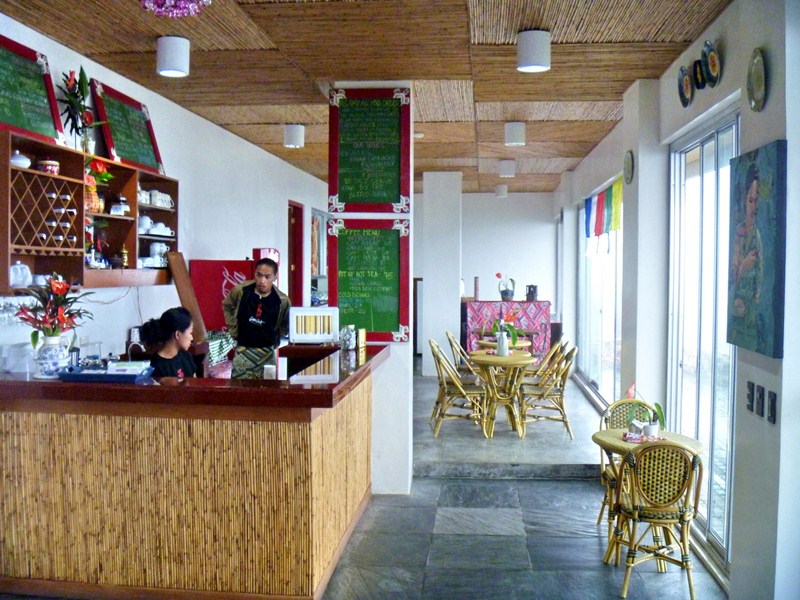
Kafe alamid comes from civets (you guessed it, locally called alamid or musang)  who eat the coffee beans for their fleshy fruit pulp. Proteolytic enzymes in the civet’s stomach seep into the beans, making shorter peptides and more free amino acids and, when defecated, the beans keep their shape. After gathering, they are thoroughly washed, sun dried and lightly roasted. S.O.U.L (Soul for Spice of Urban Life) Café in Rosario, La Union was our first stopover (6:30 AM) on the road to Baguio City during the 5-day, North Philippines Visitors Bureau (NPVB) and Manila North Tollways Corporation (MNTC)-sponsored Lakbay Norte 2 Tour (officially launched on January 23 from the Victory Liner Terminal near Kamias St. in Quezon City).

Breakfast of Alaminos longanisa, garlic fried rice
 and tortang talong

Our hearty Filipino breakfast combo here consisted of Alaminos logganisa, boneless daing na bangus, garlic fried rice, hot chocolate, tortang talong made with creamy egg pesto and olive oil and, to kick start our day, an expresso shot of kape alamid with caramel. According to the menu, this expresso shot costs PhP350 and, according to the cafe manager, was sourced all the way from Cavite. This brewed concoction truly lived up to its name as one of the most expensive coffee in the world as it proved to be more aromatic and less bitter than the other coffee treats I’ve tried. Banish the thought of where it came from and you get a truly great coffee experience, with its great flavor without the bitter after taste of other brewed coffee.  Scratch this one from my bucket list.

The cafe’s chic interior

S.O.U.L. Cafe: Camp One, Rosario, La Union.  Tel: (072) 712-0852.  Fax: (072) 712-1190.

Ghost Hunting in Corregidor (Cavite)

After my tour of Battery Grubb, I, together with Mark, joined a group on a ghost-hunting tour at the Hospital Ruins.   Sounds of footsteps and rumblings of normal hospital activities have been heard by many in the past but we didn’t experience any of these. At one time, our tour guide requested all of us to turn off our flashlights so as to have a feel of the eerie darkness of night.

Check out “Sunset at Battery Grubbs

The hospital walls also had lots of graffiti left by a ragtag group of Muslim soldiers who, in 1968,  trained in Corregidor for a  planned invasion of Sabah in Malaysia.  The soldiers were put up in the hospital ruins.  When the soldiers found out what they were there for, they refused to do their duty, as many of them had relatives in Sabah, and the rest were understandably reluctant to slaughter fellow Muslims. A decision was made, from top brass, to exterminate them.

Hospital Ruins

Under the pretense of taking them home, groups of 12 soldiers were led to Kindley air strip where they were machine-gunned.  All were killed except one Jibin Arula, who jumped off a cliff into the sea and, several hours later, was picked up by fishermen.  He later told the story of the infamous Jabidah Massacre. This spurred a rebellion in the Muslim south, one that lingers to this day. Their ghosts now join those of the Corregidor’s World War II dead.

Hospital graffiti with the names of some of the Muslim soldiers

Back at the Corregidor Inn, Jovy invited us all to dinner at the La Playa Restaurant.  Jovy, with Mat in tow, later joined Eric, Mark and I as we hiked, with our flashlights, the dimly-lit trails outside the hotel.  No encounters with ghosts here.

Check out “Hotel and Inn Review: Corregidor Inn

We made it up to the Power Station before we decided to turn back.  Unsatisfied with this hike, Rico, all by his lonesome, bravely went on to explore ghostly Malinta Tunnel for some photo ops, using our flashlights for lighting.  We didn’t wait up for him, leaving that to Lee, as Jovy, Mat, Mark and I returned to the inn and retired for the night.

The hospital ruins at night

Sun Cruises, Inc. (SCI) – Reservation Office: CCP Terminal A, CCP Complex, Roxas Blvd., Manila.  Tel: (632) 831-8140 and (632) 834-6857 to 58.  Fax: (632) 834-1523.  E-mail: suncruises@magsaysay.com.ph.

Sun Cruises, Inc. (SCI) – Sales Office: 21/F,  Times Plaza Bldg., Ermita, Manila.  Tel: (632) 527-5555 local 4511 and 4512.  Fax: (632) 527-5555 local 4513.  E-mail: sales@suncruises.com.ph.

Sunset at Battery Grubbs (Corregidor Island)

Once settled in at the Corregidor Inn, Mark, Rico, Jovany (with Mat) and I took the opportunity to watch the sun go down at Battery Grubbs, one of the larger gun emplacements on the island.  We were driven to the west central part of the island, passing through a Spanish-style arch (above which is the name “Battery Grubbs) at the end of road’s end. The battery was named in honor of 1st Lt. Hayden Y. Grubbs of the 6th U.S. Infantry who died in 1899, during the Philippine-American War.

Check out “Hotel and Inn Review: Corregidor Inn

Arched entrance to Battery Grubb

Arched entrance to Battery Grubb

This gun emplacement, with two 10-inch guns (Model 1895M1) mounted on Model 1901 disappearing carriages  (Watervliet #25 / #14 and #22 / #16) intended to fire to the northwest, was originally emplaced in the Manila Harbor defenses.  It was built from November 1907 to early 1909 at a cost of a whopping (at that time) US$212,397.88. On February 2, 1911, it was transferred to Corregidor. These were apparently never changed during the service life of the battery.

Gun No. 1

Gun No. 1

This gun emplacement, with two 10-inch guns (Model 1895M1) mounted on Model 1901 disappearing carriages  (Watervliet #25 / #14 and #22 / #16) intended to fire to the northwest, was originally emplaced in the Manila Harbor defenses.  It was built from November 1907 to early 1909 at a cost of a whopping (at that time) US$212,397.88. On February 2, 1911, it was transferred to Corregidor. These were apparently never changed during the service life of the battery.

Gun No. 2

Gun No. 2

During the start of World War II, Battery Grubbs was not manned but, in early April 1942, Battery C of the 91st Coastal Artillery was transferred here from Battery Morrison  and the Number 2 gun was put into action.  The Number 1 gun, which had suffered some mechanical failure, was never commissioned. On April 11, an aerial bomb hit the power plant, putting the battery out of service. Five days later, a direct hit took out the number 2 gun and destroying the Battery Commander’s station.  The battery was subsequently abandoned.

The massive concrete parapets

The massive concrete parapets

After Corregidor’s surrender, the Japanese tried to restore the battery into a usable state but, before they could complete the work, it was heavily damaged during the U.S. bombardment in 1945. In 1994, the guns were repainted and railings installed for the visit of former U.S. Pres. Bill Clinton and his wife Hillary Clinton.

Sun Cruises, Inc. (SCI) – Reservation Office: CCP Terminal A, CCP Complex, Roxas Blvd., Manila.  Tel: (632) 831-8140 and (632) 834-6857 to 58.  Fax: (632) 834-1523.  E-mail: suncruises@magsaysay.com.ph.

Sun Cruises, Inc. (SCI) – Sales Office: 21/F,  Times Plaza Bldg., Ermita, Manila.  Tel: (632) 527-5555 local 4511 and 4512.  Fax: (632) 527-5555 local 4513.  E-mail: sales@suncruises.com.ph.

A Historical Tour of Corregidor (Cavite)

Battery Hearns

Come morning, prior to breakfast, Lee and Mark opted to do some fishing as South Dock.  The fish that early morning weren’t biting and the only thing they had to show for their unsuccessful effort was a lost fish hook.   After a hearty and filling breakfast, Mark and I, with other hotel and day tour guests, joined the regular tour via tranvia.  Its itinerary included Batteries Hearns, Geary, Way and Crockett, plus the Pacific War Memorial (and its museum), Lorcha Dock and the Spanish Lighthouse.

A tranvia

Battery Hearns, a 12-inch seacoast gun, was built from 1918 to 1921 at a cost of US$148,105. One of the last major additions to Corregidor’s defense system, it had a maximum range of 29,000 yards and was capable of firing in all directions. Intended to defend the island against enemy naval threat from the South China Sea, Battery Hearns had been in action firing towards Cavite from February 1942 and, on April 8 and 9, 1942, towards Bataan. When Corregidor fell, this gun emplacement was captured nearly intact by the Japanese.  It was subsequently repaired and put back into action.  However, in January and February of 1945, it was completely neutralized by American aerial bombardment.

Battery Way

Battery Way, built from 1904 to 1913 at a cost of US$112,969, was named after 2nd Lt. Henry N. Way of the 4th U.S. Artillery who was killed in 1900 during the Philippine-American War.  It was armed with four 12-inch mortars capable of firing a 1,000-lb. deck piercing of 700-lb. high explosive shell in any direction with a maximum range of 14,610 yards at the rate of one round per minute per mortar.  Three of the serviceable mortars opened fire on April 28, 1942 and on May 2, two of these were hit.  After more than 12 hours of continuous firing, the remaining mortar finally froze tight on May 6, the last to cease firing before the surrender.

Battery Geary

Battery Geary was built from 1907 to 1911 at a cost of US$145,198. It was named in honor of Capt. Woodbridge Geary of the 13th U.S. Infantry who died in 1899 during the Philippine-American War. With a maximum range of 14,610 yards, its eight 12-inch mortars were capable of firing in any direction.  Considered as the most effective anti-personnel weapon in Corregidor, the vertical plunging trajectories of the mortars made them ideal for use against enemy entrenched on higher grounds in Bataan.  The battery had two mortar pits with 3 magazines and its standard crew consisted of 4 men per mortar.

Battery Crockett

Battery Crockett, one of the 6″ disappearing” gun batteries that formed the interlocking field of fire which totally encircled the island, was built from 1905 to 1908 at a cost of US$290,049. Armed with two 12-inch seacoast guns mounted on disappearing carriages behind a concrete parapet, this battery basically fired south across the major southern channel into Manila Bay.  It had a range of 17,000 yards and was capable of a 170-degree traverse, with overlapping fields, or a total of 220 degrees coverage for the battery. Similar to Battery Cheney and Battery Wheeler in design, it was centrally located on the island.

Pacific War Memorial

The Pacific War Memorial, standing on the highest part of Corregidor, on the island’s west,  was built by the U.S. government and completed in 1948 at the cost of US$ 1,230,000.  It is dedicated to the Filipino and American soldiers who shed their blood on Corregidor. The memorial’s dome has an opening at the top through which sunlight shines through to exactly fill a circular altar on the week of May 6, the Fall of Corregidor. Left of the acacia tree-shaded entrance is the Cine Corregidor Ruins and behind it is a small, modest marble museum containing war relics, photos, a documentary film projection room, souvenir shop and descriptive information.

Eternal Flame

To the right of the museum is the remains of the Bachelor Officers’ Quarters and the Post Headquarters.  Within the complex is the steel wing-shaped sculpture Eternal Flame designed by Greek-American sculptor Archimedes Demetrius. The flagpole, originally a mast of a Spanish warship, was salvaged by Admiral George Dewey after the Battle of Manila Bay, and had it planted in Corregidor.  It is where the American flag was lowered during the surrender and raised again during the liberation.  The American flag was lowered for the last time on October 12, 1947 and the Philippine flag was hoisted in its stead.

Lorcha Dock

Lorcha Dock, situated near Gen. Douglas MacArthur Park (has a life-size bronze statue of the general), is often referred to as The Army Dock or MacArthur’s Dock.  It was at this dock where, on March 11, 1942, Gen. Douglas MacArthur boarded PT Boat 41, under the command of Navy Lt. John Bulkeley, for Australia.  The Spanish Lighthouse, located on the highest point of the island (628 ft. above sea level), is a reproduction of the old lighthouse built in 1897 but destroyed during World War II.  It has a commanding view of the island.  We previously visited the lighthouse and the Pacific War Memorial during the Adventour.

Mark tries out the ROCKet zipline

After the tour, we returned to the hotel for lunch and check out.  After lunch, all four of us, together with Jovy and Mat, proceeded to the Mile Long Barracks for additional photo ops and, prior to our leaving, Mark (a first for him) and I tried out the ROCKet Zipline (http://www.benjielayug.com/2009/12/launch-of-the-rocket-zipline-corregidor-cavite.html).  a 40-ft. high, 300-m. long free-fall cable ride.  Gravity-propelled and with rocket-like speed, it stretches from Corregidor Inn to the South Beach.  This piece de resistance truly capped two adrenalin-fulfilling days in the historic, and now adventure-filled, island of Corregidor.

Sun Cruises, Inc. (SCI) – Reservation Office: CCP Terminal A, CCP Complex, Roxas Blvd., Manila.  Tel: (632) 831-8140 and (632) 834-6857 to 58.  Fax: (632) 834-1523.  E-mail: suncruises@magsaysay.com.ph.

Sun Cruises, Inc. (SCI) – Sales Office: 21/F,  Times Plaza Bldg., Ermita, Manila.  Tel: (632) 527-5555 local 4511 and 4512.  Fax: (632) 527-5555 local 4513.  E-mail: sales@suncruises.com.ph.

Overnight in Corregidor (Cavite)

After the Corregidor Adventour and our delightful boodle lunch, Bernard Supetran and SCI’s Roland Portes and Bob Aquino and the other participants left for the mainland on board the 2:30 PM boat but four us, professional photographer Lee Llamas, blogger Mark Vincent Nunez, Philippine Star Lifestyle columnist Enrico “Rico” Miguel Subido and me, opted to stay overnight at the Corregidor Inn.   Market Development Officer Jovany Ann “Jovy” Lee, with her daughter Mat, joined us.

Check out “Corregidor Island: Adventour Challenge

Corregidor Inn

This would my first time to stay overnight on the island, aside from my 1975 overnight bivouac during my high school  pre-military training (PMT).  The inn, sometimes called the Corregidor Hotel & Resort, is strategically located on top of a hill at the center of the island (Middleside), between the North and South Dock.

Check out “Hotel and Inn Review: Corregidor Inn

The standard twin room we stayed in

At the inn’s second floor, Mark and I stayed in an airconditioned standard twin room with bath (one of 30) while Lee and Rico stayed at the inn’s lone but more opulent and roomy suite located at the end of the hall.  Our room had no cable TV but the lobby had one (although showing only local channels). All 31 rooms have a star lantern making the inn, as our tour guide would jokingly say, the only 31-star hotel in the world.

Hallway leading to the rooms


La Playa Restaurant

A short walk away from the inn is the beach with some unique stones. Called bloodstones, they have red blemishes which, according to a story, are believed to be the blood of the dead soldiers.

The inn’s swimming pool
Corregidor Inn: Signal Hill, Brgy. San Jose, Corregidor Island, Cavite.  Mobile number: (0917) 527-6350. E-mail: corregidor_inn@suncruises.com.ph.  Website: www.corregidorphilippines.com/corr_inn.html.
Sun Cruises, Inc. (SCI) – Reservation Office: CCP Terminal A, CCP Complex, Roxas Blvd., Manila.  Tel: (632) 831-8140 and (632) 834-6857 to 58.  Fax: (632) 834-1523.  E-mail: suncruises@magsaysay.com.ph.
Sun Cruises, Inc. (SCI) – Sales Office: 21/F,  Times Plaza Bldg., Ermita, Manila.  Tel: (632) 527-5555 local 4511 and 4512.  Fax: (632) 527-5555 local 4513.  E-mail: sales@suncruises.com.ph.

The Kamistisuhan Houses of Malolos City (Bulacan)

From the basilica, we made a walking tour of the city’s Kamistisuhan Houses which are mostly located along Pariancillo St. These houses, built by landed Filipino-Chinese families, typify the intricate architectural design of Spanish buildings.  When Pres. Emilio Aguinaldo moved the seat of government to Malolos, he established the various cabinet offices at these houses. Some of these houses are still inhabited by the descendants of the original owners and in a good state of preservation.  Others have been demolished or have been converted to commercial establishments.

The beautifully restored Adriano-Vasquez Mansion, a perfect example of adaptive reuse, once housed Aguinaldo’s Gobierno Militar de la Plaza.  Now the Meralco Bldg. (Meralco bought it in 1995 and restored it in 1997), it has a filigreed cast iron staircase that wind up to the balustered rampart.

The Adriano House
 The 2-storey Bautista Caryatid House, behind the Adriano House, has ornately sculpted Neo-Classic touches and was built in 1855 and redecorated in 1877 in the French Art Noveau style.  It was the Secretaria de Fomento and home of Antonio Bautista, Aguinaldo’s Secretary of the Interior.  It contains heirloom memorabilia including the original KKK flag and here, Jose Rizal and Marcelo H. del Pilar spoke to the 21 women of Malolos on June 27, 1892.  Through the years, the house has been used as a municipal hall, a primary school and a barracks for Japanese soldiers.  Restored in the 1970s by descendant Basilidez “Dez” Bautista, its ground floor has an arched double door while the second floor’s columns are decorated by unique caryatids.
 
The Bautista Caryatid House 

The Erastro Cervantes House, beside an old movie theater, once housed Aguinaldo’s Department of the Interior.   The Arcadio Ejercito House housed Aguinaldo’s Department of War.  The Lino Reyes House, across the side entrance of the cathedral, once housed Aguinaldo’s Secretaria de Exterior.  Built by couple Lino and Maria Reyes probably after they were married in 1892, it was progressively renovated in the 1930s.  The house has an octagonal rose window and a weather vane on top of the roof.  

A sad case in point is the Ponciano Tiongson House which was demolished in the 1980s.  Formerly located across the Erastro Cervantes House, it had intricate balustered windows and once served as Aguinaldo’s Commisaria de Guerra.  An internet cafe now stands in its place.

The Hermogenes Reyes House

Other ancestral houses were built during the early American era.  The Hermogenes Reyes House, located a few blocks from the cathedral, was built in 1904 by couple Hermogenes and Teodora Reyes.

The gabled roof Lomotan House
The Dr. Luis Santos House, built in 1933 by an EENT doctor, has a spacious front garden with a fountain with a pair of lovely nymphs. The house sports a pastel blue and white, Art-Deco-inspired facade.

Dr. Luis Santos House

Adriano-Vasquez Mansion: Pariancillo St., Malolos City, Bulacan.
Arcadio Ejercito House: cor. Estrella and Pariancillo Sts., Malolos City, Bulacan.
Bautista Caryatid House: Sto. Nino St., Malolos City, Bulacan
Erastro Cervantes House: Pariancillo St.,Malolos City, Bulacan.
Hermogenes Reyes House: F.T. Reyes St. (formerly Calle Electricidad), Brgy. Sto. Nino, Malolos City, Bulacan.
Lino Reyes House: Estrella St., Malolos City, Bulacan.
Lomotan House: Sto. Nino St., Malolos City, Bulacan

Minor Basilica of Our Lady of the Immaculate Conception (Malolos City, Bulacan)

After our Barasoain Church visit, Jandy and I proceeded on our way to the nearby Minor Basilica of Our Lady of the Immaculate Conception, the ecclesiastical seat of the Diocese of Malolos.  Located in front of the city hall, this Neo-Classical church, and its convent, were first built with light materials in 1591, rebuilt and enlarged in 1691 by Fr.  Roque Barrionuevo, rebuilt with stronger materials in 1734 by Fr. Fernando Sanchez and completed in 1740 by Fr. Juan de Meseguer. Fr. Jose de Vivar did minor restorations in 1753.  Both were destroyed by fire in 1813. From 1963, several restorations were pursued by Engr. Alfredo Aldaba, affecting the facade, dome, transept and main altar.  The present church was started in 1819 by Fr. Melchor Fernandez and consecrated on October 14, 1826.  Severely damaged during the June 3, 1863 earthquake, it was restored from 1859 to 1872 by Fr. Ezekiel Moreno.

Minor Basilica of Our Lady of the Immaculate Conception

The convent was damaged during the July 19, 1880 earthquake, restored in 1883 by Fr. Juan M. Tombo and completed in 1884 by Fr. Felipe Garcia. It was the official residence (Palacio Presidential) of Pres. Emilio Aguinaldo from September 10, 1898 to March 29, 1899.  The convent was reconstructed in 1975.  In 1976, both church and convent were blessed  by Rev. Bruno Torpigliani, the Apostolic Nuncio to the Philippines.

The convent

The basilica has a moderately-decorated, symmetrical facade divided into 3 segments by superpositioned Doric columns and dominated by large, semicircular arched openings on the first level.  The triangular pediment, decorated by a stylized Augustinian emblem at the center, is topped by acroteria and torch-like finials.  The horizontal Doric frieze is decorated with triglyphs and the fluted pilaster-flanked, statued niche is topped by a segmented canopy crowning the tilted frame of the center window.

The basilica’s interior

The basilica has a slender, 4-storey bell tower on its right.  It used to have a triangular cone which was replaced, during the basilica’s renovation in 1970, by a concrete statue of the Immaculate Conception (donated by Amparo Bautista).

The Kalayaan Tree

In front of the basilica (at the right side of the plaza) is a 12-m. high siar tree (Peltophorum pterocarpum), now known as the Kalayaan Tree.  It was said to have been planted by Gen. Aguinaldo during a lull in the convention. proceedings.  Under this tree is a monument depicting a meeting of Filipino revolutionaries Gregorio del PilarIsidoro Torres, Don Pablo Tecson, Fr. Mariano Sevilla and Dona Basilia Tantoco.

The monument under the Kalayaan Tree

Barasoain Church (Malolos City, Bulacan)

After breakfast and swimming at DJ Paradise Resort & Hotel, Jandy and I checked out of our room, boarded our Toyota Revo and proceeded to the city proper where we plan to visit Malolos’ historical sights.  The first item in our agenda was, fittingly, the Barasoain Church (also called the Church of Our Lady of Carmel), the site of the Revolutionary Congress which ratified independence, framed the Malolos Constitution and inaugurated the short-lived First Philippine Republic (Malolos Republic). Former president Joseph E. Estrada also took his oath of office here.

Barasoain Church

This noble and dignified church, with its beautiful concerto of rhythmic layers, has a Neo-Classical facade with a recessed main entrance with concentric arches (a Romanesque feature) flanked by two smaller doors, fluted  flat pilasters (a Renaissance feature), a Baroque segmental pediment,  and sharp line moldings at the cornice, base and top of the piers.  The two sides of the facade, with its sweeping concave lines at the upper wall, curve inward to form an oval shape.

The altar frontal
The church interior
The church pulpit

Inside is a unique 18th century altar frontal with beautiful stone columns and murals on the walls and ceilings done by Baliwag artists and the National Historical Institute.  The church is now airconditioned during Sunday mass.

The bell tower

The 4-storey, octagonal bell tower on the left, was built in 1889 by Fr. Martin Arconada and is crowned by a conical roof.  It has 3 bells installed in 1897 and has alternating open and false windows rising in uneven modules that end up in the crenellated base of the pointed pinnacle.

Barasoain Convent

Beside the church is the convent.  First built in 1859 by Fr. Francisco Arriola, it was restored in 1889 by Fr. Martin Arconada and in 1894 by Fr. Miguel de Vera.  During the short-lived Philippine Republic, it was again restored by Arcadio Arellano and used as the Universidad Cientifica y Literaria de Filipinas.  It now houses two museums: the Ecclesiastical Museum and the Barasoain Museum.   Both church and convent were declared as National Landmarks on August 1, 1973 and on January 23, 1999.

Carriage used by Pres. Aguinaldo during his inauguration
The convent courtyard
Barasoain Church: Paseo de Congreso, Malolos City, Bulacan.  Tel: (044) 662-7686.

National Shrine of St. Anne (Hagonoy, Bulacan)

National Shrine of St. Anne

The National Shrine of Saint Anne, honoring St. Anne, the mother of the Blessed Virgin Mary, was first built of stone and brick from 1731 to 1734 by Fr. Juan Albarran OSA, but burned down on August 12, 1748. The church was rebuilt on its present site (moved due to flooding on the former site) by Fr. Eusebio Polo in 1749 and completed in 1752 by Fr. Buenaventura Roldan.

It was replaced with a stone church by Fr. Juan Coronado from 1815 to 1836, damaged by fire in 1856 and enlarged in 1862 by Fr. Manuel Alvarez.  The church was again damaged by during the 1871 earthquake and was repaired in 1872 by Fr. Ignacio Manzanares who strengthened the choir loft’s supporting arches.

NHI plaque installed in 1981

It was intermittently restored in 1936 and, in 1961, a monumental porte-cochere  was added by Fr. Celestino Rodriguez.  Prior to the mid-20th century renovation, the church façade was bare of ornamentation save for volutes founds on the end of the imaginary triangular pediment, circular reliefs and buttress-like pilasters capped with roof tiles.

The church’s Baroque facade

However, much of the design of the façade has been changed after the 1968 to 1970 renovation (under Monsignor Jose B. Aguinaldo and inaugurated on July 25, 1970) when the wood trusses and galvanized iron roofing were replaced, roof and main altar painted and the façade coated white and decorated with images placed above pilasters.

Statue of St. Anne

In 1981, a marker bearing a brief history of the church was installed on the facade by the National Historical Institute (now the National Historical Commission of the Philippines) and, in 1991, church was declared as a National Shrine.

Statues of Augustinian saints

The church’s Baroque façade, pierced with 5 windows (three semicircular arched ones and two rectangular ones on the first level), now sports three arched entrances, all featuring hardwood doors carved with great details.  The main entrance, with an antique hardwood door carved with bas-reliefs, is flanked by two smaller semicircular arched doorways.

Another row of statues of Augustinian saints

The four sets of superimposed pilasters, incorporated with Tuscan capitals, divide the facade into two levels (the first smaller than the second) and ends up in a triangular pediment with huge, contemporary statues of Augustinian saints flanking that of St. Anne.  At the center of the pediment is a rose window and a tableau of Saint Anne and the Virgin Mary. The porte-cochere, with its balustraded top, mars the view of the bottom part of the façade.

Cross with two cherubs at the top of pediment

The second level, dominated by a rose window in the center, has windows corresponding to the choir loft and partly hidden by the portico.  The convent beside the church is now the main building of St. Anne’s Catholic School.

The former convent, now St. Anne Catholic School

The six-storey square bell tower, to the left of the church, was originally a five-level tower.  During the 1968 to 1970 reconstruction of the church, the sixth level and a cupola was added. for Save for the balustrade, semicircular arch windows and buttresses placed at the corners of the tower, the bell tower is bare of detailed ornamentation. A cross, held up by two cherubs, caps off the entire façade.

Elaborately carved wooden door at main entrance

Another elaborately carved wooden door at the side entrance

This church holds the relics of St. Anne from the Basilica of Sainte-Anne-de-Beaupré, the international shrine in QuebecCanada and also the relics of St. Joachim, the husband of St. Anne. 

The six-storey bell tower

National Shrine of St. Anne: Brgy. Sto. Niño, Hagonoy. Tel: (044) 793-2829. Feast of St. Anne: July 26.

How to Get There: Hagonoy is located 55.6 kms. (a 1.5-hour drive) from Manila an 15.5 kms. (a 40-min. drive) from Malolos City.

Church of St. Ildelfonsus (Guiguinto, Bulacan)

Our slow progress along the MacArthur Highway was finally halted at Guiguinto where the bridge to Malolos was being repaired.  Parking my car at the municipal hall, we walked over to the nearby Church of St. Ildelfonsus.  This stone church and its convent, located near a saltwater stream, was built sometime in the late 17th century (1621 to 1691?), finished by 1734 (?) and was severely damaged during the June 3, 1863 earthquake where the upper part of its belfry fell off.

Guiguinto Municipal Hall

The church has Baroque and Muslim features with 4 sets of paired, superpositioned Doric columns, a large, semicircular main entrance in the center and Muslim-inspired geometric motifs on one of the side entrances.  The triangular pediment has a circular window almost at the base and a raking cornice decorated with volute crestings.

Church of St. Ildelfonsus

Its 4-level, octagonal bell tower, on the church’s left, has a blind surface that ends up in a balustraded pinnacle.  Of its existing bells, one dates to 1889 and was cast by Hilario Sunico and installed by Fr. Pedro Quiros.  A smaller one was installed in 1887.

The church’s interior

Back at the municipal hall, it was now time to make our way to Malolos City via the  alternative use of a confusing maze of narrow alleys and byroads.  Luckily, there were assigned personnel to safely guide us along the way.

Upon arrival in Malolos City, Jandy and I checked in at the very popular DJ Paradise Resort & Hotel.  This wasn’t the first I’ve been in this 5.7-hectare, Class AAA resort, having been here during Jandy’s school excursions, but this would be our first time to stay overnight.

Check out “Resort Review: DJ Paradise Resort

DJ Paradise Resort: MacArthur Highway, Brgy. Dakila, Malolos City, Bulacan. Tel: (044) 791-5129 (connecting all departments), 662-4135 & 791-5384.   E-mail: info@djparadise.com.ph.  Website: www.djparadise.com.ph.