MacArthur Highway (Bulacan)

Guiguinto Welcome Arch

This day, Jandy and I planned to stay overnight at the DJ Paradise Resort and Hotel in Malolos City.  However, instead of using the faster but monotonous North Luzon Expressway (and entering Malolos via the Tabang Exit), I plan to leisurely traversed the length of the more interesting but traffic-laden MacArthur Highway to get to Malolos City.  Formerly called the Manila North Road, this old, 2 to 6-lane highway was named after Lt.-Gen.  Arthur MacArthur, not after Gen. Douglas MacArthur, his more famous son, as I previously thought.

Valenzuela City Hall

The highway starts from the Bonifacio Monument in Grace Park, Caloocan City and extends through the Central Luzon provinces of Bulacan, Pampanga and Tarlac up to the Ilocos Region provinces of La Union and OPangasinan.  I entered it at Valenzuela City, a former Bulacan town that is now a city and part of Metro Manila.  Here, we made a short stopover at its city hall. 

Balagtas Public Market

From the city, we now entered the province of Bulacan,  absorbing the rural and urban feel of a number of Bulacan towns (Marilao, Bocaue, Balagtas and Guiguinto) and Meycauayan City along the way.  The highway is not as smooth as the newer NLEX and can be sometimes chaotic as you vie for road space with buses and the slower tricycles and jeepneys.  However, here you drive underneath a canopy of trees and the roadside scenery is more charming.

MacArthur Highway at Meycauayan City

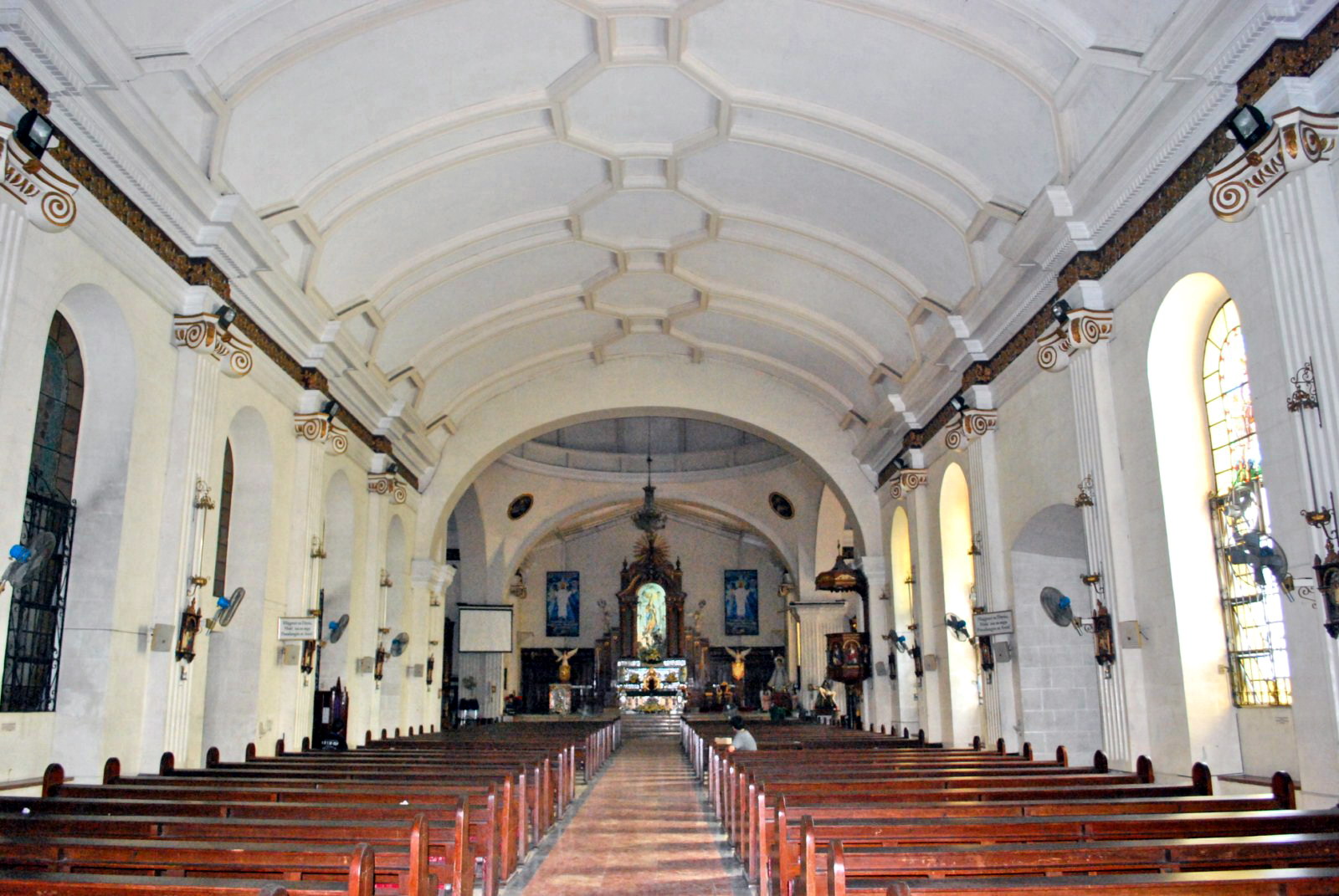
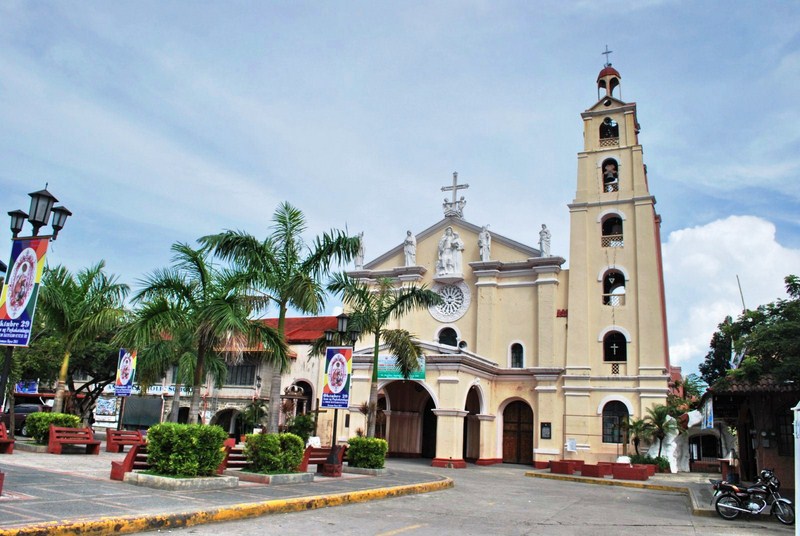
National Shrine of St. Anne (Hagonoy, Bulacan)

National Shrine of St. Anne

First built of stone and brick from 1731 to 1734 by Fr. Juan Albarran, this church was burned down on August 12, 1748. In 1749, it was rebuilt on its present site by Fr. Eusebio Polo  and completed in 1752 by Fr. Buenaventura Roldan. 

It was replaced with a stone church by Fr. Juan Coronado from 1815 to 1836, damaged by fire (which also damaged 30 houses in the town center) in 1856 and enlarged in 1862 by Fr. Manuel Alvarez.  The church was again damaged by during the 1871 earthquake and was repaired in 1872 by Fr. Ignacio Manzanares who strengthened the choir loft’s supporting arches.

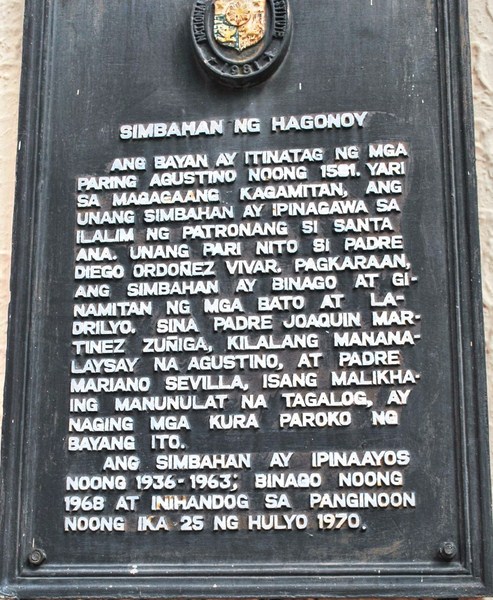
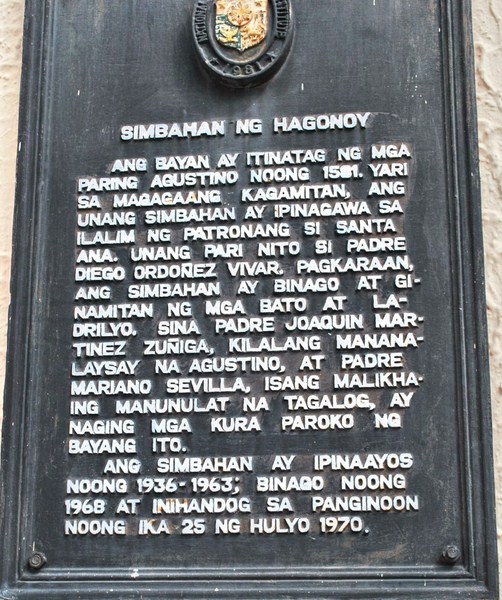
Historical plaque installed by the National Historical Institute in 1981

It was intermittently restored in 1936, 1961 (a monumental porte-cochere was added by Fr. Celestino Rodriguez) and from 1968 to 1970 (under Monsignor Jose B. Aguinaldo) which changed much of the design of the façade (the wood trusses and galvanized iron roofing were replaced, roof and main altar painted and the facade coated white and decorated with images placed above pilasters).

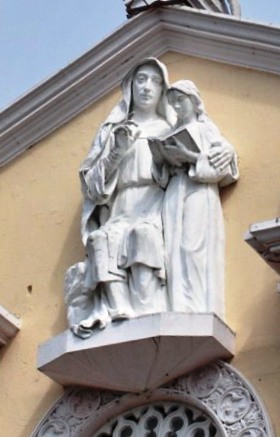
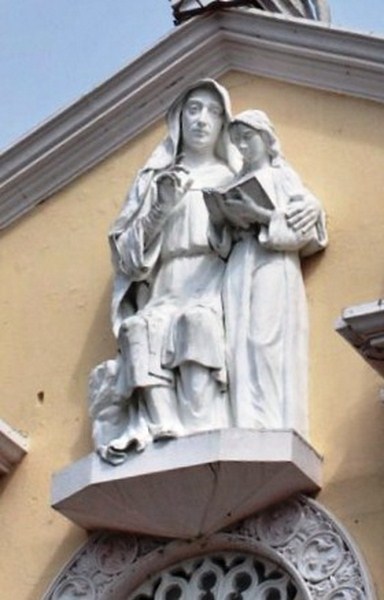
Statue of St. Anne

In 1981, a marker bearing a brief history of the church was installed on the church by the National Historical Institute (precursor of the National Historical Commission of the Philippines). In 1991, it was declared a National Shrine.

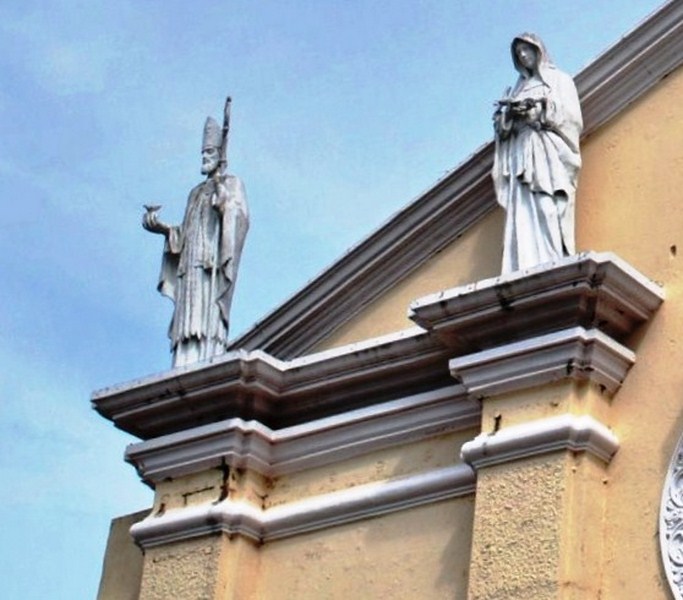
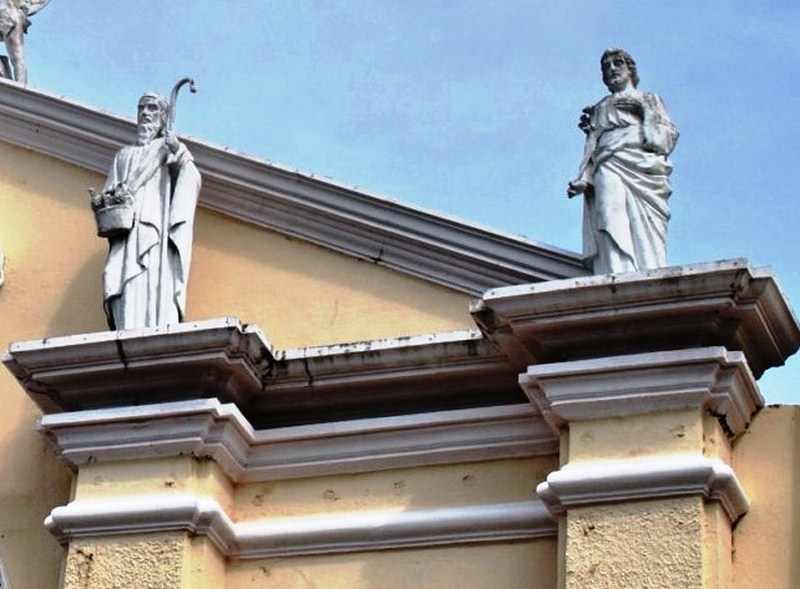
Statues of Augustinian saints

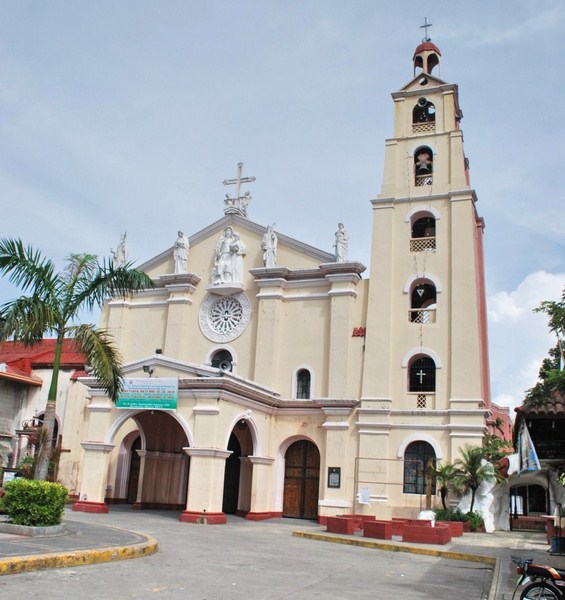
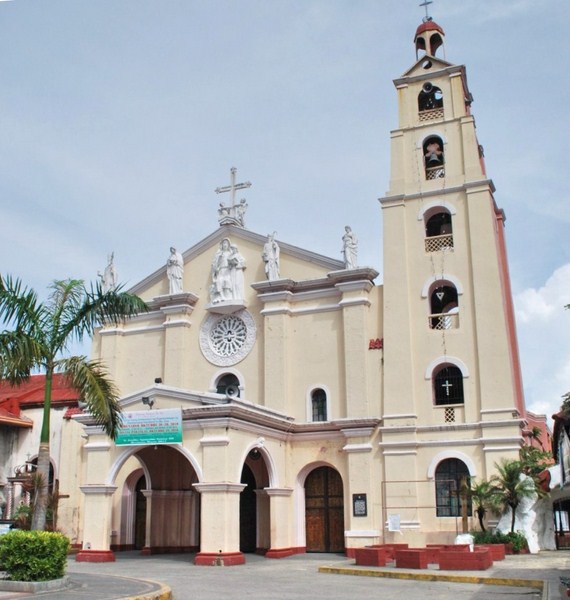
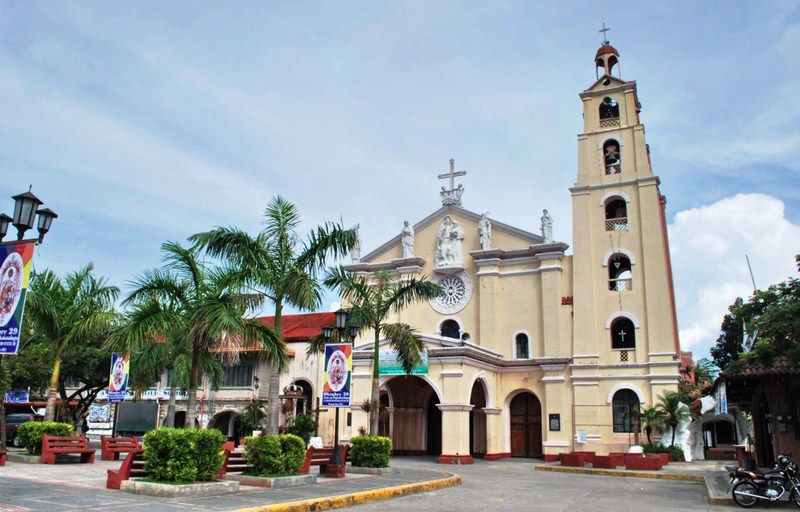
The church’s Baroque façade, bare of ornamentation (save for volutes founds on the end of the imaginary triangular pediment, circular reliefs and buttress-like pilasters capped with roof tiles), is pierced with 5 windows: three semicircular arched ones and two rectangular ones on the first level.

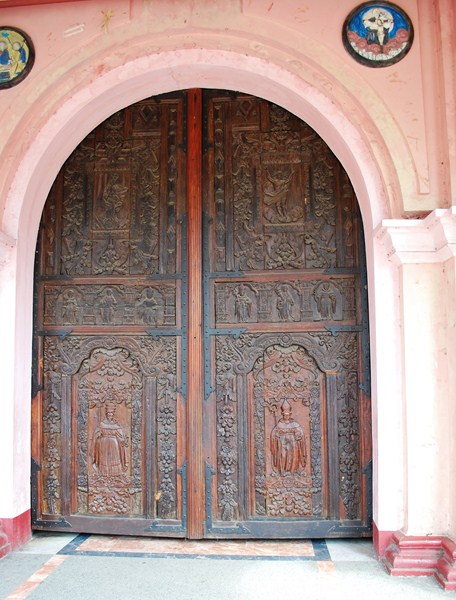
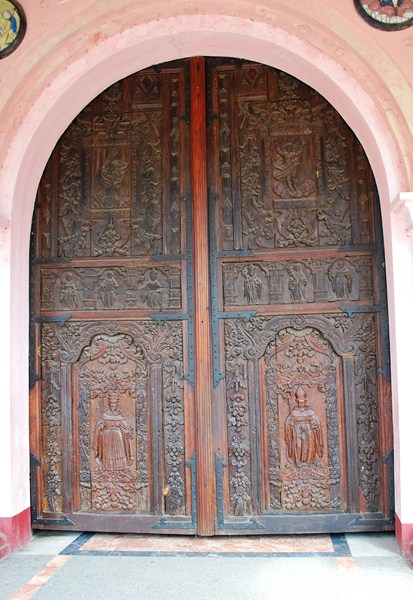
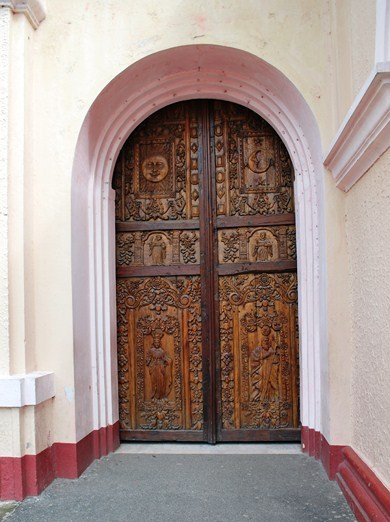
Main wooden entrance door carved with bas reliefs

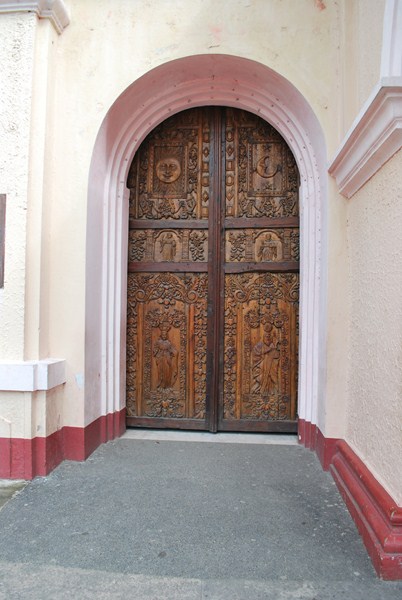
porte-cochere, with a balustraded top, mars the view of the bottom part of the façade. . The façade also sports three semicircular arched entrances (one main and two smaller flanking ones), all featuring antique hardwood doors carved with bas-reliefs.

One of two smaller wooden doors

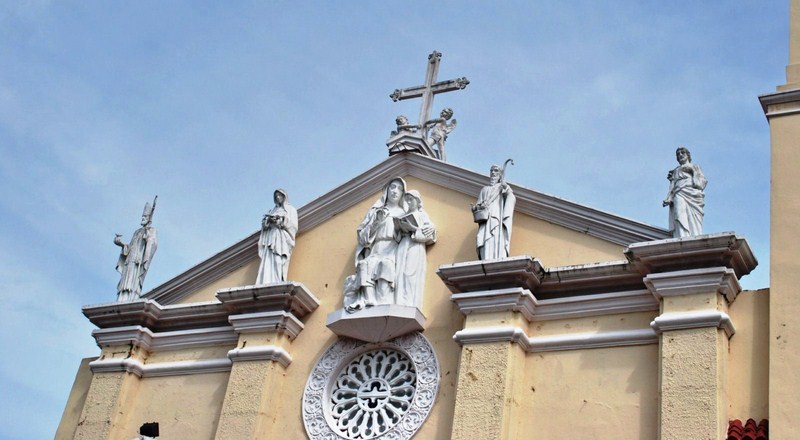
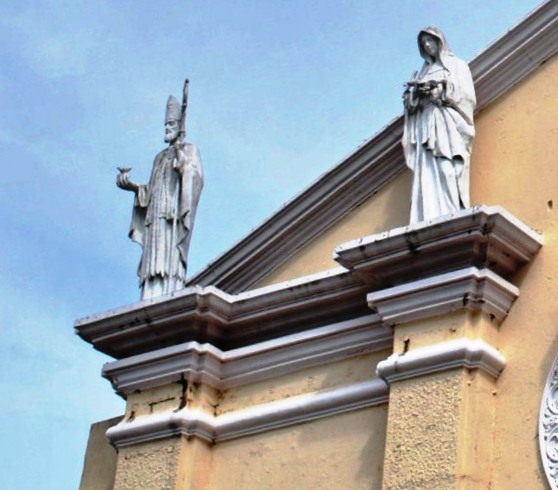
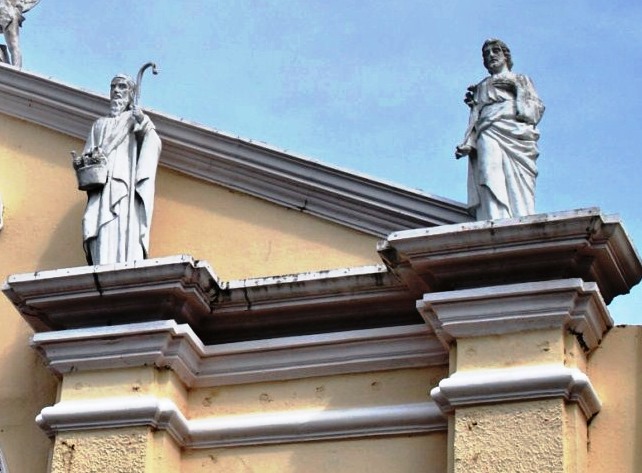
Four sets of superimposed pilasters, incorporated with Tuscan capitals, divide the facade into two levels (the first smaller than the second) and ending up in a triangular pediment with huge contemporary statues of Augustinian saints flanking that of St. Anne.

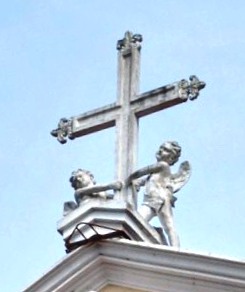
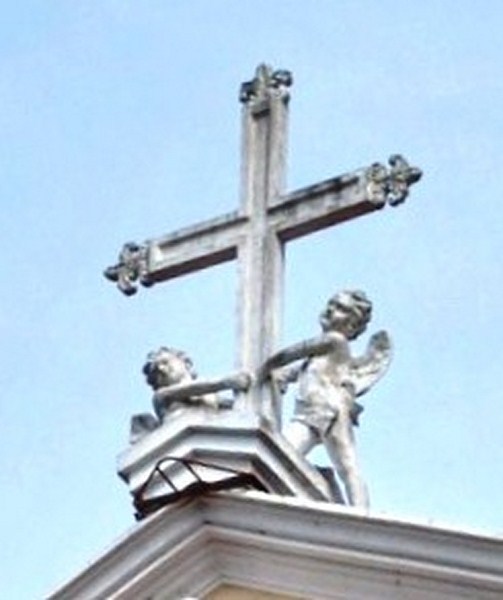
Cross with two cherubs

The second level, dominated by a rose window and a tableau of St. Anne and the Virgin Mary in the center, has windows corresponding to the choir loft and partly hidden by the portico.  The entire façade is capped off with a cross held by two cherubs.

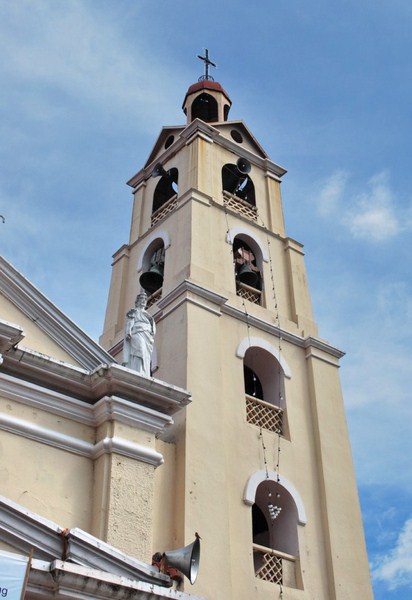
The six storey bell tower

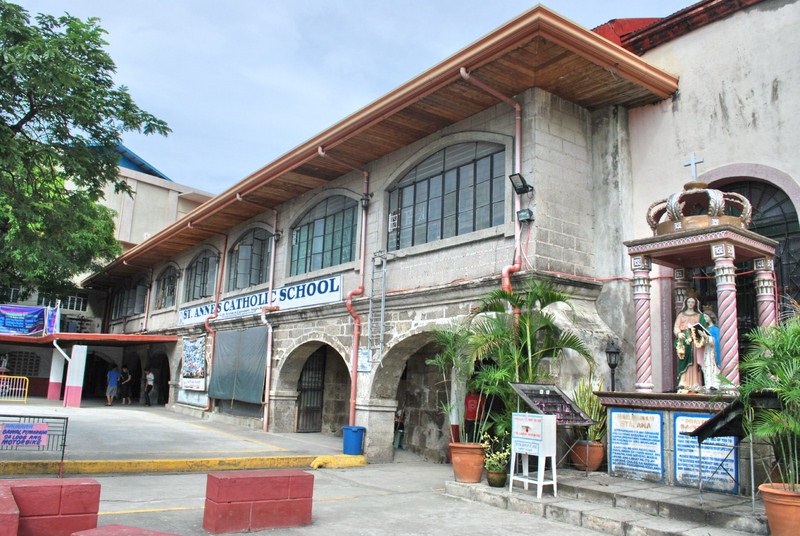
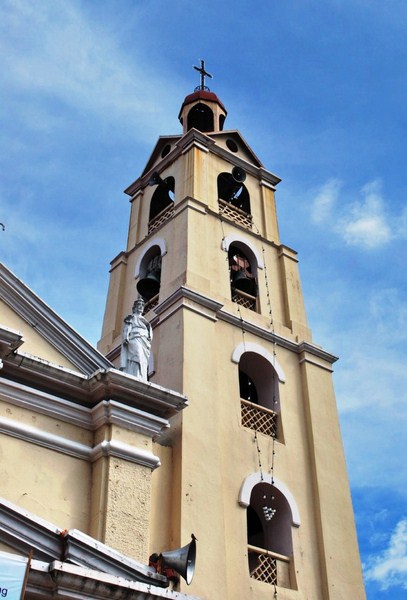
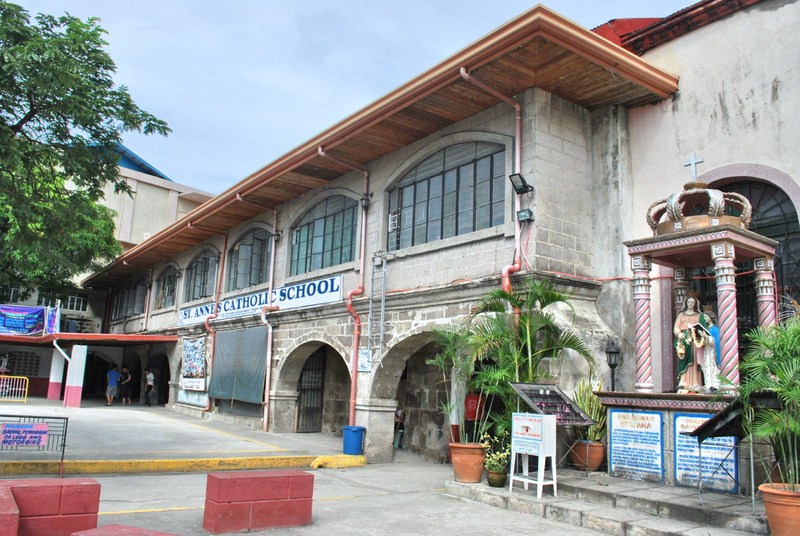
The convent beside the church is now the main building of St. Anne’s Catholic School.  The six-storey rectangular  bell tower (originally with five levels , a sixth level and a cupola was added during the latest reconstruction of the church) is also bare of detailed ornamentation except for the balustraded semicircular arch openings and buttresses placed at the corners of the tower.

St. Anne Catholic School

National Shrine of St. Anne: Brgy. Sto. Niño, HagonoyBulacan. Tel: (044) 793-2829. Feast of St. Anne: July 26.

How to Get There: Hagonoy is located 55.6 kms. (a 1.5-hour drive) from Manila an 15.5 kms. (a 40-min. drive) from Malolos City.

Winchsurfing at Virgin Beach Resort (San Juan, Batangas)

Joey winchsurfing

Mr. Joey Cuerdo of Powerup Gym invited me and fellow travel writer Joselito”Lito” Cinco to join him and his kids (daughters Frankie and Kitkat and son Kobe) as guests of Mr. Butch Campos, owner of Virgin Beach Resort along Laiya Beach in San Juan, Batangas.  To record the moment, I brought along my daughter Cheska, a photography buff.   Laiya Beach is located along the coast of Sigayan Bay (one of the cleanest bays in the country) and Verde Island Passage.

The resort’s white sand beach

Normally, the trip, via South Luzon Expressway (SLEX) and Star Tollway, even on a Saturday (the day we left) was just 2.5 to 3 hrs. but hey it was the eve of the May 10 elections and last-ditch efforts by candidates to woo voters, via rallies and miting de avance, was the rule and not the exception, causing long traffic waits.  We left early in the morning but only arrived at the resort just in time for lunch.  Still, we were lucky.  Other invited guests, skim boarders from Nasugbu who left after lunch, arrived at the resort at 7 PM.

The Balinese-style restaurant

It being noon, the more than 7 km,. long, slightly coarse sand beach at the resort was at its whitest and, as lunch was still being prepared, we took time to explore the place. Very noticeable was its high level of cleanliness which sets it apart from the others. Mr. Campos, our host, sees to it that it remains such, personally picking up trash and cigarette butts and depositing them at ashtrays and trash receptacles provided specifically for food, and non-food items.  This 40-hectare (6 hectares developed) Class “A” resort, opened in 2005, is also noted for the oversized proportions and sprawled layout of its facilities.  The majestic Mt. Lobo serves as a tranquil backdrop to its beautiful beachfront area, truly a combination of land, sea and sky.

The Parasols

After this guided tour by Mr. Campos, we all walked back to the huge Balinese-style restaurant/pavilion were a scrumptious set lunch of salad, soup, main course (with a choice of chicken, beef or pork and seafood) and dessert awaited us.

After lunch, Joey then proceeded to set up the resort’s newest attraction: winchskating.  This is not new to the country as Camarines Watersports (Naga City, Camarines Sur) and Lago de Oro (Calatagan, Batangas)  offer cable wakeboarding, wake skating and water skiing in manmade, freshwater lakes.  However, this will the first time that that cable wakeboarding and wake skating is being done along a seashore and this resort will be the first to offer such.
Joey instructing Cheska

This recent concept is simpler but safer and more affordable, using a U.S. made, 9 HP, 4-stroke portable, lightweight wakeboard winch (manufactured by Ridiculous Winches and distributed here in the country by Outward Bound Gear), anchored and held stationary by stakes on a sand spit, to pull, using variable speeds, a wakeboarder via a sturdy, 200-ft. long rope along the shallow seashore.  Joey, a professional surfer, took first crack at it initially using his own surf board and, finally, a wakeboard (more suitable because of its shorter fins).  Soon, he riding the waves of the shore like the professional that he is.  Mr. Campos, Frankie and Cheska took unsuccessful cracks at it.  Joey hopes, that with the introduction of this winch, the wakeboarding domain will be revolutionized to some extent and more venues will be opened as wakeboard winches have made wake skating accessible to a large number of spectators as one can fix them anywhere.

Virgin Beach Resort: Brgy. Hugom, San Juan, Batangas.  Tel: (632) 815-2584, 815-2587, 759-2020 and 759-2828. Fax: (632)817-6334 Mobile number: (0917) 813-1301. Email: sunkisd@pldtdsl.net.  Website: www.virginbeachresort.com.

Bantayog ng mga Bayani (Quezon City, Metro Manila)

Bantayog ng mga Bayani

The Bantayog ng mga Bayani (“Monument of Heroes”) is a monument, museum, and historical research center designed to honor the martyrs and heroes who struggled against the 21-year dictatorship of former President Ferdinand Marcos, regardless of their affiliations, who live before and, later, beyond the 1986 People Power Revolution.

The granite “Wall of Remembrance,” the central element of the Bantayog memorial, is inscribed with the names of the martyrs and heroes who fought abuses of the Marcos dictatorship.

Nominated by victims’ families, civic organization members or the general public, individuals to be honored on the wall were reviewed under a set of criteria by the Bantayog ng mga Bayani Memorial Foundation’s Research and Documentation Committee.

The committee makes recommendations to its Executive Committee for further review then the foundation’s Board of Trustees gives the final approval.

In 1992, the first batch of 65 names were enshrined on the wall. They include:

As of 2018, 305 names have been enshrined on the Wall of Remembrance.  Francisco “Soc” A. Rodrigo (former senator) and Jose Mari U. Velez (journalist) were added on November 28, 1998; Jaime L. Sin (Cardinal) and Haydee B. Yorac (law professor) on December 9, 2005;  Catalino “Lino” O. Brocka (movie director) and Cecilia Munoz-Palma (Supreme Court justice) on November 30, 2006); and Corazon “Cory” C. Aquino (Philippine president) on November 30, 2009. 

The 35-ft. high “Inang Bayan” Monument, depicting a woman reaching out to the sky for freedom and holding the body of a fallen young man, is another prominent element of the memorial.

Prominently located near the roadside frontage of the memorial (so that it can be seen by vehicles along Quezon Avenue near its corner with EDSA), the woman is a metaphorical depiction of the Philippine “motherland” (inang bayan in Filipino) while the man represents self-sacrifice and heroism, alluding to the martyrs who gave their life for the freedom of the Philippine people.

Inang Bayan

At the monument’s base are tree plaques containing the last stanza of Jose Rizal‘s “Mi Ultimo Adios” in English, Filipino, and the original Spanish.


Bantayog ng Mga Bayani: Quezon Avenue, Diliman, Quezon City.

Patag Valley (Silay City, Negros Occidental)

On our last day in Silay City, I, together with my wife Grace and children Jandy and Cheska, decided to do some trekking at Patag (meaning “flat plain” in the vernacular) Valley, located 45 kms. from Bacolod City in a valley 1,600 ft. (490m.) above sea level, between the highlands of Mt. Silay and Mt. Marapara.  After breakfast at Balay Daku, my grandfather’s ancestral house, we left by 7:30 AM and were accompanied by Neil Solomon “Solo” Locsin, my young first cousin, who was familiar with the place.  During World War II, the valley was a battlefield, being the last stronghold, in the whole region, of the Japanese Imperial Army’s Nagano detachment.   Here, 15,000 Japanese and hundreds of Filipino and American (from the U.S. 40th Division) soldiers died.  The Japanese surrendered after 5 months.  Today, a wide Japanese altar commemorates the last battle between the two forces and underground, manmade Japanese tunnels can still be found.  

The Von Einsiedel Resthouse


Throughout the 32 km., 1-hour trip, east of the city, to the valley, we passed huge expanses of sugar fields.  We first made a stopover at the beautiful resthouse of Milou von Eisiedel, another first cousin of Neil and I.  Designed by her husband and fellow U.P. alumni and architect Nathaniel “Dinky” von Einsiedel, the a resthouse had two bedrooms, living and dining area, kitchen, a mezzanine and a huge balcony that overlooks a terraced garden with beautiful flowers below and the verdant valley and mountains beyond.  

Returning to our car, our driver then drove us up to the end of a dirt road.  From hereon, it was all footwork as  we were to trek to a waterfall.  Leading the way, Solo guided us along a well-marked but slippery trail.  We were all wearing shorts which seem unsuitable as it exposed our legs to scratches from prickly plants and sharp rocks.  At one time, we had to wade through a stream made murky by an unsightly dam.  This aside, everything else was beautiful as we passed small waterfalls and beautiful turquoise-colored streams After 30 mins. of continuous hiking, we finally arrived at a beautiful, 25-ft. high waterfall.  This was as far as our schedule would allow and, after some photo ops, we retraced our steps back to the car. 

This short tour perked up an appetite to explore the valley, in more detail, sometime in the future.  The valley is a favorite for ecotours, it being a base for exploring stretches of rain forest and some of its 300 waterfalls, the most beautiful of which is the breathtaking Pulang Tubig Waterfalls (not in our itinerary though, being too far out) whose waters seems red in color because of its red or orange rocks it falls unto.  The valley is also home to sulfataras (sulfur geysers) and endangered species of wildlife including the Negros spotted deer (cervus alfredi).  This is also the jump off point for the hike going to Tinagong Dagat (Sipalay City) or Mt. Mandalagan and a site for Boy Scout Jamborees and Red Cross Training.

Bernardino-Ysabel Jalandoni Museum (Silay City, Negros Occidental)

From Balay Negrense, Solo next brought us to the nearby 2-storey Bernardino-Ysabel Jalandoni Museum, beside the City Public Market  and near the San Diego Pro-Cathedral.  Also called the Pink Museum, the house was first owned by Don Bernardino Jalandoni and his wife Dona Ysabel Ledesma-Jalandoni.
Bernardino-Ysabel Jalandoni Museum
Their grandson, Luis Jalandoni, was a former priest who became one of the top leaders of Communist Party of the Philippines.  Since the 1970s, he has been living in exile in the Netherlands.  Luis spent the first 12 years of his life in this house.  The current heirs, Mr. and Mrs. Antonio J. Montinola have entrusted its care to the Silay Heritage Foundation, a non-government organization.  Built from 1908-1912, it was declared, on November 6, 1993, as a National Historical Landmark by the National Historical Institute (NHI).
The expensive doll collection
The sala
A 4-poster, “An Tay” bed
The Steinway piano
Solo and Jandy browsing through books
on the round, single slab table
An old phonograph

We were toured around the house by a male guide.  The house was built with durable balayong, a hardwood coming all the way from Mindoro.  At the ground floor are photographs of Silay’s ancestral houses, a display to the Jalandoni’s expensive doll collection, 2 carriages, a gallinera (its bottom was used as a temporary enclosure for chickens) and a carroza with the statue of the Blessed Virgin Mary which is still being paraded around the city during Holy Week.

A Stradivarius violin
A grandfather clock
A wooden harp

The second floor has embossed, prefabricated steel trayed ceilings imported from Hamburg, Germany.  Intricately carved, French-designed wooden calado transoms, a study of visual aesthetics and function, allow air to circulate within the house.  On display are antique furniture (including a single slab round table and 4-poster, Chinese-made “An Tay” beds), a wooden harp, Ming Dynasty chinaware, an old telephone, sewing machine, a Stradivarius violin, a grandfather clock, an old phonograph, a Steinway piano, chandeliers, etc.  The museum also features a fine collection of books, glassware and lace supplied by the Silay Heritage Foundation members.

Grace and Cheska at the grand stairway
Bernardino-Ysabel Jalandoni Museum: cor. Rizal and Severino Sts., Silay City, Negros Occidental.  Open Tuesdays to Sundays, 9 AM-5 PM.  Admission: PhP50.  Tel: (034) 495-5093.

Balay Negrense (Silay City, Negros Occidental)

After lunch at Locsin Reunion venue, Solo again toured us around the city, this visiting the 12-bedroom Balay Negrense (Hiligaynon for “Negrense House”), one of the largest if not the largest ancestral house in the city.  The first museum to be established in Negros Occidental, it was built in the Neo-Renaissance style, from 1898-1912, by Yves Gaston.  Yves was the son of 19th century sugar baron Yves Leopold Germain Gaston of Lisieux (Normandy, France) and Prudencia Fernandez, a Batanguena.  Yves generated wide-scale interest in commercial-scale sugar cultivation with his horno econonmico, the precursor of today’s sugar mills.  

 
Balay Negrense

Victor Gaston and his 12 children lived here from 1901 until Victor’s death in 1927. During World War II, the house was said to have been occupied by Japanese military officers. Later, the house became a venue for a ballet school run by one of the descendants until the early 1970s but was abandoned shortly thereafter and fell into disrepair.

The grand W-shaped staircase

The Negros Cultural Foundation, a group of concerned Negrenses, managed to acquire, through a donation, the house from the heirs of Gaston. The structure was then repaired and furnished with period furniture and fixtures through donations from prominent individuals and, later, the Department of Tourism.  This lifestyle museum was officially inaugurated on October 6, 1990.  

The spacious living area
The round table with names of Gaston descendants

Now a showcase of Negrense art and culture, it displays antique furniture, a grand piano, Filipiniana costumes and Gaston memorabilia.  The museum boasts of a grand W-shaped stairway (women used the right stairway, men the left), calado or carved panels that served as ventilators between rooms, etched window glass, fancy-grilled ventanillas (smaller windows beneath the large windows with sliding panels that can be opened to admit the wind) and sprawling gardens.  Solo showed us a big round table with lists of the names of the owner’s descendants, some of them familiar names of celebrities and politicians.  Some of them were my relatives.

The grand piano
The 2-storey house has a lower storey of concrete, with foundation posts made with trunks from the balayong tree, a local hardwood also used as floorboards for the house. The upper storey is made of wood while the roof uses galvanized iron.  The house has a 4-m. high ceiling and is elevated from the ground level by a 1 m. high crawlspace which enhanced air circulation, allowing the wooden foundations to be aerated, preventing dampness from rotting the wood and preserving the integrity of the house.
 
L-R: Jandy, Grace, Solo and Cheska
 
Balay Negrense: Cinco de Noviembre St., Brgy. III, Silay City, 6116 Negros Occidental.  Open Tuesdays to Sundays, 9 AM-5 PM. Tel: (034) 714-7676 and 495-4916.

Ramon Hofilena: The "Father of Heritage Conservation" in Silay City (Negros Occidental)

Manuel Severino Hofilena Heritage House

Certainly one of the highlights of our three-day visit to Silay City (Nregros Occidental), with my wife Grace and children Jandy and Cheska, was, aside from attending the 8th Locsin Family Reunion (my first), our tour of some of Silay’s 31 ancestral homes, accompanied by my young Silayanon cousin  Neil Solomon “Solo” Locsin.  Our longest visit was at the Manuel Severino Hofilena Heritage House, an illustrado’s house built in 1934.  A visit here was by appointment with current owner Ramon “Monching” Hofilena but Solo set it up for us with call to him. On hand to greet us was the 72-year old Ramon Hofilena himself.  

Ramon Hofilena

Since 1962, Monching has been welcoming visitors to his family’s ancestral house, the first Heritage House in Silay to be opened to visitors.  Also, since his return from New York in the 1970s, Monching has also been on a life-long crusade  to restore and protect Negrense cultural heritage.  He organized the Annual Cultural Tour of Negros Occidental (ACTNO), the longest running (nearly 40 years) cultural tour in the world.  Its itinerary includes Bacolod  City, Silay City (Jalandoni and Hofileña heritage homes), Victorias City (Church of St Joseph the Worker); Manapla (Chapel of the Carwheels) and Talisay City (PhP600/person, limited to 55 people).  The tour is often conducted yearly on all Saturdays of December, except holidays, from 9 AM to 5:30 PM.

The living room

The interiors of the house to be  exudes touches of genteel elegance.  The formal living room still has its original 1930s Art Deco period furniture.  Beside it is a 150-200 year old, German-made M.F. Rachals upright piano handed down by Monching’s great grandmother. Monching, a lover of art and culture, gave us a two-hour guided tour of his collection of museum-worthy pieces such as  antique lamps and chandeliers, large Ming dynasty jars, copies of the world’s first pocket books, silver picture frames (with pictures of his parents and 8 siblings; all of whom were involved in the arts: piano teachers, ballet and flamenco dancers, theater artists), a dining table set with fine china, silverware, wooden images of St. Vincent Ferrer, saved from the island’s old churches), wine glasses and silver candelabras, none of them reproductions.

The dining room


The comedor (dining room) has hardwood and glass cabinets (plateras ) that display Pre-Hispanic Chinese porcelain and ceramics, all of them archeological finds discovered in Silay (some an incredible 3,000 years old).  Monching also has a  collection of small dolls (said to be the smallest in the world, you need a magnifying glass to appreciate them) and curios from around the world, including tektites (meteorite stones) and anting-antings (good luck amulets).  The house also has an old press from Silay Printmaking (founded in 1970), the oldest printmaking workshop outside Manila.  Monching is working to popularize printmaking as an art form.  

Monching shows us his painting collection

Upstairs, lining the walls, are Monching’s  impressive collection (the most comprehensive personal collection on public display) of more than 1,000 works by foreign artists Francisco Goya, Pablo Picasso, Albrecht Durer, Katsushika Hokusai and Utagawa Hiroshige; National Hero Dr. Jose Rizal (when he was 15 year old student at Ateneo) and works of local artists from the 19th century to the present – Juan Luna, Felix Resurreccion Hidalgo, Ang Kiukok, Fernando Amorsolo, H.R. Ocampo, Jose T. Joya, Cesar Legaspi, Napoleon Abueva, Vicente Manansala and Bencab (Benedicto Cabrera).  Monching, with much emotion, gives special mention to abstract expressionist paintings of Conrado Judith, a poor and unknown Silaynon high-school graduate with no formal art education who died from tuberculosis at the age of 34. His canvas paintings, some damaged by sun and rain, were discovered by Monching in his thatch house.

L-R: Ramon Hofilena, Solo Locsin, Grace, Jandy, me and Cheska
Manuel Severino Hofilena Heritage House: Cinco de Noviembre St., Silay City, Negros Occidental.  Visits are by appointment.  Tel: (034) 495-4561.

Adaptive Reuse in Silay City (Negros Occidental)

Victor Fernandez Gaston Heritage House (Balay Negrense)

Most of the heritage houses in Silay City are still residential homes, lived in by the descendants of the original owners or bought by others who continue to live in them and not open to the public. However, a few of  them have been converted to museums, a bakery, restaurants, shops or city government and private offices in an action called adaptive reuse, referring to the process of reusing an old site or building for a purpose other than which it was built or designed for.

Check out “Silay City’s Ancestral Houses

Hofilena Museum (Manuel Hofilena Ancestral House)

Three ancestral houses have been opened for visitors – the Victor Fernandez Gaston Heritage House (Balay Negrense), the Manuel Severino Hofileña Heritage House (visits by appointment) and the Bernardino and Ysabel Lopez-Jalandoni Ancestral House (a lifestyle museum, commonly called The Pink House). The first two are located along Cinco de Noviembre Street while the latter is along Rizal Street.

Check out “Balay Negrense,” Ramon Hofilena: The “Father of Heritage Conservation” in Silay City and the “Bernardino-Ysabel Jalandoni Museum

Bernardino-Ysabel Jalandoni Museum

NOTE:

A number of ancestral houses have also been converted into bed and breakfasts. On June 11, 2016, the charming, two-storey German Unson Heritage House was opened as a bed and breakfast with four spacious rooms – German-Fe Room, Lourdes Room, Rene Room and the Carmen-Cristina Room. The house was built in 1938 and was restored in its original design in mid-1970s. On April 6, 1993, it was declared as a heritage house by the National Historical Institute.

The Generoso Reyes Gamboa Twin House, owned by Generoso and wife Olympia Severino, both heroes of Cinco de Noviembre, was built for their sons Ernesto and Generoso Jr.  In 2020, the present owners have now converted the house into the 1898 Casa and Restorante, a bed and breakfast with 5 bedrooms on the ground floor and a main dining room at the second floor. It is considered to be the first twin house in the Philippines, with both houses (the one beside it) being mirror images of each other.  The house is embellished with beautiful, ornamental Art Nouveau pierced screens or “calados” (ornately carved room dividers depicting stylized flowers, lyres and anahaw leaves) and cast-iron brackets.


Generoso Gamboa Twin House

Two ancestral houses, along Generoso Gamboa Street (formerly Plaridel Street), were bought by the Silay City government and were converted into offices – the Angel Araneta Ledesma Ancestral House (now the Arts and Culture Office) and the Benita Jara Ancestral House (now the Sangguniang Panglungsod building). The former, a Colonial Plantation-style heritage house called the Green House (Balay Verde) by the locals, was built in the 1930s and features American clapboard with material sourced from the Araneta family’s lumber business.

Benta Jara Ancestral House (Sanggunian Panglungsod)

Also along this street is the Alejandro Amechazura Heritage House, now the office of Celsoy Agro-Industrial Corporation. This simple and graceful house, built between the 1920s and 1930s, is a good example of American Period architecture. It has an entrance porch with double columns on a concrete base.  Repetitive pointed arches on the lower floor hints at a Neo-Gothic influence. 

Maria Golez Ledesma Ancestral House

A lot of adaptive reuse can be seen along Rizal Street, the city’s main road, where a number of ancestral houses were converted to commercial establishments. The regal Maria Ledesma Golez Ancestral House, an excellent example of adaptive architectural reuse, was purchased by Rizal Commercial Banking Corporation (RCBC) in 1992.  RCBC remodeled the interiors while the exterior was preserved. The first floor was converted into their Silay branch while the second floor is used as a storage area.  Embellished with masques, caryatids and lion heads, Art Deco elements are prevalent, especially in the archways and corner entrance.  On April 6, 1993, it was declared as a Heritage House by the NHI.

Lino Lopez Severino Ancestral House

Another heritage structure that has been converted for commercial use is the Lino Lope Severino Building, the first department store in Negros. This Art Deco structure is now owned by two separate individuals, the left wing of the building, rented by a religious group, was bought by an Indian businessman while the right wing, a pension house (Baldevia Pension House) with function rooms available for rent at the second floor, was bought by the Baldevia family.

NOTE:

In 2013, a MacDonald’s Fries and Sundae Station was opened in the building (now called the Baldevia Building).  Also on the ground floor are a pawn shop outlet, a drug store and a Chooks-to-Go branch.


Antonio Novella Sian Heritage House

The Antonio Novella Sian Ancestral House, at cor. of Rizal and Zamora Streets, features traditional media agua (canopy over a window) and sliding ventanillas on the second floor, also has a suite of shops at the ground floor – barber shop, convenience store (Mayflor & Me Minimart) and a bakery.

NOTE:

In October 2019, a MacDonald’s branch was opened at the Antonio Novella Sian Ancestral House


El Ideal Bakery

The Cesar Lacson Locsin Ancestral House is home to El Ideal Bakery which started operations in 1920, making it one of the oldest bakeries in the country. It specializes in homemade breads (pan gasiosa), biscuits (quinamoncil, biscocho prinsipe, broas, sinambag, favorita, lubid-lubid, quinihad, etc.) fresh lumpiang ubod (made of fresh young coconut trunk sauteed in pork, shrimps and hard boiled egg, and wrapped with a flavorful garlic sauce) and cookies (angel cookies) as well as pastries such as guapple pie (a combination of apple and guava pie) dulce gatas (Silay City’s version of the pastillas, made with carabao milk and sugar) and the traditional piaya (a type of flat bread). Ms. Maritess Villanueva Sanchez, its current proprietor, is the granddaughter of Cesar.

Check out “Restaurant Review: El Ideal Bakery


Kapitan Marciano Montelibano Lacson Ancestral House

The Kapitan Marciano Montelibano Lacson Ancestral House, at Rizal cor. Zamora Streets, Brgy. II, is home of New City Cafe (Kapehan Sang Silay).  The lower floor of the Josefita Tionko Lacson Ancestral House has a branch of 7-11.

Josefita Tionko Lacson House

German Unson Heritage House Bed and Breakfast: 5 Zamora Street.  Tel: (034) 432-2943.  Mobile number: (0921) 762-2359. E-mail: guheritagehouse@gmail.com.

1898 Casa and Restorante: 960 Zamora cor. Cinco de Noviembre Street. Tel: (034) 485-5566.  Mobile number: (0951)) 769-3655.

El Ideal Bakery: 118 Rizal cor. Eusebio Streets.  Tel: (034) 495-4430.

Bernardino-Ysabel Jalandoni Museum: cor. Rizal and Severino Sts..  Open Tuesdays to Sundays, 9 AM-5 PM.  Admission: PhP50.  Tel: (034) 495-5093.

Balay Negrense: Cinco de Noviembre St., Brgy. III.  Open Tuesdays to Sundays, 9 AM-5 PM. Tel: (034) 714-7676 and 495-4916.

Manuel Severino Hofilena Heritage House: Cinco de Noviembre St..  Visits are by appointment.  Tel: (034) 495-4561.

Silay City’s Ancestral Houses (Negros Occidental)

Calle Rizal

Another reason for my visit with my family to Silay City, aside from visiting my mom’s hometown and attending the 8th Locsin Family Reunion, was to see for myself Silay’s ancestral houses.  Silay, founded in 1760, became prosperous in 1846 with the cultivation of sugar cane and its new-found wealth translated into the construction of many opulent ancestral homes, located mostly along Calle Rizal.

The two-storey Antonio dela Rama Locsin Heritage House, dating back to the Spanish Colonial Period, is said to be the oldest house in Silay. This was the house where the late Architect Leandro V. Locsin (National Artist for Architecture) grew up. The house has capiz sliding windows and ventanillas.

Silay is the second city in the Philippines, after Vigan City (Ilocos Sur), to be named a museum city, making it one of the country’s top 25 tourist destinations.

The Soledad and Maria Montelibano Lacson Ancestral House, with its American-inspired look, features windows with glass panes and a galvanized iron sheet media agua, a secondary roof that helps protect windows from rain. The second floor still retains its sliding capiz windows and ventanillas.  When coming from Talisay City, this is the first ancestral house that will greet you.

Most ancestral houses in the city are named after their owners while other more famous houses are known for their unique characteristics or colors (Twin Houses, Green Hose, White House, Pink House, etc.).

The ancestral house of Jose “Pitong” Ledesma, along Cinco de Noviembre Street, was built in 1917.  It was the home of the renowned Silaynon pianist, conductor and philantrophist who was known for his sonata Tanda de Valse.” Ledesma also brought operettas de zarzuelas from Europe to Silay. The present owner of the house is Magdalena Locsin-Ledesma, piano accompanist of opera singer Conchita Gaston.

A total of 31 (some well-preserved) have been identified by the National Historical Institute (NHI, now the National Historical Commission of the Philippines) as National Treasures.  Nine of them are Level 1 (Declared):

  • Carlos Arceo Ledesma Heritage House
  • Antonio de la Rama Locsin Ancestral House
  • Delfin Ledesma Heritage House – 28 Generoso Gamboa Street
  • Juana Coloso Ledesma House
  • Amelia Hilado Flores House (owned by Jison-Alano)
  • Arsenio Lopez Jison Ancestral House – Rizal Street
  • Antonio Novela Sian House – cor. of Rizal and Zamora Streets
  • Manuel de la Rama Locsin Ancestral House – Rizal Street
  • Josefita Tionko Lacson Ancestral House

The two-storey Teodoro Morada Ancestral House, also called the “White House, was built in the early 1990s. A fusion of Spanish and American colonial architecture, this beautifully restored heritage house exudes a genteel Neo-Classical liner. It has a grand double winding staircase on the ground floor, glass paned windows, and a second set of Persiana windows behind them. Now the home of Rene and Jessica Velez Dimacali, is the favorite house in Silay of Liza Macuja.

Sadly, three Level 1 houses have already been demolished.  They are the Augusto Hilado Severino House (bought by the Iglesia Ni Cristo), the Claudio Hilado Akol Heritage House (bought by the Locsin Genealogy Foundation – balcony has been retained) and the Modesto Ramirez Hojilla (Carlos Javelosa Jalandoni) Ancestral House.

The two-storey Modesto Ramirez Hojilla Ancestral House, a Beaux Arts-style house currently owned by Carlos Javelosa Jalandoni Sr., was built in the 1920s. It is an example of an American Era adaptation of the classic bahay na bato which was influenced by 19th century “salt shaker” houses, with their wooden horizontal clipboard facades. Currently dilapidated, it is notable for its adaptation, introduced by the Americans, to Filipinos living on the ground floor.

Nineteen others are Level 2 (With Marker).  My grandfather’s house, built in the 1930s and locally called Balay Daku or “Big House, is one of these.   The others are:

  • Victor Fernandez Gaston Heritage House (Balay Negrense) – Cinco de Noviembre Street, Brgy. III
  • Alejandro Amechazura Heritage House – Plaridel Street, now the office of Celsoy Agro-Industrial Corporation
  • Manuel Severino Hofileña Heritage House – Cinco de Noviembre Street
  • Bernardino and Ysabel Lopez-Jalandoni Ancestral House – Rizal Street, Brgy. II, a lifestyle museum, commonly called The Pink House
  • Jose “Pitong” Ledesma Heritage House – cor. Jose Ledesma and Teodoro Morada Streets
  • Kapitan Marciano Montelibano Lacson Heritage House -Rizal cor. Zamora Streets, Brgy. II, home of New City Cafe (Kapehan Sang Silay)
  • Vicente Conlu Montelibano Heritage House – Zamora Street
  • Maria Ledesma Golez Heritage House  – Rizal Street, now RCBC Silay branch
  • El Ideal Bakery (Cesar Lacson Locsin  Ancestral House) – 118 Rizal Street
  • Jose Benedicto Gamboa Heritage House – Roque Hofilena Street, the Oro, Plata, Mata” (1982) house
  • Angel Araneta Ledesma Heritage House  (Culture and Arts Office of Silay) – Plaridel Street, commonly called The Green House
  • Teodoro Morada Heritage House – cor. of Cinco de Noviembre and Zamora Streets
  • Digna Locsin Consing Heritage House
  • Generoso Reyes Gamboa Heritage House (Twin Houses) – 960 Zamora cor. Cinco de Noviembre Streets
  • Soledad and Maria Montelibano Lacson Heritage House – Rizal Street
  • German Locsin Unson Ancestral House – 5 Zamora Street
  • Severino Building/Lino Lope Severino Ancestral House – cor. Rizal and Burgos Streets.
  • Benita Jara Ancestral House (ancestor of Nicolas Armin Jalandoni- last owner) –  Generoso Gamboa Street, now Silay City Sangguniang Panlungsod Building.

Check out “Jose C. Locsin Ancestral House,” “Balay Negrense,” Ramon Hofilena: The “Father of Heritage Conservation” in Silay City and the “Bernardino-Ysabel Jalandoni Museum

The two-storey Digna Locsin Consing Ancestral House, across the Teodoro Morada Ancestral House, is also called the “Red House.” Now the home of Judge Reynaldo Alan, this heritage house displays American-Period horizontal clapboard sidings with Art Deco grillework.

There are also a number of ancestral houses that have not been declared as Heritage Houses.  They are the Felix Tad-y Lacson Ancestral House (sadly, demolished 2014), the Antonia de la Rama Locsin Ancestral House, the  Aguinaldo Gamboa House (house where Gen. Douglas MacArthur stayed), St. Theresita’s Academy and the Locsin House (Freedom Blvd, Brgy.Mambulac).

The Josefita Tionko Lacson House, the only heritage house in Silay with an elevator, has a Nativity scene show every December featuring Belen characters purchased during her many travels in Europe. Her house, propped up by Classical columns, allows the public to remain under shade.

Silay City Tourism Office: Sen. Jose C. Locsin Cultural and Civic Center, 6116 Silay City.  Tel: (034) 495-5553.  Fax: (034) 495-0848.  E-mail: silaycity_tourism@yahoo.com. Open Mondays to Fridays, 9 AM – 5 PM.  Coordinates: 10.79907,122.97658.