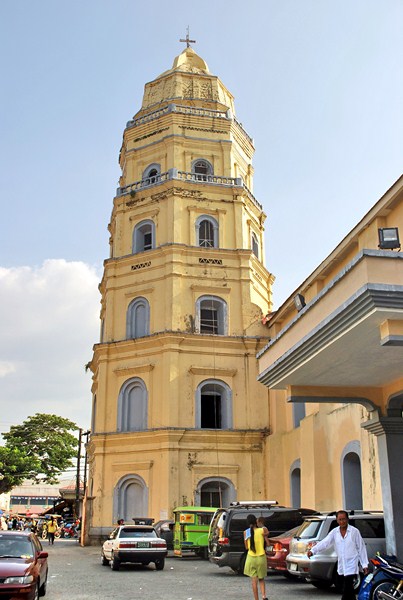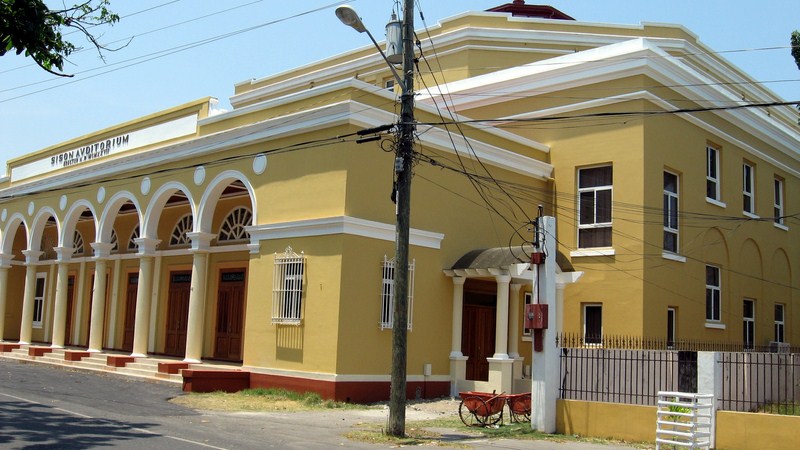
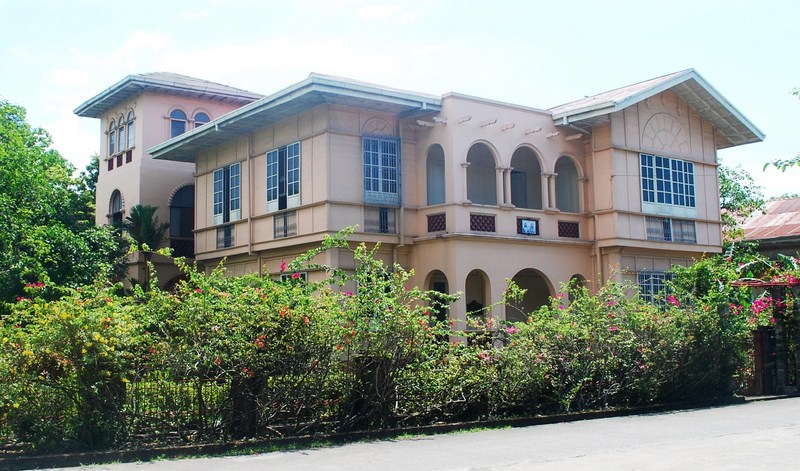
War Memorial Museum (Lingayen, Pangasinan)

War Memorial Museum

War Memorial Museum

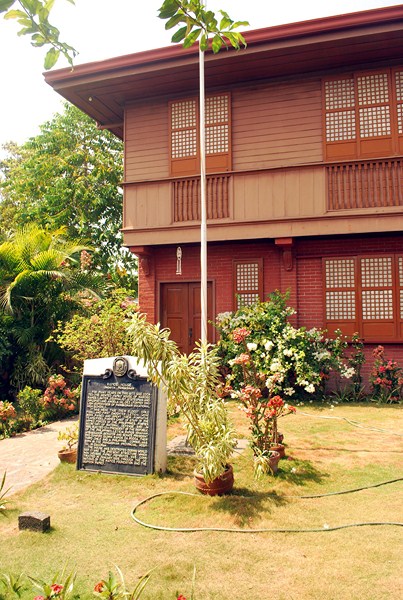
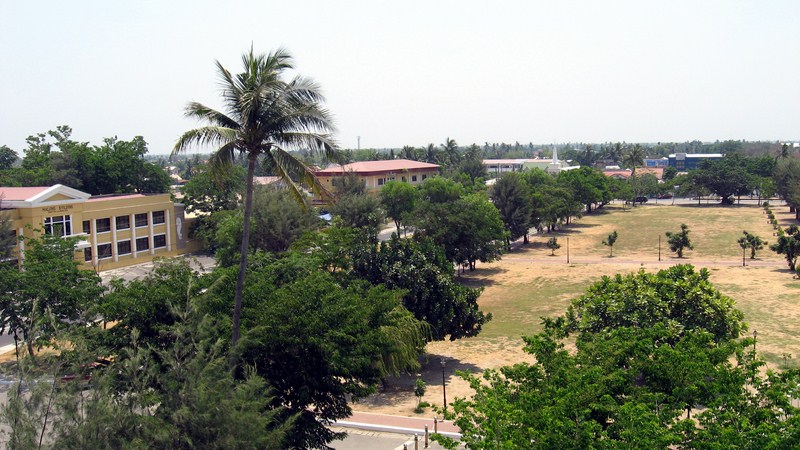
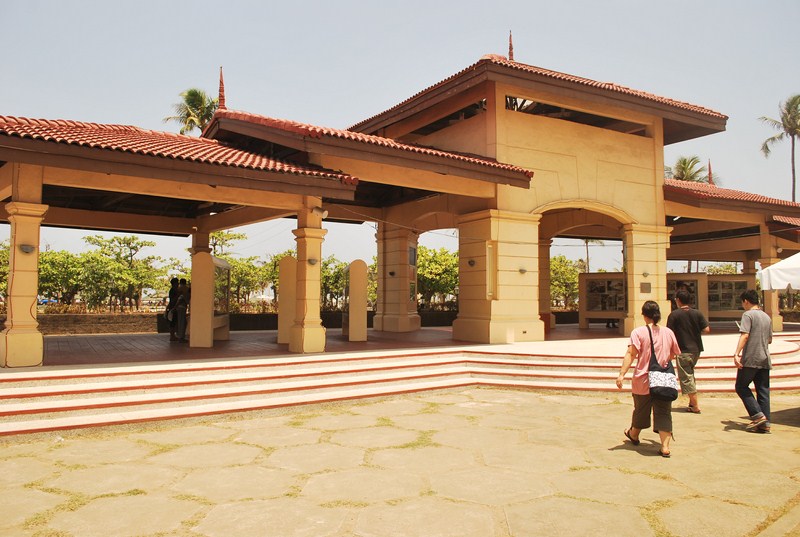
This open-air museum, within the Lingayen Gulf War Memorial at the Provincial Capitol Compound, has relics of the American landing during World War II. On December 22, 1941, during World War IIJapanese Gen. Masaharu Homma and his 43,000 troops landed at Lingayen Gulf. Four years later, on January 9, 1945, Gen. Douglas MacArthur also landed here with 68,000 American troops during the liberation.  A stone marker here marks the landing site.

The exhibits

The exhibits

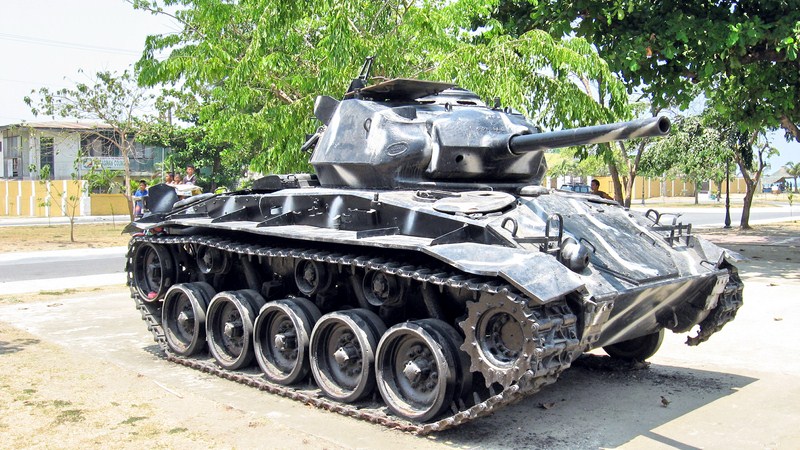
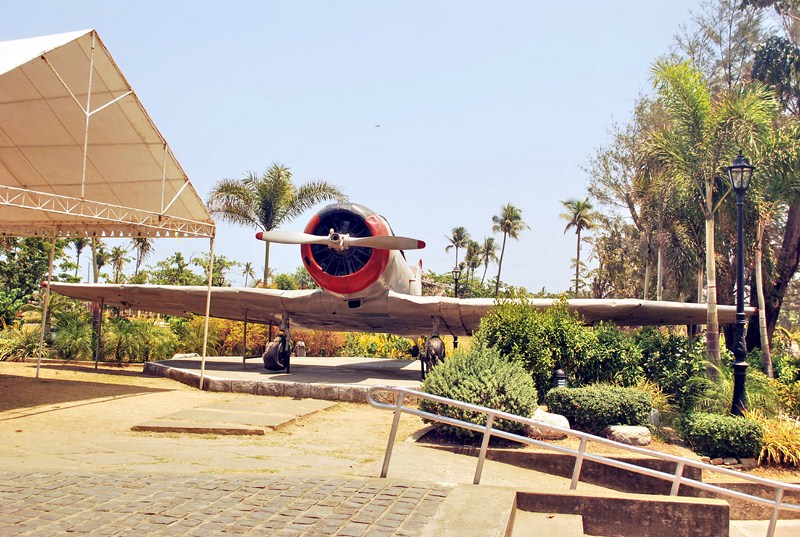
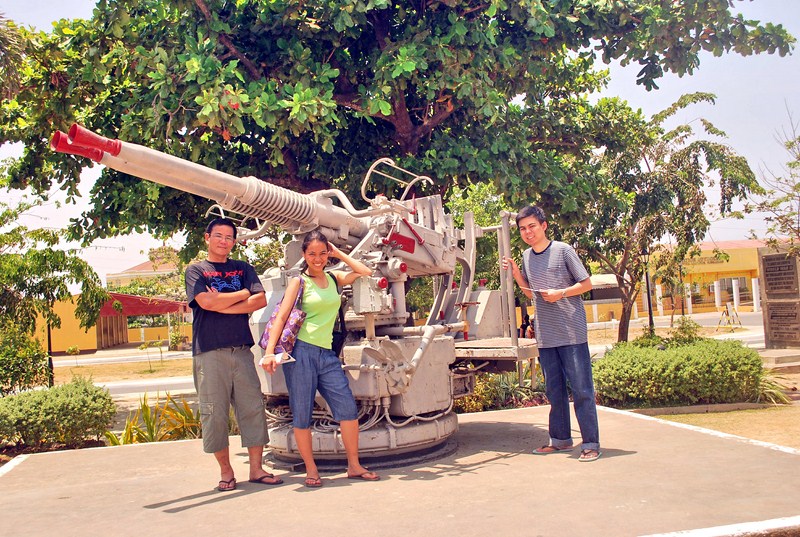
The open-air exhibits include a twin 40 millimeter ant-aircraft gun, a naval 3” gun, a Japanese Nakajima “Kate” torpedo bomber and two repainted U.S. M24 “Chaffee” tanks (one has its turret turned to the side, and the other’s turret is to the front).

A repainted U.S. M10 tank

A repainted U.S. M24 “Chaffee” tank

Japanese Nakajima “Kate” torpedo bomber

Japanese Nakajima “Kate” torpedo bomber

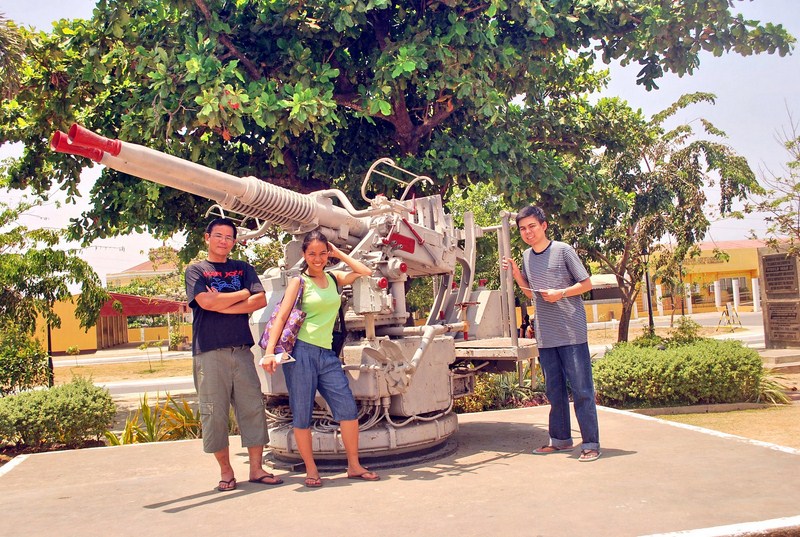
The author, Cheska and Jandy beside an ant-aircraft gun

The author, Cheska and Jandy beside a twin 44 mm. anti-aircraft gun

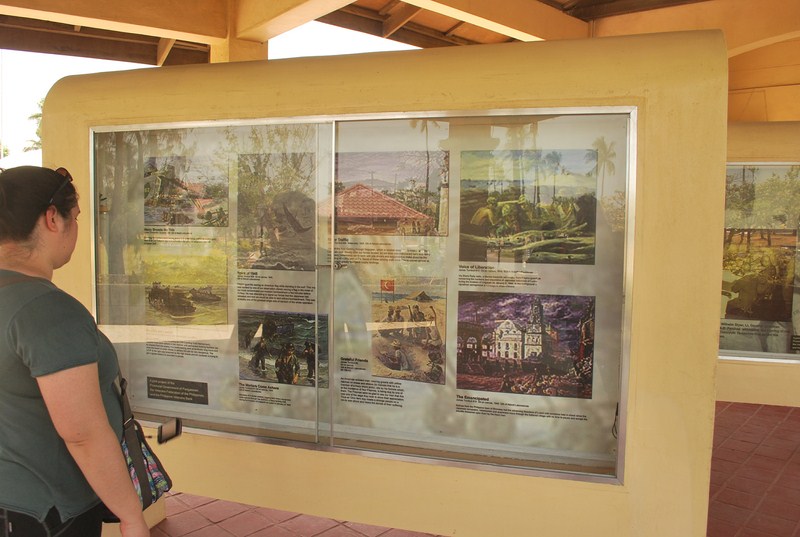
A pagoda displays a collection of historic photographs (including information on HMAS Australia hit by Kamikazes) while a bronze compass and map, in the center of the compound, details the US Army units that landed on January 9, 1945 at Lingayen Gulf.

Holy Week in Pangasinan

El Puerto Marina Beach Resort & Spa

Come Holy Week, I got an invitation from El Puerto Marina Beach Resort and Spa owners Roland and Flordeliza Versoza to stay at their resort in Lingayen and, not having any other activity planned for the holidays, decided to accept their offer.

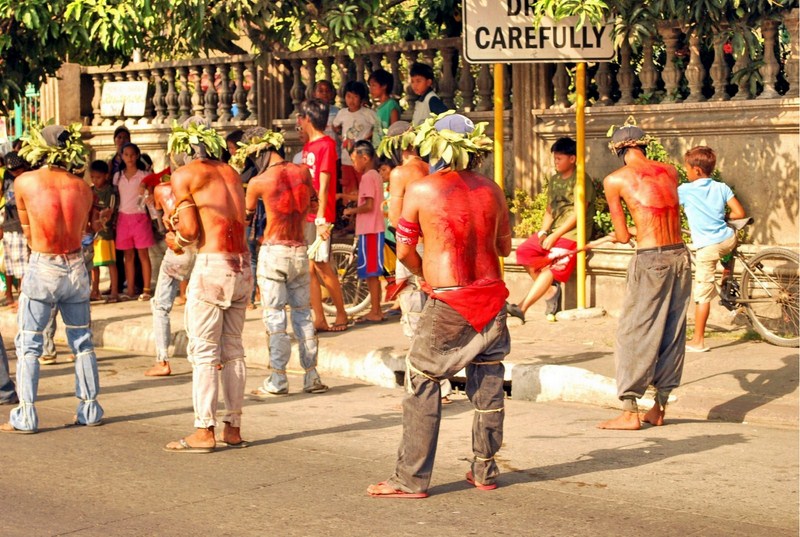
A group of flagellants

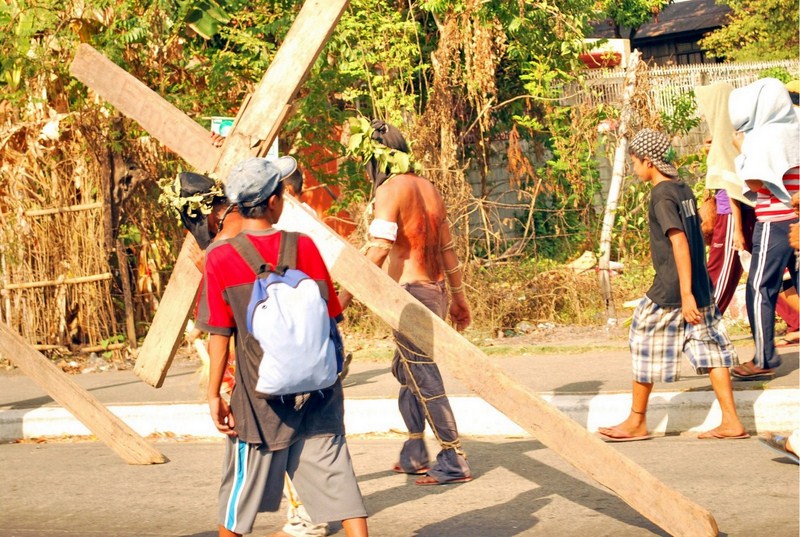
A penitent carrying a wooden cross

It was also to be my first visit to Pangasinan’s capital.  For company, I brought along my children Jandy and Cheska and we all left on Wednesday afternoon, the eve of the Holy Week rush.  As such, my 227-km. trip, normally a 4.5-hour drive, took all of 6 hrs., it being a holiday.  We arrived at the resort by 8 PM.

Check out “Resort Review: El Puerto Marina Resort and Spa

Our room for the night

We were welcome by Flor who billeted us at one of the resort’s rustic airconditioned native-style bungalows with bath and cable TV.  Resting on stilts, these bungalows are cantilevered over a fishpond and reached via an S-shaped wooden footbridge. Quite famished, we dined at its equally rustic pavilion before calling it a night.

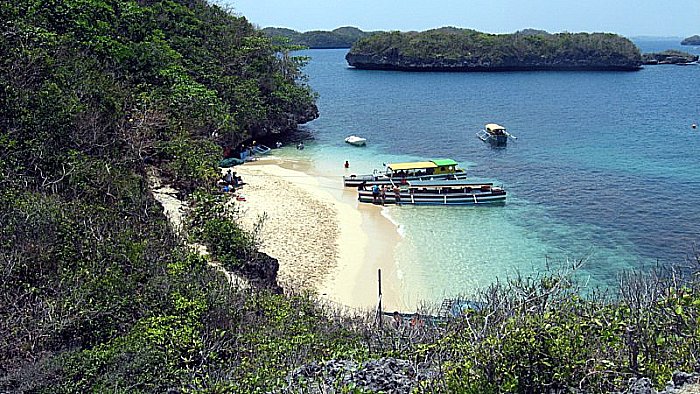
Cheska at the Hundred Islands

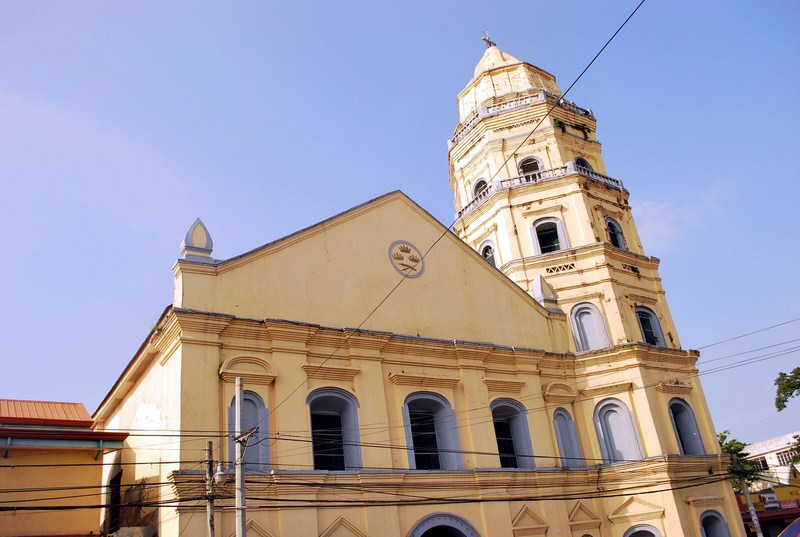
The next day, we joined a group which included Fil-American Katrina Nogoy and Malaysian-American Janet Jun Siew Loh, both teachers in Japan, for a tour of the Hundred Islands  (Cheska was a first-timer to these islands) in Alaminos City. On our way back to the resort, we dropped by the Cathedral of the Epiphany of our Lord in Lingayen.

Check out “Return to the Hundred Islands” and the “Cathedral of the Epiphany of Our Lord” 

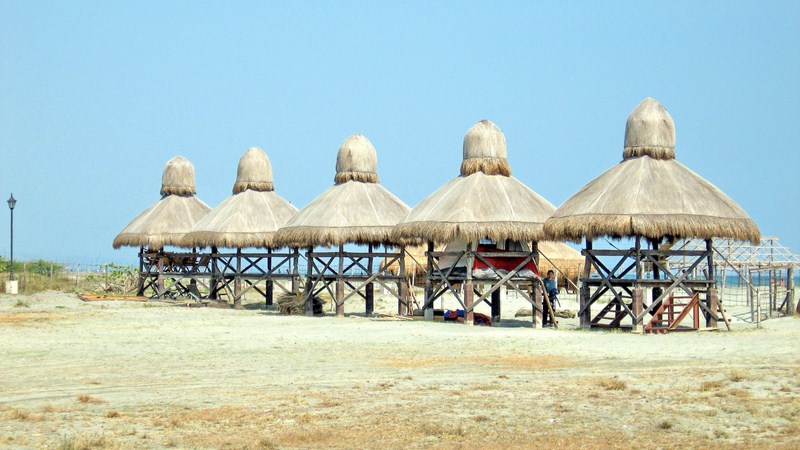
Picnic sheds along Lingayen Beach. We pitched our tent at the second hut from the right

On our second night at the resort, I brought out my 5-pax Coleman tent and  went camping along this adjoining, gently-sloping, cool, quiet gray sand beach. A bonfire was set up that night by the resort.

One of the resort’s resident arapaimas

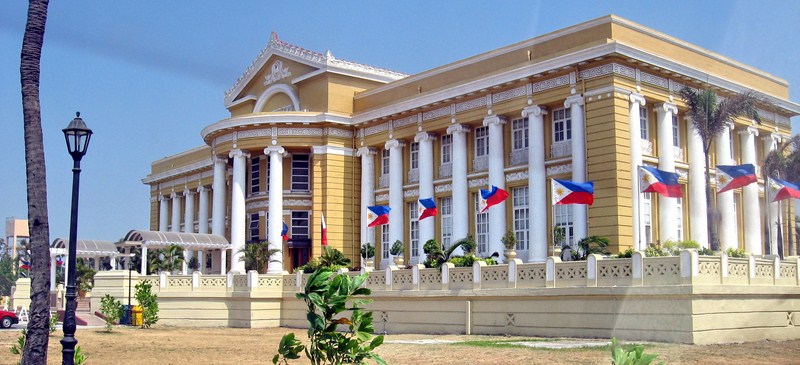
The next day, we watched 2 big South American arapaimas being fed at the resort’s  koi pond. Later, Katrina and Janet joined us as we toured Lingayen, visiting the Pangasinan Provincial Capitol, the Sison Cultural and Heritage Center and the War Memorial Museum.

Check out “Pangasinan Provincial Capitol,” “Sison Cultural and Heritage Center” and “War Memorial Museum

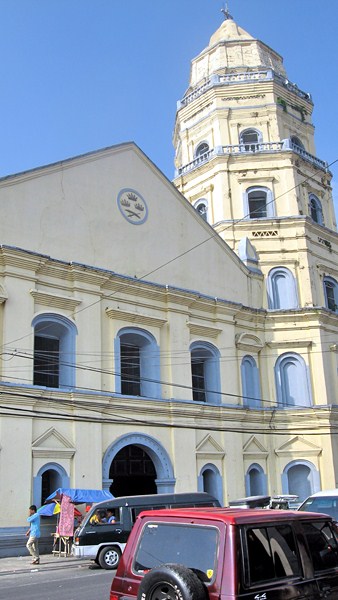
Cathedral of the Epiphany of Our Lord

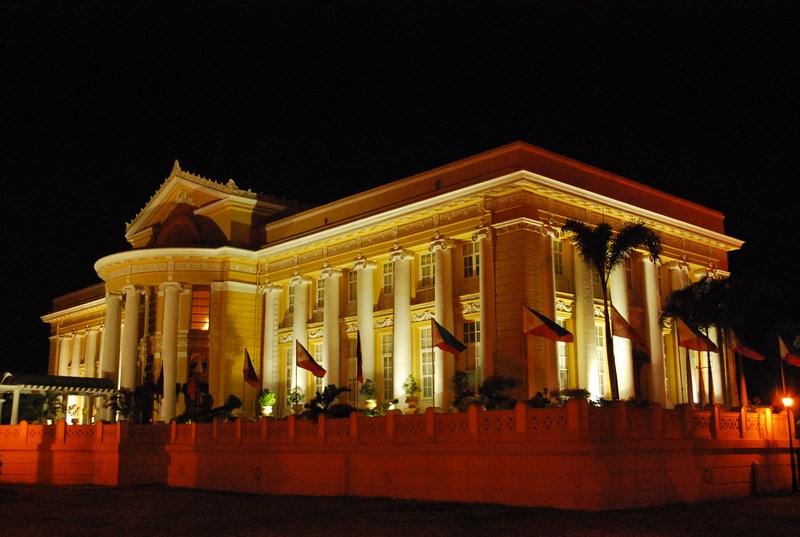
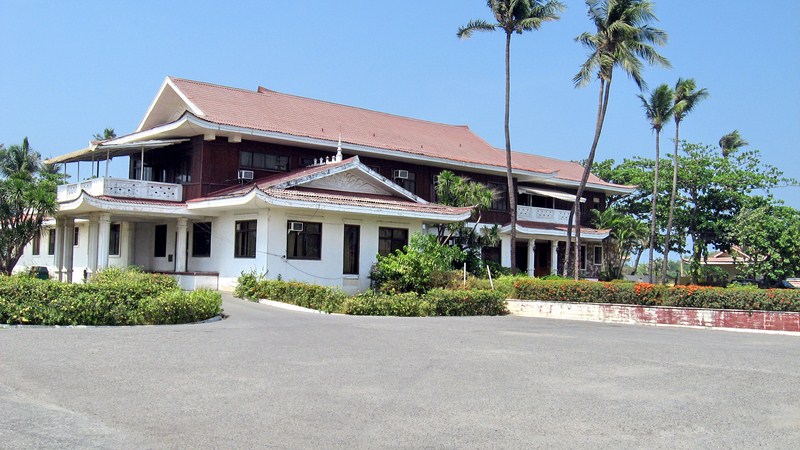
Provincial Capitol

The author (left) with Cheska and Jandy at War Memorial Museum

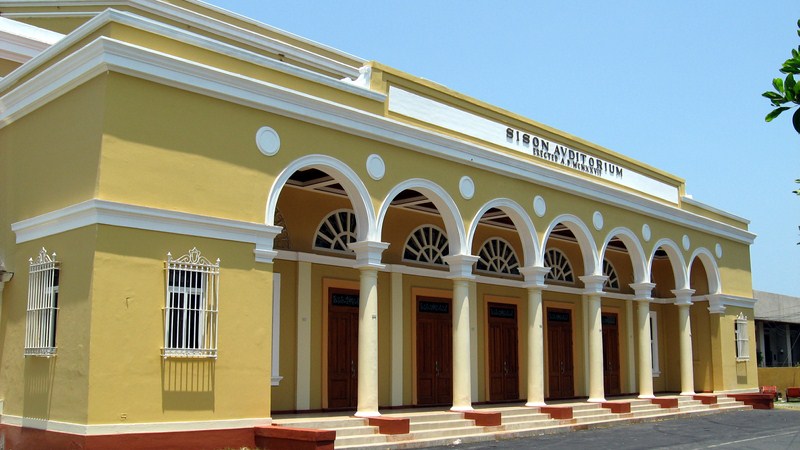
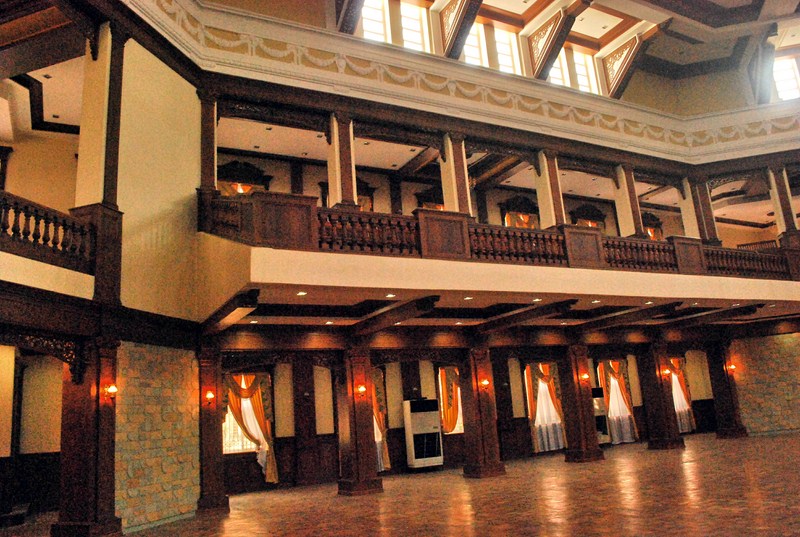
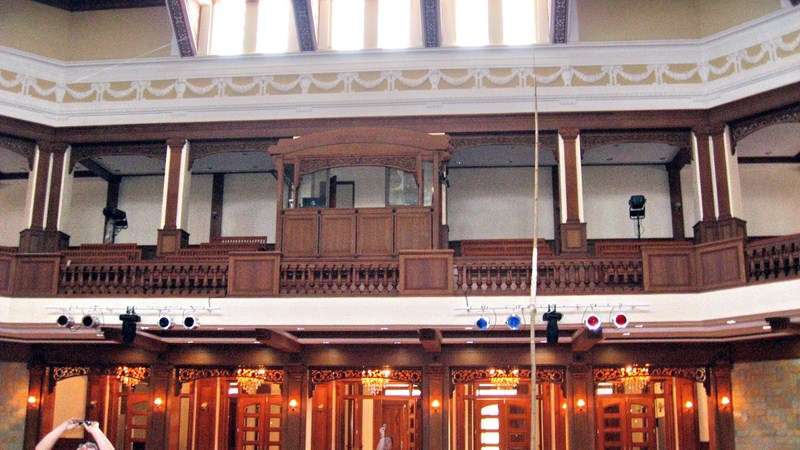
Sison Cultural and Heritage Center

El Puerto Marina Beach Resort and Spa: Don Martin Domingo St., Pangapisan North, Lingayen, Pangasinan.  Tel: (075) 542-5328.  Fax: (075) 542-2285.  Mobile: (0917) 867-3908 and 3906. Manila tel: (632) 852-3404, 986-3404 and 775-6789.  Fax: (632) 824-7384.   E-mail: inquiries@elpuertomarina.com.  Website: www.elpuertomarina-pangasinan.com.

Malinta Lateral Tour (Corregidor Island)

After the launch of the ROCKet Zipline, I joined the media group on a ghost-hunting tour of the unexplored and unlighted hospital laterals of Malinta Tunnel.   Here,we donned hard hats for head protection (some parts of the tunnel have low head rooms) and brought flashlights.  We started the tour at the tunnel’s east entrance, proceeded to the second lateral on the right side, then headed northward towards the tunnel’s north entrance.

Check out “Launch of the ROCKet Zipline

Malinta Tunnel entrance

Malinta Tunnel entrance

At one time, our tour guide requested us to turn off our flashlights for a few seconds so as to have a feel of the eerie darkness of night.  He also pointed out the location where, just prior to the recapture of Corregidor by the Americans, a number of Japanese soldiers who, rather than surrender, strapped themselves together and committed suicide by blowing themselves up with grenades.

Into the darkness

Into the darkness

Our guide narrating the tunnel's past history

Our guide narrating the tunnel’s past history

The guide  also pointed to a piece of bone (presumably Japanese), charred as a result of the Americans pouring gasoline down the air vents and then dropping grenades to detonate it. As a result, most of tunnel walls (ironically, built with Japanese Asada cement) were blackened with soot.  Of the 2,000 remaining Japanese, only 26 of them survived the blazing inferno.

An air vent where gasoline was poured into the tunnel

An air vent where gasoline was poured into the tunnel

Land crab - denizen of the dark

Land crab – denizen of the dark

Sun Cruises, Inc. (SCI) – Reservation Office: CCP Terminal A, CCP Complex, Roxas Blvd., Manila.  Tel: (632) 831-8140 and (632) 834-6857 to 58.  Fax: (632) 834-1523.  E-mail: suncruises@magsaysay.com.ph.

Sun Cruises, Inc. (SCI) – Sales Office: 21/F,  Times Plaza Bldg., Ermita, Manila.  Tel: (632) 527-5555 local 4511 and 4512.  Fax: (632) 527-5555 local 4513.  E-mail: sales@suncruises.com.ph.
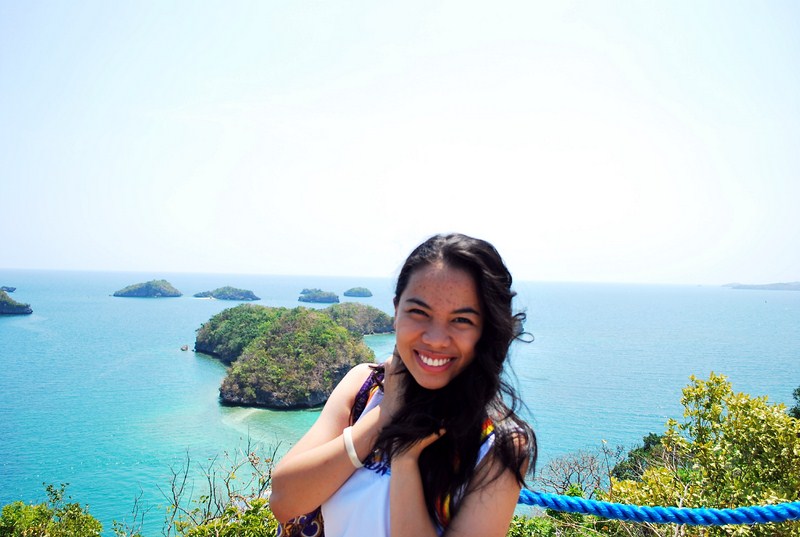
Calicoan Island (Guiuan, Eastern Samar)

Talisay Beach

One of the 2 reasons why Jandy and I dropped by Guiuan (the other was the town itself) was to visit Calicoan Island.  Called the “Sleeping Beauty of Eastern Samar,” this island is blessed with long stretches of unspoiled white sand beaches; limestone cliffs (tempting for rock climbers); alien abstract rock formations (great for camera buffs); dive destinations (Pearl Island, Binabasalan Island and Baul Island); crystal clear blue waters; numerous, cathedral-like caves for spelunkers (the large Buro Cave is accessible during low tide) with stalactites along the seashore; 20 isolated and romantic coves; 6 huge and unexplored saltwater lagoons and nature trails inside tropical virgin forests (50% of the area).

Causeway to the island

Come morning, after a hearty Filipino breakfast at the Calicoan Surf Camp’s restaurant, we opted to burn calories by exploring the island on foot (for me still the best way), bringing along resort staffer Mr. Marcial Orocay as guide.  From the resort, we cut across the 3-km. width of the island, to the western side which faces the calm waters of Leyte Gulf, its 8-km. long beach ideal for swimming, snorkeling, picnics and watching magnificent sunsets.   The forest along the way is said to be home to mischievous monkeys, monitor lizards and colorful birds.  Though we didn’t get to see any up close, we did get to see a snake crossing our trail.

Sulangan Beach

Skirting the western coast, we visited Sulangan Beach, the habitat of the world-famous and rare Golden Cowrie (Conus gloriamaris) shell. These shells were being sold (at a whopping PhP1,500 per piece) at souvenir shops at nearby  St. Anthony of Padua Church, also a notable pilgrimage site.  With its schools of multi-colored fish, Sulangan Beach is also an ideal site for scuba diving.

The original 3149 Base flagpole

Caliocan Island, a low coralline island in Brgy. Ngolos, 23 kms. from the town was, during World War II, the site of the U.S. Navy’s 3149 Base.  The base’s original flagpole still stands.  The late U.S. Pres. John F. Kennedy, a PT boat commander during the war, was also stationed here.

Guiuan Airport runway

The runway of the former U.S. Navy airbase, located on the eastern edge of the town, was once one of the biggest U.S. bases in the Pacific and was also used actively until the Korean War.  Its 60 m. wide and 1.9 km. long runway was built, during the liberation, by U.S. Army engineering battalions in December 1944.  Here, the B-26 Superfortress bomber Enola Gay, which dropped the atomic bomb on Hiroshima, Japan (August 6, 1945), was launched.  Disused for some time after its turnover to the Philippines, it is now undergoing a PhP142 million rehabilitation (its runway, now with an overlay of asphalt, is now 2.134 kms. long) and will opened this October as a feeder airport for chartered or regular flights.  Its opening would be heaven-sent as it would make Guiuan easily accessible by plane (cutting its dependence on Tacloban City’s airport), thus supporting the commercial and tourism industry in the region, most especially Calicoan Island, an upcoming island resort which boasts of miles of white sand beaches as well as powerful swells rolling in from the Pacific over the 10,000 m. Philippine Deep, making it a surfer’s paradise. A PhP38 million water system that would supply the island resorts’ operational requirement is also nearing completion. All these aim to promote Guiuan as the next eco-tourism hub in the country, a place that offers visitors a lot when it comes to cultural and historical heritage sites, natural beauty plus the warmth and hospitality offered by its 38,694 Guiuananons.

Calicoan Surf Camp (Guiuan, Eastern Samar)

Our Guiuan host, Ms. Vibina “Bebeng” Juacon, facilitated our visit to Calicoan Island with a call to Mr. Danilo Molina, Gen. Manager  of Calicoan Surf Camp, the resort where she recommended we stay overnight.  Once given the green light, we thanked Ms. Juacon and Jandy and I hired a tricycle (for PhP400) to get to the island and the resort.  There were to be no boat crossings as the “island” is connected to the mainland by a short concrete causeway.  Once across, we traversed a dirt and gravel road  which runs the length of the island.

Calicoan Surf Camp

Calicoan Surf Camp is island’s best and most luxurious.  This hideaway was developed by Cebu-based lawyer and pioneer developer Maning Go who owns about 500 hectares of the island’s 1,600 hectares.  It was designed, with distinctive Asian-inspired (Thai, Balinese, Indonesian and Filipino) lines, by Frenchman Nicolas Rambeau, owner and creator of the highly-acclaimed, high-end Pansukian Resort in Siargao (Surigao del Norte).

Bungalow interior

After a short interview with Mr. Molina, we called it a night and Mr. Molina checked us in at one of the resort’s 7 well-appointed, spacious bungalows with its soaring rooflines.  Each bungalow has a native feel, with its own deck and floor with alternating dark and light wood stripes.  Modern amenities include airconditioning, compartmentalized bathroom with hot and cold shower, satellite TV, coffee/tea maker, hair dryer, minibar and safety deposit box.

Infinity pool

Tired after a long trek around the island, we dipped our tired bodies at the resort’s inviting 300-sq. m. saltwater infinity pool bordering the 3-km. long, white ABCD Beach, the island’s prime surfing area.  Verdant pandamus trees (locally called bariw) grow through the pool’s uniquely-designed wooden deck, embracing it and providing cool shade, thus binding nature with design.  Here, we watched the surging, breathtaking surf (boasting perfectly-shaped left or right reef breaks) as the island’s  eastern side juts out to the rolling surf of the Pacific Ocean (its powerful swells tirelessly rolling in over 10,000 m. Philippine Deep), making it a surfer’s paradise. The best surfing months, according to  Mr. Molina, are March, April and September to October when southwesterly winds blow offshore, piling up incoming ocean swells and carving them into glassy shaped hollows.  Surfboards are rented out for a small fee and beginner’s lessons can be provided, on request, by the resort staff.  Surfers must wear booties as protection against the sharp rocks. Although the currents are strong here, the island offers opportunities for big game fishing along the “Tuna Highway,” the migratory route for tuna to Japan.

The resort’s restaurant

Also quite famished after such a long trek, we later indulged ourselves at the resort’s restaurant which offers International and Filipino cuisine including seafood such as freshly caught, fleshy, sweet and delicious lobster, prawns, scallops, abalone, crabs and fish.  After a filling lunch, we packed up our gear, checked out, thanked the resort staff and hired a tricycle (this time for PhP350) to bring us back to the bus station at Guiuan town proper for our trip back to Tacloban City.  Along the way, we made a brief stopover at Calicoan Island Ocean Villas, another of Maning Go’s development projects.  Go enlisted the multi-awarded architectural firm of Francisco “Bobby” Manosa to prepare the island’s master plan.  He envisions zoning development where visitors can make nature treks to large areas of the island without encountering any bar, souvenir shop or billboard, thus offering more natural attractions and leisure activities with less of the hustle of the better-known Boracay.  With continued but controlled growth, may it stay that way, making Calicoan truly a diamond in the rough.

Calicoan Island Ocean Villas

Calicoan Surf Camp: Calicoan Island, Guiuan, Eastern Samar.  Manila Tel: (632) 376-5818.  Website: www.thesurfcamp-calicoanisland.com.

Church of the Immaculate Conception (Guiuan, Eastern Samar)

Church of the Immaculate Conception

After attending the star-studded and colorful Sangyaw Festival of Tacloban City, Jandy and I decided to get some “rest and recreation” at the progressive town of Guiuan in Eastern Samar, our first in the province. To get there, we left the city after lunch, proceeded to downtown and boarded an airconditioned Van-Van van.  The trip took just 3 hrs., made possible by the opening, in the late 1990s, of the South Samar Coastal Road which cut land travel time to Guiuan by about 2 hrs..  As usual, we crossed the beautiful, S-shaped San Juanico Bridge (the country’s longest) into Samar, traveling along a coastal highway which runs past mountains, steep cliffs, distant rock islands and boat-filled bays, then making a right at a T-junction (the left goes to Borongan City) to an occasionally potholed asphalt road all the way to Guiuan.  We arrived there by 4 PM and were guests at the house of Ms. Vibina “Bebeng” Juaban. 

San Juanico Bridge

The best way to explore this coastal town is by hired tricycle.  Vestiges of Spanish era history can be seen at the “fortress Baroque” Church of the Immaculate Conception, considered to be the finest in the Eastern Visayas.  Started in the 1630s, it was rebuilt in stone in the early 18th century.  From 1844 onwards, Fr. Manuel Valverde and Pedro Monasterio renovated the church, covering the roof with tiles. In 1854, Franciscan friars added a transept and baptistery and built a massive bell tower (which once served as a watchtower) on top of a seaside bastion of the fort.   

The church belfry

The church’s façade has triple but slim engaged columns, arches and carvings at the pediment’s borders and 3 entrances with elaborately carved, hardwood doors.  Inside are a single nave with a main altar and two side altars, a beautiful retablo from Franciscan times, a Rococo frontal with the Augustinian emblem and old santos.  The church is enclosed within the partially preserved quadrilateral fort of cut stone, said to be the best and most regularly planned in all the Visayas. Today, this church has been declared as a National Cultural Treasure (unique structures that possess outstanding artistic, historical and cultural values that are significant to the nation), one of 26 named as such by the National Museum in 2001. 

Sangyaw Festival (Tacloban City, Leyte)

Cocowayan Festival of Basilan

I was supposed to attend both the simultaneous Pintados Kasadyaan and the Sangyaw (derived from the Waray word meaning “to herald the news”) Festivals in Tacloban City (Leyte), both held on the month of June, but missed out on the former as my son Jandy still had classes on the day of the parade (June 27).  The Sangyaw Festival’s parade, held on June 29, the day after our arrival, was still worth the visit.  This cultural festival was first created by former First Lady Imelda Marcos in 1974 but was discontinued after 1986.  After an absence of more than 2 decades, it was revived last year by Tacloban City Mayor Alfred S. Romualdez, Imelda’s nephew. 

Image of Sto. Nino de Tacloban

This year’s parade promised to be extra special as it was the 120th celebration of the Fiesta of Sto. Niño de Tacloban, the city’s patron saint, plus Tacloban also just became the first city in the Eastern Visayas Region to be classified as a highly urbanized city.  As with previous parades, our grand view deck for watching the 3-hr., 3-km. long afternoon parade was Avenida Veteranos, packed, since early morning, with thousands of onlookers lining up to watch this unprecedented display of pomp and revelry.

Pattaradday Festival of Isabela

The festival’s street dancing competition was participated in by 17 contingents from different provinces and cities from Luzon (the Pattaradday Festival of Santiago City, Isabela; the Magayon Festival of Legazpi City, Albay; etc.), the Visayas (Sinulog Festival of Cebu City; the Dinagyang Festival of Iloilo City, the Masskara Festival of Bacolod City, Negros Occidental; Kawayan-Banigan Festival of Basey, Samar; etc.) and Mindanao (Bonok Bonok Marajaw Karajaw Festival of Surigao City, the Cocowayan Festival of Isabela de Basilan City, etc.)Tacloban City’s Tribu Kabatuk, last year’s grand prize winner, was on hand to defend their title.  Cash prizes, for the Open or Free Interpretation Category, plus trophies were up for grabs. 

Kawayan-Banigan Festival of Basey

Like with previous cultural competitions, these street dances depicted Filipino culture and tradition.  Each contingent performed, for 3 mins., in designated streets (Imelda St., Rizal St. and Justice Romualdez St.) before performing, for 5 mins., at the Balyu-an Amphitheater. The dance drama presentation showcased the ingenuity, talent and creativity of the over 1,000 participants as well as the cities, schools and institutions they represented. Makati City was ably represented by its Drum, Lyre and Bugle Corp contingent, dressed in their gay blue and white parade attire. 

The Bonok-Bonok Maradjaw-Karadjaw Festival

The Bonok-Bonok Maradjaw Karadjaw Festival, represented by Surigao City’s West Central Elementary School, grabbed all four minor prizes (PhP50,000 each) in the open category (best in costume, best in musicality, best in street dancing and best in choreography) plus  the PhP500,000 grand cash prize. Second place (Php300,000) went to the Kawayan-Banigan Festival and third place (PhP200,000) went to the Pataraday Festival.  

Alibangbang Festival of Dolina

In the community and school-based category (with 10 participating contingents), best in costume (PhP10,000) went to the Alibangbang Festival of Dolina and best in musicality, street dancing and choreography (PhP10,000 each) to the Eastern Visayas State University (ESU).  The eventual grand champion (winning PhP300,000) was EVSU.  Second place (PhP150,000) went to Holy Infant College and third place (PhP100,000) to Sagkahan.  

Makati Drum, Lyre and Bugle Corp

Come nighttime, these same people who lined the streets for the parade also filled up Balyuan Barbecue Park and Amphitheater and the Tacloban City Convention Center, venues of concerts and other entertainment for the weeklong socio-cultural festivities.  Business was brisk and hotels and inns were fully booked with tourists, both local and international, truly an indicator of the festival’s success and its worthiness of being returned to the tourist map.

City Tourism Operations Office: City Hall, Kanhuraw Hill, Tacloban City, Leyte.  Tel: (053) 325-8955, (053) 325-2491, (053) 523-9671 & (053) 325-6248.

Jack’s Ridge Resort and Restaurant (Davao City, Davao del Sur)

After checking out at Pearl Farm Resort, we shuttled back to Pearl Farm Marina at Davao City where we had lunch at Marina Cafe.  After lunch, we had our scheduled Davao City tour, having hired a driver and van the previous day.  Grace and my in-laws opted to visit an orchid farm while the kids and I visited the Philippine Eagle Sanctuary and Wildlife Preserve.

Check out  “Pearl Farm Resort and “Philippine Eagle Sanctuary and Wildlife Preserve”  

Once done, our driver drove us, up a winding cemented uphill road, to Jack’s Ridge Resort & Restaurant for dinner.  This would be my second visit (the first was in 2007 with fellow architect Jose “Jay” Mendoza)  and the first for the rest.

Daytime ridge view of Davao City CBD

When the Americans landed in Davao on May 1, 1945, the retreating Japanese were forced to beat a path to Matina Hills where they set up their headquarters.  Here, they had a commanding view of the Davao Gulf where the American ships were anchored.Thus, it was the scene of fierce fighting between the two forces.

Caves dug by the Japanese still pockmark the area and, once in a while, people still find bullet casings and other war materials in the rocky soil. There is even the ruin of a Japanese plane that crashed on a mountainside beside the ridge.

Davao City by night

Today, over half a century later, this area, now called Jack’s Ridge, is now popular with foreign and local tourists, not only for its commanding view of Central Business District (CBD) of Davao City and Davao Gulf, but also because of its popular and classy restaurants, cafes and bars now located there that offer different delicacies, truly a completely different dining experience.

Jack’s Ridge Resort

One of the most popular restaurants here is Taklobo Restaurant where we dined.  The restaurant is noted for its wide array of delectable and mouthwatering Dabawenyo dishes such as calamares, sinigang, kinilaw, grilled tuna, pork or chicken.  A group of musicians also serenaded us while we were eating amidst the cool evening breeze.  We also posed beside a life-size statue of a Japanese soldier.

Prehistoric taklobos  outside the restaurant

Just outside the  restaurant are some prehistoric giant clam shells (taklobo) found at the ridge, an indication that this area, once submerged under the sea, was tossed  to these heights by strong geological forces millions of years ago. On one side was a covered concrete stairway leading to a spacious and elegant open amphitheater where one can lounge al fresco.

Stairway leading to open amphitheater

Jack’s Ridge Resort & Restaurant: BCG Drive, Shrine Hills, Matina, Davao City. Davao del Sur. Tel: (082) 297-8830 to 31.  Fax: (082) 297-6535.  E-mail: info@jacksridgedavao.com and  jacksridgedavao@yahoo.com.ph. Website: www.jacksridge.com.

Isla Malipano (Island Garden City of Samal, Davao del Norte)

On our second day at Pearl Farm Resort, Grace, Jandy, Cheska, my in-laws and I decided to crossed over (a 2.5-min. boat ride) to the secluded, 7-hectare Isla Malipano and check out its facilities.  We were dropped off at the 200-pax, octagonal and multi-functional Malipano Gazebo at the other end of the island, a perfect alternative for weddings, theme parties and other occasions.  My in-laws decided to stay here while we went around the island.

Check out “Resort Review: Pearl Farm Resort” and “Pearl Farm Resort

Malipano Gazebo

Also a part of the resort, Isla Malipano has a white sand beach, an offshore reef plus 7 lavishly-decorated, 3-storey private luxury villas, each with a wide veranda with breathtaking views of the Davao Gulf. Small barbecue parties can be held at the veranda.

Check out “Resort Feature: Malipano Villas

The island’s sparkingly white sand beach

The villas are composed of 3 octagonal structures with reception areas, guest suites and dining area, all around a cantilevered deck. Their roof design is patterned after the salakot (traditional Filipino hat).  Four of the villas are perched on stilts directly above the sea while the 3 other villas are built over rock outcrops on the beach.

The Malipano Villas

Five villas have 3 bedrooms (with 2 queen-size beds and 2 single beds or 3 queen-size beds) while 2 villas have 4 bedrooms (with 3 queen-size beds and 2 single beds or 4 queen-size beds).

Veranda with a great view

All villas are airconditioned and equipped with minibar, coffee and tea making facilities, safety deposit box (at the master’s bedroom), cable TV, hair dryers, spacious living room and toilet and bath (the master’s bedroom has a bathtub).  Butler service is available for food orders and other guest assistance while a standby speedboat is available to transport guests to the restaurant and other resort facilities.

One of the villa’s master bedrooms

The island is also ideal for scuba diving as the wrecks of two World War II Japanese freighters are located 60 m. away and in front of the resort.  The 40-m. (132-ft.) long Wreck I is located just a few meters from the resort’s Samal houses, in 35 m. (115 ft.) of water.  Here, you can find groupers, jacks, moray eels and others.  For advanced divers, an open bay hatch allows safe penetration.   It is also recommended for underwater photography.  The slightly smaller, 35-m. (115-ft.) long Wreck II rests on its side at a shallower dept of 28 m. (98 ft.) of water.

Pearl Farm Resort: Kaputian District, Island Garden City of Samal, Davao del Norte.  Tel: (082) 221-9970 to 73.  Fax: (082) 221-9979.  E-mail: pearlfarmresort@fuegohotels.com.  Website: www.pearlfarmresort.com.  Davao Citysales office: G/F, Anflocar Corporate Center, Damosa Bldg., Lanang.  Tel: (082) 235-0876 and 234-0601.  Fax: (082) 235-0873.  E-mail: dvosm@pearlfarmresort.com.  Manila sales office: 15/F, 1504 Corporate Center, 139 Valero St., Salcedo Village, Makati City.  Tel: (632) 750-1896 and 98.  Fax. (632) 750-1894. E-mail: mlasm@pearlfarmresort.com.

Pearl Farm Resort (Island Garden City of Samal, Davao del Norte)

My first visit to Pearl Farm Resort in Davao, during the the November 2007 Flavors of Spain, so enamored me with the place so much so that I decided to return, this time with my whole family in tow.

Check out “Flavors of Spain in Davao

The Parola at Pearl Farm Resort

This 11-hectare, Class “AAA” resort, located on a secluded cove at the Island Garden City of Samal’s Kaputian District, was formerly the home, since 1958, of the Aguinaldo Pearl Farm which produced cultured pink, white and gold pearls from white-lipped oysters brought from Jolo.   It ceased operations in 1980 but was developed into a world-class beach resort, opened in 1992.  It started out with 10 hillside cottages and 2 Samal cottages on stilts.

Check out “Resort  Review: Pearl Farm Resort

The resort’s white sand beach and backdrop of greenery

Today, the main resort has expanded into 70 guestrooms (17 standard Hilltop rooms, 21 superior Samal Houses, 6 executive, 2-storey Samal suites and 19 de luxe Mandaya Houses and 7 Malipano Villas) made mainly with bamboo and wood and harmonizing with the clear, blue sea, the white sand and its backdrop of impressive greenery.

Davao International Airport

We book flights with Philippine Airlines and left Manila for Davao City, the gateway to the resort, on the very early 4:30 AM flight.  We arrived at Francisco Bangoy International Airport by 6:30 AM and were whisked, via a resort van together with other guests, to the Pearl Farm Marina in Lanang.  From its developed wharf, we were to be transported to the resort via a large motorized outrigger boat.  Our boat left by 8:30 AM and the ride took all of 45 mins.

Waiting for our boat at Pearl Farm Marina

We arrived at the resort by 9:15 AM and we were checked in at a luxurious, 2-storey, Muslim-inspired Samal Suite, specifically Suite 1.  This was convenient for my octogenarian in-laws as this particular suite was the nearest to the Maranao Restaurant, allowing for shorter walks.  Noted architect Francisco “Bobby” Mañosa designed the cottages and villas as close as possible, in both materials and form, to the different Mindanao tribes they were named for: the Bagobo, B’laan, MaguindanaoTausugT’boli and Yakan.  Ours was the Tausug.  For its depiction of regional traits, the resort received the Kalakbay Award for Best Resort for two consecutive years (1994 and 1995) and was one of the venues of the 1994 Miss Universe pageant.

The Samal Suites

The Samal suites (as well as the cottages) were patterned after the stilt houses of seafaring Samal tribes of the Sulu Archipelago. My wife Grace, my kids Jandy and Cheska and I occupied the master bedroom, with its king-size bed, on the second floor while my in-laws occupied the living room on the first floor which was converted to another bedroom with a sofa bed with trundle bed being provided.  Both floors have their own private bathroom with the masters’ provided with a bathtub.

The master bedroom

Both rooms are airconditioned and provided with cable TV, a well-stocked mini-bar, coffee and tea making facilities, safety deposit box and hair dryer. Our veranda,  overlooking the serene blue water, had a private staircase leading down to our very own small yet private beach. A jar of water and a coconut shell dipper are placed near the entrance to our suite so that we may wash away the sand after a day of barefoot walking on the beach. In local custom, this gesture is also symbolic of a cleansing of the spirit.

The converted living room

After checking in at our suite, we all proceeded to the Maranao Restaurant for brunch.  This cavernous dining pavilion, replete with tribal motifs, has a menu with an assortment of international culinary influences, all wonderfully prepared by Filipino chef Edgar Chavez.  The buffet features Spanish paella and calamares,  Madras seafood curry, Italian pasta, Japanese tempura and even Thai tom yum soup plus sweet pomelo, mangoes and other tropical fruits.

Maranao Restaurant

Cocktails, plus inspiring views of the sea and nearby De la Paz and  Malipano  Islands, can be enjoyed at the Parola Bar.  Both restaurant and bar offer free Wi-Fi internet access.  The resort also has two swimming pools, one of which was built right on the shore, giving the illusion that the pool water meets the sea, while the other has a jacuzzi.

Check out “Isla Malipano

Infinity pool
The resort’s second swimming pool

The Ylang-Ylang Spa, located beside a waterfall and beneath swaying coconut palms, offers several indulgent body and beauty treatments based on natural products.  They include a relaxing Papaya Body Scrub, a revitalizing Honey and Cucumber Facial Cleansing and the refreshing Floral Foot Soak. Massage therapies, embracing the most effective European and Asian techniques and using the stress-busting and soul-soothing power of coconut oil, includes the healthy aromatherapy massage.

Ylang-Ylang Spa
Getting around the resort was easy as there are two shuttles, one of them electric-powered. The Mandaya weaving house has a couple of tribal women making colorful tribal dresses, costumes and jewelries.  Pearls, hats, T-shirts and other accessories can be bought at the nearby boutique. There are also 2 function rooms, 2 tennis courts, game room (billiards, chess, mahjong, etc.), children’s playground and a mini-aviary.

The Game Room
Aqua Sports Center
Function Room
Mandaya Weaving Center

An aqua sports center offers windsurfing, fishing, jet skiing, sea kayaking, island hopping, banana boat rides, Hobie cats, wave runners, snorkeling and scuba diving.   Here, we tried our hand at sea kayaking, Grace and Cheska on a tandem kayak while Jandy and I took single kayaks.  Donning life jackets, we paddled all the way to Malipano Island.  On our way back, it started to rain, some swells started to appear and my kayak capsized.  I floated around for some time, not knowing how to get back on my kayak.  Luckily, the staff at the Aqua Center noticed my predicament and rescued me, using their speedboat.

Cheska and Grace on their tandem kayak
Jandy on his single sit-on kayak
That’s me bringing up the rear


Pearl Farm Resort: Kaputian District, Island Garden City of Samal, Davao del Norte. Tel: (082) 221-9970 to 73.  Fax: (082) 221-9979.  E-mail: pearlfarmresort@fuegohotels.com.  Website: www.pearlfarmresort.com.  Davao Citysales office: G/F, Anflocar Corporate Center, Damosa Bldg., Lanang.  Tel: (082) 235-0876 and 234-0601.  Fax: (082) 235-0873.  E-mail: dvosm@pearlfarmresort.com.  Manila sales office: 15/F, 1504 Corporate Center, 139 Valero St., Salcedo Village, Makati City.  Tel: (632) 750-1896 and 98.  Fax. (632) 750-1894. E-mail: mlasm@pearlfarmresort.com.