San Diego de Alcala Pro-Cathedral (Silay City, Negros Occidental)

During a break in the Locsin Reunion proceedings, Jandy, Cheska and I took time out to visit a beautiful Silay landmark – the  San Diego de Alcala Pro-Cathedral.  Designed by Italian architect Lucio Verasconi (he also designed the Silay Wharf, destroyed during World War II), he was commissioned by wealthy Silay resident and sugar baron Don Jose R. Ledesma, Sr. who also donated 75% of the funds needed to build the new church. The rest of the funds needed was raised through popular contribution, including fund-raising by schoolchildren.

San Diego Pro-Cathedral

This Romanesque-style church was formerly called the San Diego Parish Church or St. Didacus of Alcala (locally called San Diego de Alcala) Parish Church before its elevation to Pro-Cathedral on December 1994, the second in the country to be declared so and the only one outside Metro Manila.  Behind the cathedral are the ruins of the city’s original church, started by Fr. Eusebio Locsin in 1841 but never finished and left in disrepair.  It is now a grotto with a mini-chapel that serves as a prayer room.

The cathedral’s interior
The beautiful dome above the nave

The church was laid out in the shape of a Latin cross, with a cupola or dome rising 40 m. above the nave, the only church in the province to have one.  Groundbreaking was started in 1925 and the church was completed and inaugurated in 1927.  Freddie Ledesma, Don Jose’s grandson, did the paintings, of the Four Evangelists with their respective beasts, at the foot of the dome.  In 1938, upon the initiative of Mr. Vicente Montelibano, a clock costing PhP7,000 was installed on one of the church’s twin, domed bell towers (the one on the right).

The old church ruins

San Diego Pro-Cathedral: Rizal St., Silay City  6116, Negros Occidental.

New Bacolod-Silay International Airport (Negros Occidental)

Grace, Jandy, Cheska and  I decided to attend the 2010 Locsin Reunion in Silay City, the first for all of us.  Jandy, Cheska and I took the morning Cebu Pacific Air flight while Grace would follow in the afternoon.  Before 2007, flights to Bacolod City arrived at the old Domestic Airport.  Not anymore as we arrived via the new Bacolod-Silay International Airport, now the primary gateway to Negros Island.

New Bacolod-Silay International Airport


The airport, built by Japanese firm Takenaka-Itochu Joint Venture at a cost of PhP4.3 billion, was started on August 2004 and completed on July 16, 2007.  On September 26, 2007,  a small, 14-seater Reims-Cessna F406, piloted by Steve Gray of New Zealand,  landed at the airport, the first aircraft to do so.

Interior of airport terminal

On January 18, 2008, the airport officially opened and started operations and, that same day, a Cebu Pacific Air Airbus A319-100 (Flight 5j-473), piloted by Silaynon native Capt. Allan Garces, landed at the airport, the first commercial flight to arrive.  The first international flight to arrive was a chartered plane from Kazahkstan which landed on January 2 the following year.  


Bacolod-Silay International Airport: Brgy.   Bagtic, Silay City 6116, Negros Occidental.

Jose C. Locsin Ancestral House (Silay City, Negros Occidental)

Jose C. Locsin Ancestral House

This wouldn’t be the first time I would be visiting Negros Occidental, having visited Bacolod City during a GPS mapping tour, but this would be the first time I would be visiting Silay City, hometown of my late mom.  With me was my wife Grace, my son Jandy and daughter Cheska.  Arriving at the New Bacolod-Silay International Airport, via a Cebu Pacific flight from Manila, we would be attending the 8th Nationwide Locsin Family Grand Reunion to be held from April 9 to 10.

Check out “New Bacolod-Silay International Airport

Historical plaque installed by the National Historical Institute (now National Historical Commission of the Philippines) in 1995

Upon arrival, we were picked up at the airport by my cousins (both a generation younger than me) Neil Solomon “Solo” and Lorenzo “Enzo” Locsin.  After a short 15min. (11.2-km.) drive, we arrived at Silay City.

The living area

Upon arrival, Solo billeted us at the one-storey house of the late Tita Conchi Locsin, my mom’s first cousin and sister of the late Philippine Free Press editor Teodoro M. Locsin Sr. (father of Teodoro “Teddy Boy” Locsin Jr.).  Solo now resides here.  Just across is the 80 year old, two-storey ancestral house of my late maternal grandfather Dr. Jose Corteza Locsin.

Portrait of Sen. Jose C. Locsin

Born in Silay on August 27, 1891 in Silay, Jose Corteza Locsin was the third child among the five children of Domingo Locsín and Enriqueta Corteza, devout Roman Catholics who were originally from Molo, Iloilo but resettled in Silay, acquired lands there and engaged in sugarcane farming.  After finishing his primary education in Silay, José C. Locsín was sent to Manila to study, first at Liceo de Manila, obtaining his Bachelor of Arts degree in 1907, and afterwards at the Universidad de Santo Tomas where, at age 21, he graduated with the degree of Doctor of Medicine, receiving the honor “Meritissimus.”

Starting his medical profession in Silay, he established the Maternity and Children’s Hospital (later the Silay General Hospital) and was also responsible for the establishment of a Rest and Resettlement Center for Tuberculosis in the mountain barangay of Patag. He also organized several women’s clubs to run puericulture centers  and was also responsible for the establishment of the Negros Occidental Provincial Hospital (and, later, its School of Nursing). He was named representative of the Social Welfare Commissioner in Negros Occidental, elected president of the Negros Occidental Medical Association and, in 1938, he became president of the Philippine Medical Association (reelected in 1939).

Although a medical practitioner, he had an inclination for politics and, because of his service to the people of Silay, he decided to run for public office and was elected as Municipal Councilor . After that, he was elected Provincial Board Member of Negros Occidental and, in 1925, became Governor of the Province of Negros Occidental, building roads and bridges throughout the province, establishing a waterworks system and, together with the Provincial Board, initiated the construction of the Provincial Capitol building. Placing a high priority in improving the province’s educational system, he was responsible for having had more schools built during his term than all the governors before him combined.

After his three year term as governor, he ran for Congress and, in 1928, was elected Representative of the 1st District of Negros Occidental, a district whose primary means of livelihood rely on the sugar industry. He worked for the modernization of sugar centrals, increased the share of sugarcane planters in the sugar produced, and raised the wages of farm laborers. As Chairman of the Committee on Public Instruction for three years, he worked on the establishment of schools in remote barrios and well as plazas in towns to promote cultural events.

As a delegate to the 1935 Constitutional Convention, he was chairman of that body’s Committee on Nationalization of Natural Resources where he advocated safeguards to protect the national patrimony. He was responsible for the inclusion of social justice in the Constitution’s declaration of principles. He was a member of the Philippine economic mission headed by Senator Laurel which worked for the Laurel-Langley Trade Agreement of 1945.  From 1945 to 1946, Dr. Locsín served under President Sergio Osmena as Secretary of the Department of Health and Public Welfare to help people recuperate from the ravages of World War II.

From 1951 to 1957, he served the country as a senator and was chairman of two Senate committees: Account and Health as well as a member of other Senate committees. As Chairman of the Health Committee, he worked for the approval of various measures to ensure and promote the health and safety of people through the establishment of Rural Health Units, the standardization of hospital services, and the National Campaign Against Tuberculosis. In addition, he also secured appropriations for the construction of new hospitals, health centers, clinics and other health care facilities and, at the same time, worked for the improvement of salary levels of public health care personnel, especially doctors. As Chairman of the Committee on Accounts, in order to prevent any deficiency during his term, he strived to maintain the annual appropriation.

As a senator, his other achievements include sponsorship of the Rural Banks Act; authorship of the Flag Ceremony Law (which gave importance to recognizing and respecting the Philippine flag); increase of the salary of public school teachers; and passage of a measure to celebrate the centennial of the birth of Dr. Jose Rizal in an appropriate manner.  It was during his term as senator that Pres. Carlos Garcia signed Republic Act 1621 in June 12, 1957 making Silay the second town in Negros Occidental to become a city.

His greatest contribution to the upliftment of the Filipino people was during his term (from 1958 to 1961) as Chairman of the National Economic Council (NEC, now the National Economic and Development Authority, or NEDA) when he authored the bill popularly known as the “Filipino First Policy,” which gave impetus and encouragement to agro-industrial development, resulting in the establishment of more cement factories, flour mills, and FILOIL–the first of the Filipino-owned gasoline companies.

It also led to the banning of importation of plywood, the financing of irrigation and fertilizer programs, the construction of artesian wells and hydro-electric power plants in different parts of the Philippines, and the development of new industries through the Industrial Dispersal Program, and the program for social and economic development of the Mindanao Region.

At the same time that he was Chairman of NEC, he headed the National Productivity Board of the Philippines, contributing to the establishment of the Asian Productivity Organization (APO) of which he was unanimously elected its first Chairman in May 1961 during its inaugural meeting in Tokyo, Japan, an honor not only to himself but to the Philippines which he represented.

In 1961, when his term as NEC Chairman ended, he was appointed as Acting Secretary of the Department of Agriculture and Natural Resources where he had the licensing of forest concessions investigated which led to a marked reduction in the granting of such licenses and the filing of legal cases against illegal logging in the country.

As a staunch member of the Nacionalista Party, Dr. Locsín was a dedicated advocate of its principles and a loyal supporter of its members, supporting Ferdinand Marcos’ candidacy for president in 1965 after he switched allegiance and ran under the Nationalista Party. However, when Marcos declared Martial Law in 1972, he was disheartened and regretted having given his support to Marcos’ presidency. Although no longer active in politics during the time of Martial Law, Dr. Locsín wore a black ribbon, even on his deathbed, as a sign of protest against Marcos symbolizing his mourning of the death of democracy.

In 1974, Dr. Locsín suffered a stroke (which some say was brought about by his frustration with not being able to directly do anything about abolishing Martial Law) and, from then on, underwent several surgical procedures due to problems with his gallbladder and prostate.  In 1976, because of complications brought about by old age and his illnesses, he became bedridden and, on May 1, 1977, he died at the age of 88.

He married the former Salvacion Locsin Montelibano and had eighteen children with her (one of whom, Julio Cesar, died of typhoid at the age of four). In 1959, he experienced another loss when his wife died of cardiac arrest at the age of 61. In 1962, at the age of 70, he remarried. His second wife, Delia Ediltrudes Santiago, a social worker from Bacolod, bore him a son (Popeye) and a daughter (Marla).


Salvacion and Jose Locsin

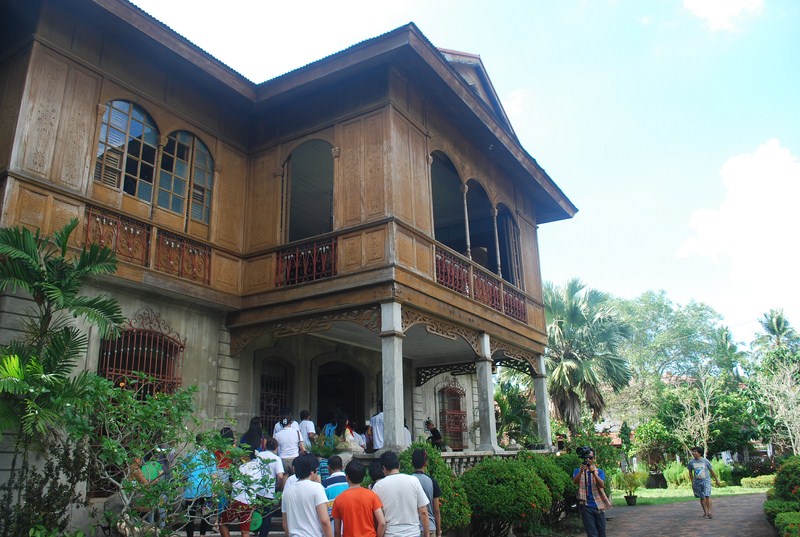
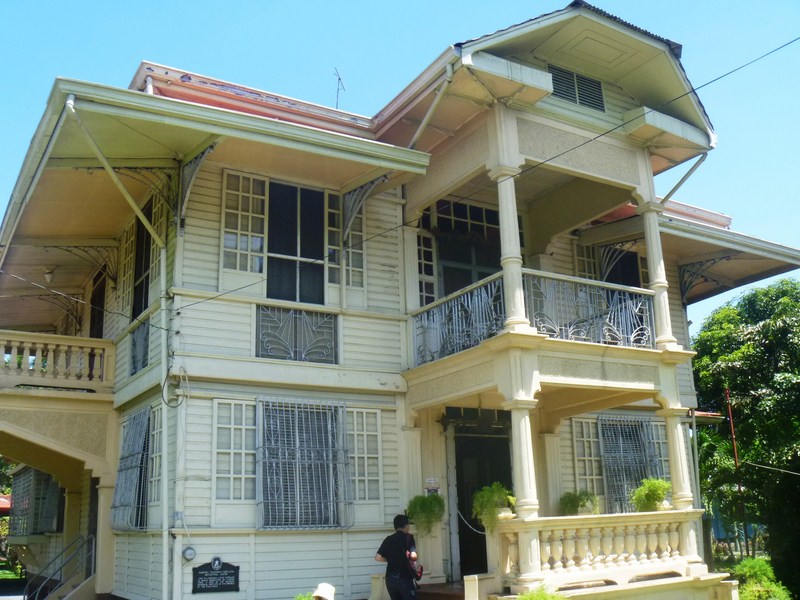
Built in in the 1930s in the Art Deco style of architecture, the house, fondly called Balay Daku (“Big House”), is beautifully preserved and one of the biggest in the city.  It has been named as a Heritage Houses of the Philippines by the National Historical Commission of the Philippines on April 6, 1993 and an NHCP marker, installed in 1995, can be found outside the front door of the house.

AUTHORS NOTES:

The central façade has a Spanish Mission Revival style, with arcades (a series of arches supported by columns) on the ground floor entrance porch and the second floor balcony with its projecting vigas (exposed beams). Arches are also seen in other windows as well as moldings above the windows.  Elsewhere in the façade are huge French windows with sliding wood and glass and persiana panels, below which are grilled ventanillas with sliding wooden panels for added ventilation.

Now resided in by my elderly aunt Rosario “Charet” Locsin (sister of Conchi), it still retains most of the original furniture of the house (upright piano, aparadors, china cabinet, solihiya chairs, etc.),  baldosa (tilework) and hardwood flooring.

There were portraits of the late senator’s parents, painted by Fernando Amorsolo (National Artist of the Philippines for Painting in 1972) as well as photos of the senator with different Philippine presidents.

On the steps leading up to the second floor of the house is a haunting bronze bust of four-year-old Julio Cesar created by sculptor Guillermo Tolentino (National Artist of the Philippines for Sculpture in 1973).  At the informal dining area is a spiral staircase with exquisite fretwork patterns.

The exquisite spiral staircase

During our stay in Silay, Solo would sometimes invite us to have our breakfast there or for snacks of homemade Silaynon delicacies such as tsokolate (made from round cacao tablets and fresh carabao’s milk), bizcocho (thin slices of toasted bread much like the biscocho, but without the butter and sugar), the sweet and decadent dulce gatas (a mixture of fresh carabao’s milk and muscovado sugar reduced to a thick caramel-like concoction) and meringue prepared by my Tita Charet.

The informal dining area

L-R: Cheska, Grace, Solo and Jandy

Jose C. Locsin Ancestral House: Juan Valencia cor. J.Pitong Ledesma Sts., Silay City Heritage Zone, SilayNegros Occidental Philippines. Coordinates: 10.7981254, 122.9741791

A Good Friday Roadside Scene (Tarlac)

On our way back to Manila from our Holy Week vacation at Lingayen (Pamgasinan) with my kids Jandy and Cheska, we encountered, along the highway in Camiling, a group of barefoot Filipino men  marching along the road, one carrying a heavy wooden cross while others were whipping their already bloody backs.  Curious, we stopped and parked our Toyota Revo along the road to join the crowd of onlookers observing this annual, gory Good Friday religious ritual.

A gory Good Friday roadside staple

During the Lenten season, many Filipino devotees (including some women), as a form of worship and supplication, perform religious penance during the week leading up to Easter Sunday.  However, these practices, widely believed by devotees to cleanse sin, cure illnesses and even grant wishes, are discouraged by the Catholic Bishops Conference of the Philippines who describe them as “inappropriate.”  However, these practices cannot be easily relinquished as it is already embedded in local culture and tradition. 

The man with the cross

Normally, those carrying the cross wear a maroon robe but the man we observed was, like the others, just naked from the waist up.  His face, also like the others, was covered by a piece of cloth with a crown of leaves on their head.  Bloody gashes, from the repeated strikes of their whips, could be seen on the backs of the flagellants who believe that their sacrifice would, somehow, grant salvation for their sins.

The self-flagellants

The self-flagellation ritual starts with the tying of ropes around the arms and legs of the flagellants (the one carrying the cross was similarly tied).  Then, with a blades, wounds are inflicted on their backs.  They then march, under the scorching heat of the sun, for about 4 to 5 hours.  Every 500 m. or so, they stop to rest.

Ramos Ancestral House (Lingayen, Pangasinan)

Ramos House

After the tour of the Provincial Capitol Grounds, Jandy, Cheska, Janet, Katrina and I proceeded to the restaurant of nearby Hotel Consuelo’s for lunch (Janet’s treat).

Check out “Hotel and Inn Review: Hotel Consuelo Resort and Chinese Restaurant

After lunch, we visited the restored ancestral house of AFP chief-of-staff and 12th Philippine president (1992-1996) Fidel V. Ramos and his sister, the former Sen. Leticia Ramos-Shahani.  The Ramoses weren’t around and the gates of the house were closed, again it being a holiday.

The house is a January 1995 re-construction of the original, which was destroyed during World War II. However, some of the furniture and family memorabilia have been saved and is now displayed in the restored house. That done, we returned to the resort, dropped off Janet and Katrina and proceeded on our way back to Manila.

Historical plaque

Ramos Ancestral House: Primicias St., Lingayen, Pangasinan.Tours of the Ramos ancestral house can be arranged through the Tourism Office at the Provincial Capitol Building.

Sison Cultural and Heritage Center (Lingayen, Pangasinan)

From the Provincial Capitol, Jandy, Cheska, Janet, Katrina and I proceeded to the just newly restored Sison Auditorium which was just a few blocks away. The pre-World War II Sison Auditorium, now the Sison Cultural and Heritage Center, was built from 1926 to 1927.

Sison Auditorium

Sison Cultural and Heritage Center

Formerly known as the Grand Provincial Auditorium in the 1930s, iti was a popular venue for zarzuelas and other cultural performances in pre-war and early post-war period.  The auditorium was later renamed after the late governor Teofilo Sison, the first Pangasinense to become secretary of National Defense.

Image-07Image-04Image-01

From 2008-2010, it was restored and refurbished by Gov. Amado T. Espino, Jr. and was inaugurated on April 5, 2010.  The refurbished Neo-Clasical-style auditorium, now a venue for cultural activities in the region, was meticulously designed to compete with the best cultural centers in the land.  

Cheska "performing" on stage

Cheska “performing” on stage

This beige and white colonnaded building has a 7-bay loggia  with round, monolithic columns with Classical capitals supporting a semicircular arch.  Above each column are circular tondi (roundels) set in spandrels (the space between arches). Its intricately handcrafted interiors includes state-of-the-art lighting and a majestic chandelier, imported from Austria, hanging from the highest point of the ceiling.

The majestic chandelier

The majestic chandelier

Sison Cultural and Heritage Center: Capitol Compound, Lingayen, Pangasinan

Pangasinan Provincial Capitol (Lingayen)

The Pangasinan Provincial Capitol

The Pangasinan Provincial Capitol

At the Capitol Grounds, Jandy, Cheska, Katrina, Janet and I visited the Provincial Capitol.  Built in 1912 (one of the first to be built in the country) during the term of Gov. Daniel Maramba, this imposing “Potomac Greek” building is, for me, the most beautiful in the country.  We first saw it when we arrived at the town at night, its stately marble columns beautifully lit.

The beautifully lit Provincial Capitol at night

The beautifully lit Provincial Capitol at night

Surprisingly, it was open during this holiday and the caretaker allowed us to climb its exquisite spiral staircase to visit the Governor’s Office and  the Provincial Board Room. At the latter, we got to sit at the Vice-Governor’s chair, handle a gavel and “preside” over a meeting.

The winding stairway

The winding stairway

Cheska, Katrina, the author, Janet and Jandy at the Governor's Office

Cheska, Katrina, the author, Janet and Jandy at the Governor’s Office

Later, we went up the roof deck where Commonwealth Pres. Manuel L. Quezon used to host elegant receptions and parties before World War II.

View of the Capitol grounds and Lingayen Gulf from the roof deck

View of the Capitol grounds and Lingayen Gulf from the roof deck

Here, we had a panoramic view of the Capitol Grounds, Lingayen Gulf and the town. The west wing was restored after destruction by shelling in 1945.

Lingayen (Pangasinan)

After breakfast at the resort, we still had time to kill before leaving for Manila in the afternoon of Good Friday, so I decided to explore Lingayen town in detail, notably the Capitol Grounds.  Together with my children Jandy and Cheska, we also brought along our Hundred Islands companions (and resort guests) Janet and Katrina.

The Provincial Capitol Gounds

The Provincial Capitol Gounds

Lingayen has two architecturally distinct and culturally disparate districts, one Spanish and the other American.  The older, more populous Spanish section, which escaped the destruction of World War II, was built inland and clustered around the plaza with its municipal building and the market.

Urduja House

Urduja House

The newer American seafront district, built near the Lingayen Gulfis more spacious, with a promenade and wide-spreading flame trees. It consists of many provincial government buildings including the Provincial Capitol and Urduja House, all located in the Capitol Grounds.

Return to the Hundred Islands (Alaminos City, Pangasinan)

View of Islands from View Deck

The last time I’ve been to the Hundred Islands in Alaminos City, Pangasinan was way back March of 2005, Holy Week with son Jandy and 2 lady friends, and we only got to explore 3 of its islands, camping overnight at Marta Island. I considered this a poor batting average considering that there are 127 of these granite and scrub-covered islands and islets, a number of them having white sand beaches.  Again it was Holy Week and this time I, together with Jandy and daughter Cheska, found ourselves in Pangasinan, staying at El Puerto Marina Resort and Spa at the provincial capital town of Lingayen.  The resort offered day tours to the islands and we decided, especially Cheska who was a first-timer to these islands, to join the tour.  Our group included Fil-American Ms. Katrina Nogoy and Malaysian-American Ms. Janet Jun Siew Loh, both visiting school teachers from Japan.  Our guide was resort employee Mr. Viramel “Ram” Velasco. 

Lucap Wharf

The trip, via a van driven by Mr. Nixon Fernando, to Brgy. Lucap, take-off point to the islands, took all of 1 hour. Again, it being a long holiday, the wharf and every island with a white sand beach was packed with tourists.  Although I brought a 5-pax tent with me to Lingayen, camping on an island was out of the question.  However, we decided to explore beyond the normal tourist boat route which only included the partially developed Children, Governor’s and Quezon Islands, this time including the other outlying but interesting islands, paying a hefty PhP800 to do so.  While waiting for our boat, I made a short visit to Lucap’s Marine Museum which has a collection of corals and other marine life.  This 1,844-hectare national park, declared as such on January 18, 1940 through Proclamation No. 667, is believed to be the second largest marine reservation in the world with 2,000 species of marine life.

Lucap Wharf Marine Museum

The whole park can be readily covered, even by a slow banca, in half a day.  Most of the islands we passed are small (the smallest being less than 20 sq. m.), heavily-undercut at the base and have an elevation of 20 m. .  Many do not have trees to shade you from the sun and do not carry a name.  Some that do carry names are fancifully named after luminaries in the country (Marcos Island, Romulo Island, Quezon Island, etc.) while others are named after plants and animals that they resemble (Mushroom Island, Turtle Island, etc.).  An interesting photo opportunity was Cathedral Island, so named after its cathedral-like, fruit bat-inhabited cave with domed rock formations.  

Cathedral Island and Cave

Our first stop was Governor’s Island.  The island had white sand beaches on both sides but lolling around at the packed beaches wasn’t yet in our agenda.  Instead, all five of us decided to climb up the top of the island which, unlike 5 years ago, now had paved stairs and roped railings leading to a concrete view deck with railing (and packed with tourists).  What hasn’t changed, though, was the magnificent and panoramic view it afforded of this mini-archipelago said to have been formed from the tears of a prehistoric lovelorn giant who pined for his lost lady love.   The island also has a not-too-deep, sea-sculpted cave.

Marcos Island

Our next and longest stopover was Marcos Island.  Marked by mermaid statues, the island consists of 3 mounds, a 70-foot drop-off, a nice white sand beach (difficult to land on when the waves are high) and a helipad on the smaller dome.   From the beach, a well-marked trail, on the left, leads to the top of the island where its chief attraction is the bat-inhabited Imelda Cave which can be peered down from a blowhole above. Here, the adventurous and brave could climb down a wooden stairs to a ledge where they can cliff dive to the sea below.    

Waiting in line for our cliff dive
All five of us took a shot at it but the visibly scared Katrina and Jandy (although he knows how to swim) donned life vests just in case.  Upon hitting its suitably deep waters, we swam or clung to the cave walls, out to the cave mouth and back to the white sand beach.  Although Janet and Katrina only tried it once, we liked it so much that we went back for second shots (Cheska tried it thrice).  With our adrenaline rush sated, we finally settled down to lolling around in the rock-shaded portion of its beach. 
Cheska taking the plunge

It was now noontime and, after this exciting but adrenalin-sapping exercise, we were visibly hungry, our previous meal being an early breakfast at the resort.  We got back to our boat and proceeded to Quezon Island (at 25 hectares, the largest in this mini-archipelago).  This most frequented island was truly packed to rafters with tourists as it had, aside from its white sand beach, a pavilion for guests, stores (where one could dine) and toilet and bathing facilities (for a fee).  Again, it being a holiday, prices of goods bordered on the cutthroat but, hungry as we were, still ordered cooked Spam (at PhP250, twice that in Manila) plus rice (at PhP25 per cup) washed down with half-liter bottles of water (at PhP60).  The island also has a nursery for giant clams (locally called taklobo), a demonstration site for 300 clams dispersed here and at Children’s and Governor’s Islands, and all monitored on a regular basis. These, as well as the corals and mangroves, were rehabilitated through a program called “Marine Biodiversity Enhancement,”  a project of the Philippine Tourism Authority (PTA), the University of the Philippines Marine Science Institute (UPMSI) and the Marine Environment and Resources Foundation (MERF). 

Cuenco Island and its Cave
Backed at our boat, we passed by, but did not land, at the similarly packed Children’s Island which has a walkway and a calm, nearly wave-free shoreline suitable for children (hence its name). Cuenco Island, also called Quinco Island, was our last stopover.  This interesting island has two white sand beaches, on two sides, and a huge cave that passes through its center. 

Cathedral of the Epiphany of Our Lord (Lingayen, Pangasinan)

This church, built in 1712, was destroyed by fire and rebuilt in 1892.  The dome was built by parish priest (1826-1834) Fr. Miguel Aparicio.  On January 9, 1945, the bishop’s residence was greatly damaged and the church was partially destroyed when American forces dropped bombs on the Poblacion.

Cathedral of the Epiphany of Our Lord

Cathedral of the Epiphany of Our Lord

The renovated church reopened in 1965 but it was damaged again during the July 16, 1990 earthquake and later repaired.  This massive adobe church, formerly the Three Kings Parish Church, is now the seat of the Lingayen Diocese which was created in 1932 with Msgr. Cesar Ma. Guerrero as its first bishop.

The 5-storey, octagonal bell tower

The 5-storey, octagonal bell tower

Its interiors have fine specimens of religious art in wood and metal and its imposing, Oriental pagoda-like (supposedly an architectural influence of the town’s Christianized Chinese inhabitants during the Spanish colonial period) , 45 yard high, 5-storey bell tower is said to be the tallest in the country.  Its centuries-old church bells dating back to the 1800’s, which fell during the American bombardment, are displayed in the Kampana Museum within the cathedral grounds.

Check out “Kampana Museum

Cathedral of the Epiphany of Our Lord: Poblacion, Lingayen, 2401 Pangasinan.  Tel: 542-6235.  Feast of the Three Kings: January 4-6.

How to Get There: Lingayen is located 200 kms. from Manila and 15 kms. west of Dagupan City.