Tour of Batan Island: Mahatao (Batanes)


Batan Island circuit road

On my second day in Batanes, I paid a courtesy call and asked for assistance from Gov. Vicente S. Gato and Tourism Officer Elmo Merin at the Provincial Capitol (built from 1794 to 1798 as the Casa Real or Spanish Governor’s residence) in Basco.  The Capitol fronts the grassy plaza leading down to Kanyuyan Port and Beach in Baluarte Bay.  Gov. Gato, a keen promoter of Batanes’ tourism potential, gladly allowed me the use of a Toyota Revo to be driven by Mr. Luciano “Anong” de Guzman.  He also assigned Ms. Joy Gabaldon and Mr. Jose “Boging” Astudillo as my guides.

The Provincial Capitol

Our route around the 35.5-sq. km., generally mountainous Batan Island skirted the west coast through Mahatao and Ivana to Uyugan. The winding circuit around the island took nearly 1.5 hrs. This included stopovers for photo ops and a longer wait to replace a flat tire.  All throughout, I was rewarded with a vista of sheer limestone cliffs alternating with gently rolling hills, great boulder beaches and some black and white sand beaches hemmed in by a broad fringing reef.  

Reliving the “Sound of Music” at Payaman

The wind-swept, vast and sprawling Racuh a Payaman, at Mahatao’s outskirts, is a huge track of communal pastureland preserved by the villagers.  Popularly called the “Marlboro Country of Batanes,” cattle, carabao and horses grazed at its endless array of rolling hills.  A photographer’s and nature lover’s delight, the hills have a breathtaking view of Mt. Iraya, the Pacific Ocean, the Mahatao Lighthouse and nearby fields hedged with trees that break the wind’s full fury, allowing root crops to grow.   They say this the place to catch a breathtaking Batanes sunrise.  Here, I can’t help but do a “Sound of Music  pose. 

Church of San Carlos Borromeo
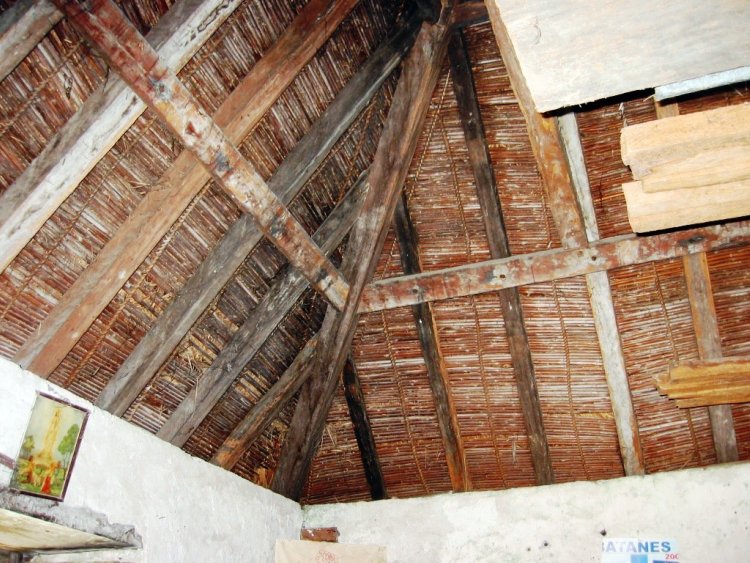
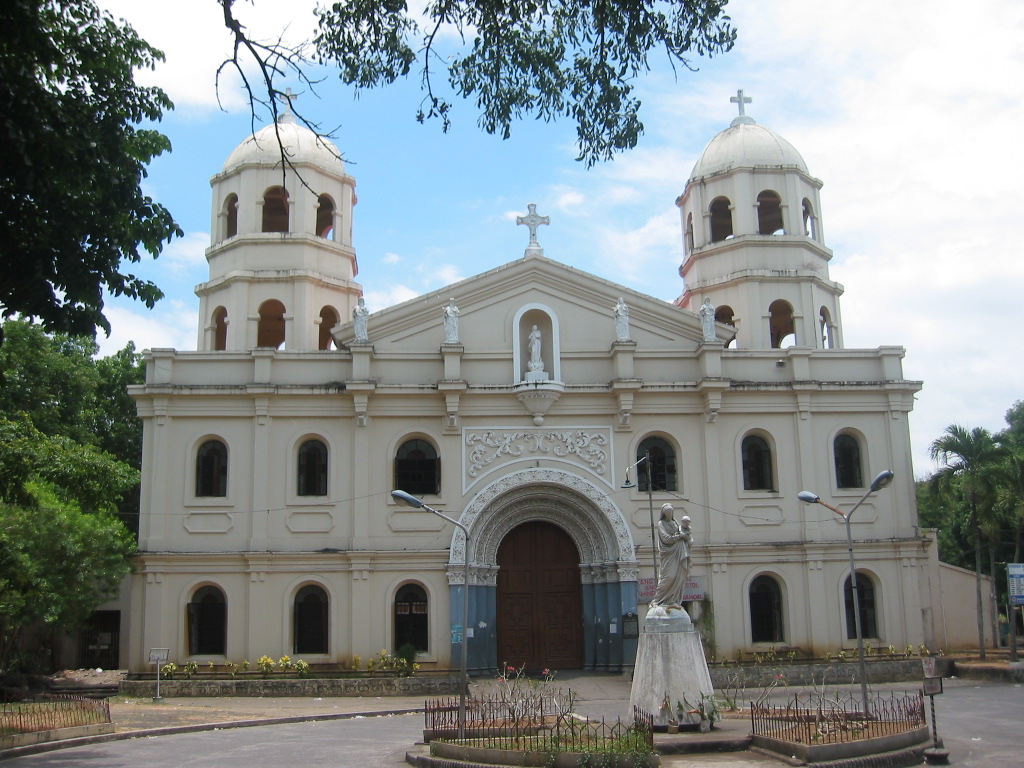
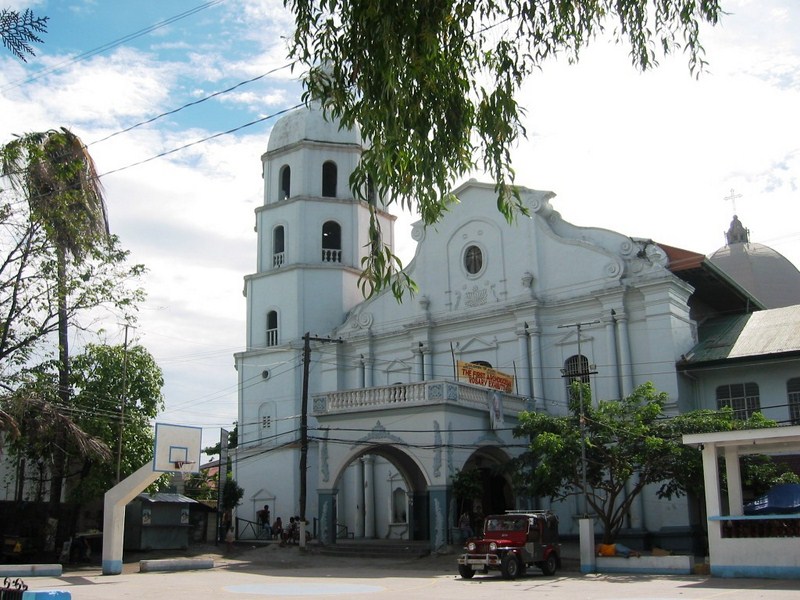
At Mahatao town proper is the venerable San Carlos Borromeo Church, in Mahatao, one of 26 churches listed as National Cultural Treasures by the National Museum.  First built by Dominican friars in 1789, the present church dates to 1873.  It has an espadana-style façade (with two round arches at roof levels for the bells) and massive buttresses at the outer walls (which serve as stairways for servicing its then cogon-covered roof).    At the church courtyard and at the elementary school grounds are Spanish-era stone lampposts used as guiding lights to guide fishermen and early mariners safely to the anchorage just beyond the town’s seaport.   The town’s Spanish-era bridge also retains its centuries-old features.  

Naidi Hills (Basco, Batanes)

Come late afternoon, I decided to hike up the nearby Naidi Hills, northwest of Basco proper.  Here, I had a unique view of Baluarte Bay, Basco, mist-shrouded, 1,009-m. high  Mt. Iraya (Batanes’ highest mountain), the sunset and the rolling hills.  The hills used to be the site of the Philippine’s tallest wireless communications facility, bombed by the Japanese planes on December 8, 1941.  Only the base remains.  Also on the hill are the damaged buildings and bunkers that used to house the communications facilities. 

The bucolic Naidi Hills

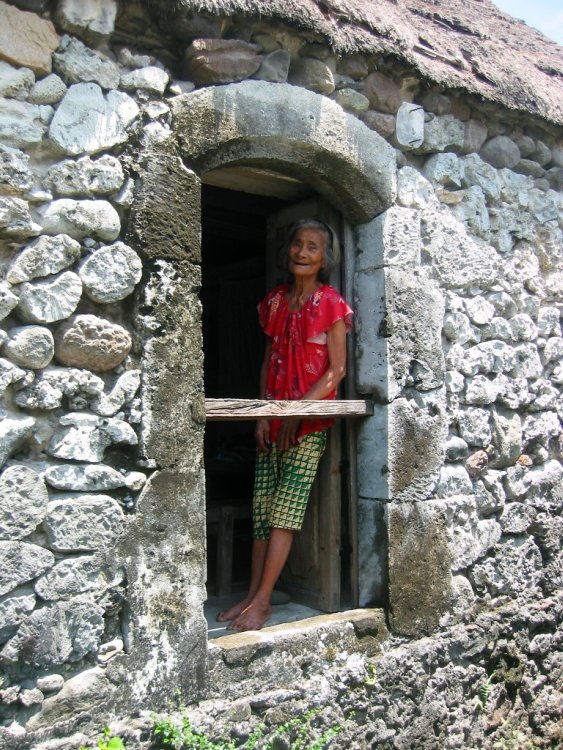
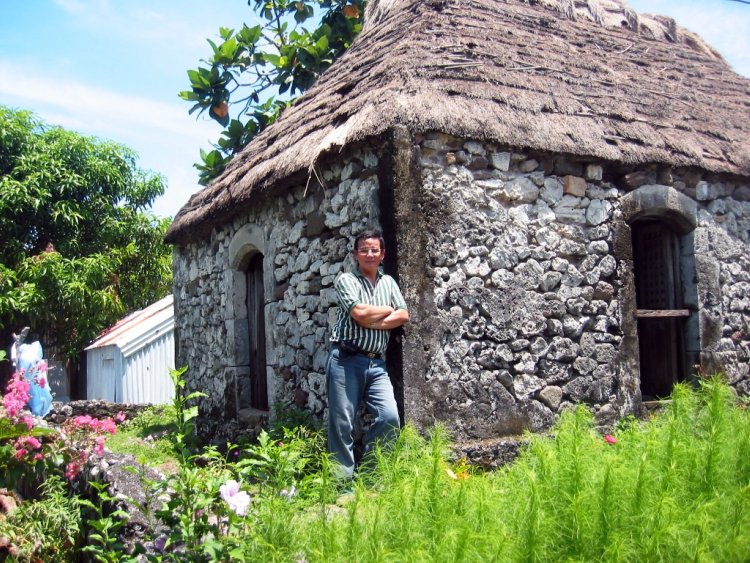
The hill is now home to the new 6-storey, 66-ft. high conical Basco Lighthouse (also called Naidi Lighthouse), one of 3 lighthouses proposed by former Congressman Florencio “Butch” Abad.  Built in 2003, it is located a few meters away from Radyo ng Bayan station  and standing on the same site of Basco’s first lighthouse.  It has a view deck on the fifth floor.  Beside it is an Ivatan stone house constructed of native materials and essentially of vernacular architecture.  The hill is also home to grazing cattle.  On one occasion, one bull gently prodded me to vacate the grass I was sitting on. 

One of Naidi Hills resident cattle

Naidi Hills: Sitio Diajang, Brgy. San Antonio, Basco, Batanes.

Batanes: A Dream Fulfilled

Postcard-pretty Basco

Even for a seasoned traveler like me, getting to remote Batanes has always remained a dream.  However, winning a round trip Asian Spirit plane ticket, via a raffle draw during my college’s Golden Anniversary celebration, made that dream a reality as I could choose from any of its destinations served.  I chose the farthest – Batanes.  After reserving and paying the other charges for the ticket (around PhP1,700), I wasted no time in making plans, summer having just ended and the rainy season just about to begin.  This would be my first local trip alone, without family or friends to accompany me.  I left Manila for Basco the morning (9:40 AM) of June 1, Thursday.  The trip took all of 2 hrs., Basco being 483 air kms. from Manila.  The plane also made a 30-min. stopover at Tuguegarao (Cagayan) Airport.  It was just about lunchtime when I arrived in Basco Airport, tired, hungry and with a queasy stomach, the result of a very bumpy flight (now I know why the stewardess gave us mint candies prior to the flight).   

Asian Spirit plane at Basco Airport

From the airport, I took a tricycle to the town center and checked in at one of Mama Lily Inn’s 3 fan-cooled rooms with common bath.  This was to be my home for the 5 days I was to stay in this beautiful province. Basco, the lovely provincial capital and the center of commerce, is the  biggest and most urbanized among the 6 towns of the province. It houses the provincial offices of most national government agencies as well as the larger business establishments and collegiate institutions.  Formerly called Vasay, the town was renamed after Spanish Gov.-Gen. Jose Basco y Vargas. 

Jose P. Laurel Museum and Memorial Library (Tanauan City, Batangas)

From the Cathedral of St. John the Evangelist, Jandy and I moved on to the nearby Jose P. Laurel Museum and Library, the home of Jose P. Laurel, the president of the Japanese-sponsored Second Philippine Republic (October 14, 1943-August 17, 1945).  Laurel was born here on March 9, 1891.  The Laurels, being a prominent family, built their residence just walking distance from the cathedral and town hall and 100 m.  from the national road. 

Jose P. Laurel Museum and Memorial Library

Built in 1880, this ancestral house was restored by Jose P. Laurel’s son Mariano and daughter-in-law Alicia on March 9, 1964 and was donated to the national government to serve as a public library.  It also houses Jose P. Laurel’s memorabilia.  The 2-storey house has a ground floor of stone and an upper level of wood with wooden posts, sliding capiz windows and a floor of brightly polished wooden planks. 

The dining room
The living room
Laurel’s office

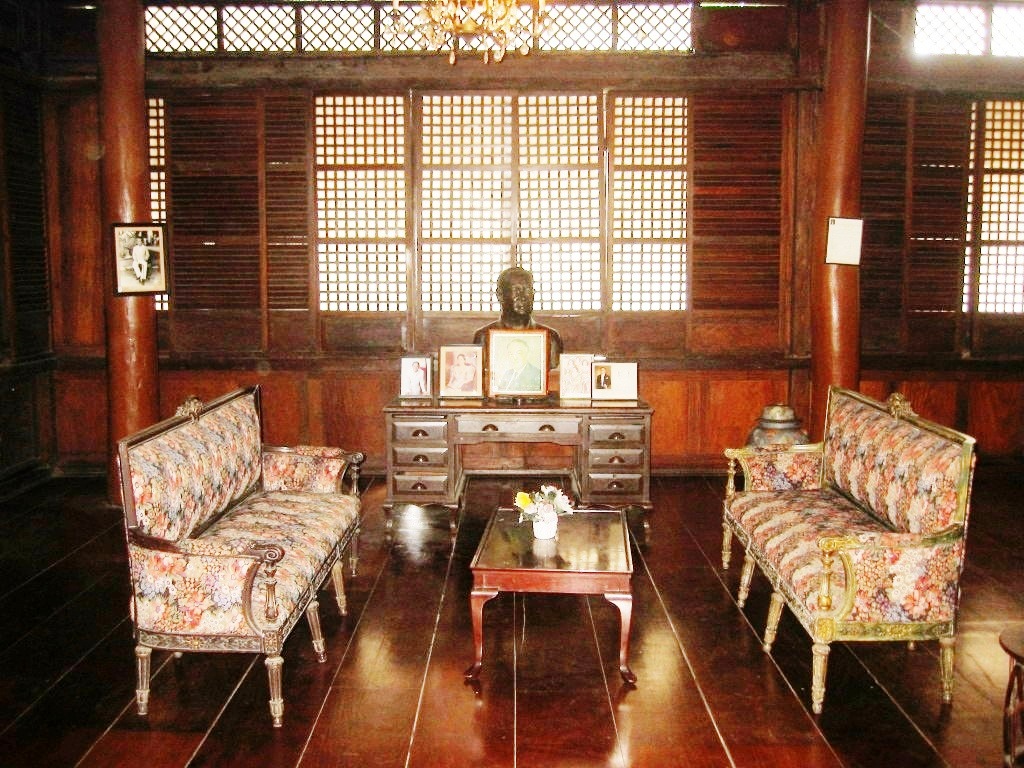
It was a holiday (Labor Day) during the time of our visit but the caretaker gladly allowed us free rein to tour the areas of the house – the living room (with its prominent bust of Laurel), dining room (with its 8-seater dining table and mounted photo of Laurel delivering a speech) and Laurel’s bedroom (with its antique 4-poster bed) and office (with Laurel’s desk and chair).    Beside an oil painting of Laurel is a wooden harp.  Outside the house is an antique church bell.

Laurel’s bedroom
A wooden harp
The old church bell

Jose P. Laurel Museum and Memorial Library: A. Mabini Ave, Poblacion, Tanauan City, Batangas. Open daily, 8 AM-5 PM.

Cathedral of St. John the Evangelist (Tanauan City, Batangas)

Jandy and I were now on our way home from our overnight stay in Lipa City.  At a KFC outlet in Tanauan City, we made a short stopover for an early fried chicken lunch.  After lunch, we walked over to the city’s beautiful Cathedral of St. John the Evangelist for some sightseeing.  First built with wood in 1690, it was replaced with stone from 1732-67 and later rebuilt in 1812 by Fr. Ramon Cosio.  
 
Cathedral of St. John the Evangelist
The present structure was built from 1881-98 by Fr. Jose Diaz.  The church was damaged in 1944 and rebuilt in 1948 by Monsignor Marino and Arch. Jose L. Zaragoza in the Romanesque style.  The convent, built in 1872 and also destroyed in 1944, was rebuilt together with the cathedral.
      
The unremarkable modern interior
The cathedral’s simple, High Renaissance and Romanesque facade, resembling the original one, has an ornate Romanesque-style recessed main entrance (resembling layers of lace) supported by 6 sets of elaborately decorated semicircular arched windows, a triangular pediment with a semicircular statued niche and a balustrade supporting statues of saints projecting over stone bases from the frieze.   The rounded arches tapering down to the strong pillars harmonize with the uncluttered lines of the central ceiling.  The church is also noted for its wide open central nave and circular niches. The churchyard has life-size tableaus of the 14 Stations of the Cross.  Its bell tower, mounted on the horizontal extension of the facade, is topped by a Baroque-style dome.
 
Cathedral of St. John the Evangelist: A. Mabini Ave., Brgy. 1, Poblacion, Tanauan City, Batangas.

Mt. Malarayat Golf & Country Club (Lipa City, Batangas)

While in Lipa City, we made a short visit to the 200-hectare Mt. Malarayat Golf & Country Club where my brother Frank plays golf.  This private proprietary club, developed by the Active Group, is nestled at the foot of the mountain range for which it was named.  It has a 27-hole, flood-free, all-weather championship golf course designed by  Bob Moore of the internationally renowned J. Michael Poellet (JMP) Golf Design Group.  
 
It consists of three courses named  for peaks in the Malarayat Range -the 18-hole, 6,284-yard, par 72 Mt. Lubo and Mt. Malepunyo golf courses and the 9-hole, 3,168-yard par 36 Mt. Makulot golf course.  The tight and challenging layout is complemented by beautiful scenery. The rough and fairways are Tifton 419 bermuda grass.  On the first 18 holes, water hazards are found on Hole No. 1, 7, 8, 9 and 18 and, on the third nine, Hole No. 6 and 9.  There are sand traps on the fairways and on the greens.  The 591-yard Hole No. 4 is the longest hole.
       
Facilities here include a 40-room hotel adjacent to the golf course, a driving range, practice putting green, clubhouse with restaurant, bar, pro shop, function room, tee houses, lounge, lockers, jacuzzi, sauna, massage areas, gym, boutique, children’s center, equestrian center, indoor sports club (basketball, billiards, darts, badminton, tennis, squash, pingpong and bowling) and golf clinic.  Guest must be accompanied or introduced by a member.
 
Mt. Malarayat Golf & Country Club: Brgy. Dagatan,
Talisay Sapac & Munting Pulo, Lipa City, Batangas.  Tel: (043) 756-7000. Fax: (043) 756-7008.

Agnaga Falls and Cold Spring (Malay, Aklan)

During one of our family visits to Malay (Aklan), I decided, for a change, to veer outside our normal routine of visiting Boracay Island by visiting one of the town’s little-known tourist attractions – Agnaga Falls.  Though listed as one of Malay’s 7 natural wonders (Boracay is No. 1 of course), not many people, aside from the locals, know about or visit the place.

L-R: Cheska, John Paul, Ningning and Jandy

Joining me were my kids Jandy and Cheska plus their third cousin John Paul and John Paul’s mom, Ningning.  After lunch, we all boarded the Mitsubishi L-200 pickup and were driven my Naciang, Ningning’s husband and my wife Grace’s second cousin, along the road to Buruanga up to the jump-off point.  This was as far as the pickup could go.  Naciang stayed behind with the pickup to await our return.

Agnaga Falls

From here, it was to be all footwork through a dirt trail within a light forest. After about 20 mins. of leisure hiking, the sound of the fall’s flowing waters told us we have finally reached our destination.  The falls wasn’t high, just about twice my height, but the cool turquoise waters at its small, shallow pool were inviting. Besides, we were the only visitors around and we had the falls all to ourselves.   Simply heaven.

Agnaga Falls: Brgy. Kabulihan, Malay, Aklan.

Stopover: Church of the Immaculate Conception (Guagua, Pampanga)

The town’s brick and stone church was started in 1641 and supervised by Fr. Jose Duque.  It was artistically painted by Fr. Antonio Bravo in 1862 and the beautiful dome above the transept was built by Fr. Paulino Fernandez in 1886.

Church of the Immaculate Conception

Church of the Immaculate Conception

Its Classic facade has slender, superimposed and paired Doric columns and a scarcity of decorative elements.  The undulating pediment has a raking cornice in the form of a large scroll.  It also has an oval window at the retablo and geometric motifs within a stilted semicircular arch molding.

The church's interior

The church’s interior

The present stone convent was built by Fr. Manuel Carillo but was recently razed with only the walls remaining.

The altar retablo

The altar retablo

How to Get There: Guagua is located 77 kms. from Manila and 10 kms. south of the City of San Fernando.

Church of St. Augustine (Lubao, Pampanga)

This church was first built by Fr. Juan Gallegos using light materials.  The present brick and adobe church was started by Fr. Francisco Coronel, continued by Fr. Geronimo de Venasque in 1635 and completed by Fr. Francisco Figueroa in 1638.  It was damaged during the 1645 earthquake and was enlarged in 1829 using masonry materials.  Fr. Antonio Bravo did some repair work in 1877 while Fr. Antonio Moradillo worked on the interior decoration in 1893 (the murals depicting scenes from the life of St. Augustine were probably done during this time).

Church of St. Augustine

Church of St. Augustine

The church was occupied by revolutionaries in 1898, used as a hospital for American soldiers in 1899 and in 1942, during World War II, the dome, transept and roof collapsed during the heavy Japanese bombardment.  The main retablo was undamaged but sunken panels and other liturgical ornamentations done by Italian artist Alberoni were lost.  It was restored from 1949 to 1954 by Fr. Melanio Garcia but was again damaged by a strong typhoon in 1962.

The church's facade

The church’s Neo-Classical-style facade

The church is 82.45 m. long, 21.12 m. wide, 10.50 m. high and has 2.46-m. thick walls.  The simple, plastered stone Neo-Classic-style facade has a semicircular arched main entrance flanked by engaged, fluted pilasters spanned by a lintel frame above which is a rectangular window with the same pilaster and lintel arrangement and flanked by small niches.  Above the window is a statued niche with a small segmental pediment above it and elegant curvilinear lines flowing from the mid-section.  An imaginary triangular pediment masks the roof.

The 5-storey, octagonal bell tower

The 5-storey, stone and brick bell tower

Its only nave was originally painted by Dibella and Alberoni, both Italian artists.  The central retablo is flanked by rectangular openings with triangular segments as well as coupled pilasters on the first level and single columns on the second level.   The 5-storey, 31-m. high stone and brick bell tower, still unrestored, has two square stories and three octagonal.  The convent, at the opposite end of the church, is profusely ornamented.

The church's retablo

The church’s retablo

How to Get There; Lubao is located 83 kms. from Manila and 16 kms. south of the City of San Fernando.

Ocean Adventure Marine Park (Subic Freeport Zone, Zambales)

After dropping off our luggage and freshening up at the Subic International Hotel, Jandy and I then returned to our Toyota Revo and hied off to Ocean Adventure Park, nestled at Camayan Wharf in the West Ilanin Forest area inside the Subic Bay Freeport Zone.  Once in, we first had to satisfy our growling stomachs, doing just that with much-needed lunch at the park’s 240-sq. m., 70-pax Ilanin Bay Cafe.

Bottlenose dolphins

The world-class Ocean Adventure, managed by the Subic Bay Marine Exploratorium Inc. (SBME), is the first and most astounding nautical sanctuary in the country and the first and only open-water marine park facility in Southeast Asia.  Opened on September 15, 2001, this 20,000-sq. m. (12,000 sq. m. on land and 8,000 sq. m. on water) park showcases some of the world’s most amazing sea mammals and is home to 8 South American sea lions (Otaria byronia), 6 false killer whales (Pseudorca Crassidens), 4 bottlenose dolphins (Tursiops truncatus gili) from Japan, and porpoises, all moving about in their inherent, natural habitat (not man-made as in similar parks abroad), fenced off only on one side of the shore.

Park trainers

The park aims to provide guests with what they call “edutainment” (educational entertainment), educating the people on marine life and the rich resources people should learn to value and conserve.  It thus gives the Filipinos an opportunity to truly appreciate the value of marine mammals as partners of humanity in the enormous task of saving our oceans.  The park is currently managed by a team of highly trained professionals, all formerly involved with internationally recognized theme parks such as the Hong Kong’s Ocean Park, Walt Disney World and Florida’s Animal Kingdom. In its effort to protect, preserve and develop wildlife and the forestland, Ocean Adventure also corroborates with the Wildlife in Needs (WIN) Foundation and the Subic Bay Metropolitan Authority (SBMA) Ecology Center, putting up a rescue center within the compound for sick, injured and confiscated wildlife in the Subic Bay area.  About 50 injured animals are presently under the care of experts and veterinarians in the facility.  The WIN Rescue Center is open for public viewing.  Here, visitors can get a peak on how the animals are being cared for and treated.

The Sea Lion Show

The Animal Care Clinic, a behind-the-scene look at how the animals are cared for, offers visitors a chance to view the actual lab work evaluating individual health parameters of the mammals.  The Animal Nutrition Center, on the other hand, is a behind-the-scene look at the kitchen support extended to the animals. Visitors can see how animal food and dietary programs are prepared.   The Sea Lion Show, at the 350-seat Nautilus Theater, starred the adorable and amusing showgirls Brandy, Simba and Thalia.  They amused us, as well as the audience, with their funny antics.

Ocean Discovery Aquarium

Next on my itinerary was the Whale Show at the 700-seat El Capitan Stadium. In between shows, we visited the 280-sq. m. Ocean Discovery Aquarium.  Its arrangement of fresh water and seawater (marine) habitats hosts different species of corals and fishes of the Philippine marine ecosystem, recreating Subic’s marine life at different levels.  The Ocean Discovery Aquarium aims to inspire understanding and help promote conservation of the natural environment by providing the public an entertaining and educational facility that serves as base for protective and educational activities, extending into the surrounding forest watershed and bay area. The 50-pax Learning Center, a classroom and library, offers educational materials and information on marine mammals and marine conservation.  We also visited the 180-sq. m. Ocean Treasures, the gift shop located by the Entry/Exit gate.

The Whale Show

The Whale Show, the main attraction, featured the three awesome false killer whales Cook, Founder and Tonka plus some dolphins. After the show, Jandy and I opted to have our pictures taken, petting a dolphin. For the more “adventurous,” the park also offers a “Whale Encounter Program” at the Encounter Cove where guests get to join in and swim with the whales in the water, pet and feed them and have souvenir photos taken with the gentle creatures.  It also offers a “Dive with the Whales Program” and dive courses.

Ocean Adventure: Camayan Wharf, West Ilanin Forest Area, Subic Bay Freeport Zone.  Tel: (047) 252-9000.  Fax: (047) 252-5883. Manila tel: (632) 706-3344 to 46.  Fax: (632) 706-0808.  E-mail: info@oceanadventure.com.ph. Website: www.oceanadventure.com.