St. Peter’s Basilica (Vatican City)

St. Peter's Basilica

St. Peter’s Basilica

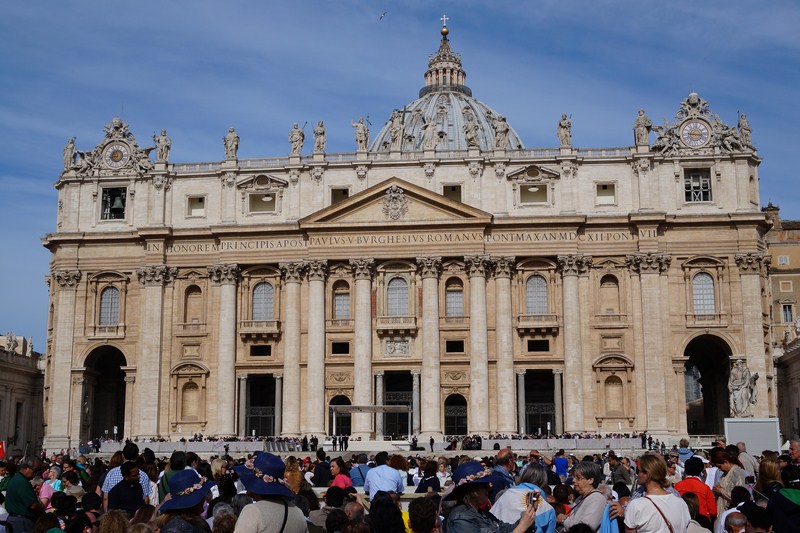
The Papal Basilica of St. Peter (LatinBasilica Sancti PetriItalianBasilica Papale di San Pietro in Vaticano), or simply St. Peter’s Basilica, the most prominent building in the Vatican City, is regarded as one of the holiest Catholic shrines and the most renowned work of Italian Renaissance architecture.  As a work of architecture, it is regarded as the greatest building of its age. Located west of the River Tiber, near the Janiculum Hill and Hadrian’s Mausoleum, its central dome Its dome is a dominant feature of the skyline of Rome. Best appreciated from a distance, the basilica is approached via St. Peter’s Square.

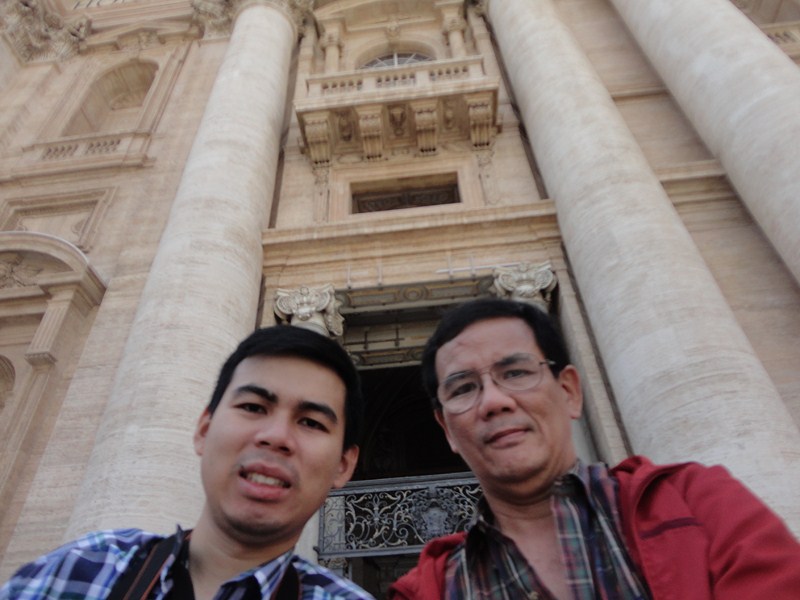
Jandy and the author at St. Peter's Basilica

Jandy and the author at St. Peter’s Basilica

The basilica has the following specifications:

  • Area: 2.3 hectares (5.7 acres)
  • Cost of construction of the basilica: more than 46,800,052 ducats
  • Geographic orientation: chancel west, nave east
  • Total length: 730 ft. (220 m.)
  • Total width: 500 ft. (150 m.)
  • Interior length including vestibule: 693.8 ft. (211.5 m.), more than ⅛ mile.
  • Length of the transepts in interior: 451 ft. (137 m.)
  • Width of nave: 90.2 ft. (27.5 m.)
  • Width at the tribune: 78.7 ft. (24 m.)
  • Internal width at transepts: 451 ft. (137 m.)
  • Internal height of nave: 151.5 ft. (46.2 m.) high
  • Total area: 227,070 sq. ft. (21,095 m2), more than 5 acres (20,000 m2).
  • Internal area: 163,182.2 sq. ft. (3.75 acres; 15,160.12 m2)
  • Height from pavement to top of cross: 448.1 ft. (136.6 m.)
  • Façade: 167 ft. (51 m.) high by 375 ft. (114 m.) wide
  • Vestibule: 232.9 ft. (71 m.) wide, 44.2 ft. (13.5 m.) deep, and 91.8 ft. (28 m.) high
  • The internal columns and pilasters: 92 ft. (28 m.) tall
  • The circumference of the central piers: 240 ft. (73 m.)
  • Outer diameter of dome: 137.7 ft. (42.0 m.)
  • The drum of the dome: 630 ft. (190 m) in circumference and 65.6 ft. (20.0 m) high, rising to 240 ft. (73 m) from the ground
  • The lantern: 63 ft. (19 m.) high
  • The ball and cross: 8 and 16 ft. (2.4 and 4.9 m.), respectively
  • Peter’s Square: 1,115 ft. (340 m.) long, 787.3 ft. (240 m.) wide
  • Each arm of the colonnade: 306 ft. (93 m.) long, and 64 ft. (20 m.) high
  • The colonnades have 284 columns, 88 pilasters, and 140 statues
  • Obelisk: 83.6 ft. (25.5 m.). Total height with base and cross, 132 ft. (40 m.).
  • Weight of obelisk: 360.2 short tons (326,800 kgs.; 720,400 lbs.)
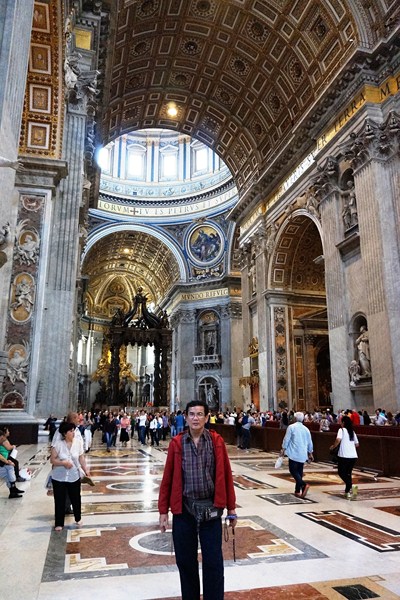
The author within the nave

The author within the nave

Here are some interesting trivia regarding St. Peter’s Basilica:

Designed principally by Donato BramanteMichelangeloCarlo Maderno and Gian Lorenzo Bernini, the façade of the basilica, designed by Maderno, is 114.69 m. (376.3 ft.) wide and 45.55 m. (149.4 ft.) high and is built of travertine stone, with a giant order of Corinthian pilasters, all set at slightly different angles to each other (in keeping with the ever-changing angles of the wall’s surface), and a central pediment rising in front of a tall attic surmounted by 13 statues: Christ flanked by 11 of the Apostles (except St. Peter, whose statue is left of the stairs) and John the Baptist.

The inscription below the cornice on the 1 m. (3.3 ft.) tall frieze reads: IN HONOREM PRINCIPIS APOST PAVLVS V BVRGHESIVS ROMANVS PONT MAX AN MDCXII PONT VII In honour of the Prince of Apostles, Paul V Borghese, a Roman, Supreme Pontiff, in the year 1612, the seventh of his pontificate)

The inscription below the cornice on the 1 m. (3.3 ft.) tall frieze reads: IN HONOREM PRINCIPIS APOST PAVLVS V BVRGHESIVS ROMANVS PONT MAX AN MDCXII PONT VII In honour of the Prince of Apostles, Paul V Borghese, a Roman, Supreme Pontiff, in the year 1612, the seventh of his pontificate)

The huge cornice, above them, ripples in a continuous band, giving the appearance of keeping the whole building in a state of compression. The facade stretches across the end of the square and is approached by steps on which stand two 5.55 m. (18.2 ft.) statues of Saints Peter and Paul, the 1st-century apostles to Rome.  Construction of the current basilica, replacing the Old St. Peter’s Basilica  begun by the Emperor Constantine the Great (between 319 and 333 AD), was started on April 18, 1506 by Pope Julius II.  In the next 120 years, after a succession of popes and architects, it was solemnly dedicated by Pope Urban VIII  on November 18, 1626.

The nave

The nave

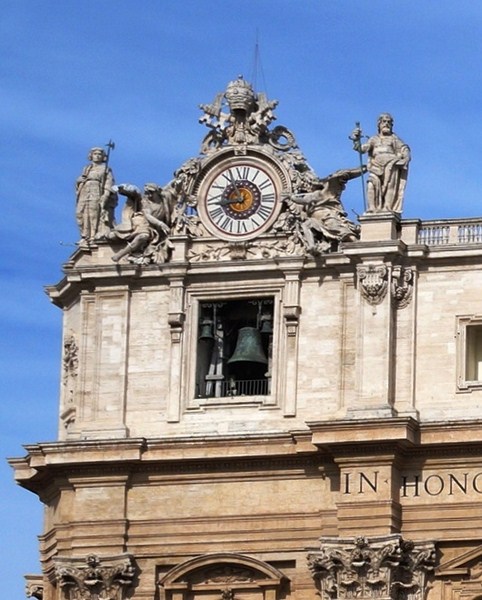
Cruciform in shape, the basilica has an elongated nave in the Latin cross form with a central space dominated, both externally and internally, by one of the largest domes in the world. In the towers to either side of the facade are two clocks, designed by Giuseppe Valadier from 1786-1790. The one on the right, called the Oltramontano Clock, has one hand showing European mean time. The one on the left, called the Italian Clock, shows Rome time. The oldest bell of the clock on the left, operated electrically since 1931, dates from 1288.

The clock on the left of the facade

The clock on the left of the facade

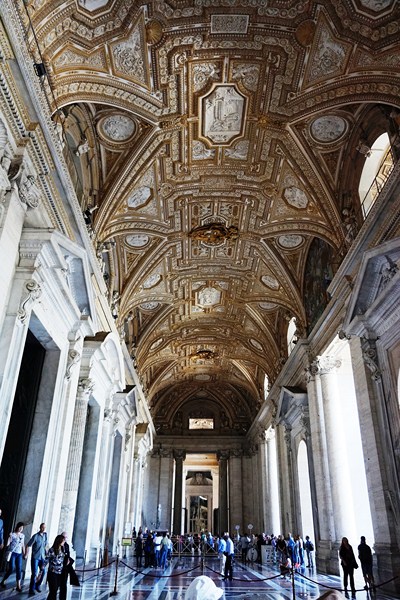
Behind the façade of St. Peter’s, stretching across the building, is a narthex (long portico or entrance hall) such as was occasionally found in Italian Romanesque churches. Part of Maderno’s design, it has a long barrel vault decorated with ornate stucco and gilt and successfully illuminated by small windows between pendentives.  Its ornate marble floor is beamed with light reflected in from the piazza

The Narthex

The Narthex

A mosaic, one of the most important treasures of the basilica, is set above the central external door. Called the “Navicella,” it is mostly a 17th-century copy of Giotto‘s early 14th century and it represents a ship symbolizing the Christian Church. At each end of the narthex is a theatrical space framed by Ionic columns.  Within each is set a equestrian statue – an 18th century equestrian figure of Charlemagne by Cornacchini in the south end and Constantine the Great by Bernini (1670) in the north end.

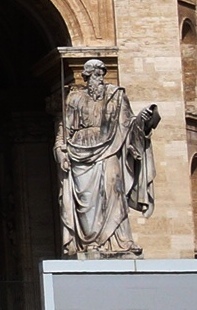
Statue of St. Peter

Statue of St. Peter

Of the five portals (three framed by huge salvaged antique columns)from the narthex to the interior, three contain notable doors. The Renaissance bronze  door (called Filarete), the central portal created by Antonio Averulino  in 1455 for the old basilica, was somewhat enlarged to fit the new space. The “Door of the Dead,” the southern door, was designed by 20th-century sculptor Giacomo Manzù and includes a portrait of Pope John XXIII kneeling before the crucified figure of St. Peter. The “Holy Door,” the decorated northernmost bronze doors leading from the narthex is, by tradition, walled-up with bricks and opened only for holy years such as the Jubilee year by the Pope. The present door is bronze and was designed by Vico Consorti in 1950 and cast in Florence by the Ferdinando Marinelli Artistic Foundry. Above it are inscriptions commemorating the opening of the door.

The design of St. Peter’s Basilica and, in particular, its dome, has greatly influenced church architecture in Western Christendom. They include:

Elements of St Peter’s Basilica’s were imitated, to a greater or lesser degree, by a great number of churches built during 19th and early-20th-century Post-Modernism architectural revivals.  They include:

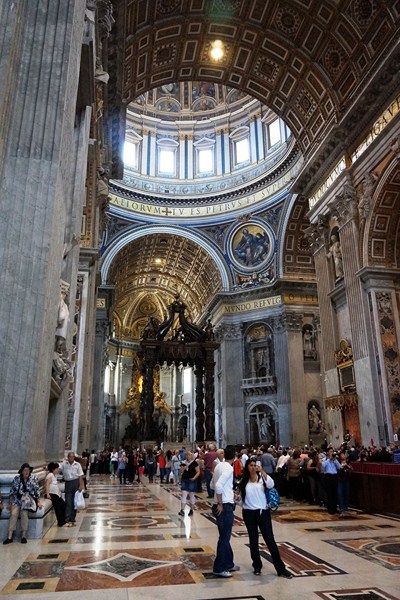
Compared with other churches, its entire, “stupendously large” interior, lavishly decorated with marble, reliefs, architectural sculpture and gilding, has vast dimensions so much so that it is hard to get a sense of scale within the building. The nave, framed by wide aisles (which have a number of chapels off them), lead to the central dome and is in three bays, with piers supporting a barrel vault, the highest of any church.  In keeping with Michelangelo’s work, it has huge paired pilasters.

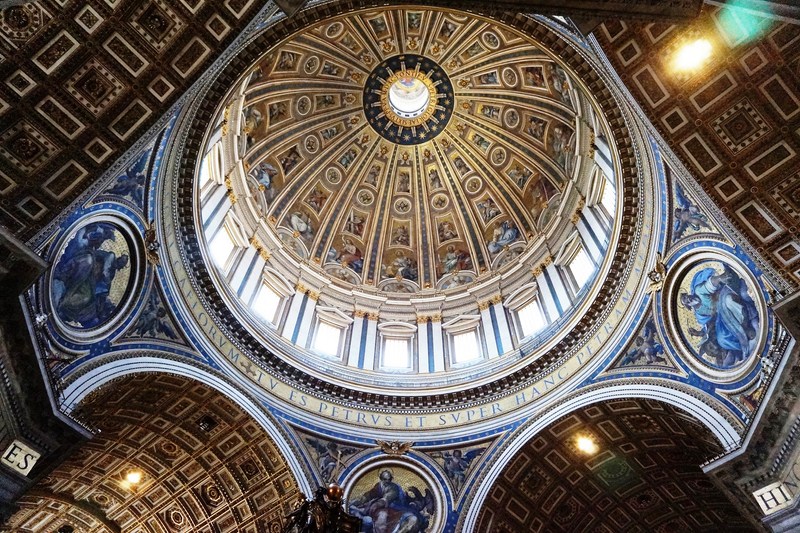
The central dome

The central dome

The aisles each have two smaller chapels and a larger rectangular chapel, the Chapel of the Sacrament and the Choir Chapel. Though lavishly decorated with marble, giltsculpture, stucco and mosaic they, remarkably, have very few paintings, although some, such as Raphael’s “Sistine Madonna” have been reproduced in mosaic. A small icon of the Madonna, removed from the old basilica, is the most precious painting.

The sanctuary culminates in a sculptural ensemble, also by Bernini, and contains the so-called “Chair of Saint Peter” (Cathedra Petri ), a large bronze throne in the apse enshrined, with great celebration, in its new home on January 16, 1666.  Symbolizing the continuing line of apostolic succession from St. Peter to the reigning Pope, the chair is raised high on 4 looping supports held effortlessly by massive and dynamic bronze statues, with sweeping robes and expressions of adoration and ecstasy, of the four Doctors of the Church – Saints Ambrose and Augustine, representing the Latin Church, and Athanasius and John Chrysostom, the Greek Church.  A window of yellow alabaster, behind and above the Cathedra, illuminates, with a blaze of light, the Dove of the Holy Spirit at its center.

The Nave

  • Two holy water basins, fluttering against the first piers of the nave, are held by four  cherubs,  each commissioned by Pope Benedict XIII from designer Agostino Cornacchini and sculptor Francesco Moderati, (1720s). They appear of quite normal cherubic size but, once approached, it becomes apparent that each one is over 2 m. high and that real children cannot reach the basins unless they scramble up the marble draperies.
  • Markers, showing the comparative lengths of other churches, starting from the entrance, are found along the floor of the nave.
  • Medallions, with relief depicting the first 38 popes, are on the decorative pilasters of the piers of the nave.
  • Statues, depicting 39 founders of religious orders, are in niches between the pilasters of the nave.
  • A statue of St. Peter Enthroned, set against the north east pier of the dome, is sometimes attributed to late 13th-century sculptor Arnolfo di Cambio (some scholars dating it to the 5th century). One foot of the statue is largely worn away by pilgrims kissing it for centuries.
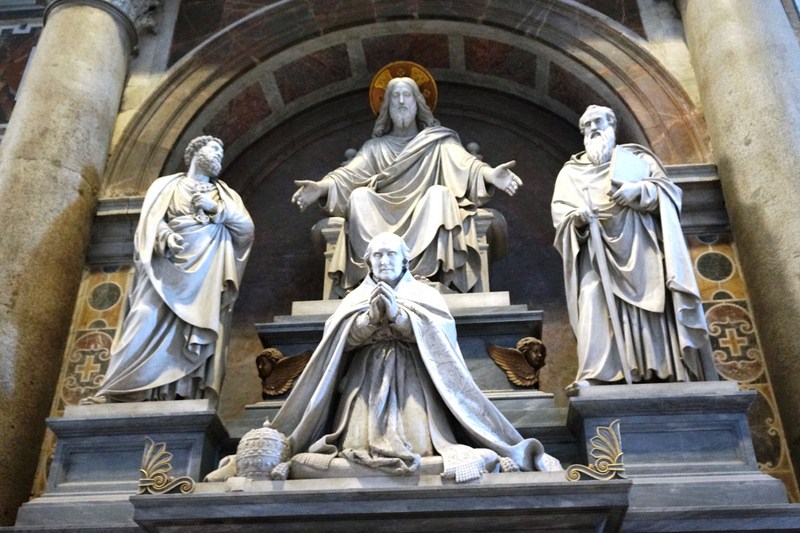
  • The sunken, crypt-like Confessio or “Chapel of the Confession” (in reference to the confession of faith by St. Peter, which led to his martyrdom), leading to the Vatican Grottoes, is located at the heart of the basilica, beneath the dome and high altar. Maderno’s last work, it contains a large kneeling statue, by Canova, of Pope Pius VI, who was captured and mistreated by the army of  Napoleon Bonaparte.  Two curving marble staircases, remnants of the old basilica, lead to this underground chapel at the level of the Constantinian church and immediately above the purported burial place of Saint Peter. Here, cardinals and other privileged persons could descend in order to be nearer to the burial place of the apostle. Around its balustrade are 95 bronze lamps.
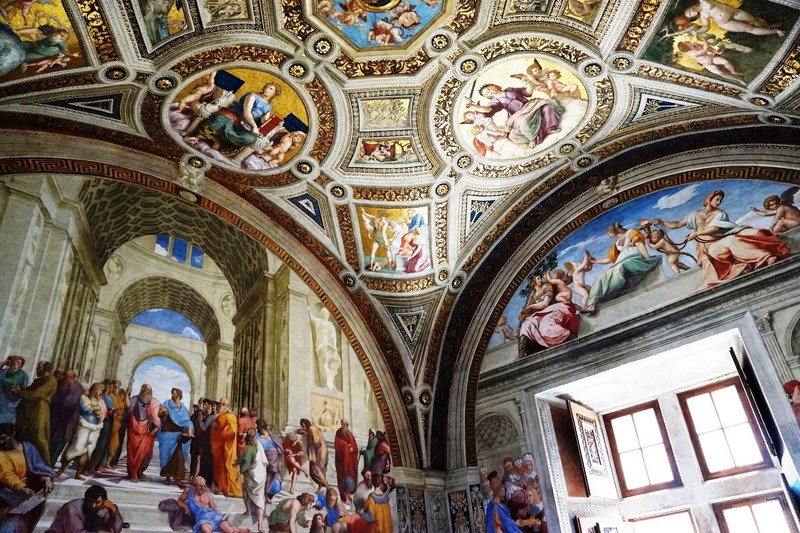
  • The Niche of the Pallium (“Niche of Stoles”), in the Confessio, contains a bronze urn, donated by Pope Benedict XIV, to contain white stoles embroidered with black crosses and woven with the wool of lambs blessed on St. Agnes’ Day.
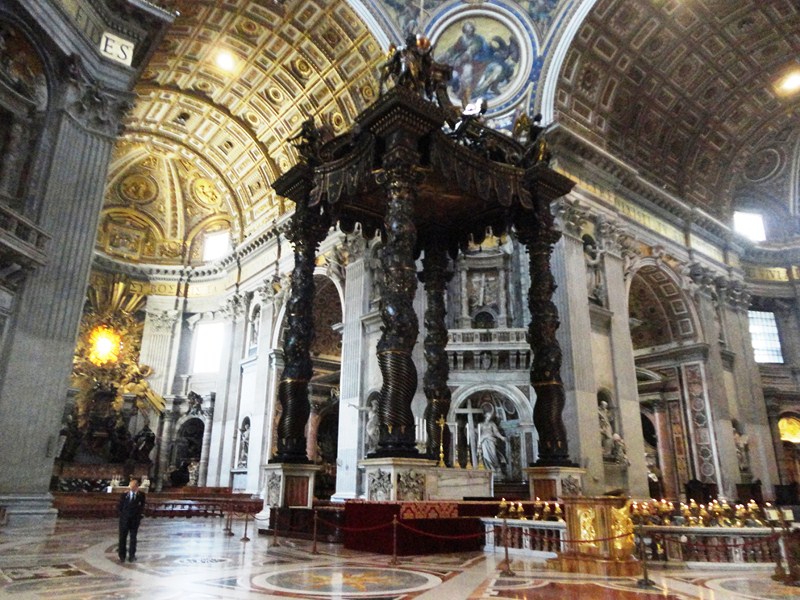
The badalchin

The badalchin

  • The High Altar, surmounted by a baldachin (baldacchino), its central feature, was the first work designed by Gian Lorenzo Bernini at St. Peter’s.  This 30 m. (98 ft.) high, pavilion-like structure, claimed to be the largest piece of bronze in the world, stands beneath the dome and above the Papal Its design, based on the ciborium (of which there are many in the churches of Rome), serves to create a sort of holy space above and around the table on which the Sacrament is laid for the Eucharist and emphasizing the significance of this ritual.
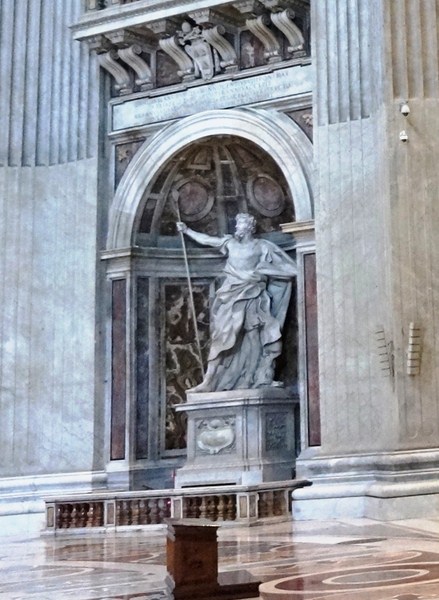
  • As part of the scheme for the central space of the church, Bernini had the piers, , hollowed out into niches, and had staircases made inside them, leading to four balconies. On the balconies Bernini created showcases, framed by the eight ancient twisted columns, to display the four most precious relics of the basilica. Set in each of the niches, within the four huge piers (begun by Bramante and completed by Michelangelo) supporting the dome, are the huge statues of the saint associated with the basilica’s primary holy relics – Saint Helena, Constantine’s mother, holding the True Cross and the Holy Nails (by Andrea Bolgi); Saint Longinus holding the spear that pierced the side of Jesus (by Bernini, 1639); Saint Andrew, the brother of St. Peter, with the  Andrew’s Cross (by Francois Duquesnoy) and Saint Veronica holding her miraculous veil with the image of Jesus’ face (by Francesco Mochi).
Statue of St. Longinus (Bernini)

Statue of St. Longinus (Bernini)

North Aisle

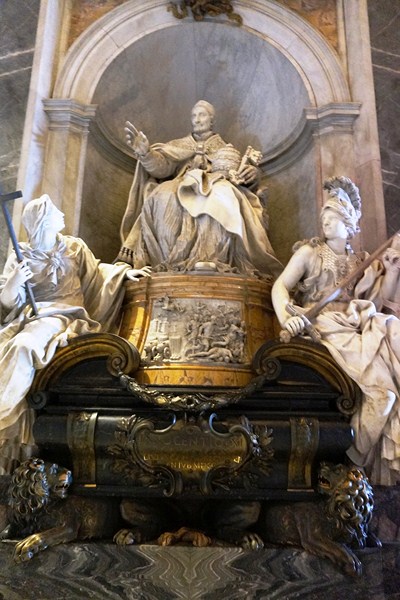
Monument to Pope Innocent XI

Monument to Pope Innocent XI

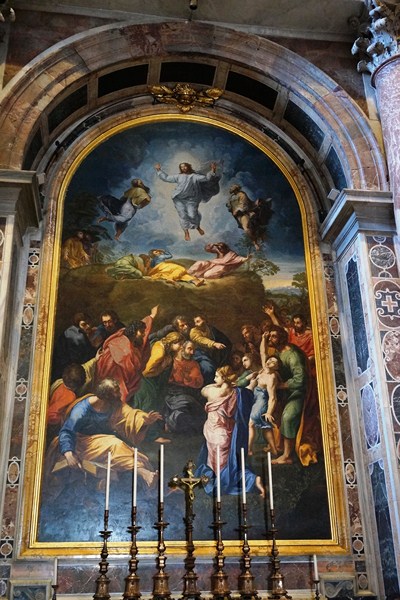
  • The second chapel, dedicated to Sebastian, contains the statues of popes Pius XI and Pius XII. The space below the altar, housing the remains of Pope John Paul II (placed here on May 2,  2011), used to be the resting place of Pope Innocent XI whose remains were moved to the Altar of the Transfiguration on April 8, 2011.
Altar of the Transfiguration

Altar of the Transfiguration

  • The Chapel of the Blessed Sacrament, the large chapel on the right aisle, contains the tabernacle by Bernini (1664). Resembling Bramante‘s Tempietto at San Pietro in Montorio, it is supported by two kneeling angels and, behind it, is a painting of the Holy Trinity by Pietro da Cortona.
  • The monuments of popes Gregory XIII by Camillo Rusconi (1723) and Gregory XIV are near the Altar of Our Lady of Succor.
  • An altar containing the relics of Petronilla, with an altarpiece “The Burial of St Petronilla by Guercino (Giovanni Francesco Barbieri), 1623, is at the end of the aisle.
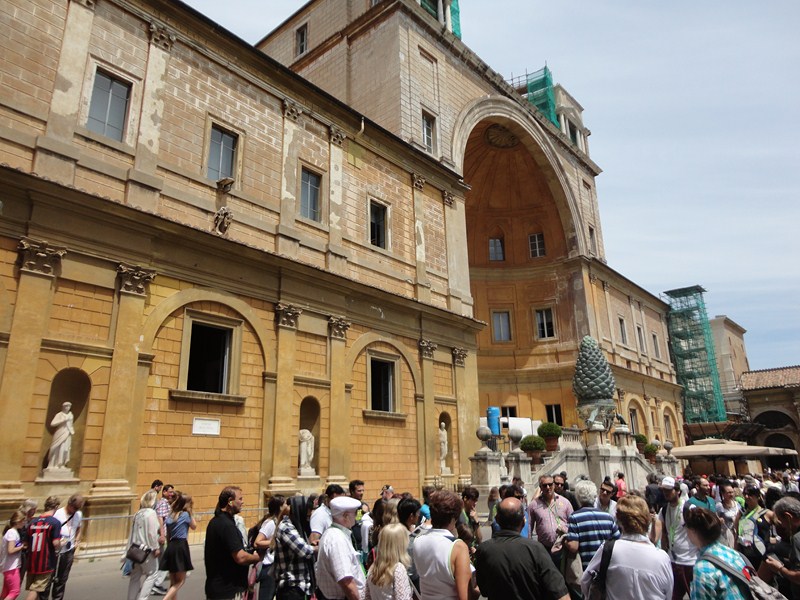
South Aisle

Baptistery

Baptistery

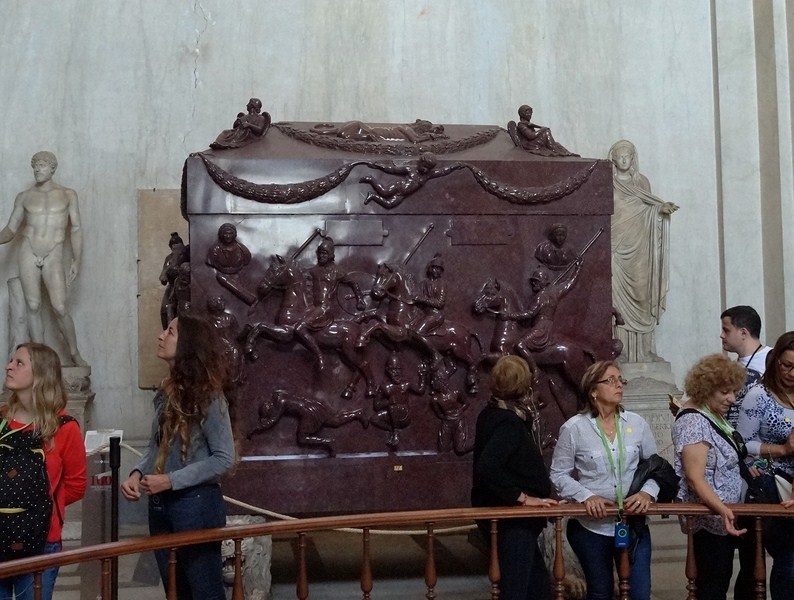
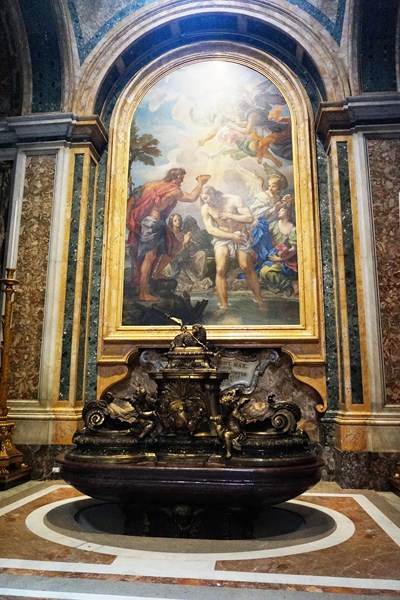
  • The baptistery, the first chapel in the south aisle, was commissioned by Pope Innocent XII and designed by Carlo Fontana, (great nephew of Domenico Fontana). The font, previously located in the opposite chapel, is the red porphyry sarcophagus of Probus, the 4th-century Prefect of Rome. The lid came from a sarcophagus which had once held the remains of the Emperor Hadrian. Previously stored in the Vatican Grotto, workmen broke it into ten pieces during removal and Fontana restored it expertly and surmounted it with a gilt-bronze figure of the “Lamb of God.”
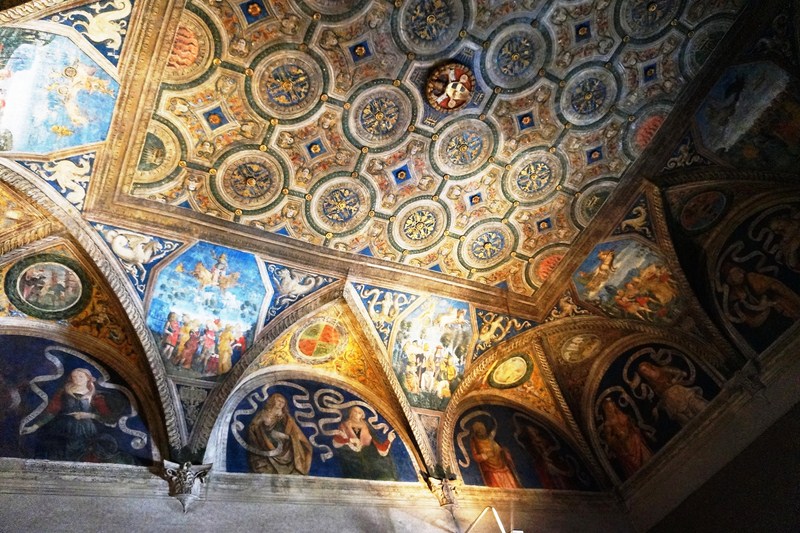
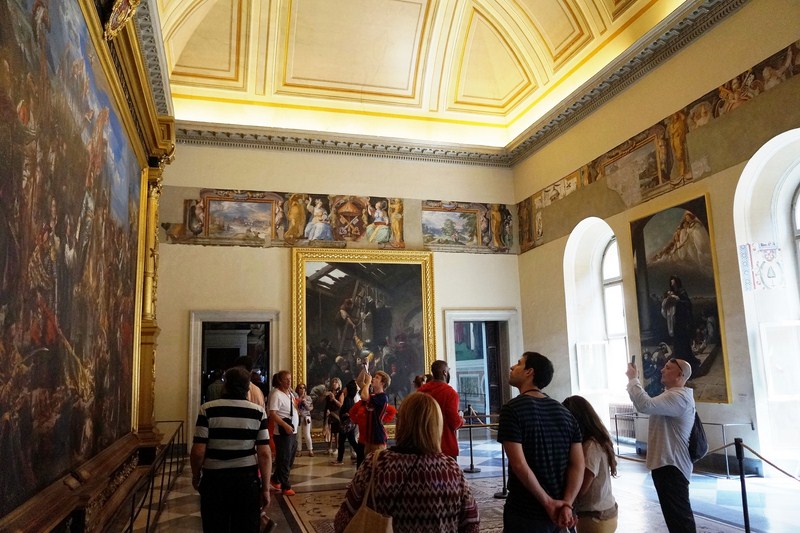
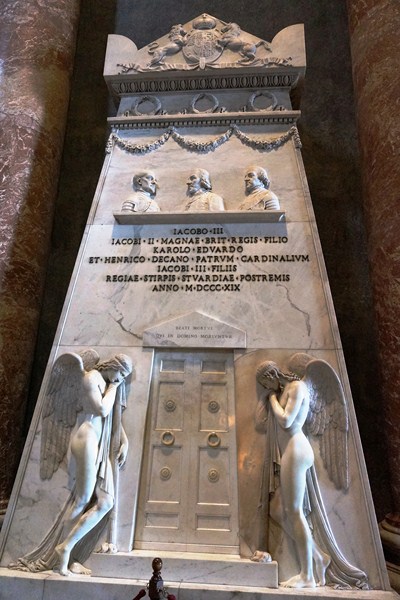
Monument to the Royal Stuarts

Monument to the Royal Stuarts

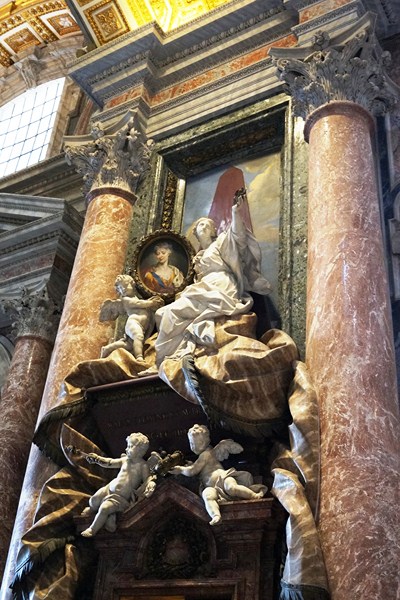
Monument to Maria Clementina Sobieski

Monument to Maria Clementina Sobieski

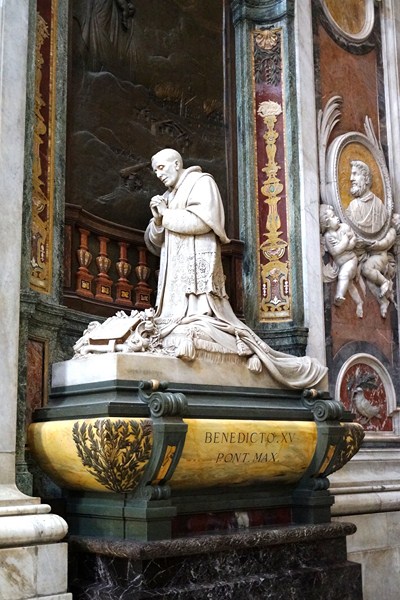
Monument to Pope Benedict XV (Pietro Canonica, (1928)

Monument to Pope Benedict XV (Pietro Canonica, (1928)

Monument to Pius VIII (Pietro Tenerani, 1866)

Monument to Pius VIII (Pietro Tenerani, 1866)

  • The altars of Saint ThomasSaint Joseph and the Crucifixion of Saint Peter are at the south transept.
  • Towards the end of the aisle is the tomb of Fabio Chigi, Pope Alexander VII.  The work of Bernini and called by Lees-Milne “as one of the greatest tombs of the Baroque Age,” it is awkwardly set in a niche above a doorway, utilized by Bernini in a symbolic manner, into a small vestry. Pope Alexander, facing outward, kneels upon his tomb. The tomb, supported on a large draped shroud in patterned red marble, is supported by four female figures, of whom only the two at the front, representing Charity and Truth, are fully visible. The foot of Truth rests upon a globe of the world, her toe being pierced symbolically by the thorn of Protestant England. The skeletal winged figure of Death, coming forth, seemingly, from the doorway as if it were the entrance to a tomb, has its head hidden beneath the shroud, but its right hand carries an hour glass stretched upward towards the kneeling figure of the pope.
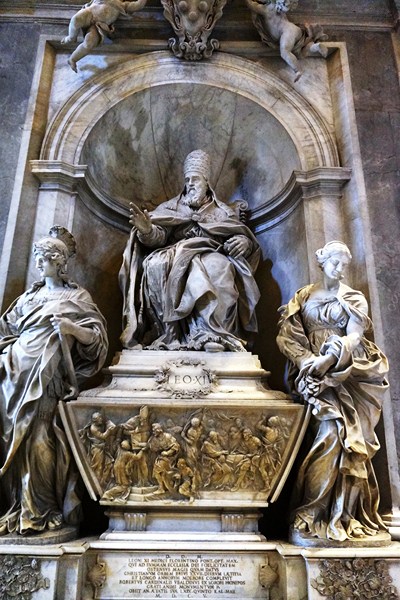
Monument to Pope Leo XI (Alessandro Algardi)

Monument to Pope Leo XI (Alessandro Algardi)

  • The white marble Monument to Leo XI, by Alessandro Algardi (1595-1654), has roses carved on the plinth and the inscription “Sic florui”, refer to the fact that he reigned only 27 days, in 1605. Beside him are two female allegories: Fortitude and Generosity.
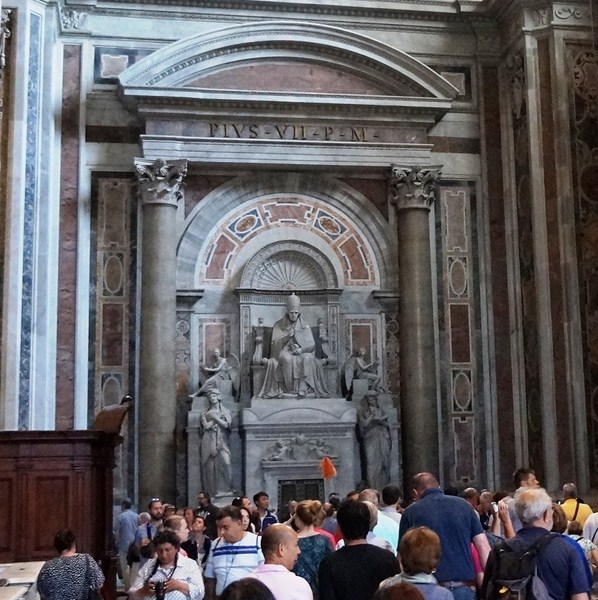
Monument to Pope Pius VII

Monument to Pope Pius VII

  • The Monument of Pius VII, occupying part of the left wall of the Clementine Chapel, is the work of the Danish sculptor, Bertel Thorvaldsen (1770-1844).Two winged cupids, one symbolizing time (hourglass) and the other history (book), are located on the sides of the throne. The two statues of “Knowledge” and “Fortitude,” on high pedestals, are located on the sides of the Doric door. The first is depicted in a meditative pose, with the Bible open and, at its feet, an owl, the symbol of prudence. The second figure is dressed in lion skins, while one foot stands on a club.
Altar of the Lie

Altar of the Lie

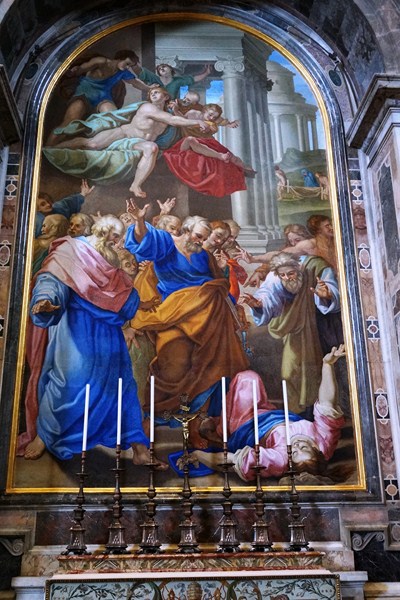
  • Passing from the transept to the left aisle, on the left is the Altar of the Lie or the Altar of Ananias and Sapphira. Its mosaic, after a painting by Cristoforo Roncalli (known as Pomarancio, 552-1626), shows the punishment of the couple who had lied to St. Peter about the price of a field sold by them, and were therefore immediately struck dead.

St. Peter’s Basilica: Piazza San Pietro, 00120 Città del Vaticano, Vatican City. Open daily, April -September, 7 AM -7 PM; October – March,  7 AM – 6 PM.

How to Get There:

By Subway – Take Linea A (red line) toward Battistini and exit at Ottaviano-S. Pietro. Walk south on Via Ottaviano toward St. Peter’s Square.
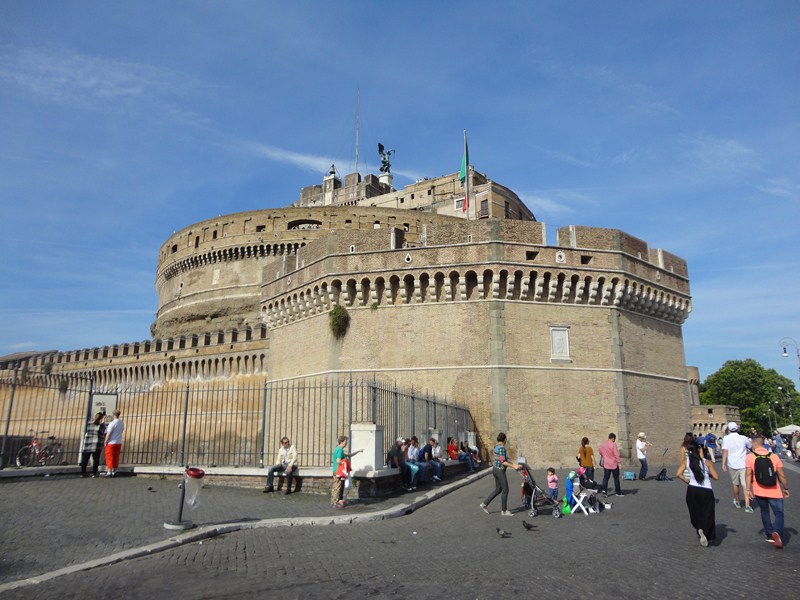
By Walking – From the city center, the most direct route is to cross the Tiber and walk straight up Via Conciliazioni. A more interesting route is to go under the Passetto arch near Castel S. Angelo and walk up Pio Borgo, providing a more dramatic entrance from the right (north) side of the Piazza.

Palatine Hill (Rome, Italy)

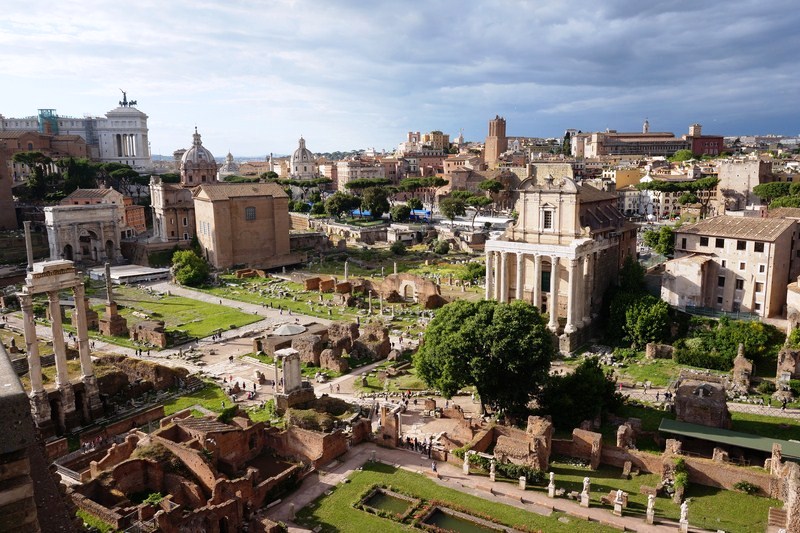
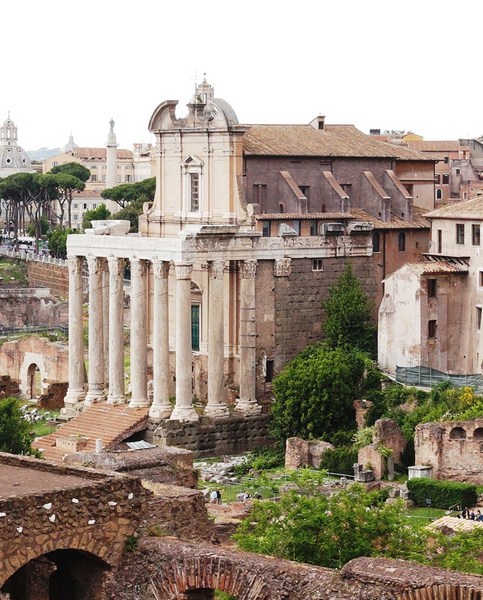
The Roman Forum

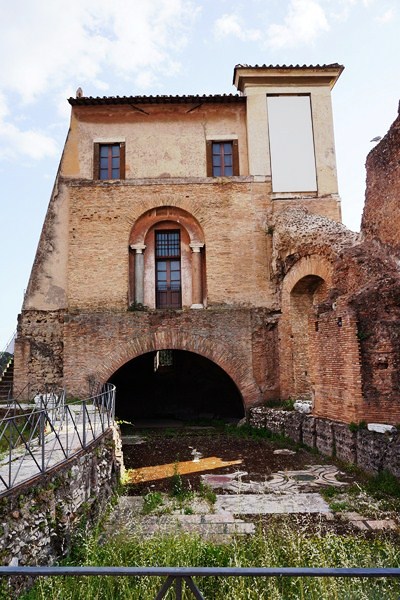
The surprisingly peaceful and majestic Palatine Hill (LatinCollis Palatium or Mons Palatinus; ItalianPalatino) is the centermost of the Seven Hills of Rome and is one of the most ancient parts of the city. It stands 40 m. above the Forum Romanum, looking down upon it on one side, and upon the Circus Maximus on the other. Here are some interesting trivia regarding the Palatine Hill:

  • The English word “palace,” the Italian word “palazzo,” the French word “palais,” the German word “palest,” the Czech word “palace,” etc.,  are all derived from the Palatine.
  • Cacus, a ferocious, fire-breathing giant cannibal , was said to have once lived in a cave the Palatine. Regularly terrorizing the residents of neighboring Aventine Hill, he was finally defeated by the hero Hercules.
  • The Palatine is site of the festival of the Lupercalia, derived from the Lupercal, the cave where Romulus the mythical founder of Rome, and his twin brother Remus were found and raised by the she-wolf.
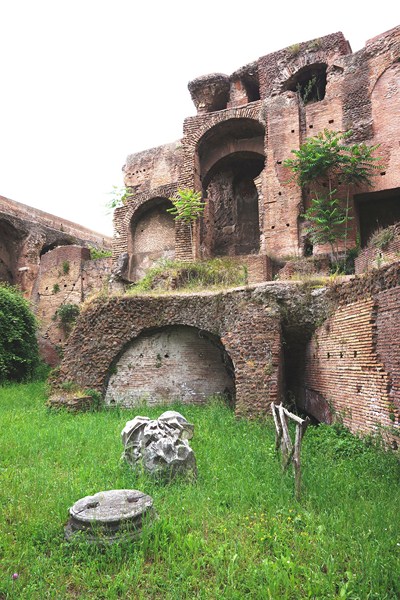
  • Regarded as one of the most prestigious neighborhoods in the city because of its mythical association, central location, spectacular views of the city, cooler summer temperature and cleaner air, the Palatine was the site of the residences of many affluent Romans of the Republican period (c.509 BC – 44 BC) and, during the Empire (27 BC – 476 AD), was the site of the palaces, now in ruins, of Emperors Tiberius (14 – 37 AD) and Domitian (81 – 96 AD).
  • The emperor Augustus (27 BC – 14 AD) was born on the Palatine.  He later lived there in luxury, with his wife Livia (58 BC – 29 AD). The remains of the House of Augustus and the House of Livia, with some of the most impressive ancient art in the city, are beautifully decorated with colorful frescoes. Beside his own palace, Augustus also built a temple to Apollo. Situated near the House of Livia is the temple of Cybele, currently not fully excavated and not open to the public. Cut into the side of the hill behind this structure is the so-called House of Tiberius.
  • In 41 AD, the 28 year old Emperor Caligula was assassinated in the cryptoporticus, a a semi-subterranean, barrel-vaulted corridor of about 130 m. beneath the palaces on the Palatine, stabbed up to 30 times by his loyal guard who responded by indiscriminately slaughtering anyone (including innocent bystanders) who were nearby.
  • During the Middle Ages, convents and churches (the oratory of Caesarius, Santa Anastasia, Santa Lucia, San Sebastiano) were built over the remains of older buildings of the Palatine, and the noble Frangipani family used them, along with the Colosseum and Arch of Constantine, to create a fortified stronghold.
  • In 1550, during the Renaissance Period, Cardinal Alessandro Farnese purchased a section of the Palatine and created beautiful Farnese Gardens, the first private botanical gardens in Europe.  Featuring a nymphaeum, an aviary, a tree-shaded park of terraces, lawns, flowerbeds, pavilions, fountains and a wealth of art, over time it fell into disuse but some parts can still be visited today.

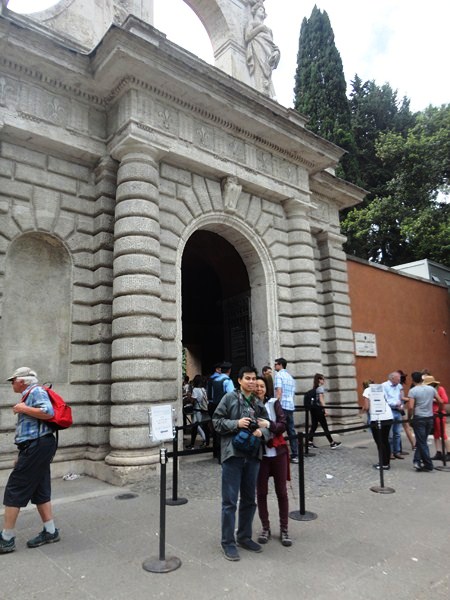
The Palatine Hill, and the Forum Romanum  beneath it, is now a large open-air museum.  Using the same ticket as the Colosseum, we visited it via the entrance on Via di San Gregorio, the street just beyond the Arch of Constantine, going away from the Colosseum.

Check out “Colosseum” and “Arch of Constantine

Jandy and Grace at the Via di San Gregorio entrance

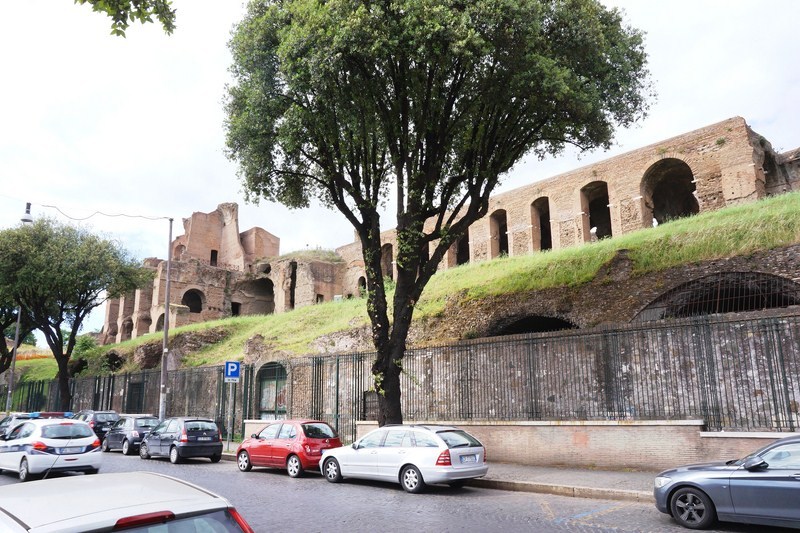
Overlooking the  Roman Forum is the enormous Flavian Palace  (also known as the Domus Flavia or the Domus Augustana) which was built, extended and modified largely during the reigns of VespasianTitus and Domitian of the Flavian dynasty (69 – 96). This palace, which extends across the Palatine Hill, looks out over the Circus Maximus, a huge structure which could accommodate 300,000 spectators. During the reign of the emperor Septimius Severus (146 – 211), the imposing brick building of the greater part of the palace visible from the Circus was undertaken.

Domus Severiana

The 621 m. (2,037 ft.) long and 118 m. (387 ft.) wide Hippodrome of Domitian or Stadium, which could accommodate 150,000 spectators, was built between AD 81 and 96.  Situated in the valley between the Aventine and Palatine hills, immediately adjacent to the Flavian palace of Severus, it is the first and largest stadium in ancient Rome and its later Empire.

House of Livia

House of Augustus

Temple Antoninus

The Hippodrome has the appearance of a Roman Circus (its name means “circus” in Greek) but is too small to accommodate chariots. Hippodromes, originally areas for exercising horses, were later used, in Rome, to describe elongated rectangular gardens or as a Greek stadium that is a venue for foot races. The tower is part of a medieval fortification

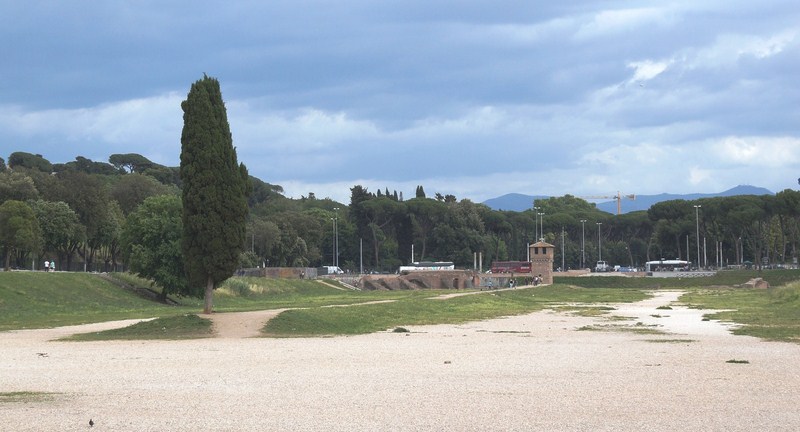
Circus Maximus

During the Severan period, it was used for sporting events and, while it is certain that it was most likely originally built as Domitian’s private stadium-shaped garden, its exact purpose is disputed.

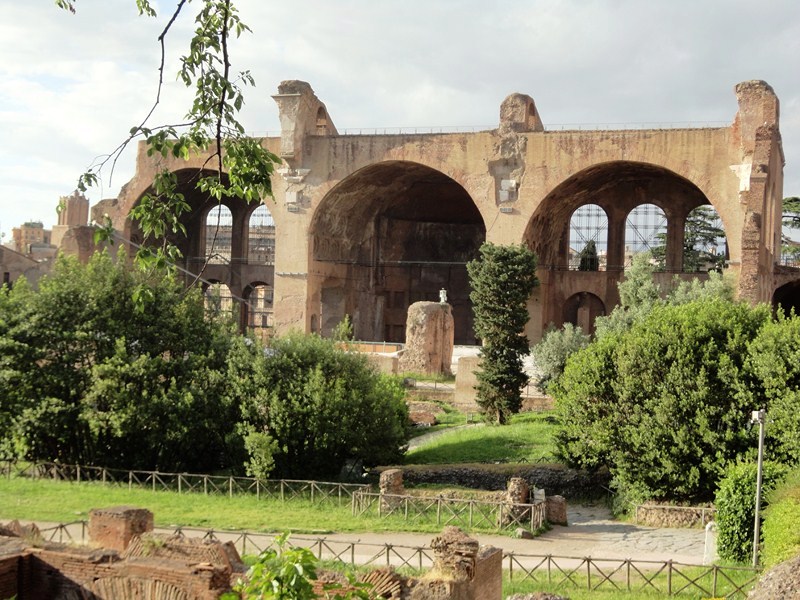
Basilica of Maxentius

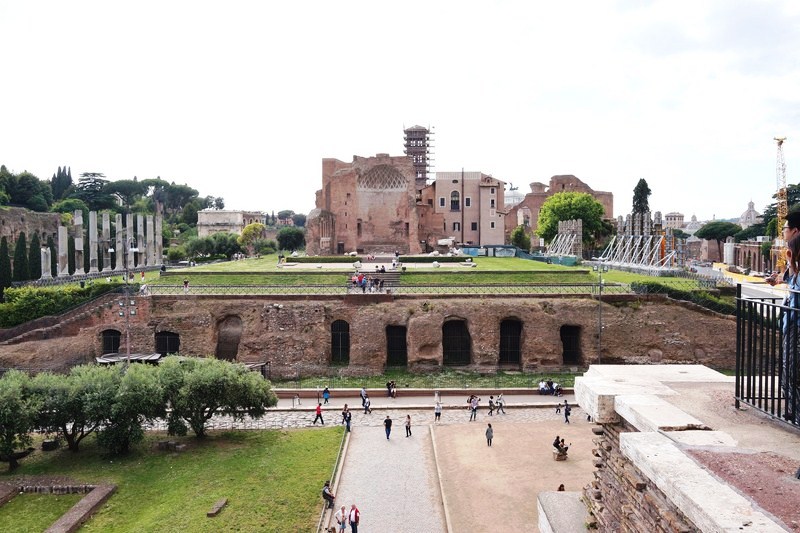
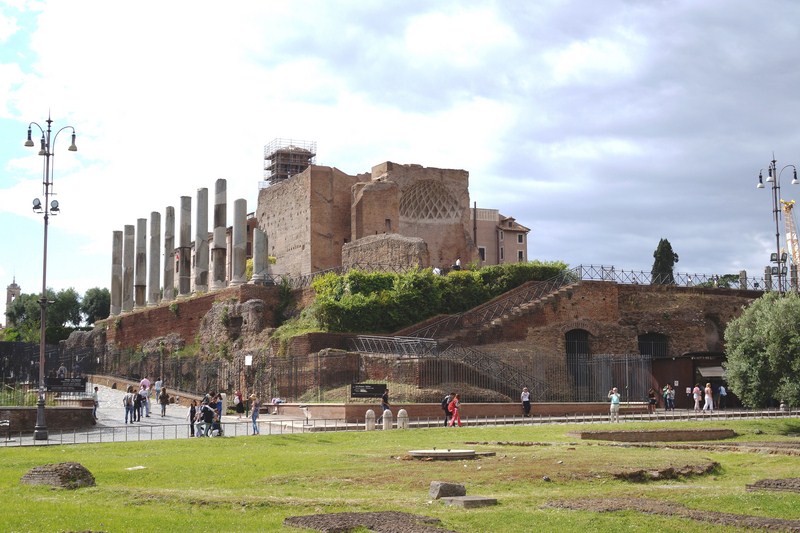
Temple of Venus and Rome

Antiquarium Forense

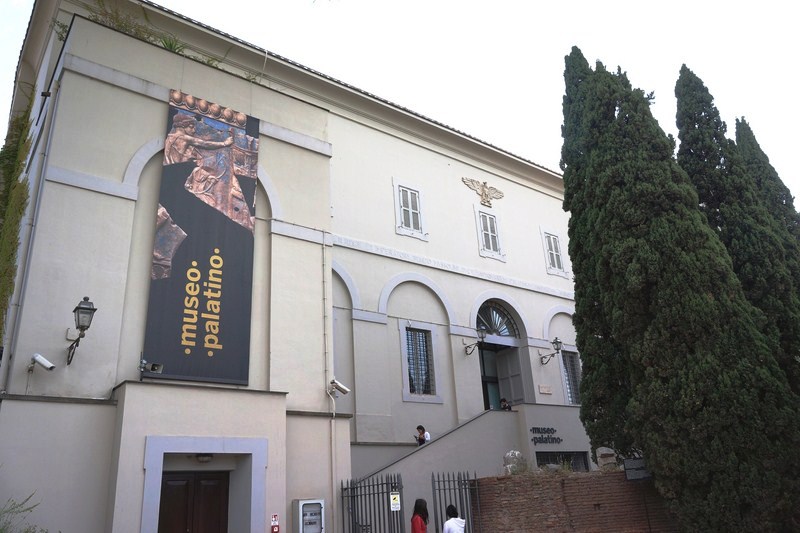
The nearby, small Palatine Museum exhibits Roman statuary (most coming from the Hippodrome) and artifacts dating from before the official foundation of Rome.

Palatine Museum

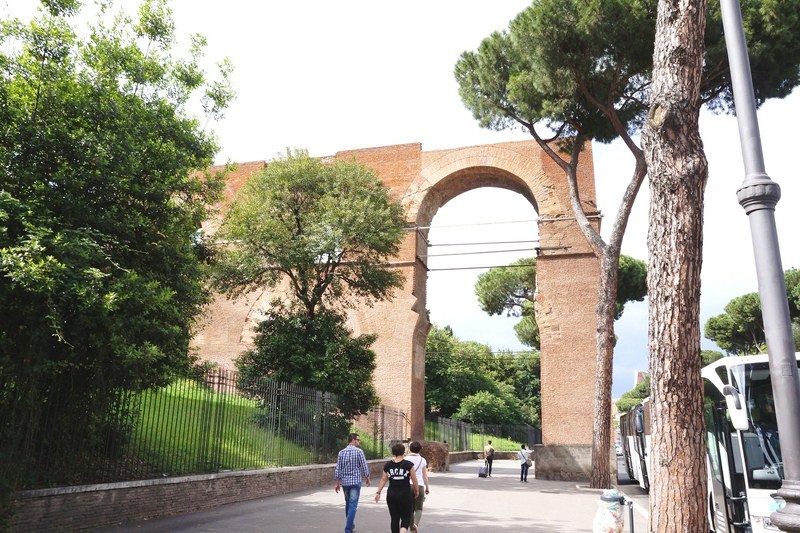
Claudian Aqueduct

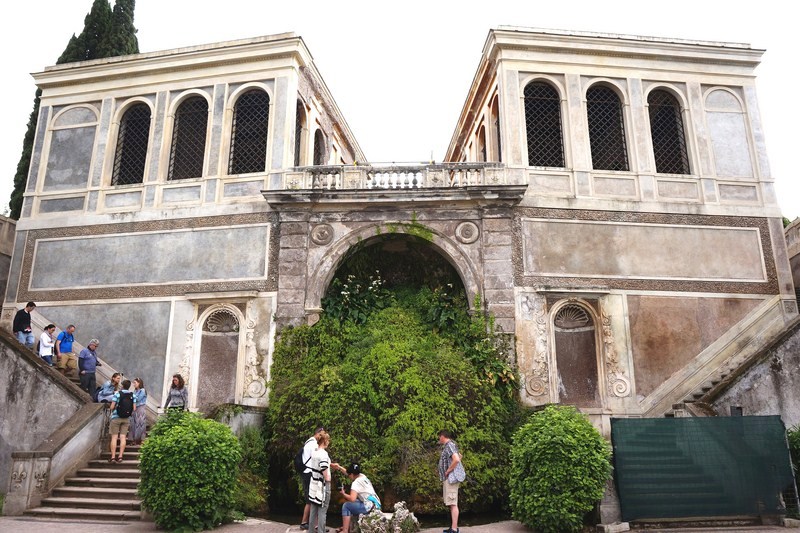
On the eastern side of the Hippodrome is a large exedra decorated with sculptures and fountains commanding views of the garden below.

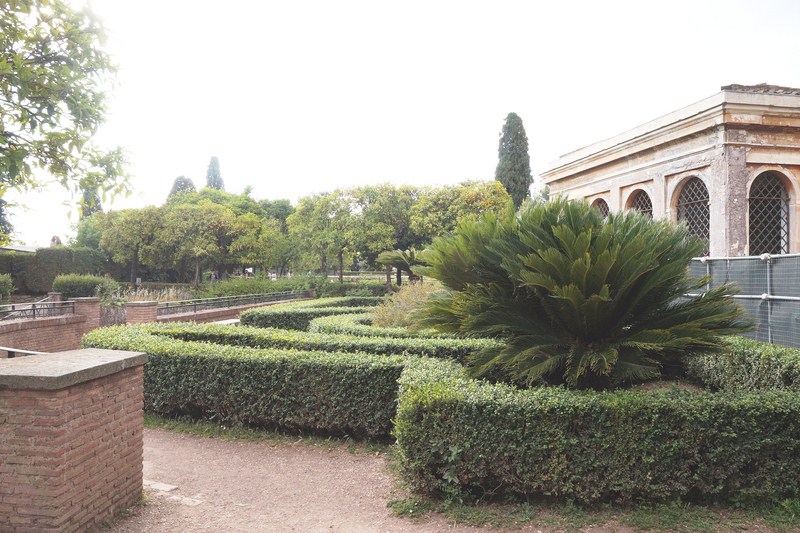
Farnese Gardens

Aviaries of the Farnese Gardens

Palatine Hill: Piazza di Santa Maria Nova, Rome. Admission: €12 (including admission to the Colosseum and Roman Forum). Tickets to the House of Augustus and House of Livia need to be booked separately and in advance.

How to Get There: Located close to the Colosseum and Roman Forum, the area around Palatine is walking distance from the Circus Maximus and Piazza Venezia. Well-served by public transport, lots of buses, such as the 75 and 87, stop near the Colosseum and it is also a short walk from the Colosseo (Line B) metro station. If going to Palatine by bus or taxi, keep in mind that the Via dei Fori Imperiali (the road connecting Piazza Venezia and the Colosseum), is mainly closed to traffic on Saturdays and Sundays.

Museo Orlina (Tagaytay City, Cavite)

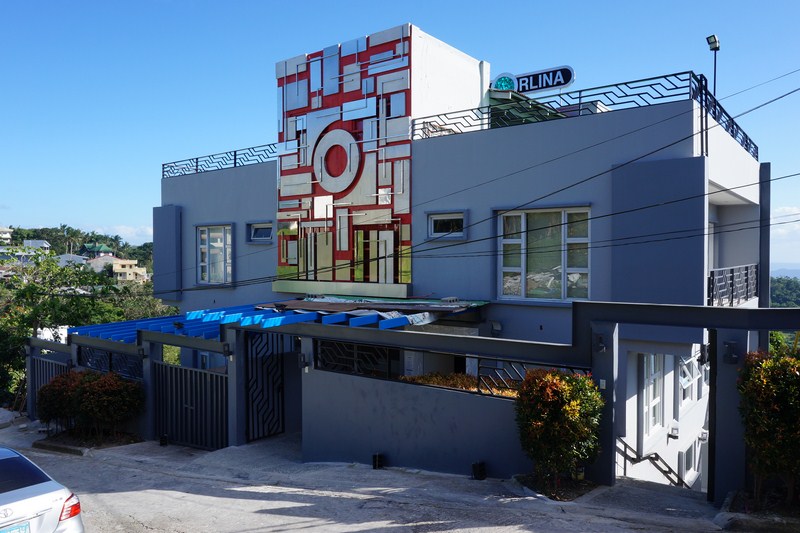
Museo Orlina

On our way back to Manila with my son Jandy, friend Rainy Canillas and her daughters Tricia and Arianne, we noticed, from the main road, the sign for Museo Orlina and decided to make a stopover there.

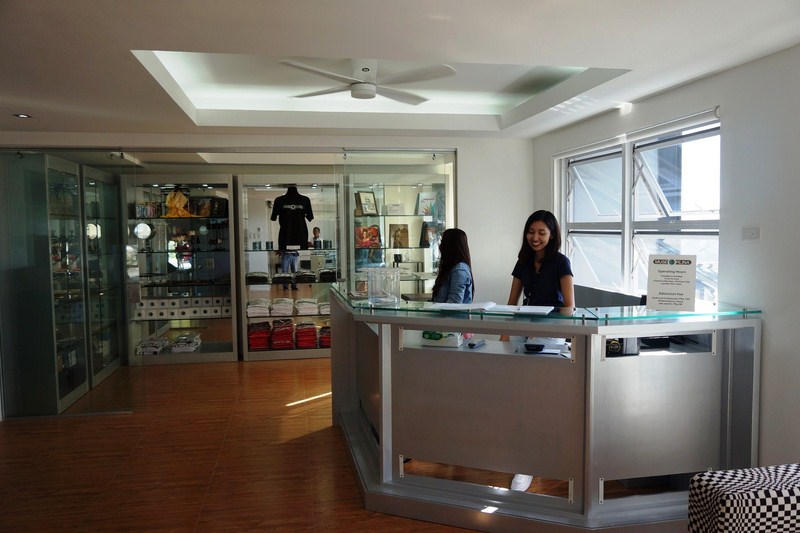
Reception Area

The museum itself was hidden at the back, at the bottom of a short, but very intimidatingly  steep and narrow road. Parking was not easy here. The museum is a just few meters across the Sta Rosa-Tagaytay road, near the rotunda. Landmarks are the Econo Hotel and the Balibago-Tagaytay jeepney terminal.

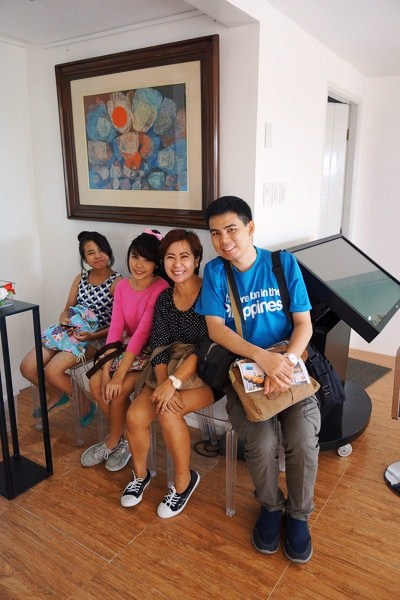
L-R: Arianne, Tricia, Rainy and Jandy

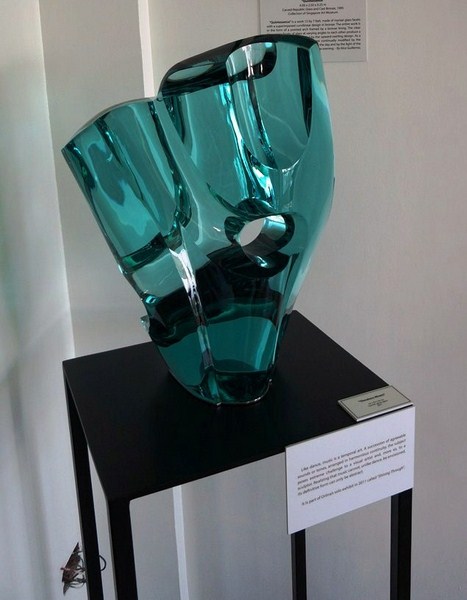
A showcase of the artistry of internationally-acclaimed and multi-awarded Ramon Orlina, the pioneer and foremost practitioner of glass sculpture in the country, Museo Orlina adds culture as part of Tagaytay City by exhibiting, to the delight and enchantment of art lovers and enthusiasts, superb and exultant body of works showcasing Ramon Orlina’s scintillating artistry.

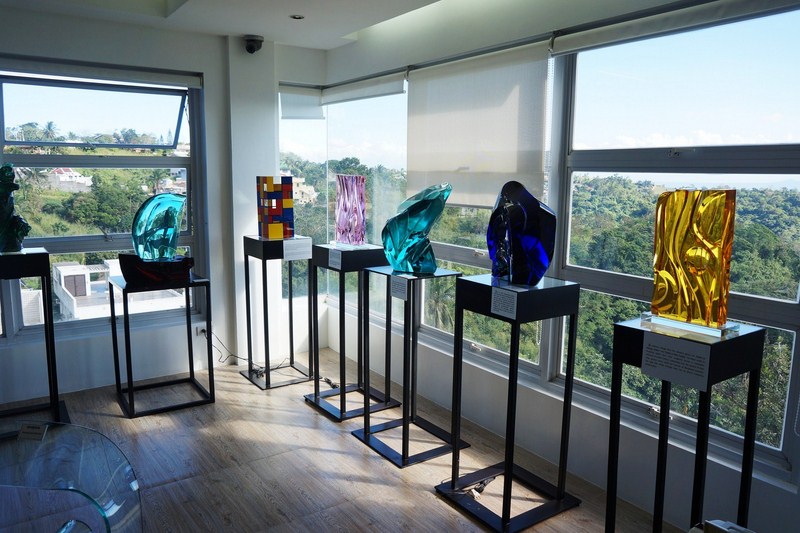
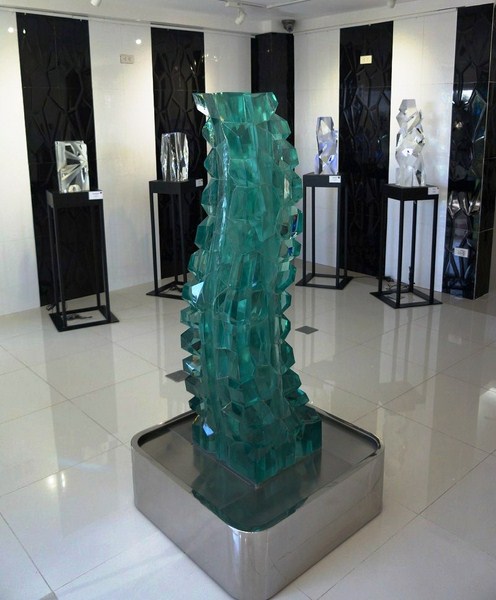
An array of colorful glass sculptures

The museum had its soft opening last December 2013 and formally opened its doors to the public on April 9, 2014.

Arcanun XIX (Paradise Gained, 1976) – Orlina’s first glass sculpture

Ramon Orlina, an architect by profession, had a late calling to sculpture.  The “Father of Philippine Glass Sculpture,” he is best known for his abstract glass sculptures that use angles, illusions, and the fine lines and colors.

Ecstasy II

Orlina transformed glass by elevating it, from beyond the humble origin of its utilitarian, industrial function (drinking vessels, window glass panes,  automotive windshields, etc.), to the dignity and respectability of art, producing unique works that have dazzled the art scene and placed the Philippines in the International Art Map.

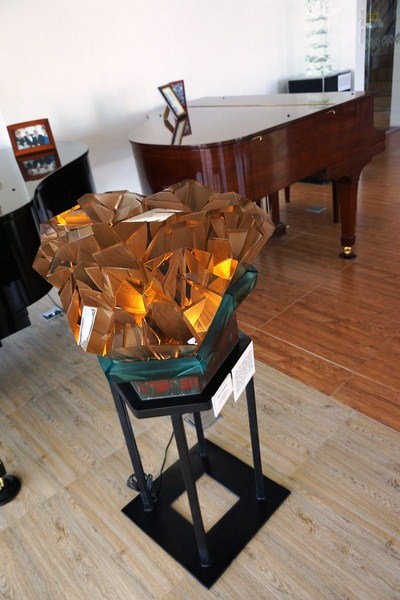
Burst of Sunflowers

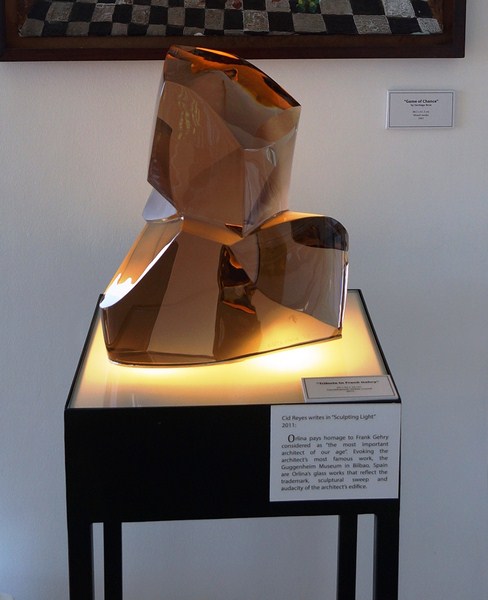
Tribute to Frank Gehry

His unique art pieces, ranging from 4-digit prices to multi million pesos each (the prices, though stiff, were befitting the work of a world class artist), are coveted, both locally and internationally, by avid art enthusiasts, numerous collectors and industrial designers and now grace finer homes, offices, commercial establishments and respected art galleries.

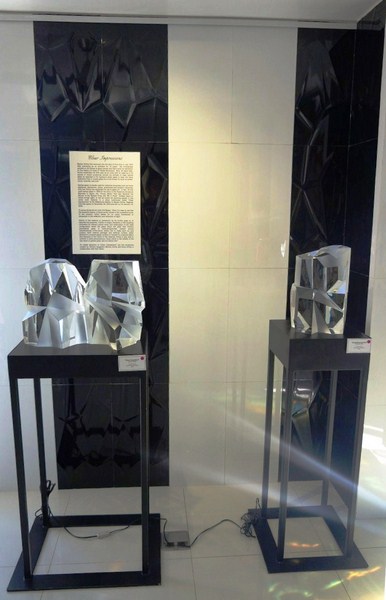
Clear Impressions

Timeless Music

He is also a master in bronze sculptures and canvass pieces. His glass sculptures focused on slabs of thick, transparent glass with subdued colors (especially his hallmark deep green) and the glass is molded into some amazing shapes as well as some powerful moments.

Fountain of Hope

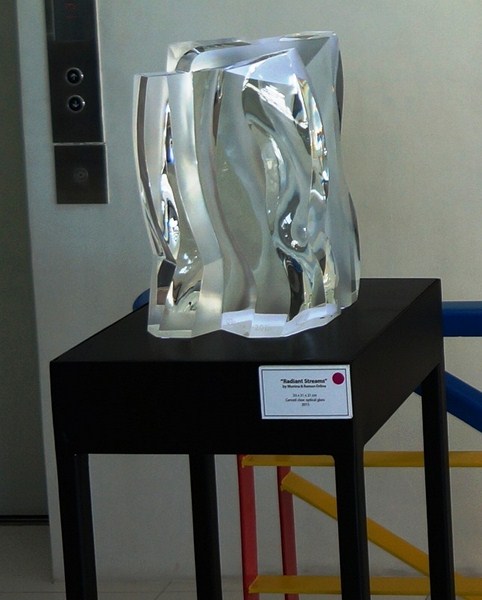
Radiant Streams

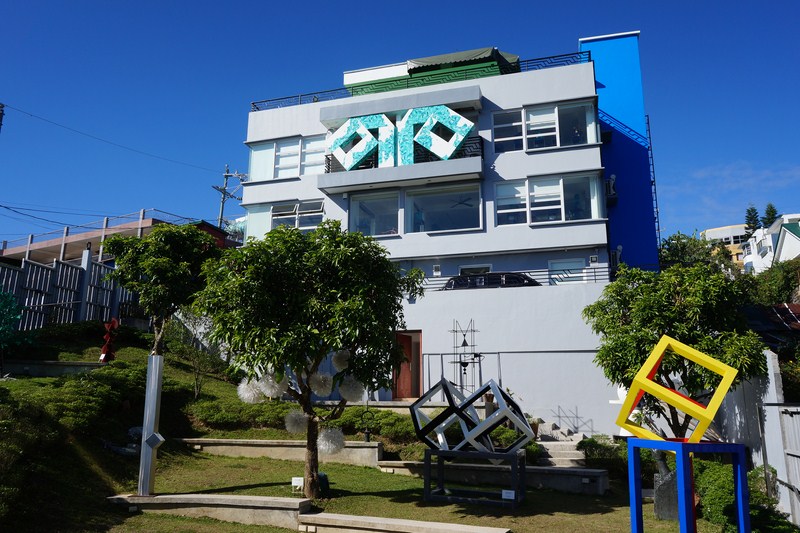
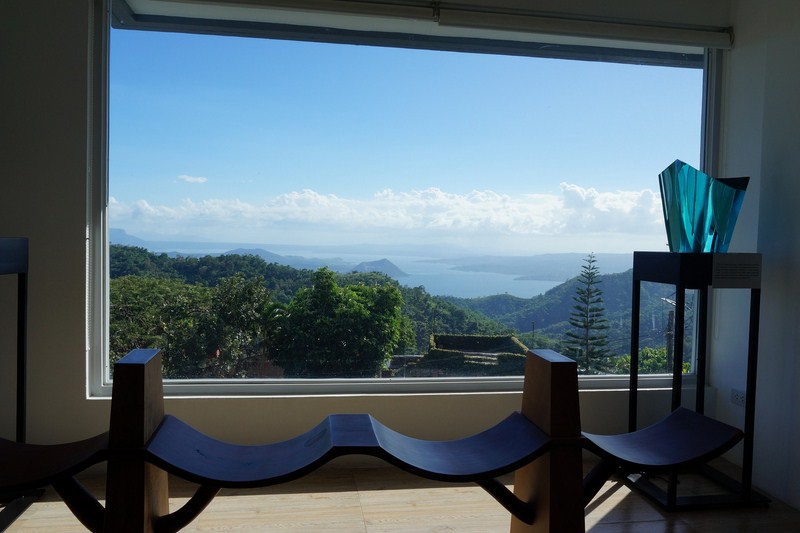
Orlina’s second museum,  the first being at his ancestral home in Taal, Batangas (Casa Gahol), this 4-storey modern, glass and concrete, box-type building, on a cliff, faces the Tagaytay Ridge, affording visitors a lovely vista of the famed Taal Lake and Taal Volcano.

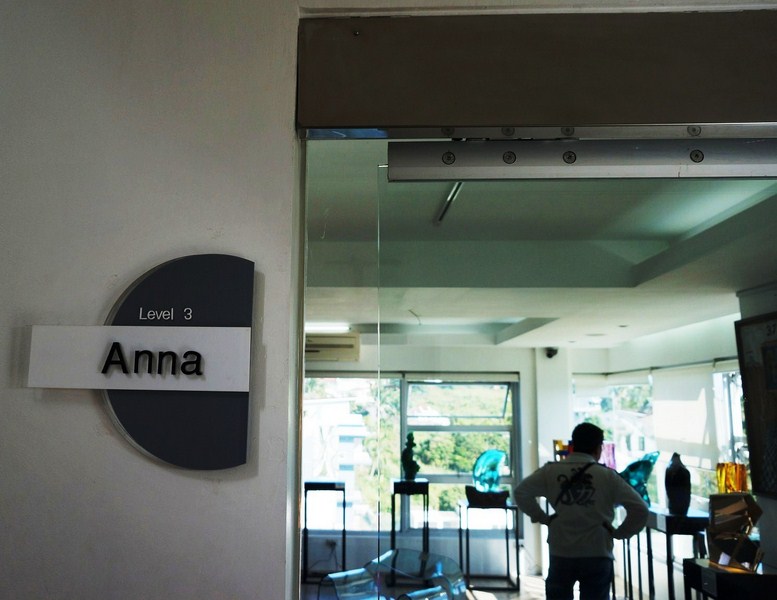
Anna Gallery

The building is divided into two and has a number of galleries (all named after the artist’s daughters) – Reflections & Naesa Gallery (Level 1, an exhibition area for up and coming artists), Ningning Gallery (Level 2) and Anna Gallery (Level 3).

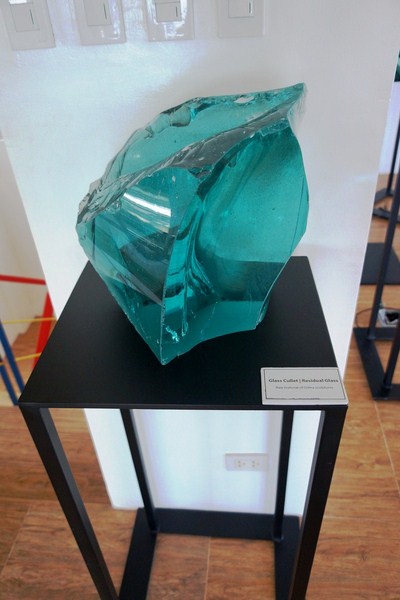
Glass Cutlet Residual Glass

When visitors arrive, they are usually shown a short, 15-min. video introduction before going into the museum. It narrates how Orlina started this museum and how he himself got into glass sculpture and his other forms of creative works. We skipped this.  Flash photography and video taking is prohibited. The staff was nice and friendly.

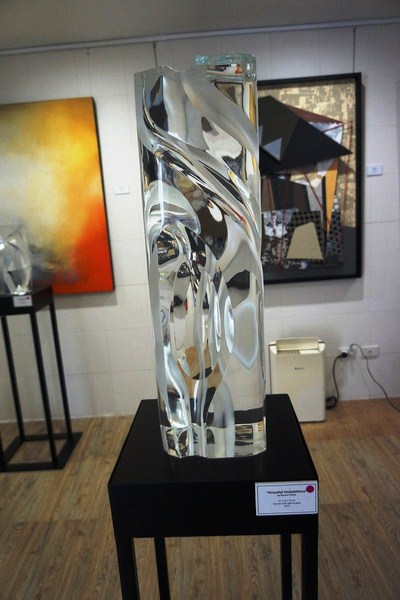
Graceful Undulations

Too bad Mr. Orlina was having an afternoon nap when we arrived (his office doubles as his bedroom when he pulls down his Murphy bed). It would have been nice to meet and talk with him as I appreciated, up close and personal, the masterpieces of this renowned and exceptionally talented artist.

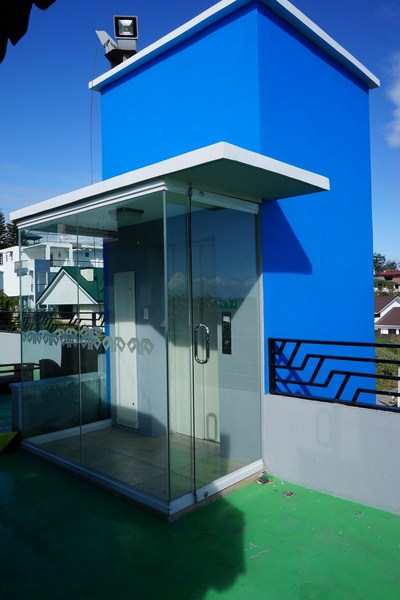
Elevator

My exploration of the exhibits took one hour. or senior citizens, persons with disability and pregnant women, there’s an elevator going from floor to floor.

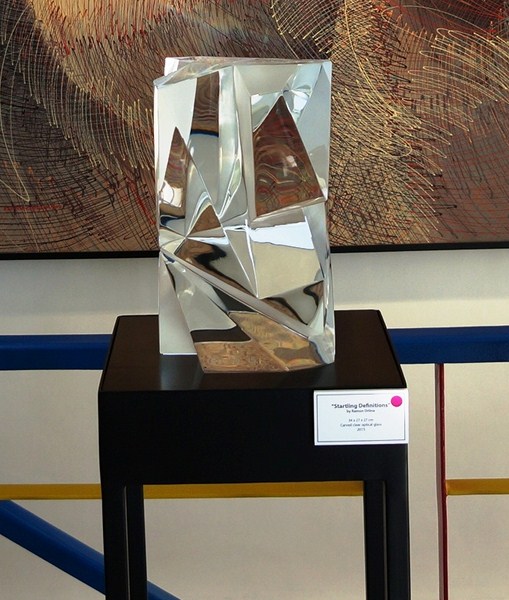
Startling Definitions

Imposing

All of Orlina’s artworks here are only for display, except for a room where artworks (most of which are Orlina’s works and some renowned artists), while on display, are also available for public auction.

Rich Harvest in Banawe

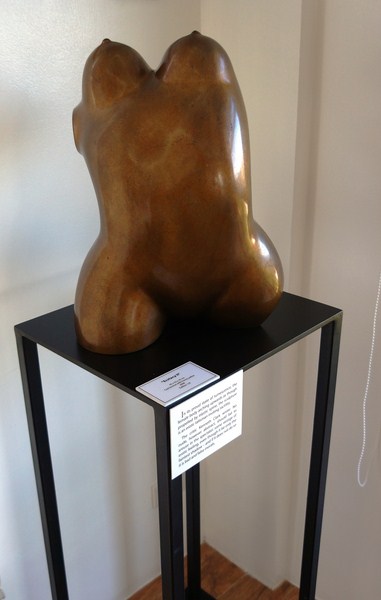
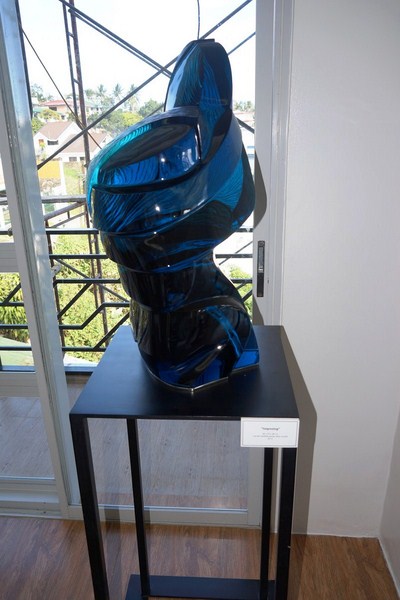
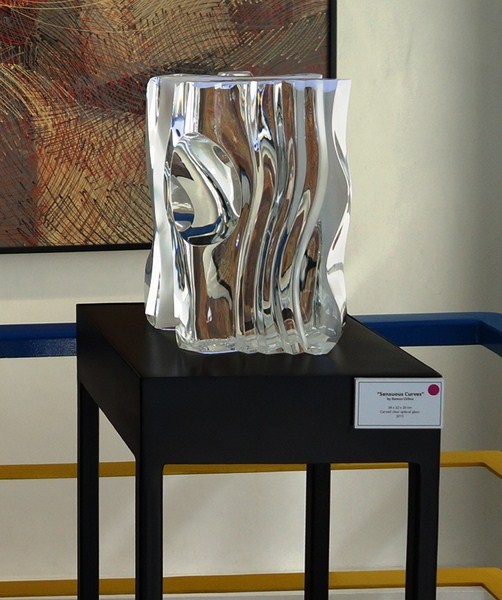
Sensuous Curves

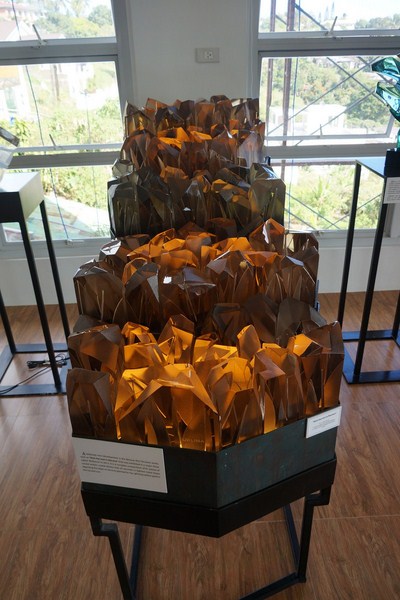
The lovely and interesting glass sculptures on display, many placed along the windows fronting  Taal Lake, are made in different colors and hues of glass and crystals (pink, yellow, orange) and each piece tells an interesting story.

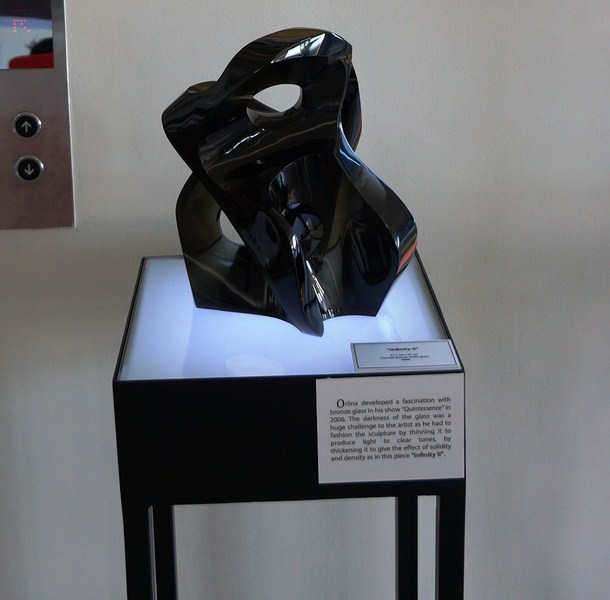
Ininity II

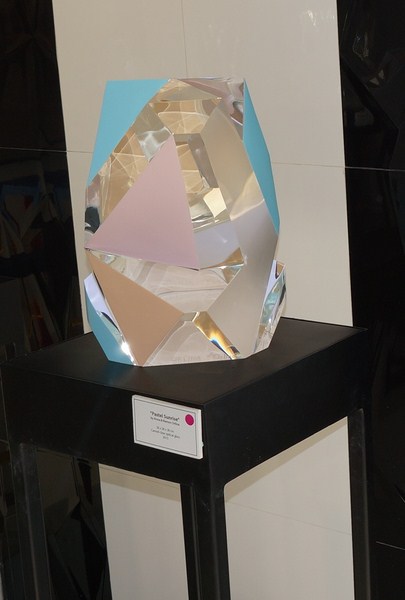
Pastel Sunrise

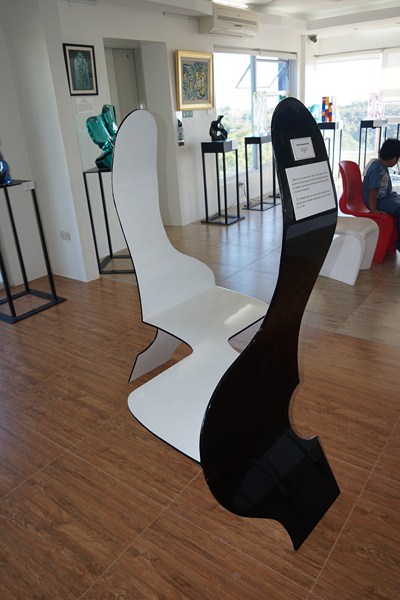
The glass sculptures are interspersed with jewelry, art cars, chairs and photographs of the artist’s works abroad as well as pieces made from a variety of mediums such as bronze and wood.

Orlina Romantic Chair

The quite informative exhibits have nameplates and a short explanation of the art piece.

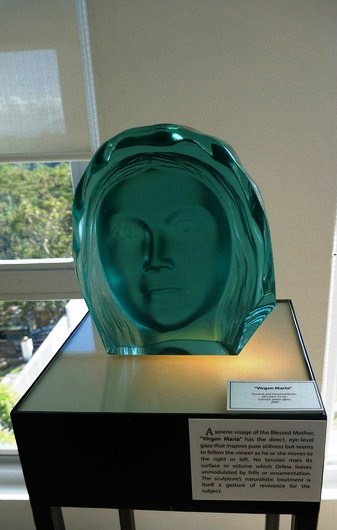
Virgen Maria

One of my favorites is the two dimensional glass sculpture of Virgen Maria, a woman’s head that looks different from various angles. From the back angle, if you look at the sculpture’s eyes, you are given the illusion that they follow and watch you as you move.

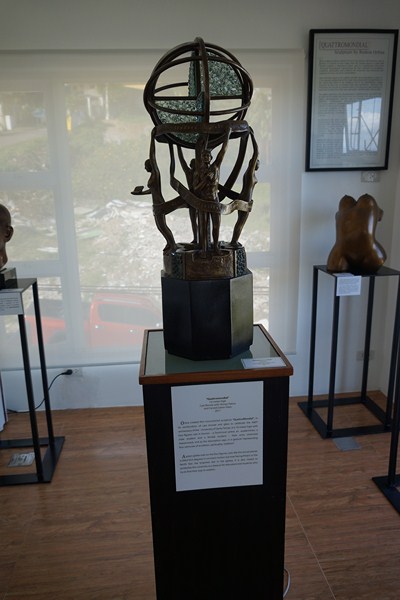
Quattro Mondial

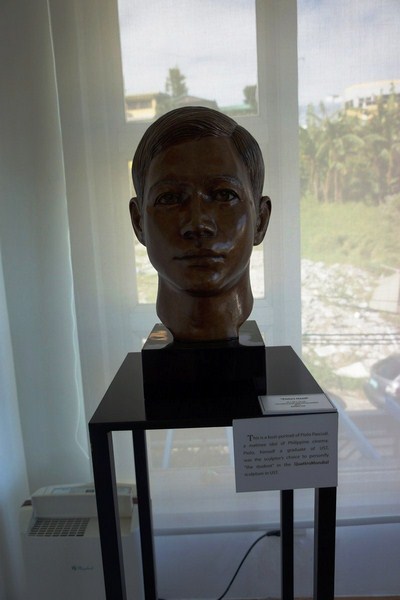
The UST (Orlina is a University of Sto. Tomas Architecture graduate) quadricentennial sculpture, supposedly one of Orlina’s most expensive art works, displays bronze studies including a face bronze sculpture of Piolo Pascual, the artwork’s male model.

Piolo Pascual

Framed artworks, sketches and chairs from other renowned Philippine artists such as Juvenal Sanso, Elmer Borlongan, Ann Pamintuan, Bencab (Benedicto Cabrera), Federico Alcuaz, Napoleon Abueva and other Philippine art masters were also on exhibit.

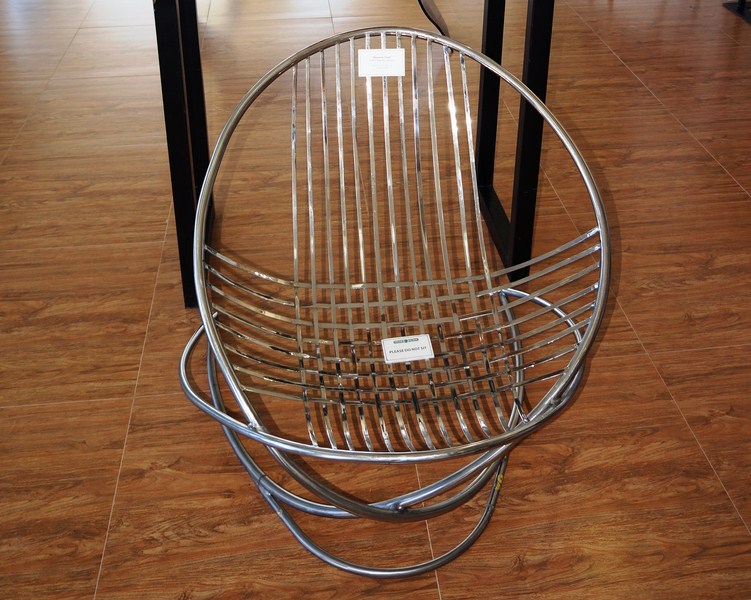
Abueva Chair

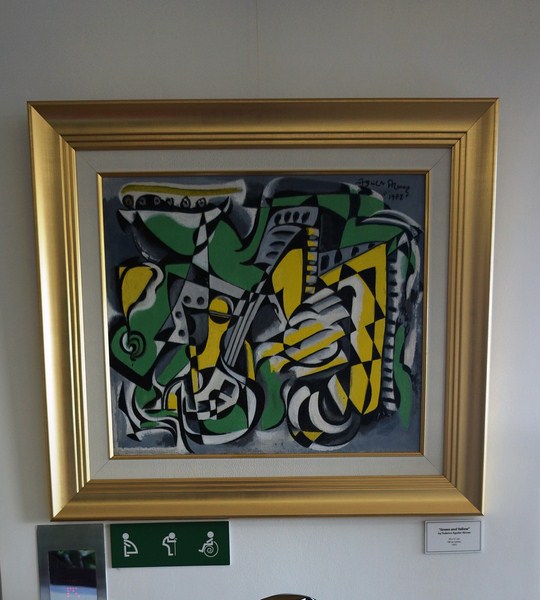
Green and Yellow (Federico Aguilar Alcuaz)

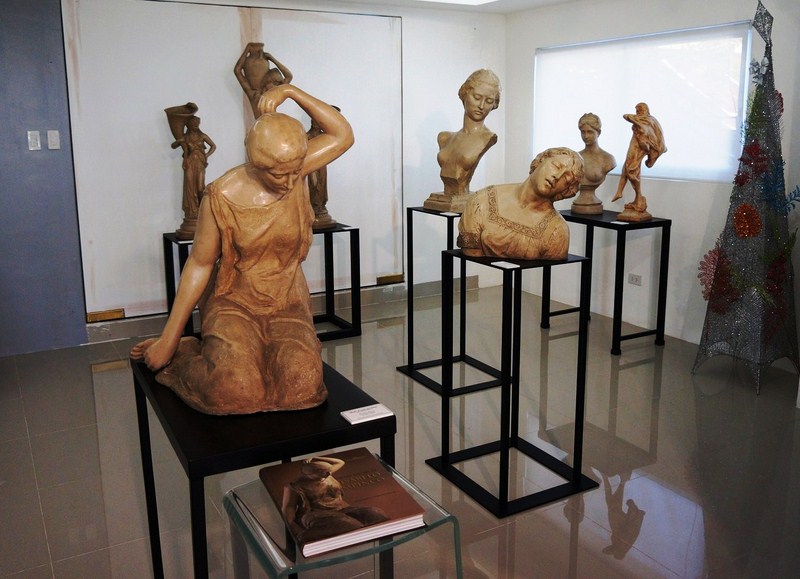
The Art of Isabelo Tampinco, made possible by a loan to the museum from the collection of Ernie and Chichi Sales, was ongoing at the Reflections Gallery.

The Art of Isabelo Tampinco

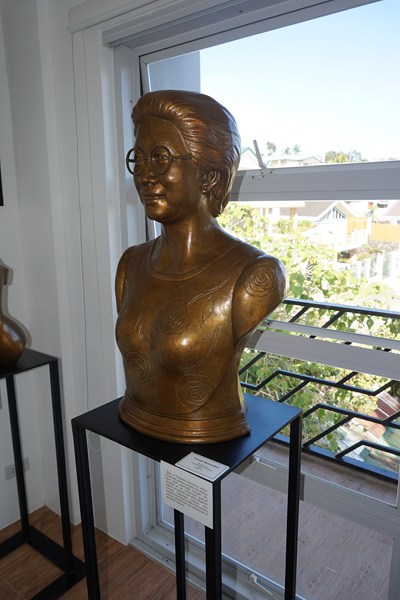
Pres. Corazon Aquino

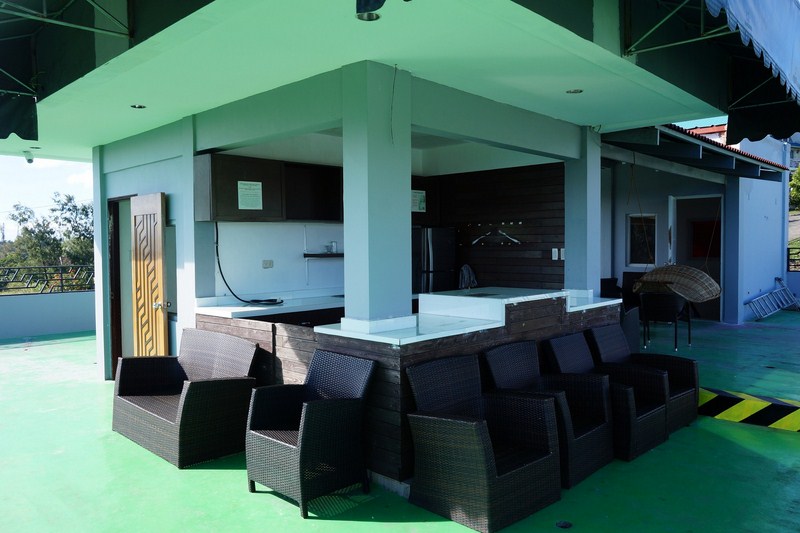
The roof deck, with its breathtaking view of Taal Volcano, has a coffee shop which was closed during my visit.

Coffee Shop

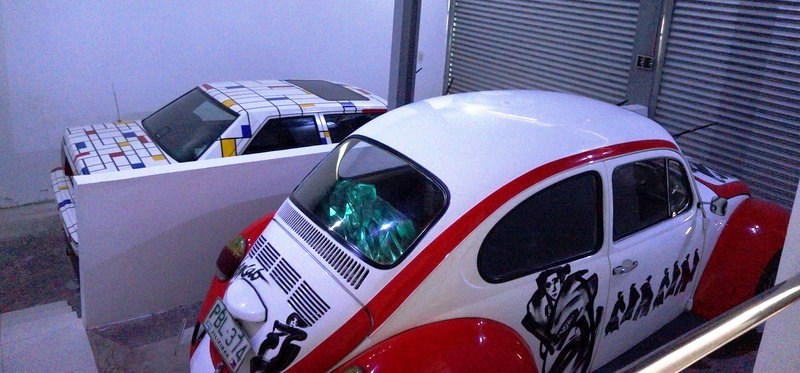
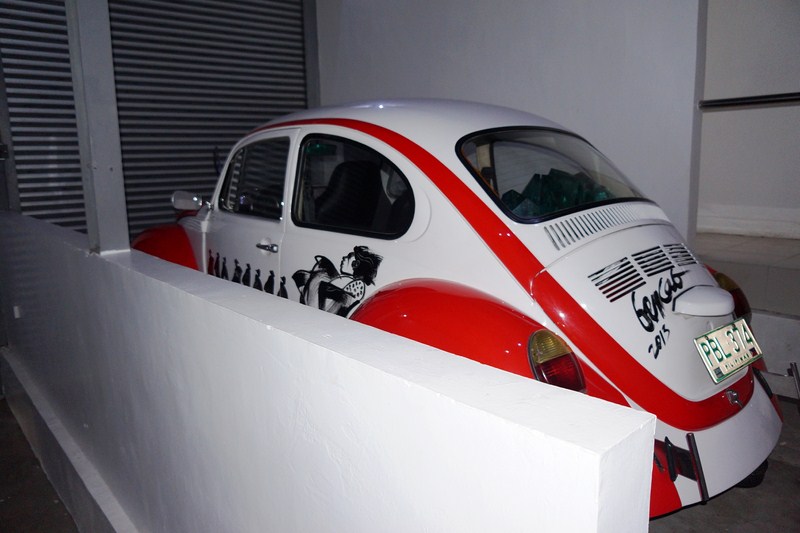
Stairs located at the back of the stage lead you to a garage where you will find a vintage, red and white Volkswagen Beetle, aptly called Sabel, which is rented out as a bridal car.

The garage

Fully-restored, and retrofitted and accessorized, it has a ref; champagne and glass holders; dividing in-door windows and leather seats; and its body is painted with artwork, inspired by the taong grasa (literally translated as “oily person,”- meaning “homeless and dirty”) by fellow Kapampangan and National Artist Benedicto Cabrera (Bencab).

The Volkswagen Beetle

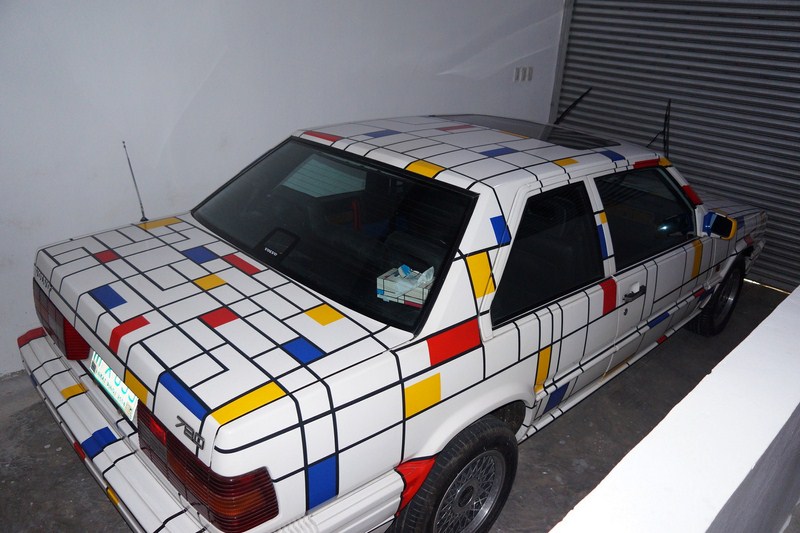
There’s also a fully restored, vintage Volvo, owned and accessorized by Orlina, with an interesting cubist-abstract hue. Orlina’s signature colors of orange, green, white and blue are painted, in a Piet Mondrian-linear style, all over the car’s body.

The Volvo

At the ridge side is an amphitheater where plays, events, and other special occasions can be held for a fee.

The amphitheater

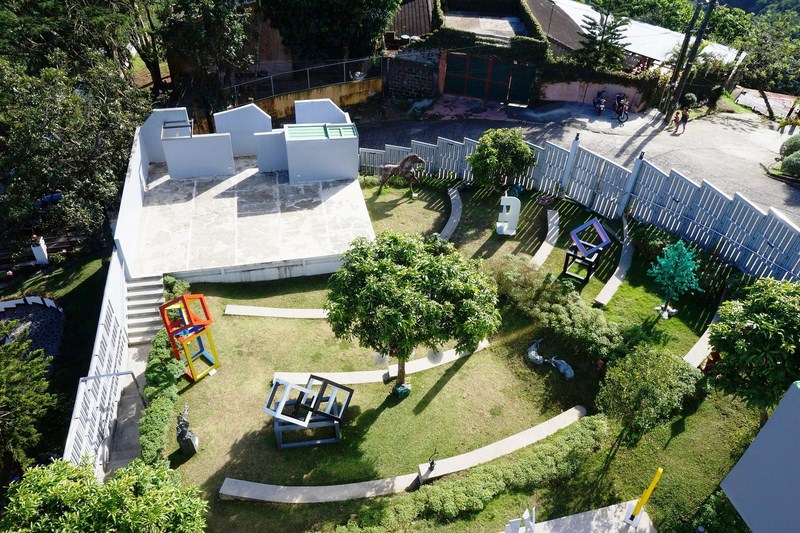
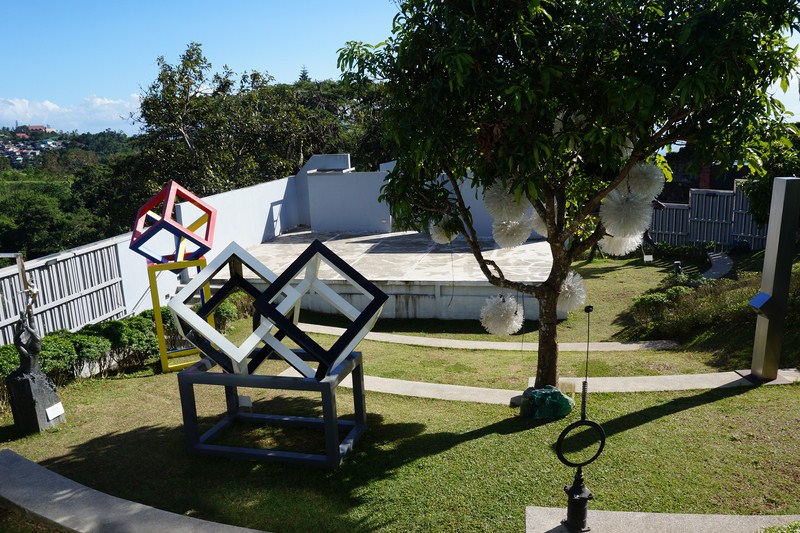
There’s also an outdoor Sculpture Garden with art piece installations.  While, taking a leisurely walk through the exhibit, visitors can also enjoy the Tagaytay breeze and the ridge view.

The rear of the museum as seen from the Sculpture Garden

Outdoor sculpture at the Sculpture Garden

The quaint, clean and well-maintained Museo Orlina, a cultural indulgence where one may get to appreciate awesome art pieces and works from one of the country’s renowned artists, adds a certain refined and cultured option for Tagaytay visitors and weekend residents who are looking for something unique while enjoying the cooling breeze and lake vista.

View of Taal Lake and Volcano from the museum

Museo Orlina: Hollywood Subdivision Rd., Hollywood Subd., Brgy. Tolentino East, Tagaytay City, Santa Rosa – Tagaytay Rd., Tagaytay, Cavite.  Open Tuesdays to Sundays, 10 AM – 6 PM. Tel: (046) 413 2581. Mobile number: (0995) 735-4462. E-mail:   info@museo-orlina.org. Website: www.museo-orlina.org. Admission (includes guided tour): general (PhP100), students and senior citizens with valid ID (PhP80. Manila office:  Orlina Atelier. Tel: (02) 781-5918 and 781-9471.  Fax:  (02) 749-6439. Mobile number : (0917) 880-5108. E-mail:   orlina@pldtdsl.net.  Website :   www.orlina.com.

Bahay na Bato Open Art Gallery (Luna La Union)

Bahay na Bato Open Art Gallery

Bahay na Bato Open Art Gallery

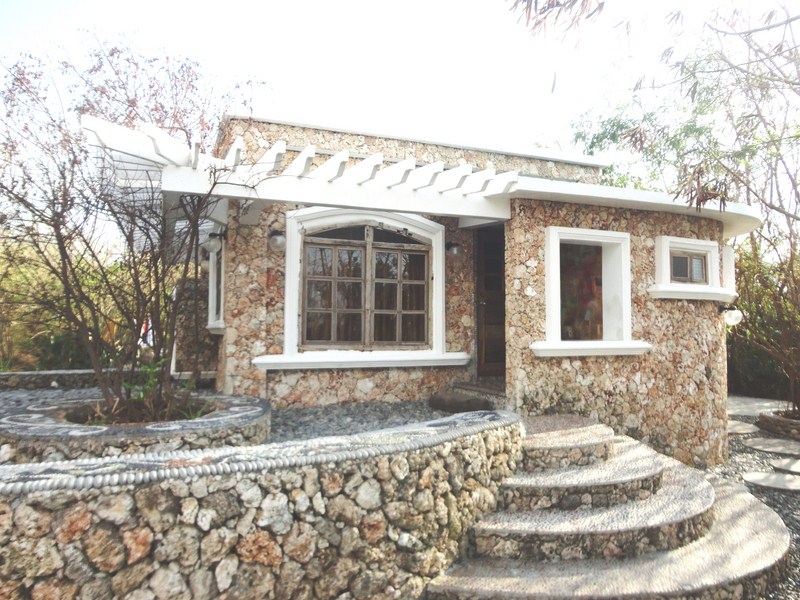
Upon checking in and lunch at Sebay Surf Central  Resort, we began our half day tour with Mr. Lawrence Fontanilla “Amar” Carbonell as our guide.  We proceeded to the nearby town of Luna where we first visited the Bahay na Bato Open Art Gallery, the newest tourist destination in Luna. Built way back in 2000, the attraction was originally just meant to be a family rest house for its owners, Dr. Edison and Dra. Purita Noble.

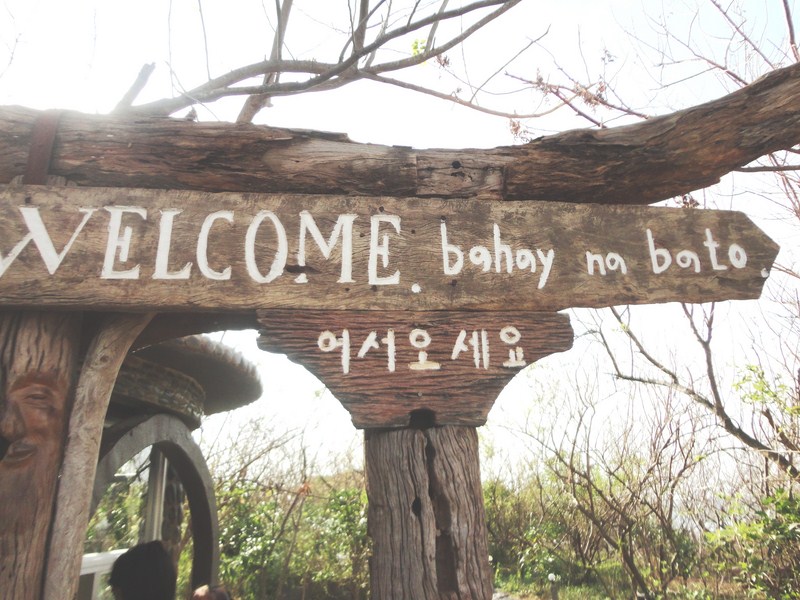
Bahay na Bato welcome sign

Bahay na Bato welcome sign

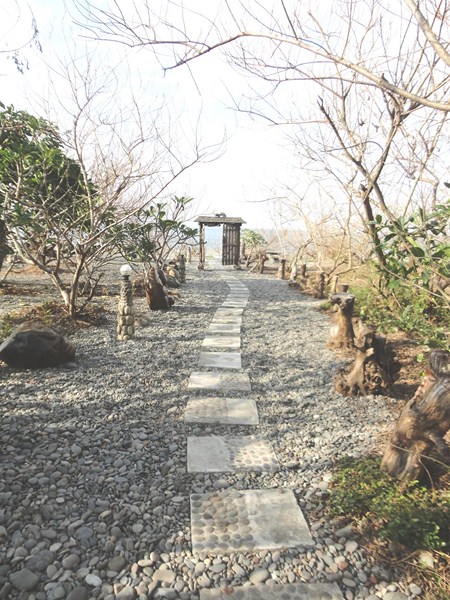
Gravel and flagstone pathway

Gravel and flagstone pathway

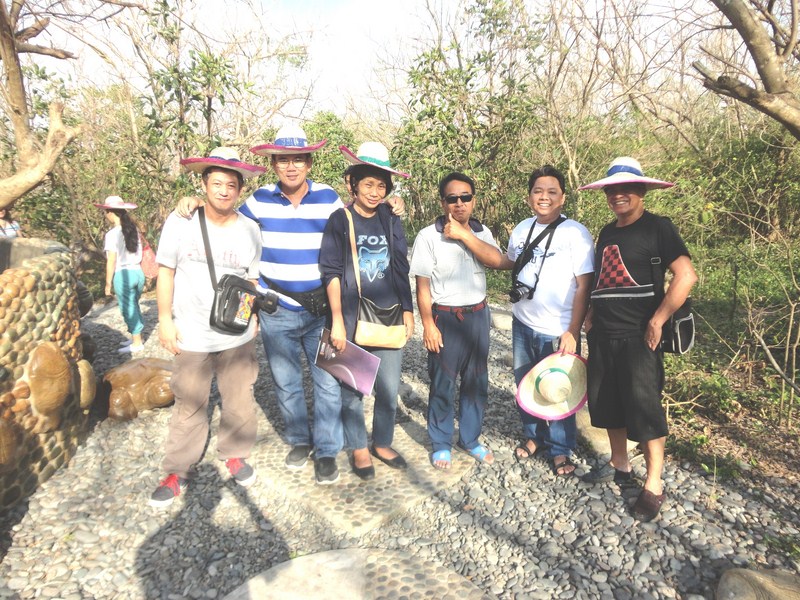
Vong Kim (third from right) with media group

South Korean artist Kim (third from right) with media group

However, in 2014, Luna Mayor Marvin Marron saw the potential of this property as a tourist attraction, thinking that the house could attract visitors.  Marron persuaded the owners to open the property to public and the municipal government extended help in the development of the new tourist spot, putting up promotional materials along the town’s major roads and helping in processing the registration of the site as a full-fledged tourist attraction.

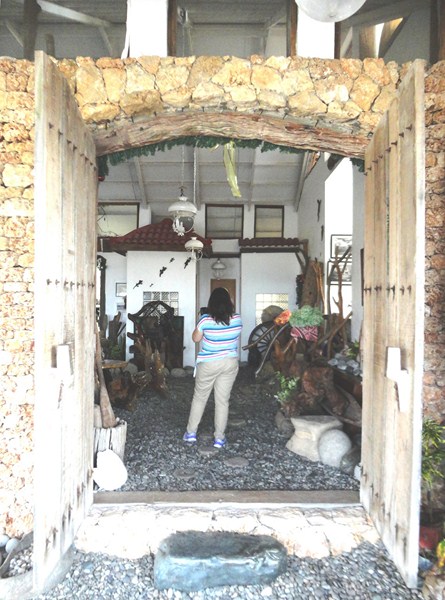
Entrance door

Wooden entrance door

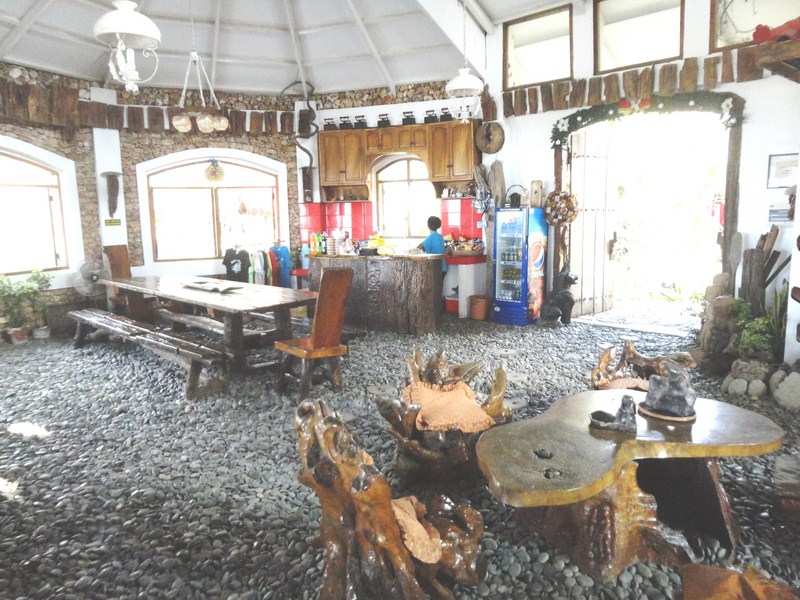
Lower level

Lower level

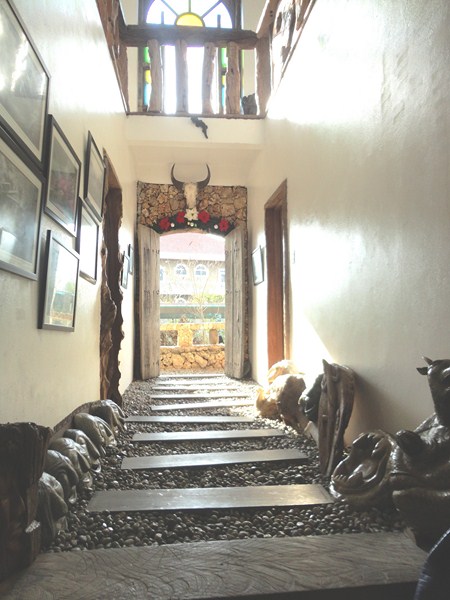
Art-lined hallway

Art-lined, gravel and flagstone hallway

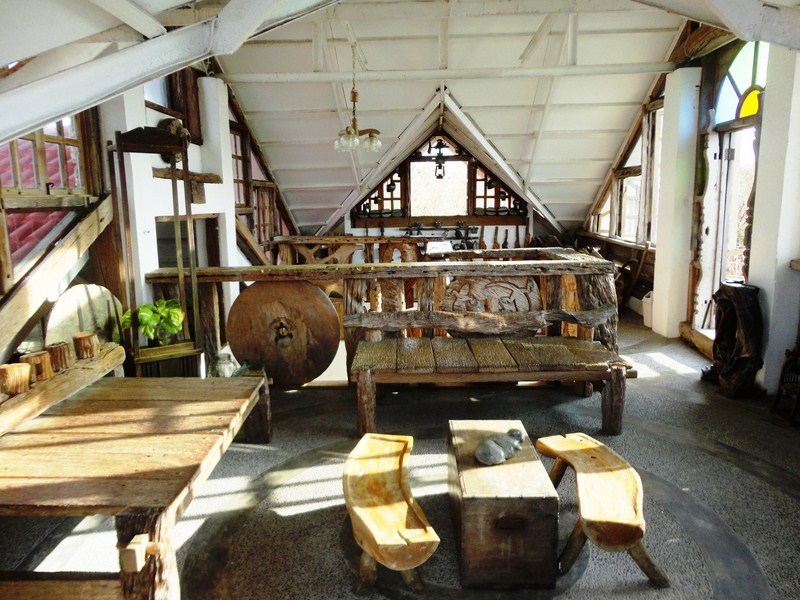
The Bahay na Bato premises offers numerous stone carvings, masterpieces created by South Korean national Mr.  Vong Kim, the in-house sculptor for the tourist site. Imelda Montison and Gloria Dizon, the rest house caretakers, and their families serve as the staff for the Bahay na Bato. Other residents were hired to serve as security and maintenance aides. Montison’s daughter, Beverly, who serves as the manager is married to Kim.

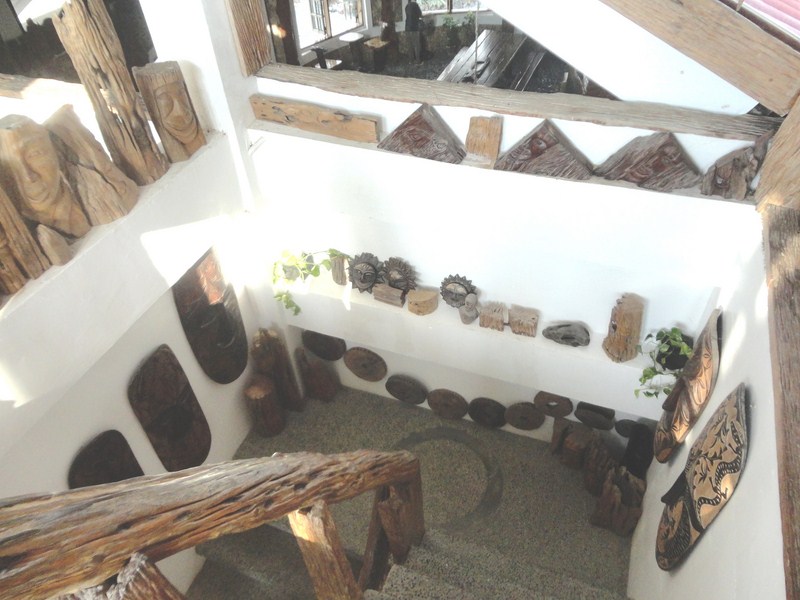
Stairway leading to second level

Stairway leading to second level

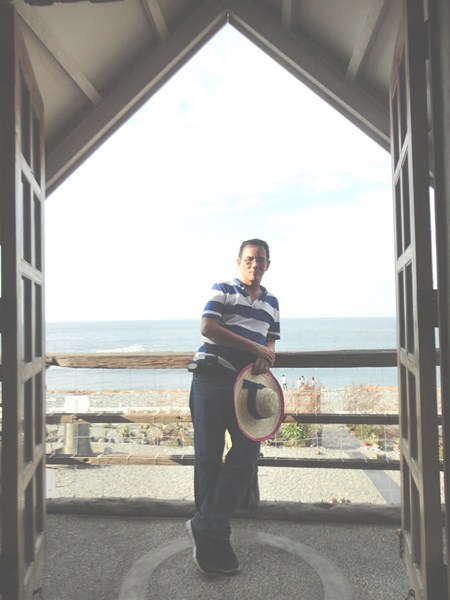
Author at the second level balcony

Author at the second level balcony

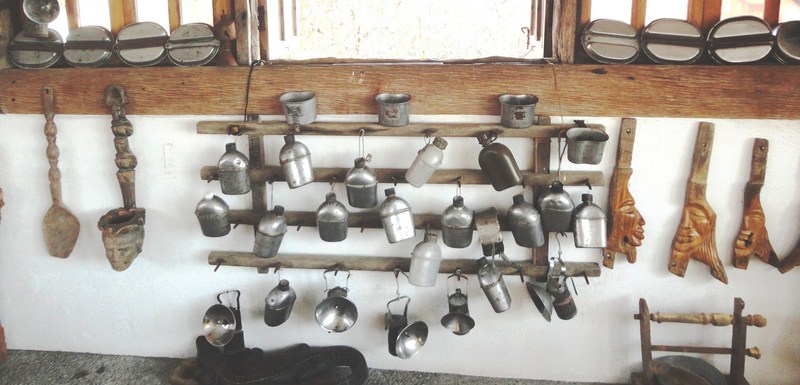
World War II canteens and lamps

World War II canteens, mess kits and lamps

Second level

Second level

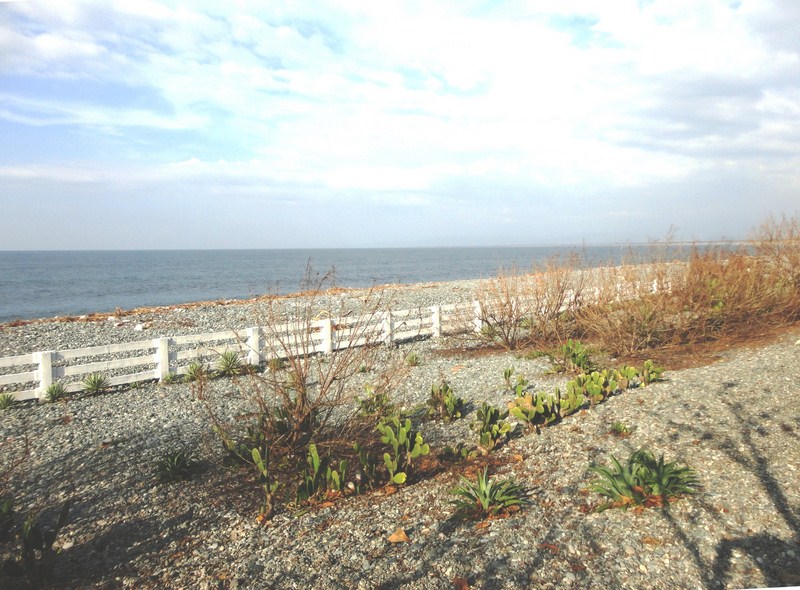
Luna’s shorelines are covered, not with fine sand, but with an unending supply of stones of various colors, shapes and sizes that seem to be replenished year by year, a mystery that has long baffled the community, some of whom believe that these stones are gifts from heaven.  These stones are  sold to become construction materials or garden ornaments.

Pebble beach

Multi-colored pebble beach

Bahay na Bato Open Art Gallery (32)

Sun dial

Sun dial

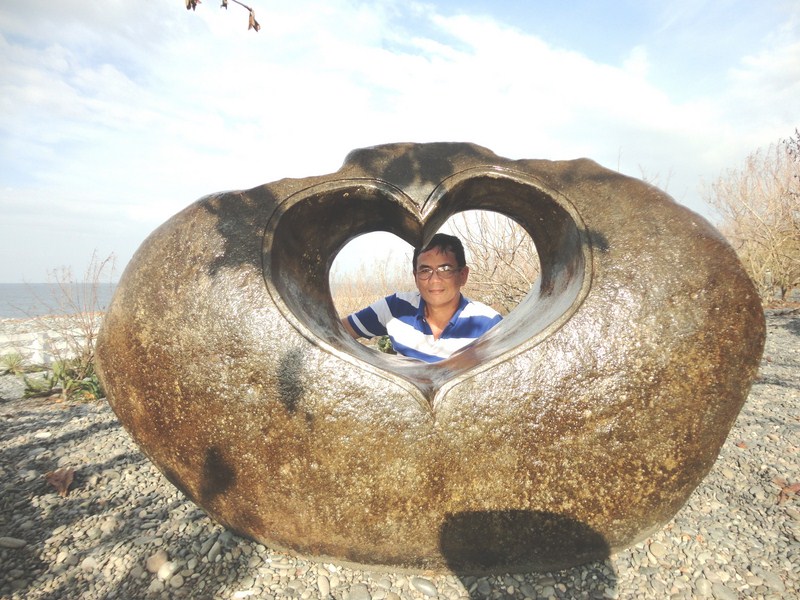
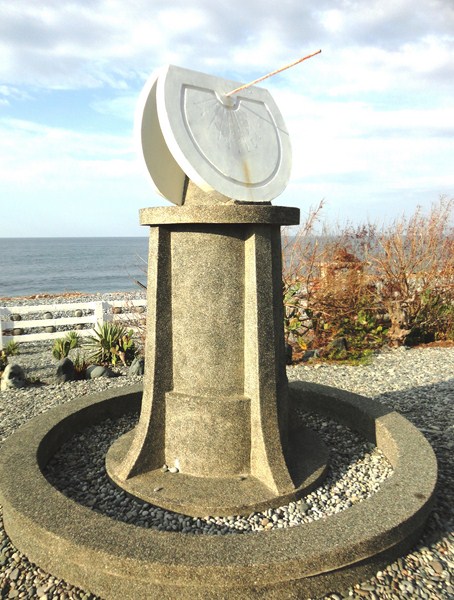
Using handpicked stones, Kim, with a great deal of imagination, carved figures out of the stones and boulders and these creations are now displayed in the Bahay na Bato Open Art Gallery. Kim also trained the local artisans on stone carving, a new way of making money out of these jewels for the locals who live near the beach area.

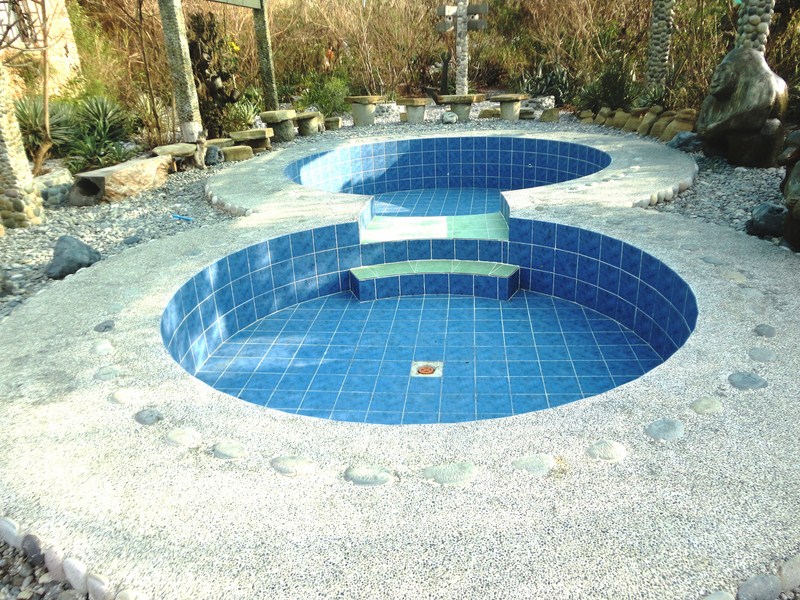
Figure 8 swimming pool

Shallow figure 8 swimming pool

Function hall

Function hall

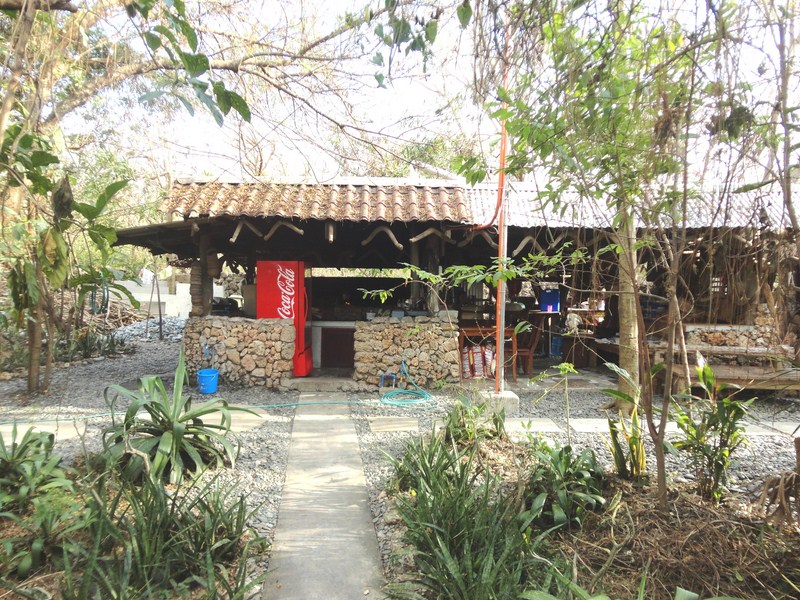
Cooking pavilion

Cooking pavilion

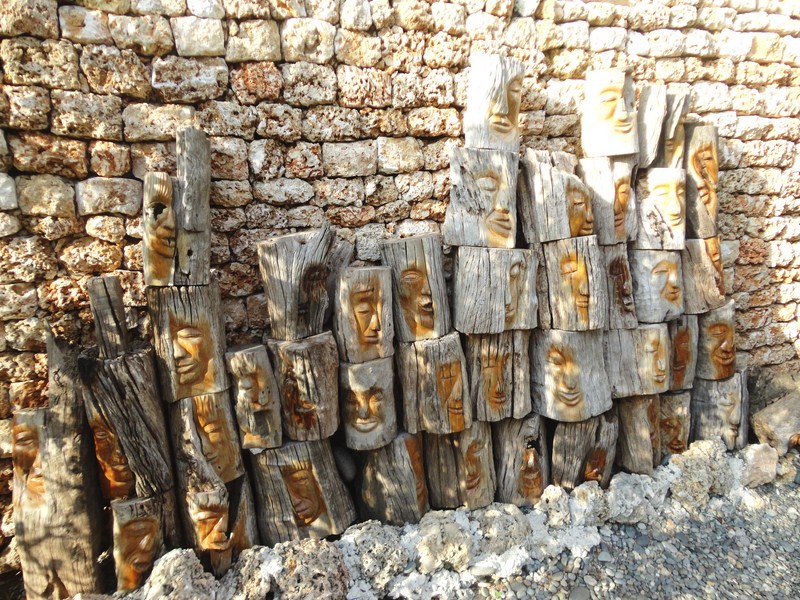
Today, droves of tourists come here to visit this new attraction and its magnificent works of art. The local tourism office has recorded a staggering number of visitors. In December 2014, it registered more than 10,000 visitors, and another 7,800 for January 2015. On one corner, stone faces greet us with cryptic smiles while on the other, stones are piled according to size and color. Further on, we saw boulders shaped as turtles, fish, flowers, hearts and even phalluses.

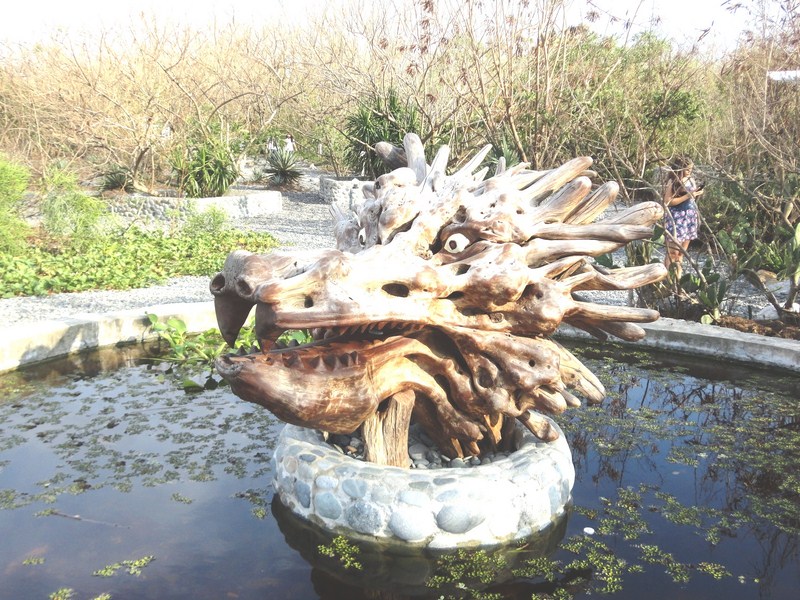
Dragon head made with driftwood

Dragon head made with driftwood

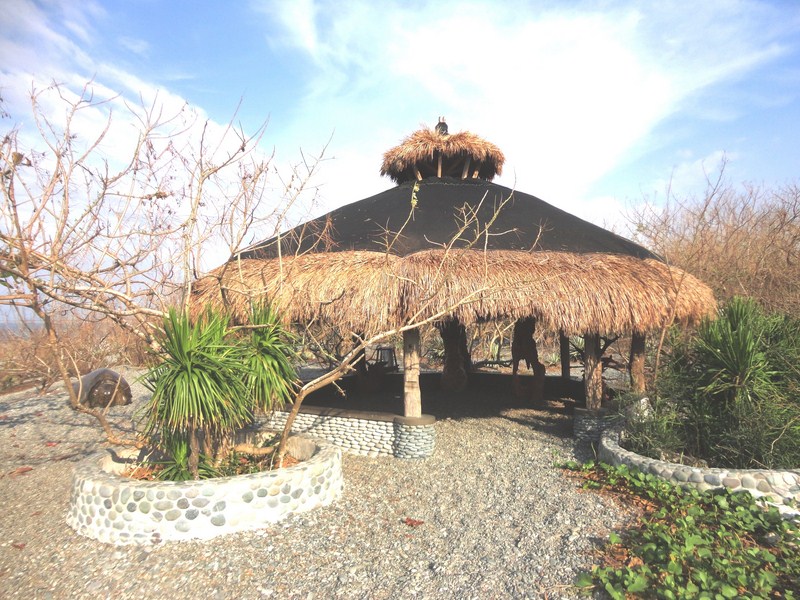
Native-style gazebo

Native-style gazebo

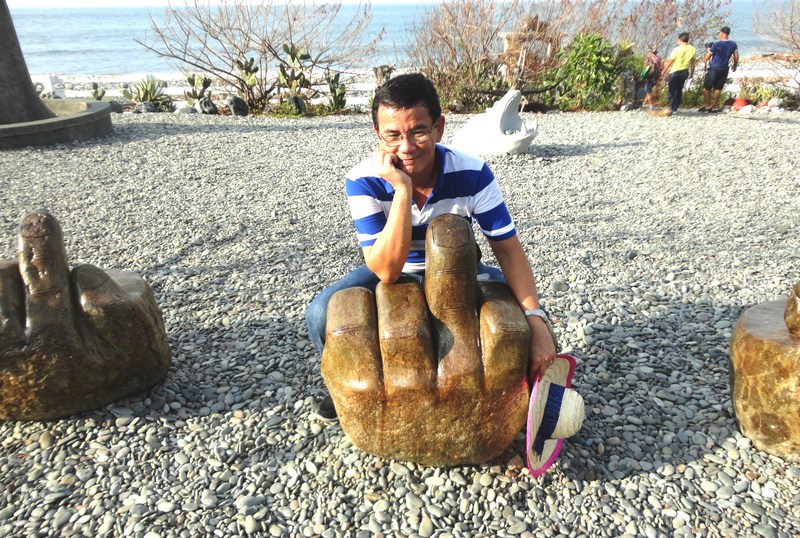
Dirty finger sculpture

Dirty finger sculpture

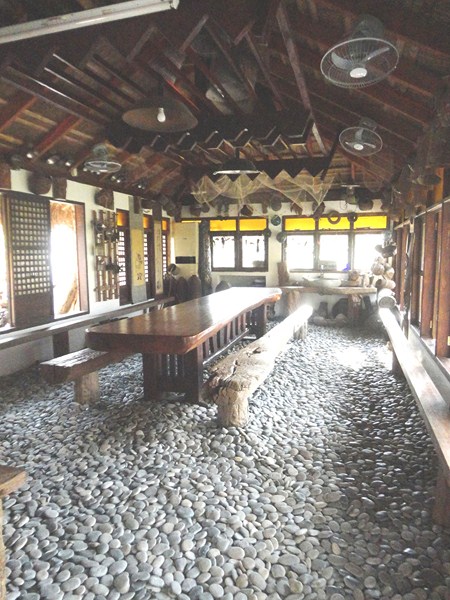
The 2-storey main house by itself is not entirely built with stones as wood also encompasses the area surrounded by green trees that dance with the sound of the waves coming from the beach.. As we passed through the entrance, huge carved art stones welcomed us. The ground floor, with speckled, palm-size pebbles for flooring,has two private rooms, one facing the beach area and the other one facing the swimming pool area.  The reception area has fabulous dining wood furniture.

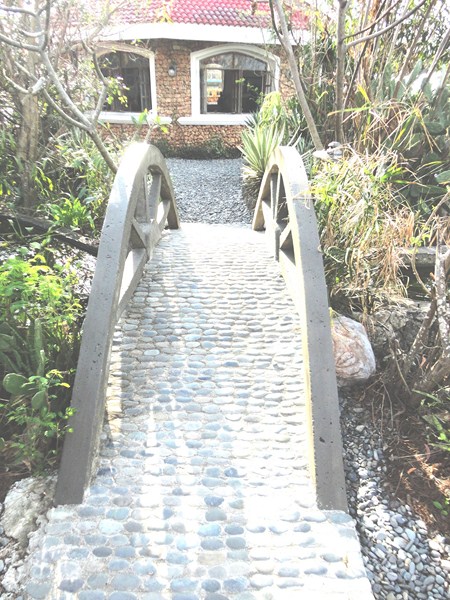
Stone bridge

Stone bridge

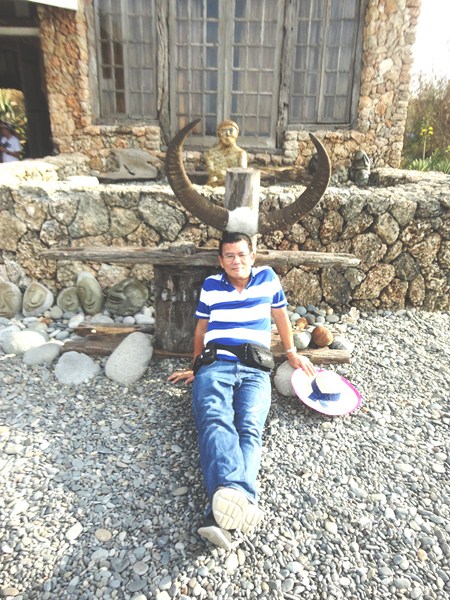
The horny author

The “horny”” author

Bahay na Bato Open Art Gallery (62)

Carved stones, of various shapes and sizes, are cleverly placed along the hallway. The second level, with its panoramic view of the pebble beach and the lawn is surrounded by various carved stone artifacts, showcases World War II items such as kerosene lamps, charcoal iron, water canteens (kantina), carbide lamps, wooden trunks and stainless steel kitchen utensils .

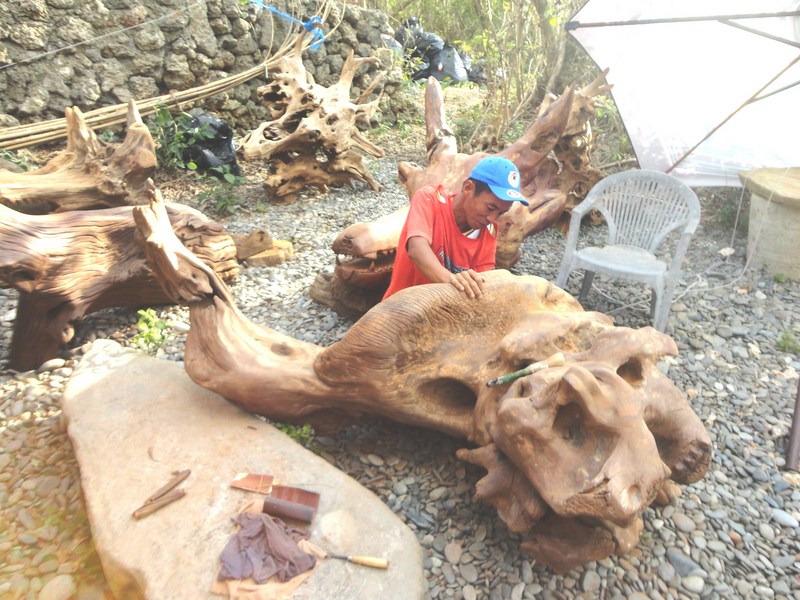
Local artisan at work on a piece of driftwood

Local artisan at work on a piece of driftwood

Bahay na Bato Open Art Gallery (63)

Bahay na Bato Open Art Gallery: Brgy. Nalvo Norte, Luna, La Union. Open daily, 6 AM to 8 PM. Admission: PhP20.00 (kids below four years old are admitted in for free).

How to Get There: Luna is located 267.48 kms.  from Manila and 34.8 kms. north of the City of San Fernando.  Air conditioned buses from Dominion Bus Lines, Philippine Rabbit, Partas, Fariñas, Maria de Leon, and Viron depart from terminals in Manila that is bound for Ilocos. Destinations can either be La Union, Narvacan, Vigan, Laoag or Abra. Just tell the bus attendant that you are going to Luna.


Melk Abbey – Stiftskirche (Melk, Austria)

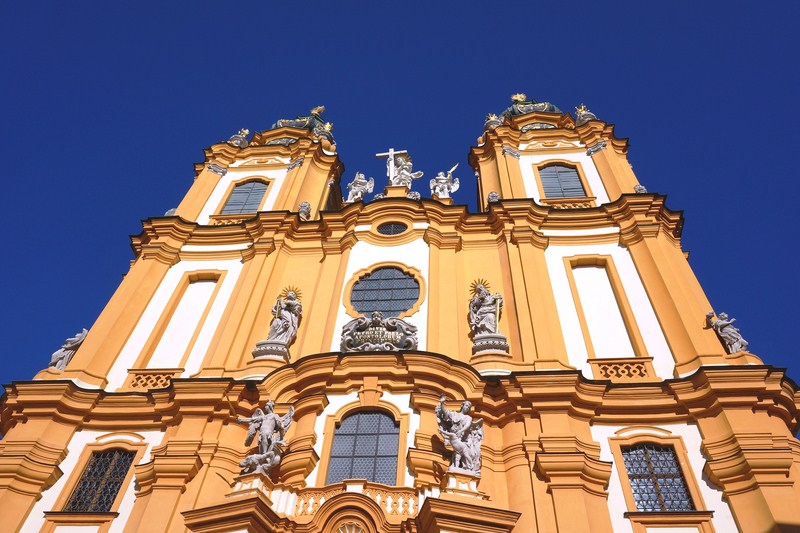
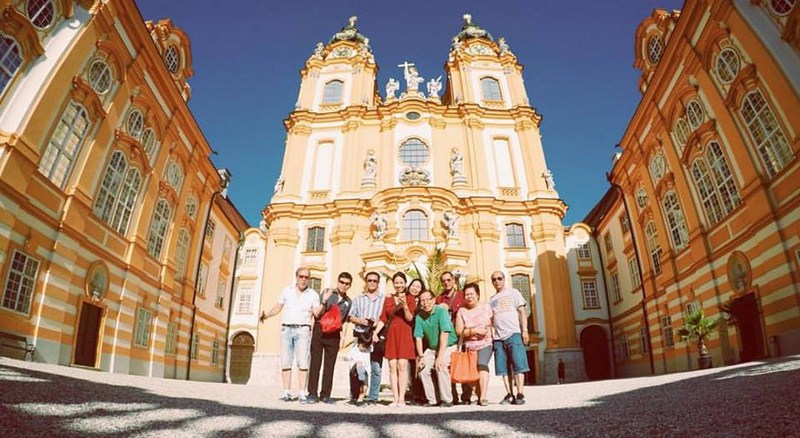
Facade of Stiftskirche (Abbey Church)

Facade of Stiftskirche (Abbey Church)

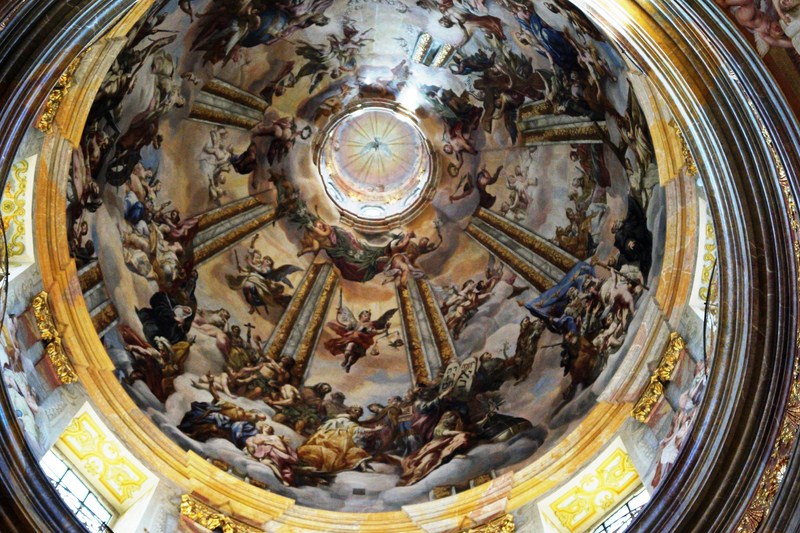
The highlight and end of our Melk Abbey tour, though, is certainly the full-on Baroque  Stiftskirche (Abbey Church) with its 200-ft. tall dome, symmetrical towers and astonishing number of windows.

Check out “Melk Abbey

Dome

The 200 ft. tall dome with frescoes of the heavens opening

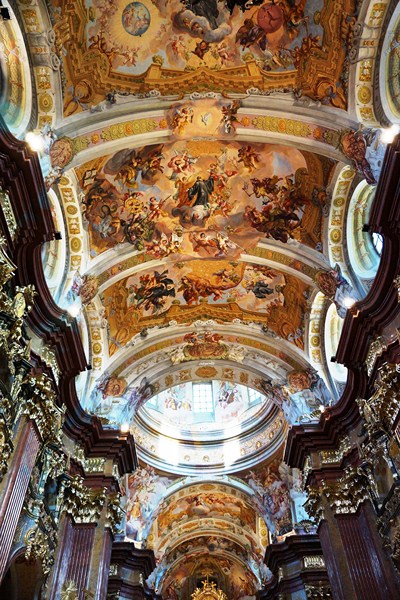
This grand finale, resplendent in a golden hue, is richly embellished with marble and altar paintings and frescoes by Johann Michael Rottmayr, with help from Paul Troger.

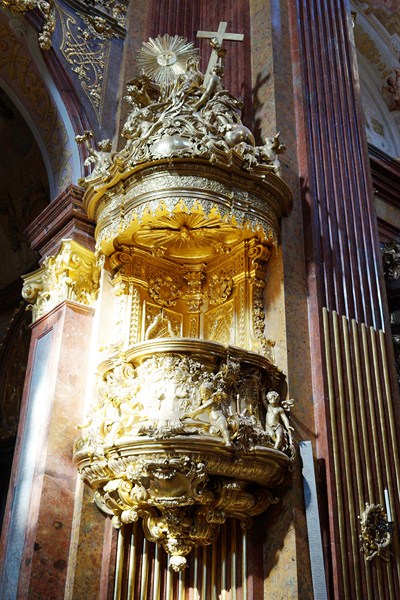
Pulpit

Pulpit of Giusseppe Galli-Bibiena

Jakob Prandtauer and, after his death, by his nephew Joseph Munggenast were the leading architects.  For the interior design and sketches for the frescoes, Antonio Beduzzi definitely was involved in the planning.

Interior of church

Ceiling frescoes by Johann Michael Rottmayr

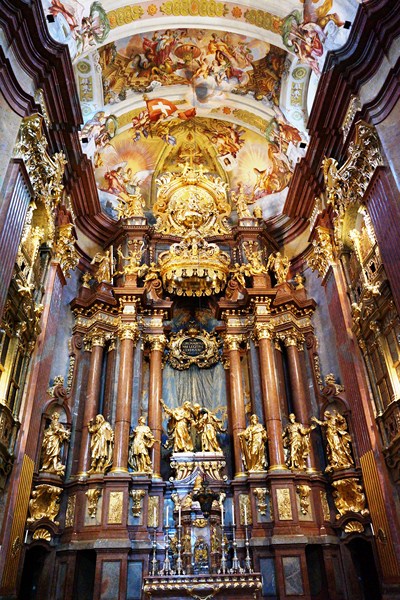
Together with other prominent artists and masters in their fields such as Giuseppe Galli-Bibiena (designs for the pulpit and high altar), Lorenzo Mattielli (design for the sculptures), Peter Widerin (sculptures) and many others, they created a synthesis of the arts to the glory of God, an unparalleled, indisputably classic example of Baroque.

High Altar

High Altar

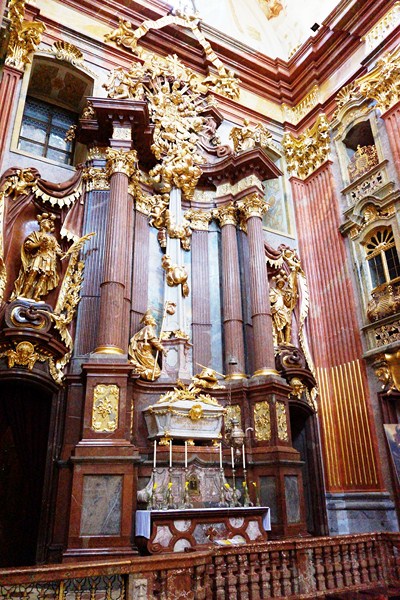
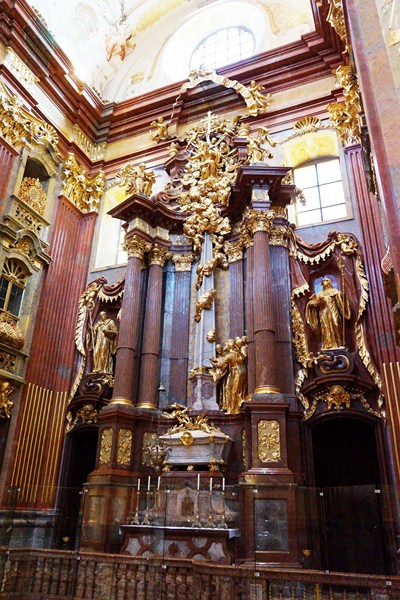
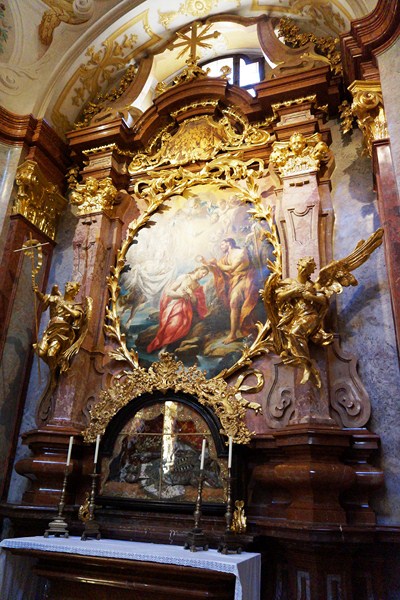
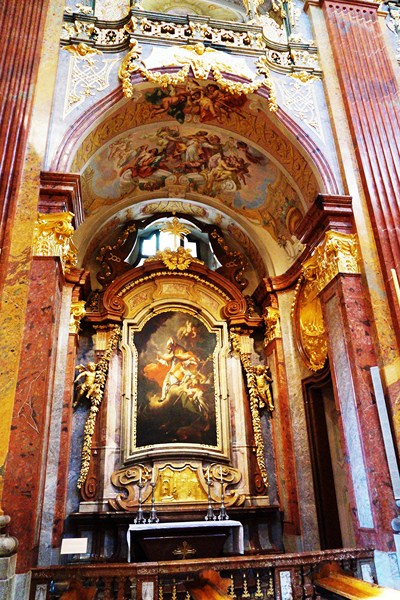
The inscription (from 2 Timothy 2,5), on the high altar, reads “non coronabitur nisi legitime certaverit” (“Without a legitimate battle there is no victory”). The left side altar (Coloman Altar), in the transept, contains, in a sarcophagus, the skeleton of St. Coloman of Stockerau.

St. Coloman's Altar

St. Coloman’s Altar

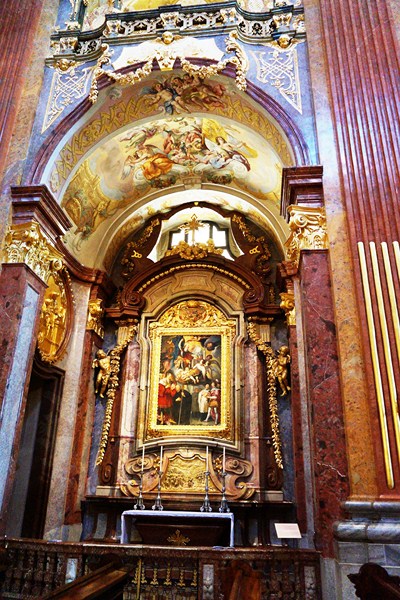
St. Benedict's Altar

St. Benedict’s Altar flanked by statues of St. Scholastica and St. Berthold of Garsten

The altar to the right is dedicated to St. Benedict.  It cenotaph (empty sarcophagus) bears the inscription “erit sepulchrum eius gloriosum” (“his grave will be glorious”). To the right of the altar is the statue of St. Scholastica (Benedict’s sister) while on the left is St. Berthold of Garsten.

St. Michael's Altar

St. Michael’s Altar

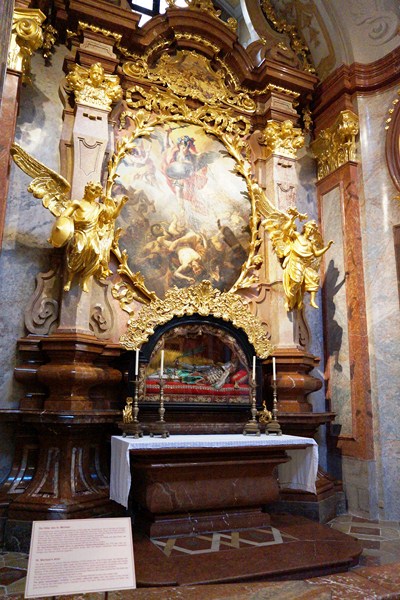
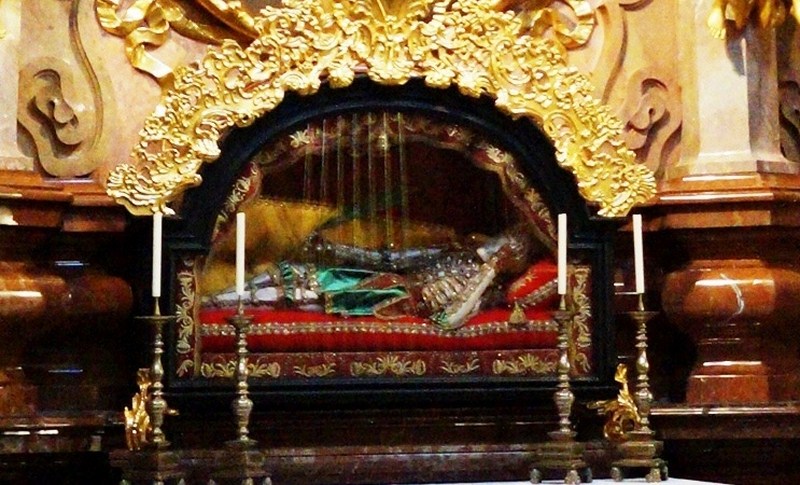
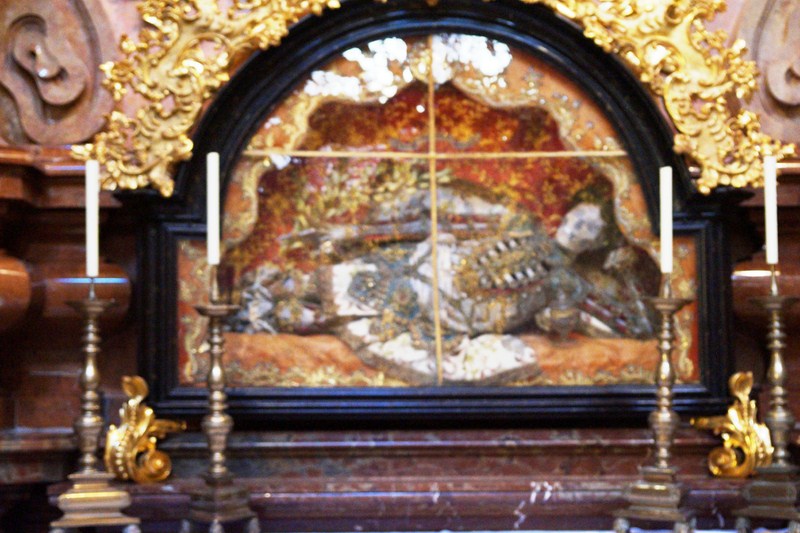
Glass sarcophagus of St. Clemens

Glass sarcophagus of St. Clemens

The St. Michael Altar has a glass sarcophagus with the skeleton of a so-called catacomb saint, given to the monastery in 1722 by Viennese nuncio Cardinal Alessandro Crivelli, and given the name Clemens.

St. John the Baptist Altar

St. John the Baptist Altar

Glass sarcophagus of Friedrich

Glass sarcophagus of Friedrich

Opposite is the St. John the Baptist Altar, also with a glass sarcophagus of a catacomb saint given as a gift to the monastery by Maria Theresa and displayed here in 1762. The unknown saint received the name Friedrich.

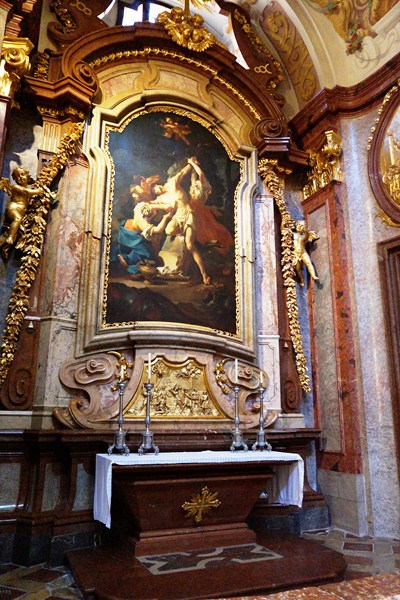
St. Sebastian's Altar

St. Sebastian’s Altar

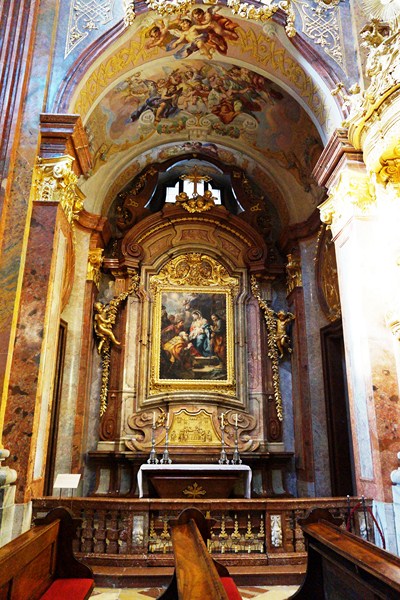
The Epiphany Altar

The Epiphany Altar

The altar painting at St. Leopold’s Altar, painted on a lead plate in 1650 by Georg Bachmann, is from the old abbey church.  It shows a depiction of the history of the foundation on the Melk monastery. Other side altars are dedicated to the Epiphany, St. Nicolas  and St. Sebastian.

St. Nicolas Altar

St. Nicolas Altar

St. Leopold's Altar

St. Leopold’s Altar

St. Benedict’s battle for virtue, the theme most strongly expressed by the nave’s fresco, depicts victory in this battle as portrayed, on the one hand, by the large victory crown on the high altar and the dome frescoes, in which the heavens open and, on the other hand, by the victor’s laurels over the monk, who has achieved spiritual fulfillment.

Melk Abbey:  Abt-Berthold-Dietmayr-Straße 1, 3390 Melk, Austria. Tel: +43 2752 5550.  Open 9 AM – 6 PM. Website: www.stiftmelk.at. Admission (abbey park and the bastion): Adults: (€4,00), Students (€ 3,00), Children (6-16  years) (€ 1,00).

Melk Abbey (Melk, Austria)

Melk Abbey

Melk Abbey

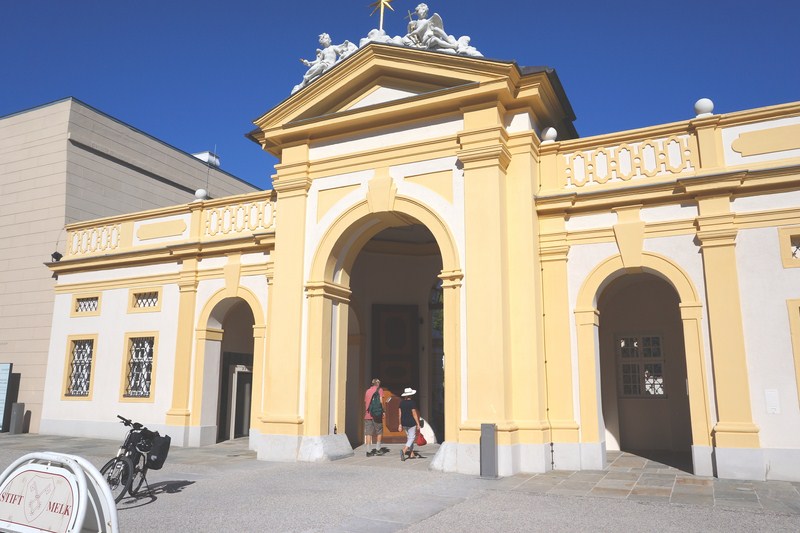
After our tour of Mathausen Memorial, we again boarded our van for the 86.8-km. (1-hour) trip, via the A1, to huge Melk Abbey (German: Stift Melk), one of Europe’s great sights located on a rock-strewn outcrop overlooking the banks of the Danube River.  Adjoining the Wachau Valley between Salzburg and Vienna, it is a Benedictine abbey above the town of Melk in Lower Austria. 

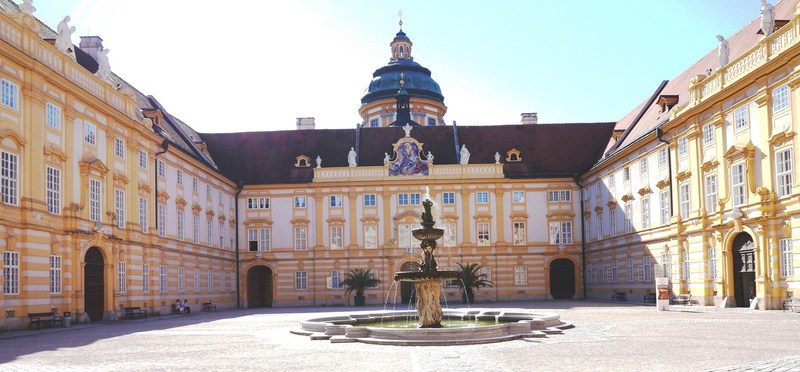
Inner (Prelates) Courtyard

Inner (Prelates) Courtyard

The 497-room (with 1,365 windows) abbey, founded in 1089 when Leopold II, Margrave of Austria gave one of his castles to Benedictine monks from Lambach Abbey (who turned it into a fortified abbey), contains the tomb of St. Coloman of Stockerau and the remains of several members of the House of Babenberg, Austria’s first ruling dynasty who ruled Austria from 976 until the House of Hapsburg took over.

Abbey gate

Abbey gate

A monastic school, the Stiftsgymnasium Melk, was founded in the 12th century and the abbey’s influence and reputation as a center of learning and culture spread throughout Austria.  The Name of the RoseUmberto Eco‘s popular novel, was researched by Eco in the abbey’s monastic library which is renowned for its extensive manuscript collection (the monastery’s scriptorium was a major site for the production of manuscripts).

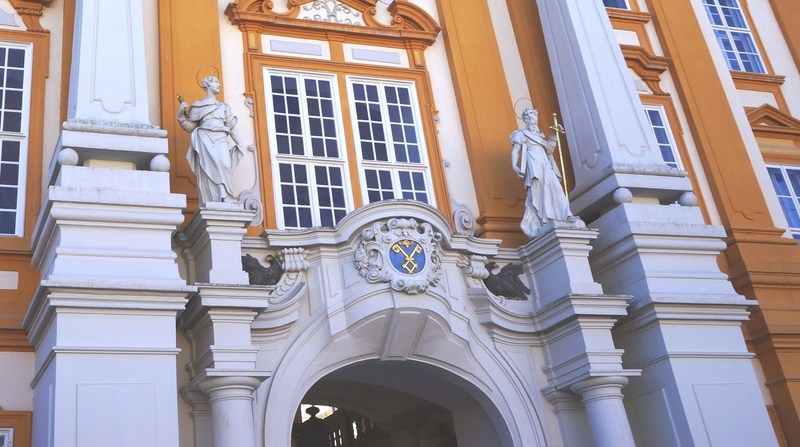
Main Entrance with statues of Apostles Peter & Paul designed by Lorenzo Mattielli

Main Entrance with statues of Apostles Peter & Paul designed by Lorenzo Mattielli

As a tribute to the abbey and its famous library, he named the apprentice, one of the protagonists, as “Adson von Melk.” Members of the Melk monastic community have achieved significant success in the fields of natural science and the arts and among its alumni was the 19th-century Austrian dramatist and short-story writer, Friedrich Halm.

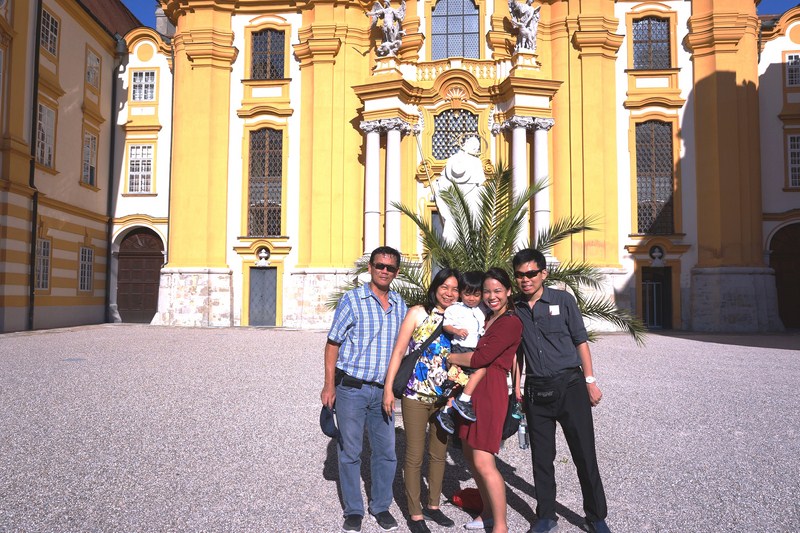
L-R: the author, Grace, Kyle, Cheska and Jandy

L-R: the author, Grace, Kyle, Cheska and Jandy

Since 1625 the abbey has been a member of the Austrian Congregation, now within the Benedictine Confederation. During the Reformation and the 1683 Turkish invasion, Melk Abbey suffered damage but it was spared direct attack when the Ottoman armies were halted just outside Vienna.  In 1701, a Baroquization of the abbey church was planned but, after 1701, at Abbot Berthold Dietmayr’s instigation, a complete reconstruction of the church took place, following plans by architect Jakob Prandtauer, and completed in 1736.

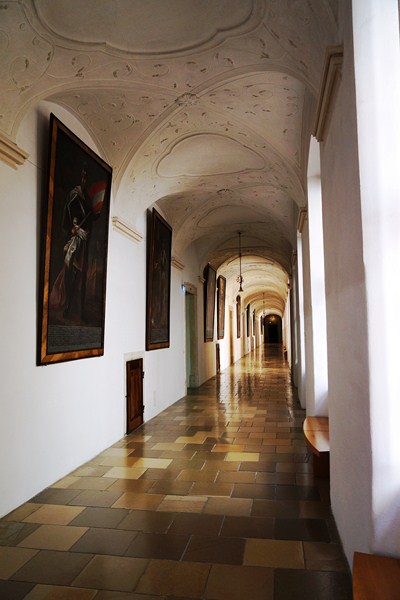
Kaisergang (Emperors' Gallery)

Kaisergang (Emperors’ Gallery)

Between 1780 and 1790, under Emperor Joseph II, many Austrian abbeys were seized and dissolved but, due to its fame and academic stature, Melk managed to escape dissolution. The abbey also managed to survive the Napoleonic Wars and the period following the Anschluss in 1938, when the school and a large part of the abbey were confiscated by the state. After the Second World War, the school was returned to the abbey and now caters for nearly 900 pupils, of both sexes, in secondary and preparatory school. Today, the institution survives, funded by agriculture and tourist visits.

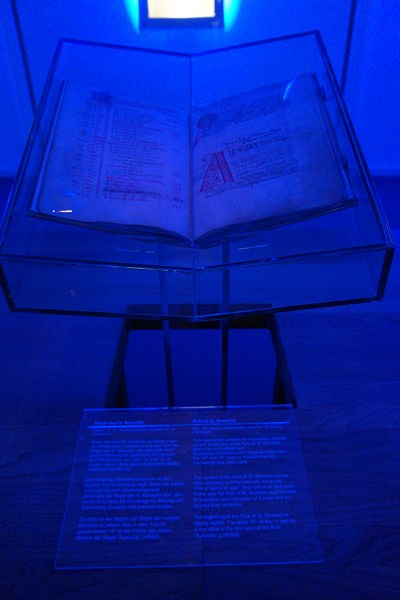
Rule of St. Benedict at Room 1 - Listen with Your Heart

Rule of St. Benedict at Room 1 – Listen with Your Heart

In 1947, the abbey church was damaged by fire but, after a 10-year long restoration, financed with help from the state and federal government, was finished in 1987. To celebrate the 1,000th anniversary of the first reference to a country named Österreich (Austria), another grand restoration project,  financed in part by the sale of the abbey’s Gutenberg Bible to Harvard University (which was later donated to Yale University), was completed by 1996.

Room 2 - A House for God and Man

Room 2 – A House for God and Man

Room 3 - The Ups and Downs of History

Room 3 – The Ups and Downs of History

Upon arrival, we entered Benedict Hall, above which is a leitmotif with the Latin words “absit gloriari nisi incruce” (“Glory is found only in the cross”) and a huge copy of the Melk Cross, one of the abbey’s greatest treasures (the original is hidden in the treasury, viewable only with special permission).

Room 4 - The Word of Life

Room 4 – The Word of Life

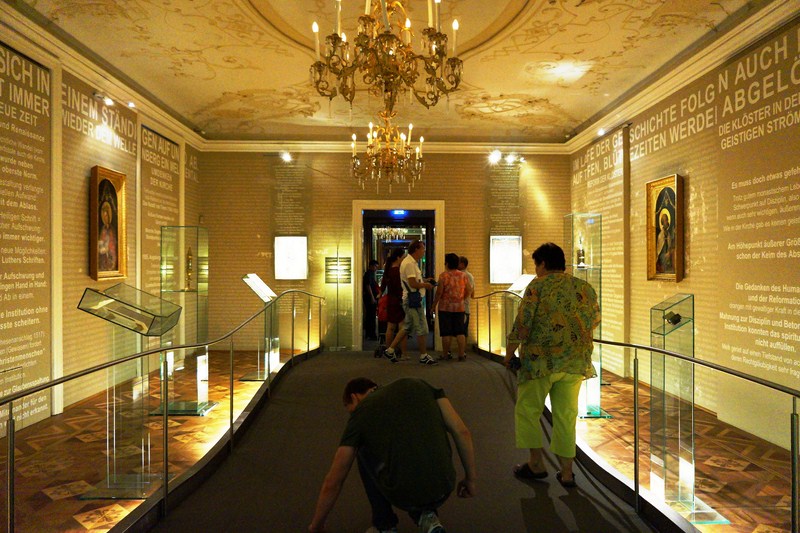
We first visited the imperial rooms with its restored inlaid wood floors, currently home to the most modern abbey museum in Austria, passing through the art-lined Kaisergang (Emperors’ Gallery) which stretches for 197 m. (644 ft.) and is decorated with portraits of Austrian royalty.

Room 5 -Now we are seeing a dim reflection in a mirror … (1 Cor. 13,12)

Room 5 -Now we are seeing a dim reflection in a mirror … (1 Cor. 13,12)

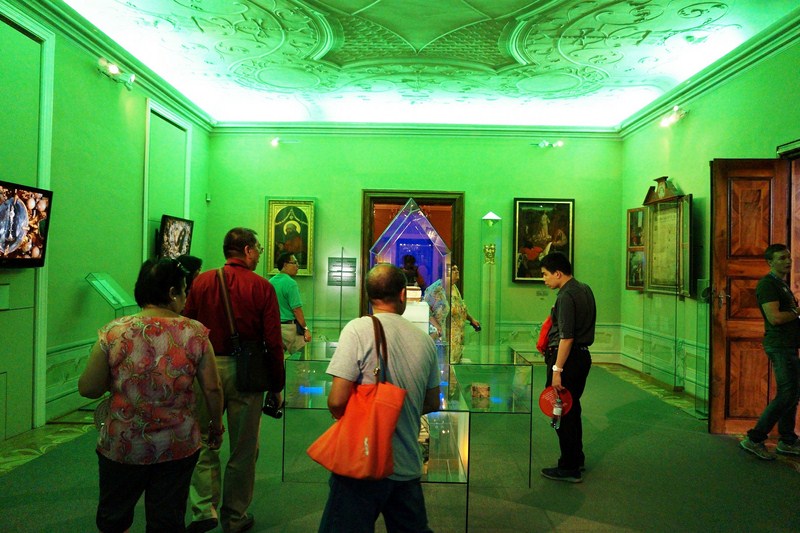
The museum’s current exhibition, entitled “The Path from Yesterday to Today – Melk Abbey in its Past and Present,” was designed by architect Hans Hoffer, also the designer of the “Klangtheater Ganzohr” in Vienna and the director of the “Linzer Klangwolke” several times.   The exhibits chronicle the ages of the abbey, and each room is lit up with a symbolic color.

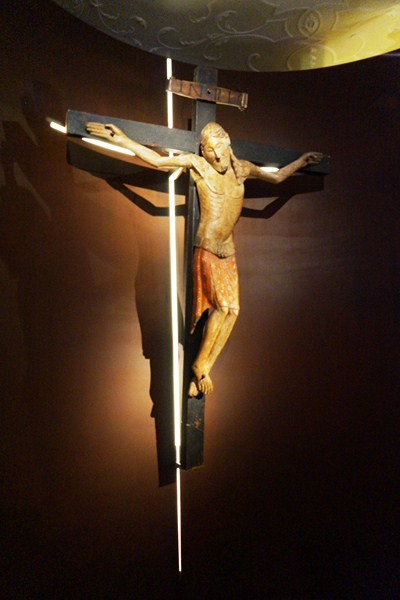
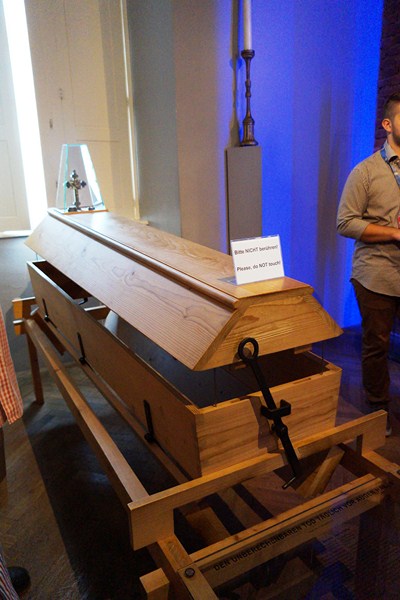
Reusable coffin at Room 7 - In the Name of Reason

Reusable coffin at Room 7 – In the Name of Reason

Room 9 - The Path to the Future

Room 9 – The Path to the Future

They are divided into the blue-colored “Listen with Your Heart,” the green-colored “A House for God and Man,” “The Ups and Downs of History,” “The Word of Life,” “Now we are seeing a dim reflection in a mirror … (1 Cor. 13,12),” “Heaven on Earth,” “In the Name of Reason,” “The Whole Person,” “The Path to the Future,” “To Glorify God in Everything and The City on the Mountain” and “Motion Is a Sign of Life.”

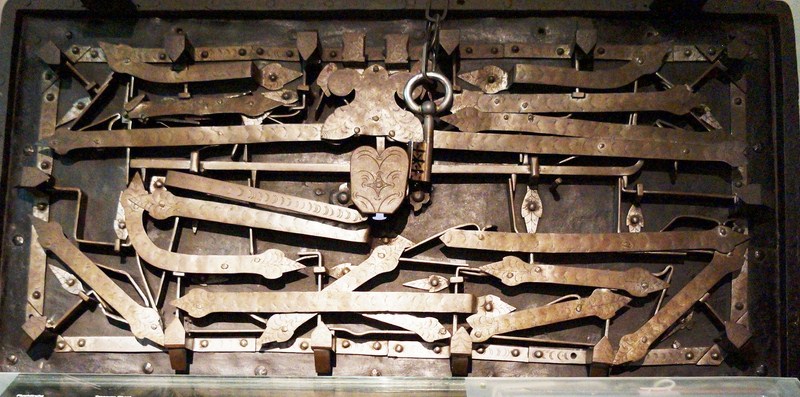
Room 10 - a very complicated lock box that operated with a single key

Room 10 – a very complicated lock box that operated with a single key

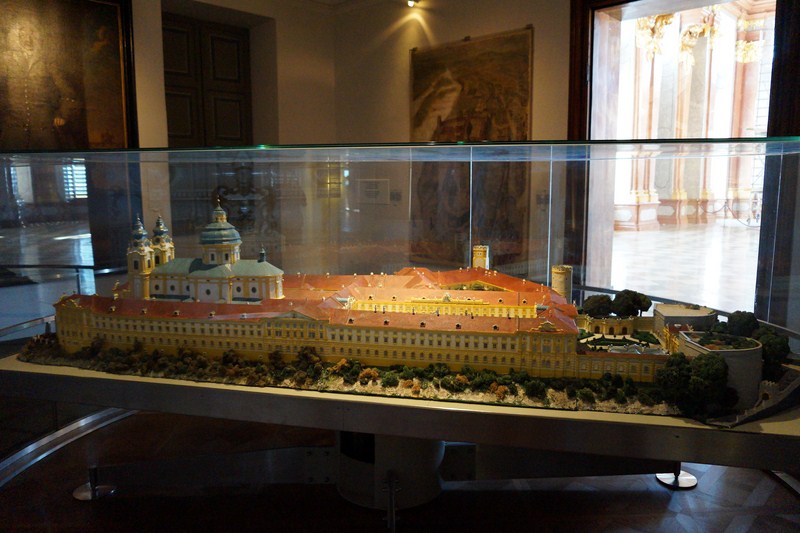
Model of the 497-room Melk Abbey at Room 11 - Motion Is a Sign of Life

Model of the 497-room Melk Abbey at Room 11 – Motion Is a Sign of Life

The Prelate’s Hall, with its Baroque painting gallery, is one of the most beautiful rooms in the monastery. Though not open to the public, it is used by the abbot for representative purposes.

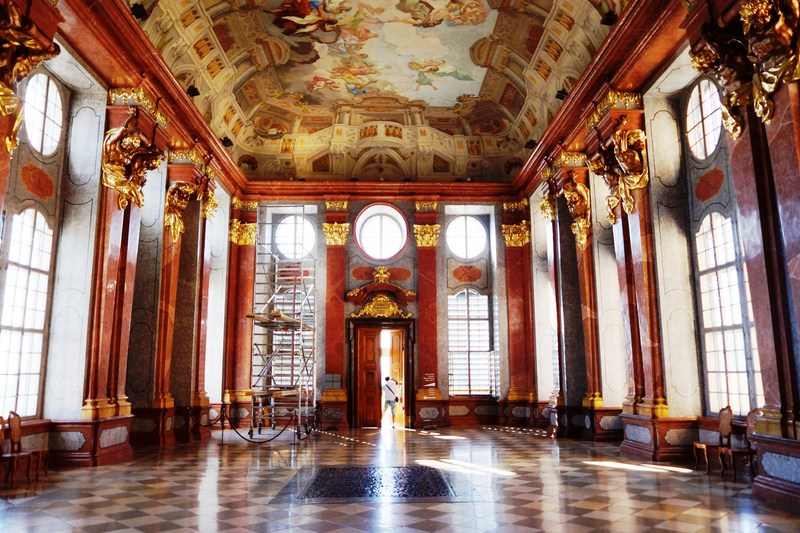
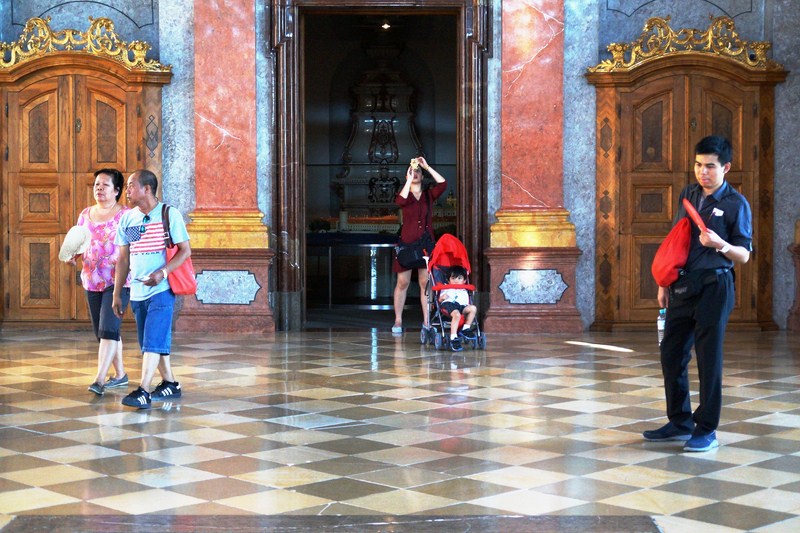
The Marble Hall

The Marble Hall

From the museum, we proceeded to the Marmorsaal (Marble Hall), the gorgeous room that served as a dining hall for the imperial family and other distinguished guests, as well as a festival hall. Containing pilasters coated in red marble and walls of stucco marble, it has impressive allegorical painted ceiling frescos, by Tirolean Paul Troger (1731), and an optical illusion framing it. The architectural painting, done by Gaetano Fanti, gives the impression that the ceiling rises up and curves higher than it does but is, in fact, flat.

Marble Hall (6)

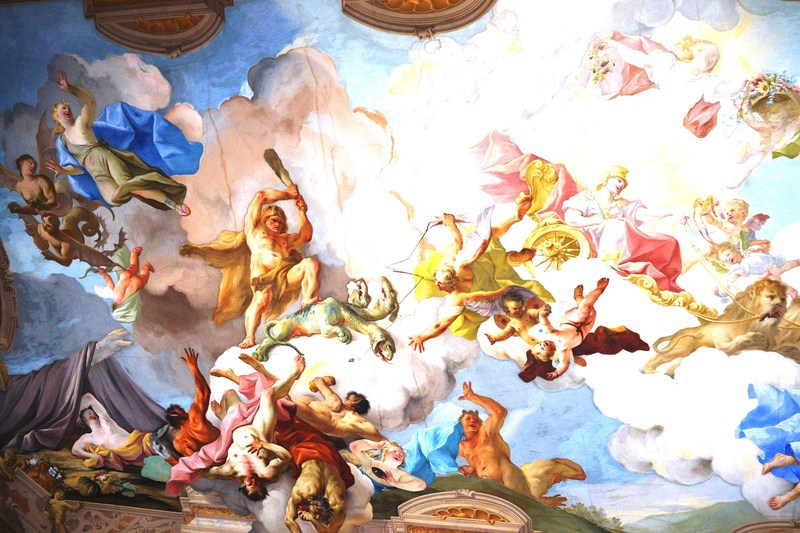
It shows, in the middle, Pallas Athena on a chariot drawn by lions as a symbol of wisdom and moderation. To her left is Hercules who symbolizes the force necessary to conquer Cerberus (the three-headed hound of hell), night and sin. Both Pallas Athena and Hercules allude to Emperor Karl VI, who liked to be celebrated as a successor to the Roman emperors in the Hercules legend. In effect, it shows the essence of the House of Habsburg – the ruler brings the people from darkness to light, from evil to good.

The ceiling frescoes

The ceiling frescoes of Paul Troger depicting Pallas Athena and Hercules

The doors, with frames  made of genuine marble from Adnet and Untersberg (in the province of Salzburg), are inscribed with quotes from the Rule of St. Benedict, indicating the purpose of the room – “Hospites tamquam Christus suscipiantur” (“Guests should be received as Christ would be”) and “Et omnibus congruus honor exhibeatur” (“And to each the honor given which is his due”).

The abbey terrace

The abbey terrace connecting the Marble Hall with the library

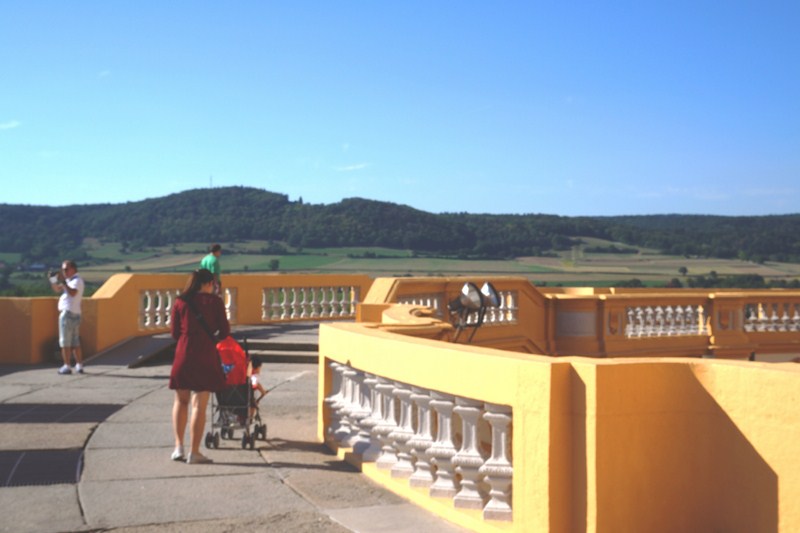
From the Marble Hall, we went out into the abbey’s terrace, a balcony connecting the Marble Hall and the library. Napoleon probably used it as a lookout when he used Melk as his headquarters for his campaign against Austria. From here, we had a wonderful view of the Danube River, the western facade of the abbey church, the scenery of the Wachau Valley and the town of Melk.

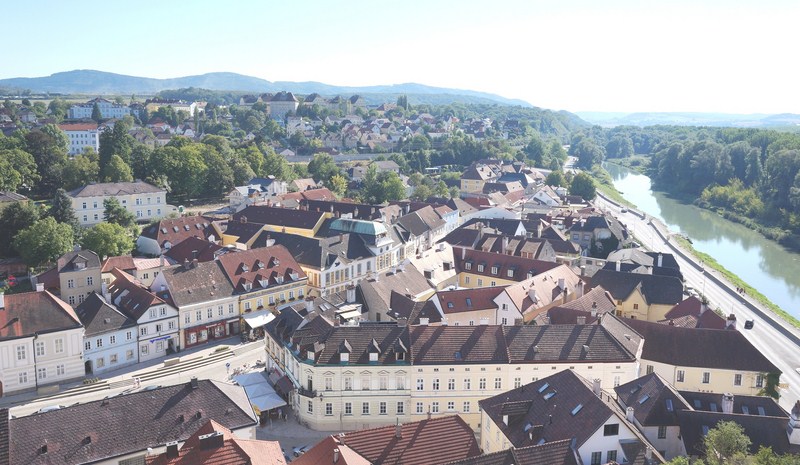
View of the town of Melk from the terrace

View of the town of Melk and Danube River from the terrace

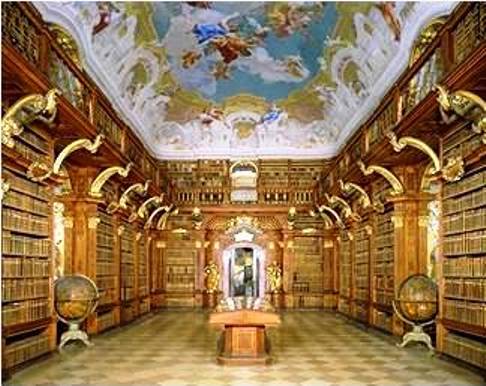
From the terrace, we entered the 12-room library  which rises two floors. Second only to the church in the order of importance of the rooms in the Benedictine monastery, the library houses around 80,000 volumes of priceless medieval manuscripts  including a famed collection of musical manuscripts,  750 incunabula (printed works before 1500), 1,700 works from the 16th century, 4,500 from the 17th century and 18,000 from the 18th century.  Together with the newer books, it totals approximately 100,000 volumes with about 16,000 of these found in this library room. They are organized by topics: beginning with editions of the Bible in Row I, theology (Rows II to VII), jurisprudence (Row VIII), geography and astronomy (Row VIIII), history (Rows X to XV) and ending with the Baroque lexica  in Row XVI.

The Library

The Library (photo: www.stiftmelk.at)

The monks had a high regard for their library as seen from the valuable artistic decoration.  The ceiling fresco, also by Paul Troger (1731 to 1732), shows, in contrast to the secular scenery of the Marble Hall, a symbolic depiction of Faith. In the center is a recognizable female figure, the allegory of Faith. She is surrounded by four groups of angels, who stand for the four Cardinal Virtues: Wisdom, Justice, Fortitude and Temperance. The four wooden sculptures are depictions of the four faculties – Theology, Philosophy, Medicine and Jurisprudence.

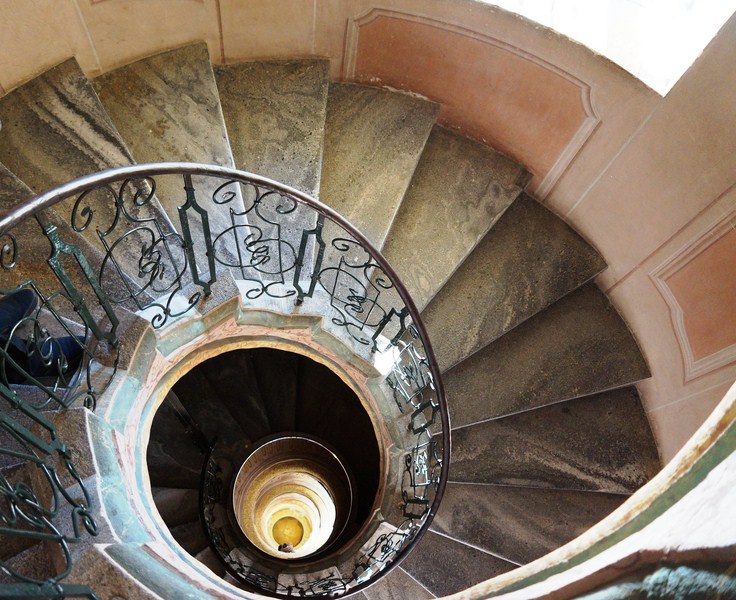
Spiral Staircase

Spiral Staircase

The Small Library room contains mainly historical works from the 19th century onwards. The spiral staircase, with Rococo grate, leads to the two upper floor reading rooms of the library, which are not open to the public. Its ceiling fresco, by Paul Troger, shows an allegorical portrayal of Scientia (Science), while the architectural painting on the ceiling fresco was done by Gaetano Fanti. From the library, we proceeded to explore the Stiftskirche (Abbey Church)

Check out “Stiftskirche

Abbey Garden

Abbey Garden

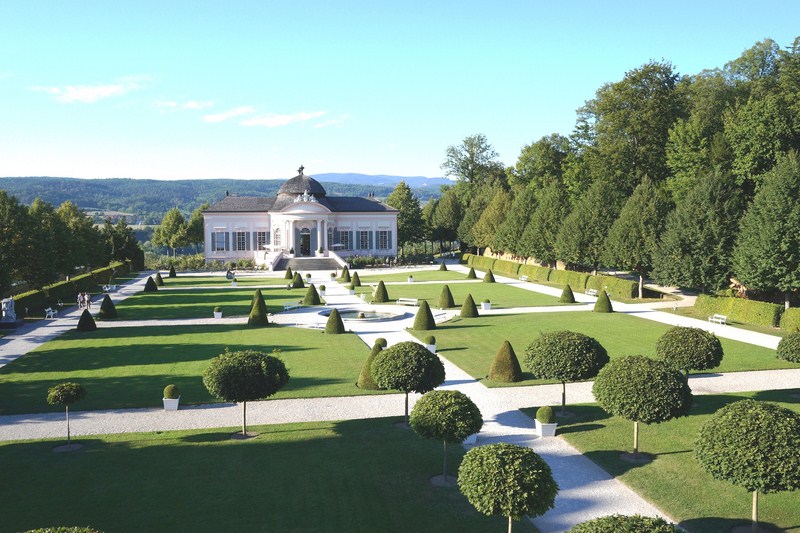
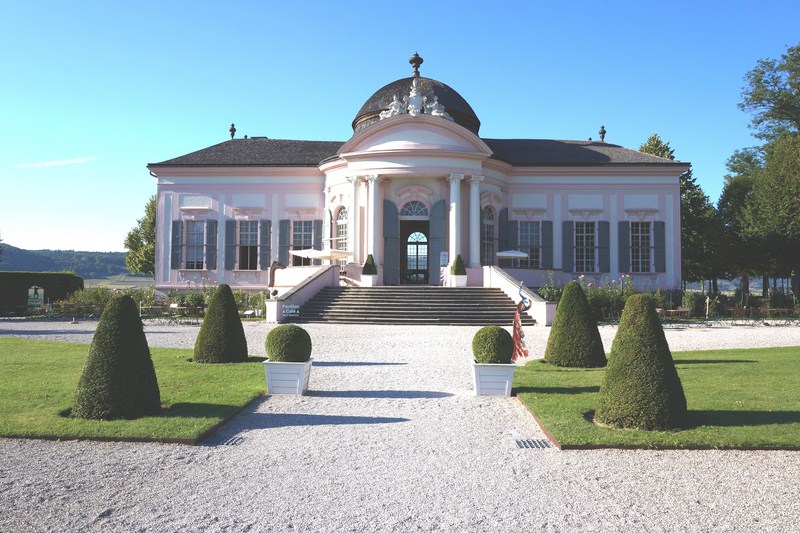
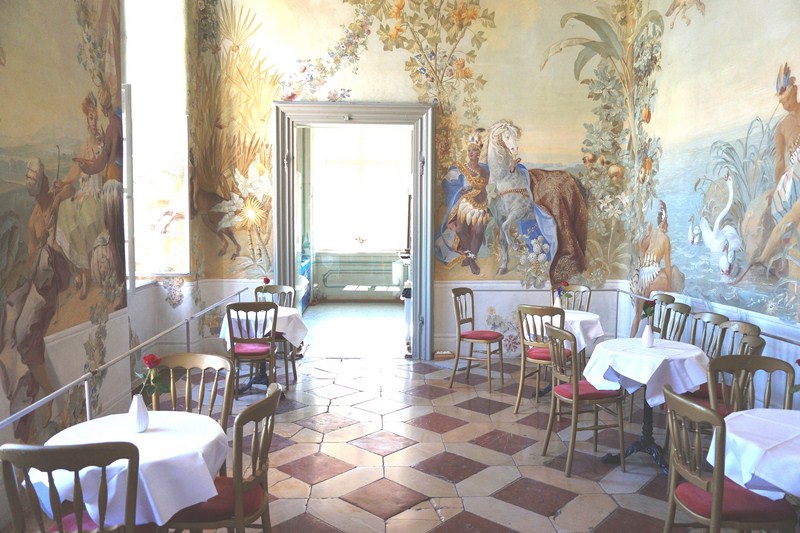
Just outside is the abbey’s park, designed as a baroque park in 1750 and, in 1822, replanted as an English landscape garden.  It has a picturesque Baroque garden pavilion, built like a small belvedere by Franz Mungenast in 1748.  It houses some fine frescoes exotic animals and plants, jungles and native people created by Johann Wenzel Bergl in 1764.

Baroque Garden Pavilion

Baroque Garden Pavilion

It was renovated from 1998-1999 and, since 2000, has been opened to the public. The pavilion was once situated above the Danube River which was once much wider, reaching as far as the rock below the gardens.  Within the pavilion is a self-service café. Murals, in the courtyard, are modern additions that blend in well with the look of the place. Each is a representation of the four virtues: Prudence, Justice, Fortitude, and Temperance.

Self-service cafe at Baroque Garden Pavilion

Self-service cafe at Baroque Garden Pavilion

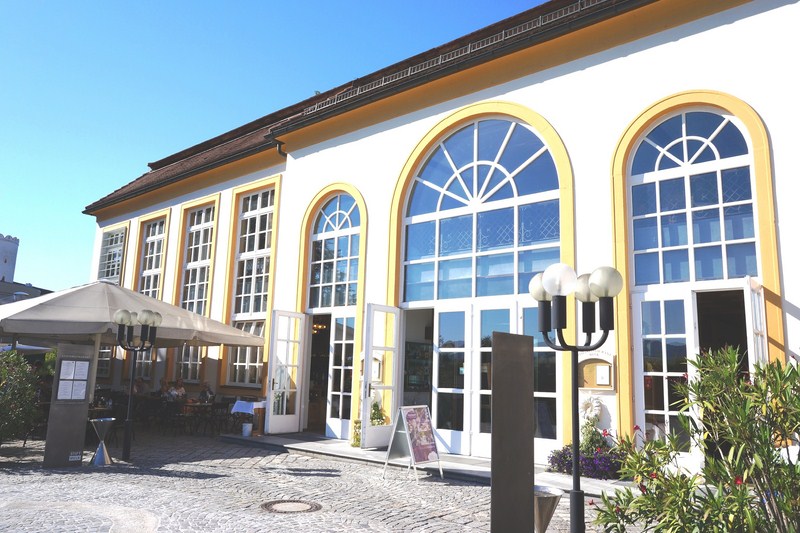
Before leaving, we dropped by the Stiftsrestaurant Melk, the abbey restaurant located near the entrance. It serves hot meals and monastery wine in beautiful Baroque and outdoor surroundings. Here, we had some ice cream sundae.

Stiftsrestaurant Melk

Stiftsrestaurant Melk

Melk Abbey:  Abt-Berthold-Dietmayr-Straße 1, 3390 Melk, Austria. Tel: +43 2752 5550.  Open 9 AM – 6 PM. Website: www.stiftmelk.at. Admission (abbey park and the bastion): Adults: (€4,00), Students (€ 3,00), Children (6-16  years) (€ 1,00).

St. Stephen’s Cathedral (Vienna,Austria)

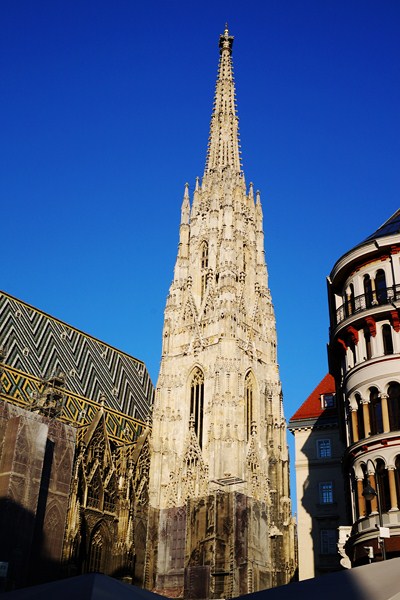
St. Stephen’s Cathedral (Stephansdom)

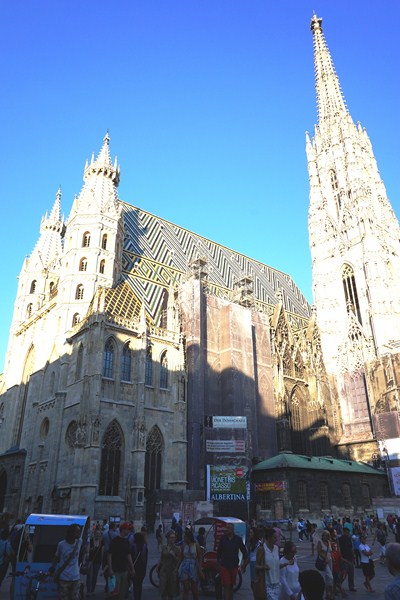
Our first and only mass in Austria was held in St. Stephen’s Cathedral (Stephansdom)  in the Stephansplatz of Vienna. With its multi-colored tile roof, it is most important religious building in Vienna and one of the city’s most recognizable symbols. St. Stephen’s Cathedral has also borne witness to many important events in Habsburg and Austrian history.

The author at St. Stephen’s Cathedral

Here are some interesting trivia regarding this cathedral:

  • It is the mother church of the Roman Catholic Archdiocese of Vienna and the seat of the Archbishop of Vienna (Christoph Cardinal SchönbornOP)
  • The cathedral, dedicated to St. Stephen (also the patron of the bishop’s cathedral in Passau), is oriented toward the sunrise on his feast day of December 26, as the position stood in the year that construction began.
  • It is affectionately referred to, by the city’s inhabitants, as “Steffl” (a diminutive form of “Stephen”)
  • The main entrance to the church is named the Giant’s Door (or Riesentor), referring to the thighbone of a mastodon that hung over it for decades after being unearthed in 1443 while digging the foundations for the north tower.
  • Composer Ludwig van Beethoven discovered the totality of his deafness when he saw birds flying out of the bell tower as a result of the bells’ tolling but could not hear the bells.
  • At 20,130 kgs. (44,380 lb), its St. Mary Bell is the largest in Austria and the second largest swinging bell in Europe after the 23,500 kgs. (51,800 lb) Peter in Cologne Cathedral).
  • Stephen’s Cathedral is featured in media including films, video games, and television shows including The Third Man and Burnout 3.
  • The cathedral is also depicted on the Austrian 10 cent euro coins.
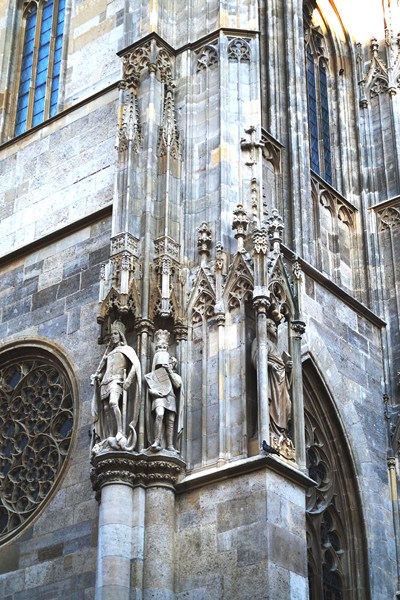
  • The South Tower is considered the most beautiful German Gothic tower in Europe thanks to features such as the statues below the richly ornamented canopies on the second floor.
  • In 1741, the funeral of the Italian composer, Antonio Vivaldi occurred in this cathedral.
  • On the packaging of the Manner-Schnitten wafer treat, the Archdiocese of Vienna allowed the Manner company to use the Cathedral as its logo in return for funding the wages of one stonemason doing repair work on the Cathedral.
  • This was Wolfgang Amadeus Mozart’s parish church when he lived at the “Figaro House” and he was married here, two of his children were baptized here, and his funeral was held in the Chapel of the Cross. Shortly before his death, he was appointed an adjunct music director here. A memorial tablet gives a detailed account of his relationship with the cathedral.
  • In 2008,Sarah Brightman performed a concert promoting her latest album, Symphony, which was recorded for a TV broadcast and a further DVD release in late September.
  • Since 2008, the two sabers of theBalint Balassi Memorial Sword Award, founded by Pal Molnar, have been blessed during a Balassi Mass held a few days before the award ceremony. On January 25, 2013, in the presence of some 300 Hungarians, Bishop Laszlo Kiss-Rigo blessed the two swords during a Mass celebrated in the cathedral.
  • Over the centuries, soot and other forms of air pollution accumulating on the church have given it a black color, but recent restoration projects have again returned some portions of the building to its original white.
  • Its roof is so steep that it is sufficiently cleaned by the rain alone and is seldom covered by snow.

Bas relief

Built of limestone, the current Romanesque and Gothic form of the cathedral was largely initiated by Duke Rudolf IV and stands on the ruins of two earlier churches, the first a parish church consecrated in 1147.  It is 107 m. (351 ft.) long, 40 m. (130 ft.) wide and 136 m. (446 ft.) tall at the massive south tower, its highest point and a dominant feature of the Vienna skyline.

Bas relief

The soaring South Tower, built from 1368 to 1433, served as the main observation and command post for the defense of the walled city during the Siege of Vienna in 1529 and again during the Battle of Vienna in 1683.  Until 1955, it contained an apartment for the watchmen who, manned the tower at night and rang the bells if a fire was spotted in the city.  It’s a tough climb up the 343 steps to the Watch Room which has a spectacular view over the city. At the tip stands the double-eagle imperial emblem with the Habsburg-Lorraine coat of arms on its chest, surmounted by a double-armed apostolic cross (which refers to Apostolic Majesty, the imperial style of kings of Hungary). A peal of 11 electrically operated bells, cast in 1960, hangs in the south tower.

The South Tower

The North Tower, standing at 68 m. (223 ft.) tall (roughly half the height of the south tower), was originally intended to mirror the south tower but, considering the era of Gothic cathedrals was nearing its end, its design proved too ambitious and its construction was halted in 1511. However, in 1578, its tower-stump was augmented with a Renaissance cap (nicknamed the “water tower top” by the Viennese).

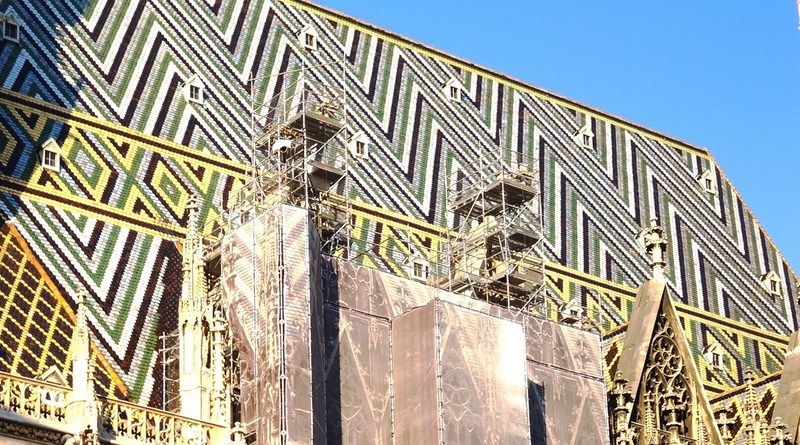
The ornately patterned and richly colored roof

The glory of St. Stephen’s Cathedral is its 111 m. (364 ft.) long, ornately patterned and richly colored roof which is covered by 230,000 glazed tiles. On the south side of the building, above the choir, the tiles form a mosaic of the double-headed eagle that is symbolic of the empire ruled from Vienna by the Habsburg dynasty. On the north side are depicted the coats of arms of the City of Vienna and of the Republic of Austria.

St. Stephen’s Cathedral has 23 bells in total. Some are replacements for other ancient bells lost in the 1945 fire. The north Roman Tower contains six bells, five of which were cast in 1772, that ring for evening prayers and toll for funerals. They are working bells of the cathedral and their names usually recall their original uses. The 1945 fire destroyed the bells that hung in the south Roman Tower. Four bells are used for an ordinary Mass.  The quantity increases to as many as ten for a major holiday Mass; and the eleventh and largest is added when the Cardinal Archbishop of Vienna himself is present. They include:

  • Mary – 20,130 kgs. (44,380 lbs.). Usually called Pummerin (“Boomer”), it hangs in the North Tower and was originally cast in 1711 from cannons captured from the Muslim invaders.  In 1951, it was recast (partly from its original metal) after crashing onto the floor when its wooden cradle burned during the 1945 fire. The new bell has a diameter of 3.14 m. (10.3 ft.) and was a gift from the province of Upper Austria. It sounds on only a few special occasions each year, including the arrival of the New Year. A fast lift takes visitors to a viewing platform.
  • Stephen – 5,700 kgs. (12,600 lbs.)
  • Leopold – 2,300 kgs. (5,100 lbs.)
  • Christopher – 1,350 kgs. (2,980 lbs.)
  • Leonhard – 950 kgs. (2,090 lbs.)
  • Josef – 700 kgs. (1,500 lbs.)
  • Peter Canisius – 400 kgs. (880 lbs.)
  • Pius X – 280 kgs.
  • All Saints – 200 kgs. (440 lbs.)
  • Clement Maria Hofbauer – 120 kgs. (260 lbs.)
  • Speisglocke (“dinner bell”) – North Tower, 240 kgs. (530 lbs.), cast in 1746, no longer in use
  • Zügenglocke (“processions bell”) – North Tower, 65 kgs. (143 lbs.), cast in 1830, no longer in use.
  • Kleine Glocke (“small bell”) – North Tower, 62 kgs. (137 lbs.), cast around 1280, no longer in use
  • Michael – 60 kgs. (130 lbs.)
  • Tarsicius – 35 kgs. (77 lbs.)
  • Primglocke– South Tower, recast in 1772, marks the passing of the hours
  • Uhrschälle– South Tower, cast in 1449, marks the passing of the hours
  • Feuerin (“fire alarm”) – North Roman Tower, cast in 1859, now used as a call to evening prayers
  • Kantnerin – North Roman Tower, used to call the cantors (musicians) to Mass
  • Feringerin – North Roman Tower, used for High Mass on Sundays
  • Bieringerin (“beer ringer”) – North Roman Tower, for last call at taverns
  • Poor Souls – North Roman Tower, the funeral bell
  • Churpötsch – North Roman Tower, donated by the local curia in honor of the Maria Pötsch icon in the cathedral

The Late Romanesque Giant’s Door is notable for its uncommonly rich ornamentation of dragons, birds, lions, monks, and demons. The tympanum above the door depicts Christ Pantocrator, flanked by two winged angels, while on the left and right are the two approximately 65 m. (213 ft.) tall Heathen Towers or Heidentürme (the German word Heiden means “heathens” or “pagans”).  The name is derived from the fact that they were constructed from the rubble of old structures built by the Romans during their occupation of the area. Square at the base and octagonal above the roofline, the Heidentürme originally housed bells.  Those in the South Tower were lost during World War II, but the North Tower remains an operational bell tower. The Giant’s Door, together with the Heathen Towers, are the oldest parts of the church.

The Bishop’s Gate, originally reserved for female visitors, boasts fine figurative sculptures from 1370, along with a number of coats-of-arms, while the Singer Gate,  the entry for male visitors, is notable for its figures of the Apostles and the legend of St. Paul dating from 1378.

Here’s the historical timeline of the cathedral:

  • Following the Treaty of Mautern, it was founded in 1137
  • In 1147, the partially constructed Romanesque church was solemnly dedicated to Saint Stephen in the presence of Conrad III of GermanyBishop Otto of Freising, and other German nobles who were about to embark on the Second Crusade.
  • In 1160, the first structure was completed
  • From 1230 to 1245, the initial Romanesque structure was extended westward. The present-day west wall and Romanesque towers date from this period.
  • In 1258, a great fire destroyed much of the original building.
  • On April 23, 1263, a larger replacement structure, also Romanesque in style and reusing the two towers, was constructed over the ruins of the old church and consecrated. Each year, the anniversary of this second consecration is commemorated by a rare ringing of the Pummerin bell for three minutes in the evening.
  • In 1304,a Gothic three-nave choir east of the church, wide enough to meet the tips of the old transepts, ordered to be constructed by King Albert I.
  • In 1340, the 77th anniversary of the previous consecration, the Albertine choir, whose construction was continued by Duke Albert II, was consecrated.
  • On April 7, 1359, Duke Rudolf IV (1339–1365), Albert II’s son, laid the cornerstone for a westward Gothic extension of the Albertine choir in the vicinity of the present south tower. This expansion would eventually encapsulate the entirety of the old church.
  • In 1365, just six years after beginning the Gothic extension of the Albertine choir, Rudolf IV disregarded St. Stephen’s status as a mere parish church and presumptuously established a chapter of canons befitting a large cathedral. This move was only the first step in fulfilling Vienna’s long-held desire to obtain its own diocese.
  • In 1430, as work progressed on the new cathedral, the edifice of the old church was removed from within.
  • In 1433, the south tower was completed
  • From 1446 to 1474, the vaulting of the nave took place.
  • In 1450, the foundation for a north tower was laid and construction began under master Lorenz Spenning
  • In 1511, its construction was abandoned when major work on the cathedral ceased.
  • In 1469,Emperor Frederick III prevailed upon Pope Paul II to grant Vienna its own bishop, to be appointed by the emperor.
  • On January 18, 1469, despite long-standing resistance by the Bishops of Passau (who did not wish to lose control of the area), the Diocese of Vienna was canonically established with St. Stephen’s Cathedral as its mother church.
  • In 1722, during the reign of Karl VIPope Innocent XIII elevated the see to an archbishopric.
  • During World War II, the cathedral was saved from intentional destruction, at the hands of retreating German forces, when Capt. Gerhard Klinkicht disregarded orders from the city commandant, Josef Dietrich
  • On April 12, 1945, as Soviet Army troops entered the city, the wooden framework of the roof cathedral’s roof was severely damaged by fires lit by civilian looters in nearby shops and carried by the winds, causing it to collapse. Fortunately, protective brick shells built around the pulpit, Frederick III’s tomb, and other treasures, minimized damage to the most valuable artworks. However, the Rollinger choir stalls, carved in 1487, could not be saved. Replicating the original wooden bracing for so large a roof (it rises 38 m. above the floor) would have been cost prohibitive, so over 600 metric tons of steel bracing were used instead.
  • On December 12, 1948, after rebuilding, the cathedral was partially reopened.
  • On April 23, 1950, the cathedral was fully reopened.
  • In 1960, Michael Kauffmann finished a large electric organ with 125 voices and 4 manuals, financed with public donations.
  • In 1991, the Austrian firm of Rieger rebuilt the mechanical choir organ with 56 voices and 4 manuals.
  • As of December 2008, the majority of the restoration on the south tower has been finished, and most scaffolding removed.
  • On March 29, 2014, a 37-year-oldGhanaian asylum seeker vandalized the interior of the cathedral by pushing the statue of  Jude Thaddeus from its marble base.

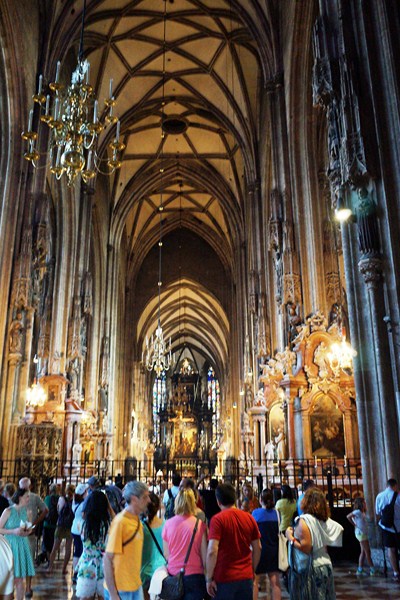
The three-aisled interior

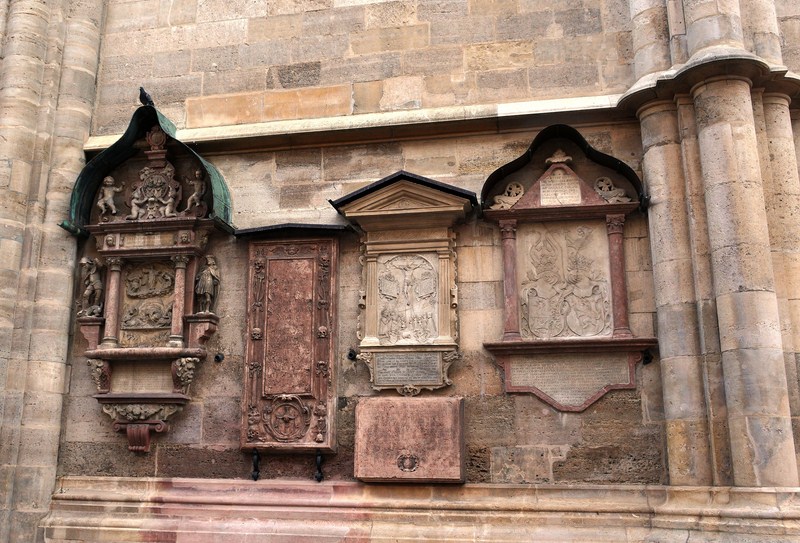
The spacious three-aisled interior is divided by clustered pillars on which are life-size statues, including one of St. Christopher dating from 1470. The middle nave is largely dedicated to St. Stephen and All Saints while the north and south nave are dedicated to St. Mary and the Apostles respectively.  To the left of the main entrance, embedded in the cathedral wall, is the official Viennese ell length, standards for verifying the measure of different types of cloth sold. At the southwest corner are various memorials from the time the area outside the cathedral was a cemetery and a recently restored 15th-century sundial, on a flying buttress. There’s also a figure of Christ affectionately known to the Viennese as “Christ with a toothache” (from the agonized expression of his face).

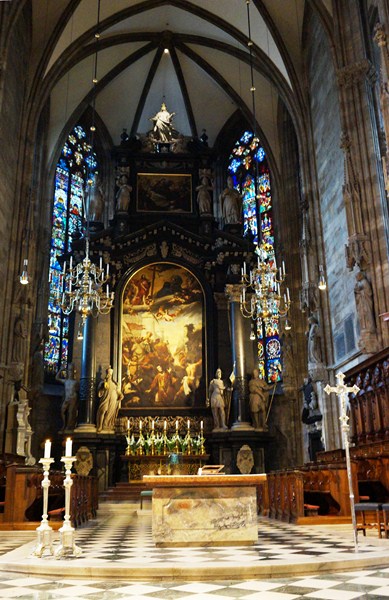
The High Altar

The main part of the church contains 18 altars, with more in the various chapels. The distant High Altar, the first focal point of any visitor, is the most famous. Built in the Baroque style from 1641 to 1647 by Tobias Pock at the direction of Vienna’s Bishop Philipp Friedrich Graf Breuner with black marble from PolandStyria and Tyrol, it represents the stoning of the church’s patron St. Stephen. The altar is framed by figures of Saints Leopold, FlorianSebastian and Rochus, all patron saints from the surrounding areas, and surmounted with a statue of St. Mary which draws the beholder’s eye to a glimpse of heaven where Christ waits for Stephen (the first martyr) to ascend from below.

The Wiener Neustädter Altar

The Wiener Neustädter Altar (GermanWiener Neustädter Altar), at the head of the north nave, was ordered in 1447 by Emperor Frederick III (his tomb is located in the opposite direction). On the predella is his famous A.E.I.O.U. device first ordered by Frederick for the Cistercian Viktring Abbey (near Klagenfurt), where it remained until the abbey was closed in 1786 as part of Emperor Joseph II’s anti-clerical reforms. It was then sent to the Cistercian monastery of St. Bernard of Clairvaux (founded by Emperor Frederick III) in the city of Wiener Neustadt and, when the Wiener Neustadt monastery was closed after merging with Heiligenkreuz Abbey, finally sold to St. Stephen’s Cathedral in 1885.

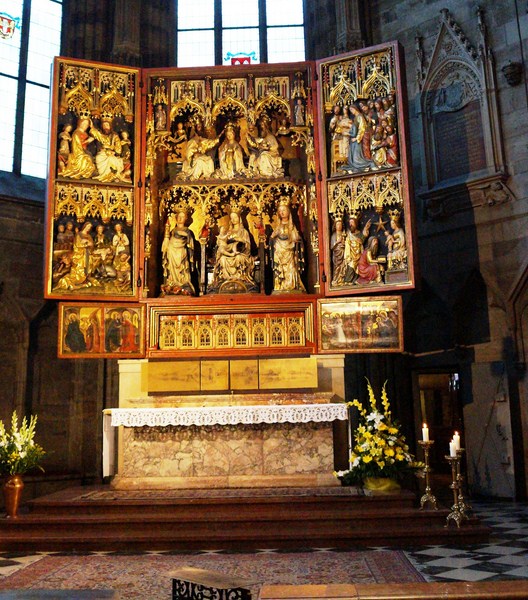
The altar is composed of two triptychs, the upper being four times taller than the lower one. The Gothic grate of the former reliquary depot, above the altar, is revealed when the lower panels are opened. A drab painted scene, involving 72 saints, is displayed when the four panels are closed on weekdays while gilded wooden figures, depicting events in the life of the Virgin Mary, are shown when the panels are opened on Sundays. In 1985, on its 100th anniversary, restoration began. Primarily because its large surface area of 100 sq. m. (1,100 sq. ft.), it took 20 years, 10 art restorers, 40,000 man-hours, and €1.3 million to complete.

The stone pulpit

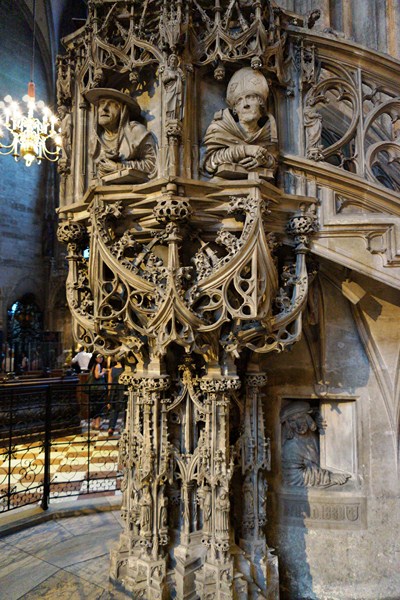
The 16th century stone pulpit, the most important work of art in the nave and a masterwork of late Gothic sculpture, stands against a pillar out in the nave, instead of in the chancel at the front of the church so that the local language sermon could be better heard by the worshipers in the days before microphones and loud speakers.  Long attributed to Anton Pilgram, today, Niclaes Gerhaert van Leyden is thought more likely to be the carver.

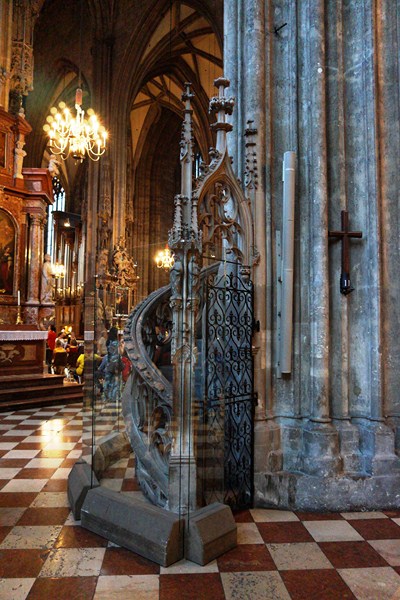
The sides of the pulpit, erupting like stylized petals from the stem supporting it, has a stairway handrail ((has fantastic decorations of toads and lizards biting each other, symbolizing the fight of good against evil) that curves its way around the pillar from ground level to the pulpit. A stone puppy, at the top of the stairs, protects the preacher from intruders. The  Gothic petals has relief portraits of the four original Doctors of the Church (St. Augustine of Hippo, St. Ambrose, St. Gregory the Great and St. Jerome), each of them in one of four different temperaments and in one of four different stages of life.

A stone self-portrait of the unknown sculptor gawking (German: gucken) out of a window (German: fenster), famously known as the Fenstergucker, is located beneath the stairs.  One of the most beloved symbols of the cathedral, the chisel in the subject’s hand, and the stonemason‘s signature mark on the shield above the window led to the speculation that it could be a self-portrait of the sculptor.

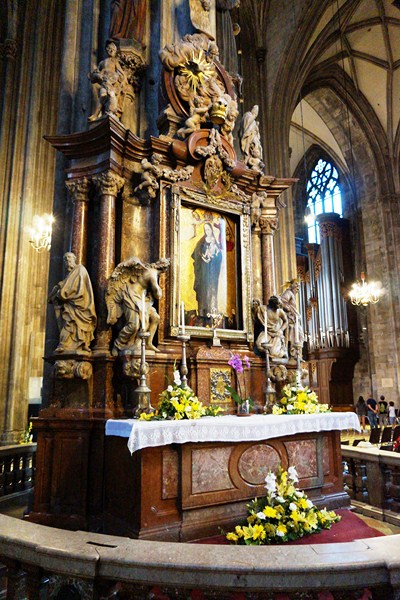
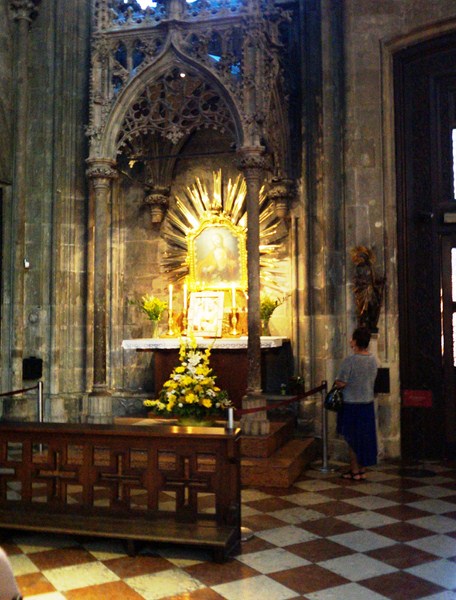
The Maria Pötsch Icon, a 50 x 70 cm. Byzantine style icon, takes its name from the Hungarian Byzantine Catholic shrine of Máriapócs (pronounced Poach), from where it was transferred to Vienna. The picture shows the Virgin Mary  pointing to the child Jesus (signifying “He is the way”) and the child holding a three-stemmed rose (symbolizing the Holy Trinity) and wearing a prescient cross from his neck. The icon was commissioned from painter István Papp by László Csigri in 1676 upon his release as a prisoner of war from the Turks who were invading Hungary at the time. As Csigri was unable to pay the 6-forint fee, the icon was bought by Lőrinc Hurta who, in turn, donated it to the church of Pócs.

In 1696, after two miraculous incidents with the Virgin Mary in the picture shedding real tears, Emperor Leopold I ordered it brought to St. Stephen’s Cathedral, where it would be safe from the Muslim armies that still controlled much of Hungary. In 1697, after a triumphal five-month journey, the icon arrived in the cathedral and Empress Eleonora Magdalena commissioned the splendid Rosa Mystica oklad and framework (now one of several) for it.  The Emperor personally ordered the icon placed near the High Altar in the front of the church, where it stood prominently from 1697 until 1945. Since then, the icon has been in a different framework, above an altar, under a Medieval stone baldachin near the southwest corner of the nave.  Many burning candles here indicate the extent of its veneration, especially by Hungarians.

Since its arrival, the icon has not been seen weeping again but other miracles and answered prayers have been attributed to it, including Prince Eugene of Savoy‘s victory over the Turks at Zenta, a few weeks after the icon’s installation in the Stephansdom.

Lady’s Altar

There are several formal chapels in St. Stephen’s Cathedral. They include:

  • Barbara’s Chapel, in the base of the north tower, is used for meditation and prayer.
  • Katherine’s Chapel, the baptismal chapel in the base of the south tower, has a 14-sided baptismal font completed in 1481 whose cover was formerly the sound board above the famed pulpit in the main church. Its marble base (plinth) shows the Four Evangelists, while the niches of the basin feature reliefs of the Twelve Apostles, Christ and St. Stephan.
  • Eligius’s Chapel (or Duke’s Chapel), in the southeast corner, with its important 14th-century statues, is open for prayer. The altar is dedicated to St. Valentine whose body (one of three, held by various churches) is in another chapel, upstairs.
  • The recently restored Bartholomew’s Chapel is above St. Eligius’ Chapel.
  • The Chapel of the Cross (or Tirna Chapel), in the northwest corner of the cathedral, is not open to the public. Built in1359, it holds the burial place of Prince Eugene of Savoy, commander of the Imperial forces during the War of the Spanish Succession, in a vault containing 3 coffins and a heart urn, under a massive stone slab with iron rings. The funeral of Mozart occurred here December 6, 1791. Above the altar is a 15th-century crucifix and the beard on the crucified Christ which is made of human hair and, according to legend, is still growing.
  • Valentine’s Chapel, above the Chapel of the Cross, is the current depository of the hundreds of relics belonging to the Stephansdom (including a piece of the tablecloth from the Last Supper). A large chest holds the bones of St. Valentine that were moved here about a century ago, from what is now the Chapter House to the south of the High Altar.

Since its earliest days, it has always been an honor to be buried inside the cathedral, close to the physical presence of the saints whose relics are preserved there, and it has sheltered the bodies of notables and commoners. Those less honored were buried near, but outside the church.

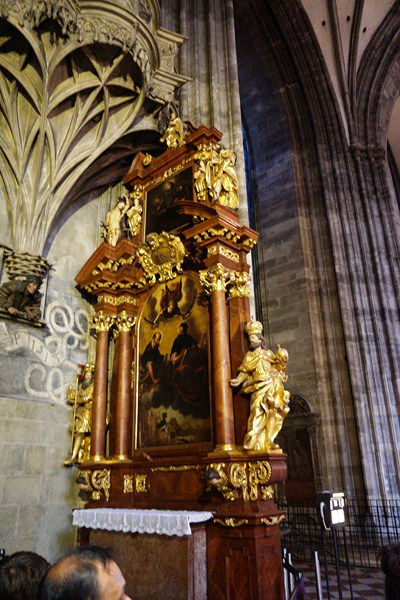
Peter and Paul Altar

Aside from the aforementioned Prince Eugene of Savoy  in the Chapel of The Cross, also inside the cathedral is the tomb of  Frederick III, Holy Roman Emperor, under whose reign the Diocese of Vienna was canonically erected on January 18, 1469, in the Apostles’ Choir (south choir, southeast corner of the cathedral).

The construction of Emperor Frederick’s tomb, spanning over 45 years, started 25 years before his death. The impressive raised sarcophagus, carved by Dutch artist  Niclaes Gerhaert van Leyden, is made of the unusually dense red marble-like stone found at the Adnet quarry. The tomb lid shows Emperor Frederick in his coronation regalia, surrounded by the coats of arms of all of his dominions. The body of the tomb, a glory of Medieval sculptural art, has 240 statues.

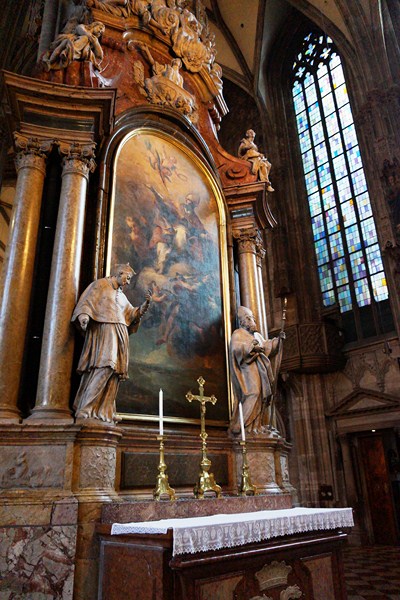
St. Januarius Altar

The basement of the cathedral also hosts the Bishop’s Crypt (completed in 1952) under the south choir, Provost’s Crypt and Ducal Crypt under the chancel. The most recent interment in the Bishop’s crypt was that of 98-year-old Cardinal Franz König in 2004. Provosts of the cathedral are buried in another chamber while other members of the cathedral chapter are now buried in a special section at the Zentralfriedhof.

The Ducal Crypt, ordered built by Duke Rudolf IV (for his remains in the new cathedral he commissioned) before his death in 1365, holds 78 bronze containers with the bodies, hearts, or viscera of 72 members of the Habsburg dynasty.

The small rectangular chamber, overcrowded with 12 sarcophagi and 39 urns by 1754, was expanded with an oval chamber added to the east end of the rectangular one and, in 1956, the two chambers were renovated and their contents rearranged. The sarcophagi of Duke Rudolf IV and his wife were placed upon a pedestal and the 62 urns containing organs were moved from the two rows of shelves around the new chamber to cabinets in the original one.

In 1735, the charnel house and eight cemeteries abutting the cathedral’s side and back walls were closed due to an outbreak of bubonic plague  and the bones within them were moved to the catacombs below the church. In 1783, burials directly in the catacombs were discontinued when a new law forbade most burials within the city. Today, the catacombs, with remains of over 11,000 persons stacked up in tiers, may be toured.

Altar dedicated to St. Padre Pio

Adjacent to the catacomb entrance is the Capistran Chancel.  Its pulpit, now outdoors, was the original cathedral’s main pulpit inside until it was replaced by Niclaes Gerhaert van Leyden’s pulpit in 1515.  Here, St. John Capistrano and Hungarian general John Hunyadi preached a crusade in 1456 to repel Muslim invasions of Christian Europe. The 18th century Baroque statue shows St. Francis under an extravagant sunburst, trampling on a beaten Turk.

The fascinating Cathedral Treasure, located in the West Gallery, houses many of the cathedral’s most important and valuable objects.

St. Stephen’s Cathedral : Stephansplatz 3, 1010 Wien, Austria. Tel: +43 1 515523054. Website: www.stephanskirche.at.

How to Get There: St. Stephen’s Cathedral is within walking distance of Vienna’s city center and its major tourist attractions. By bus, it is well served by Vienna’s bus service (Routes 1A, 2A, or 3A). The nearest U-Bahn subway station is Stephansplatz. No on-site public parking is available.

Hofburg Palace (Vienna, Austria)

Hofburg Palace Complex

The popular Hofburg, the extensive former imperial palace complex of the Habsburg dynasty rulers, was the political centre of the monarchy and was their principal imperial winter residence for over 600 years, as Schönbrunn Palace was their summer residence.  Previously, the castle of the Austrian rulers had been located on the Am Hof, a square near the Schottenstift (Scottish Monastery).

Check out “Schonbrunn Palace and Gardens

Since 1279, the Hofburg was the documented seat of government for various empires and republics,  housing some of the most powerful people in European and Austrian history including kings and emperors of the Holy Roman Empire of the German Nation (from 1438 to 1583 and from 1612 to 1806) and, thereafter, the seat of the Emperor of Austria of the Austro-Hungarian Empire until 1918. Today, part of it forms the official residence and workplace of the Austrian Federal President.

Originally a fortified Medieval castle built in the 13th century, the Hofburg area has, over the centuries, been expanded by each emperor to include various residences (with the Amalienburg), the Imperial Chapel (Hofkapelle or Burgkapelle), the Naturhistorisches Museum (Natural History Museum) and Kunsthistorisches Museum, the Austrian National Library (Hofbibliothek), the Imperial Treasury (Schatzkammer), the Burgtheater, the Spanish Riding School (Hofreitschule), the Imperial Horse Stables (Stallburg and Hofstallungen), and the Hofburg Congress Center.

Check out Kunsthistorisches Museum,”Imperial Treasury” and “Natural History Museum

This sprawling, asymmetric complex extends over 240,000 sq.m., consists of 18 wings, 19 courtyards and 2,600 rooms in which nearly 5,000 people still work and live today.

The Hofburg faces Heroes Square (Heldenplatz), ordered built under the reign of Emperor Francis Joseph, as part of what was to become an Imperial Forum (Kaiserforum), a two-winged structure reaching beyond the Ringstraße that was never completed. Standing at the foci of Heroes Square are the equestrian statues of Prince Eugene of Savoy and Archduke Charles, the two most important Austrian field marshals.

The statue of Archduke Charles

The Alte Burg (Old Fortress), the  oldest part of the Hofburg has, since the 18th century, been called the Schweizertrakt (Swiss Wing) after the Swiss Guards who served as the palace watch. Over the centuries, the palace underwent alterations and, thought the core of the Medieval fortress complex has been preserved, its four corner towers, most of the moat and the drawbridge had to make way for that.

The Swiss Court (Schweizerhof), built during the reign of Emperor Ferdinand I in the style of the Renaissance, corresponds somewhat to a square formed around the oldest sections of the castle which originate from the 13th century and were primarily constructed by the last of the Babenbergers or by Ottakar II of Bohemia. The lower section of this wing once accommodated the imperial kitchen.

Grace and the author at the Imperial Treasury (Schatzkammer)

Situated here are the Burgkapelle (the Vienna Boys’ Choir still sings on Sundays at High Mass), a Gothic chapel built in 1449; the Schatzkammer, the Imperial Treasury which holds, among other objects, the Imperial Insignia of the Holy Roman Empire (Reichskleinodien) and that of the Empire of Austria); and the Hofmusikkapelle (the Imperial Music Chapel).

Cheska and Kyle entering the Swiss Gate

Its famous Schweizertor, the red-black Swiss Gate, is the main motif in the silver 20 euro Renaissance commemorative coin.  The gate, designed by Pietro Ferabosco, is one of only a handful of Renaissance monuments in Vienna. It displays the many titles of Emperor Ferdinand I and the insignia of the Order of the Golden Fleece. It is flanked by two soldiers in period attire, a reminder of the unsettled times which saw Vienna besieged by Turkish armies in 1529, as well as the struggles between Protestants and Catholics during the Reformation.

The many titles of Emperor Ferdinand I and the insignia of the Order of the Golden Fleece at the Swiss Gate.

The formerly free-standing Amalienburg (Amalia Residence) wing, across from the Swiss Gate, was named after Empress Amalie Wilhelmine, who used it as her dower residence after the death of husband, Emperor Joseph I.

Grace and Vicky at Amalienburg

Constructed during the 16th century, in the style of the late Renaissance, as the Viennese residence of Emperor Rudolph II, it had already been in use for more than a century. Its last occupant was Empress Elisabeth, whose apartments are today open to the public. The small domed tower has an astronomical clock on its façade.

Astronomical Clock Tower at Amalienburg

The early Baroque Leopoldine Wing (the Leopoldischiner Trakt), connecting the Amalienburg with the Swiss Court, was designed by Italian architect-engineer Filiberto Luchese and built between 1668 and 1680 under Emperor Leopold I. After the Siege of 1683 by the Turks, the Leopold Wing was rebuilt by Giovanni Pietro Tencala with an additional floor installed.

The Leopoldine Wing

During the 18th century, it was occupied by Empress Maria Theresa and, after her death, its magnificent apartments were used as state rooms until the end of the monarchy. The architecture of this wing still bears a connection to the late Renaissance. Since 1946, this wing houses the offices of the Federal President. As well as that of the Amalienburg, the lower section of this wing served as the enormous wine cellar for the Hofburg.

Plaque at the Leopoldine Wing

The Imperial Stables (Stallburg), although not physically connected to the rest of the Hofburg complex, was started in 1559 and were originally built as a residence for Maximilian II, the son of Ferdinand I and the then crown prince. Later, this structure accommodated the art collection (which formed the core of the later Kunsthistorisches Museum from 1889) of Archduke Leopold Wilhelm, the art-inclined brother of Emperor Ferdinand III. The first Austrian parliament sat here in 1848. Only later was it used to house the imperial horses. Today, it is still used by the Spanish Riding School (Spanische Hofreitschule). The famous Lipizzan stallions, can be seen here daily (except on Mondays), at their morning training.

The Winter Riding School (Winterreitschule), where you can watch performances of Lipizzan stallions, is located across from the Stallburg and was also designed by the Baroque architects Lukas von Hildebrandt and Joseph Emanuel Fischer von Erlach.

Imperial Chancellery Wing (Reichskanzleitrakt)

The Imperial Chancellery Wing Reichskanzleitrakt, across from the Leopold Wing, was originally planned by Baroque architect Johann Lucas von Hildebrandt and completed in 1730.  It accommodated the Aulic Council (Reichshofrat), the offices of the Imperial Vice Chancellor (Reichsvizekanzler).  After the end of the Holy Roman Empire in 1806, this wing housed the apartments of the Duke of Reichstadt (Napoleon II) and, from the middle of the 19th century, those of Emperor Francis Joseph I.

Attika with Shield of Kaiser Karl VI

On the Chancellery portals are sculptures, representing the Labors of Hercules, by Lorenzo Mattielli. The Kaisertor (Emperor’s Gate), at the central section, gives access to the imperial apartments. The imposing armorial shield of Emperor Charles VI with the double eagle bearing the Austrian shield in the colors of red, white and red and surmounted by the imperial crown, rises from the edge of the roof.

The originally free-standing Imperial Library (Hofbibliothek), housed on the other side of the complex, was founded by Charles VI.  Now called the Prunksaal, it now houses the Austrian National Library (Österreichische Nationalbibliothek). Its construction was begun by Baroque court architect Johann Bernhard Fischer von Erlach and, after Johann’s death in 1723, finished in 1735 by his son Joseph Emanuel Fischer von Erlach.  This magnificent hall, the most significant part of the Hofburg in artistic terms, contains the precious book collection of Prince Eugene, an enormous ceiling fresco by Daniel Gran, and statues of emperors by Paul Strudel.

The exterior, decorated with Attika figures, was executed, in 1726, by Lorenzo Mattielli who placed a statue of Pallas Athene, riding on a quadriga, above the main entrance. He also situated Atlas, supporting the celestial globe and flanked by Astronomy and Astrology, on the left portion of the roof and, on the opposite side, Gaia with the terrestrial globe, flanked by allegories of Geometry and Geography.

The present Joseph Square (Josephsplatz), one of the most beautiful locations in Vienna, was created when, from 1763 to 1769, Nicolo Pacassi connected the Imperial Library to the other parts of the Hofburg and its other side to St. Augustine’s Church (Augustinerkirche).  At the center of Joseph Square is the equestrian statue of Emperor Joseph II by Franz Anton von Zauner.

On the southeast side of Joseph Square, adjacent to the Imperial Library, is the Baroque Augustinian Wing, so identified for its proximity to the Augustinian Church and Monastery.  The Augustinian Church (Augustinerkirche), used by the Habsburgs as their court church and also for weddings, was where Emperor Franz Joseph I and Empress Elisabeth, alias Sisi, were married.

As the Hofburg Palace expanded, the wing became part of it. Because of its structural connections to the Augustinian Monastery, the Archduke Albrecht Palace (formerly Tarouca-de Sylva Palace), home of the Albertina Museum, is also considered part of the Hofburg Palace after the renovation of the Albertina in the 1820s by Joseph Kornhäusel. In early years of the 19th century, Archduke Albrecht and, later, his nephew, Archduke Friedrich, Duke of Teschen, both members of the Habsburg Family, lived in the building.

The Hearts’ Crypt, behind the Loreto side chapel, is a semicircular-shaped annex, separated by an iron door, where 54 hearts of House of Habsburg members are kept in silver urns.

The magnificent  Zeremoniensaal (Ceremonial Hall), built for Emperor Franz II/I by the Belgian architect Louis Montoyer at the beginning of the 19th century, was nicknamed as the “Nose of the Hofburg,” derived from the fact that it, for almost a hundred years, formed a clearly visible protrusion at right angles to the Leopold Wing.

Neue Burg

Having a truly imperial aspect, the Zeremoniensaal, fully integrated into the New Castle (Neue Burg), has an ornate coffered ceiling, 26 crystal chandeliers (which once held 1,300 candles) and 24 Corinthian columns with an artificial marble finish (the surface is not real stone but a form of painted gypsum known as stucco lustro).

Check out “Neue Burg

During an exclusive Ball at the Court held here, Napoleon I asked for the hand of Marie Louise, the daughter of Emperor Franz II/I and, during a traditional Maundy Thursday ceremony, Emperor Franz Joseph and Empress Elisabeth invited twelve poor old men and women to have their feet washed.

The St. Michael’s Wing, originally planned by Joseph Emanuel Fischer von Erlach, was built from 1889 to 1893, utilizing a slightly altered plan of Ferdinand Kirschner. It serves as the connection between the Winter Riding School and the Imperial Chancellery Wing.

The Redoutensaele (derived from the French word “wikt:redoute” meaning an elegant masked ball), a 17th-century opera house converted into the beautiful dance and concert halls by Maria Theresia, became the setting for a cultivated style of entertainment. Its original plans were drawn up by Jean Nicolas Jadot de Ville-Issey (de), while the external facades are the work of Nicolò Pacassi and Franz Anton Hillebrandt (de).

Johann Strauss served as musical director to the court for the balls held at the Redoutensaele, and the audience was treated to music by Joseph HaydnNicolo Paganini and Franz Liszt and, in 1814, the premiere of Beethoven‘s 8th Symphony took place there. Over the centuries, in line with changing tastes, various modifications have been made in the balls. On November 27, 1992 the whole wing with the Redoutensaele was seriously damaged by fire and the reconstruction and faithful restoration work performed lasted five years. The Redoutensaele reopened in 1998 and, since then, became part of the Hofburg Congress Center.

Fiaker  (Horse-Drawn Carriage) inside the Hofburg

Hofburg Palace: Michaelerplatz 1 (Michaelerkuppel), 1010 Vienna, Austria. Tel: +43 1 5337570. Open 9 AM-6 PM.

How to Get There:

Underground: U3 Herrengasse

Tram: 1, 2, 71, D Burgring

Bus: 2A, 3A Hofburg

HOP ON HOP OFF: Red Line: Kunsthistorisches Museum / Heldenplatz

Kunsthistorisches Museum – Collection of Greek and Roman Antiquities (Vienna, Austria)

Collection of Greek and Roman Antiquities

From the Egyptian and Near Eastern Collection, a change of flooring and presentation, gave way to the delights of Ancient Greece and Rome with my entry into Gallery 10 and its Collection of Greek and Roman Antiquities.

The 2,500 objects in the collection, some on permanent display, span a period of more than three millennia and range from Bronze Age ceramics of Cyprus dating from the 3rd millennium B.C. to early Medieval finds.

Check out “Kunsthistorisches Museum

This collection, one of the best of its kind, covers three main areas in a beautifully atmospheric gallery layout – the unique and spectacular antique cameos and gemstones; the treasure troves dating from the period of the great migrations and the early Middle Ages (such as the golden Treasure of Nagy Szent Miklós); and the collection of vases (with such masterpieces as the Brygos Cup).

Votive Statue of a Man from Cyprus

Among the other highlights of the collection are the larger-than-life Votive Statue of a Man from Cyprus, the Amazonian Sarcophagus, the bronze tablet with the famous Senatus consultum de Bacchanalibus, the Theseus Mosaic from Salzburg and the Youth from the Magdalensberg, to name only a few.

Sarcophagus with Fighting Amazons

Sarcophagus of the Muses

Sarcophagus with a Scene of Abduction of Persephone by Hades

However, though a lot of thought has been clearly put by the curators into how the items were displayed in this collection, surprisingly there was little English information for such wonderful displays and we needed an guidebook or an audio guide to really appreciate what we’re seeing.

Youth from the Magdalensberg

At Gallery 11, we saw a huge original mosaic in the floor. Taken from a 4th century villa near Salzburg, it tells one of the versions of the story of Ariadne and Theseus (of Minotaur-slaying fame).

Marble Statue of Discobolus (2nd century AD)

Torso of the Javelin Bearer Doryphoros (2nd Century AD)

As we walked toward the entrance portal of Gallery 13, we were welcomed by a statue of a majestic Emperor Vespasian, his head is from 70 A.D. and his torso from sometime in the first century.

Gallery 13 (Busts)

This bust gallery, possessing an eerie quality enhanced by the subtle and varied lighting and shadows cast on the marbled floor, has a delightful display of busts, each on its own high column. We also saw mummy portraits placed on mummies in Rome-influenced Egypt in the second century AD.

Gallery 14 (Greek Vases)

Gallery 14 features real Greek vases and other ceramics (not the kind from souvenir shops in Athens and Kos).  The “Kabinetts,” leading off the rooms, each focus on a special topic such as Cypriot ceramics from the Bronze and Iron Ages, Etruscan Art, etc..

Gallery 14 (Greek Vases)

The magically dark Gallery 15 features bronze statues of the gods and other figures of mythology, each piece lit with pools of light that makes a dramatic impression, plus Roman tableware, jewelry, decorated oil lamps and fibulae (brooches for fastening clothing).

Marble Sphinx from Roman Egypt (150 – 200 AD)

The darkly lit Gallery 16, with wall cabinets and spotlights, features brightly-colored miniature reliefs (cameos) and engraved gems from Rome which were used as signet rings, pendants and other adornments. The room also features the famous Gemma Augustea, a large cut onyx stone, from 9-12 A.D., honoring the Emperor Augustus.

Spot-lit cabinets at Gallery 17 house a wide range of Roman and early Germanic jewelry and other items of bronze, silver and gold coming from various finds, such as Nagy Szent Miklós (in modern-day Romania) or Zalesie (modern-day Poland).

Collection of Greek and Roman Antiquities: Raised Ground Floor, Kunsthistorisches Museum, Maria Theresien-Platz, 1010 Vienna. Tel: +43 1 525 24- 4902. E-mail: info.ansa@khm. Open Tuesdays – Sundays, 10 AM – 6 PM, Thursdays, 10 AM – 9 PM.

Kunsthistorisches Museum – Kunstkammer (Vienna, Austria)

Kunstkammer

The Kunstkammer Wien, the most important collection of its kind in the world, has 2,162 fabulous artworks passionately collected by the Habsburg emperors (above all Rudolf II) and archdukes over centuries.

Check out “Kunsthistorisches Museum

Ibonized and ormolu cabinet of Ferdinand ll von Tirol

One of the most important chambers of art and wonders in the world, it was opened to the public on March 1, 2013 after years of extensive refurbishment (between 2002 and 2012).

Gold Platter with a Relief (Christoph Lencker)

This “museum within the museum” has 20 galleries which fills the lower eastern wing of the main building of the museum. On an area of 2,717 sq. m., more than 1,000 years of history can be experienced in the Kunstkammer.

Emperor Charles V (Leone Leoni, 1555, bronze)

A Carolingian ivory tablet from the 9th century is the oldest exhibit while a ceiling painting, from the year 1891, is the youngest.

Golden Candlesticks

The Kunstkammer, aside from showcasing the standout items of various Habsburg collections put together from the 16th century onwards, also demonstrated the best of nature and man’s creative abilities.

Altar of St. Jerome (Jacob Cornelisz van Oostsanen)

The encyclopedic and universal collections of the Kunst-und Wunderkammern (arts and natural wonders rooms) from the late Middle Ages to the Renaissance and Baroque periods attempted to reflect the entire knowledge of the day.

Jacob and Rachel (Democrito Gandolfi)

Of particularly interest are the desirable, exotic, rare, curious and unusual objects, often ascribed with magical powers, such as precious stones, ostrich eggs, coral and shark’s teeth, natural products from which artists created virtuoso works of art.

Cabinet of Archduke Ferdinand II

Among its highlights are numerous other art objects which have been collected since the Middle Ages such as carvings, timepieces, paintings, ivory sculptures, strange scientific instruments, wall-hangings, tapestries, coins, weapons, precious stone vessels, elaborate automatons, sumptuous game boards, drinking games and all sorts of humorous vessels, and a wide range of curiosities from the natural world.

Danae, part of a 6-piece Mythological Representation (Francesco Primaticcio, 1540-50)

They include examples of fabulous goldsmith work such as the celebrated and precious Saliera (“salt cellar,” which dates to the middle of the 16th century) by Benvenuto Cellini (at the heart of the collection) and the valuable  gold and porcelain breakfast service of Maria Theresia; the so-called “Natternzungenkredenz” (around 1450), including fossil sharks’ teeth, considered to be the mystical remains of dragons; the natural cast of a real toad; outstanding sculptures such as the Krumau Madonna; magnificent bronze statuettes; a “Narwalhornbecher” from the 17th century claimed at the time to be made from a unicorn horn (actually a narwhal tusk); the Dragon Bowl made from lapis lazuli; delicate and bizarre ivories; carved rhinoceros horns, a valuable musical clock in the shape of a ship, a glass container (tafelaufsatz) shaped like a heron with real heron feathers; etc.

Large tafelaufsatz in the shape of a heron (Saracchi Workshop, ca. 1590)

Each gallery, with its excellent design and layout carrying you along on a journey through changing times and techniques, has an overview explaining its theme and/or relevance to art and history.  As you move from room to room, different art forms progressed, at different rates, in different regions.

Kaiser Franz I (Camillo Pacetti)

Each item has an accompanying short description and touch screens provide further background information, more detail on selected exhibits and the genealogy of the Habsburg dynasty.

Gallery 19 (Golden Hall)

Gallery 19 (Golden Hall) impressed us with its huge ceiling painting “Mäcene the House of Habsburg,” the magnum opus of the now almost-forgotten history painter Julius Victor Berger which pays homage to the Habsburg art patrons and their favorite artists.

Mäcene the House of Habsburg (Julius Victor Berger, 1891)

In Gallery 20 is the ivory collection of Emperor Leopold I, nephew of Archduke Leopold Wilhelm. They include the impressive ivory piece, from 1700, depicting Archduke Leopold adorned with angels, with a foot resting on his vanquished Ottoman foes following the famous defeats of the Ottoman armies, most notably at the Siege of Vienna in 1683 (though he was nowhere to be seen at that time in Vienna).

Gallery 20

There’s also the detailed (check out the mind-blowing detail of the battle of Amazons) ivory and cedar reliefs, from the late 1600s and early 1700s, by Ignaz Elhafen; and the ivory reliefs by Johann Ignaz Bendl (he also contributed to the famous plague column in Vienna’s city center).

Ivory Goblet (Marcus Heiden)

Gallery 22 displays the Master of the Furies, gorgeous ivory statuettes by an unknown artist, and a delightful ivory phoenix from 1610/1620.

In Gallery 23 (to the side of Gallery 22), we found 17th century clocks and scientific instruments from the collection of Archduke Leopold Wilhelm.

Handstones

Gallery 24, which continues the theme of intertwining nature and art, features items from the 16th century Innsbruck collection of Archduke Ferdinand II including the so-called hand stones (pieces of ore with biblical or mining scenes carved into them, with added decorative elements and models); plus pieces of glassware and crystal ware from Milanese workshops (e.g. Saracchi, Miseroni), many of which mimic the human body, plants, animals, and shells and often incorporate natural materials and surprisingly practical functions (a tortoise becomes a powder flask, a nautilus shell becomes a drinking vessel, etc.).

Dragon Shell (Gasparo Miseroni, 1565-70) features a fierce dragon motif in gold, enamel, rubies, emeralds and pearls

Gallery 25 houses some of the sumptuous and artistic settings of the Habsburgs such as rhino horns and ostrich eggs.

Gallery 25

Often attributed with medicinal and magical powers by Europeans, these settings often served to emphasize the exotic nature of each of these items.

Displays include a figure of an African below an ostrich shell; a 1611 silver goblet made from rhino horn and decorated with warthog tusks; a giant 1592 basin and ewer decorated with pearl and garnets (its edges have metal casts of frogs and insects, in the 1500s people believed that putting one in a drink got rid of poison); and a large bezoar (indigestible masses found in the gastrointestinal system of animals, in this case a llama) on a gold, emerald and ruby base from the late 1500s.

Lidded rhinoceros-horn goblet with warthog tusks

Ornamental basin with ewer (Nikolaus Schmidt, ca. 1592)

Gallery 26, covering the stonecutting arts, features 17th century landscapes and cityscapes built, mosaic-like, from precious agate, jasper and hornstone.  On display are a small private altar, from 1590/1600, which features Christ and the Woman of Samaria at Jacob’s Well by Gian Ambrogio Caroni, constructed from precious gems and metals (rock crystal, jasper, agates, lapis lazuli, emeralds, amethyst, gold, enamel, gilded silver and pearls).

Gallery 27, holding items from the Prague collection of Emperor Rudolf II, showed us how art, science and engineering began to combine with its displays of various automatons such as a mechanical ship from 1585 (the sails are miniature paintings); mechanical clocks from the late 1500s and early 1600s; sundials; vessels made of precious stone (believed to have healing or restorative powers), and much more.

Automaton in the form of a ship (Hans Schlottheim, 1585)

There’s also a narwhal goblet, made of narwhal ivory, gold, enamel, diamonds, rubies, and agate, from 1600/1605; a gilded silver and enamel ornamental ewer and basin from 1601/1602; the bronze figure of a Flying Mercury, from 1585, by Giambologna; and the German Mercury figure.

Flying Mercury (Giambologna)

Gallery 28 features measuring instruments; precious, 16th and 17th century carved coconuts gilded with silver; a wood, bronze and pearl cabinet from 1560/1570 designed for storing art.

Vicky and Grace at Gallery 29

At Gallery 29, we found the famous 1543 Saliera by Benvenuto Cellini (also known as the Cellini salt cellar), a golden salt and pepper dispenser for the table estimated to be worth about US$65 million.  An allegory for the cosmos in gold, enamel, ebony and ivory, it was originally owned by King Francis I and given by King Charles IX of France, the king’s grandson, as a present to Archduke Ferdinand II.

Saliera or Salt Cellar (Benvenuto Cellini)

Stolen in 2003 by an opportunistic passerby who scaled the scaffolding during renovations and disappeared off with the work, authorities recovered the Saliera in 2006 unharmed, found interred in a forest near Vienna.

Winged Mompelgarder Altar

In Gallery 30 is the Mompelgarder Altar, a ca. 1540, bright and colorful winged altarpiece created in the workshop of Heinrich Füllmaurer, whose many panels bear inscriptions from Martin Luther’s German translation of the Bible.

Gallery 31 features a sensational, incredibly detailed (check out the small flowers and distant backgrounds accompanying the two horsed emperors), carved backgammon set, from 1537. A statement of power and prestige, its pieces depict intricate literary scenes and its board back shows representations of the Habsburg dynasty, its lands, and its spiritual (though not actual) predecessors, such as Roman emperors.

At Gallery 32, we saw how art spread beyond its original (mostly religious) context, with artists starting to push back the borders of what’s possible.  This is best illustrated by two bronze figures (ca. 1580), with its fluidity of apparent movement not seen in earlier bronzes, by Giambologna whose sculptures aim to create statues that invite you to walk around them. The gallery also displays an early automaton (or mechanical model) – a female musician from the late 1500s.

Busts of the family of Emperor Leopold I (Paul Strudel, 1695)

Gallery 34 displays 15th century figures and busts.  Highlights here include the Vanitas Group of three figures, representing the beauty and transience of youth, carved from a single piece of limewood; a bronze statue of Bellerophon taming Pegasus, from around 1481 by Bertoldo di Giovanni, a pupil of Donatello (creator of the famous bronze David) and a teacher of Michelangelo (creator of another famous David); and a collection of plaquettes (small bronze reliefs) from the 15th century and later.

Vanitas group by Michel Erhart or Jörg Syrlin the Elder, ca.1470-80

In Gallery 35 is the so-called Adder’s Tongues Credenza from around 1450, an ornament embedded with fossil shark’s teeth (considered to be dragon’s tongues, they were thought to sweat or change color when near poisoned food or drink) as well as a tiny, finely detailed boxwood rosary pendant displaying the Passion of Christ, a truly astonishing work of art.

Galleries 36 and 37 mainly feature ecclesiastical items from the 11th to 14th centuries which dominated early art. On display are a griffon-shaped aquamanile, basically a water jug used for the ritualistic washing of hands, from around 1125.

Kunskammer Wien: Raised Ground Floor, Kunsthistorisches Museum, Maria Theresien-Platz, 1010 Vienna. Tel: +43 1 525 24- 4902. E-mail: info.ansa@khm. Open Tuesdays – Sundays, 10 AM – 6 PM, Thursdays, 10 AM – 9 PM. Audio guides, in both English and German (see here for general visitor tips for the museum), are also available in the museum entrance hall..

How to Get There: take U1 going to Leopoldau at Keplerplatz, transfer to U2 going to Aspernstrabe at Karlsplatz, exit at Volkstheater.