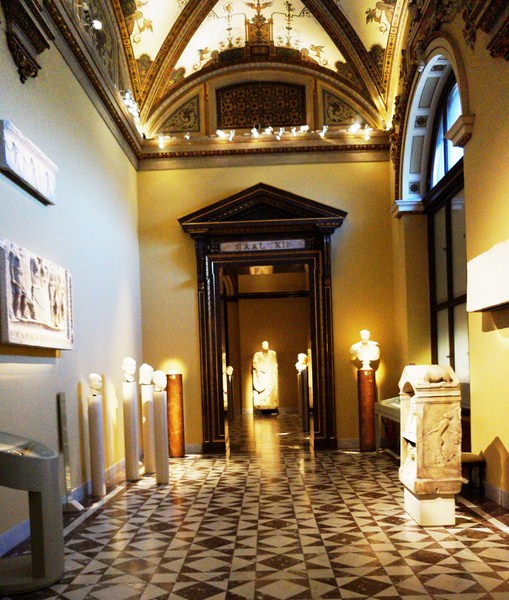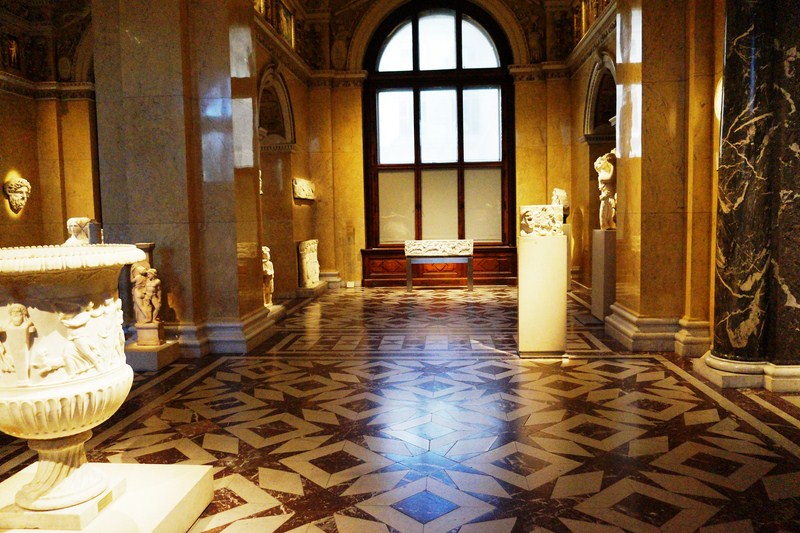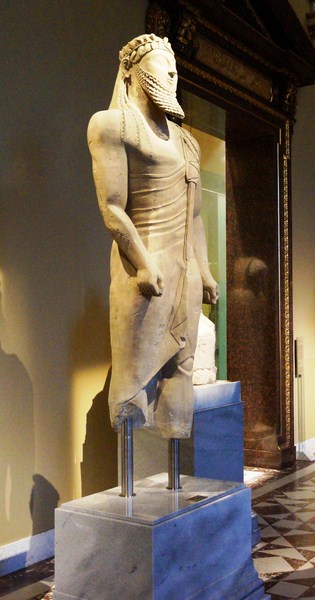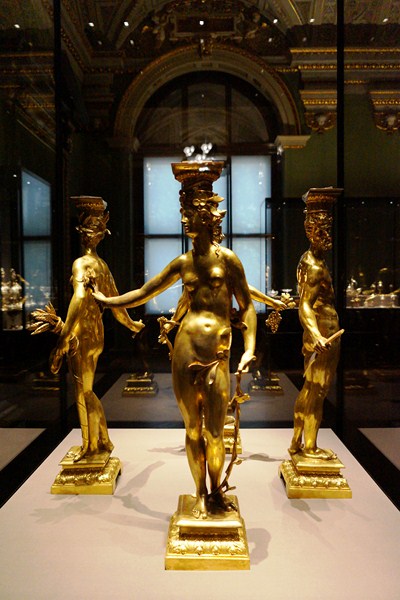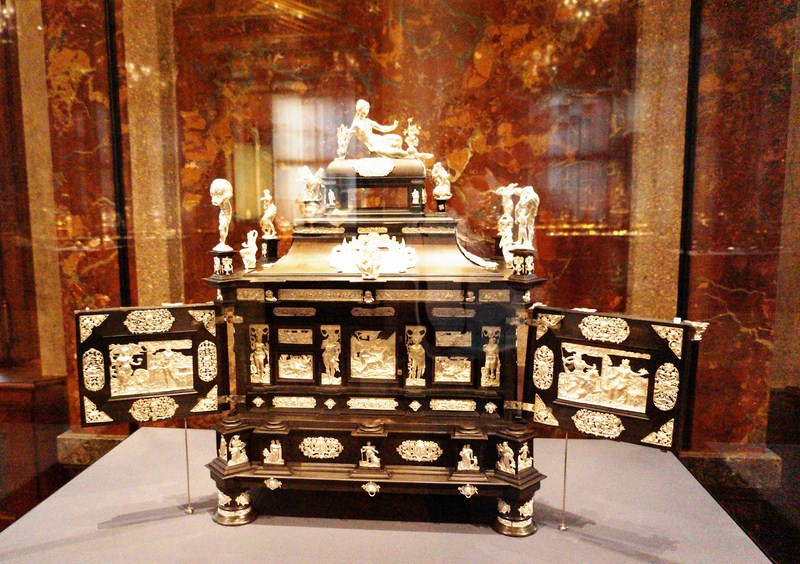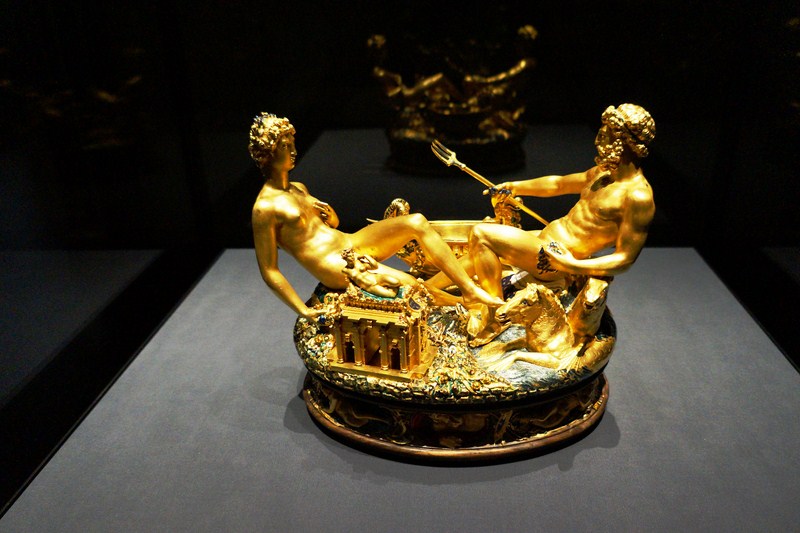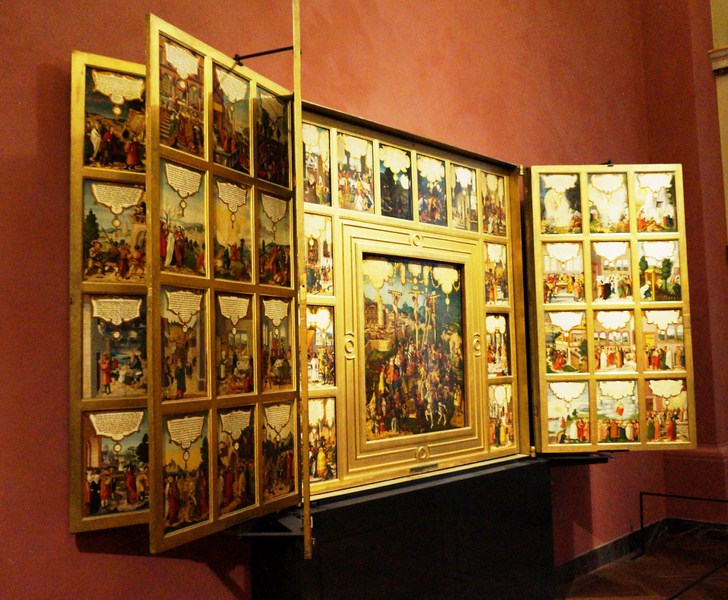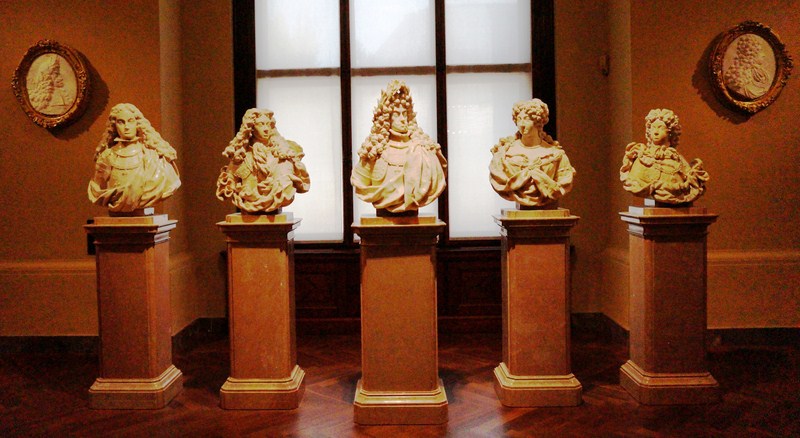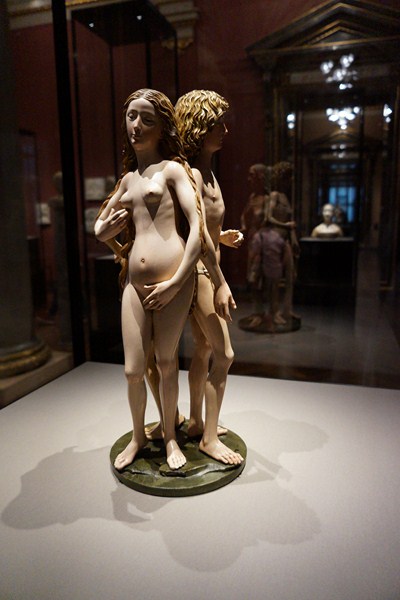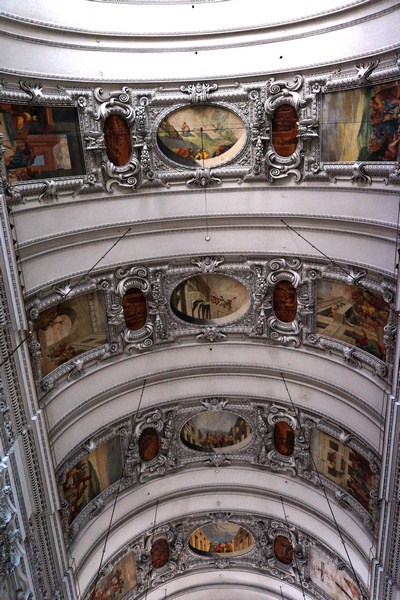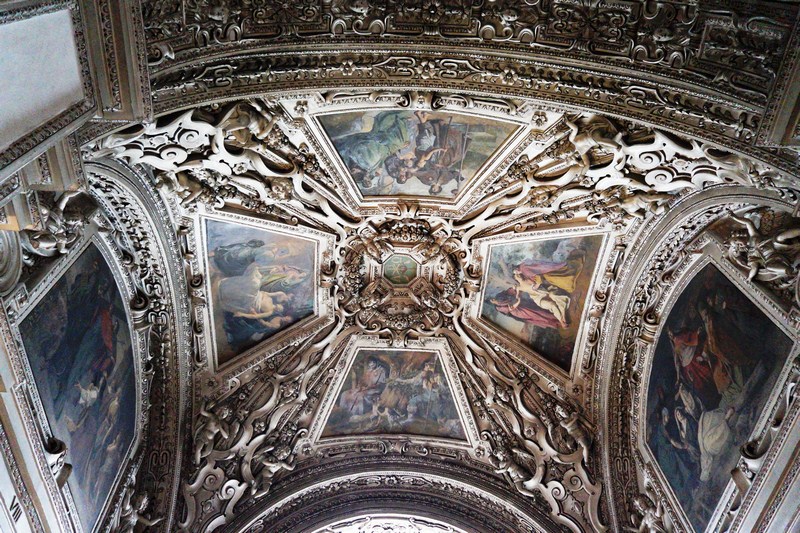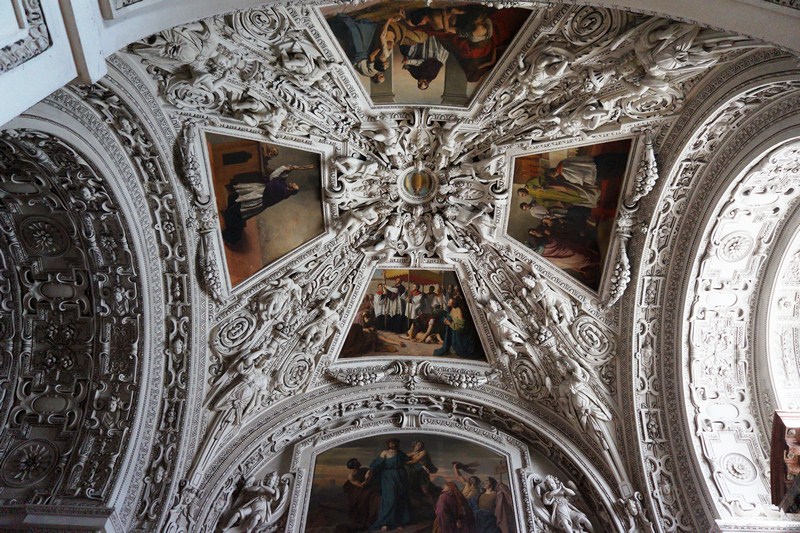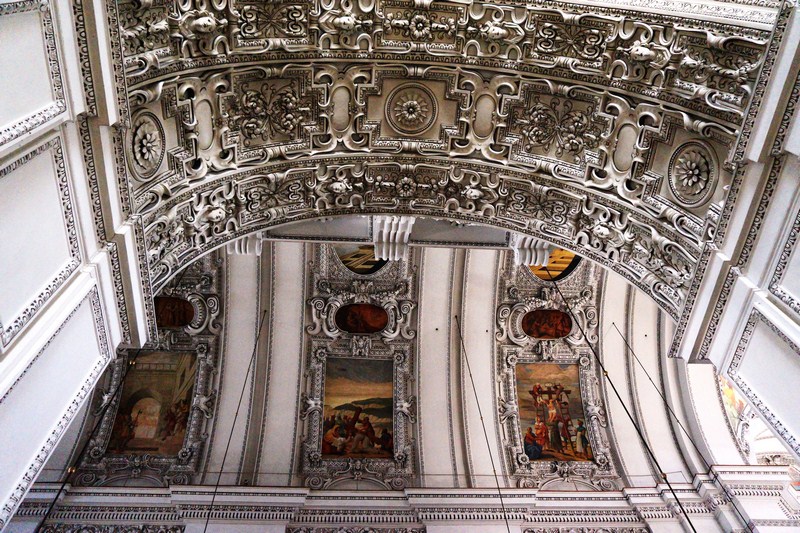
Kunsthistorisches Museum – Picture Gallery (Vienna, Austria)

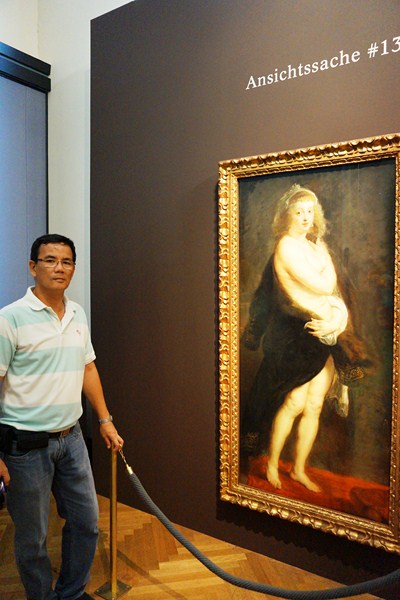
The author beside the painting of Helene Fourment (Peter Paul Rubens), Picture Gallery, Kunsthistorisches Museum

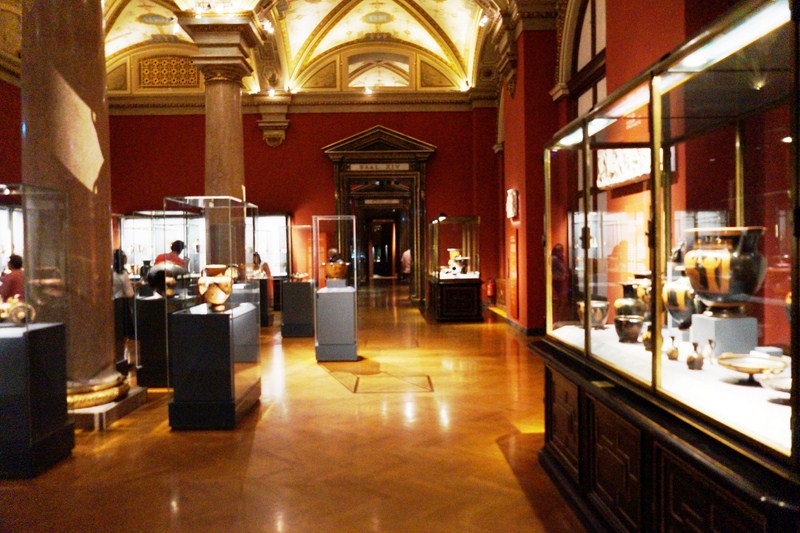
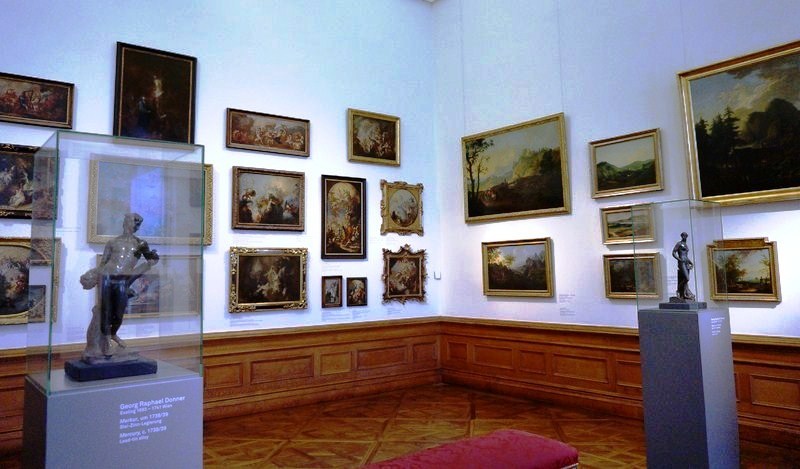
The Picture Gallery of the Kunsthistorisches Museum, developed from the art collections of the House of Habsburg (notably Rudolf II in the late-16th/early-17th century and Archduke Leopold Wilhelm in the mid-17th century), is one of the largest and most important of its kind in the world with numerous masterpieces from European art history.

Check out “Kunsthistorisches Museum

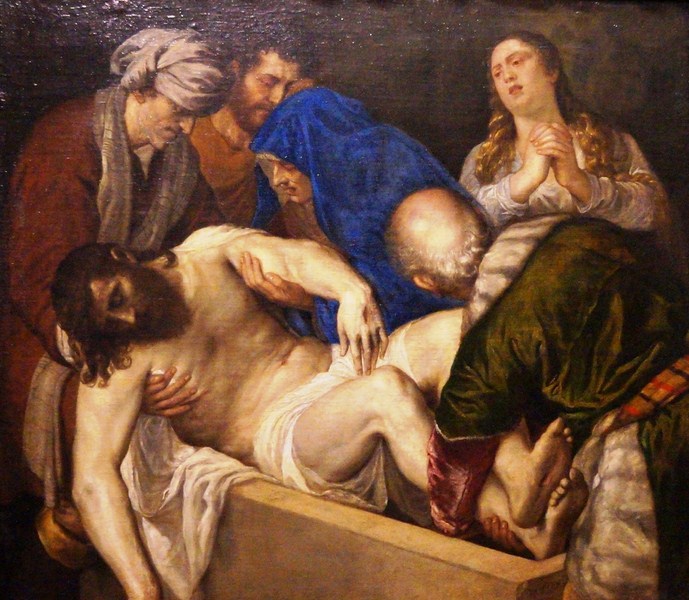
Grablegung Christi (Tizan)

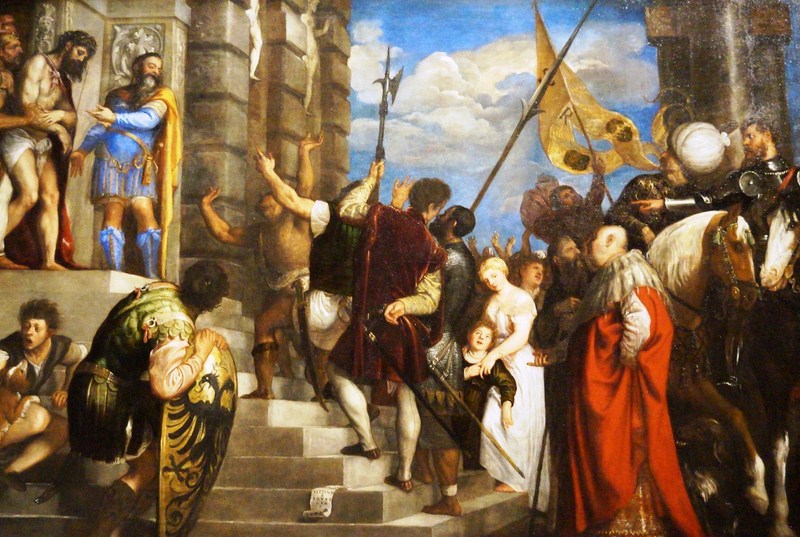
Ecce Homo (Tiziano Vecellio, 1543)

It occupies two wings of the first floor with one wing focusing on 16th-century Venetian painting (Titian, Paolo Veronese, Tintoretto, etc.), Spanish and French works and the other on Dutch painting (Jan van Eyck, Rogier van der Weyden, etc.), 17th-century Flemish painting (Peter Paul Rubens, Sir Anthony Van Dyck, etc.) and German Renaissance painting (Albrecht Dürer, Lucas Cranach, etc.).

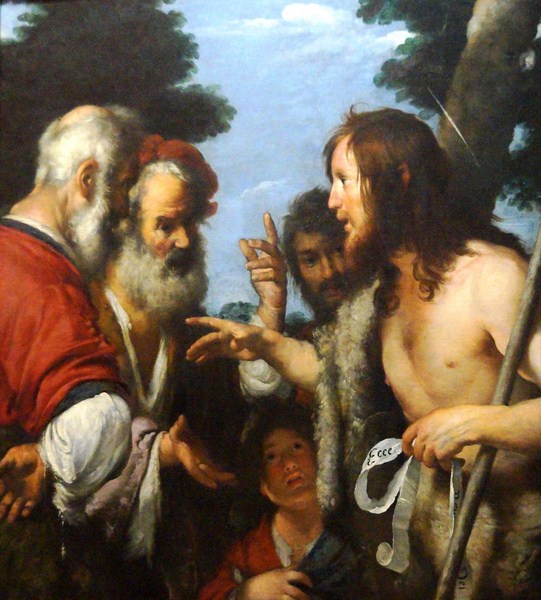
John the Baptist Preaching (Bernardo Strozzi)

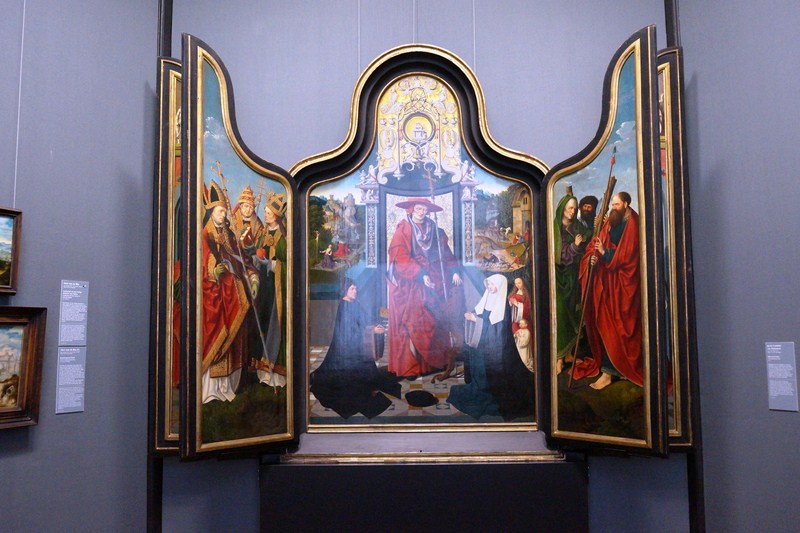
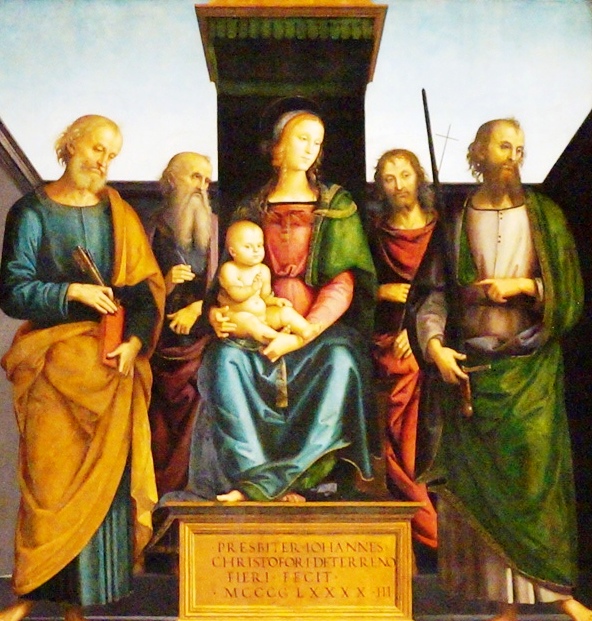
Mary with Child and Saints (Perugino)

The gallery includes the world’s largest collection of works by Pieter Brueghel the Elder, painted depictions of 16th century life which are unique worldwide and are an absolute joy.

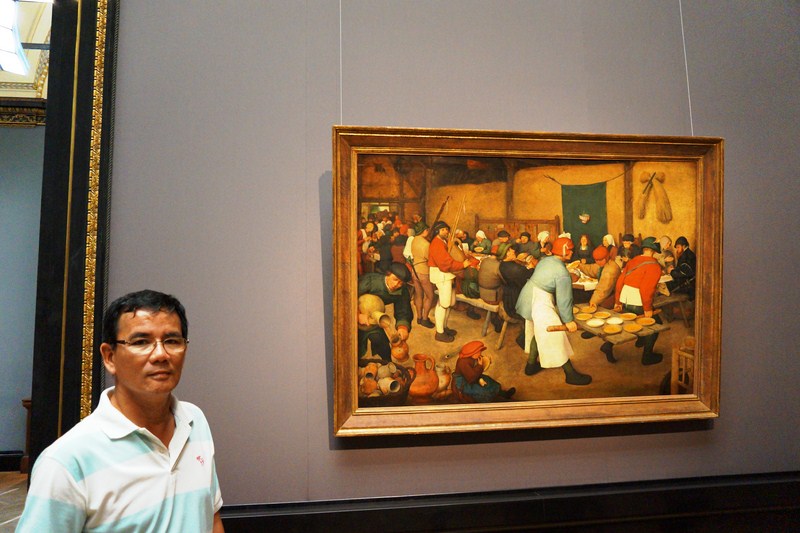
The author (left) beside the painting of The Peasant Wedding of Pieter Bruegel the Elder (1568)

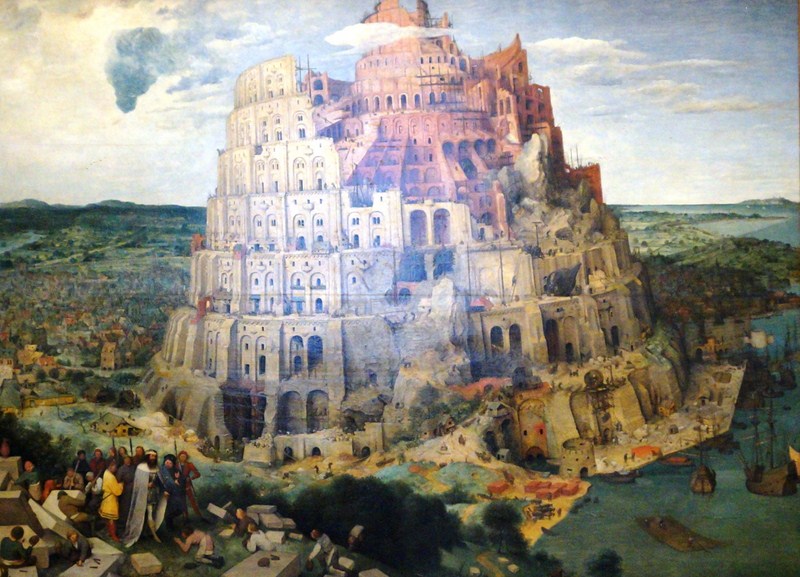
Tower of Babel (Pieter Bruegel)

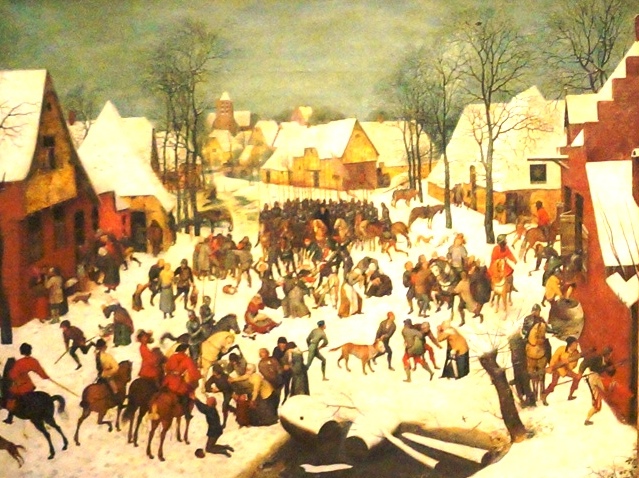
The Massacre of the Innocents (Pieter Bruegel the Elder)

It features such famous works as the iconic The Tower of Babel (1563), The Fight Between Carnival and Lent (1559), Children’s Games (1560),  The Procession to Calvary (1564), The Gloomy Day (February-March, 1565), The Return of the Herd (October-November, 1565), The Hunters in the Snow (December-January, 1565), The Peasant and the Nest Robber (Bauer und Vogeldieb, 1568), The Peasant Wedding (1568/69) and The Peasant Dance (1568/69).

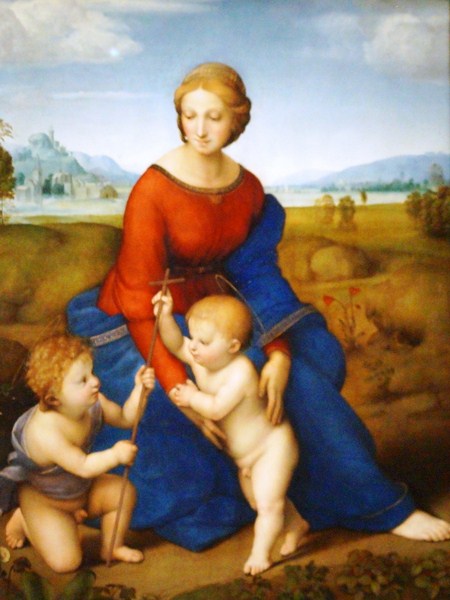
Madonna of the Meadow (Raphael)

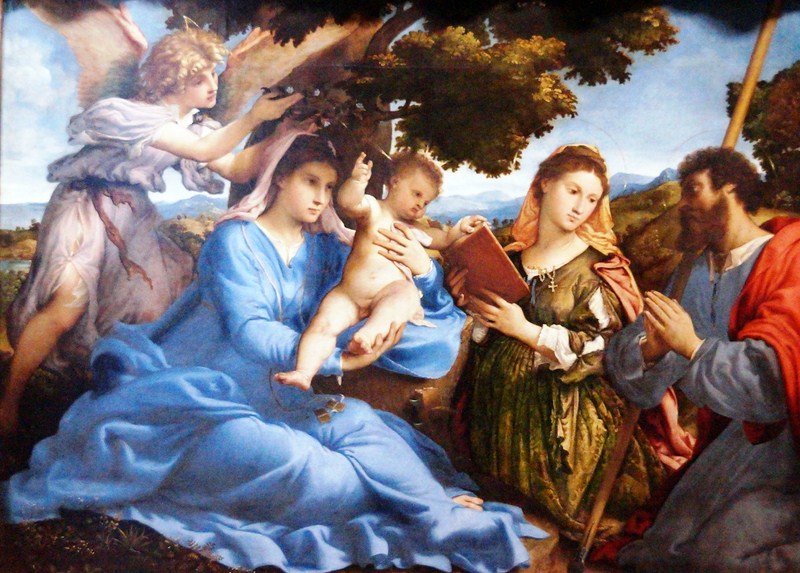
Madonna and Child with Saints Catherine and James (Lorenzo Lotto)

Among the other highlights hanging in the hallowed museum walls of the Picture Gallery are its holdings of masterpieces of Europe’s greatest artists from the 15th, 16th, 17th, and 18th centuries such as:

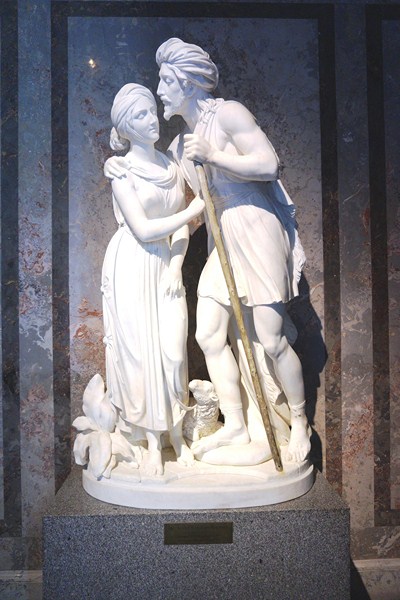
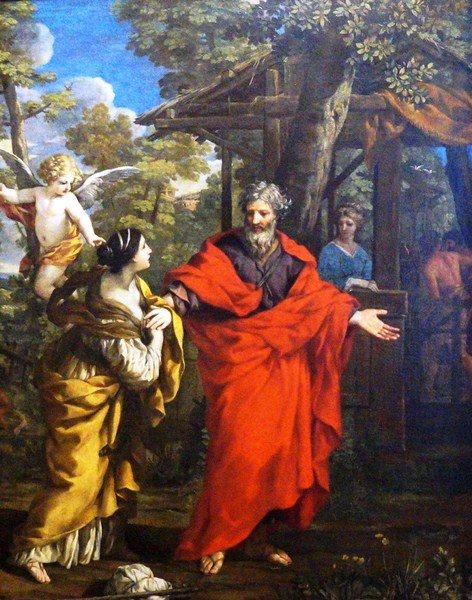
Homecoming of Hagar (Pietro da Cortona)

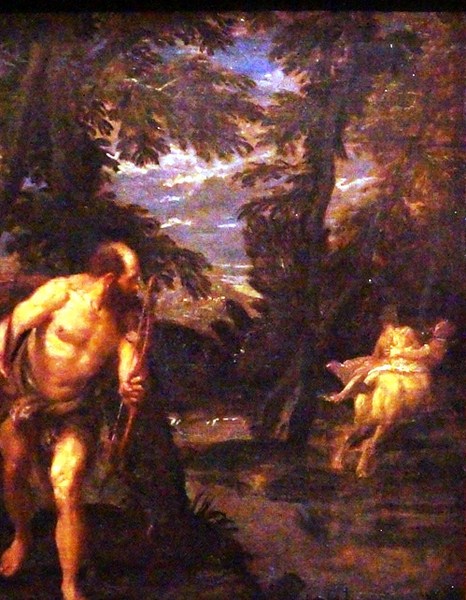
Hercules, Dejanira and the centaur Nesius (Paolo Veronese)

The paintings, though hanging in tall galleries, are more or less at eye level, making them easy to view from lovely upholstered sofas.

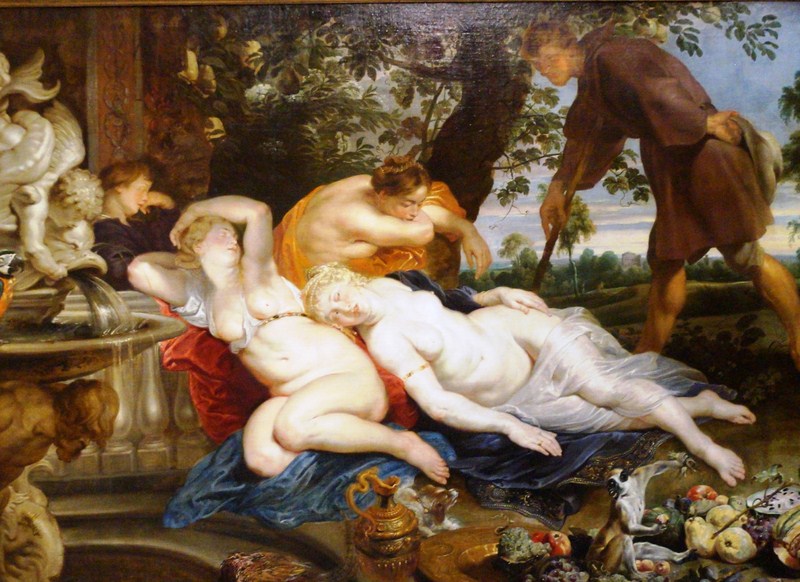
Cimon and Iphigenaia (Peter Paul Rubens)

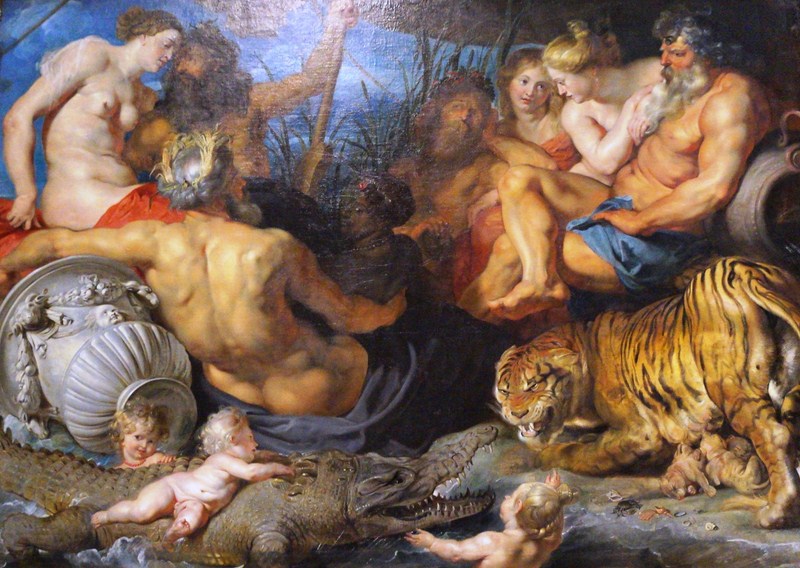
The Four Rivers of Paradise (Peter Paul Rubens, 1615)

The protective rails feature accessible, individual descriptions in both German and English.

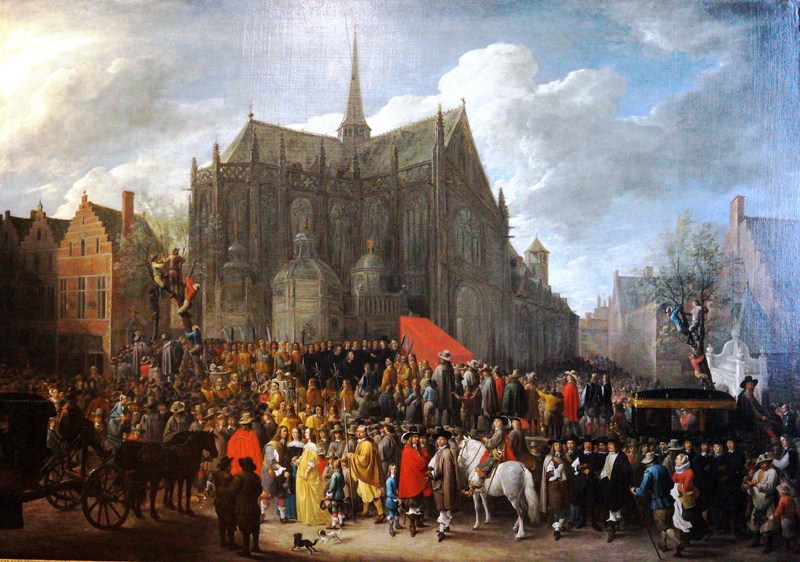
Bird hunting in Brussels (David Terniers, 1652)

Around 1890, Gustav Klimt, Ernst Klimt and Franz von Matsch painted the areas between and around the arches and columns on the north wall of the main staircase.

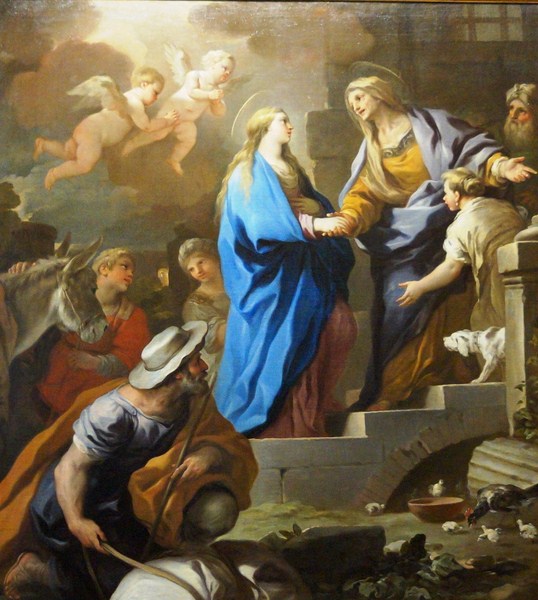
Advent … Elizabeth’s Moment (Luca Giordano)

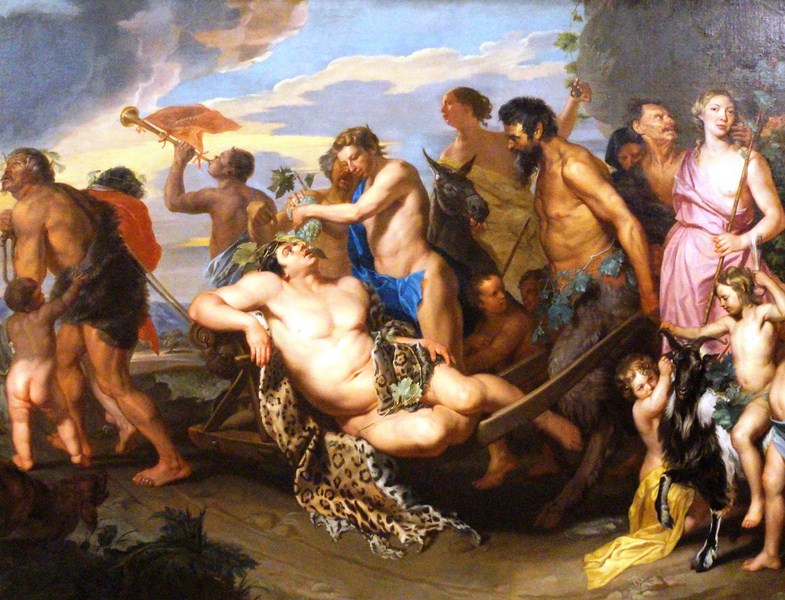
The Triumph of Bacchus (Michaelina Woutiers)

Picture Gallery: First Floor, Kunsthistorisches Museum, Maria Theresien-Platz, 1010 Vienna. Tel: +43 1 525 24- 4902. E-mail: info.ansa@khm. Open Tuesdays – Sundays, 10 AM – 6 PM, Thursdays, 10 AM – 9 PM.

How to Get There: take U1 going to Leopoldau at Keplerplatz, transfer to U2 going to Aspernstrabe at Karlsplatz, exit at Volkstheater.

Kunsthistorisches Museum (Vienna, Austria)

Kunsthistorisches Museum

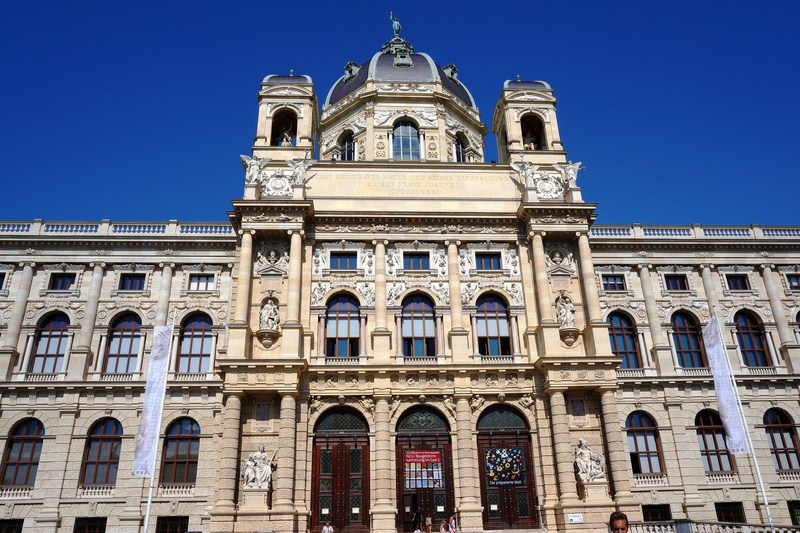
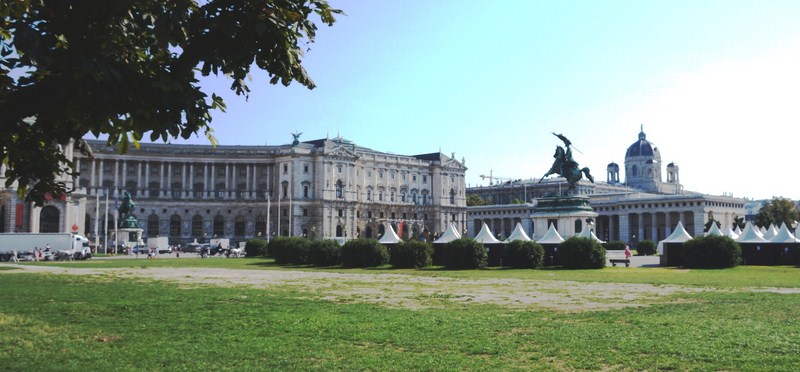
The Kunsthistorisches Museum (Museum of Art History), also often referred to as the “Museum of Fine Arts,” is housed in its festive palatial building, on the RingstraßeThe term Kunsthistorisches Museum applies to both the institution and the main building.

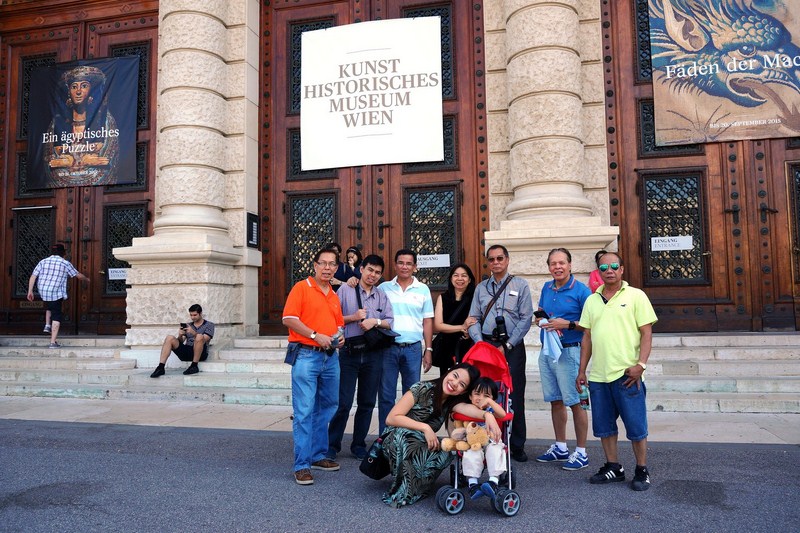
L-R (standing): Popong Flores, Jandy Layug, the author, Grace Layug, Manny Sta. Maria, Freddie Sta. Maria and Isko Dionela. Seated: Cheska and Kyle Layug

It was opened by Emperor Franz Joseph I of Austria-Hungary around 1891, the same time as the Natural History Museum (Naturhistorisches Museum) across Maria-Theresien-Platz.

Check out “Natural History Museum

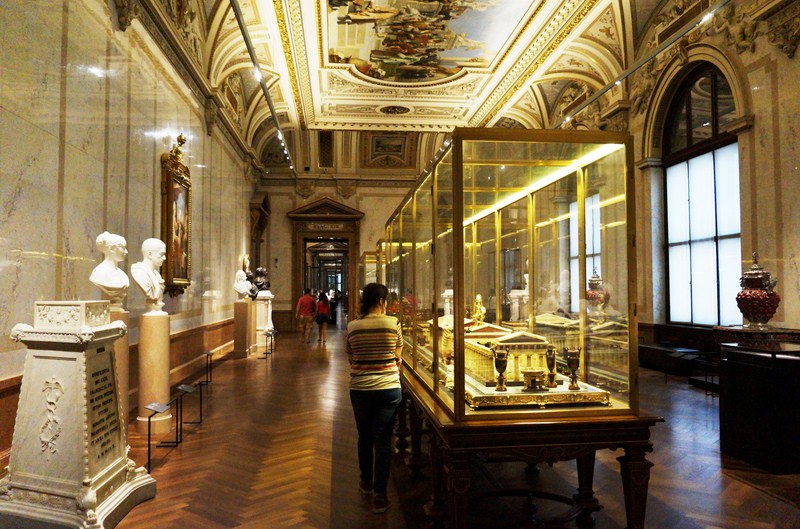
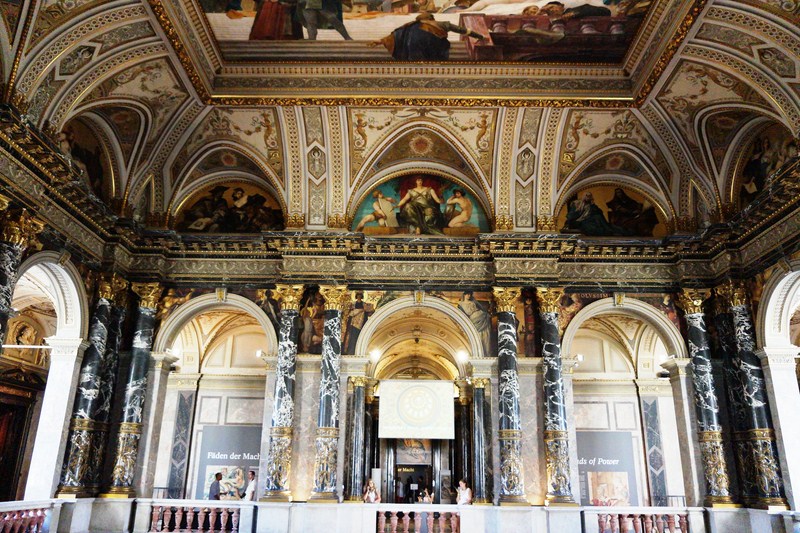
The ornate interior

The two museums, with identical exteriors,  were commissioned by the Emperor in order to find a suitable shelter for the Habsburgs‘ formidable art collection and to make it accessible to the general public.

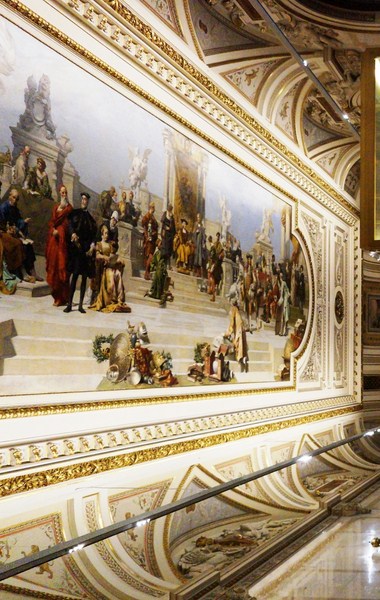
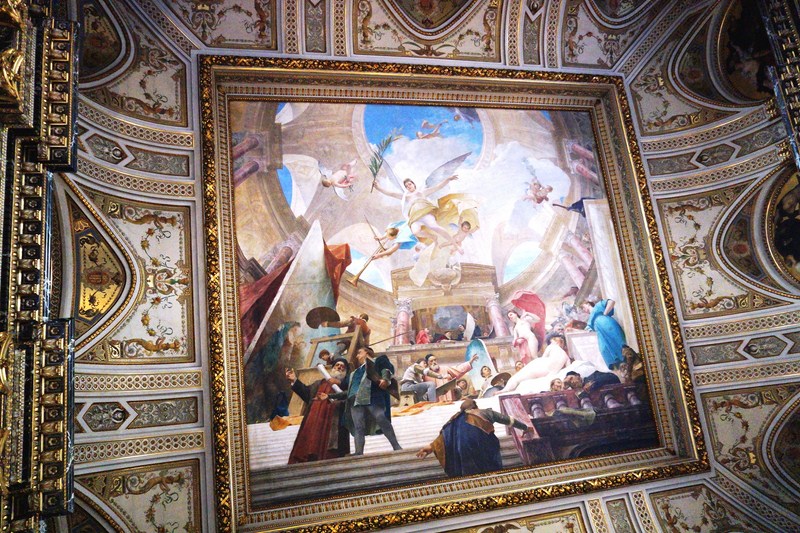
Apotheosis Of The Renaissance (Mihaly Munkacsy, 1844-1900, Hungary)

Both were built between 1872 and 1891 according to plans drawn up by Gottfried Semper and Karl Freiherr von Hasenauer.

This rectangular building, with its sandstone façade, is topped with a 60 m. high octagonal dome.  Its interior is lavishly decorated with marble, stucco ornamentations, gold-leaf, and paintings.

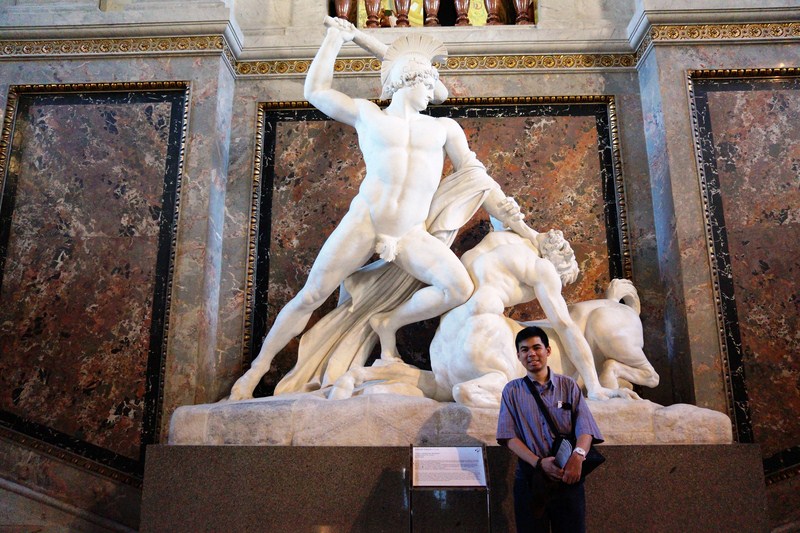
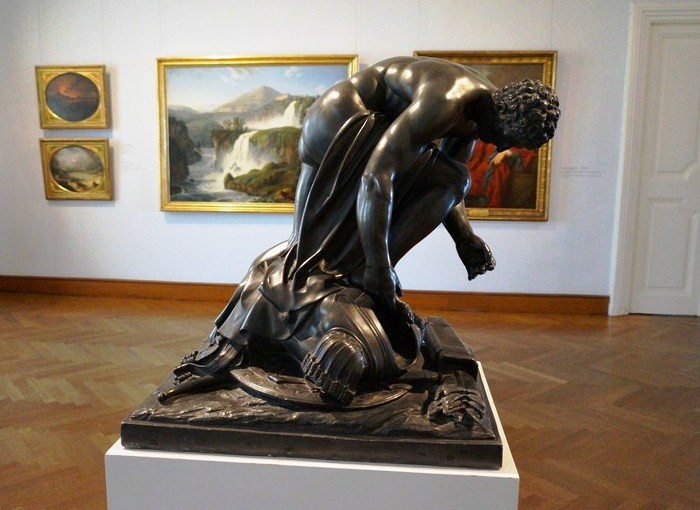
Jandy beside sculpture of Theseus Defeats the Centaur (Antonio Canova)

Here are some interesting trivia regarding the museum:

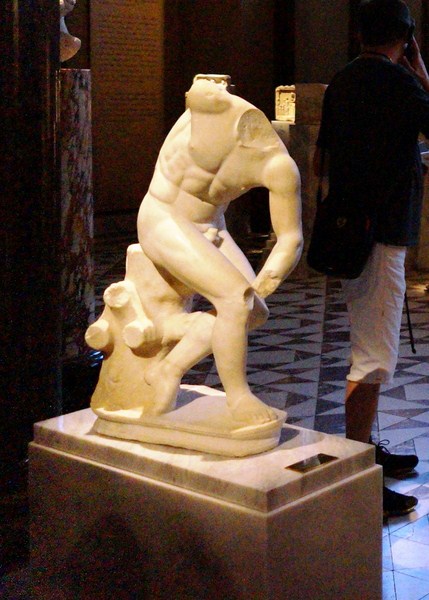
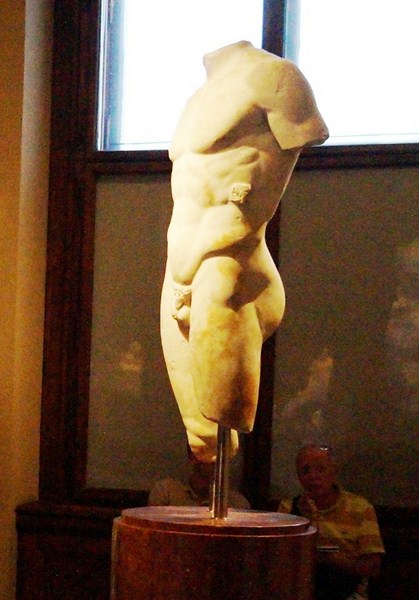
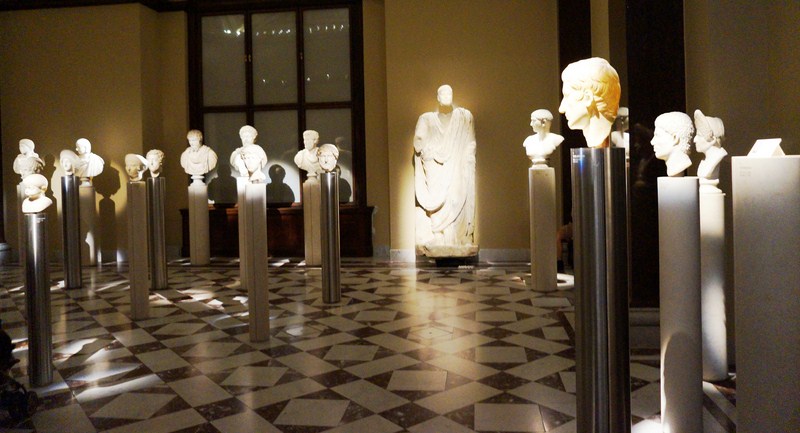
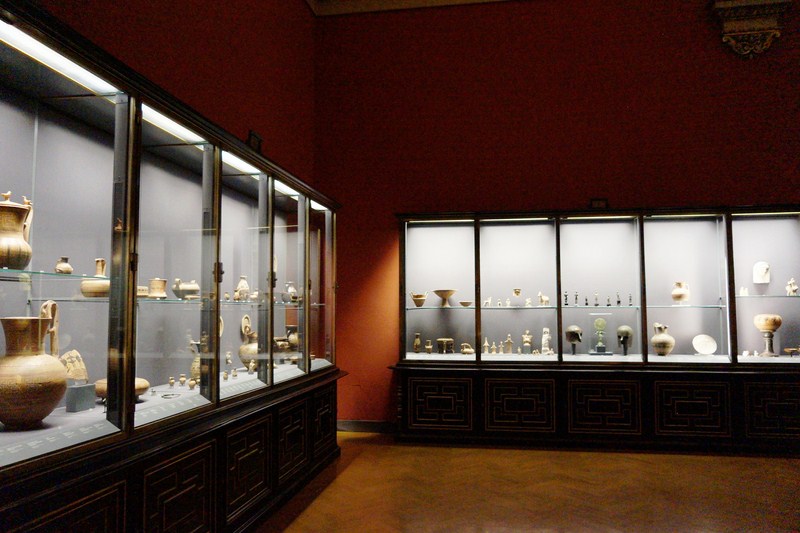
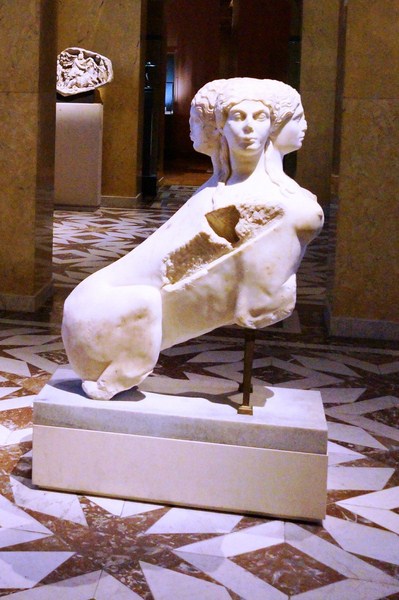
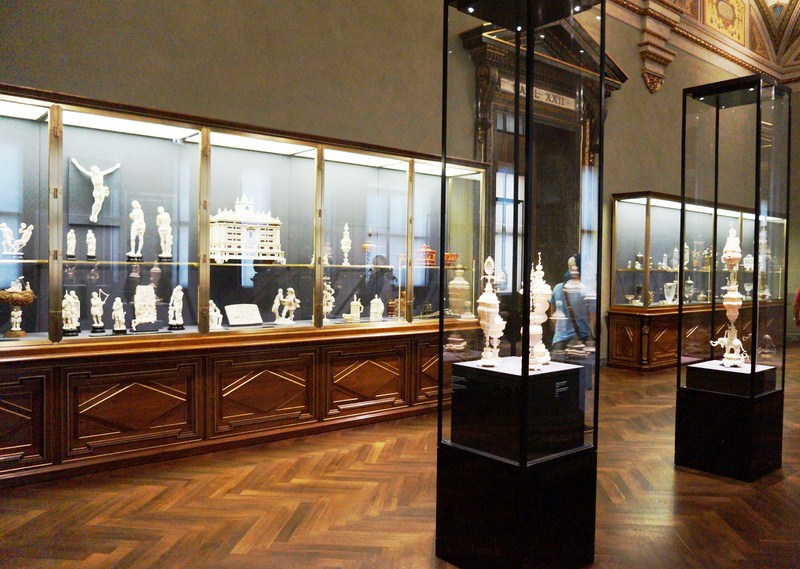
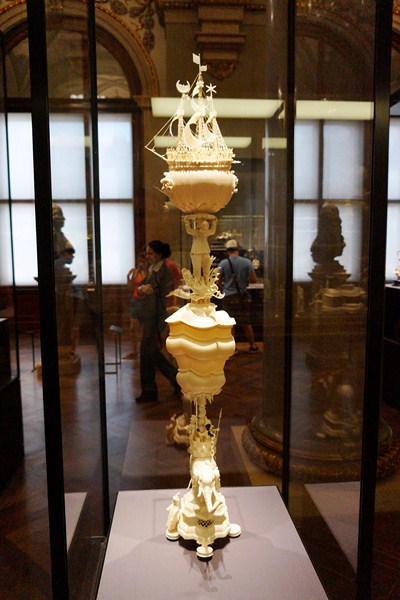
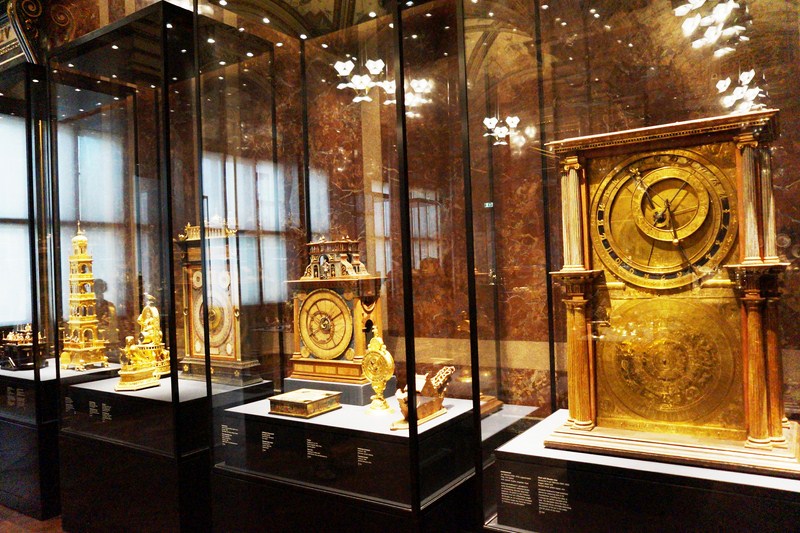
The collections of the Kunsthistorisches Museum  include the Picture Gallery, the Egyptian and Near Eastern Collection, the Collection of Greek and Roman Antiquities, Kunstkammer (Collection of Sculpture and Decorative Arts), the Coin Cabinet and the Library.

Check out “Kunsthistorisches Museum – Egyptian and Near Eastern Collection,” “Kunsthistorisches Museum – Collection of Greek and Roman Antiquities,” “Kunsthistorisches Museum – Picture Gallery” and “Kunsthistorisches Museum – Kunstkammer.”

Kunsthistorisches Museum: Maria Theresien-Platz, 1010 Vienna. Tel: +43 1 525 24- 4902. E-mail: info.ansa@khm. Open Tuesdays – Sundays, 10 AM – 6 PM, Thursdays, 10 AM – 9 PM.

How to Get There: take U1 going to Leopoldau at Keplerplatz, transfer to U2 going to Aspernstrabe at Karlsplatz, exit at Volkstheater.


Österreichische Galerie Belvedere (Vienna, Austria)

Osterreichische Galerie Belvedere

The highlight of our tour of the Belvedere Palace, the summer residence of  the great art patron and collector Prince Eugene of Savoy (1663–1736), was our tour of the Österreichische Galerie Belvedere (Austrian Gallery), an art museum housed in the Upper Belvedere, one of two palaces that make up the Belvedere.

Check out “Upper Belvedere

The author

Named as such in 1921, this museum houses an extensive and permanent collection which includes several thousand masterpieces from the Middle Ages and Baroque up to the 21st century contemporary art, focusing on Austrian painters from the Fin de Siècle and Art Nouveau period complemented by the works of international artists.

Further attractions at the museum include key works of French Impressionism and the greatest, outstanding and most important collection of Viennese art from the Biedermeier Collection as well as highlights of the Baroque and Medieval Collection.

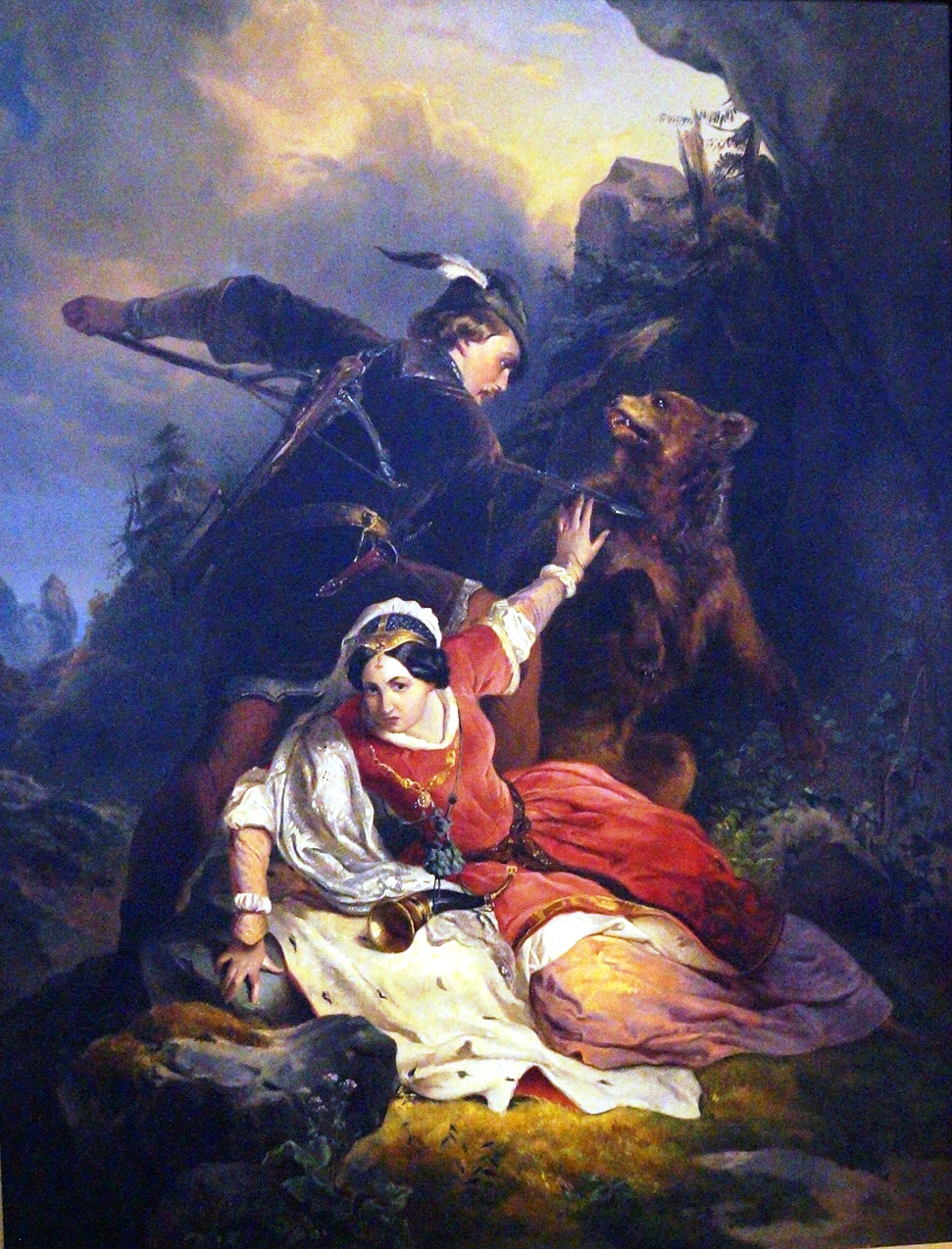
Duke Ernst the Iron Saves Cimburgis (Franz Dobyaschofsky, 1850, oil on canvas)

The collection threw a fresh and exciting light on artworks by well known Austrian artists that includes the world’s largest collections of paintings by Ferdinand Georg Waldmüller and Gustav Klimt and the Character Heads by Franz Xaver Messerschmidt. Other Austrian artists with works displayed include Rueland Frueauf the Elder, Erika Giovanna Klien, Egon Schiele, Helene Funke, and Oskar Kokoschka.

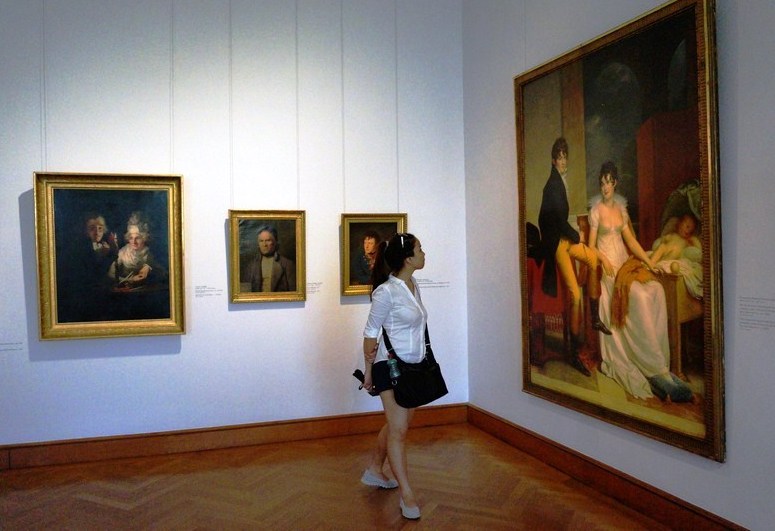
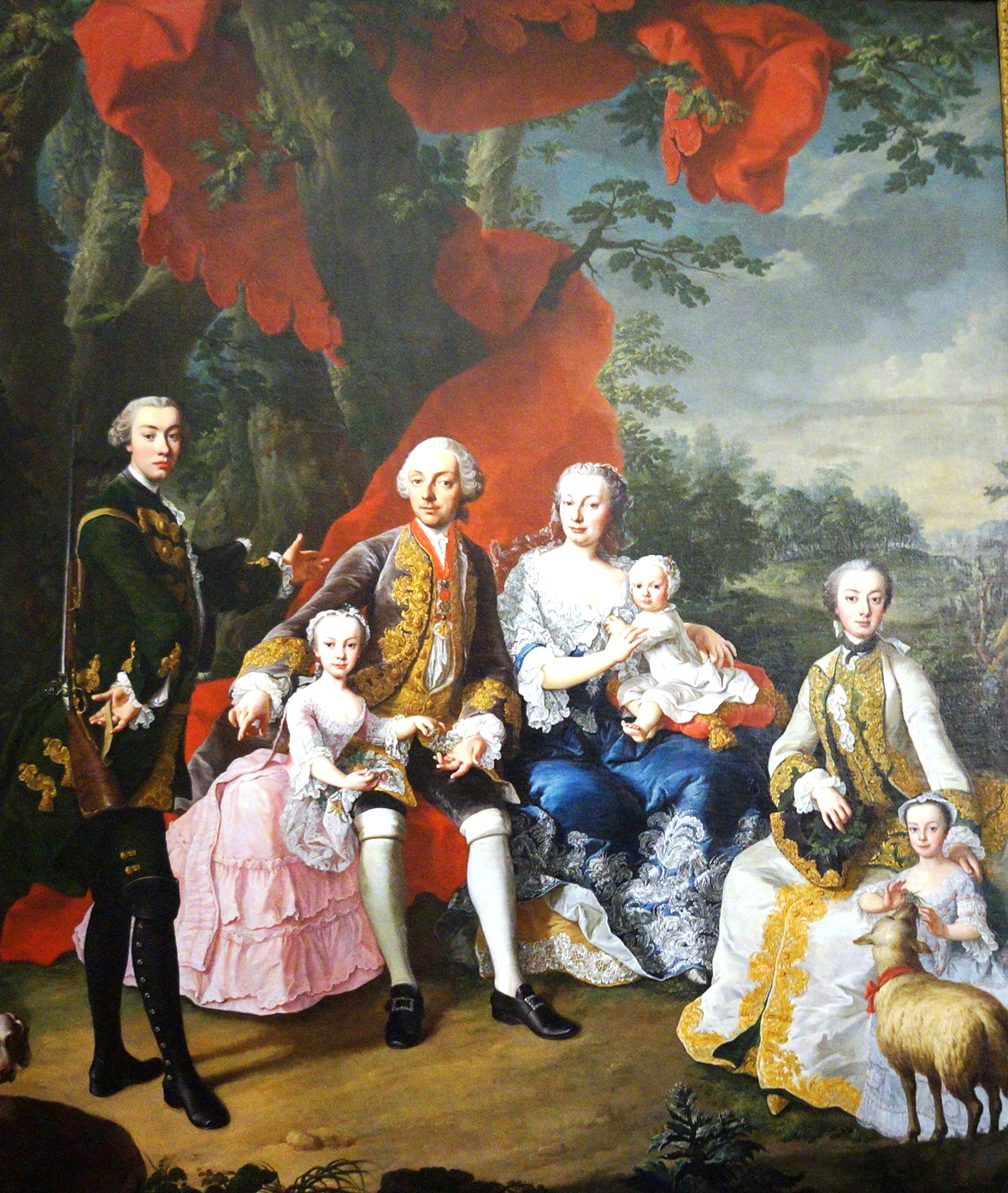
Cheska admiring “Count Moritz Christian von Fries and his Family,” an oil on canvas painting by François Pascal Simon Gérard

The museum’s display concept offered fresh approaches to these masterpieces of art through four innovative and thematically organized galleries (Austrian Baroque; Habsburg – Myth and Truth; Austria in Exile: Artists in Exile – Destinies in Dark Times; and Austria on the Move) that enlivened the path through the chronologically arranged periods of art in the permanent collection, sparking a multi-layered dialogue between the classics of art history and contemporary artists, for example Erwin Wurm and Christian Philipp Müller.

Empress Maria Theresa with her Children (Heinrich Fuger, tempera on parchment, 1776)

Conceived as a deliberate pause, the magnificent staterooms provides an opportunity to engage with, as well as focus on, issues and questions concerning Austria’s art, identity and history over the course of different epochs. An exciting interaction between past and present, we encountered and experienced an almost complete overview of the development of over 500 years of art history in Austria and, thus, an insight into the country’s history, rediscovering old favorites in a new context.

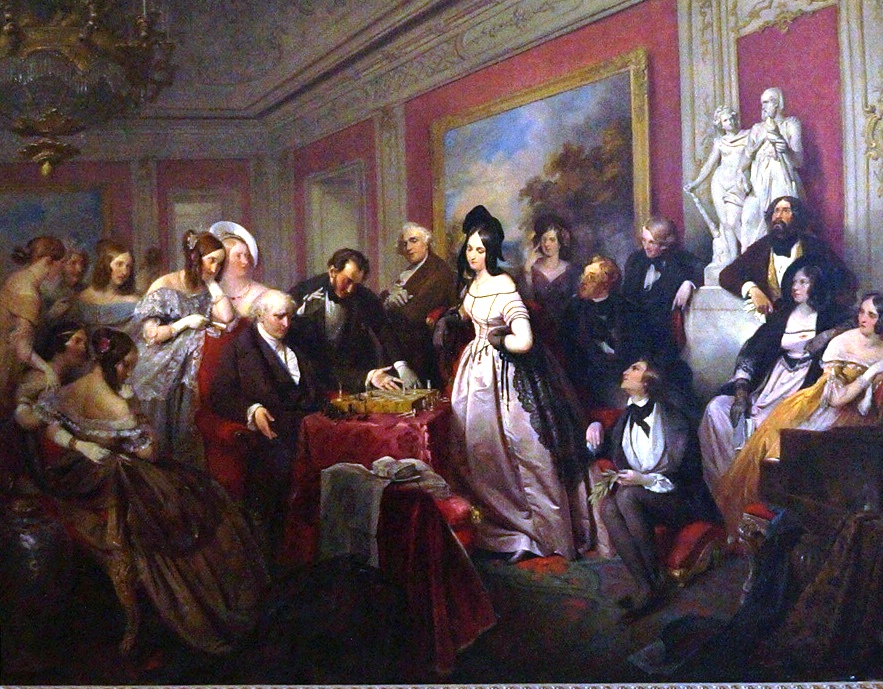
The Chess game (Josef Danhauser, 1839)

A section in the exhibition is dedicated to the tempestuous history of the Belvedere covering Prince Eugene’s building of the palaces, the foundation of the museum, the signing of the Austrian State Treaty, and its role today as a modern museum.

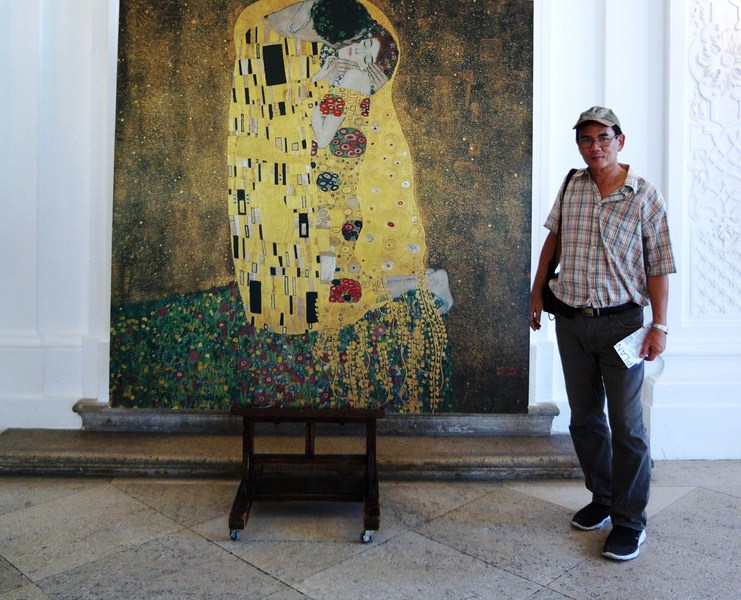
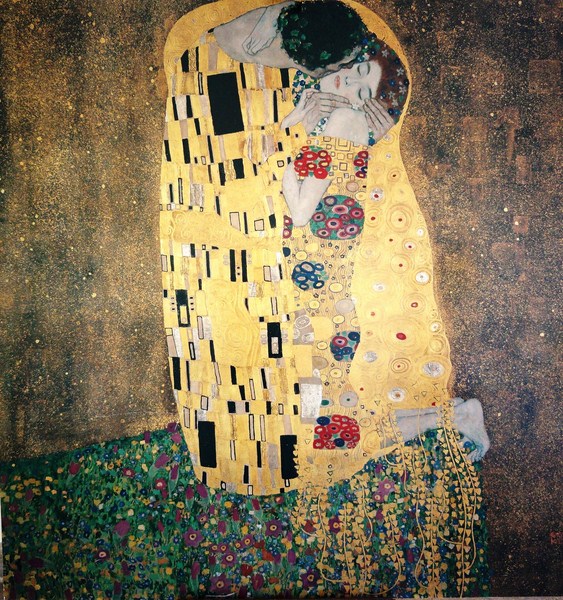
Gustav Klimt, The Kiss (Lovers), 1908–1909. Measuring 180×180 cms., the ornamental character of this masterpiece is enhanced with gold and silver. According to a contemporary rumor, the couple depicted is the artist himself and his lifelong partner Emilie Flöge. which was Bought in 1908 by the Moderne Galerie, Klimt reached the pinnacle of his “golden” phase with “The Kiss.”

At the Galerie des 19. und 20. Jahrhunderts (Gallery of 19th- and 20th-Century Art), I found works by the artists of the 1897 Secessionist movement. Most outstanding is Gustav Klimt (1862-1918), one of the movement’s founders.  The heart of the presentation of “Art around 1900” is the collection of 24 of his works (portraits, landscapes, and allegorical scenes), the world’s largest collection of his paintings, which allowed us to trace the evolution of his style, from elegant portraiture (e.g. 1897/1898’s Sonja Krips), through to portraits with abstract elements (1906’s Fritza Riedler), impressionist landscapes (1907’s Flowering Poppies) and, of course, the golden pictures The Kiss (1907/08), his most famous painting, and Judith (1901).

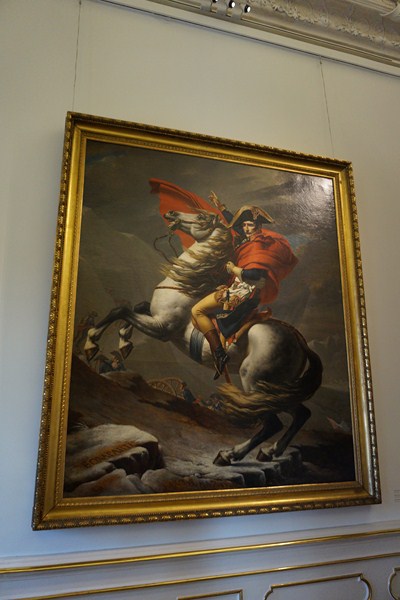
Napoleon at the St. Bernard Pass (Jacques Louis David, 1801. Oil on canvas, 246 x 231 cm.)

Sharing almost equal billing with Klimt is Egon Schiele  (1890-1918).  The museum hosts some of Schiele’s masterpieces, including The Wife of an Artist, The EmbraceDeath and the Maiden, and The Family (a self-portrait painted just months before his death in 1918 from Spanish flu; the expressions on their faces suggest that Schiele and his wife almost seem to know what’s coming).

Österreichische Galerie Belvedere: Upper Belvedere, Prinz Eugen-Straße 27, 1030 ViennaAustria. Tel: +43 1 795 57-0 and +43 1 79557134. Open: 10 AM -6 PM. E-mail: info@belvedere.at. Website:  www.belvedere.at.  Admission (Upper Belvedere): €16 (adult)

How to Get There: take U1 going to Reumannplatz at Stephansplatz, exit at Hauptbahnhof, then walk.
Kollegienkirche (Salzburg, Austria)

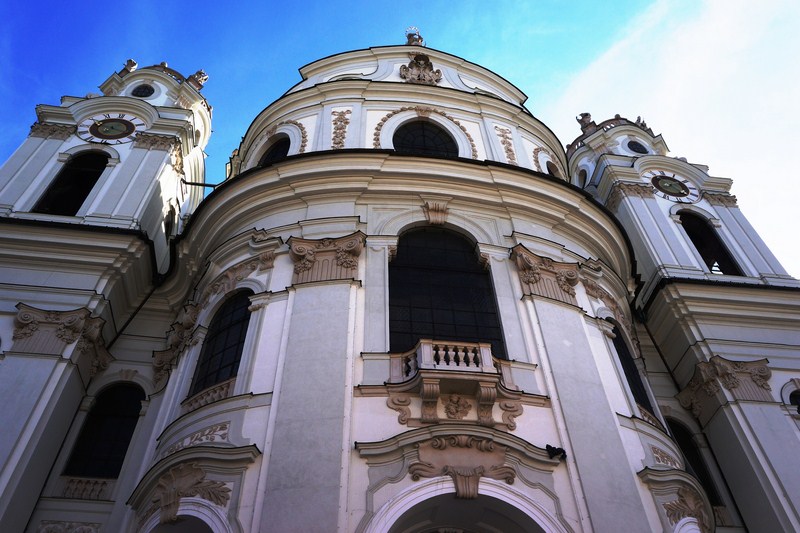
On our way to Mozart’s Geburtshaus, we passed by Universitätsplatz (“University Square”) where a farm market takes place here every Monday to Friday.  The square lead up to  the Kollegienkirche (Collegiate Church, sometimes called the Universitätskirche), another elaborate Baroque church of Salzburg. Grace and I went in for a visit.
Kollegienkirche (Collegiate Church)

Kollegienkirche (Collegiate Church)

The church, dedicated to “Unserer Lieben Frau” (Our Blessed Lady), was built between 1694 and 1707 from the local Benedictine university founded in 1622. The university was disbanded in 1810 but reopened in 1962 as part of the University of Salzburg whose main campus is in the suburb of Nonntal. After Napoleon Bonaparte’s invasion of 1800, the church was converted into a hay store. Kollegienkirche functioned as a military church and, under the Austro-Hungarian monarchy, was a classical secondary school. In 1922, the premiere of the Great World Theater was held here. With the reopening of the University of Salzburg, Kollegienkirche regained its original purpose.

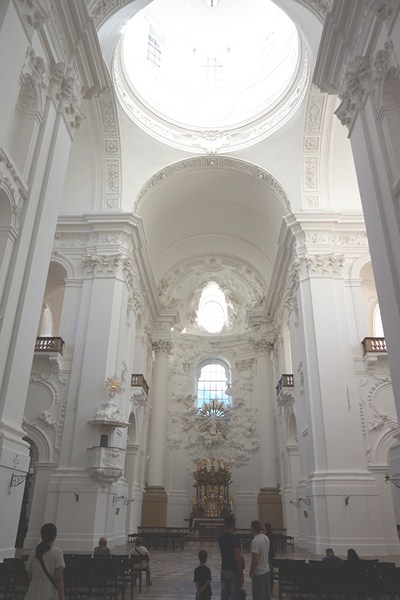
The bright and spacious interior

The bright and spacious interior

One of the most celebrated churches in Austria and he largest church in Salzburg from the Baroque period, it was designed by the great Baroque architect Johann Bernhard Fischer von Erlach (who also built the Mirabell Garden, Holy Trinity ChurchMarkuskirche and Dreifaltigkeitskirche). Attached to the church  is the Furtwänglerpark, a lovely piece of green, and the oldest buildings of the university.

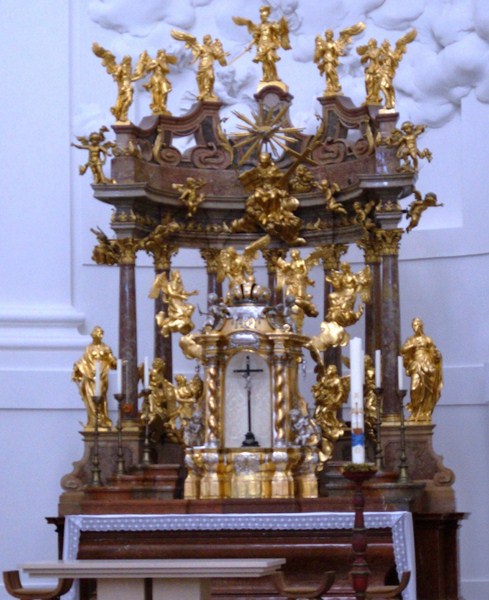
Altar built by Josef Anton Pfaffinger in 1735

Altar built by Josef Anton Pfaffinger in 1735

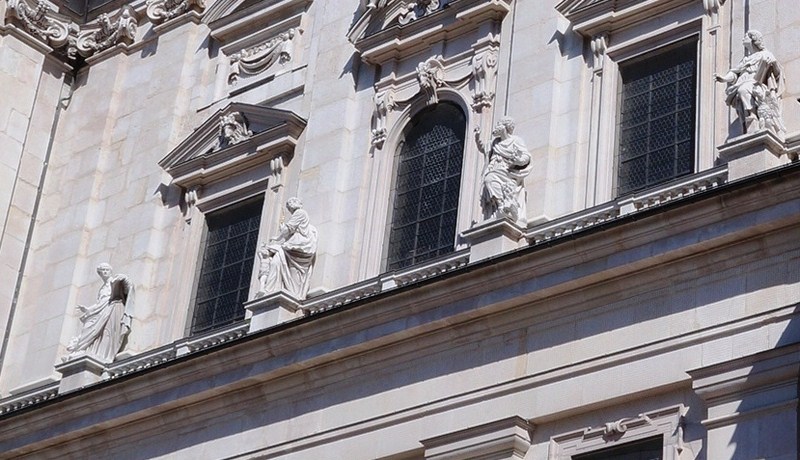
The Kollegienkirche, built on a modified Greek cross (cruciform) plan, has a unique, ornamental north-facing convex façade with many finely wrought details. It is flanked by two free standing bell towers.  On the top of the façade are four tapering statues resting on a coping which is bordered by balustrades.

Figures above the tabernacle

Figures above the tabernacle

Its spacious and bright interior, with its very steep proportions, is one of the most impressive and unusual creations in Baroque style. It is filled with elaborate stucco works, large windows surrounded by delicate decorative features, the coat of arms of Archbishop Johann Ernst von Thun set in the closing gable area, angels and an eye-catching Maria Immaculata statue, designed by Fischer von Erlach and Diego Francesco Carlone, framed by statues of the Four Evangelists on the left tower and of the four Church Fathers on the right, all done by Michael Bernhard Mandl. The porch is separated from the nave by three round-arched arcades. The cupola and transept are situated exactly in the center.

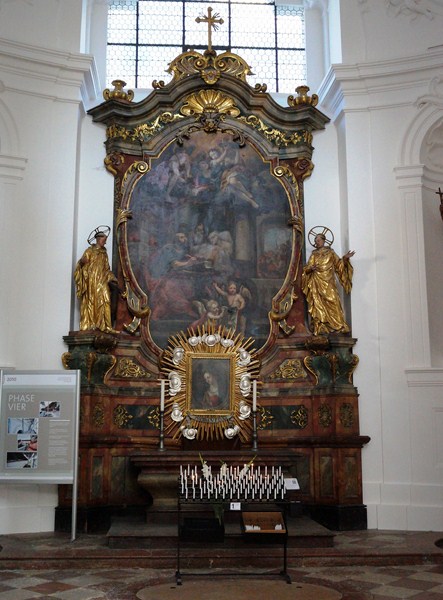
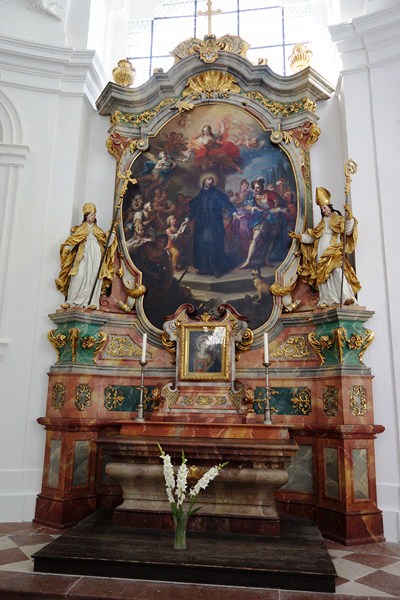
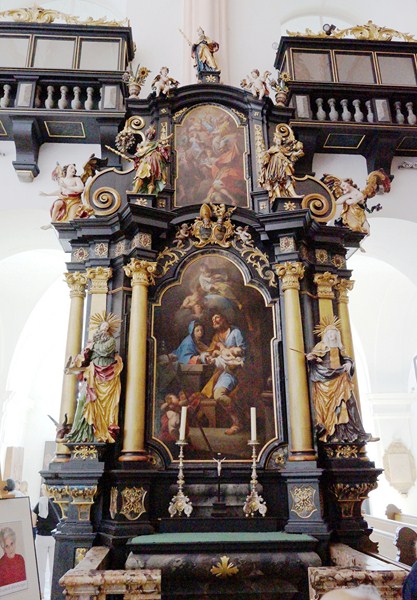
Side Altar (1)

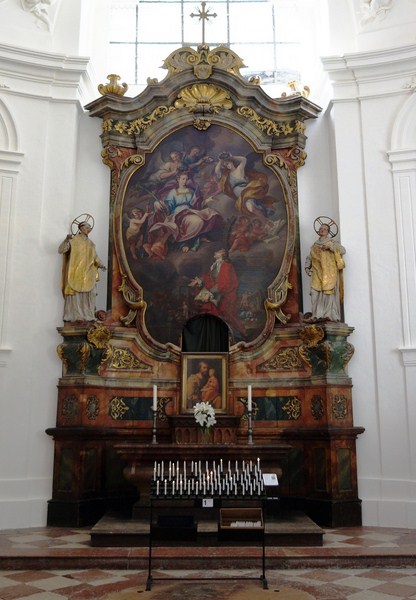
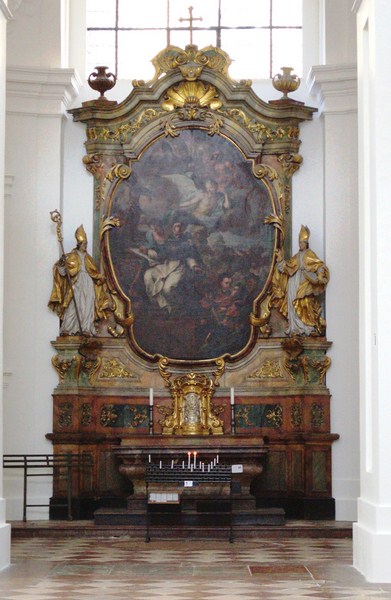
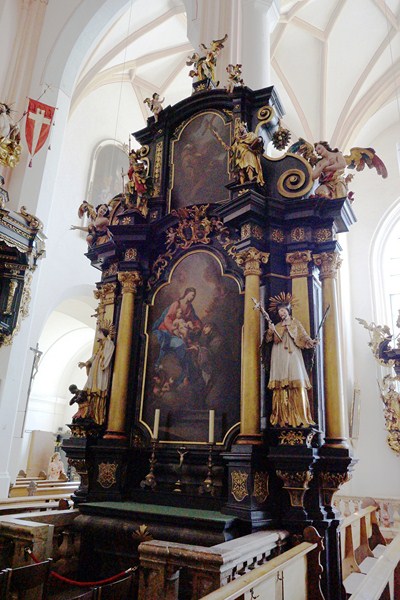
Side Altar (2)
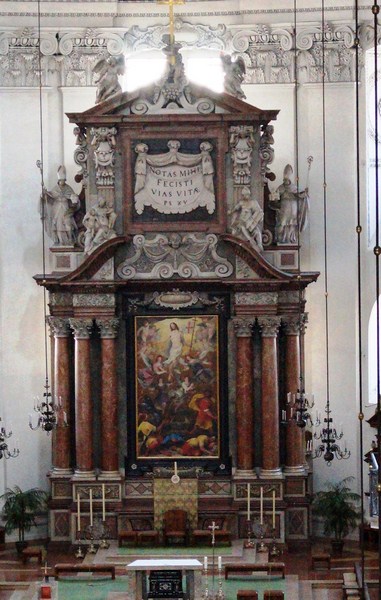
Initially, instead of a high altar, the Kollegienkirche choir originally held only a high tabernacle of stone.  Today, however, the church does have an altar, made by Josef Anton Pfaffinger and dating from 1735. Its seven classical columns (representing the Seven Pillars of Wisdom), of red marble, in the center hall, are topped by angels, with St. Michael the Archangel in the middle.

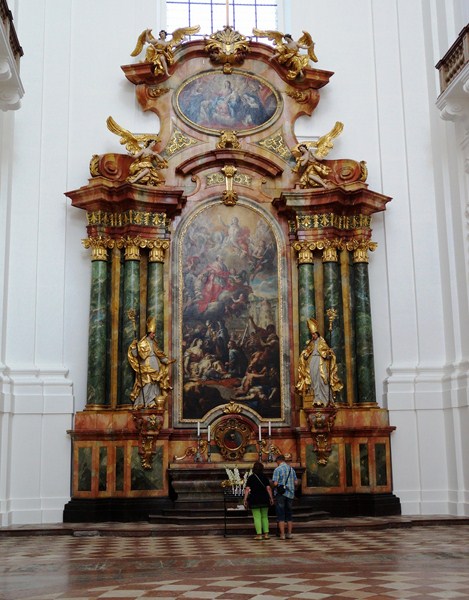
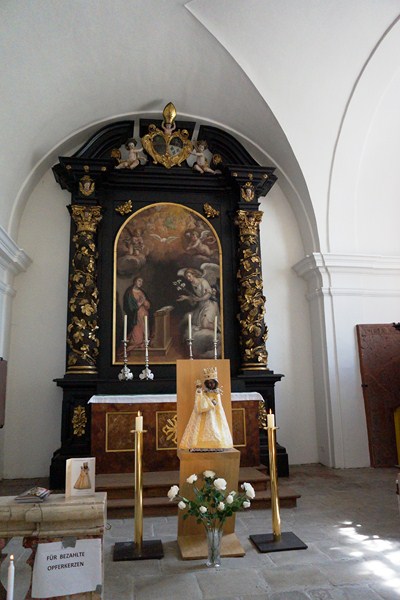
Side Altar (3)

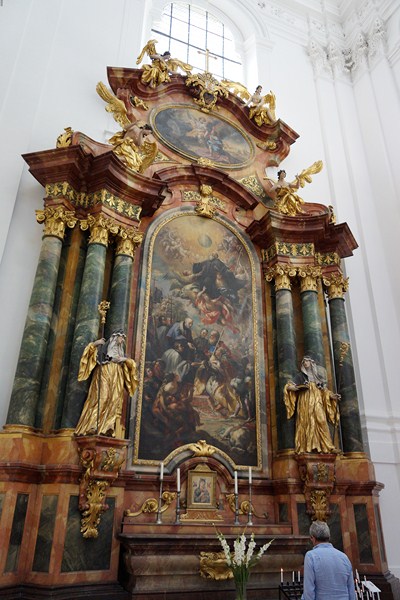
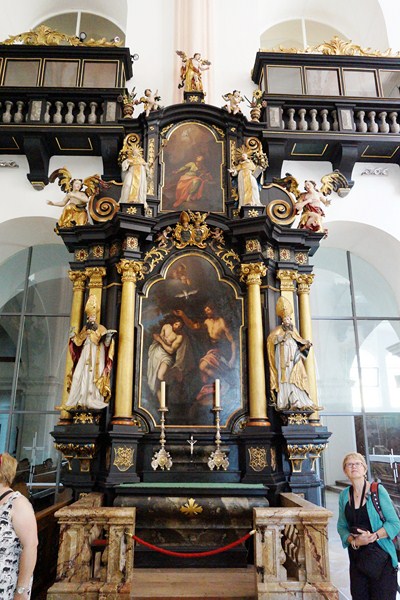
Side Altar (4)

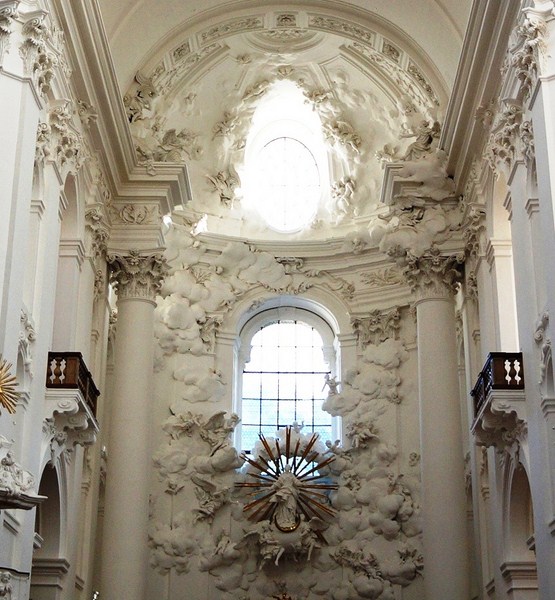
Around the tabernacle are figures, surmounted by throned allegorical figures representing Faith, depict the various aspects of the human spirit. Above the angels is a stucco aureole of clouds, rays and putti (cherubs) encircling the floating Immaculate Virgin. This design, by Fischer von Erlach, was executed by Diego Francesco Carlone and Paolo d`Allio.

Side Altar (5)

Side Altar (6)

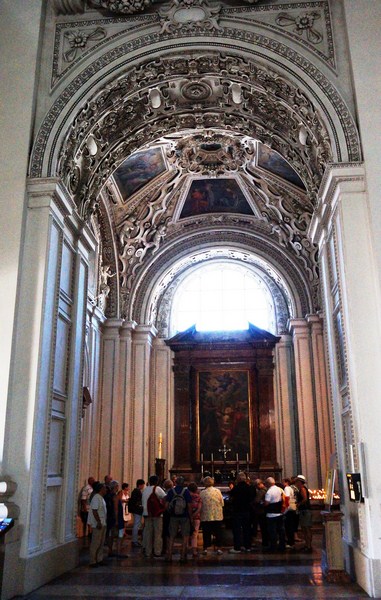
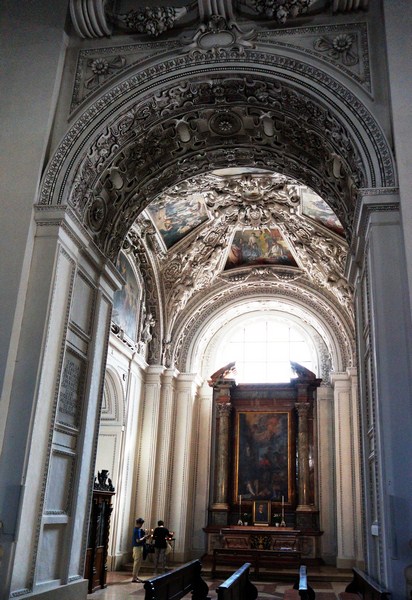
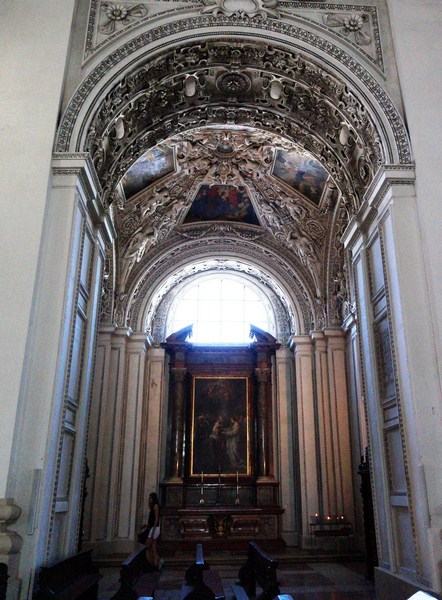
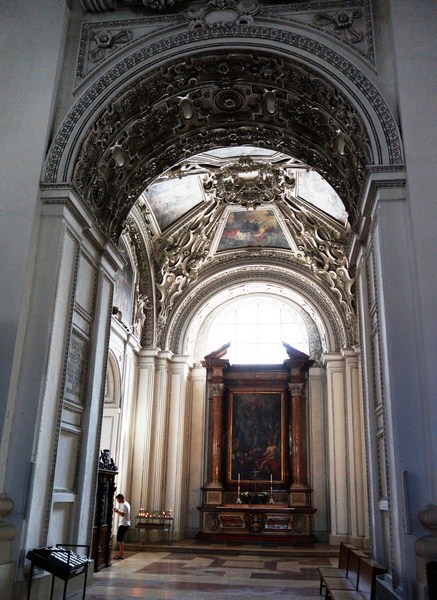
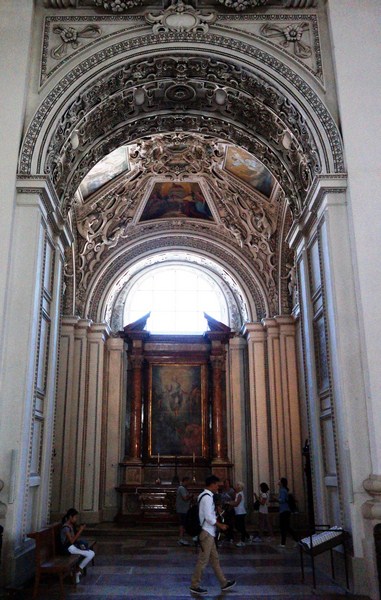
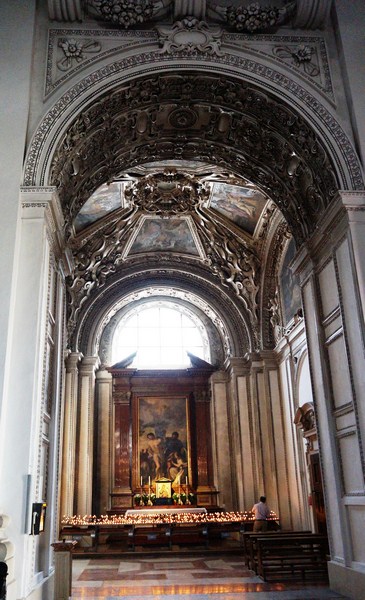
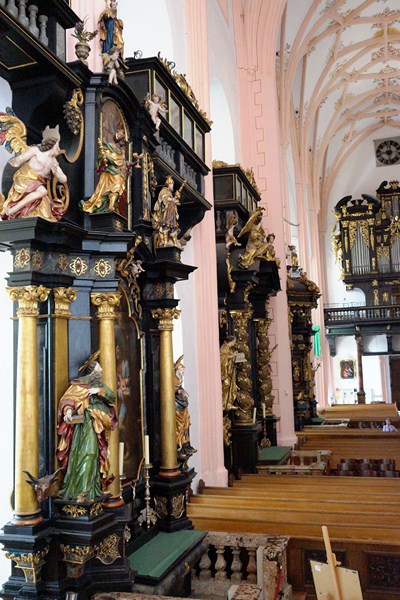
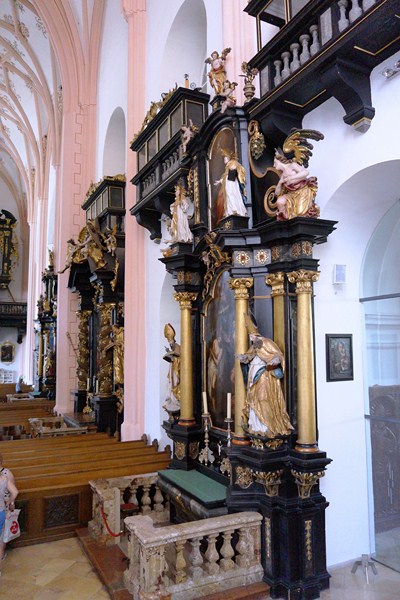
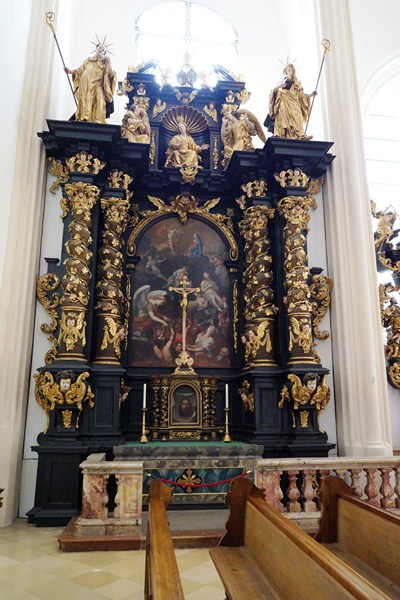
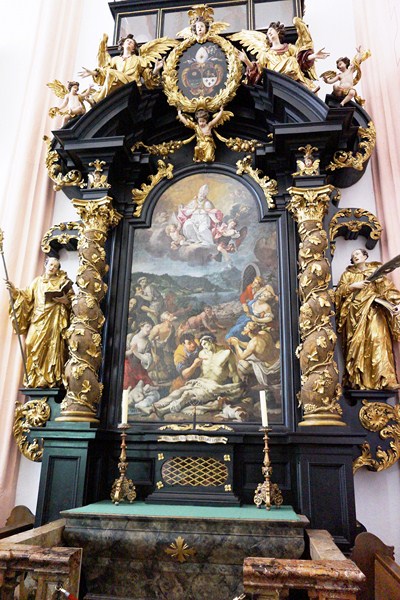
The elaborate side nave altars bear remarkably intense colors. The altar paintings on the left hand side were made by Johann Michael Rottmayr in 1721 and depict St. Barromäus. The painting is flanked by St. Rupert and St. Vergillius.  The altar paintings on the right hand side, painted by Rottmayr in 1722, depicts St. Benedict baptizing a pagan chief.  It is flanked by St. Erentrude and St. Scholastika. The Stations of the Cross, depicting the passion of Jesus Christ, adorn the spandrels.

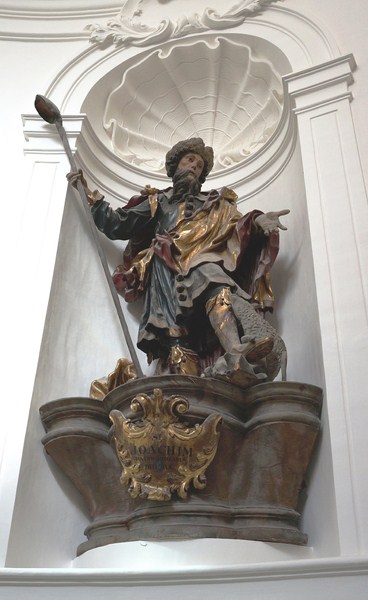
Statue of St. Joachim

Statue of St. Joachim

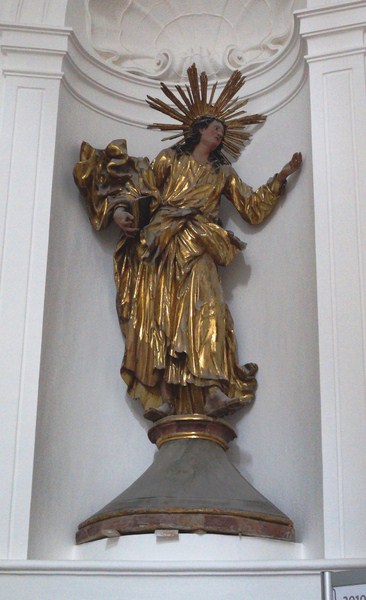
Statue of St. John

Statue of St. John

The statues in the side chapels refer to the “Fakultäten,” the schools of the university: St. Thomas Aquinas (school of theology), St. Luke (school of medicine), St. Ivo (school of law) and St. Catherine (school of philosophy). The sparse use of sculptures and stucco works aims to highlight the architecture.

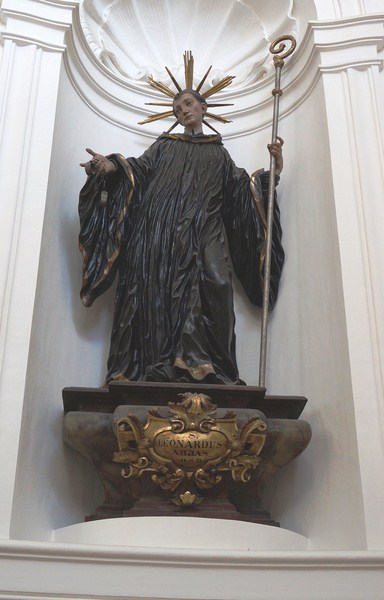
Statue of St. Leonard

Statue of St. Leonard

Kollegienkirche: Universitätsplatz (University Square), 5020 Salzburg, Austria. Tel:+43 662 841327.  Open daily, 9 AM – 6 PM.
Residenz Palace (Salzburg, Austria)

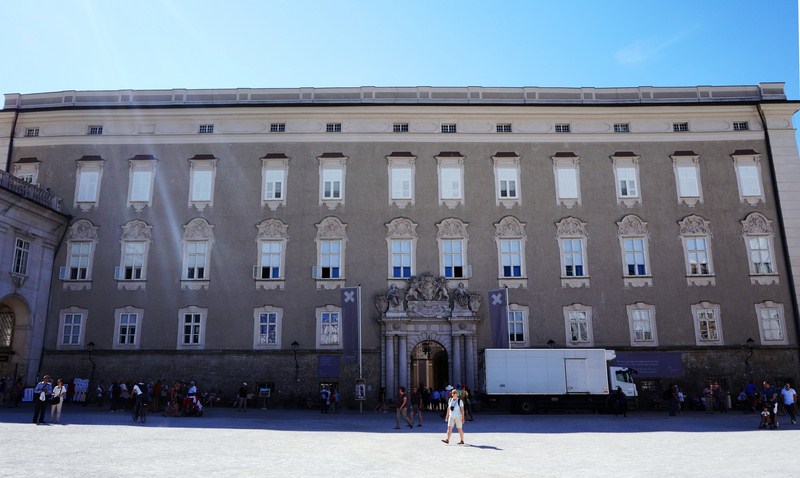
Residenz Palace

Salzburg Residenz, a Baroque  palace located at Domplatz and Residenzplatz in the old part of the city has, throughout the centuries, been the residence of the Archbishops of Salzburg (who used the palace to present and represent their political status) as well as a place of public gatherings and state affairs, all taking place in a setting that reflected power and grandeur.
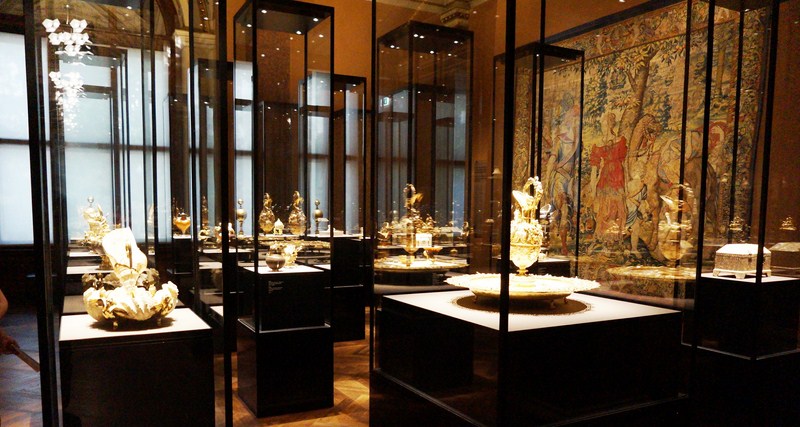
Along with Salzburg Cathedral and St. Peter’s Abbey, the Salzburg Residenz is one of the three buildings which provide the backdrop for the Dom Quartier (opened in 2014). The Residenz Palace is also, alongside with the Hohensalzburg Fortress and the Salzburger Dom, probably the most important historic building of Salzburg.
Check out “Salzburg Cathedral,” “Hohensalzburg Fortress“ and “St. Peter’s Cemetery

Today, the Salzburg Residenz, one of the most impressive attractions in the city, houses the Residenzgalerie (visited separately from the palace), a museum intended to replace the art collection of the prince-archbishops, which had been lost during the Napoleonic wars in the early nineteenth century.  Intended to support a planned academy of art, as well as promote tourism, it houses paintings from the sixteenth to the eighteenth century, and Austrian paintings from the nineteenth century.

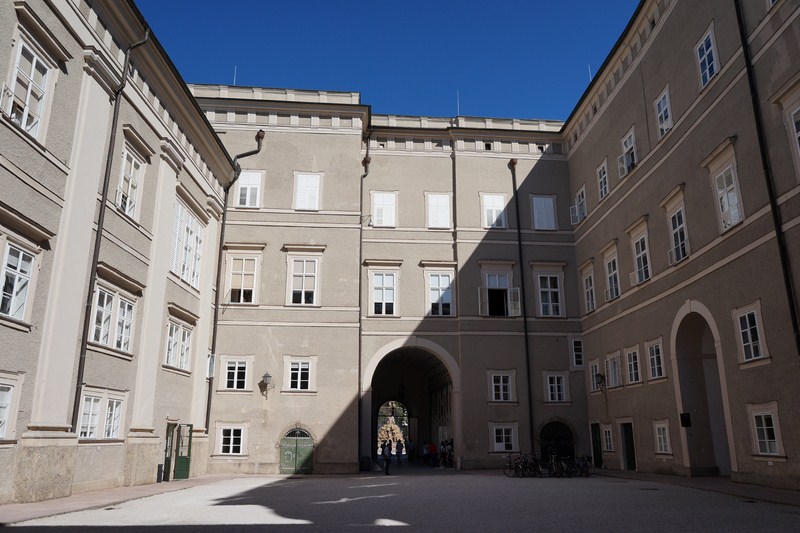
The so-called Tuscany Wing (Toskanatrakt), in the north, is used by the School of Law and the law faculty of Paris Lodron University of Salzburg.    The palace is also used during the Salzburg Festival, for state receptions, conferences and international congresses can also be rented for private occasions.  The Knights’ Hall, with its excellent acoustics, is ideal for concerts and other events.

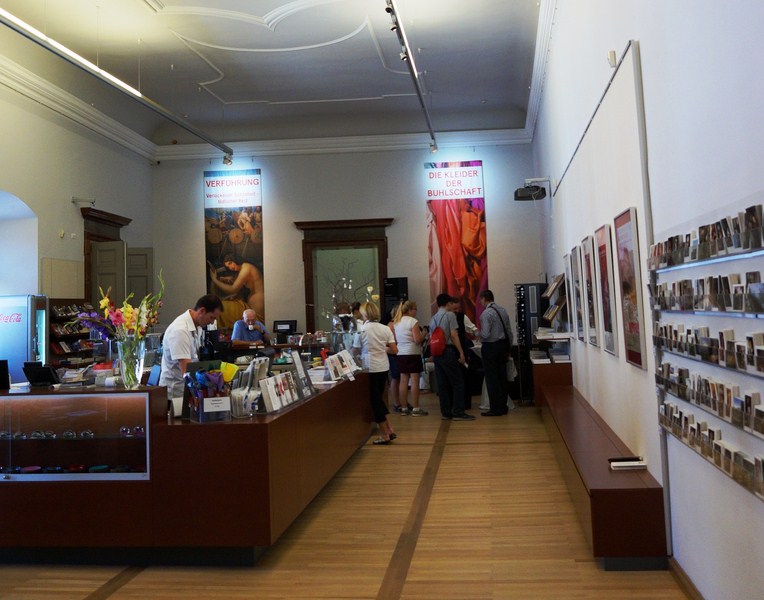
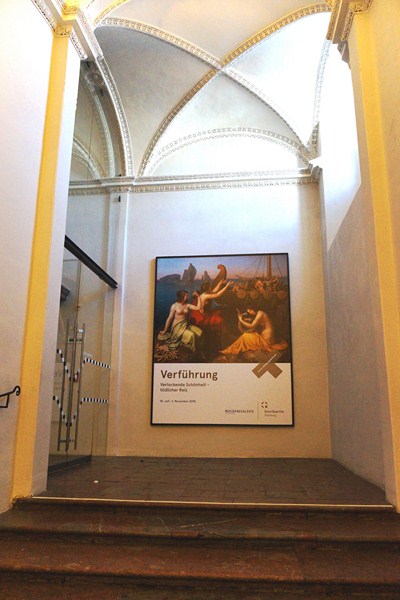
We were able to visit the palace using our Salzburg Card but photography wasn’t allowed inside. During our visit, the exhibit “Seduction: Tempting Beauty, Deadly Charm” (July 10 – November 1, 2015) was ongoing.

Here is the historical timeline of the palace:

  • The earliest recorded reference to the bishop’s palace was in a document dated 1232. Construction began under Archbishop Conrad I.
  • In the sixteenth century, several changes and additions to the structure were made.
  • Under the auspices of Wolf Dietrich von Raitenau (1587–1612), the bishop’s palace took on its present appearance.
  • In 1606, the Hofbogengebäude and Wallistraktwere finished.
  • In the early seventeenth century, work began on the south wing, which included the addition of the large staircase and the Carabinieri-Saal, a section that connected the palace to the Franziskanerkirche and a large courtyard.
  • To allow the Residenz Palace to blend in visually with the Salzburger Dom, Prince Archbishop Guidobald Reichsgraf von Thun (1654 to 1668) added a floor to the main building.
  • In 1660, the Carabinieri-Saal was enlarged
  • In 1689, the elaborate stucco work and the three paintings on the ceiling of the  Carabinieri-Saal were  finished
  • In 1690, the additional floor at the Wallistrakt was completed.
  • Around 1710, the façade was renewed under Prince Archbishop Franz Anton von Harrach according to a design by Johann Lucas von Hildebrandt.
  • In 1714, the ceiling paintings at the Rittersaal were completed.
  • During the 19th century, the Residenz Palace was temporarily used as a private palace by some members of the Austrian royal family as well as the line of Habsburg-Toskana.
  • Through to the end of the eighteenth century, the successors of Wolf Dietrich continued to expand and refine the palace.
  • On May 1, 1816, Emperor Francis I accepted homage and the oath of allegiance from the civic leaders of Salzburg at the Knights’ Hall, marking the beginning of Salzburg as a part of Austria.
  • In 1867, Emperor Franz Joseph I received Emperor Napoleon III at the Residenz.
  • In 1919, a plan to assemble an art gallery was proposed by the Residenzmuseum.
  • In 1922, planning for the Residenzgalerie was completed by Eduard Hütte, the official curator of Salzburg.
  • In 1923, the Residenzgalerie was opened

Ticket counter

During our visit, we first stepped into the  Carabinieri-Saal, the sala grande of the Salzburg Residenz.  The Carabinieri-Saal, used as a common room for the Prince Archbishop′s bodyguards, but also for theatre and banquettes or balls, and Rittersaal Halls, also called Prunkräume or “glorious rooms” (State Apartments), are the two most important halls for representative purposes in the Residenz Palace.

The elaborate stucco work of the Carabinieri-Saal was made by Francesco and Karlo Antonio Brenno and Antonio Carabelli. The three paintings on the ceiling, painted by Johann Michael Rottmayr depict representations of the four elements – Neptune rules over the wind (water and air), the Calydonian hunt for boars (earth) and the workshop of Vulcanus (fire). The smaller artworks in the corners represent the four gods of wind. The four gates, made of marble, date back to around 1610.

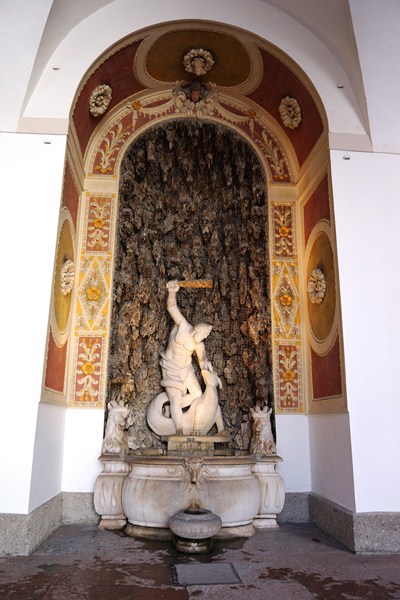
Illuminated fountain at Residenzgalerie yard

The Rittersaal, bordering the Carabinieri-Saal, has ceiling paintings, done by Johann Michael Rottmayr, depicting scenes from the life of Alexander the Great, mainly his taming of the horse Bucephalus.  Over the mantelpieces are plastic allegories and armor trophies. A gate towards the east, dating back to 1770, connects the Residenz Palace with the Salzburger Dom.

The Wallistrakt, a wing of the prince archiepiscopal Salzburg Residenz, is a composition of various architectural components built during different construction stages. The only original wing contains a two-storey hall with a central pillar in Tuscany style that was taken from the old cathedral.

Due to several re-constructions and changes of proprietors, the apartment here hasn’t been dealt with as a part of the prince archiepiscopal residence.  It connects the Residenz Palace with a pillar hall over the Franziskanergasse alley.

On the northern side of the Wallistrakt are two Roman mosaics from the 3rd century, found during the 1964 to 1965 renovation work, added to the arcades.

The so-called Hofbogengebäude was originally a place of accommodation for the apartment of prince archbishop Wolf Dietrich of Raitenau.

There was enough space in the medieval Frohnhof (the forecourt of the cathedral) to quickly build a new living unit for the prince archbishop without disturbing the procedures of the residence or having to redeem civic houses. After the Hofbogengebäude was completed, the medieval Residence was open to further renovation and modernization.

To the north, the Hofbogengebäude was connected directly to the Carabinieri-Saal hall. From there, the second floor apartment extended southwards to the prince archbishop’s private chambers in the very south of the building. From there, a richly stuccoed staircase led to a garden hall which opened towards the Hofgärtl, a giardino segreto (secret garden) located in the west surrounded by a high garden wall.

Jandy, Cheska, Kyle and Grace making their way down a stairway

The buildings of the Toskanatrakt wing, ordered erected by Prince Archbishop Hieronymus von Colloredo (1772–1803), replaced former wings from the time of Prince Archbishop Wolf Dietrich von Raitenau (Colloredo planned to rebuild the western wings in Neo-Classic style, but only the Toskanatrakt wing was altered).

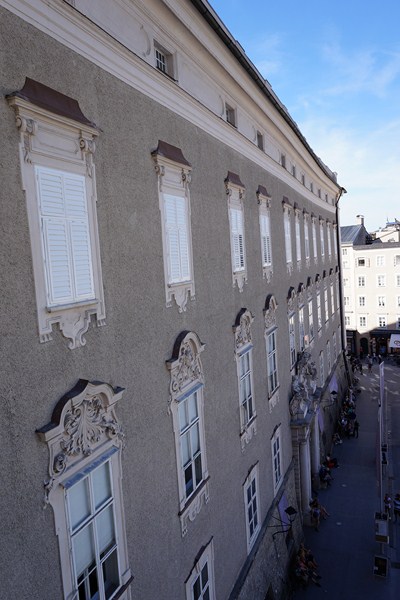
Its façade bears decorations around the windows that date back to the late 18th century. The northern wing consists of arcades, built in the early 17th century, with ionic pillars that span two floors. The southeast corner, dating back to the first building period of the Residenz Palace, contains a staircase and stucco work from around 1600.

The first floor Steinsaal hall contains elaborate stucco decorations from the 18th and 19th century while the second floor Toskana Appartement (Tuscany apartment) contains a ceiling and walls with stucco work from 1862.

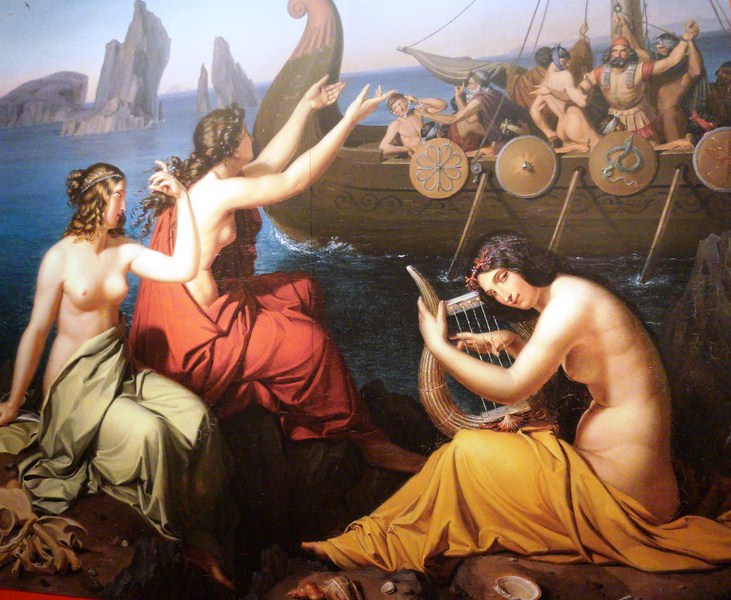
Odysseus and the Sirens (Ferdinand Alexander Bruckmann, 1829)

Salzburg Residenz: Residenzstraße 1, München, Salzburg, Austria. Tel: +49 89 290671. Open 10 AM – 5 PM.

Salzburg Cathedral (Austria)

Image

Salzburg Cathedral

This cathedral, of the Roman Catholic Archdiocese of Salzburg, is dedicated to Saint Rupert and Saint Vergilius. It was founded by St. Rupert on the remnants of a Roman town. The first cathedral was built under Saint Vergilius of Salzburg, who might have used foundations by St. Rupert.

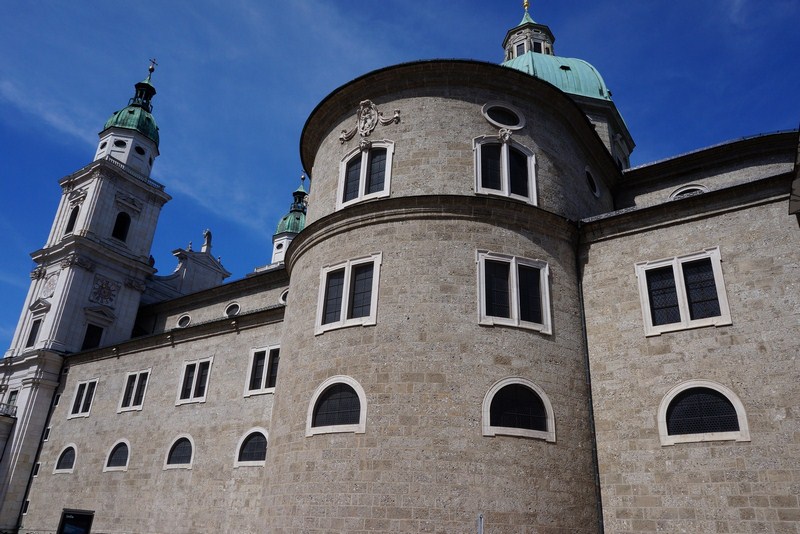
The present seventeenth-century  Baroque cathedral was built in the seventeenth century under Prince-Bishop Wolf Dietrich Raitenau  (also responsible for the building of the nearby Alten Residenz, which is today connected to the cathedral), a patron and supporter of modern Italian Baroque architecture, having seen it from its origins in Italy and particularly Rome.

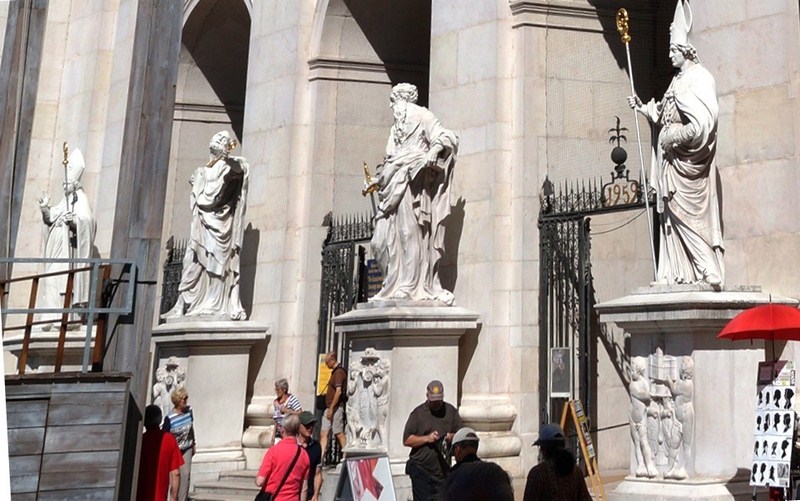
Statues of diocesean and cathedral patrons. The coats-of-arms of Prince Archbishop Guidobald von Thun and Prince Archbishop Johann Ernst von Thun are at the bases.

Here’s a historical timeline of the cathedral’s construction:

  • In 774, the first Dom was recorded.
  • From 767 to 774, the so-called 66 m. long and 33 m. wide Virgil Dom was built
  • Archbishop Arno (785 – 821) was the first to arrange renovations of the Dom, which was in place for less than 70 years.
  • In 842, the building burned down after being struck by lightning.
  • Three years later, the re-erection of the building started.
  • Between 1000 and 1080, under Archbishop Hartwig, a long choir with a crypt was built and an extension of the rebuilt cathedral was built towards the towards the west
  • From 1106 to 1147, under Archbishop Konrad I, the west towers were built
  • In 1167, the Virgil Dom was seriously damaged in a fire.
  • In 1181, the cathedral was rebuilt during the reign of Archbishop Konrad III
  • During the early Middle Ages, the original church experienced at least three extensive building and rebuilding campaigns, the final result of which was a somewhat ad hoc Romanesque basilica.
  • In 1598, the basilica was severely damaged in a fire
  • After several failed attempts at restoration and reconstruction, Prince-Bishop Wolf Dietrich Raitenau (Archbishop from 1587–1612) ordered that the building be finally demolished.
  • In 1614, Mark Sittich von Hohenems (Archbishop from 1612–19 and Wolf Dietrich’s successor),  laid the cornerstone of the new cathedral.
  • In 1628, remarkably in less than 15 years, the cathedral was completed. That same year, the Marienglocke and the Virgilglocke, the oldest bells in the cathedral, were both cast.
  • On September 24, 1628, the cathedral was consecrated by Prince Archbishop Paris Lodron.
  • In 1652 and 1655, the towers were finished.
  • Between 1766 and 1771, the Maria Immaculata (Immaculate Mary) column was executed by brothers Wolfgang and Johann-Baptist Hagenauer.
  • During World War II, the cathedral was damaged when a single bomb crashed through the central dome over the crossing.
  • From 1945 to 1959, the Salzburger Dom was rebuilt in its original shape and reopened by Archbishop Andreas Rohracher.
  • On September 24, 1961, 5 new bells were added.

Coats of arms of Markus Sittikus and Paris Londron at the tympanum

Here are some interesting trivia regarding the cathedral:

  • The present cathedral was built partially upon the foundations of the old basilica. Indeed, the foundation stones of the preceding church building may be seen in the Domgrabungen, an excavation site under the cathedral that also features mosaics and other artifacts found here when this location was the forum of the Roman city Juvavum.
  • Italian architect Vincenzo Scamozzi was hired by Wolf Dietrich to prepare a plan for a comprehensive new Baroque building but the present cathedral was designed by Santino Solari, who fundamentally changed the original Scamozzi plan.
  • At the cathedral’s consecration, 12 choirs positioned in the marble galleries of the cathedral sang a Te Deum composed by Stefano Bernardi,   the Kapellmeister to the Salzburg court. The score has since been lost.
  • One other surviving relic that predates the Baroque edifice is the 14th century Gothic baptismal font.
  • Salzburg Cathedral still contains the baptismal font in which composer Wolfgang Amadeus Mozart was baptized.
  • When the cathedral was completed, the relics of St. Rupert were transferred here.
  • The finished church is 466 ft. long and 109 ft. high at the crossing/dome.
  • The Baroque style can be seen in the choir and the nave.
  • The Salvatorglocke (“salvation bell”) of the cathedral, weighing 14,256 kgs., is the 2nd largest bell in Austria, after the Pummerin bell in Vienna Cathedral

Statues of the Four Evangelists

The cathedral is located adjacent to Residenzplatz and Domplatz (accessed by three open arcade arches in the north, south, and west) in the Altstadt (Old Town) area of Salzburg.
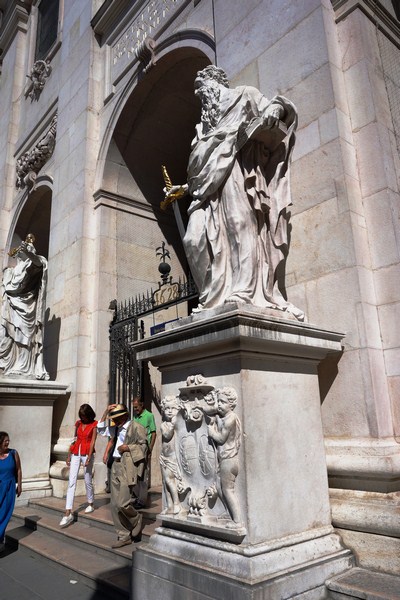
Statue of St. Paul

The “cathedral arches” unite the cathedral with the Salzburg Residenz and St. Peter’s Abbey , forming a unique self-contained square. It is 101 m. long, 69 m. wide and 81 m. high.

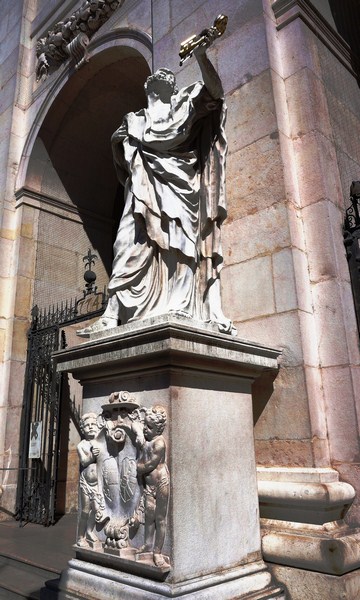
Statue of St. Peter

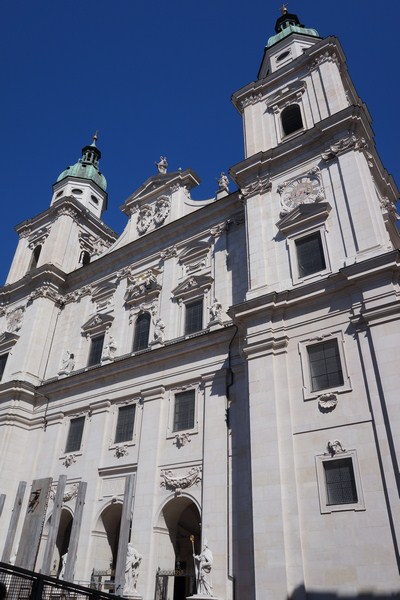
The richly decorated façade, made of bright Untersbergmarmor (Untersberg mountain marble) and divided into three horizontal sections, is framed by two towers and a curved gable.

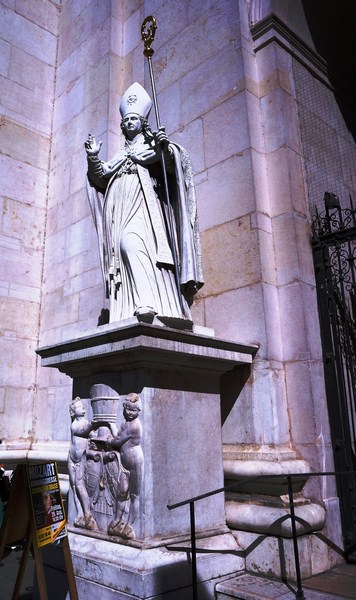
Statue of St. Rupert

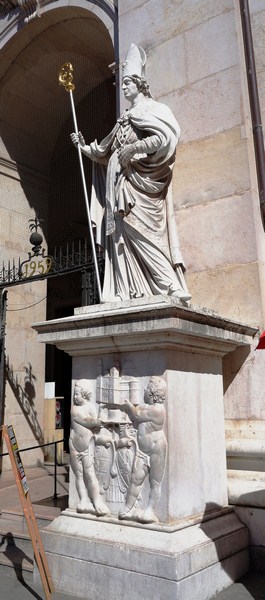
Three high round arches or portals, at the lower section, provide access to three bronze doors and are flanked by four large sculpted figures representing the diocesean and cathedral patrons.

Statue of St. Virgilius

The mitered figures of St. Rupert, holding a salt barrel, and St. Virgilius, holding a church, were created c. 1660 by Bartholomäus van Opstal. The inside figures of St. Peter, holding keys, and St. Paul, holding a sword, were sculpted c. 1697 by Bernhard Michael Mandl, who also created all the pedestals.

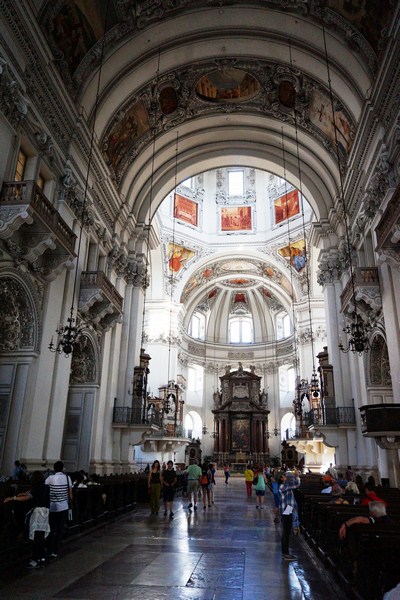
Interior of the cathedral

The coats-of-arms of Prince Archbishop Guidobald von Thun and Prince Archbishop Johann Ernst von Thun are at the bases. The mantelpieces, over the central windows, contain a lion and an ibex (the animals depicted in the coats-of-arms) and a golden crown that aligns with the Marien column in the Domplatz.

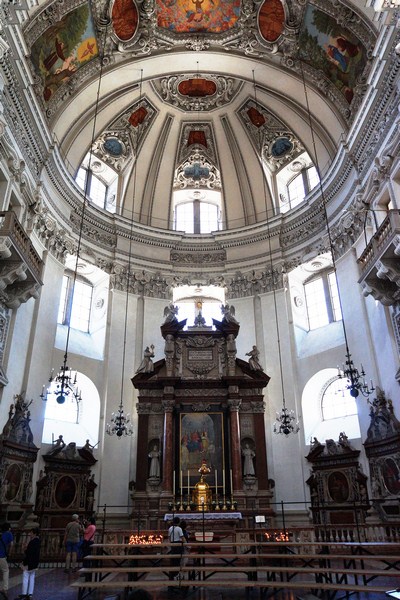
The main altar

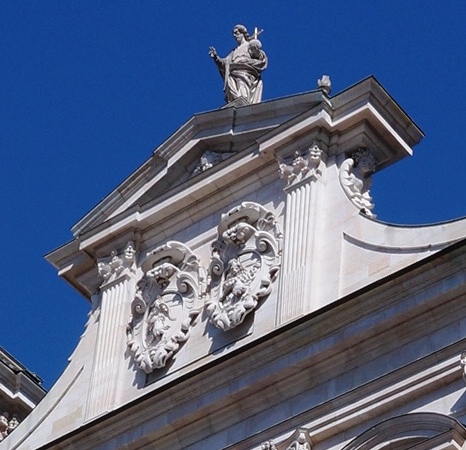
The statues of the Four Evangelists (Saint MatthewSaint MarkSaint Luke and Saint John), at the central section of the façade, represent the salvation offered through their preaching.  The coats-of-arms of the builders of the cathedral, Markus Sittikus and Paris Londron, are at the top section tympanum.

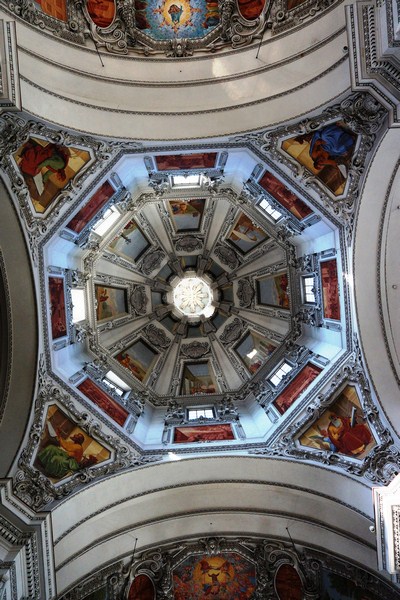
The cathedral dome with frescoes depicting scenes from the Old Testament around it.  Above it are the coats-of-arms of Prince Archbishop Paris Lodron and Archbishop Andreas Roracher. At the corners are paintings of the Four Evangelists.

The figure group on the pediment, representing the Transfiguration of Jesus on Mt. Tabor, shows Christ as Salvator Mundi, with Moses holding the tablets on the left and the prophet Elijah to the right. Tommaso di Garona, the mason who built the Residenz Fountain, created the three statues in 1660. An old oven, used for baking communion bread, is housed in the north tower.

The main nave with paintings showing scenes from the life (10 smaller ones) and passion (15 large ones) of Christ, done by Donato Mascagni and Ignazio Solari.

The three bronze gates inside the portals, representing the 3 divine virtues (Göttliche Tugenden) of faith, hope and love, were erected in 1957 and 1958.  The Gate of Faith (Tor des Glaubens ), on the left, was created by Toni Schneider-Manzell (1911-1996); the Gate of Love (Tor der Liebe), at the center, was created by Giacomo Manzù (1908-1991); and the  Gate of Hope (Tor der Hoffnung), on the right, was created by Ewald Mataré (1887-1965). The flanking towers, also divided into three horizontal units, bear clocks and the bells.

Paintings on the main nave, showing scenes from the life (10 smaller ones) and passion (15 large ones) of Christ, were done by Donato Mascagni and Ignazio Solari. The stucco works were done in white (and crested by black stucco)  by Guiseppe Bassarino around 1628.  Four chapels, on each side along the main nave, each have a side altar and palatine frescos.

The 71 m. high dome, with two rows of eight frescos each, displays scenes from the Old Testament that relate to the life and passion scenes from the nave. They were also painted by by Donato Mascagni and Ignazio Solari.

On top of these paintings are paintings of the Four Evangelists (Mark, Luke, Matthew and John) and, beyond that, the coats-of-arms of Prince Archbishop Paris Lodron and Archbishop Andreas Roracher.

On the left and right side of the nave are motives of St. Francis and Virgin Mary respectively. To the left and right of the St. Francis Altar are epitaphs of Prince Archbishops Leopold Anton von Firmian (died in 1744), Guidobald von Thun (died in 1668), Max Gandolf von Kuenburg (died in 1687) and Jakob E. von Liechtenstein (died in 1747).

Around the Virgin Mary Altar are epitaphs of Prince Archbishops Andreas J. Dietrichstein (died in 1753), Johann E. Thun (died in 1709), Franz A. Harrach (died in 1727) and Siegismund Schrattenbach (died in 1772).

The main altar, probably built by Santio Solari in 1628, has a painting depicting the Resurrection of Christ and made by Donato Mascagni.

Above the painting are statues of St. Rupert and St. Virgil as well as allegories of Religio and Caritas. Between the figures is an inscriptions that reads: Notas mihi fecisi vias vitae (“You showed me the way of life”).

On top of the altar there are statues of angels holding golden crucifixes.  The right and left hand side of the main altar has epitaphs of Prince Archbishops Markus Sittikus (died in 1619) and Paris Lodron (died in 1653) respectively.

The main altar backdrop with a painting depicting the Resurrection of Christ made by Donato Mascagni

On the right hand side of the main altar is the entrance to the crypt (the tombs of the Archbishops of Salzburg) based on the foundations of the Romanesque Virgil Cathedral.

The Zehneckraum (“Ten corner room”) contains the tombs of the Prince Archbishops from the 17th to the 18th century. In the round tower is a mosaic showing the scale of the former Salzburger Dom in comparison to today′s cathedral.

The new organ built in 1988

The organ that is in use for services today was built in 1988.  The old organ is essentially the same as the one built by the famous organ builder Josef Christoph Egedacher in 1703.

The old organ built in 1703 by Josef Cristoph Egedacher

Salzburg Cathedral: Domplatz 1a, 5020 Salzburg, Austria. Tel: +43 662 80477950. Open 8AM-5PM. From June to September, there is a one-hour organ recital every Wednesday and Saturday at 11.15.
Minor Basilica of St. Michael the Archangel (Mondsee, Austria)

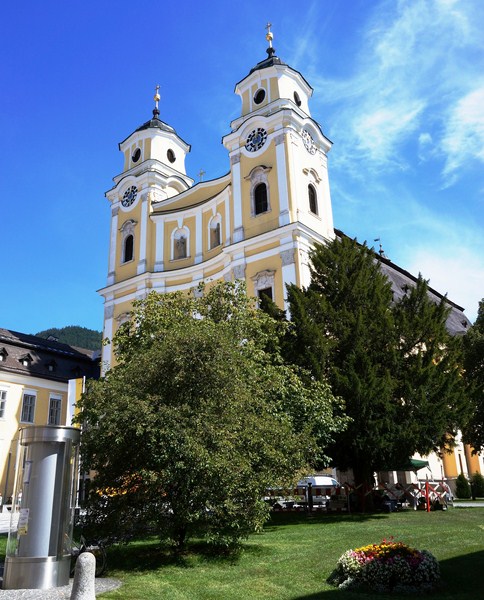
Minor Basilica of St. Michael the Archangel

Minor Basilica of St. Michael the Archangel

The last leg of our “Original Sound of Music Tour,” via Panorama Tours, brought us to Mondsee, a quaint and colorful town of lush countryside, shops and restaurants, where we made our final stopover at the Minor Basilica of St. Michael the Archangel situated right smack in the middle of the town center.  We were given an hour to explore the area.

67

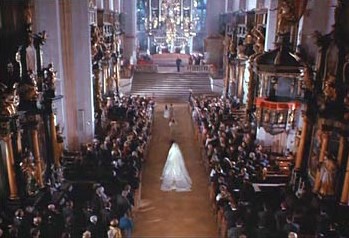
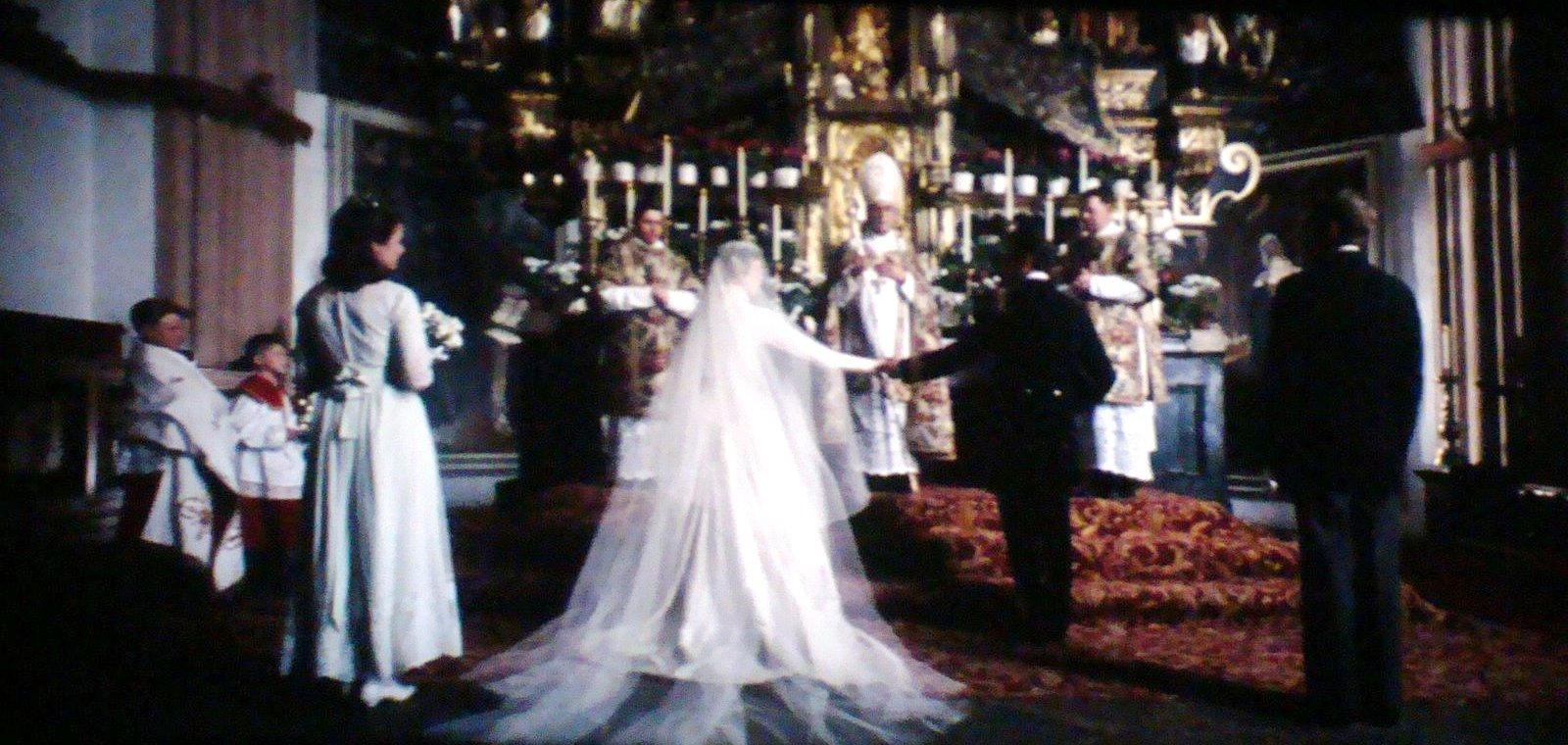
Maria (Julie Andrews) von Trapp walking down the aisle of St. Michael’s Basilica in the film “Sound of Music.”

tumblr_md0ffbNB3Z1rpe459o1_500

Another movie scene of Maria walking down the aisle. Behind is the Wolfgang Altar

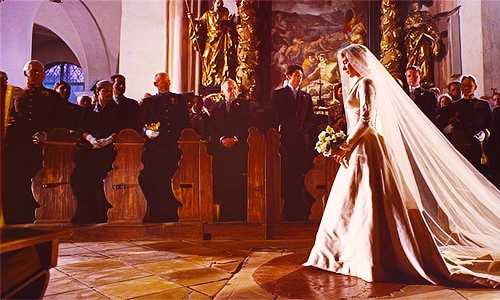
Do you remember Maria (Julie Andrews) and Captain Georg (Christopher Plummer) von Trapp’s wonderfully famous wedding scene at the “Sound of Music?” This is where the wedding in the film took place (though, in real life, they got married at Nonnberg Abbey where Maria was a postulant). The exterior of the church was never shown in the movie, as it was then under renovation.

Maria and Captain von Trapp at the high altar

Maria and Captain Georg von Trapp (Christopher Plummer) at the high altar

The bright and welcoming yellow and white, Late Gothic-style and three-aisled St. Michael’s Basilica, located next door to the monastery building (founded by Bavarian Duke Odilo II in 748, it has been restored and turned into a classy hotel) and courtyards, is the cultural and spiritual heart of the Mondsee region.

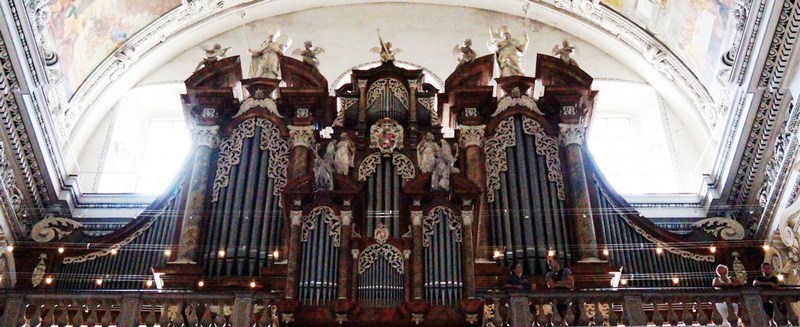
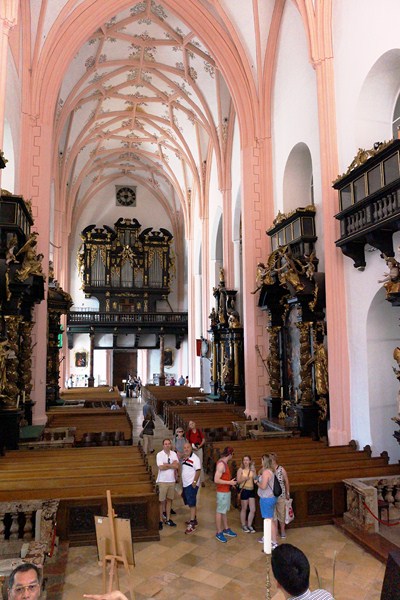
View of pipe organ from high altar

View of pipe organ from high altar

The second biggest church in Upper Austria, it is also one of the most prominent and largest monuments in Austria. This former Benedictine abbey church, officially as Pfarrkirche St Michael, was constructed under the direction of Abbot Benedikt Eck and consecrated in 1487.

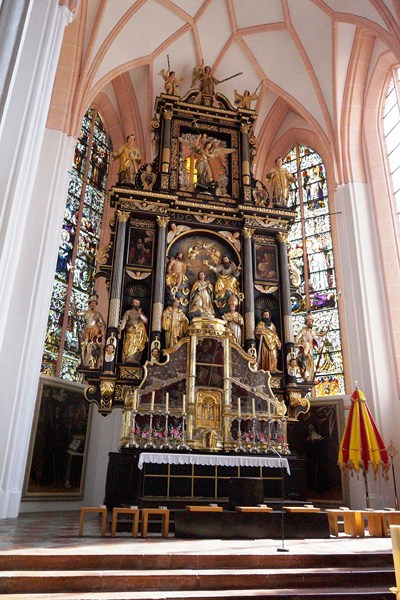
High Altar designed by Salzburg sculptor Hans Waldburger

High Altar designed by Salzburg sculptor Hans Waldburger

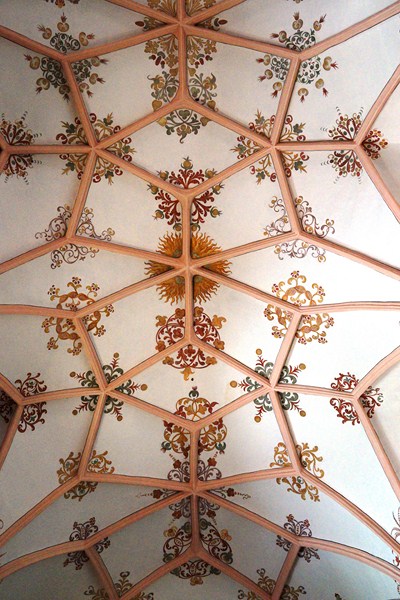
The pink and white ceiling with snowflake-like designs

The pink and white ceiling with snowflake-like designs

In 2005, Pope John Paul II upgraded the church to a minor basilica and, that same year, a huge restoration and renovation of the interior began that included every part of the basilica. During one of the many restorations, the framing on the Gothic vaults have been discovered to have been painted in the original light pink color. It took 3 years to complete and, in 2009, the church was reopened and was conferred  the title “Austria’s Monument of the Year.”

Side Altar (1)

Side Altar (2)

The basilica has two 52-m. high towers and statues of Saints Peter and Paul on the façade. For architecture buffs like me, it is unassuming on the outside but beautiful inside. We entered the basilica through a small lovely gift shop which helps in the upkeep of the basilica. The beautiful Baroque interior, dating back to the 17th century, features Baroque-style altars collaboratively created by Matthais Wichlhammer and the famous Swiss Baroque sculptor Meinrad Guggenbichler, outstanding pieces of work, with lots of black and gold, that are really stunning and nothing short of extravagant.

Poor Souls Altar

Poor Souls Altar

The light and airy interior, exactly the same as it was when the movie was filmed, was even more impressive when we looked at the ornate details up close. The ceiling, with soft almost pink snowflake-like designs on a clean white background, was also beautiful.

Wolfgang Altar

Wolfgang Altar

Seven of these altars were carved by Meinrad Guggenbichler who, from 1680, dedicated much of his life to beautifying the monastery.  Its 18 m. high early Baroque high altar. with the relics of Abbot Konrad II, dates from 1626 and was designed by Salzburg sculptor Hans Waldburger.

Altar Josef

Altar Josef

More altars were then built in the monastery church.  These included the Holy Spirit Altar, the Wolfgang Altar, the Corpus Christi Altar, the Poor Souls Altar, the Sebastian Altar and the St. Peter Altar. Later, other altars were added, this time by Franz Anton Koch. These were the John Altar, the Altar Josef, the Anna or Virgin Altar and Antonius Altar. The altar cross was put together by a Mondsee  sculptor.

Antonius Altar

Antonius Altar

Once up the high altar, we could see the equally beautiful and impressive pipe organ at the opposite end of the basilica. There are also additional artifacts to be viewed at the museum attached to the basilica. The gilded statues and paintings made me wonder where they got the resources for such extravagance.

Altar of Annunciation (1680) by Meinrad Guggenbichler

Altar of Annunciation (1680) by Meinrad Guggenbichler

I am not used to seeing such splendor. One of the most photographed churches all over the world, this cinematically famous basilica is visited by more than 200.000 people each year. Even if you are not a “Sound of Music” movie fan, the elegant and classy St Michael’s Basilica is still worth spending time walking through. 

John Altar

John Altar

Minor Basilica of St. Michael the Archangel: Kirchgasse 1, Mondsee 5310, Austria. Tel: +43 6232 4166. Open daily, 9 AM – 7 PM. Although entrance to the basilica is free, there is a small admission fee for the museum.

The museum

The museum

Gift Shop

Gift Shop

How to Get There: Bus140 from Salzburg runs every 30 minutes and takes approximately 50 minutes (25 kms.) to reach Mondsee.

Mirabell Palace and Gardens (Salzburg, Austria)

The Grand Parterre of Mirabell Gardens

The Grand Parterre of Mirabell Gardens

After checking in and freshening up at Hotel Garni Evido Salzburg City Center, we all met up at the lobby to begin our exploration of the city, starting with the nearby Mirabell Palace and Gardens, a listed cultural heritage monument and part of the Historic Centre of the City of Salzburg UNESCO World Heritage Site. One of the most beautiful Baroque gardens in Europe, it was built along a north-south axis and oriented towards the Hohensalzburg Fortress and the Salzburger Dom cathedral.

View, from Rose Hill, of the Small Parterre, Salzburger Dom and Hohensalzburg Fortress

View, from Rose Hill, of the Small Parterre, Salzburger Dom and Hohensalzburg Fortress

The palace, outside the medieval walls of Salzburg, was built about 1606 according to Italian and French models, at the behest of Prince-Archbishop Wolf Dietrich  von Raitenau as a residence for his mistress Salome Alt. From their union, 15 children were born, 10 of whom survived. When von Raitenau was deposed and arrested in 1612, Salome and her family were expelled. After Wolf Dietrich’s death, the palace was renamed “Mirabell” (from the Italian word mirabilebella meaning “amazing” or “wonderful”) by his successor, Markus Sittich von Hohenems.

Mirabell Palace

Mirabell Palace

Prince-Archbishop Franz Anton von Harrach had Mirabell Palace redesigned, according to plans designed by the famous architect Johann Lukas von Hildebrandt, in a lavish Baroque style from 1721 to 1727, integrating the individual buildings into a self-contained complex. On June 1, 1815 the later King Otto of Greece was born here, while his father, the Wittelsbach crown prince Ludwig I of Bavaria served as stadtholder in the former Electorate of Salzburg.

Rosenhugel (Rose Hill)

Rosenhugel (Rose Hill)

On April 30, 1818, the palace was damaged by the great fire that swept through the city.  A number of frescoes, including those by Johann Michael Rottmayr and Gaetano Fanti, were destroyed by the flames but the masterly grand marble staircase that led into the palace and the marble hall, one of the most precious works of art at Mirabell Palace, survived unscathed.

DSC04320

From about 1818, Mirabell Palace owes its present unassuming Neoclassical appearance to Peter de Nobile, the court’s architectural consultant and director of the Vienna School of Architecture. The edging of the windows, the capitals and stucco work are details that bear witness to the palace’s former splendor. Charming putti (cherubs) decorate the marble balustrade and the sculptures in the niches, all among the finest products of the European Baroque, are the work of the famous Georg Raphael Donner.

The Rape of Persephone

The Rape of Persephone

Aeneas and Anchises

Aeneas and Anchises

On June 3, 1944 Gretl Braun, the sister of Eva Braun (later to marry Adolf Hitler), married SS-Gruppenführer Hermann Fegelein, Reichsführer-SS Heinrich Himmler‘s liaison officer on Hitler’s staff, at the Mirabell Palace, with Hitler, Himmler and Martin Bormann as witnesses. Eva made all the wedding arrangements.

Rape of Helen by Paris

Rape of Helen by Paris

Today, Mirabell Palace houses the offices of Salzburg’s mayor and the municipal council (its rooms are not open to the public). The Marble Hall, considered to be one of the most beautiful wedding halls in the world, was formerly the prince-archbishops’ ballroom and a concert venue for Leopold Mozart and his children Wolfgang Amadeus Mozart and Maria Anna “Nannerl” Mozart.  Meetings, awards ceremonies and romantic concerts (Salzburg Palace Concerts) are regularly held here. Mirabell Palace is also a popular location for weddings.

The author at the Grand Panterre

The author at the Grand Panterre

Grace at the Grand Parterre Fountain

Grace at the Grand Parterre Fountain

The famous, geometrically-arranged Mirabell Gardens was redesigned, under Prince-Archbishop Johann Ernst Graf von Thun, in 1689 based on plans by Johann Bernhard Fischer von Erlach, and completely remodeled around 1730 by Franz Anton Danreiter. Noted for its boxwood layouts, it has mythology-themed statues dating from 1730.

Grace and Jandy

Grace and Jandy

The “Grand Parterre,” the oldest part of the Mirabell Gardens that is still preserved, is embraced by a marble railing decorated with vases by Fischer von Erlach.

Vase by Fischer von Erlach

Vase by Fischer von Erlach

In the heart of the garden is a large fountain, with four statue groups sculpted by Italian sculptor Ottavio Mosto from 1690 around it – “The Rape of Prosperina,” “The Rape of Helena by Paris,” “Aeneas and Anchises,” and “Hercules and Antaeus,”  symbolizing the 4 elements (fire, air, earth and water).

Statues of Roman gods and godesses

Statues of Roman gods and goddesses

On the balustrades are statues of Roman gods and goddesses (Ceres, Pomona. Venus, Vesta, Juno and Chronos, Bacchus, Jupiter, Mars, Hercules, Vulcan, Hermes and Apollo) made by B. van Opstal in 1689.

DSC04349

The Heckentheater (Hedge Theater), a hedge maze located in the main part of the Mirabell Gardens, was created between 1704 and 1718 and is one of the oldest hedge theaters north of the Alps.  The Heckentheater is still used for performances in the summer, including concerts of the Salzburg Festival.

The Von Trapp children at the Hedge Theater

The Von Trapp children at the Hedge Theater

The Zwergerlgarten (Dwarf Garden) features a number of misshapen creatures, made of white Untersberg marble, dating back to the time of Archbishop Franz Anton Harrach.  In 1854, the gardens were opened to the public by Emperor Franz Joseph I.

Kyle and Cheska at the Small Panterre

Kyle and Cheska at the Small Panterre

The “Small Parterre,” the part of the Mirabell Gardens just along the backside of the Mirabell Palace, is directly attached to the Grand Parterre.  At its core is the Pegasus Fountain with a copper statue of Pegasus made in 1661 by Kaspar Gras from Innsbruck for the well on the Kapitelplatz near the Salzburger Dom cathedral.
Pegasus Fountain

Pegasus Fountain

There it stayed until 1690. After that time, it was used for the well on the Mirabellplatz Square until the great fire of 1818, and finally transferred to its current location in 1913. From Rosenhügel ( “Rose Hill”), we had a beautiful view all over the Small Parterre towards Salzburger Dom and Hohensalzburg Fortress.
Maria and the Von Trapp children at the Small Panterre

Maria and the Von Trapp children at the Small Panterre

Several scenes from the 1965 movie The Sound of Music were recorded here. Maria (Julie Andrews) and the von Trapp children (Charmian Carr as Liesl, Nicholas Hammond as Friedrich,  Heather Menzies as Louisa,  Duane Chase as Kurt,  Angela Cartwright as Brigitta,  Debbie Turner as Marta and Kym Karath as Gretl) sing ‘Do-Re-Mi‘ while dancing around the Pegasus Fountain and using the steps as a musical scale.

Fraulein Maria and the children at the Grand Parterre Fountain

Fraulein Maria and the children at the Grand Parterre Fountain

f307ed68-7d65-49cc-82f0-f58e7f54023f_l

Mirabell Palace and Gardens: Mirabellplatz 4, 5020 Salzburg, Austria. Tel: +43 662 80720. Open Mondays, Wednesdays and Thurdays, 8 AM – 4 PM; Tuesdays and Fridays, 1 – 4 PM.   No visit in case of special occasions.  The Mirabell Gardens are  open daily from approximately 6 AM to dusk.  Admission is free. The Hedge Theater and Dwarf Garden are closed during the winter.   The Orangerie is open all year round, 9 AM – 4 PM.

Basilica of the Sacred Heart of Paris (Paris, France)

Basilica of the Sacred Heart of Paris

Basilica of the Sacred Heart of Paris

From the Eiffel Tower, we again walked to the Champ de Mars Metro Station where we took the Metro to Anvers, the nearest Metro station to our next destination – the imposing Basilica of the Sacred Heart of Paris, known for its many artists that have been omnipresent since 1880.  From Anvers, we walked for 2 to 3 mins., up the Rue Steinkerque, to the hill at the foot of Sacre-Couer.

The Montmartre Funicular

The Montmartre Funicular

Upon arrival, we all rode the Montmartre Funicular (a.k.a. Funiculaire de Montmartr) which runs from Place Suzanne-Valadon to Place Willette below Sacre-Couer.  Other tourists climbed the staircase alongside the tracks.  It was cold, windy and overcast during our visit.

Statue of Jesus Christ at the facade

Statue of Jesus Christ at the facade

This minor basilica, in the 18th arrondissement, to the west of the Gare de Nord and north of the Opéra Garnier, is commonly known as Sacré-Cœur Basilica or simply Sacré-Cœur (FrenchBasilique du Sacré-Cœur). This popular and iconic landmark, located at the summit of the Butte Montmartre (said to be derived from either Mount of Martyrs or from Mount of Mars), the highest point in the city, is a double (political and cultural) monument.

Statue of Joan of Arc

Statue of Joan of Arc

Sacré-Cœur is both a national penance for the secular uprising of the Socialist Paris Commune of 1871 (Montmartre had been the site of the Commune’s first insurrection) and the subsequent defeat of France in the 1871 Franco-Prussian War and is publicly dedicated to the Sacred Heart of Jesus, an increasingly popular vision of a loving and sympathetic Christ.

Statue of King St. Louis IX

Statue of King St. Louis IX

Designed by Architect  Paul Abadie (who won  over 77 other architects in a competition), its foundation stone was laid on June 16, 1875.  Abadie died in 1884 and 5 architects continued with the work: Honoré Daumet (1884–1886), Jean-Charles Laisné (1886–1891), Henri-Pierre-Marie Rauline (1891–1904), Lucien Magne (1904–1916, who added an 83 m./272-ft. high clock tower), and Jean-Louis Hulot (1916–1924)

The cathedral's interior

The cathedral’s interior

It was not completed until 1914, when war intervened, and was formally consecrated on October 16, 1919, after the end of World War I when its national symbolism had shifted.  The structure’s overall style, showing a free interpretation of RomanByzantine features, is a conscious reaction against the Neo-Baroque excesses of the Palais Garnier, which was cited in the competition, and has many design elements that symbolize nationalist themes.

The basilica's dome

The basilica’s dome

Built with travertine quarried in Château-Landon (Seine-et-Marne), its stone, when it rains, reacts to the water and exudes calcite which acts like a bleacher, ensuring that the basilica remains white even with weathering and pollution. Its portico, with three arches, is adorned by two bronze equestrian statues of French national saints Joan of Arc (1927) and King Saint Louis IX, both done (by Hippolyte Lefebvre.  The 19 ton Savoyarde bell, one of the world’s heaviest, was cast in 1895 in Annecy.  It alludes to the annexation of Savoy in 1860.  The Savoyarde clock, at the clock tower, is one of the world’s largest.

Christ in Majesty

Christ in Majesty

A 480 sq. m. mosaic in the apse ceiling, entitled Christ in Majesty and created by Luc-Olivier Merson, is the largest in France and among the largest in the world. On display in a monstrance above the high altar is the Blessed Sacrament (a consecrated host which, according to Church teaching, has become by the consecration of the priest Christ’s Body and Blood during Mass), continually on display there since 1885.

The cathedral's high altar

The cathedral’s high altar

The basilica also has a large and very fine pipe organ, built by Aristide Cavaillé-Coll and installed in Paris in 1905 by Charles Mutin Cavaillé-Coll’s successor and son-in-law), is composed of 109 ranks and 78 speaking stops spread across four 61-note manuals and the 32-note pedalboard (unusual before the start of the 20th century; the standard of the day was 56 and 30), spread across three expressive divisions (also unusual for the time, even in large organs).  The organ was ahead of its time, containing multiple expressive divisions and giving the performer considerable advantages over other even larger instruments of the day.

The parvis

The parvis

The basilica complex includes a garden for meditation, with a fountain. From its parvis, we had one of those perfect Paris postcard views. The top of the dome (the second-highest point in Paris after the Eiffel Tower), open to tourists, affords a spectacular panoramic 360°view (up to 30 kms. on a clear day) of the city of Paris, which is mostly to the south of the basilica.

View of Paris from the parvis

View of Paris from the parvis

The entrance to the dome and the chapel-lined crypt is located on the left side of the basilica. Buy a ticket, then climb a steep 234-step spiral staircase to the base of the dome. The crypt can also be visited for an additional €2.

Cheska, Jandy and Grace

Cheska, Jandy and Grace

Sacre Couer de Montmartre Basilica: 35 Rue du Chevalier de la Barre, 75018 Paris, France. Tel: +33 1 53 41 89 00. Website: www.sacre-coeur-montmartre.com.  Open day, 6 AM to 10:30 PM. Admission is free. The dome is accessible from 9 AM to 7 PM in the summer and 6 PM in the winter. When visiting the basilica, tourists and others are asked to dress appropriately and to observe silence as much as possible, so as not to disturb persons who have come from around the world to pray in this place of pilgrimage. The use of cameras and video recorders is forbidden inside the Basilica. 

How to Get There: The basilica is accessible by buses 30, 31, 80, and 85 which can be taken to the bottom of the hill of the Basilica. Line 12 of the Metro can be taken to Jules Joffrin station and visitors can then change to the Montmartrobus and disembark at Place du Tertre. Line 2 or 12 of the Metro can be taken to Pigalle station where visitors can change to the Montmartrobus and disembark at Norvins, or to Anvers station which gives easy access to the steps or the funicular car that leads directly to the Basilica. The Montmartrobus operates on a circular route from Place Pigalle (near the Pigalle Métro stop) to the top of the Butte, where you can get off for the short walk to Sacré-Coeur. Or you can stay on the bus until it goes down and around the other side of the hill, then passes Sacré-Coeur on its way back to Pigalle.

Versailles Palace – Queen’s Grand Apartment (France)

Queen’s Grand Apartment

The Queen’s Grand Apartment (grand appartement de la reine), a suite of rooms, of exceptional splendor, in the Palace of Versailles that were reserved for the personal use of the queen, overlooks the  Parterre du Midi and formed a parallel enfilade with that of the Grand Apartment of the King (grand appartement du roi,).

Check out “Versailles Palace

The queen’s apartments served as the residence of three queens of France, originally arranged for the use of Marie-Thérèse d’Autriche (wife of Louis XIV, she died not long after moving in, in 1683),  by  Marie Leczinska (wife of Louis XV) and, finally, for the Austrian archduchess Marie-Antoinette (wife of Louis XVI).  Additionally, Princess Marie-Adélaïde of Savoy (Duchesse de Bourgogne), Louis XIV’s granddaughter-in-law and wife of the Petit Dauphin, occupied these rooms from 1697 (the year of her marriage) to her death in 1712.

When Louis Le Vau‘s envelope of the old palace (château vieux) was completed, the Queen’s Grand Apartment came to include a suite of seven enfilade rooms on the first floor in the left wing with a perfectly symmetrical layout that mirrored, almost exactly, the Grand Apartment of the King in the right wing.

The Chapel corresponded to the Salon de Diane in the King’s Grand Apartment, the Salle de Gardes to the Salon of Mars (Salon de Mars), the Antichambre to the Salon of Mercury (Salon de Mercure), the Chambre to the Salon of Apollo (Salon d’Apollon), the Grand Cabinet to the Salon of Jupiter (Salon de Jupiter), the Oratory to the Salon of Saturn (Salon de Saturne) and the Petit Cabinet to the Salon of Venus (Salon de Vénus).

Check out “Versailles Palace – State Apartments of the King

With regards to the ceiling decoration, those in the Grand Apartment of the King depicted the heroic actions of Louis XIV as allegories from events taken from the antique past while the decoration of the Queen’s Grand Apartment depicted heroines from the antique past and harmonized with the general theme of a particular room’s decor.

The construction of the Hall of Mirrors, which began in 1678, changed the configuration of the Queen’s Grand Apartment. The chapel was transformed into the Queen’s Guards Room (salle des gardes de la reine) and the decorations from the salon de Jupiter were reused here. The Queen’s Guards Room communicates with a loggia that issues from the Queen’s Staircase (escalier de la reine), which corresponded (albeit a smaller, though similarly-decorated example) to the Ambassador’s Staircase (escalier des ambassadeurs ) in the King’s Grand Apartment.

Check out ““Versailles Palace – Hall of Mirrors

The loggia also provides access to the King’s Grand Apartment. Toward the end of Louis XIV‘s reign, the Queen’s Staircase became the principal entrance to the palace, with the Ambassador’s Staircase used on rare state occasions. In 1752, after the destruction of the Ambassador’s Staircase, the Queen’s Staircase became the main entrance to the palace.

However, this was soon changed when the king decided to set aside all the rooms around the Marble Courtyard for his new apartments, limiting the queen’s space to her State Apartments (which were modified by Marie Leczinska and later Marie-Antoinette) and to a few smaller rooms for more private use, situated behind the official apartments, overlooking two inner courtyards. The Queen’s Apartments consist of the Queen’s Bedchamber (Chambre de la reine),  the Nobles’ Room, the Antechamber to the Grand Couvert (formerly the Salle des gardes) and the Queen’s Guard Room (Salle des gardes de la reine).

The Queen’s bed

In 1729, to commemorate the birth of his only son and heir, Louis, Louis XV ordered a complete redecoration of the room. Elements of the Queen’s Bedchamber (chambre de la reine), as it had been used by Marie-Thérèse d’Autriche and Princess Marie-Adélaïde of Savoy, were removed and a new,  more modern decor was installed.

During her life at Queen’s Grand Apartment, Marie Leszczynska (1703–1768) annexed the salon de la paid to serve as a music room. In 1770, when Marie-Antoinette married the dauphin (later Louis XVI), she took up residence in these rooms and, upon Louis XVI‘s ascension to the throne in 1774, ordered major redecoration of the Queen’s Grand Apartment which achieved the arrangement that we see today.

The bedchamber ceiling

The Bedchamber, the most important room in the apartments, is where the Queen spent most of her time, where she slept (often with the king) and, in the morning, where she received guests during and after her toilette (like the King’s getting-up ceremony, it was a courtly affair controlled by strict etiquette).

It was also here that the queen gave birth, in public (actually misleading since, in reality, only doctors, ladies in waiting, the governess of the Princes and Princesses of the Realm, the Princesses of the royal family and a few members of the church were allowed to enter) to the Princes and Princesses of the Realm. The queen was placed on a labor bed specially brought in, and was hidden behind a screen or canvas tent.

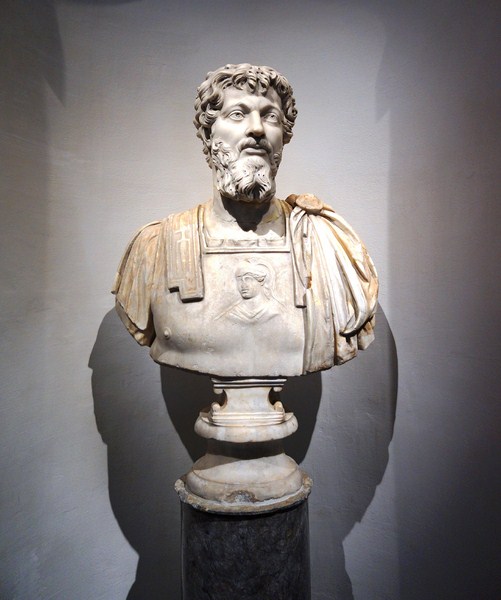
The bust of Marie Antoinette

After giving birth, she was returned to her own bed while the whole court (waiting in the other rooms in the Apartment whose doors were all symbolically left open) filed through to present their compliments. Between 1682 and 1786, 19 Princes and Princesses of the Realm were born here and two queens died here (Maria-Theresa in 1683 and Marie Leszczyńska in 1768).

The decoration in the room, still reflecting the three queens who once occupied it, features partitions on the ceiling dating back to the reign of queen Marie-Thérèse d’Autriche, a greyscale painting by François Boucher and wood panelling added for Marie Leszczyńska, all elements that survived the reign of Marie-Antoinette who replaced the furniture and fireplace and put up paintings of her mother Empress Maria-Theresa and her brother, Emperor Joseph II.

The jewelry cabinet, commissioned to Schwerdfeger by Marie-Antoinette, is placed in its original position in the alcove to the left of the bed. The 1745 Baillou and Crescent clock Marie-Antoinette placed in the bedchamber has been restored to its place. Other items returned to the room include Sené’s chimney piece, andirons by Boizot and Thomire and the bedspread by Desfarges.

Other pieces of furniture which were sold at an auction that lasted a year, such as the sofa delivered for the Countess of Provence (the queen’s sister-in-law), have been replaced by similar items. The armchairs by Tilliard and folding stools were taken from the suite of rooms belonging to the Countess d’Artois. The fabrics, hanging on the bed and walls, were re-woven in Lyon using the original patterns; the bed and balustrade have been remade and the Savonnerie carpet rewoven using ancient documents.

Queen’s Nobles Room

The Grand Cabinet, now the Nobles’ Room (salon des nobles), was used as a second antechamber where Queen Marie Leszczyńska (and, later, Marie-Antoinette) held formal audiences, seated under a canopy, as well as her Circle (the name given to the times spent in orderly conversation by the ladies of the Court). When not used for formal audiences, the Noble’s Room served as an antechamber to the queen’s bedroom.

Commode

In 1785, Marie-Antoinette, not too fond of the Louis XIV style of the room, entrusted Richard Mique, her architect,  with completely redecorating it (except for the ceiling which was kept). Apple-green damask, bordered with a wide gold stripe, were hung on the walls, and new, extremely modern and refined furniture were delivered.

Commode

When making the majestic commodes and corner cupboards for the room, the queen’s favorite cabinetmaker Riesener followed the latest English fashion by abandoning the customary marquetry in favor of large panels of mahogany. In this magnificent collection, the gilded bronze decoration and the small tables in Bleu Turquin marble matched the decoration on the new fireplace.

Mercury Spreading his Influence over the Arts (Michel Corneille)

The ceiling paintings, by Michel Corneille, depicts Mercury Spreading his Influence over the Arts.

Tapestry Portrait of Louis XV (Cozette)

A tapestry portrait of Louis XV by Cozette hangs on the wall, with mythological paintings by Francois Boucher. The mantlepiece ornaments show a Turkish influence while the commodes and corner cupboards, by Riesner and Gouthière, are dated 1786. The overdoors depict Pygmalion and Dibutade by Regnault while the bronze fireplace ornaments are by Gouthière.

Antechamber of the Grand Couvert

Traditionally, public meals at the Royal Table or Grand Couvert (a lavish court ceremony attracting a large number of curious, decently dressed onlookers), taken by the king and members of the royal family, were held at the Royal Table Antechamber, now the Antechamber of the Grand Couvert (Antichambre du Grand Couvert).  Privileged duchesses, princesses or those holding important positions sat in front them on stools while the other ladies and people whose rank granted them entry or who were admitted by the ushers stood around them.  In the 1680s, the room was sometimes used as a theatre for the château.

Almost every evening, Louis XIV strictly adhered to this ceremonial performance (seated alone at a table in front of the fireplace, his spoon, fork, and knife were brought to him in a golden box and courtiers could watch as he dined) whereas Louis XV, more often, preferred private dinners.  Louis XVI and Marie-Antoinette only ate at the Royal Table once a week, sitting with their backs to the fireplace.  Louis XVI ate well but Marie Antoinette, who was bored, requested that music be played during meals, installing a platform for musicians to this end.

Marie Antoinette and her Children (Elizabeth Louise Vigee Le Brun)

Designed for Queen Marie-Thérèse d’Autriche, the room’s lower panels were made of marble and two famous paintings of Marie Antoinette hang on the walls, including that which includes all her children. Portraits of Louis XVI’s aunts by Madame Labille-Guiard are part of the decor. Above the doors are works by Madeline de Boulogne dated 1675.

Ceiling painting of Darius’ Family at Alexander’s Feet (Charles Le Brun)

The original, very large painting of ancient heroines on the ceiling, illustrating royal virtues, by the artist Claude-François Vignon and Paillet, quickly deteriorated and, in 1814-1815, was replaced with a Veronese canvas Saint Mark Rewarding the Theological Virtues.  Later, in 1861, it was substituted by the current, equally large marouflé canvas, Darius’ Family at Alexander’s Feet, a tapestry cartoon painted by Henri Testelin after a work by Le Brun. The gilt stuccos were sculpted by Pierre I Le Gros the Younger and Benoît Massou.

In 2007, due to the bulging of the camaieus on the arches, emergency measures were taken.  Between April 2009 and July 2010, the Antechamber of the Grand Couvert was restored, thanks to sponsorship from Martell & Co.  Thanks to a 1788 inventory of the furniture in this room (the pieces were well documented but are now lost), the furniture is now as they would have been when the royal family was forced to leave the palace, with Louis XV period seats and stools with Savonnerie manufactory upholstery and a large table placed in the center of the room as it would be when the King and Queen sat down for the Grand Couvert.  In order to evoke the royal dinnerware which is close to that used by French royalty but which disappeared during the Revolution, the Louvre lent silverware produced for George III of England by Robert-Joseph Auguste.

Autumn or The Triumph of Bacchus and Ariadne

Facing the large windows is the tapestry Autumn or The Triumph of Bacchus and Ariadne, was put on deposit here by the Mobilier National from the ensemble in the gallery of the Château de Saint Cloud after cartoons by Pierre Mignard. A deep crimson damask fabric, woven according to the description afforded by a document from the first half of the 18th century, was placed on the walls.

Fireplace

The Queen’s Guard Room, where 12 of the Queen’s Guards (composed of soldiers from the four elite companies of the King’s Guards) were on duty day and night, controlled entry to the Queen’s Apartments from the Queen’s Staircase (also called the “Marble Staircase”). In 1672, the room was used as a Chapel and, in 1676-1681, received its final decoration.

The Marble Staircase

Since the Queen never spent time here and there was therefore no need to modernize it, the Queen’s Guard Room is the only room in the Apartments in which the 17th-century decoration has been fully preserved, still contains the marble paneling, enhanced with gilded bronze designed by Le Brun and executed by Le Gros and Massou, characteristic of the State Apartments’ original condition, as well as the paintings, by Noël Coypel, which were brought here in 1680 from the old Jupiter Drawing Room (later replaced by the War Room).

At dawn on October 6, 1789, a group of rioters demanding bread tried to enter the Queen’s Apartments. Warned by one of the queen’s guards, one of the ladies in waiting managed to bolt the door to the Antechamber of the Grand Couvert and help the queen hurry, through a private corridor, to the king’s apartments, via her private chambers, and flee from the Paris mob. 

Queen’s Guards Room (photo: www.chateauversailles.fr)

NOTE:

On January 2016, the Queen’s Apartment was closed for major works and, on April 16, was again open to the public.  The revived magnificence of the Rococo style of Marie-Antoinette’s bedchamber or that of the Queen’s Guard Room was restored, thanks to the patronage of American Friends of Versailles and the Société des Amis de Versailles.  Today, the tour route passes through the rooms in the opposite direction to the traditional order during our visit, now starting in the bedchamber and ending in the Queen’s Guard Room, which originally marked the entrance to the Queen’s Apartments during the Ancien Régime.

Queen’s Grand Apartment: First Floor, Chateau De Versailles, Place d’Armes, 78000 Versailles, France. Tel: +33 1 30 83 78 00. Website: www.chateauversailles.fr.  Open daily (except on Mondays and May 1)from 9:00 AM to 6:30 PM.  Last admission is 6 PM while the ticket office closes at 5.45 PM. The estate of Trianon and the Coach Gallery only open in the afternoon while the Park (7 AM to 8:30 PM) and Gardens (8 AM to 8.30 PM, last admission: 7 PM) are open every day. Access to the Gardens is free except on days of fountains shows. You can access the estate of Trianon through the Gardens or through the city. The Petit Trianon is only possible via the Grand Trianon.

Admission: 27 € for Passport with Timed Entry (days with Musical Fountains Shows or Musical Gardens), 20 € for Passport with Timed Entry (without musical fountains show or musical gardens), 12 € for Estate of Trianon ticket(without Musical Fountains Show or Musical Gardens), 10 € for Passport with Timed Entry (free admission, days with Musical Fountains Show or Musical Gardens), 9,50 € for Musical Fountains Show ticket, 8,50 € for Musical Gardens ticket, 28 € for the Fountains Night Show.

How to Get There: The cheapest option for reaching Versailles is by train. There are three train stations in Versailles.  RER line C arrives at Versailles Château – Rive Gauche train station, the closest one of the Palace (just 10 minutes’ walk to the Palace). SNCF trains from Gare Montparnasse arrive at Versailles Chantiers train station, which is 18 minutes on foot to the Palace. SNCF trains from Gare Saint Lazare arrive at Versailles Rive Droite train station, 17 minutes on foot to the Palace. RER C and SNCF train times are available on www.transilien.com