A Walking Tour of Shota Rustaveli Avenue (Tbilisi, Georgia)

Shota Rustaveli Avenue

Shota Rustaveli Avenue

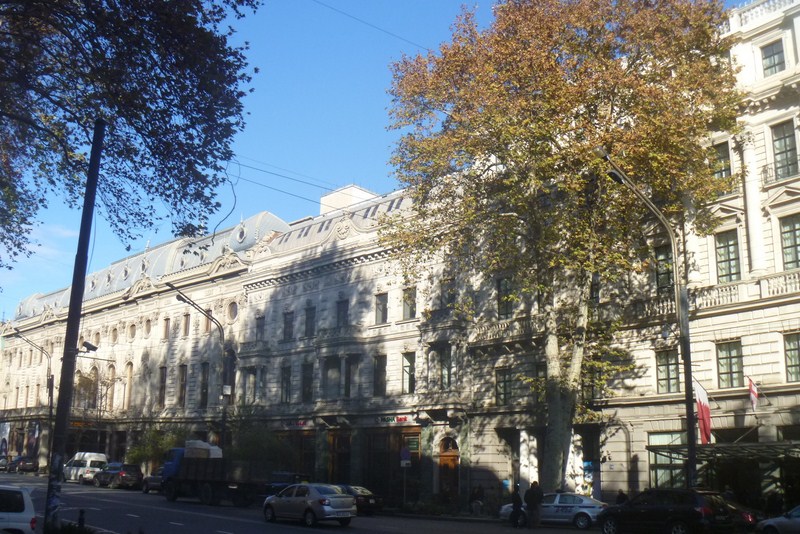
Shota Rustaveli Avenue, the central avenue in Tbilisi formerly known as Golovin Street, was built in the 19th century when M. S. Vorontsov was ruler of Georgia, was divided into two parts – Palace Street and the Golovin Avenue. In 1918, it named after medieval  Georgian poet Shota Rustaveli, author of the immortal poem “The Knight in the Panther’s Skin.”

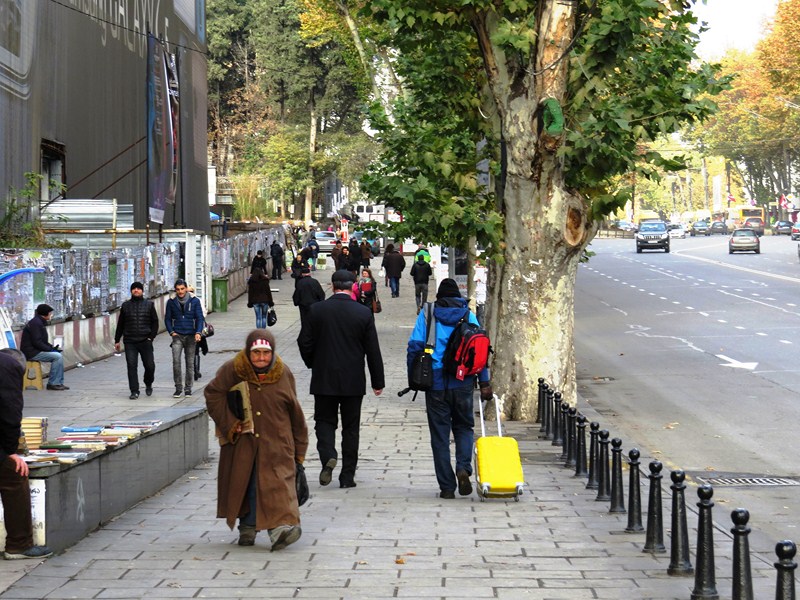
The author (in blue jacket) walking among sea of Georgians all in dark-colored jackets

The author (in blue jacket) walking among a sea of Georgians, all in dark-colored jackets and overcoats (photo: Ms. Riva Galveztan)

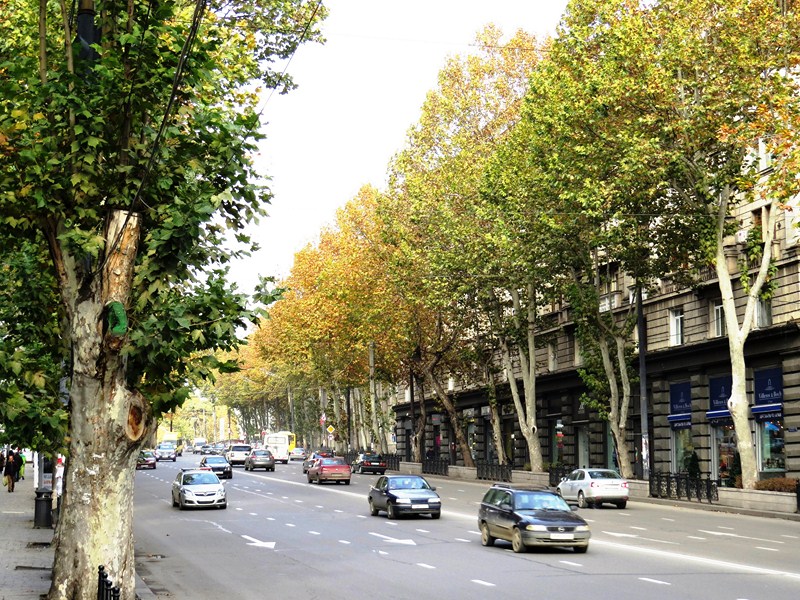
A popular place for walking, I strolled along Rustaveli to soak up the bustling, cosmopolitan atmosphere of Tbilisi’s main thoroughfare which is lined with Oriental plane trees  (Platanus orientalis) and strung with a handsome mix of modern and 20th-century architecture, with a contrasting European/Russian (Neo-Classical) look, such as important governmental, public, cultural, and business buildings as well as various cafes, shops, restaurants and other entertainment places.

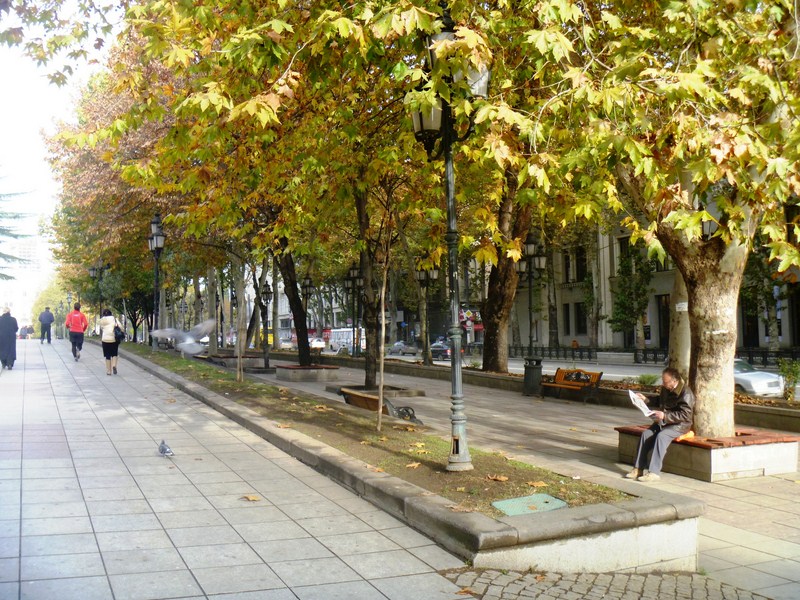
Oriental plane trees lining the sidewalks

Oriental plane trees lining the sidewalks

This fine, stately avenue, which leads off to the northwest, is one of the best architectural and tourist centers of Tbilisi.  However, it is spoilt by the amount of traffic roaring up and down it these days. There are a number of pedestrian underpasses, but people here also cross the road with great nonchalance, waiting on the centre line until there’s a gap.

Freedom Square

Freedom Square

Rustaveli Avenue (Rustavelis Gamziri in Georgian or Rustaveli Prospekt in Russian) starts at Freedom Square and extends for about 1.5 kms. before it turns into an extension of Kostavas Kucha (Kostava Street).  Also branching out from this square are five other streets – Pushkin Street, Leselidze Street, Shalva Dadiani Street, Galaktion Street, and Leonidze Street. At its far end is the Freedom Square Metro Station at Rustaveli 6 where I alighted and started my stroll.

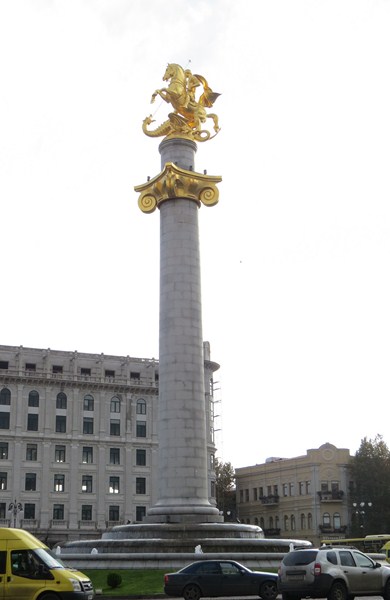
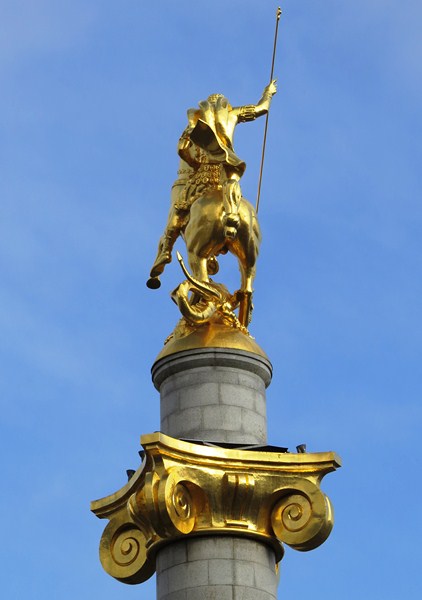
Bronze statue of St. George slaying the Dragon

Bronze statue of St. George slaying the Dragon (photo: Ms. Riva Galveztan)

Freedom Square, first called Yerevan Square was, later in the Soviet period, renamed after Lavrentiy Pavlovich Beria and then after Vladimir Lenin. In the center of Freedom Square (once occupied by a monument to Lenin which was symbolically torn down in August 1991) is the Monument of Freedom and Victory, a fountain with a very tall 40 m. high column topped by a bronze statue of St. George slaying the Dragon, a gift, unveiled on November 23, 2006, of famous Georgian sculptor Zurab Tsereteli to his native city.

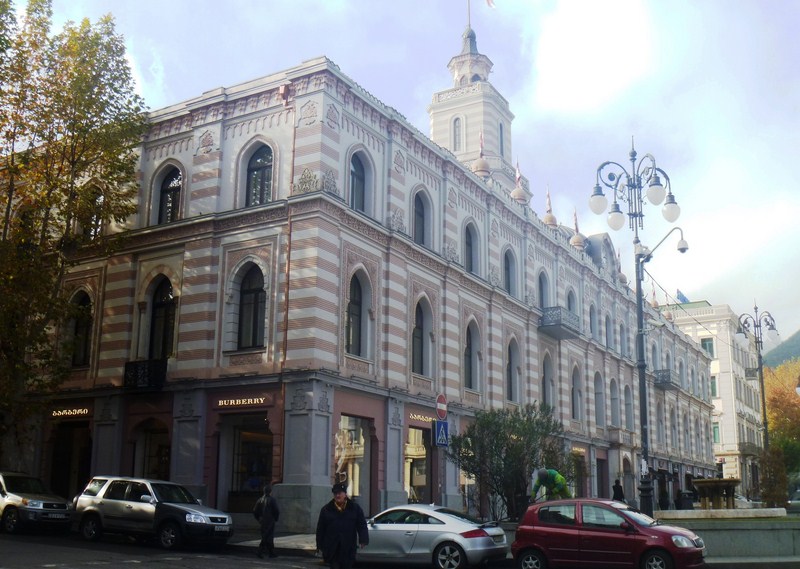
Tbilisi Sakrebulo (City Assembly)

Tbilisi Sakrebulo (City Assembly)

The entire southern line of the square is occupied by the main Pseudo Moorish-style facade of Tbilisi Sakrebulo (City Assembly), a former town council building built in 1880 by German architect Peter Stern.  Its third storey, with a clock tower, was built between 1910 and 1912. This attractive building, with stripes of sandy green and white and mauresque stucco, now houses, at the eastern side of the ground floor, a well- equipped tourist information office, with plenty of free booklets, maps and helpful English-speaking staff, plus outlets of Burberry, Chronograph and Chopard.
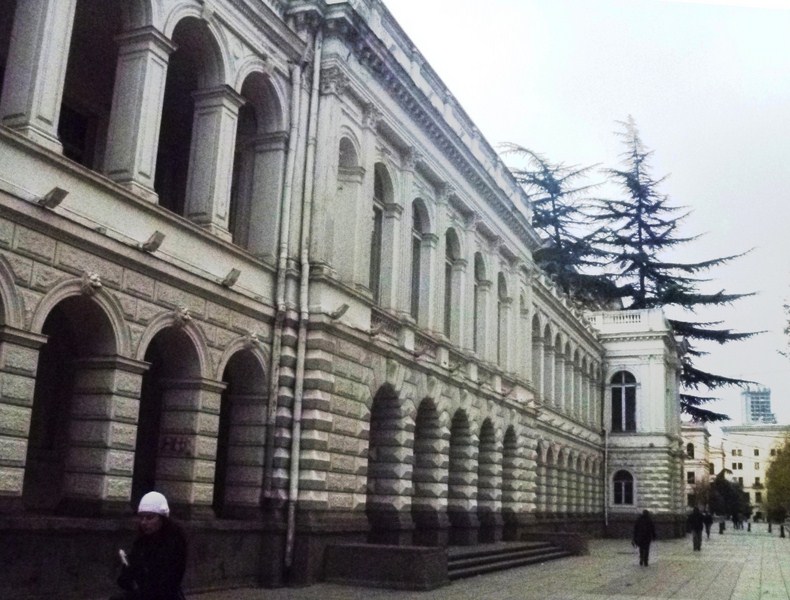
Tbilisi National Youth Palace

Tbilisi National Youth Palace

The Tbilisi National Youth Palace, erected n 1802, was rebuilt many times, the last time from 1865-1868 when the building was enlarged by architect O. Simenson who added an arcade in front. From 1844 to 1917, the building was the residence of the Russian vice-regent in the Caucasus.  On May 26, 1918, during the meeting of the Transcaucasian Seim, the Georgian delegation left the hall and, in the adjacent White Hall, proclaimed Georgia a sovereign country.

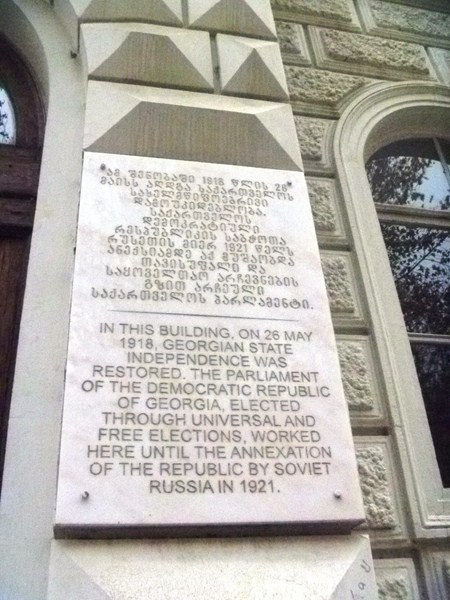
Plaque commemorating the May 26, 1918 declaration of state independence

Plaque commemorating the May 26, 1918 declaration of state independence

At one time, Josef Stalin installed his mother here.  On May 2, 1941, during the Soviet period, it served as the Pioneers’ Palace, housing the Soviet youth organization and a Museum of Children’s Toys. Still used for youth activities, it is the best place to find classes and displays of Georgian folk dance and the like.  Around the palace is a well-kept garden, the back part of which faces Ingorokva Street. Aleksey Yermolov, the former Caucasian commander-in-chief, paid special attention to this garden, planting two large plane trees. In the past, the garden belonged to a princess of the Orbeliani family.

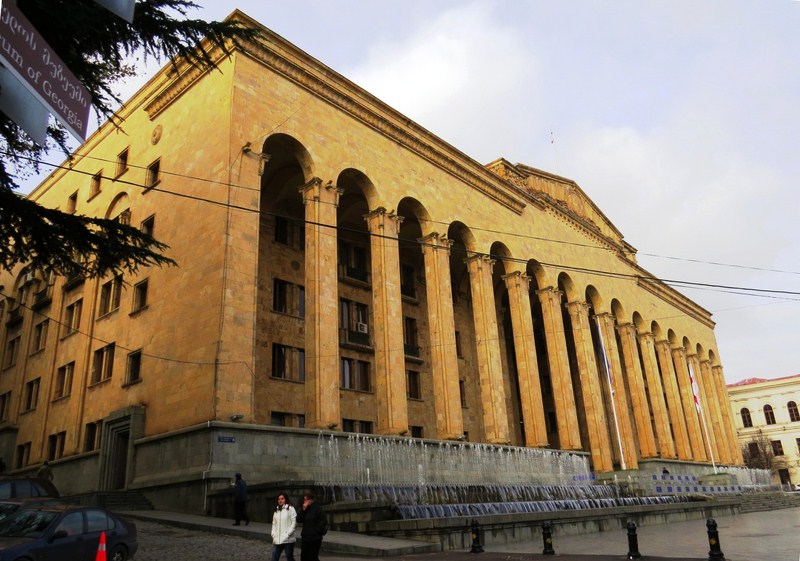
Old Parliarment Building

Old Parliarment Building (photo: Ms. Riva Galveztan)

Beyond the National Youth Palace is the Parliament Building, easily the most dominating building along Rustaveli Avenue.  Designed by architects Victor Kokorin and Giorgi Lezhava, it was built as a U-shaped block in 1938 (on the site of the Alexander Nevsky Cathedral, built in the 19th century for the Russian army), it’s very solid portico of tuff was built by German prisoners-of- war and the building was opened in 1953. Its 16 columns symbolize the 16 Soviet republics.

National Gallery

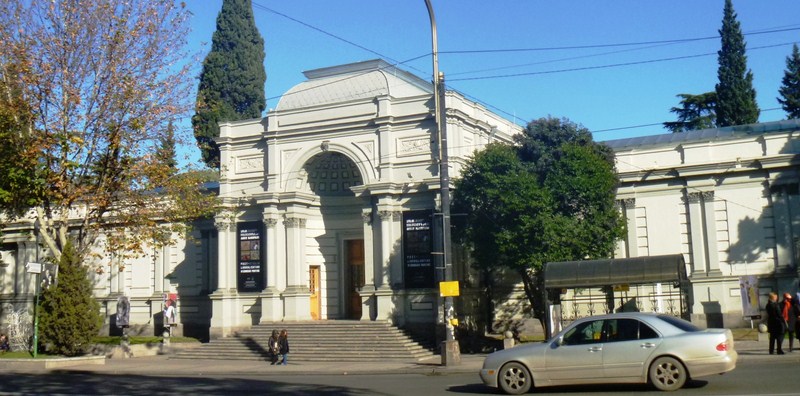
National Picture Gallery

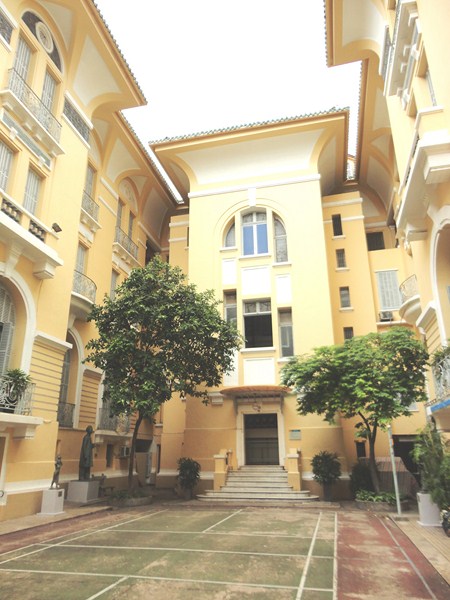
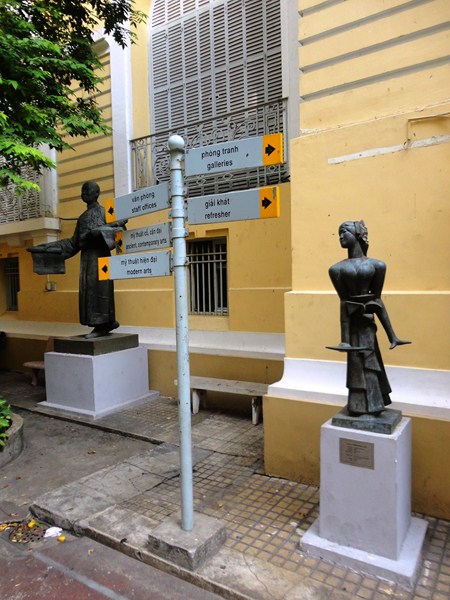
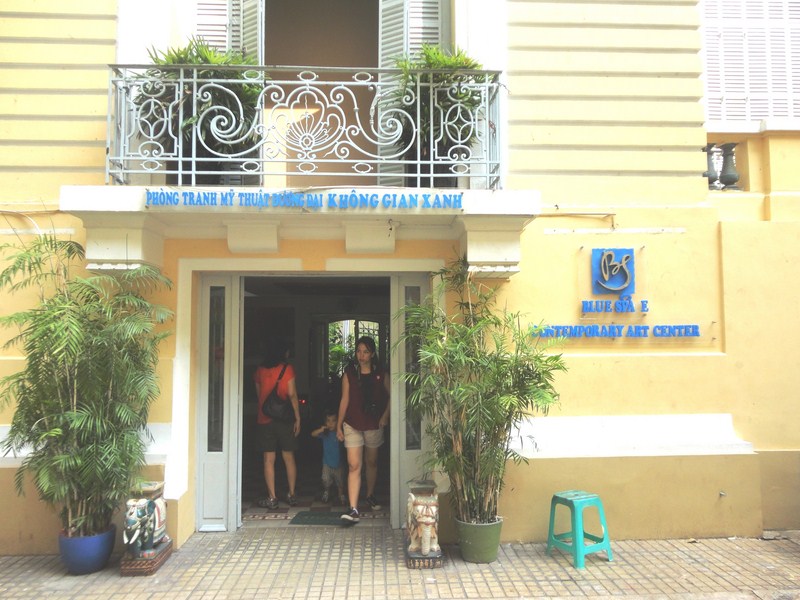
The National Picture Gallery (Blue Gallery), built in 1885,  was erected by the German architect Zalzman as the “Temple of Glory” to commemorate the victory of the Russian troops over the Persians. The trophy cannons recaptured from the Persian army, stood in front of the building in the last century.

School No. 1

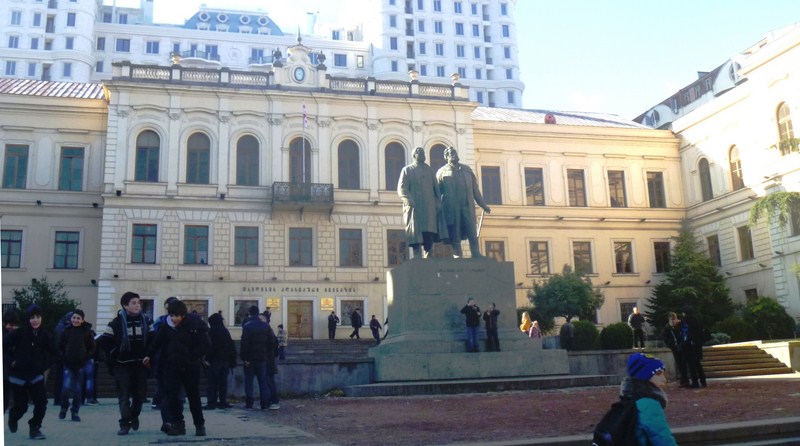
School No. 1

Immediately beyond the Parliament Building is the High School No. 1, founded in 1802 as the first European-style high school in Transcaucasia.  It educated many of the leading figures of recent Georgian history, including Merab Kostava, Zviad Gamsakhurdia, Tengiz Sigua and Tengiz Kitovani.

Plaque commemorating the March 9, 1956 massacre at the former Communications Building

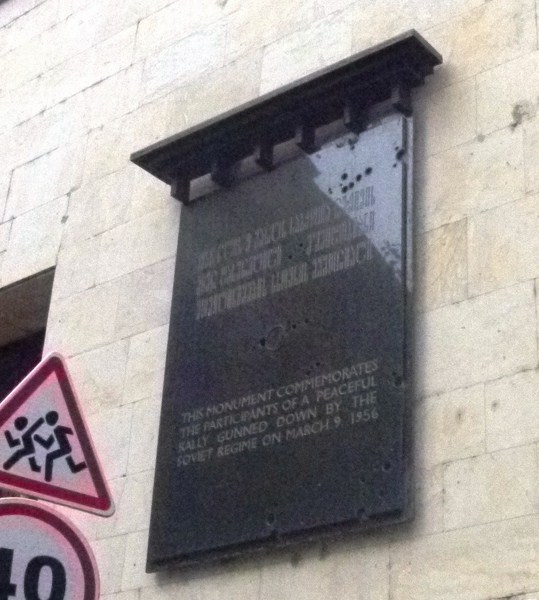
Plaque commemorating the March 9, 1956 massacre at the former Communications Building

A good example of Russian Neo-Classicism, it has statues of Ilia Chavchavadze and Akaki Tsereteli (1958) in front.  It houses the Museum of Education. A plaque here commemorates those killed by the Soviet security forces on March 9, 1956.

Tblisi Marriot Hotel

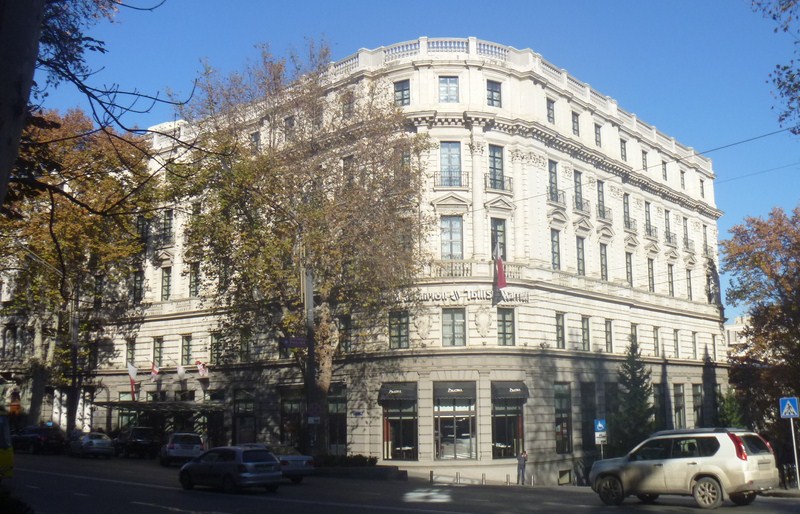
Tblisi Marriot Hotel

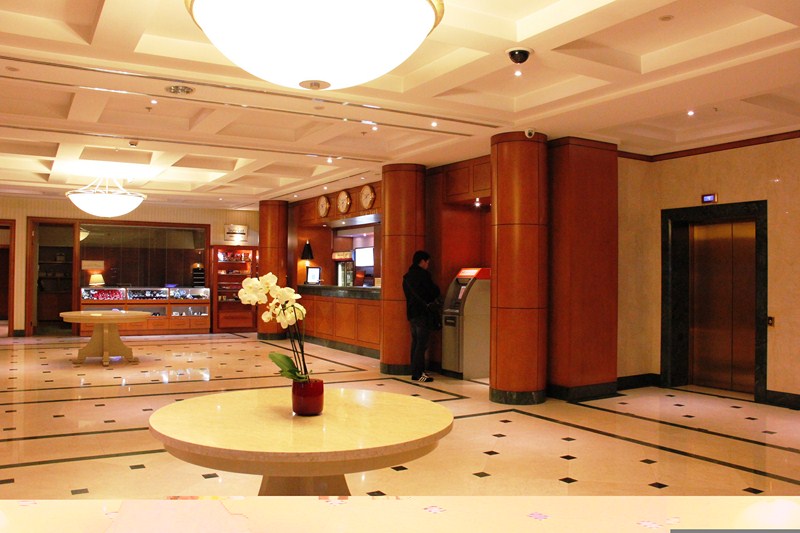
Past the school, Rustaveli Avenue bends to the left and I found myself in front of the Tbilisi Marriott Hotel (No. 13), one of the massive constructions of the 20th century.  Elegantly emphasizing the avenue’s bend, this building, opposite the Ministry of Transport and Communications, was designed by ethnic Armenian architect Gavriil Ter-Mikelov in 1915 as the Hotel Majestic.

Lobby of the Tblisi Marriot Hotel

Lobby of the Tblisi Marriot Hotel (photo: Ms. Riva Galveztan)

Later, it was renamed as Hotel Tbilisi.  During the 1991-1992 Civil War, the hotel was burned and was later restored and reopened in 2002 as the luxurious Marriott Hotel.

Rustaveli State Academic Theater

Rustaveli State Academic Theater

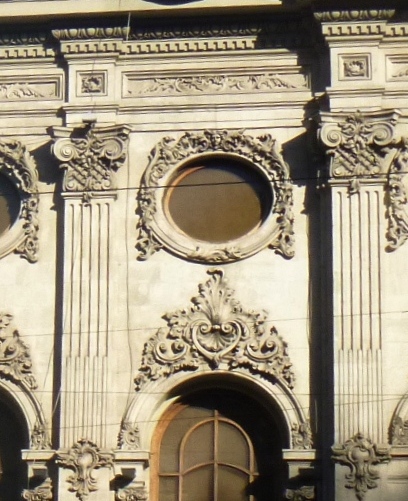
Next to the hotel is the famous, splendid Rustaveli State Academic Theater (No. 17), one of the most beautiful buildings along the avenue. Designed by architects K. Tatishev and Alexandre Shimkevich in the French Neo-Classical style from 1899 to 1901, in the past it housed the Actors’ Society Club.

Rustaveli State Academic Theater - facade detail

Rustaveli State Academic Theater – facade detail

Its ornate architecture involves the forms and motives of the Late Baroque Period, with mirror windows and a large portal. The theater was refurbished from 1920 to 1921, for the new Rustaveli Theatre Company, and was refurbished again from 2002 to 2005. Since 1921, the theater has carried the name of Shota Rustaveli, Georgia’s national poet.  In 2006, a Hollywood-style “Walk of the Stars” was begun in front.

Rustaveli State Academic Theater - facade detail

Rustaveli State Academic Theater – facade detail

It now houses a first-class theater, a large concert hall, a large and small ballroom, a small foyer, marble staircases, classical statues and a number of big and small rooms for the Actors’ Society Club. It has three stages – a main stage (about 800 seats), a smaller stage (300 seats) and a Black Box Theater (182 seats) for experimental performances. The Kimerioni (Chimera) Cafe-Bar, at the lower floor of the theater, has  frescoes  painted in 1919 by prominent Georgian painters Lado Gudiashvili and  David Kakabadze, theater set designer Serge Sudeikin as well as Sigizmund Valishevski (he was called Ziga in Tbilisi) and Moise and Iracly Toidze.  Nearby is the Theatrical Institute.

Opera and Ballet Theater

Paliashvili Opera and Ballet Theater

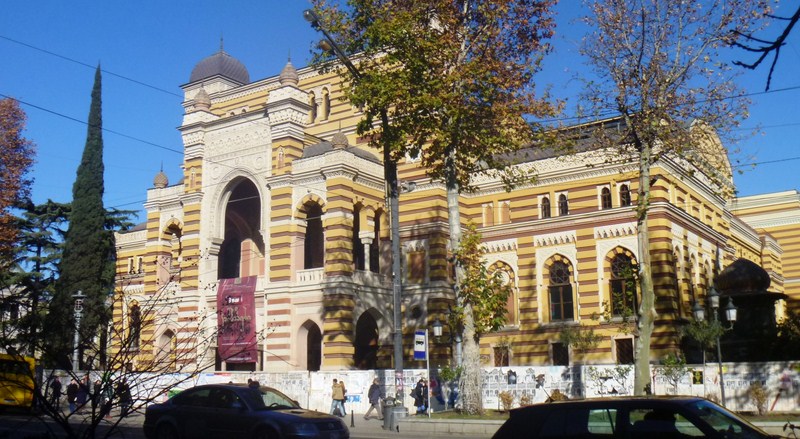
Not far from the Rustaveli State Academic Theater, along the north side of Rustaveli, is the elegant Paliashvili Opera and Ballet Theater (No. 25).   Formerly the Public Theater, it was first built in 1851 but burned down on October 11, 1874.  The present Moorish-Eastern style building was designed by architect Viktor Schroter and built from 1880 to 1896.

Z.Paliashvili Opera and Ballet Theatre

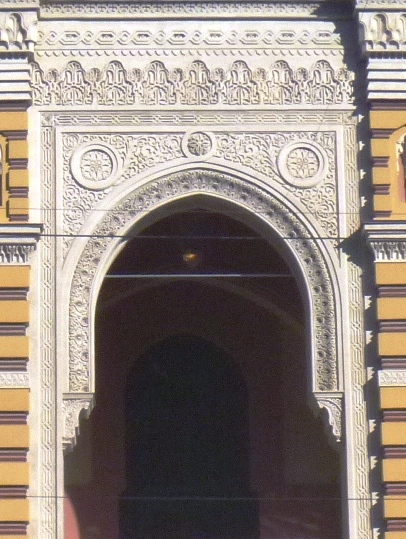
Z.Paliashvili Opera and Ballet Theater – intricate molding

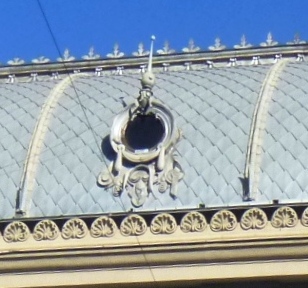
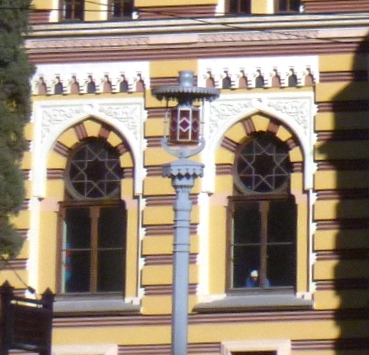
In 1937, the theater was renamed in honor of Zakaria Paliashvili, one of Georgia’s greatest composers. It too burned down in 1973 but was rebuilt in 1977. Its towers, arches, turrets, stained glass windows, ornaments and intricate molding at the front entrance were all laboriously and meticulously made with special care.

Z.Paliashvili Opera and Ballet Theater - window ornamentation

Z.Paliashvili Opera and Ballet Theater – window ornamentation

The theater hosted, at different times, opera singers such as Fedor Shaliapin (who said “I was born twice: for life – in Kazan, for music – in Tbilisi”), Sergei Lemeshev, Vano Sarajishvili, Zurab Sotkilava, Paata Burchuladze, Jose Carreras and  Montserrat Caballe; and ballet dancer Vakhtang Chabukiani.

Kempinski Hotel

Kempinski Hotel

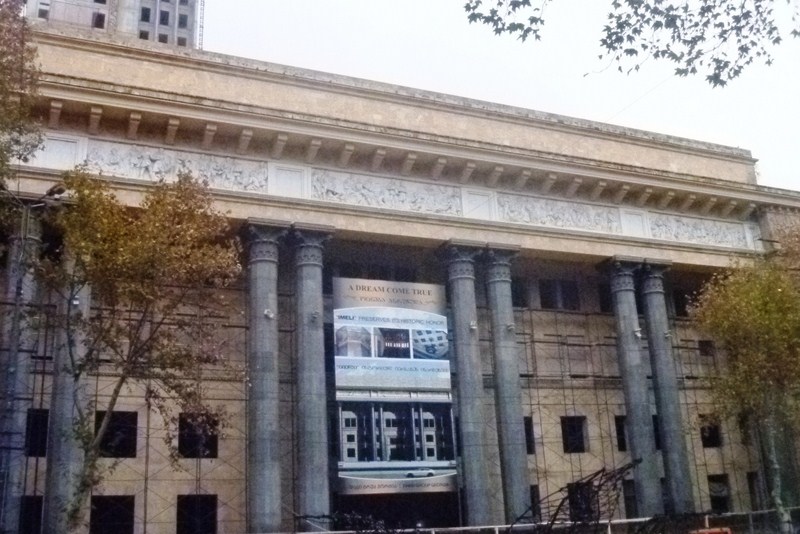
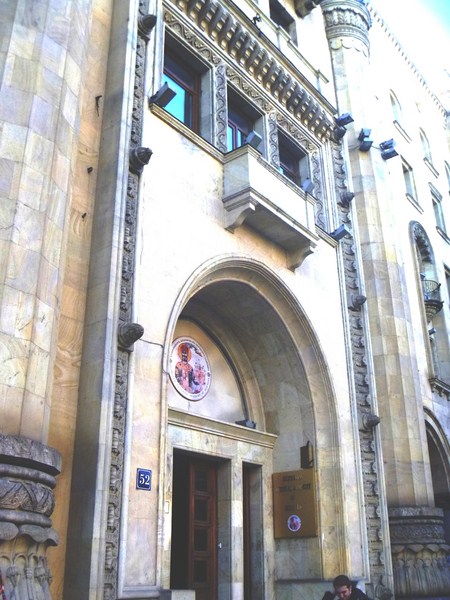
Nearing the end of Rustaveli Avenue, I espied another monumental building – the former Georgian branch of Marxism-Leninism Institute. Designed by architect A. Shukin and built in 1938, its frieze is decorated with bas reliefs made by Iakob Nikoladze. Since 1993, the Constitutional Court has had its sittings there. Today, it is now home to a 200-room hotel, 50 apartments and 8 penthouses designed by Alexey Shuyev and managed by Kempinski Hotels. The new building, incorporating the historic main façade, features a domed hotel lobby and an octagonal courtyard.

Georgian National Academy of Sciences Building

Georgian National Academy of Sciences Building

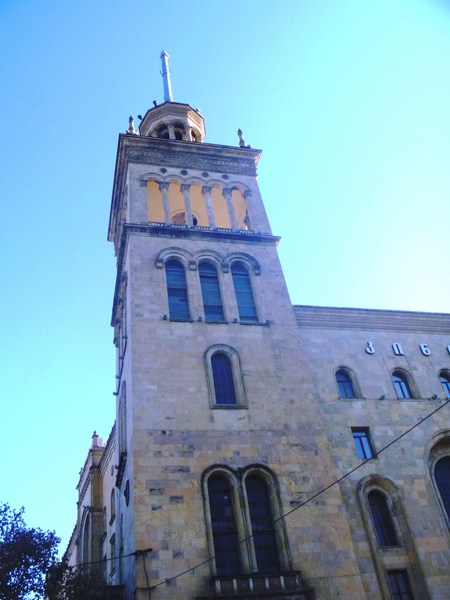
Just at the end of Rustaveli is the Georgian National Academy of Sciences, a pompous building designed by architects K. Chkheidze and M. Chkhikvadze in 1953.  It has a beautiful, low Italian-style colonnade; a solemn, angular tower revetted with Bolnisi tuff.

Tower of the Georgian National Academy of Sciences Building

Tower of the Georgian National Academy of Sciences Building

Between its columns is a through arcade where you can go to the lower station (which has an oval design) of the cableway leading to the upper plateau of Mtatsminda. On the steps of the academy artists and craftsmen sell their works.

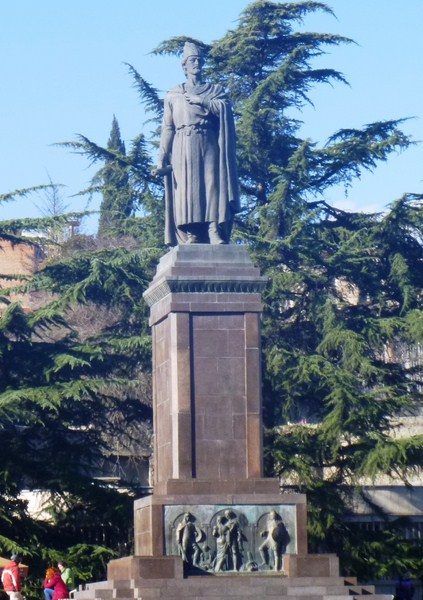
Statue of Shota Rustaveli

Statue of Shota Rustaveli

My walking tour of Rustaveli Avenue was completed upon reaching the monument to the poet Shota Rustaveli, made by a sculptor K. Merabishvili.

Pheasant’s Tears (Sighnaghi, Georgia)

(All photos courtesy of Ms. Riva Galveztan)

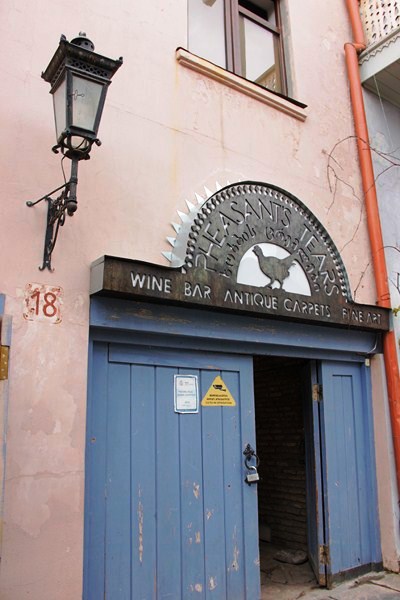
The endpoint of our GNTA-sponsored walking tour of Sighnaghi town proper was Pheasant’s Tears where Buddy, Pancho, Riva, Mel and I, together with our Georgian guide Sopho Makashvili, were to have lunch and sample some Georgian wine.  Pheasant’s Tears, a Georgian winery that produces artisanal natural wines according to ancient Georgian traditions, was founded in 2007 by John H. Wurdeman V and Gela Patalishvili.

Pheasant's Tears

Pheasant’s Tears

John, an en plein air painter and the first American graduate of the prestigious Surikov Institute in Moscow, first came to Georgia in 1996 and bought a house in Sighnaghi the following year. In 1998, he relocated to Georgia full time. Gela, a winegrower whose family’s connection with wine goes back 8 generations, met John in 2005 when John was painting in a vineyard near the highway in the Alazani Valley near the village of Tibaani.  They decided to work together and set up Pheasant’s Tears. The name “pheasant’s tears” refers to a Georgian story in which only the very best wines are good enough to make a pheasant cry.  

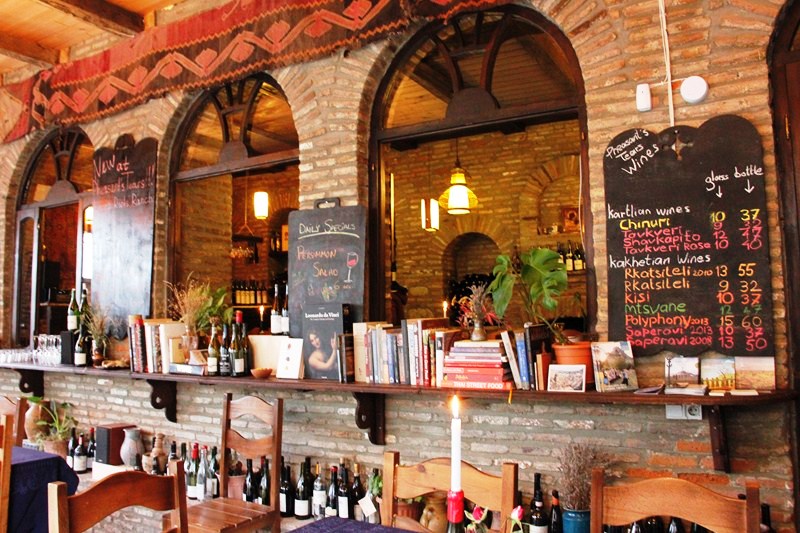
The restaurant's rustic interior

The restaurant’s rustic interior

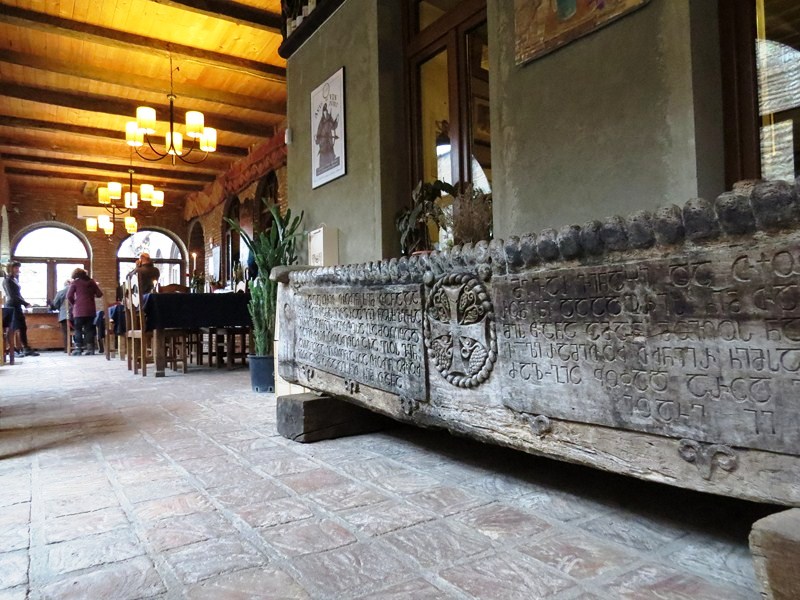
An old wine press

An old wine press

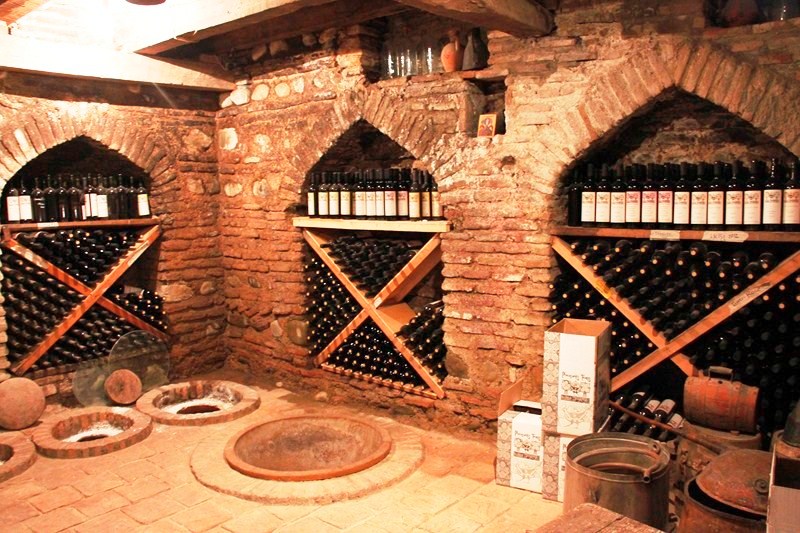
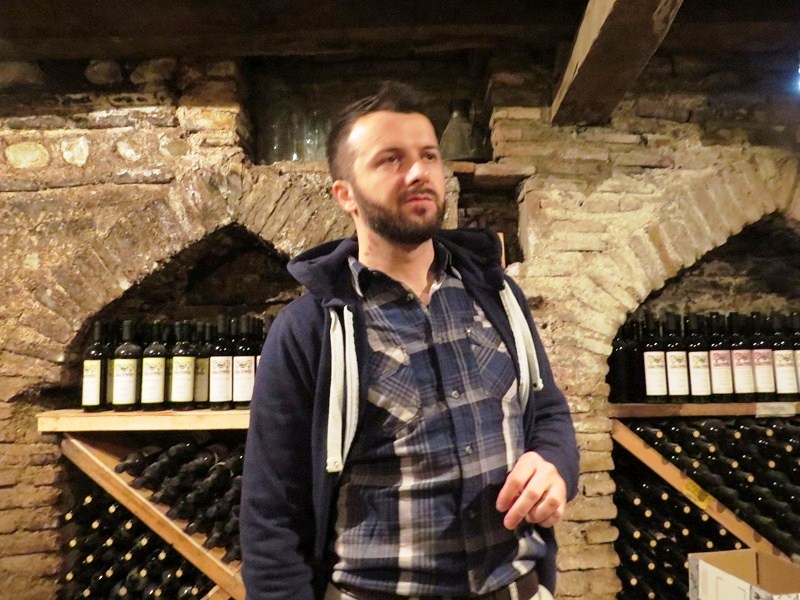
Upon arrival, we were welcomed by Mr. Shergil Pirtskhelani, Pheasant’s Tears sommelier (wine steward), who brought us all to the winery’s basement cellar and gave us a brief introduction on ancient Georgian wine making traditions.  All wines are fermented in kvevri, traditional clay amphorae which are lined with organic beeswax and buried into the ground. Kvevri wines seem to age faster than conventional wines.

The wine cellar

The wine cellar

Fermentations using naturally occurring yeast is employed and slightly different techniques are used to make each of the wines. Some have moderate skin contact while others have minimal (3 weeks to 6 months). Stems are included in the wine making process. In 2013, the ancient traditional kvevri wine-making method was inscribed on the UNESCO representative list of “Intangible Cultural Heritage of Humanity.”

Our host Shergil Pirtskhelani

Our host Shergil Pirtskhelani

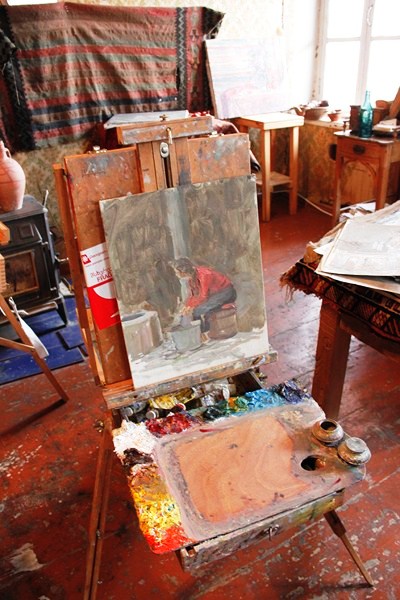
After this brief introduction, Shergil then toured us around John’s (who was at Tokyo during our visit) studio which houses his books, painting paraphernalia (easels, paint, brushes, etc.) and artwork that reflects John’s overflowing passion and love for Georgia.

Studio of John H. Wurdeman V

Studio of John H. Wurdeman V

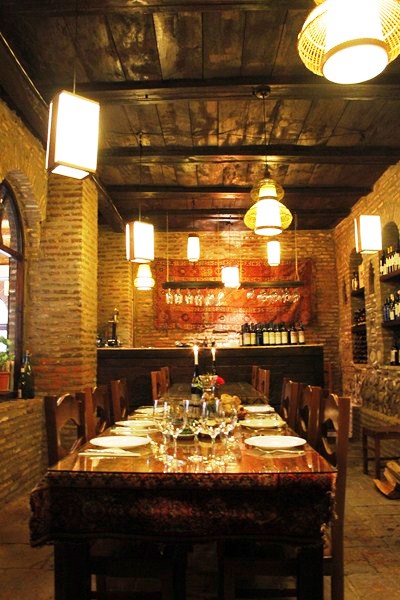
It was now time for lunch and we all went down to the private dining room which had a warming fireplace.  The supra (Georgian feast) before us, prepared with fresh ingredients from the local markets by head chef Gia Rokashvili, a local Sighnaghian, was a take on traditional Georgian cuisine with an eye towards wine and food pairings, all designed to accommodate both veggie (Sopho and Riva belonged to this category) and meat lovers.

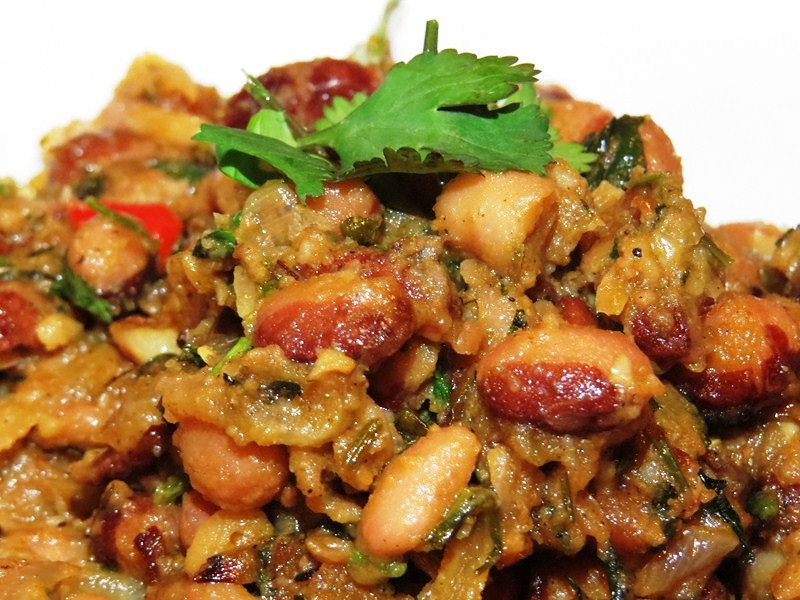
Kidney beans with wild thyme

Kidney beans with wild thyme

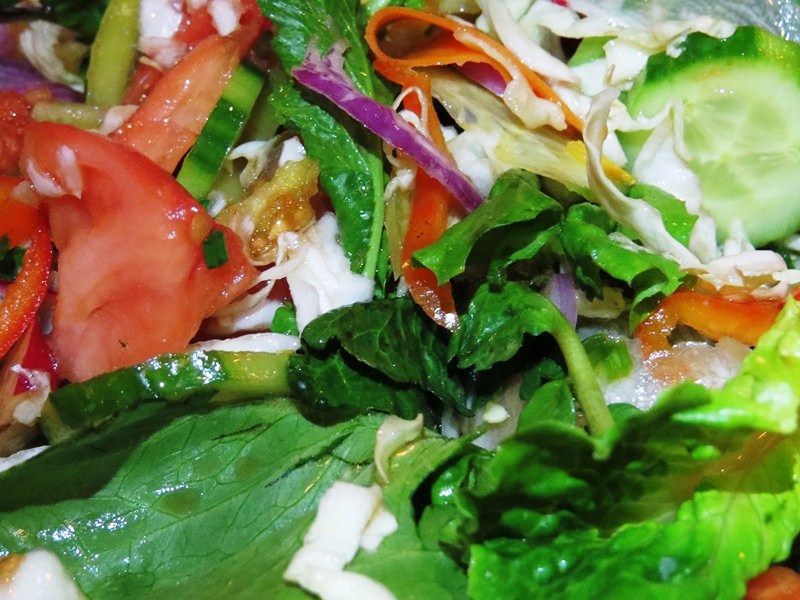
Fresh vegetable salad

Fresh vegetable salad

Stewed veal with vegetables

Stewed veal with vegetables

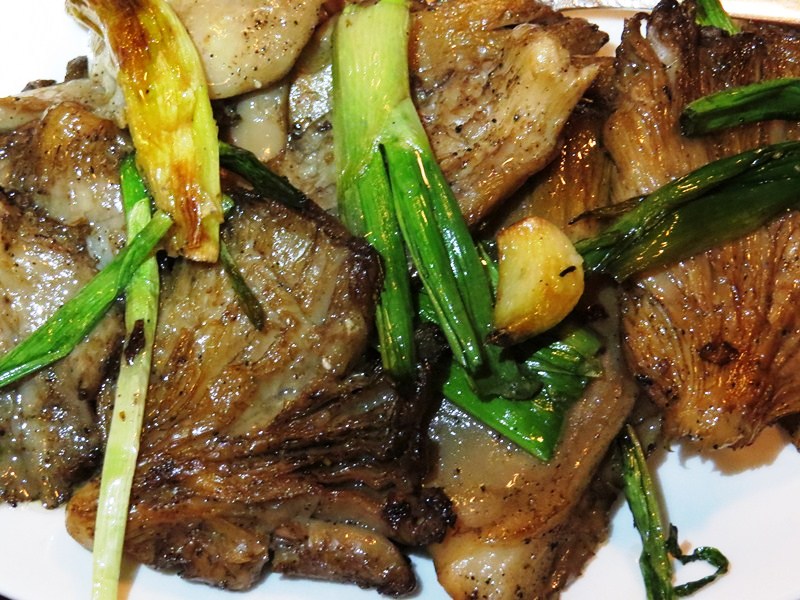
On the menu was matsoni (strained water buffalo yoghurt with red pepper); curds with black pepper and green onions; fresh vegetable salad, (radish, carrots, arugula, cabbage, onions, olives, tomatoes and cucumber in sunflower seed oil); mushrooms sautéed with garlic; kidney beans with wild thyme; omelet (radish greens, onions, pepper and broccoli); roast potatoes with tkemali (wild plum sauce) and stewed veal with vegetables.

The private dining room

The private dining room

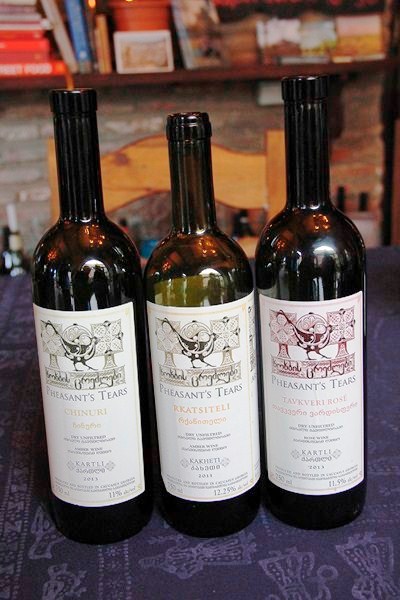
While dining, Shergil poured 3 kinds of Georgian wine in our respective wine glasses for us to taste, helping us understand the roots that these wines came from.  We started with Chinuri 2013, the lightest, crispest white wine in the line-up; followed by Rkatsiteli 2011 which was spicy and exotic on the nose, with warm peachy notes; and Tavkvevri 2013, a vivid, juicy and berryish red wine.  He also assumed the role of tamada (Georgian toastmaster) as we sampled each of these wines.

Chinuri, Rkatsiteli and Tavkvevri wine

Chinuri, Rkatsiteli and Tavkvevri wine

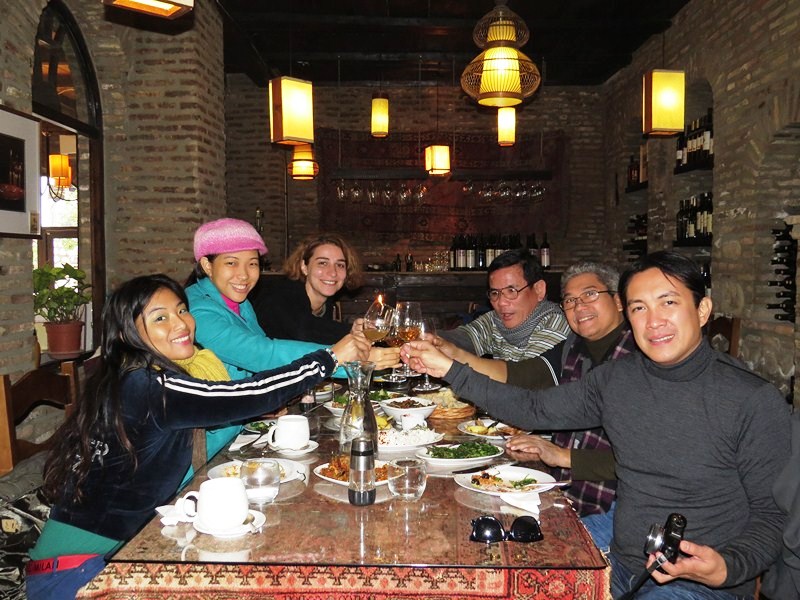
L-R- Mel, Riva, Sopho, the author, Pancho and Buddy

L-R- Mel, Riva, Sopho, the author, Pancho and Buddy

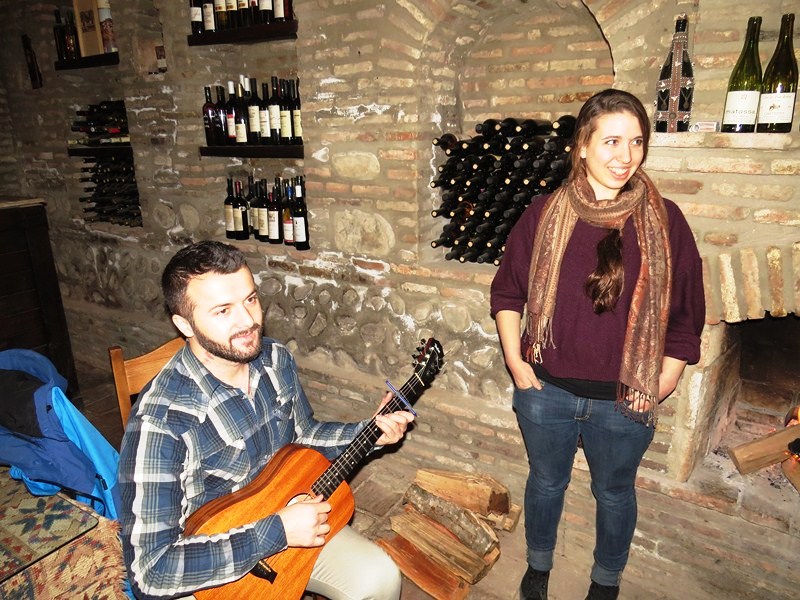
Shergil happened to be a music teacher who teaches folk and sacred songs from Georgia with traditional Georgian stringed instruments. After our magnificent repast, he regaled us by playing the guitar while Ms. Enek Peterson, an American from Boston (Massachusetts), serenaded us with the popular spiritual song “Hallelujah” (written by Canadian singer-songwriter Leonard Cohen in 1984) plus a Georgian song. This capped a wonderful afternoon filled with great art, delightful Georgian cuisine and soul-searching music.

Shergil and Enek serenading us with two songs

Shergil and Enek serenading us with two songs

Pheasant’s Tears: 18 Baratashvili St., Sighnaghi, Georgia 4200.  Tel: 0 355 23 15 56.  Mobile number: +(995 599) 53-44-84. E-mail: jwurdeman@pheasantstears.com. Website: ww.pheasantstears.com.

Georgia National Tourism Administration: 4, Sanapiro St, 0105, Tbilisi, Georgia. Tel: +995 32 43 69 99. E-mail: info@gnta.ge. Website: www.georgia.travel; www.gnta.ge.

Qatar Airways has daily flights from Diosdado Macapagal International Airport (Clark, Pampanga) to Tbilisi (Republic of Georgia) with stopovers at Hamad International Airport (Doha, Qatar, 15 hrs.) and Heydar Aliyev International Airport (Baku, Azerbaijan, 1 hr.). Website: www.qatarairways.com.

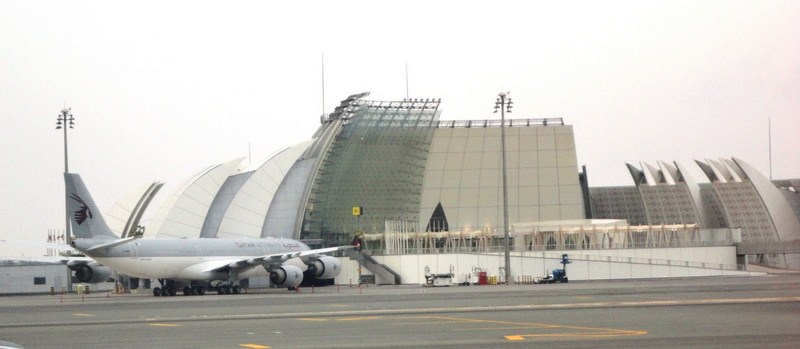
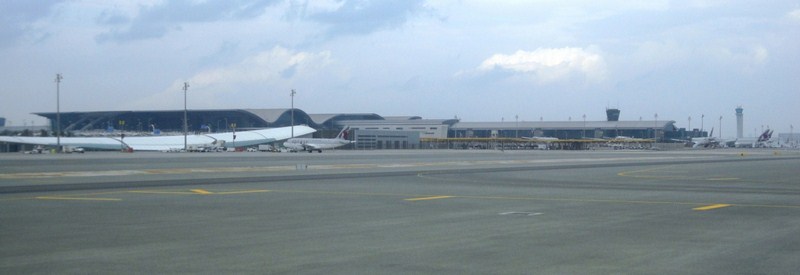
Hamad International Airport (Doha, Qatar)

Hamad International Airport

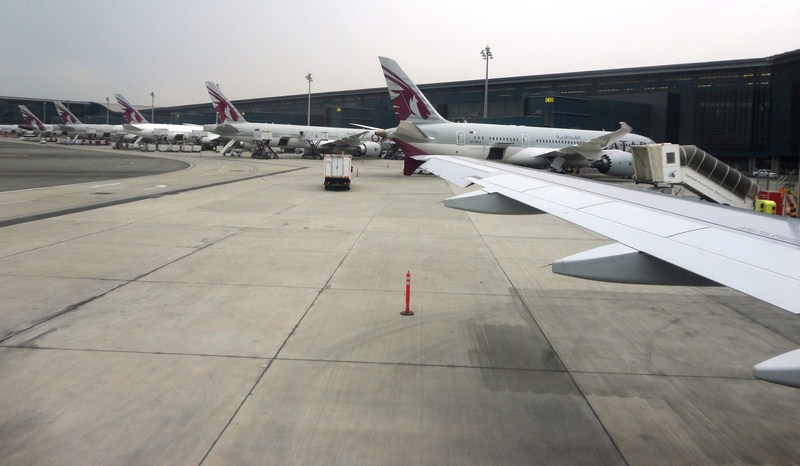
After a long, 9-hour flight from Diosdado Macapagal International Airport at Clark Freeport Zone in Pampanga, our Qatar Airways plane made its first stopover at Hamad International Airport (HIA) in the Arabian Gulf city of Doha, Qatar, the airline’s home, arriving there at 3 PM (Doha time).

The undulating roof of the passenger terminal

Here, we were to have an over 16-hour layover prior to continuing on our journey to Tbilisi, Republic of Georgia. Opened just last April, 30 2014 with the ambition of turning Doha into a global aviation hub serviced by Qatar Airways, this barely 5-month old international airport, designed by global design studio HOK, is one of the most advanced airports in the world. About 65% of the construction workers who built this airport are Filipinos.

Qatar Airways aircraft parked at the airport’s apron

Built over 22 sq. kms. (8.5 sq. mi.), half of which is on reclaimed land, this majestic structure’s expressive architecture reflects its coastal location.  The undulating rooftop silhouette of this dramatic, curving building ripples away from the concourse in swooping peaks and troughs that recalls the ocean waves of the Arabian Gulf and sand dunes.This undulating super roof can be experienced by departing passengers in the light-filled departure hall while the undulating roof line is mimicked by vaulted metal ceilings in other concourses.

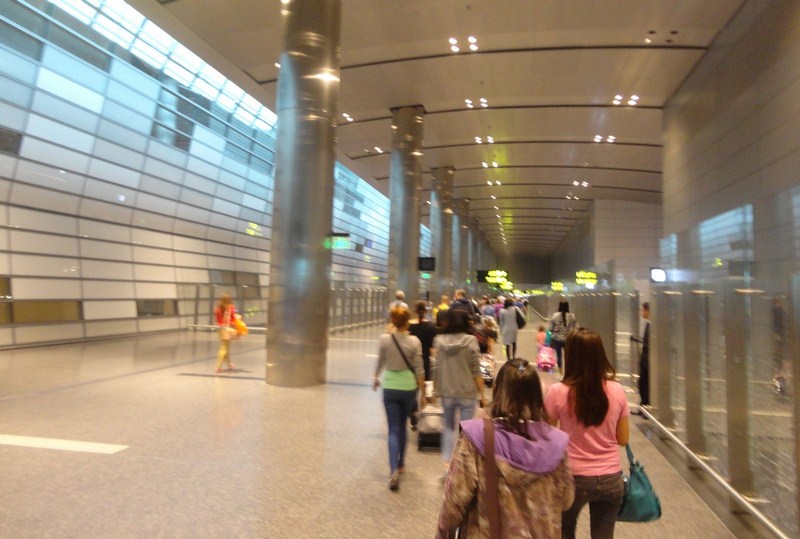
We probably arrived outside of its peak period as we walked through its beautiful hallways and lounges. As it was completely quiet, we were thinking we were the first to ever set foot in the place. There were no jarring announcements to disturb the calm.  Being new, every gleaming surface of this hyper-clean airport’s lavish departure and arrival areas was spotless and its high ceilings and expansive concourses gave it a sense of grandeur.

The steel-framed glass wall, from the curbside arrival area through the ticketing hall, provided us with unobstructed views enabling us to easily find our destinations. The east and west facades have high-performance glass that controls solar heat gain and glare.

The sleek metal and glass surfaces contrast with a vast wood ceiling that provides visual warmth in the longest concourse. One thing I noticed was the deliberate lack of ornamentation, with graceful structural arches left unadorned.  Terrazzo was used in high-circulation areas while carpet covered ancillary spaces.

Grand foyer of Duty-Free shopping hall

On the first floor, under a vast central skylight that provides visual access to one of five concourses, transfer passengers such as us, joined originating passengers, as we moved through an open immigration area. The two large transfer hubs were linked by an automatic people mover.

The arriving passengers then progress to the ground-floor baggage hall and exit to a triple-volume meeters and greeters hall which has direct access to taxi pavilions and an intermodal transportation hub. As we had hours to kill, we spent time exploring the airport. One thing that make HIA so unexpectedly cool is their groundbreaking pieces of modern art that, oftentimes, stop passengers in their tracks.

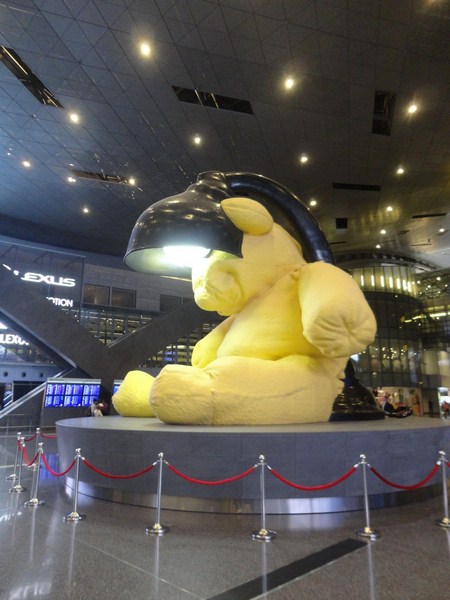
Lamp Bear (Urs Fischer)

The “Lamp Bear,” at the grand foyer of the airport’s duty-free shopping hall, is a giant, bronze, surreal, yellow teddy bear sitting under a black lamp, one of three creations by subversive Swiss artist Urs Fischer. This arresting sight, standing 7 m. tall and weighing approximately 18-20 tons, was previously displayed at the Seagram Building‘s plaza in New York City before it was purchased at a Christie’s auction for US$6.8 million by a member of the Qatari royal family.  It at has a near-constant knot of people in front of it, grabbing selfie shots.

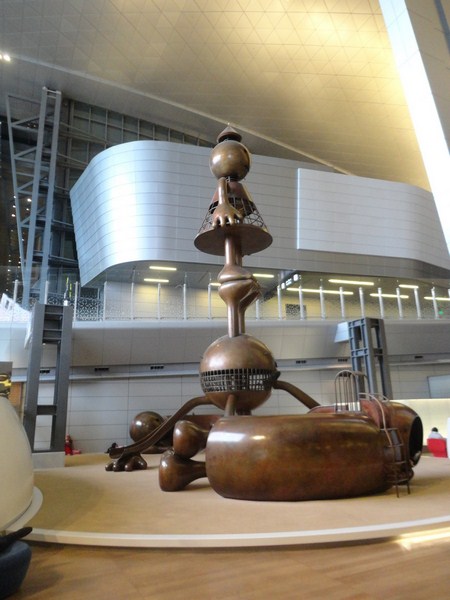
Playground (Tom Otterness, 2014)

Throughout the activity nodes in Concourse C, near gates C2, C3 and C8, are a series of eight large-scale interactive bronze sculptures done, by Tom Otterness, with slides and seats for limbs and play-pen-like chambers for torsos. Children and adults engage, interact and find recreational enjoyment with these bronze figures that appear to be in play with one another.

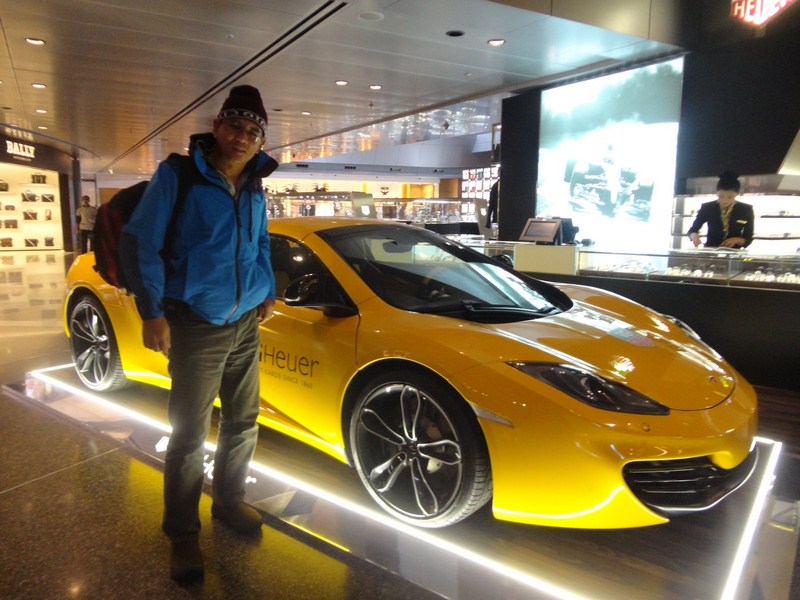
Author posing beside a McLaren MP4-12C Coupe on display at the world’s largest TAG Heuer airport boutique

The communal area seating, with all Italian-style chrome and leather, was fancy.  Come evening, we got some shut eye on comfortable recliners within the peaceful surroundings of the quiet lounge. There are also family lounges for those travelling with kids. These quiet rooms, as well as the spacious hold rooms, passenger activity nodes and 17 airline lounges, are all enveloped by glass.   Natural light and dramatic evening desert views are provided by skylights and interconnecting glass ceiling “zippers.”

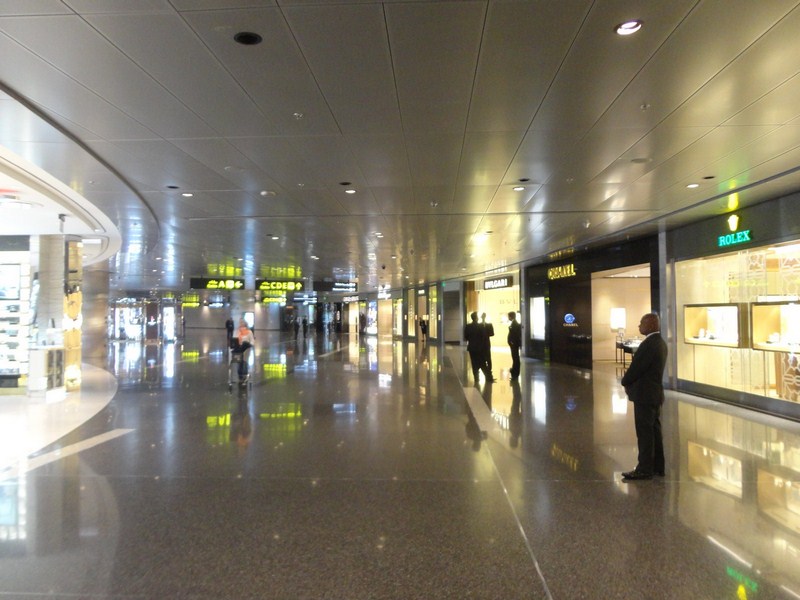
Duty-free shops

The free Wi-Fi at Hamad International Airport was fast and unlimited (simply connect to “HIAQatar Complimentary WiFi”). For standard passengers like us just passing through, there were plenty of the usual airport restaurant and retail options plus numerous upscale boutiques including Gucci, Burberry, Coach, Rolex, Swarovski and others.  A lot of Filipinos also work in these shops.  On another stopover here on my return to Manila, one of them assisted me when I bought a Sony A-3000 digital SLR camera in one of these shops

Hamad International Airport: Doha, State of Qatar. Tel: +974 465 66 66 (office) and +974 462 29 99 (flight information).  Fax: +974 462 20 44.  IATA Code: DOH.  ICAO Code: OTHH. E-mail: diainfo@qatarairways.com.  Website:  www.dohahamadairport.com.

The Chinese Compound (Pasay City)

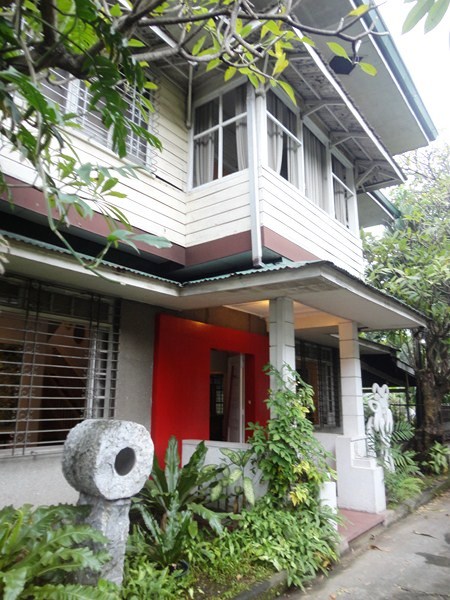
From My Mother’s Garden, we began the afternoon leg of our AAP-sponsored Pasay Media Familiarization Tour, proceeding, along F.B. Harrison St., to a compound where, upon entering its red main gate, I was instantly transported to another place and time smack in the middle of urban chaos, which makes for an interesting contrast.

The Chinese Compound

The Chinese Compound

Set amidst lush greenery is an interesting enclave of 15 post-World War II, medium-sized and nearly identical 2-storey houses.  All these houses, designed to facilitate air flow before the introduction of air-conditioning, have high ceilings, large windows and a second floor balcony.  Its floors are laden with Machuca tiles.

The boutiue hotel

The boutiue hotel

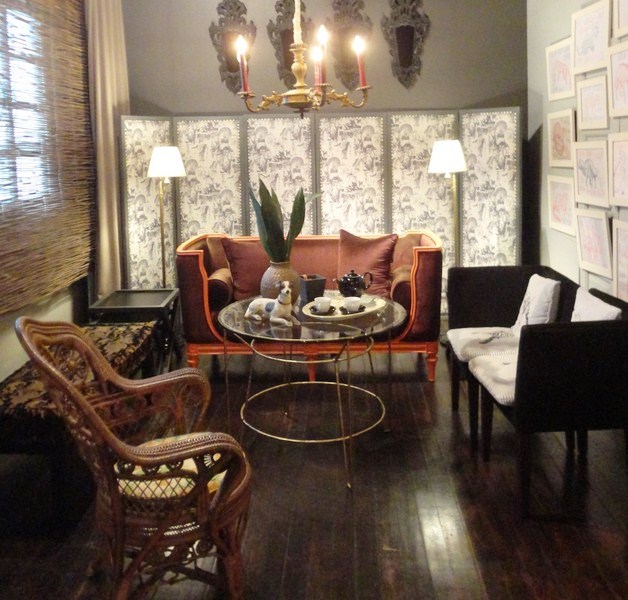
Formerly a residential abode for the Chinese owner’s large family (it is called the Chinese Compound), this tree-lined compound simply awed me with its old-world charm and serenity.  Some of these 1950s houses are just regular homes of people not connected to the artistic world  but several of the homes now house several interesting establishments such as the art gallery of Albert Avellana (Avellana Art Gallery), the atelier of top fashion designer Jesus “Jojie” Lloren and the furniture showroom (Artelano 11 Furniture Gallery- A11) of interior designer Eric Paras which occupies 2 houses.

Artelano 11 Furniture Gallery

Artelano 11 Furniture Gallery

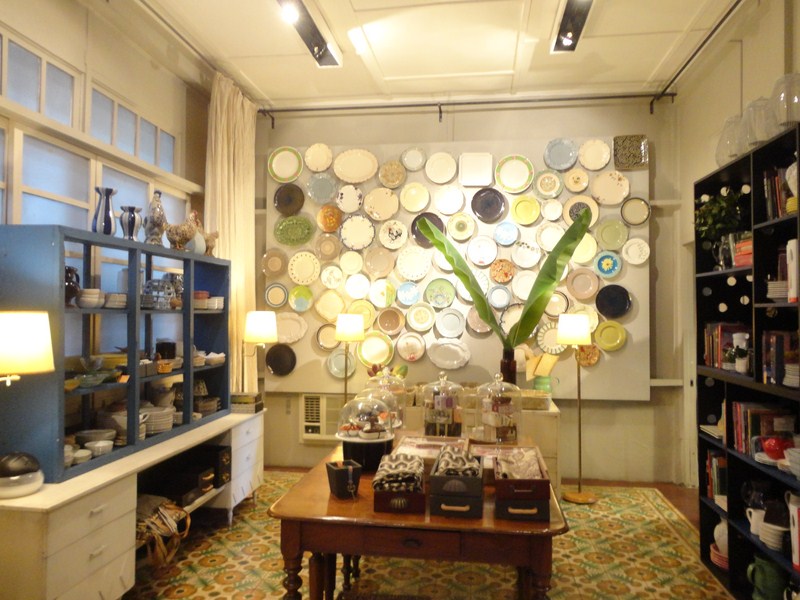
Five of the houses are also being turned into a boutique hotel, an example of adaptive reuse.  It will have a swimming pool and a restaurant.  We all toured each of these establishments (save for the boutique hotel which was still being constructed) which made the compound an artistic hotbed ever since it was occupied by creative souls. All are filled with art, classic French crockery, rustic table settings and furniture and decor that channel everything from Art Deco to mid century to a more industrial style. The space is reputed to be a source for well-known interior designers all over the country.

An A 11 furniture showroom

An A 11 furniture showroom

The Artelano 11 Furniture Gallery, opened last January 2013, houses, in a home setting, many of Eric’s designer furniture plus some  items he brought in from elsewhere.  They include a double-tiered, mid-century side tables; metal-based furniture pieces such as an iron bed frame with a wood-framed screen upholstered in toile de jouy fabric; a mid-century ambassador’s chair finished in black; an antique writing desk refinished in a dark hue; table tops and shelving units with thick slabs of exotic wood; a 4-panel screen, hung with small artwork, made with old doors; low console table, for Eric’s line of lighting, made from an enormous wood column; a metal framed lamp, topped by a marble cylindrical shade, with geometric patterns; a marble wash basin filled with decorative woven rattan balls; a pair of side tables, topped with polished white marble, with hollowed wood bases etched with designs in a random pattern; a cylindrical center table base wrapped with metal strips in a loose weave pattern; and Eric’s collection of colorful ceramic accessories.

Another A 11 showroom

Another A 11 showroom

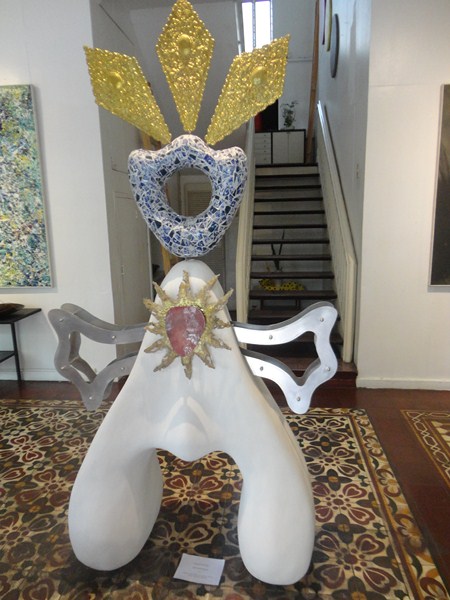
The Avellana Art Gallery, opened in 1997, specializes in eye-catching Filipino art. Its genteel old space was turned by Albert into a retro-modern gallery for the functional art.  The two floors are full of art, with the top floor being used for moving exhibitions, a perfect venue for new and more established artists.  At the entrance lobby is the sculpture “Love From Above” by Pidge Reyes.

Avellana Art Gallery

Avellana Art Gallery

Love from Above by Pidge Reyes

Love from Above by Pidge Reyes

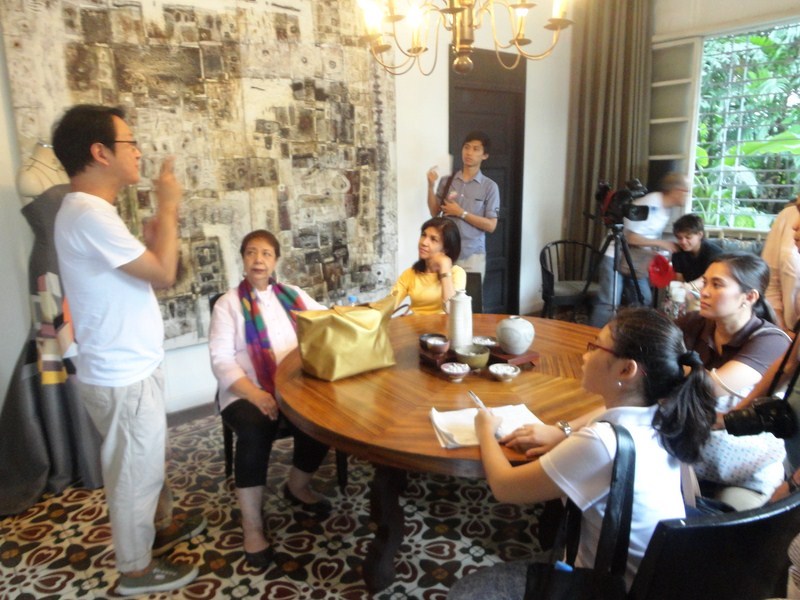
At the atelier of Jojie Lloren, we were welcomed by the mild-mannered and pleasant designer himself.  We all listened to him at his spacious living room, sitting at contemporary chairs around an old round table. His atelier looks a bit French Art Nouveau, the compact space of his workshop made stylish and beautified, in the bayanihan spirit, by his close friends.

Listening to Jojie Lloren at his atelier

Listening to Jojie Lloren at his atelier

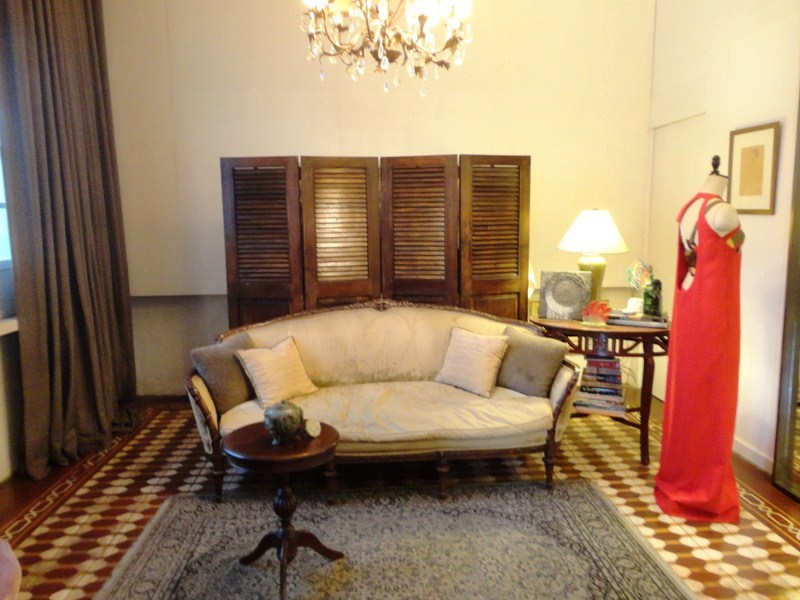
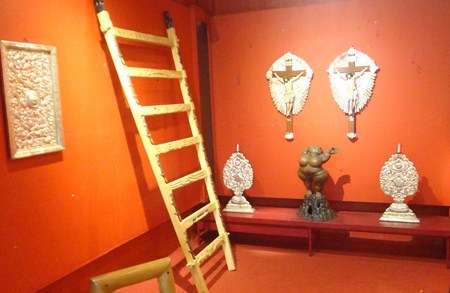
There were furniture pieces (couch, ceramic garden stools, etc.) from Eric Paras’ A11, a louver screen from Albert Avellana, a bird cage from designer James Reyes, and a chandelier from lighting designer Ricky David; all these things close to Jojie’s heart.  Jojie also added period pieces he bought from thrift shops along Evangelista St. in Makati. His display of Filipino religious includes antique Marian medallions ((that spell out his name) and modern Marian prints by Virgilio Aviado.  There are also paintings, including one from Popo San Pascual.

Reception area with a chandelier from Ricky David, couch from Eric Paras and louver screen from Albert Avellana

Reception area with a chandelier from Ricky David, couch from Eric Paras and louver screen from Albert Avellana

Despite the heavy Pasay traffic and braving the pollution and the gritty stretch of urban decay on that day, the sudden change of atmosphere, once inside this place of calm, was truly worth the extra effort.

Religious art collection of Jojie

Religious art collection of Jojie

Avellana Art Gallery: Unit A-19, 2680 F.B.Harrison St., Pasay City. Tel: (632) 833-8357. E-mail: avellana_gallery@yahoo.com.  Open Mondays to Saturdays, 10 AM to 7 PM.

Atelier of Jojie Lloren: Unit A-17 2680 F.B Harrison St., 1300 Pasay City.  Tel: (632) 556-4725, (632) 641-9347 and (632) 401-1194. Fax: (632) 896-7199. E-mail: lyorenne@hotmail.com.

Artelano 11 Furniture Gallery: Unit A-11, 2680 F.B. Harrison St., 1300 Pasay City.  Tel: (632) 832-9972.  Mobile number: (0917) 837-0115. E-mail: a_eleven05@yahoo.com.  
Automobile Association Philippines (AAP): 28 EDSA, Greenhills, San Juan City.  Tel: (632) 655-5889.  Fax: (632) 655-1878.  E-mail: info@aap.org.ph. Website: www.aap.org.ph.

AAP Travel: G/F, Sea Tower Bldg., 2332 Roxas Blvd. cor. Arnaiz Ave., Pasay City. Tel: (632) 551-0025.  Fax: (632) 551-0014. E-mail: info@aaptravel.com.  Website:www.aaptravel.com.ph.

Ta Prohm Temple (Siem Reap, Cambodia)

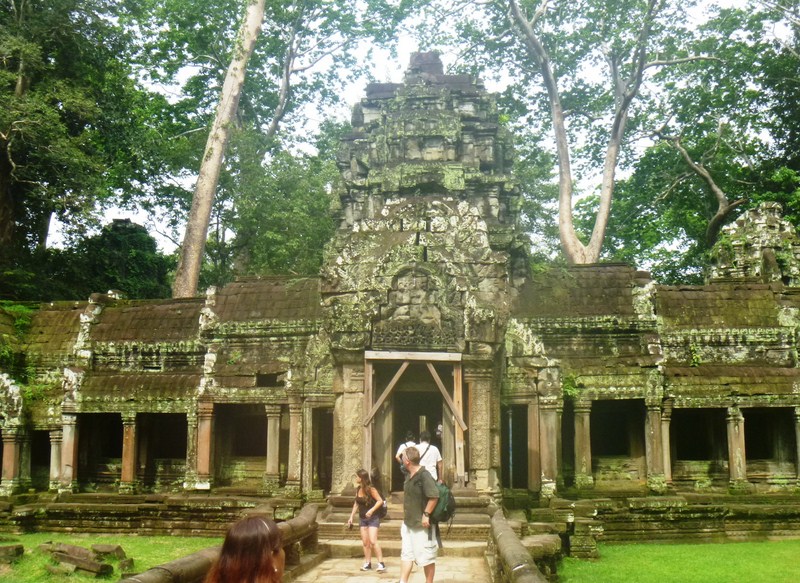
Ta Prohm Temple

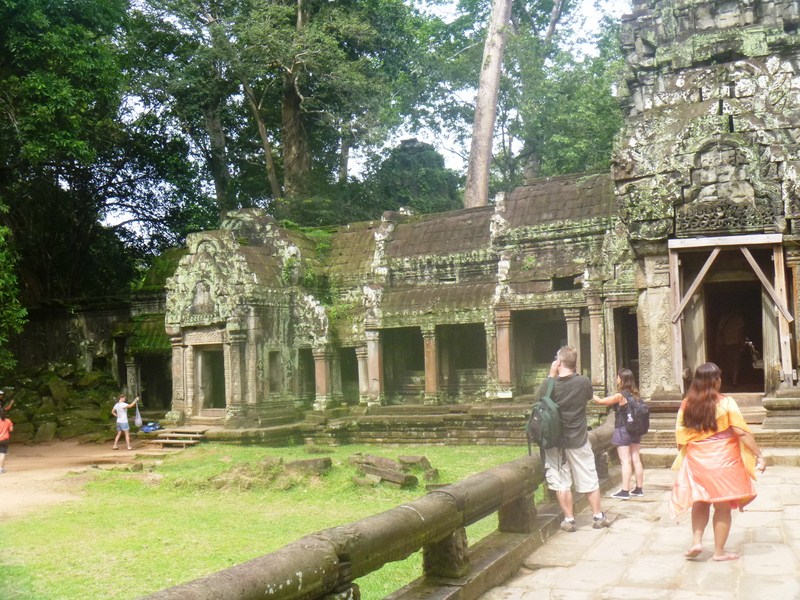
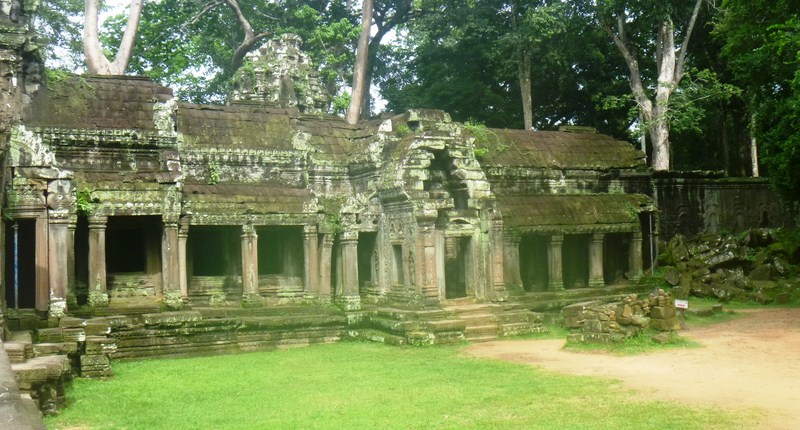
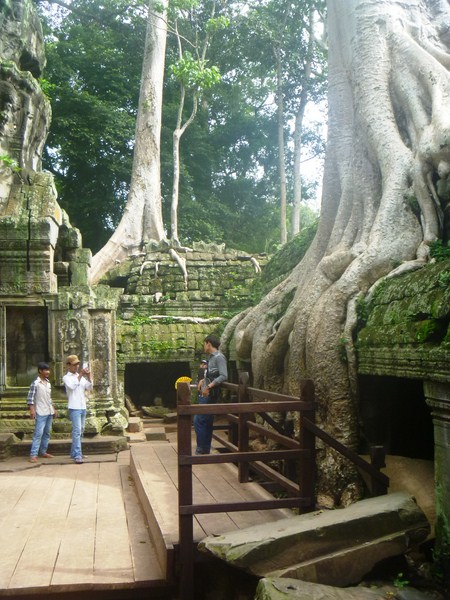
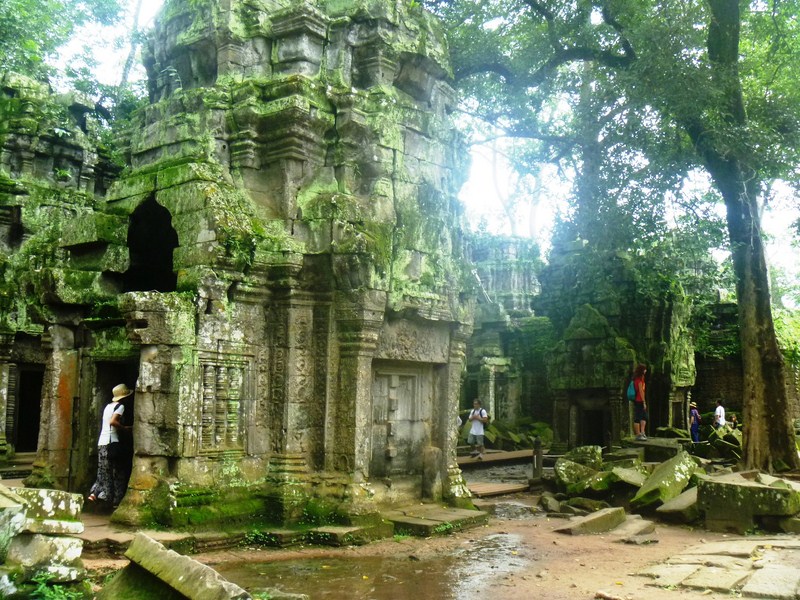
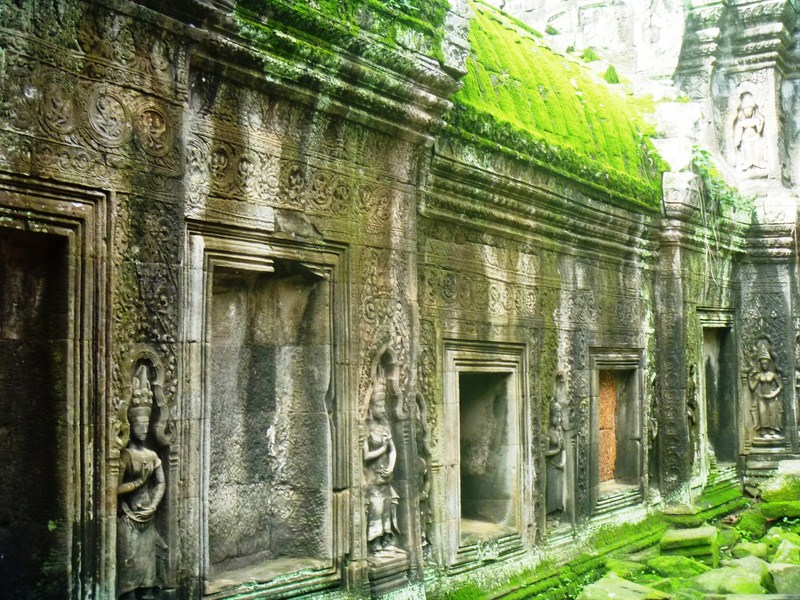
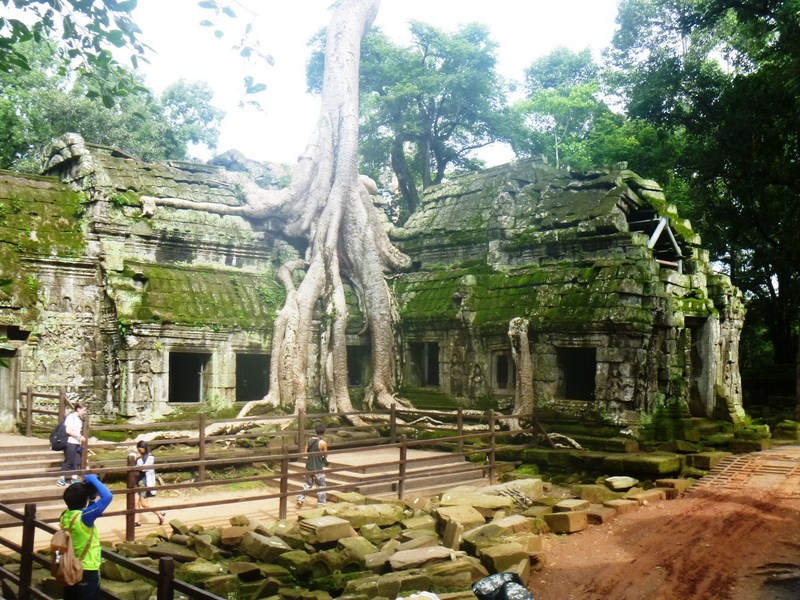
Ta Prohm (pronunciation: prasat taprohm), an atmospheric  temple ruin of towers, closed courtyards and narrow corridors built in the Bayon style, is located approximately 1 km. east of Angkor Thom, on the southern edge of the East Baray.

One of the most visited complexes in Cambodia’s Angkor region, Ta Prohm, nicknamed the “Jungle Temple,” was high on our hit list of temples to visit.

Check out “Bayon Temple

Here’s a timeline of the temple’s history:

  • In 1186 A.D. (the stele commemorating the foundation gives this date), Khmer King Jayavarman VII embarked on a massive program of construction and public works and Ta Prohm was founded as a Mahayana Buddhist monastery and university pursuant to that program.
  • In the 13th century, face towers similar to those found at the Bayon were added to the gopuras. Expansions and additions to Ta Prohm continued as late as the rule of Srindravarman at the end of the 15th century.
  • In the 15th century, after the fall of the Khmer Empire, the temple of Ta Prohm was abandoned and neglected for centuries.
  • In 1947, French explorers rediscovered Ta Prohm
  • In the early 21st century, efforts to conserve and restore the temples of Angkor
  • In 1992, Ta Prohm was inscribed by UNESCO on the World Heritage List.
  • As of 2013, most parts of the temple complex have been restored (some of which have been constructed from scratch) by the Archaeological Survey of India.

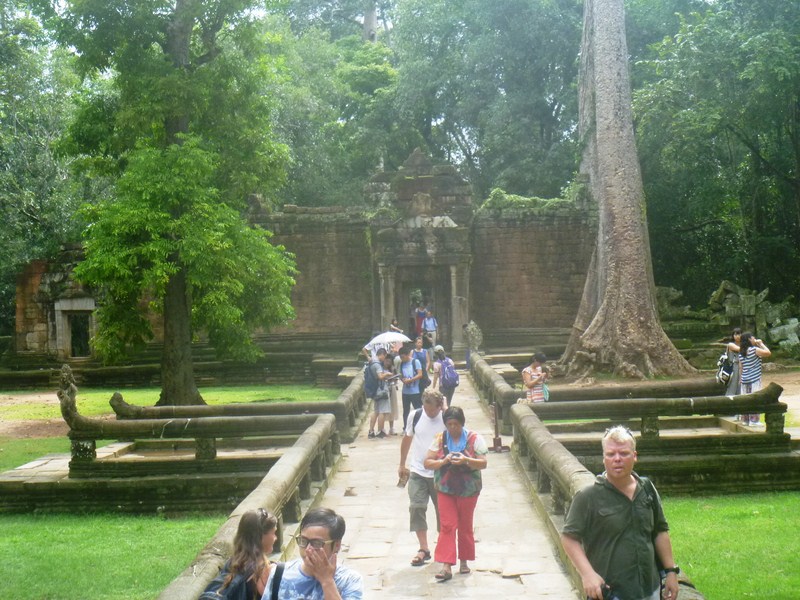
Causeway Connecting 3rd and 4th Enclosure West

Here are some interesting trivia regarding the temple:

  • Originally called Rajavihara (“monastery of the king”), the temple’s modern name means “ancestor Brahma.”
  • Unlike most Angkorian temples, Ta Prohm is still in much the same condition in which it was found. The École française d’Extrême-Orientdecided that Ta Prohm would be left largely as it had been found, as a “concession to the general taste for the picturesque.” Nevertheless, work still had to done to stabilize the ruins, to permit access, and to maintain “this condition of apparent neglect.”
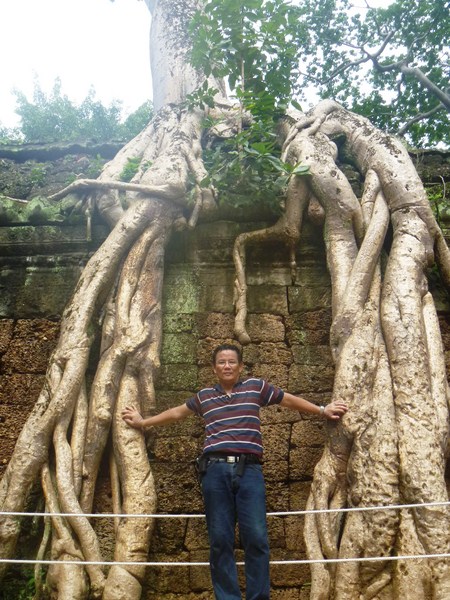
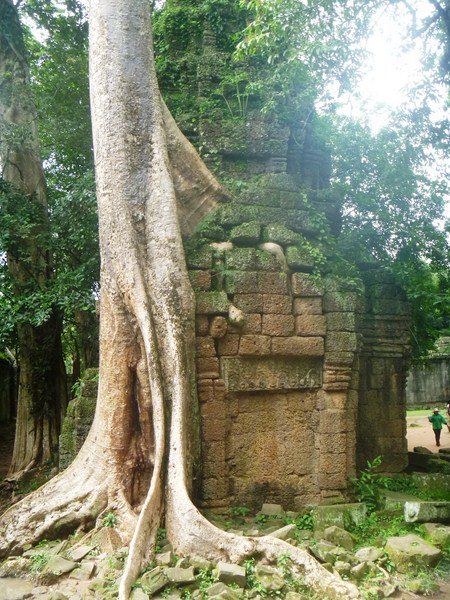
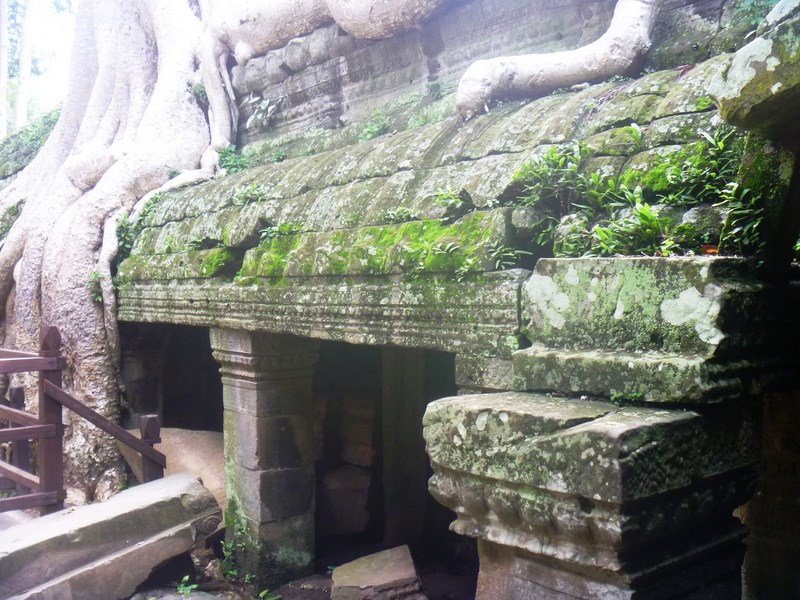
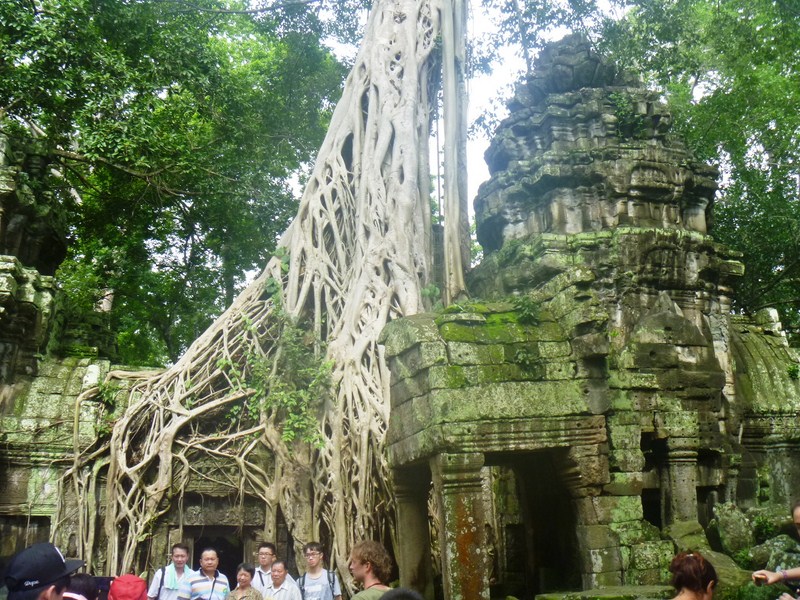
  • Perhaps the most distinctive feature of Ta Prohm are the trees that took root at the loosened stones of the temple, creating an astonishing merger of nature and architecture, and two species of trees predominate (sources, however, disagree on their identification) – the larger silk-cotton tree (Ceiba pentandra) or thitpok (Tetrameles nudiflora), and the smaller strangler fig (Ficus gibbosa) or gold apple (Diospyros decandra).
  • Like most Khmer temples, Ta Prohm is oriented to the east
  • As opposed to a temple-pyramid or temple-mountain (whose inner levels are higher than the outer), the design of Ta Prohm is that of a typical “flat” Khmer temple.
  • Jayavarman VII constructed the temple in honor of his family. The temple’s main image, the elevated stone face of Prajnaparamita (the “Perfection of Transcendent Wisdom”), surrounded by 260 lesser divinities (each housed in their own sanctuaries) was modeled on the King Jayavarman VII’s mother. The northern and southern satellite temples, within the third enclosure, were dedicated to Jayamangalartha, the king’s guru and elder brother. The temple monastery of Preah Khan, dedicated in 1191 A.D., and Ta Prohm also form a complementary pair as the former’s main image, representing Lokesvara (the Bodhisattva of compassion), was modeled on the king’s father.
  • It one of Angkor’s most popular temples with visitors due to the photogenic and atmospheric combination of trees growing out of the ruins and the jungle.
  • In the 2001 film Lara Croft: Tomb Raider (the first major motion picture to be shot in Cambodia since Lord Jim in 1964), the temple of Ta Prohm was used as a location. Although the film took visual liberties with other Angkorian temples, the scenes in Ta Prohm, making use of eerie qualities, were quite faithful to the temple’s actual appearance.
  • Several opening scenes of the 2004 film Two Brothers were also shot here with Guy Pearce hunting the adult tigers through the temple.
  • It is one of the few temples in the Angkor region where a stele (inscription) provides information about the temple’s dependents and inhabitants. Accordingly, the site was home to more than 12,640 people (including 18 high priests, 2,740 officials, 2,202 assistants  and 615 dancers) plus an additional 79,365 souls in the surrounding villages working to provide services and supplies. It also notes that the temple amassed considerable riches, including a set of golden dishes weighing 500 kgs., 35 diamonds, 40,620 pearls, 4,540 precious stones, 876 veils from China, 512 silk beds, etc..
  • One of the temple’s carvings is claim by many people (mostly young earth creationists) to resemble a living stegosaurus. However, the carving actually represents, instead, either a rhinoceros or a boar over a leafy background.
  • In the booklet for Creed‘s third album Weathered, an edited photo of the temple was used.
  • Ta Prohm’s conservation and restoration is a partnership project of the Archaeological Survey of India and the APSARA (Authority for the Protection and Management of Angkor and the Region of Siem Reap), their Cambodian counterpart.

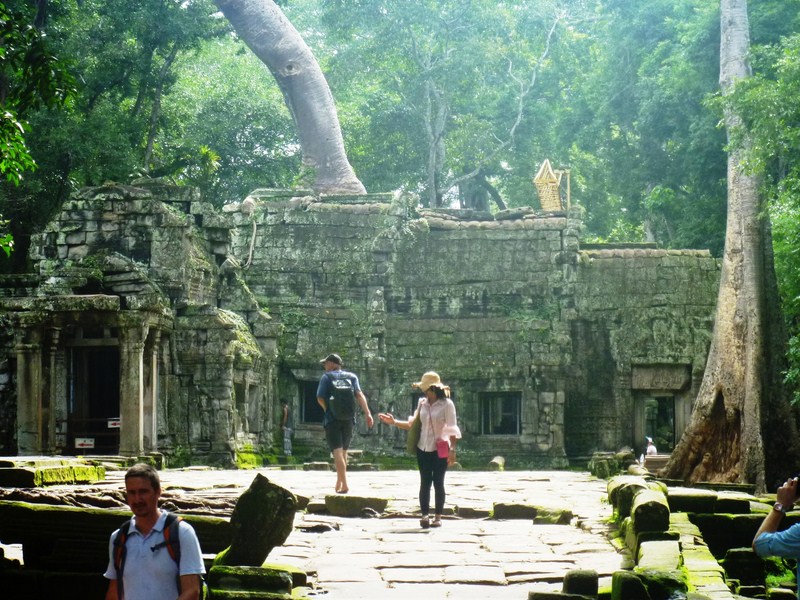
Entrance Gopura on 5th Enclosure West

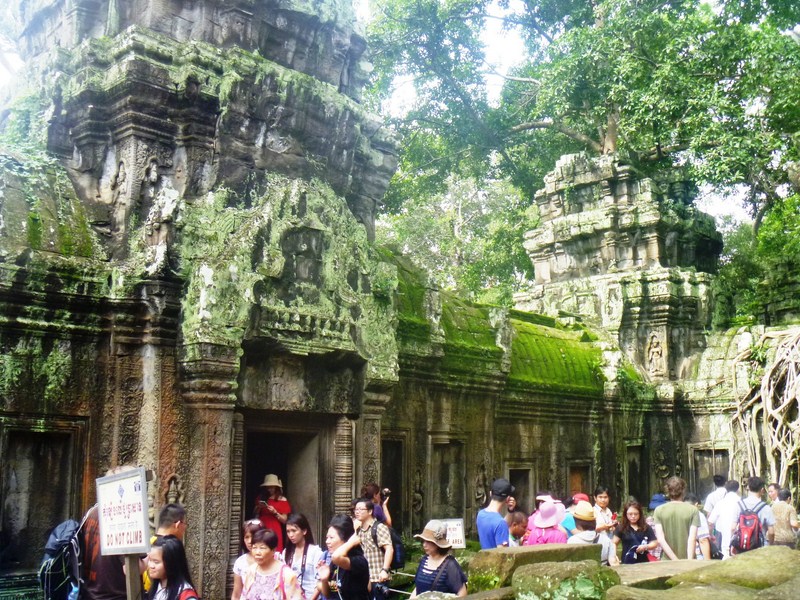
Our access around the temple was complicated and circuitous, necessitated by the temple’s partially collapsed state as well as the large number of other buildings dotting the site (some of which represent later additions).

The author

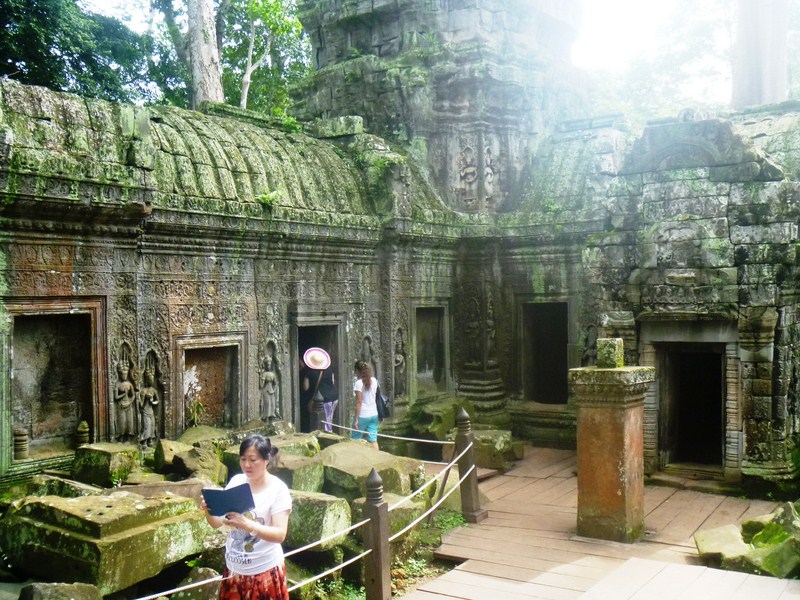
To protect the monument from further damages due to the large tourist inflow, wooden walkways, platforms and roped railings have been put in place around the site.

House of Fire

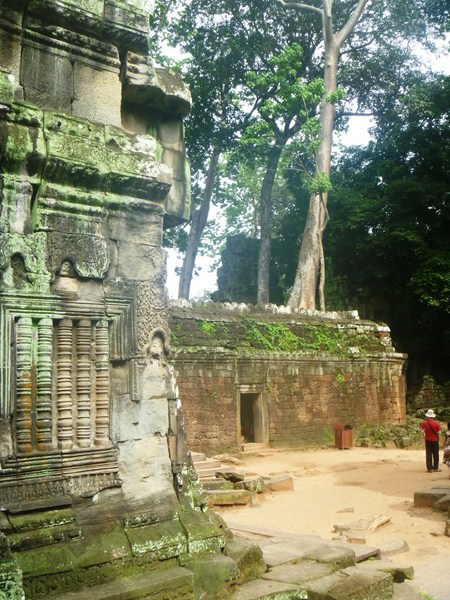
Seemingly looking very much the way most of the monuments of Angkor appeared when European explorers first stumbled upon them, it is actually manicured, with the jungle pegged back and only the largest trees left in place.

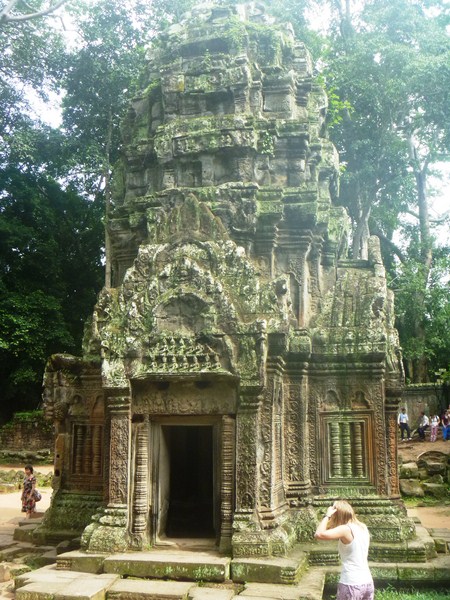
Library

Many of the corridors were impassable, clogged with jumbled piles of delicately carved stone blocks dislodged by the vast roots of huge trees.

The central sanctuary is surrounded by 5 rectangular enclosing walls and the temple proper is set back to the west along an elongated east-west axis.

The 1,000 by 650 m. outer wall, the largest of a series of gradually smaller enclosures, encloses an area of 650,000 sq. m. that, at one time, would have been the site of a substantial but now largely forested town.

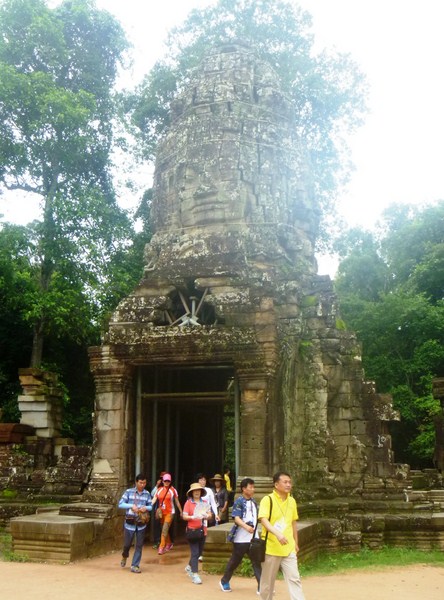
Each of the temple’s cardinal points had entrance gopuras but, today, access is only possible from the east and west. Some of its 13th century face towers have now collapsed.

At one time, the temple had 2 moats, one found inside and another outside the fourth enclosure.

The three inner enclosures of the temple proper are galleried and the first enclosure’s corner towers form a quincunx with the tower of the central sanctuary.


This buildings around the site include libraries in the southeast corners of the first and third enclosures; satellite temples on the north and south sides of the third enclosure; the Hall of Dancers (its 48 pillars, supporting its corbelled roof, has exquisite carvings of dancing apsaras, elephants, men astride horses, floral motifs, etc.) between the third and fourth eastern gopuras; and a House of Fire (or Dharmasala), a resthouse for pilgrims located east of the fourth eastern gopura.

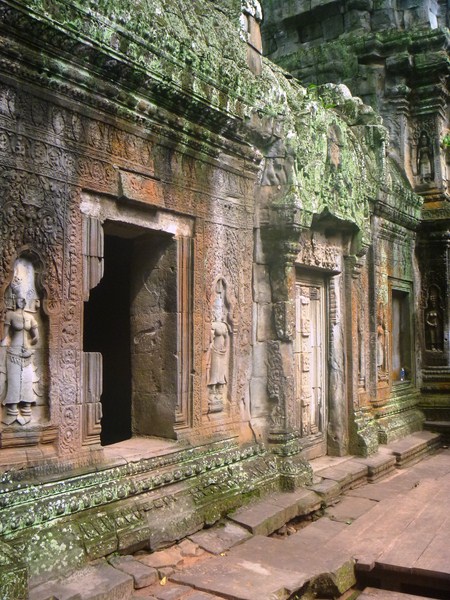
Compared to Angkor Wat or Angkor Thom, Ta Prohm does not have many narrative bas-reliefs, probably because much of the temple’s original Buddhist narrative artwork has been destroyed, following the death of Jayavarman VII, by Hindu iconoclasts.

Crocodile Tree

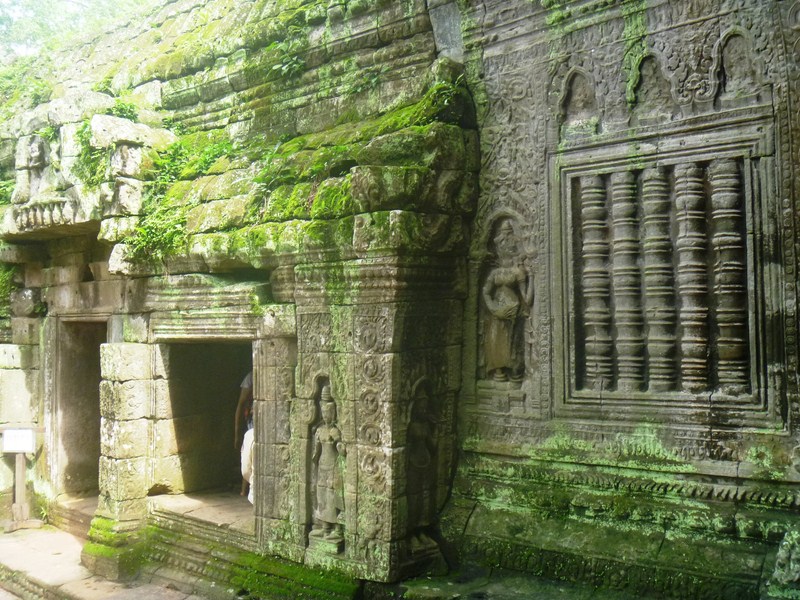
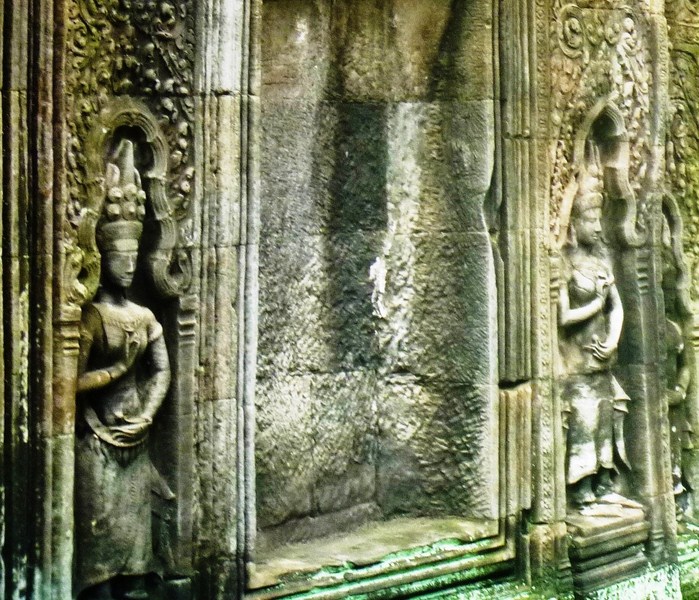
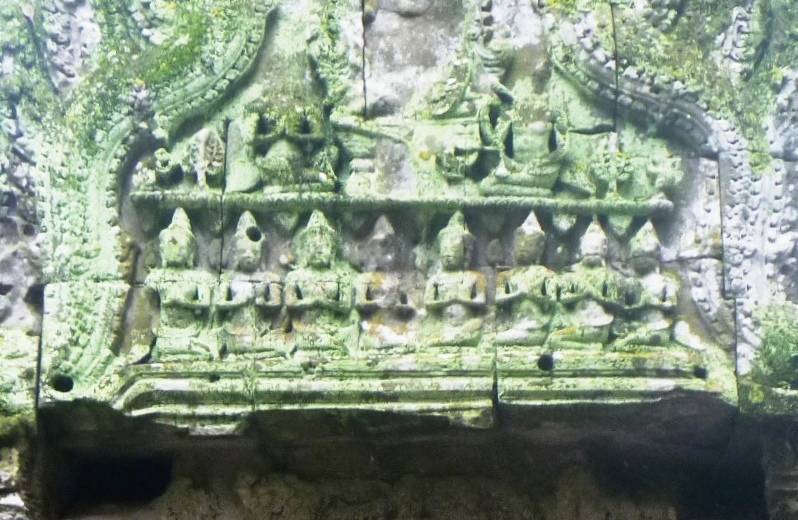
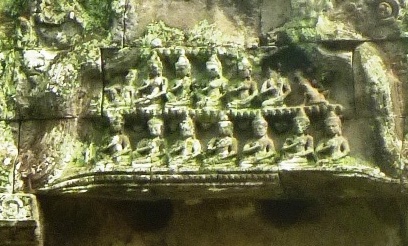
However, there are still stone reliefs of devatas (minor female deities), meditating monks or ascetics, and dvarapalas (temple guardians) plus some depictions of scenes from Buddhist mythology including one badly eroded bas-relief illustrating the “Great Departure” of Siddhartha, the future Buddha, from his father’s palace.

Apsaras

Bas-reliefs

The Crocodile Tree, the nickname of the most popular of the many strangulating root formations, is located on the inside of the easternmost gopura (entrance pavilion) of the central enclosure.

Tomb Raider Tree

The so-called “Tomb Raider Tree,” another of the most famous spots in Ta Prohm, was where Angelina Jolie’s Lara Croft picked up a sprig of jasmine flower and then the sands remarkably parted as she fell through the earth into the hidden vault of the temple (or Pinewood Studios).

Our visit to the venerable Ta Prohm temple ruins, with its bulging walls carpeted with lichen, moss and creeping plants; shrubs sprouting from the roofs of monumental porches; and ancient towering trees with leaves filtering the sunlight and casting a greenish pall over the whole scene, was a unique, other-worldly experience.

Ta Prohm: AngkorSiem Reap ProvinceCambodia. Visit the temple early in the day when it is at its most impressive. If you want to explore the maze-like corridors and iconic tree roots, allow as much as two hours to visit. To protect both temple and visitor, it is now prohibited to climb onto the damaged galleries as these precariously balanced stones, which may weigh a ton or more, could do some serious damage if they came down.

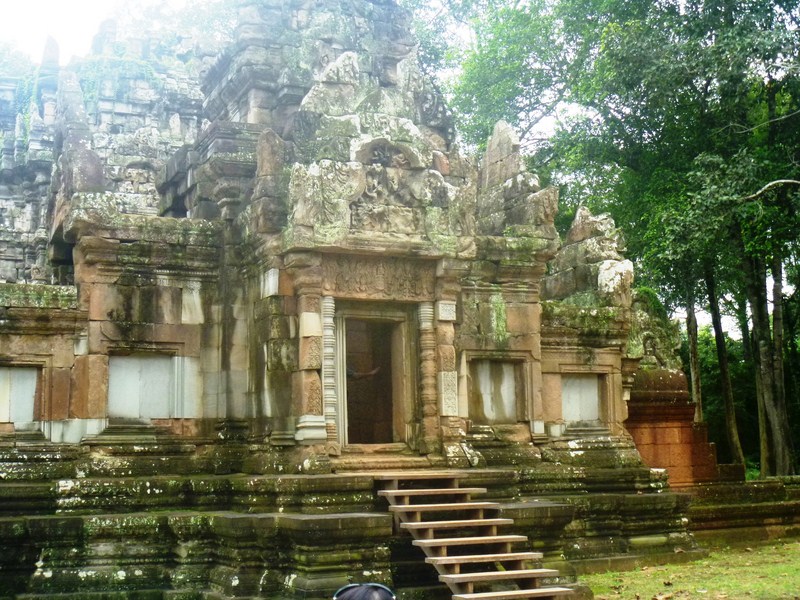
Thommanon Temple (Siem Reap, Cambodia)

Thommanon Temple

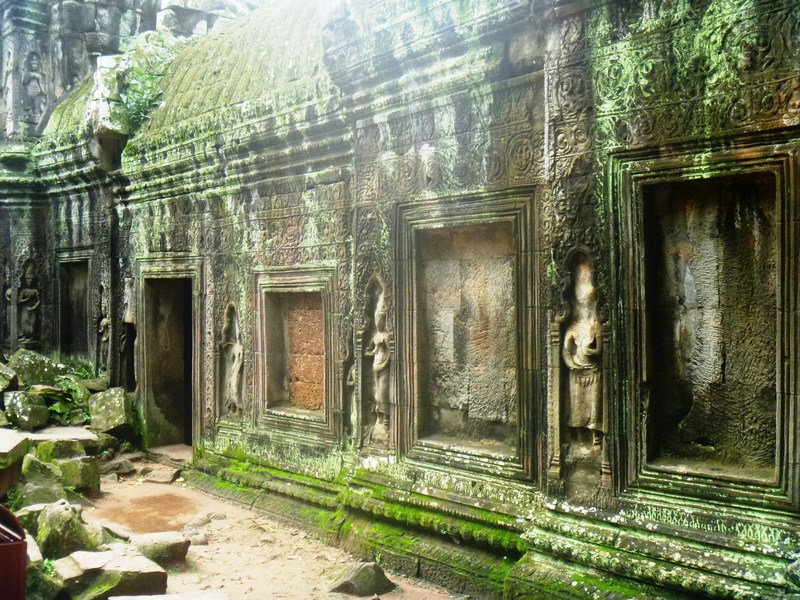
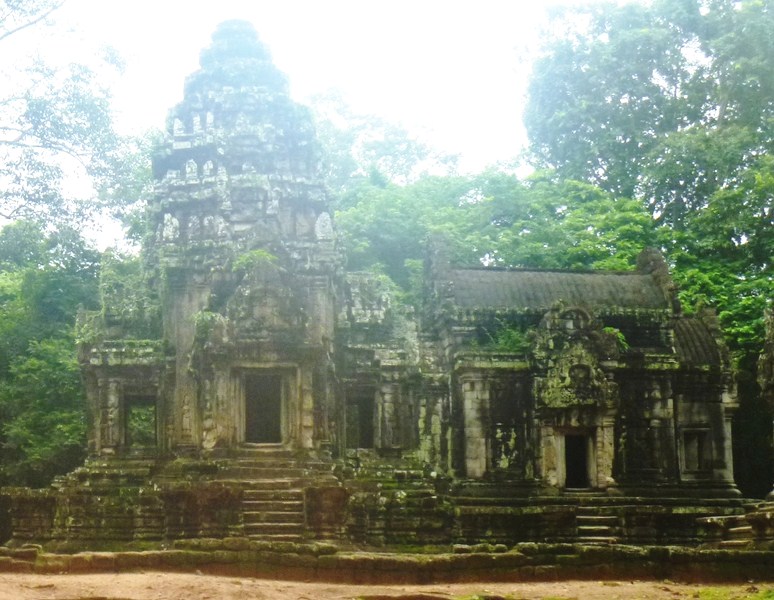
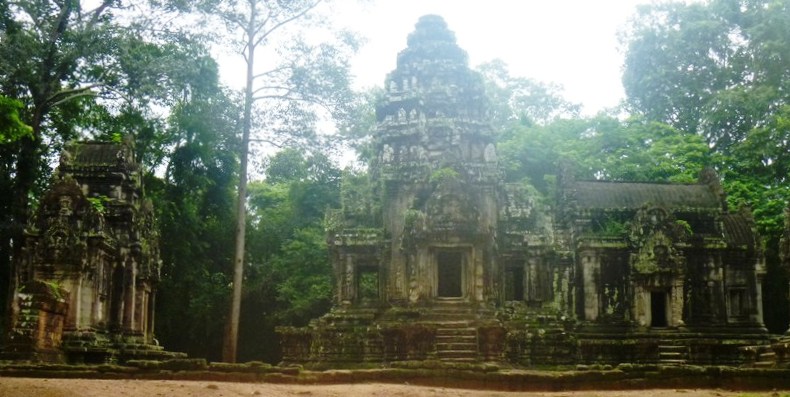
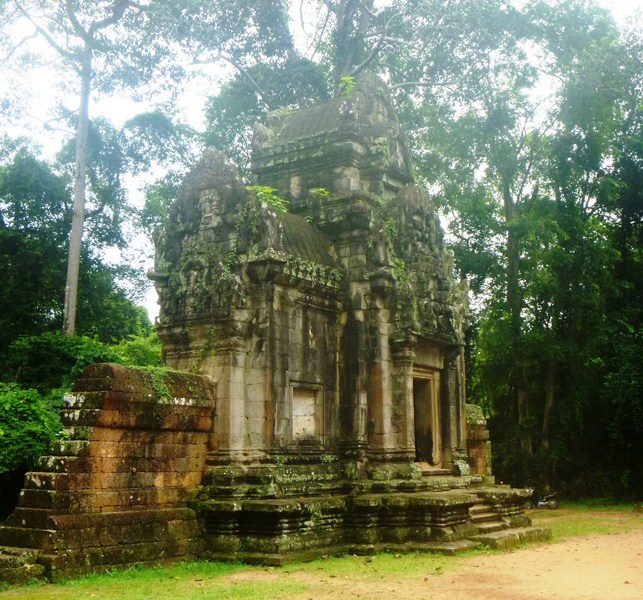
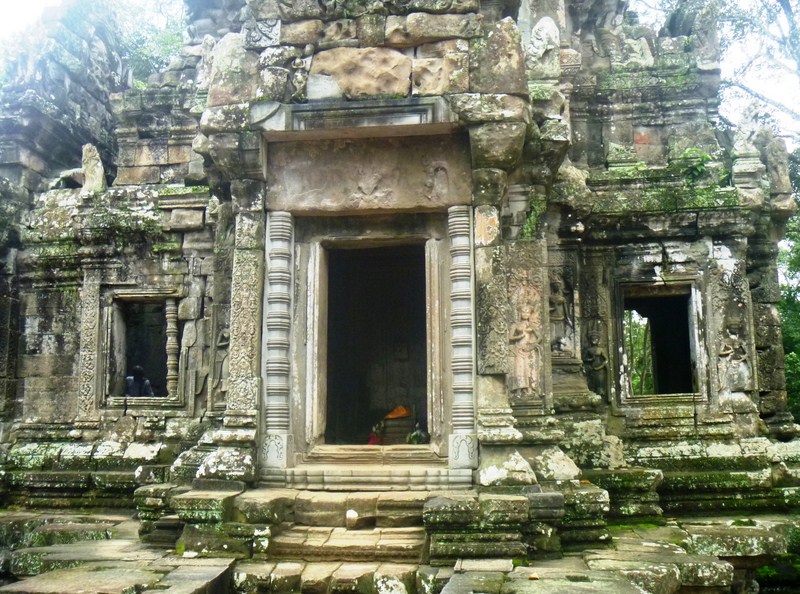
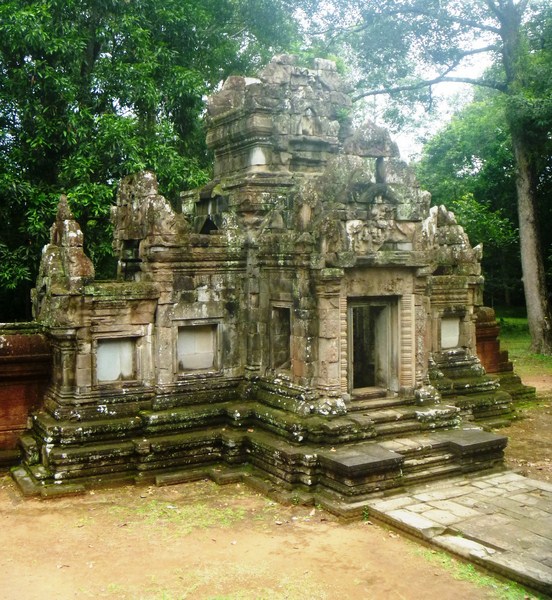
The small and elegant, single-towered Thommanon Temple, one of a pair of Hindu temples built during the reign of Suryavarman II (1113–1150), is located east of the Gate of Victory of Angkor Thom, north and direct opposite of Chau Say Tevoda, around 100m away from the ancient bridge called Spean Thma and  500 m. east of the Victory Gate (just a few minutes off Victory Way just before you reach the Siem Reap River) on the way to Ta Keo. The temple, dedicated to Shiva and Vishnu, is part of the UNESCO World Heritage Site (inscribed by UNESCO in 1992 titled Angkor).

Check out “Chau Say Tevoda

Like the other temples in the region, it’s believed that Thommanon was deserted at some point in the 16th century. In the 1960s, a full and extensive restoration, funded by the École française d’Extrême-Orient (EFEO), was undertaken by French archaeologists who restored the temple and added concrete ceilings.

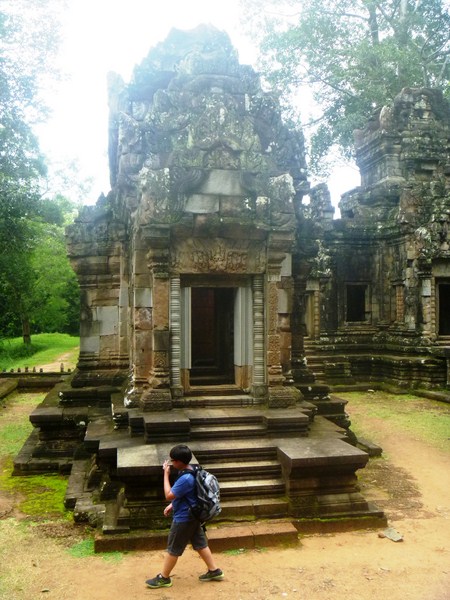
Thommanon has an east-facing central sanctuary, crowned by a tower (prasat), which can be accessed, from the east, via an entrance building (gopura), and a smaller antechamber (mandapa). The tower’s architectural style is similar to that of the Angkor Wat temple and the nearby Chau Say Tevoda.  However, though similar in design, Thommanon is better preserved than Chau Say Tevoda, attributed to the fact that its superstructure does not have stone-enclosed wood beams.

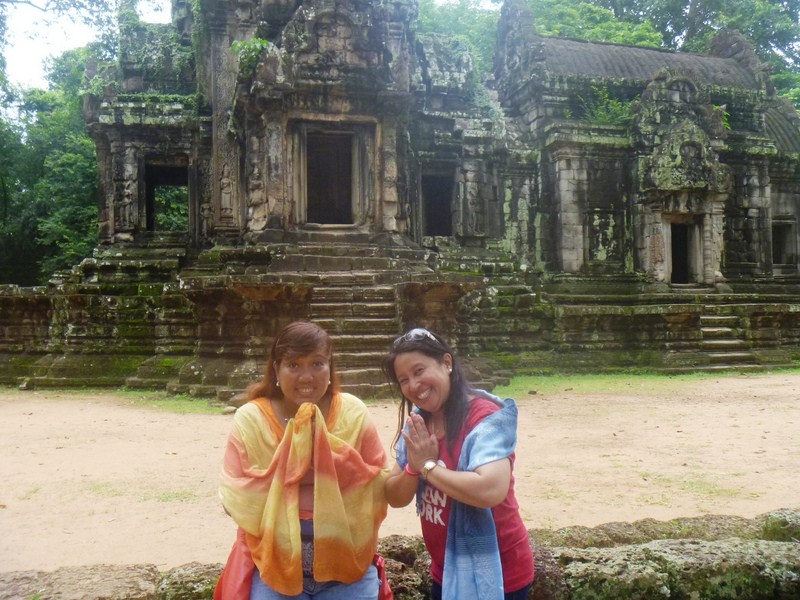
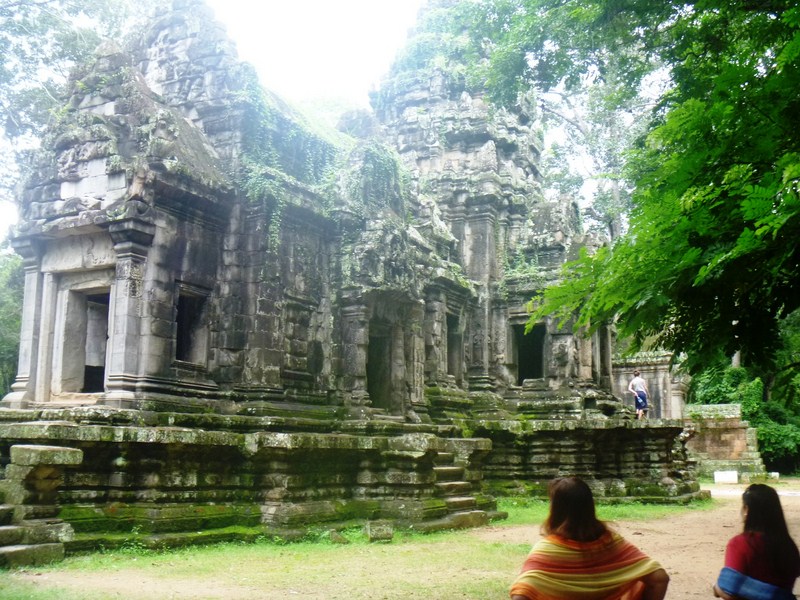
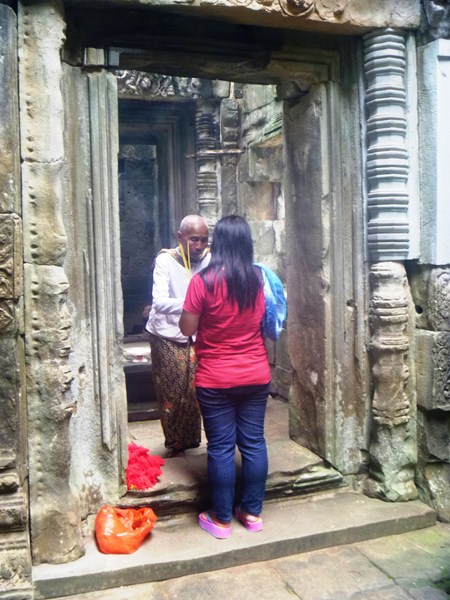
Violet and Osang at Thommanon Temple

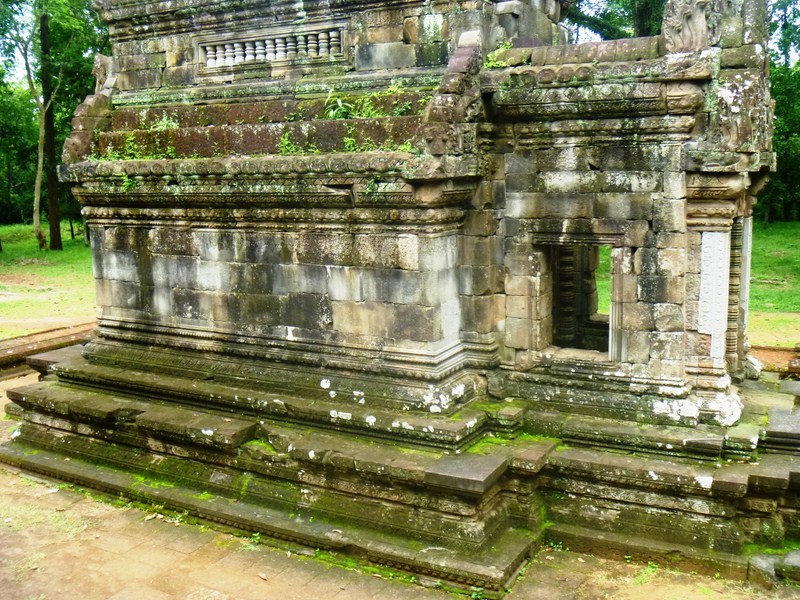
The temple’s adoption of sandstone (which provides a distinct contrast to the surrounding jungle) as the medium for its very well preserved carvings has made it more advanced, in its architectural design, vis-à-vis other mostly wood-based temples in its vicinity. All of its doorways include carved pediments.

However, only the entry gates on the east and the west and the central tower of the main temple are all that remains. The compound walls around the temple have all but disappeared.

The Library

Thommanon and Chau Say Thavoda were inferred to have been interlinked to the central tower under one large compound with large gates. The independent library building was separated from the main temple.

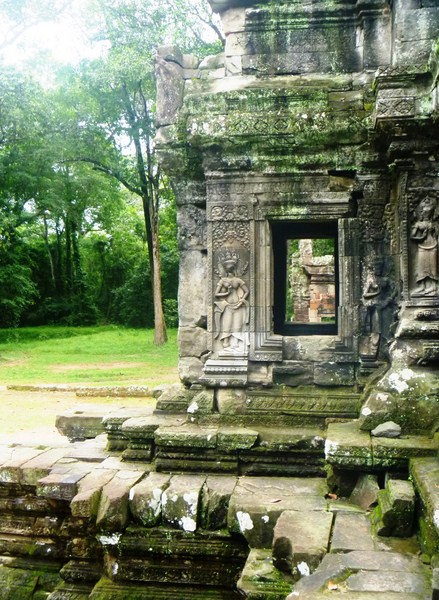
As in other Khmer temples, images of devatas, the distinctive carvings of divine female figures which include flower crowns, Cambodian skirts (sampots), necklaces, armbands, belts and ankle bands, are the centre of attraction in Thommanon and are seen in profusion here. The mudras displayed are complex.

The devatas very distinctively grip the flower in a position called by one Angkor researcher as the devata mudra, holding the ring and middle fingers against the thumb, while the index and small finger are extended.  This position is also prominent at Angkor Wat. Some believe that the devatas, indicate that they were built during the reign of Jayavarman VI (1080–1113 AD), some time at the end of the 11th century. However, after studying the devatas in Thommanon, there is greater agreement among scholars that it was built by Suryavarman II around the time of Angkor Wat and Beng Mealea from 1113 to 1150 AD.

Check out “Angkor Wat

Thommanon Temple: Angkor, Krong Siem Reap, Cambodia.

Chau Say Tevoda (Siem Reap, Cambodia)

Chau Say Tevoda

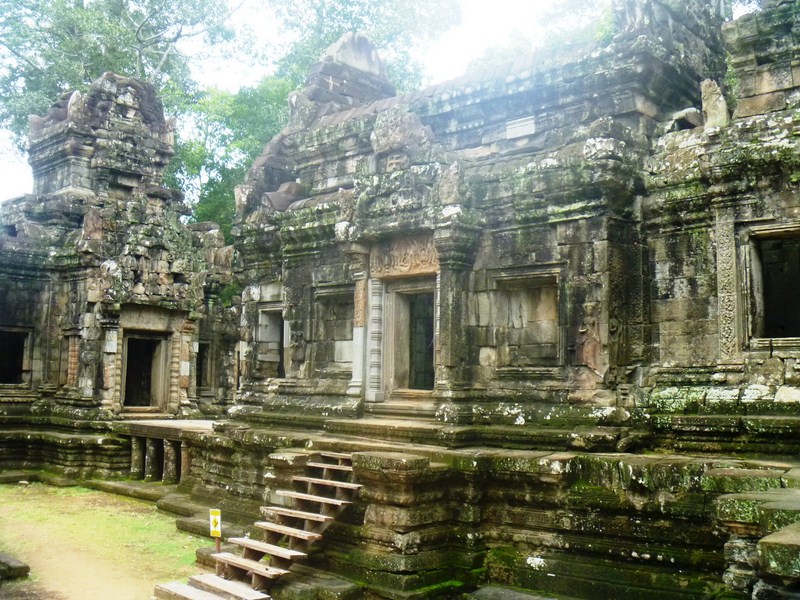
Chau Say Tevoda (literally: prolific grandchildren of a deity), a Hindu temple dedicated to  predominantly Hindu deities such as Shiva and Vishnu, is located just 500 m. (1,600 ft.) to the northeast of east gate of the ancient capital Angkor Thom and directly south of Thommanon (the temple is on its opposite side of the road) across the Victory Way (it pre-dates the former and post-dates the latter).  Unique devatas (types of female sculptures) and Buddha images are enshrined in it.

Check out “Thommanon Temple

Thommanon and Chau Say Tevoda, both similar in plan and stylistically belonging to the best period of classic art, represent two variations of a single theme of composition. However, Chau Say Tevoda is more deteriorated than Thommanon Temple.

Here is a historical timeline of the temple:

  • It was partly built in the mid-12th century in the Angkor Watperiod during the reign of Hindu King Suryavarman II.
  • During the reign of Dharanindravarman (father of Jayavarman VII, who ruled from Preah Khanof Kompong), representations of Buddha  images were built.
  • During the reign of Jayavarman VII, further supplementation of structures was done.
  • In the 16th century, like most of the temples in the area, the temple was abandoned at some point.
  • In the late 19th century, Chau Say Tevoda was rediscovered by French explorers.
  • Between 2000 and 2009, under a project sponsored by the People’s Republic of China, a Chinese team carried out restoration work, using many of the 4,000 elements lying scattered on the embankment and in the Siem Reap River.
  • In late 2009, the temple was reopened and is now fully accessible.

We entered and left Chau Say Tevoda via the north entrance. Walking towards the temple, we can see traces of a moat and vestiges of a laterite base of an enclosing wall.

About 200 m. (660 ft.) from the temple is a bridge, without a river flowing beneath it (in view of the shifting nature of the course of the Siem Reap River), built with carved stones from temple ruins in the vicinity.

Chau Say Tevoda, similar to Hindu temples built in India (particularly in Odisha), has a cruciform plan and is linked to an entrance hall. The temple, with four gopuras (towers) on the four cardinal signs, has an entrance from the east though a raised bridge. The gopuras and central chamber of the temple are linked by a long hall decorated with a very elegant pattern of flowers inscribed in squares and sculpted with stone flowers similar to those seen at Banteay Srei and Baphuon.

Check out “Baphuon Temple

The temple, consisting of a central tower with an attached mandapa(achieved through a small antarala chamber), has two libraries on its southern and northern sides and is enclosed by a compound wall with four gopuras. A raised causeway, on three rows of octagonal supports (later than the monument) to its east, leads to the Siem Reap River.

Shiva is the main deity of the temple. Many of the sculptures, depicting Vishnu, are in a fairly good condition. Totally disfigured and defaced sculptures of Buddha, deified in a lotus posture and flanked by devotees, are in a mandapa behind a pediment from the entrance door which leads to the antarala. With time, its ceiling has collapsed, leading to further deterioration.

The incomplete eastern Gopura I, oriented in the western direction, has a roof which is part of the not fully restored second “pediment of the lateral southern extension.”  A Buddha, the main figure here, is in a cross legged posture and seated on a high platform flanked by disfigured carvings which are interpreted as that of Garuda and the king of Nagas.

The top pediment of Gopura I, with a figure of Buddha, has the umbrella cover of a Bodhi tree. Carvings, depicting episodes from the life of Buddha, can be seen on the northern door of the eastern Gopura I. The notable bas-relief  of Sita, heroine of the epic Ramayana, can be found here in a seated posture over an altar flanked by rakshasis (female demons). Facing Sita is the carved Hanuman, in a small monkey form and in sitting posture, offering her Rama‘s ring. A wall enclosing the temple in the past, built with laterite stones, has disappeared.

Osang making an offering

Chau Say TevodaAngkor, Cambodia.

How to Get There: from Angkor Thom, you can reach Chau Say Tevoda by exiting through the Victory Gate along Victory Way. Alternatively, you can head east from Angkor Wat to Srah Srang. From there, turn left and then, after  Ta Prohm temple, turn right. Follow the road to the left and go across the Siem Reap River. You’ll see the temple on the left side. It’s also not too far from the town, so it’s easily accessible by bicycle, tuktuk and taxi.

Baphuon Temple (Siem Reap, Cambodia)

The beautiful, three-tiered Baphuon Temple

The  beautiful Baphuon, a three-tiered sandstone temple mountain built as the state temple of Udayadityavarman II and dedicated to the Hindu God Shiva, symbolically represents the sacred, 5-peaked Mt. Meru important in both Hindu and Buddhist cosmology.  Probably among the most impressive of the Angkor temples in its day, this temple is located approximately 200 m. northwest of the Bayon.

Check out “Bayon Temple

It was built in the mid-11th century (before the city of Angkor Thom was established) and is the archetype of the Baphuon style of design, with beautiful, intricate carvings covering every available surface including both realistic and fanciful depictions of lotus flowers, wild animals and hunters, devata figures, men in battle as well as carvings with indirect references to Hindu mythology and scenes illustrating epic poems such as the Ramayana.

Baphuon is part of the Angkor Small Circuit which takes you to all the “must-see” temples within the enormous Angkor Archaeological Park.  There are three enclosures in the Baphuon temple complex. The pyramid-style temple, situated on a high base adjoining the southern enclosure of the royal palace, measures 120 m. east-west by 100 m. north-south at its base and stands 34 m. tall without its original tower (which would have made it roughly 50 m. tall).

In the late 15th century, the Baphuon was converted into a Buddhist temple and a 9 m. tall by 70 m. long statue (one of the largest in Southeast Asia) of a reclining Buddha  was built on the west side’s second level.  To supply stones for the statue, this probably required the demolition of the 8 m. high bronze tower above (thus explaining its current absence).

The elevated sandstone walkway leading to the temple

Throughout its history, the temple’s site was unstable due to its immense size and it being built on land filled with sandy soil. By the time the Buddha was added, large portions had probably already collapsed. Surrounded by a 125 by 425 m. wall, the central tower was probably gilded wood, which has not survived.

This magnificent temple was very nearly lost to history as the ravages of time have caused significant damage.  By the 20th century, much of the temple had largely collapsed.  Restoration efforts took on an epic quality and the tale of how it was restored is just as impressive as the structure itself.  A large-scale project entailing a process known as anastylosis was proposed wherein the temple was dismantled so that its core could be reinforced before the whole is re-constructed again.

Violet making her way along the walkway.  In the background is the pavilion at the middle of the walkway

In 1970, civil war broke out and the project was abandoned. About 300,000 carefully labeled and numbered blocks, organized across 10 hectares surrounding the temple, were abandoned after the workers and archaeologists were forced to leave and, during the decade of conflict and the Khmer Rouge that followed, the plans identifying the pieces were destroyed by the Khmer Rouge and lost.

In 1996, under the guidance of architect Pascal Royère from the EFEO, a second project to restore the temple, called the “largest 3D jigsaw puzzle in the world,” was launched. Modern technology greatly aided in the process but it still took the team 16 years to complete. The lighter colored stones are the restored pieces.

Wooded stairs leading up to the terrace

After 51 years of work, the restoration was completed in April 2011 and the temple formally re-opened. On July 3, 2011, the temple was inaugurated with King Norodom Sihamoni of Cambodia and Prime Minister Francois Fillon of France  among those who first toured the renovated temple.

We approached the temple from the east via a 225 m. long, elevated sandstone walkway.  After passing through a pavilion about halfway along the walkway, we caught sight of the main temple. Next, we had a bit of a workout as we climbed the steep wooden stairs that lead us up to a terrace.

Jandy and Osang making their way down the walkway

As we visited Baphuon in the early afternoon, there is no shade available on the long walkway and the steep climb to the top was very taxing during this hottest part of the day. However, upon reaching the summit top, we had one of the best spectacular views of the Angkor Archaeological Park and the city of Angkor Thom. We are truly fortunate to have been able to visit this remarkable site.

Baphuon Temple: Angkor Thom, AngkorCambodia. Tel: +855 63 765 577.  Visit Baphuon in the morning or late afternoon as there is no shade available on the long walkway. Hiring a tuk-tuk driver to take you around the Angkor complex is an inexpensive way to efficiently cover more ground and make sure you don’t miss anything in this complex.

Preah Pithu (Siem Reap, Cambodia)

Preah Pithu (or Prasat Preah Pithu), a group of five temples (in fact, they were, in all probability, not designed as a group) identified by letters: T, U, V, W and X, are located north-east of the Bayon and the Terrace of the Leper King and in front of Tep Pranam. Except for Temples “T” and “U,” they weren’t built in the same period so there is no apparent order. The first four temple letters are Hindu while “X” is a Buddhist temple that remained unfinished and is probably the latest.

Check out “Bayon Temple” and “Terrace of the Leper King

Preah Pithu

Not much is known about the Preah Pithu temple group. It’s thought that they were built, in the art style of Angkor Wat,  in the first half of the 12th century (parts of the 13th century) during the reign of kings Suryavarman II (reigned 1113-1150) and Jayavarman VIII. It’s thought that Preah Pithu was abandoned in the 16th century, along with the other temples in the area.

Check out “Angkor Wat

Quite for sure, they were built together as they are on the same W-E axis and are oriented to the west.  They have a cruciform terrace on two levels, with nāga balustrades as entrance. An often dry single moat surrounds some of the temples.

From Bayon, Violet, Osang and I headed north. Continuing past the Terrace of the Elephants and the Terrace of the Leper King  heading towards the North Gate, we saw a small group of market stalls on the right sidel. Heading between the two groups of market stalls, we first saw Temples “T.” and “U.”  Temples “T” and “U” were on the same east-west axis, share a single moat and are both oriented to the west which is unusual for Khmer temples. To the north is Temple “V” and to the east we saw Temples “X” and “Y.”

The temples were first cleaned by Jean Commaille in 1908, then by Henri Marchal from 1918 to 1920. Only recently, the Preah Pithu complex has been cleared, made safe and opened to visitors. However, the five temples are in a bad condition, their upper levels ruined, but their interesting, decorative carvings are good and the site is rather peaceful, semi-wooded and scarcely crowded.

Temple “T” has a 45 by 40 m. sandstone enclosure with two gopuras (entrance buildings) on the main W-E axis. The sanctuary, on a 3-level, 6 m. high ornated platform, has a chamber which shelters a large linga on its pedestal. The walls are decorated with Bayon-style devatas and floral motifs. On the ground, the fragments of the lintel of the western door show a stylized depiction of the “Churning of the Sea of Milk.”

The author. Behind him is a glimpse of Temple “T”

Temple “U,” very similar in design to Temple “T”(but smaller and simpler), has a 35 by 28 m. enclosure with no gopura (entrance buildings). The lintel of the west door shows the Trimurti, with Shiva dancing on a kala-head between Vishnu and Brahma. The internal walls are sculpted with dvarapalas. The blind arches, at the base of pillars, are typical of Angkor Wat period. The northern lintel has another depiction of the “Churning of the Sea of Milk.”

Temple “V,” outside the residual moat and north of Temple “U,” is oriented to the east, where it opens with a double vestibule and has no enclosure. On the west side is a causeway which ends with a 40 m. long cruciform terrace, leading into the northeast corner of the Royal Square. Its sanctuary chamber, standing on two-tier sculpted basement, is the largest of the group, having a square side of 3.80 m. and hosting a large 1.5 m linga. Its external decorations, in the Angkor Wat style, are incomplete. The sanctuary tower, sitting on a two-tiered platform, has decorations in the Angkor Wat style.

Temple “Y,” standing on an earthen platform, north of Temple “V,” has no basement or stairways. Dated between Angkor Wat and Bayon, it is oriented to the east.  The temple has a long mandapa as entrance linked by a vestibule to a 3.5 by 3.0 m. sanctuary chamber, which hosted a 0.95 m. tall linga. The larger, mostly collapsed chamber has two remarkable half-frontons, on its western side, which depict the defeat of the asura Bana by Hindu god Krishna to the north and the three giant steps of Vamana to the south. Temple “Y” was also unfinished.

Temple “X,” a Buddhist temple, may have even been built as late as the 14th century.  It is similar in design to the other temples but its carvings are incomplete. Inside the sanctuary tower are carvings of Buddha and Buddhist motifs.

Though nothing compared to the more popular temples in the area, Preah Pithu does get quite a lot of visitors because of its beautiful carvings, some of the finest found in the Angkor Archaeological Park.  The surrounding forest also makes for a very pleasant and peaceful experience.

Preah Pithu: Angkor ThomCambodia

Terrace of the Leper King (Siem Reap, Cambodia)

Located in the northwest corner of the Royal Square of  Angkor Thom and immediately north of the Terrace of the Elephants, we accessed this U-shaped structure from the main road.  This is thought, by some, to have been used as a royal cremation site.

Check out “Terrace of the Elephants” 

The Terrace of the Leper King

The Terrace of the Leper King

It was built at the end of the 12th century, in the Bayon style, by Jayavarman VI who reigned from 1181 to 1220.  Its modern name is derived from a 15th-century sculpture, discovered at the site (now replaced by a replica) called the “Leper King.” The original statue now sits in the courtyard of the National Museum in Phnom Penh.

Osang beside the replica of the statue of the Leper King

Osang beside the replica of the now shrouded statue of the Leper King

The  statue, with thick lips, energetic chin, full cheeks, slightly open mouth, aquiline nose and clear brow,  sits in the Javanese fashion (with his right knee raised) on a platform on the terrace. The position of its missing hand suggests it was holding something. Its nakedness and teeth being shown in a smile are absolutely and strangely unique in Khmer art.

Bas reliefs

Detail of bas reliefs

Mystery and uncertainty surround the origin of its name. Some say it was so called because of its discoloration and the lichen and moss growing on it, reminiscent of a person with leprosy.  It  also said to depict Yama (the Hindu god of death or judgement), Kubera (the god of wealth, an alleged leper) and also fits in with the Cambodian legend of Yasovarman I (Dharmaraja), an Angkorian king who had leprosy.

The false corridor which allows visitors to inspect the bas relief on the first wall

The false corridor which allows visitors to inspect the bas relief on the first wall

The terrace is faced with dramatic bas-reliefs, both on the interior and exterior. During clearing, the EFEO (Ecole Française d’Extreme-Orient) found a second, 2 m. wide laterite wall, faced with sandstone, with bas-relief similar in composition to those of the outer wall. EFEO recently created a false corridor which allows visitors to inspect the bas relief on the first wall.