Gallerie dell’Accademia (Venice, Italy)

Gallerie dell’Accademia

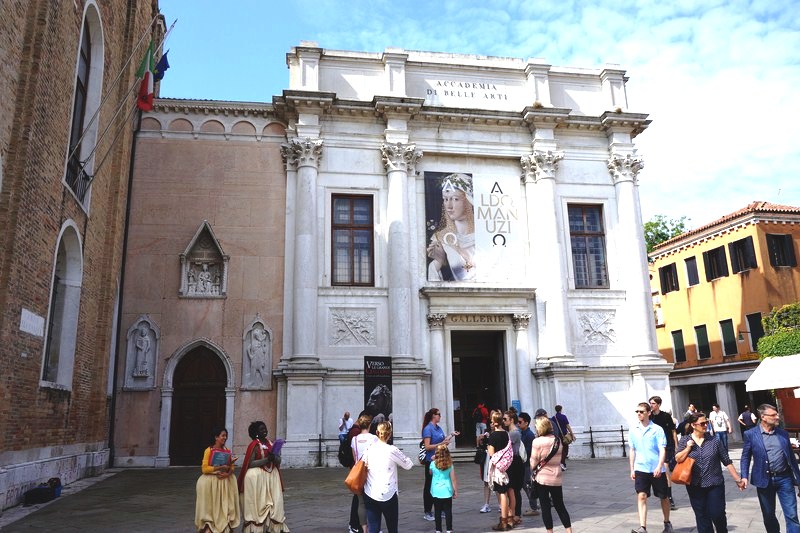
The Gallerie dell’Accademia (Accademia Gallery of Venice), on the south bank of the Grand Canal, within the sestiere of Dorsoduro, is a museum gallery of pre-19th-century art in Venicenorthern Italy.

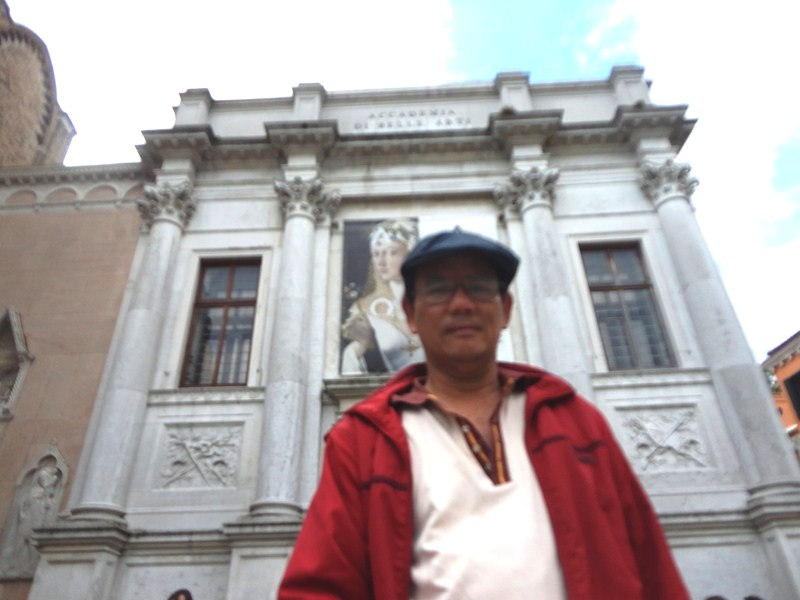
The author in front of the museum

Housed in the Palladian complex of the Scuola della Carità (the oldest of the six Scuole Grandi (though the building dates back to 1343, the scuola was formed in 1260), it was originally the gallery of the Accademia di Belle Arti di Venezia (founded on September 24, 1750, it was one of the first institutions to study art restoration starting in 1777 with Pietro Edwards, and formalized by 1819 as a course), the art academy of Venice (from which it became independent in 1879) which remained in the same building until 2004, when the art school moved to the Ospedale degli Incurabili.

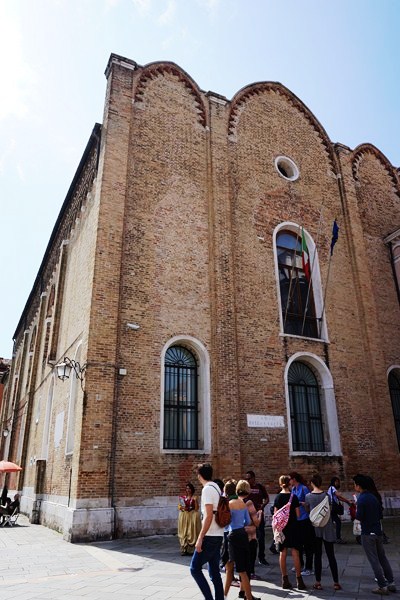
Church of Santa Maria della Carita

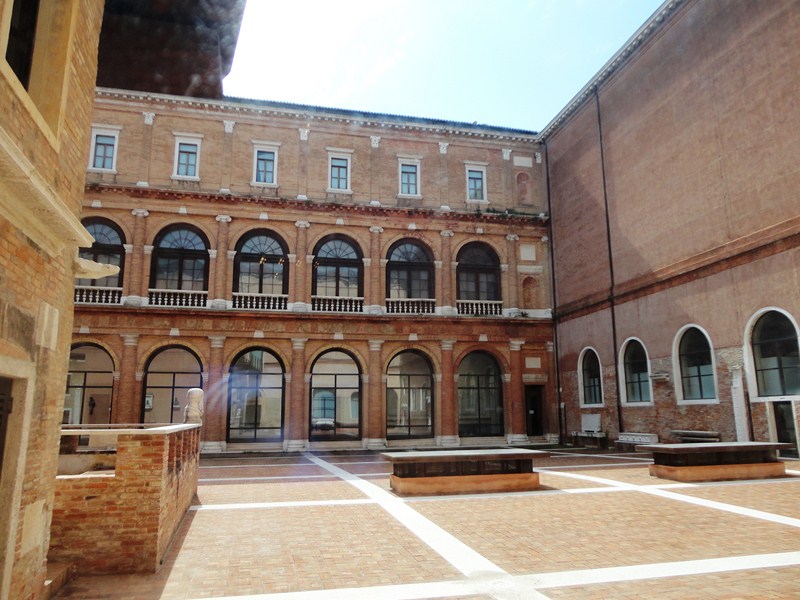
The museum courtyard

The Ponte dell’Accademia (Academy Bridge, where the museum is literally in front of) and the Accademia boat landing station (where our vaporetto water bus docked) are named after it. Like other state museums in Italy, it falls under the Ministero per i Beni e le Attività Culturali, the Italian ministry of culture and heritage.
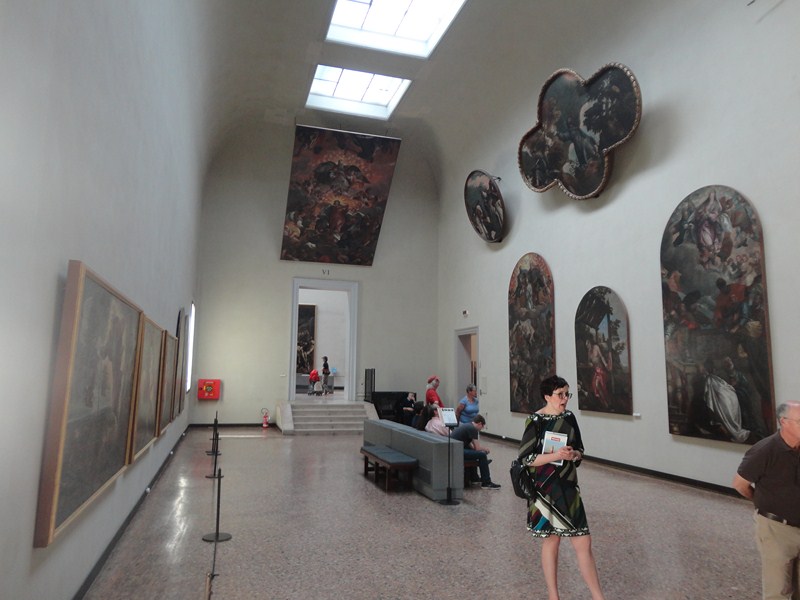
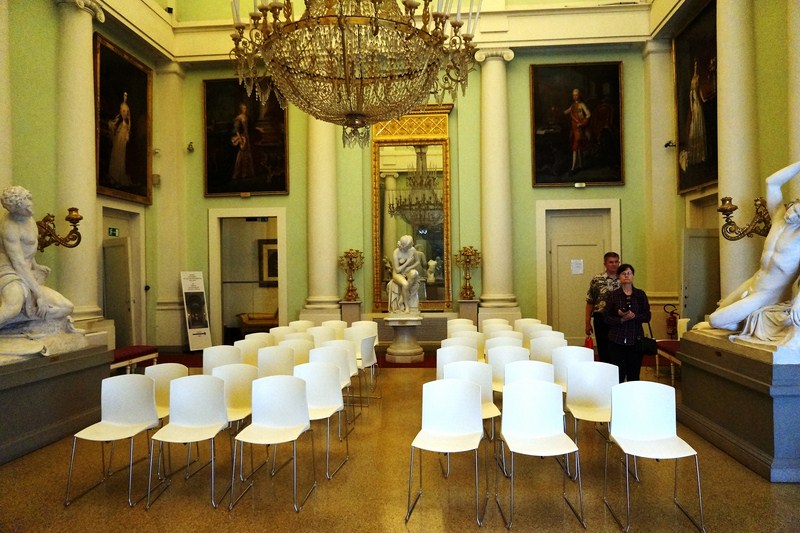
Jandy (foreground) in one of the galleries

The absolutely stunning Gallerie dell’Accademia, the picture gallery of the art academy and one of the great museums of the world, owns the most important collection worldwide of more than 800 Venetian paintings, from the Gothic until the Rococo.
Genres covered include Byzantine, Gothic, Renaissance and Baroque. Over time, the collection has increased, thanks to private donations and acquisitions.

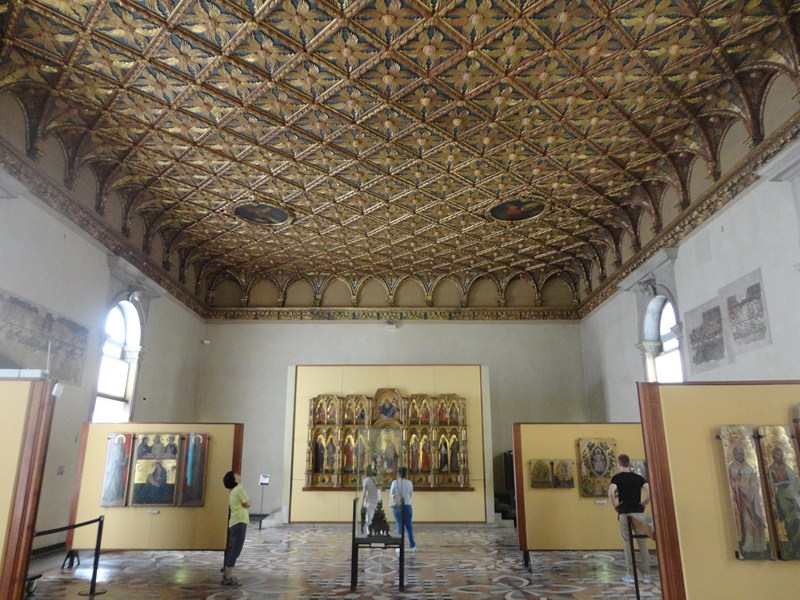
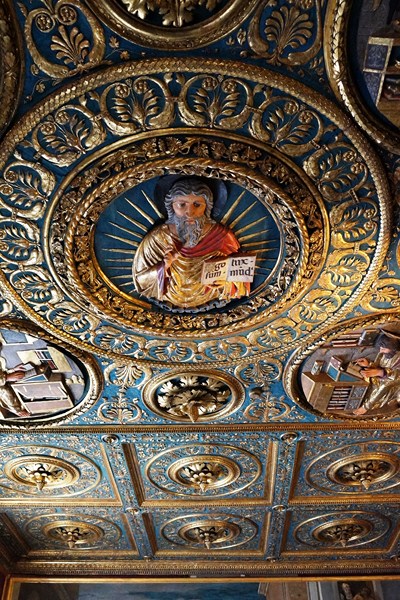
Ornate ceiling in Room 1

The museum contains masterpieces of Venetian painting from the 12th through 18th centuries, more or less generally arranged chronologically (since art in the academy has long been taught in chronological order) in 24 rooms, though some thematic displays are evident.

Jandy and Kyle in front of the painting Fisherman Presenting a Ring to the Doge Granedigo (Paris Bordone, 1534, oil on canvas)

The museum, bringing together, under one roof, all the works of art that were scattered throughout Venice, is housed in three buildings  – the Scuola della Carità, the Convento dei Canonici Lateranensi (started in 1561 by Italian Renaissance architect Andrea Palladio, it was never fully completed) and the now deconsecrated Church of Santa Maria della Carità (its facade was completed in 1441 by Bartolomeo Bon).

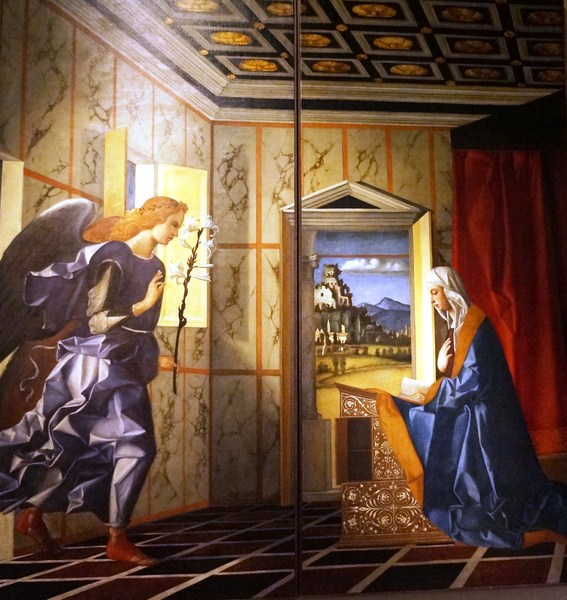
Angel of the Annunciation and Virgin Annunciate (Giovanni Bellini)

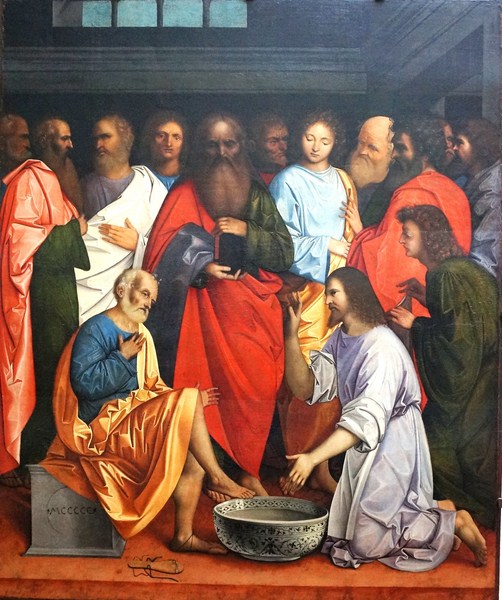
Washing of the Feet (Giovanni Agostino da Lodi, 1500, oil on board)

The former Santa Maria della Carità convent complex maintained its serene composure for centuries until 1807 when Napoleon installed his haul of Venetian art trophies here. The interior of the building is as beautiful as the art it houses.

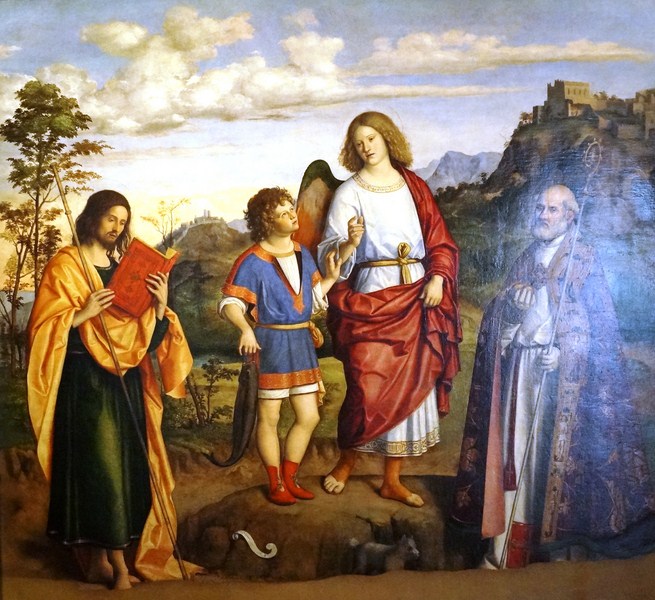
Archangel Gabriel (Giambattista Cima da Conegliano)

Supper in Emmaus (Marco Marziale, 1506)

The giants of Venetian painting, from the 13th to the 18th centuries, whose wonderful collection of art are represented here include the 1600’s Canaletto Vedutisti, Francesco Guardi, Bernardo Bellotto and Pietro Longhi, down to Renaissance artists such as Gentile and Giovanni BelliniCarpaccioGiorgione,   Titian (or Tiziano), Veronese (Paolo Caliari), Tintoretto and and the Baroque master of the swirling-heavenly-clouds ceiling fresco Gianbattista Tiepolo (who became the second director, after Rococo painter Giovanni Battista Piazzetta, of the academy after his return from Würzburg).

Chess Players (Pittore Caravaggesco)

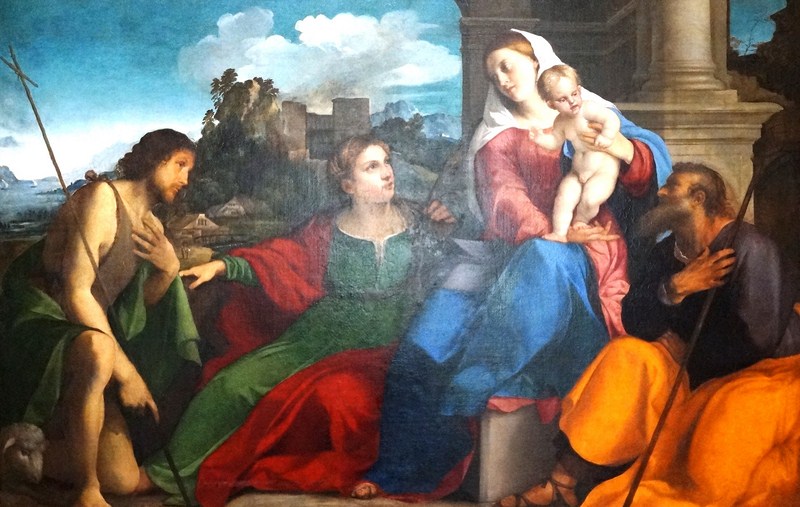
Holy Family with St. Catherine and John the Baptist (Palma il Vecchio)

Other artists include Antonello da MessinaLazzaro Bastiani,  Pacino di BonaguidaGiulio CarpioniRosalba CarrieraCima da ConeglianoFettiPietro GaspariMichele GiambonoLuca GiordanoJohann LissCharles Le BrunLorenzo LottoMantegnaRocco MarconiMichele MarieschiPiazzettaGiambattista PittoniPreti,   VasariLeonardo da Vinci (Drawing of Vitruvian Man), Alvise Vivarini and Giuseppe Zais.  All these artists influenced the history of European painting.

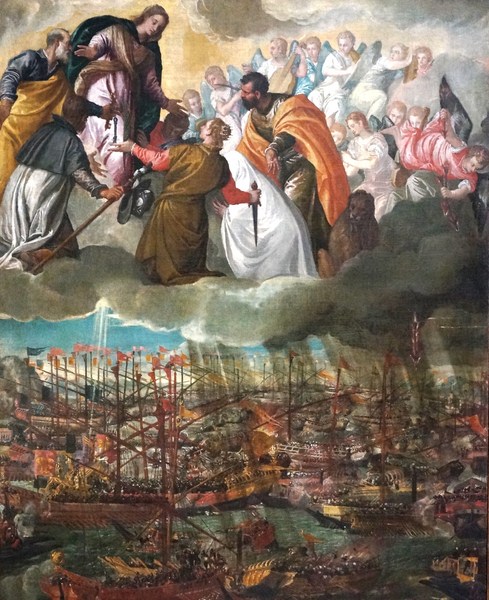
Allegory of the Battle of Lepanto (Paolo Veronese, ca. 1573, oil on canvas)

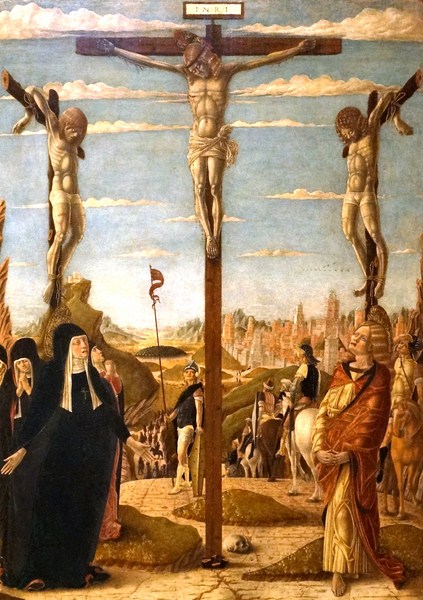
Crucifixion (Pittore Veneziano-Padovano, ca. 1460)

An essential visit for painting enthusiasts, it is the most important museum that one can visit during a stay in Venice. The route around the galleries does not really flow in one direction.  In many cases, we had to go down long corridors to view work, only to return along the same corridors, allowing us to revisit work as we walked about.

Mary with the Child of artist Francesco Morone (Francesco Morone)

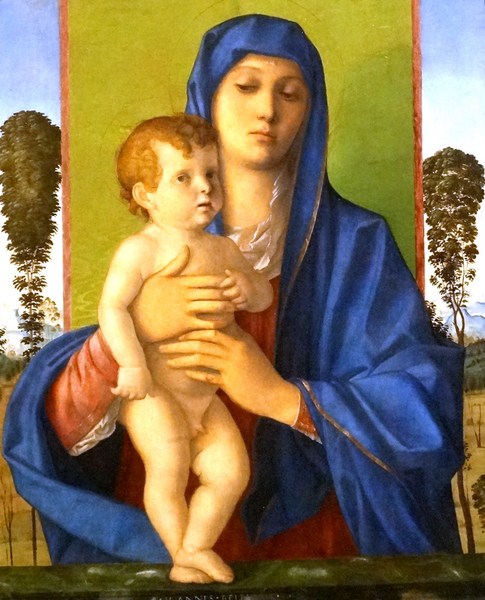
Madonna of the Small Trees (Giovanni Bellini, 1487)

Our visit to the galleries started off in the 14th century (Paolo Veneziano’s Coronation of the Virgin altarpiece, etc.), continues through Giorgione’s weirdly lit The Tempest and Giovanni Bellini’s many Madonna and Childs, and ends with Carpaccio’s intricate Cycle of St. Ursula and Titian’s late Pietà.

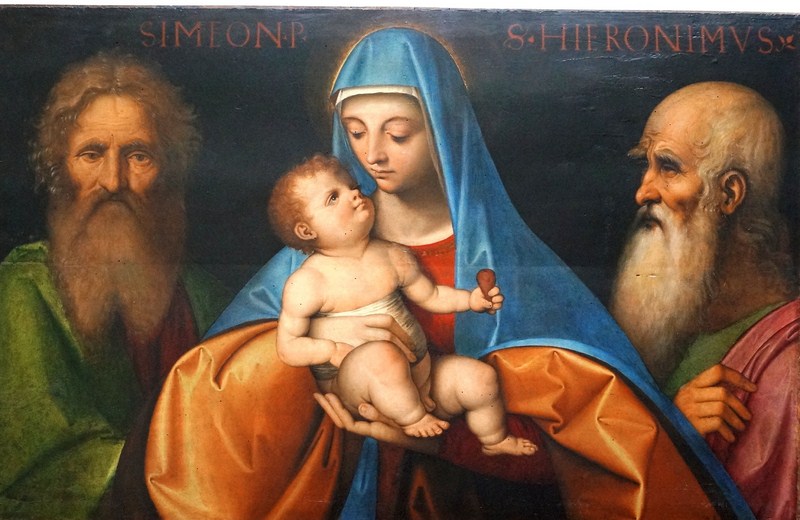
Madonna and Child with St. Simeon and St. Jerome (Giovanni Agostino da Lodi)

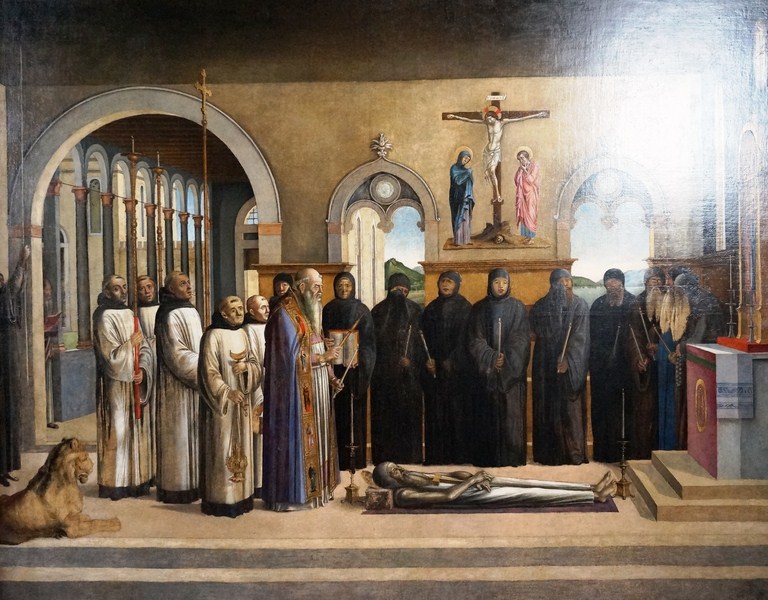
Funeral of St Jerome (Lazzaro Bastiani)

The rooms we explored all showed Venice’s precocious flair for color and drama. The massive Tintoretto paintings, from the Scuola Grande di San Marco, can’t be seen from a reasonable viewing distance as they are hung along the sides of corridors which are only about 12 ft. wide.

Triptych of the Martyrdom of St. Liberata (Hiermonymus Bosch, 1500, oil on panel)

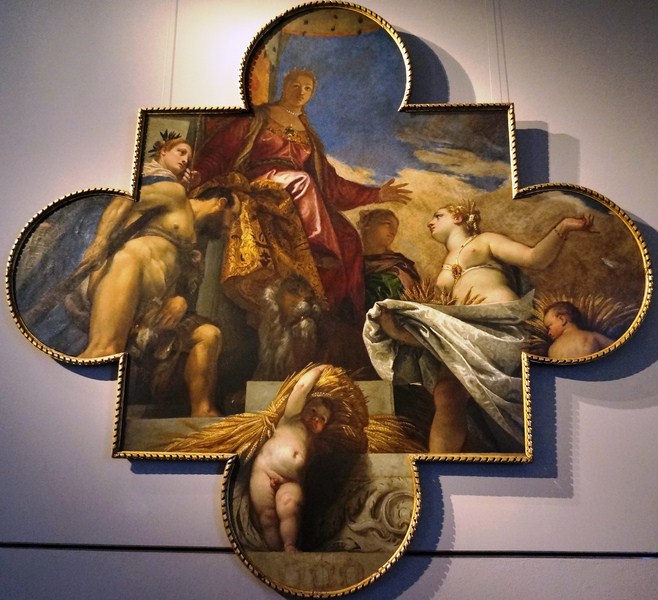
Ceres Renders Homage to Venice (Paolo Veronese, 1575)

Room 1 is where you can find Jacobello Alberegno’s Apocalypse  which shows the whore of Babylon, with babbling rivers of blood from her mouth, riding a hydra, and Paolo Veneziano’s Coronation of Mary, at the opposite end of the emotional spectrum, where Jesus bestows the crown on his mother with a gentle pat on the head to the tune of an angelic orchestra).

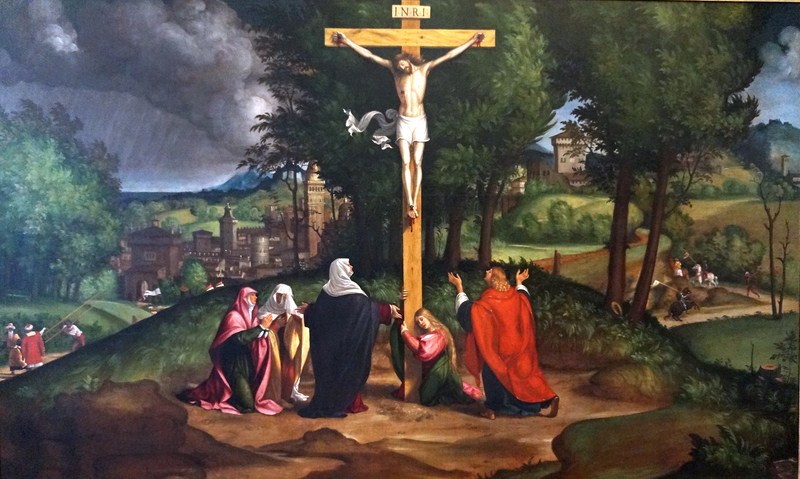
Crucifixion (Andrea Previtali)

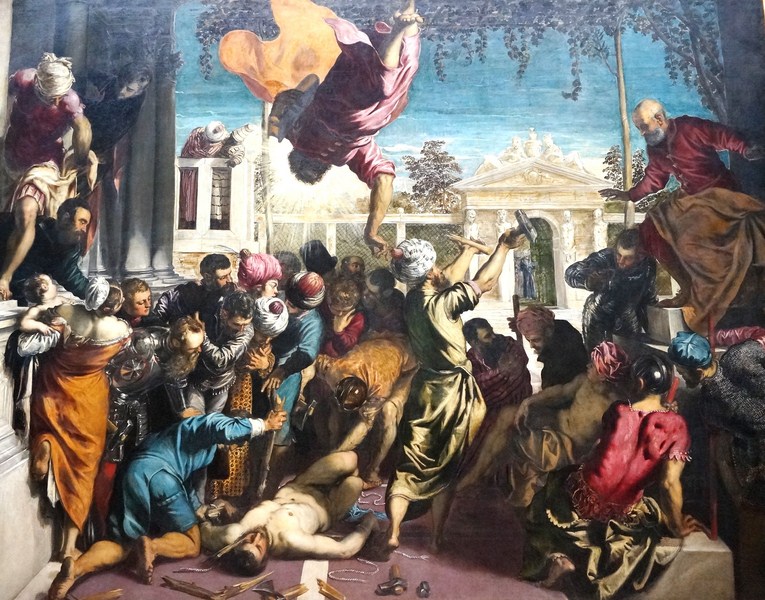
The Miracle of St. Mark Freeing the Slave (Jacopo Tintoretto, 15,48, oil on canvas)

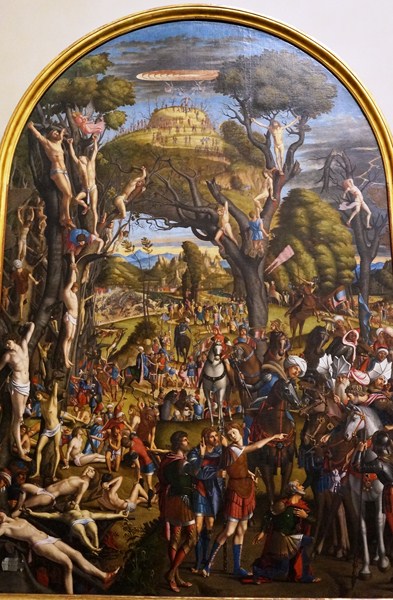
Room 2 is where the eerie, glowing skies of Vittore Carpaccio’s lively Crucifixion and Glorification of the Ten Thousand Martyrs of Mount Ararat seem to make UFO arrivals imminent.

The Crucifixion and the Glorification the Ten Thousand Martyrs on Mt. Ararat (Vittore Carpaccio, 1515, oil on canvas)

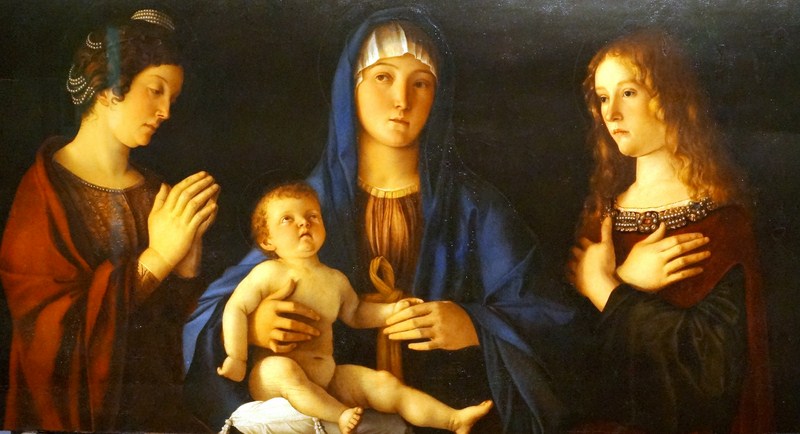
Room 4 is where you can find Giovanni Bellini’s quietly elegant Madonna and Child between St Catherine and Mary Magdalene).

Virgin and Child between St. Catherine and Mary Magdalene (Giovanni Bellini, ca. 1500)

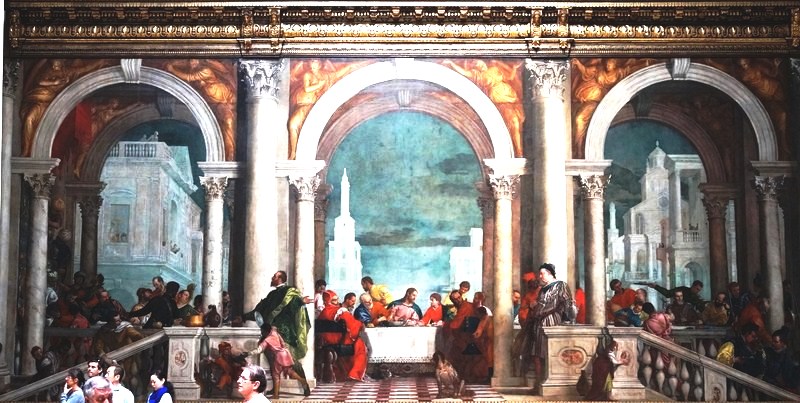
Room 10 features paintings by Tintoretto, Titian and Paolo Veronese.  The latter’s monumental Feast in the House of Levi (1573), originally called The Lord’s Last Supper, is shocking, not only for its size (at 42 ft. long, it is one of the largest canvases of the 16th century), but also for its rather racy depiction of the Lord’s holiest of moments. Here, the artist portrayed the Savior and his Apostles cavorting with drunkards, dwarves, Muslims and Reformation-minded Germans in a rousing, drunken banquet that resembled paintings of Roman orgies.

Feast in the House of Levi (Paolo Veronese, 1573, oil on canvas)

The Inquisition leaders, with their rising Puritanism, promptly condemned Veronese, charging the painter with irreverence and threatened to indict him on the very serious charge of heresy. Veronese quickly re-titled the work, still with Jesus in it but now surrounded by secular guests who were free to engage in acts of gluttony.  The mollified censors let it pass.

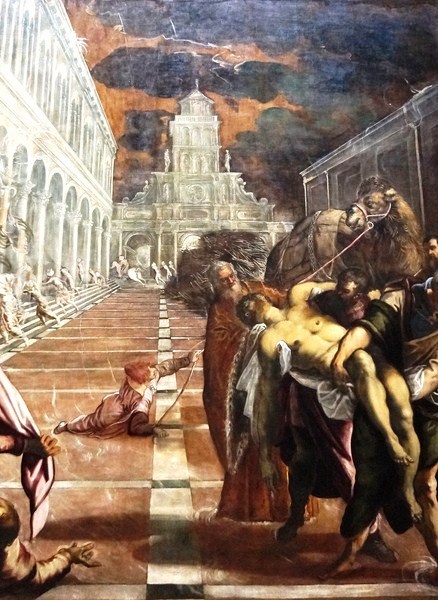
Stealing of the Body of St. Mark (Jacopo Tintoretto)

Jacopo Tintoretto’s The Stealing of the Body of St. Mark commemorates the Venetian merchants who, in 828, spirited the body of the famed saint and Evangelist away from Alexandria. During that era, Italy’s hyper-competitive maritime capitals competed to see who could steal the best saint and then build a cathedral around his bones. Acquiring bona fide saints was, thus, de rigueur for relic hunters. The painting is, obviously, a bit fanciful as it depicts the now long-dead saint, borne in the arms of the Venetian thieves, as a fresh, rather muscular corpse.

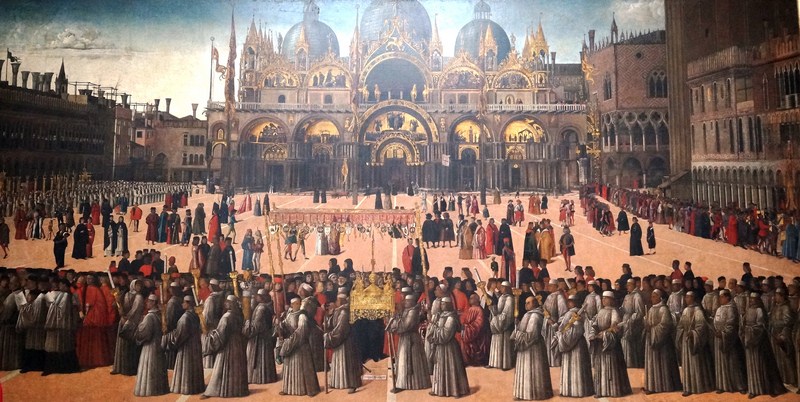
Procession in St. Mark’s Square (Gentile Bellini, 1496, tempera on canvas)

Room 12 is where you’ll find Giambattista Piazzetta’s saucy, fate-tempting socialite in Fortune Teller.  In Room 20, you’ll find works by Carpaccio and Gentile Bellini’s Procession in St Mark’s Square, which offers an intriguing view of Venice’s iconic piazza before its 16th-century makeover.

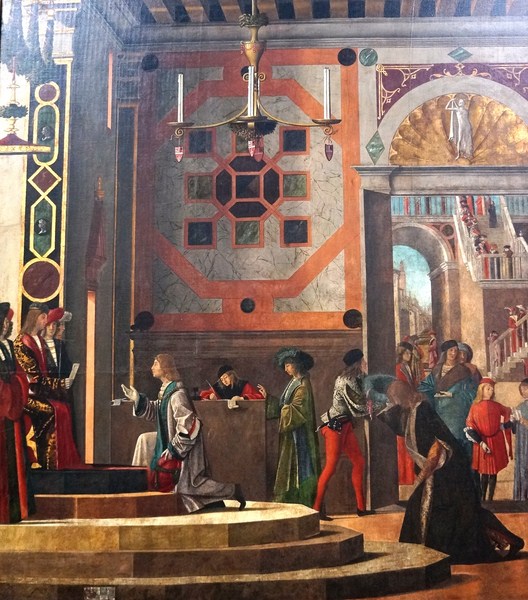
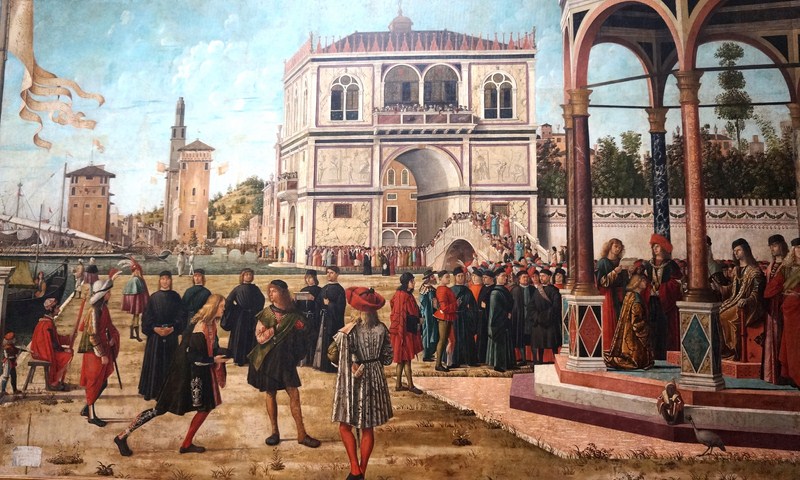
Departure of the English Ambassadors (Vittore Carpaccio, 1497-98)

The Ambassadors Return to the English Court (Vittore Carpaccio, 1495, oil on canvas)

Room 21 is home to Vittore Carpaccio’s St. Ursula Cycle, a series of 9 paintings documenting the saint’s ill-fated life. In Room 17, you’ll find works of Canaletto, Guardi and Pietro Longhi. Everything is clearly marked and explained. Rooms 12 to 19 are occasionally used for temporary exhibitions.

The Concert (Pietro Longhi, 1741, oil on canvas)

Pieta (Girolamo Romani)

Room 23, a serene showstopper fronted by a Bellini altarpiece, is the original convent chapel where tou can find Giorgione’s highly charged La Tempesta (The Storm) featuring a mysterious nursing mother and a passing soldier with a bolt of summer lightning, its meaning still debated by art historians – is this an expulsion from Eden, an allegory for alchemy, or a reference to Venice conquering Padua in the War of Cambria?

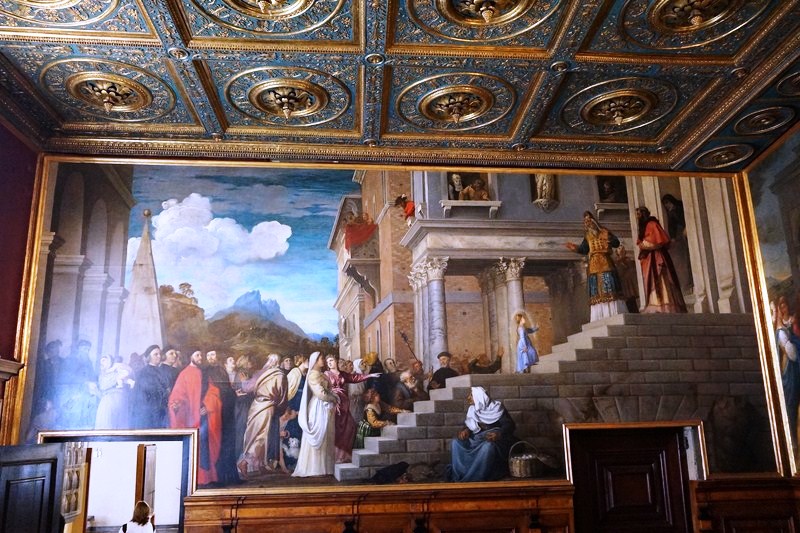
Ornate ceiling of Sala  dell’Albergo

Ornamental splendor is found at the newly restored Sala dell’Albergo, Scuola della Carità’s boardroom (Room 24), which has a lavishly carved ceiling. It faces Antonio Vivarini’s wrap-around masterpiece The Virgin Enthroned with Saints Jerome, Gregory, Ambrose and Augustine (1446 (oil on canvas), filled with fluffy-bearded saints.  closes with The touching 1534–39 Presentation of the Virgin, of Titian, features a young, tiny Madonna trudging up an intimidating staircase.  A distinctly Venetian crowd of onlookers points to her example yet few of the velvet and pearl-clad merchants offer alms to the destitute mother or even feed the begging dog.

Presentation of the Virgin at the Temple (Titian, 1534)

Gallerie dell’Accademia: Campo della Carita,  Dorsoduro 1050, 30123 Venice, Italy.  Tel: +39 041 522 2247.  Admission: €15 (entry to the museum is free on the first Sunday of every month). Open Mondays, 8:15 AM to 2 PM, Tuesdays to Sundays, 8:15 AM to 7:15 PM (last entrance at 6:15 PM). When you buy your ticket you will be asked to place backpacks and additional bags bigger than 20 x 30 x 15 cms. inside lockers (€1), but you will get you money back when you retrieve your belongings. There is an audio guide (for an extra €6). Photography is allowed as long as you do not use your flash. During the busy season, queues can be long after 10 AM. Admissions are restricted to 400 people at the same time.

How to Get There:  the museum is about a 15-20 min walk from St Marks and is easy to find as it is well signposted in the Dorsoduro district.

Church of St. Peter Martyr (Venice, Italy)

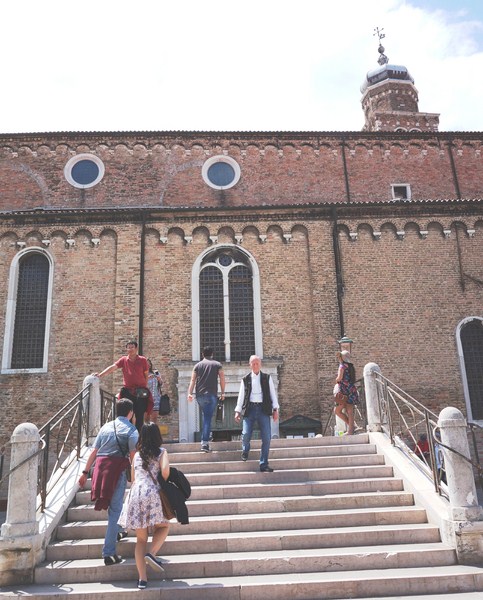
The Church of St. Peter Martyr (Italian: Chiesa di San Pietro Martire), currently one of the two main Roman catholic parish churches (the other is the Basilica of St. Donato) and one of three remaining (before Napoleon there were 18, the third is the Church of St. Mary of the Angels ) in the island of Murano, near Venice, was edificated in 1348 along with a Dominican convent and was originally dedicated to St. John the Baptist.  In 1474, a fire razed it to the ground and, in 1511, it was rebuilt and enlarged to the current appearance and rededicated to St. Peter Martyr.

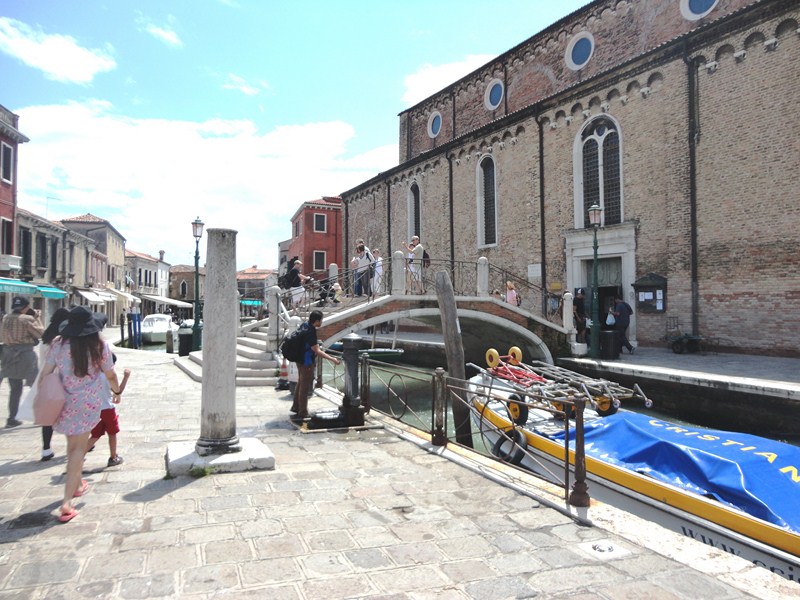
Church of St. Peter Martyr

In 1806, a few years after the fall of the Republic of Venice, it was closed but was reopened in 1813 as a parish church due to an initiative by Fr. Stefano Tosi, with art from other suppressed churches and monasteries on Murano and other islands. At its reopening the church was renamed St. Peter and Paul (S. Pietro e Paolo) but, in 1840, it reverted to its present name.

During the restoration of 1922-28, the original ceiling and the frescos of the saints above the pillars were revealed.  The colonnade from the demolished convent of Santa Chiara was also reassembled and attached to the west flank of the church in 1924. From 1981 to 1983, the church underwent a restoration campaign financed by the Italian Ministry of Culture.  The roof was repaired and the rotten brickwork was replaced. Save Venice provided emergency funding to repair stone parts of the two-light “bifora” window above the side entrance door.

The church’s Renaissance façade, of naked brickwork, is divided in three sections.  Its 16th-century portal is surmounted by a large rose window. On the left façade is a portico with Renaissance arcades and columns (perhaps what remains of the original cloister) and a bell tower, dating to 1498-1502 (its original bells came from England but have been recast many times since, most recently in 1942 after war damage). The church is 55 m. (180 ft.) long, 25 m. (82 ft.) wide and 13 m. (43 ft.) wide at the nave.

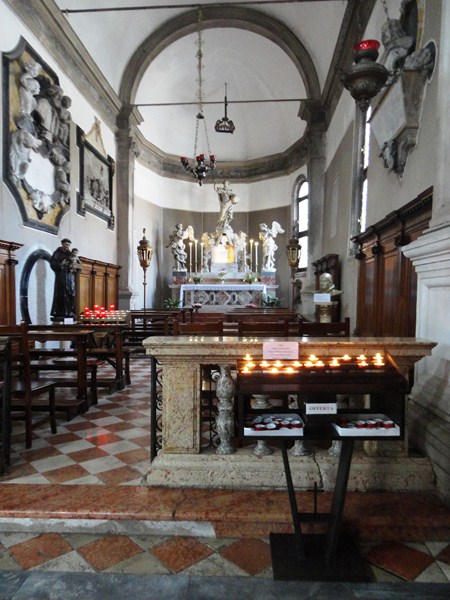
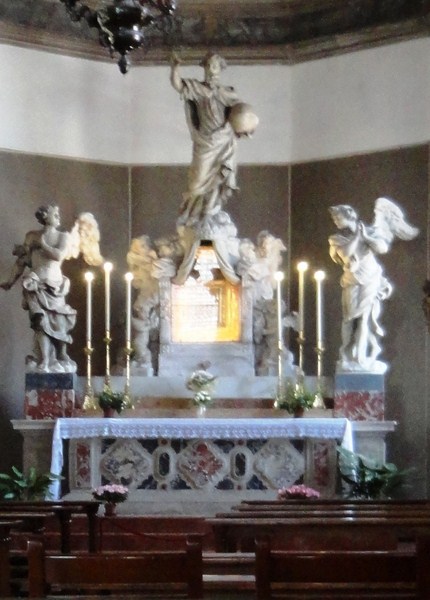
The impressively spacious and tall interior, with a basilica plan, has a nave and two aisles (divided from each other by rows of four arches supported by large columns), a wooden ceiling,  tie beams across the arches and the nave, a trussed roof, a wide and deep half-domed chancel, a high altar and three minor altars for each nave. The spandrels between the arches are nicely decorated with saints.  The quite large presbytery has barrel vaults and two small, wide and deep apsidal chapels.

In the right nave are artworks including a Baptism of Christ (attributed to Tintoretto, it came from above the high altar of the demolished San Giovanni dei Battuti on Murano) plus two works by Giovanni BelliniAssumption with Saints (1510–1513) and the Barbarigo Altarpiece (or The Madonna with Doge Agostino Barbarigo, 1488), taken from the nearby church of Santa Maria degli Angeli and brought here in 1815.

The row of arches supported by large columns

Other paintings include a St. Jerome in the Desert by Paolo Veronese (also from Santa Maria degli Angeli), St Agatha Visited in Prison by St. Peter and an Angel  (also by Veronese), the Barcaioli Altarpiece (or Virgin and Child with Saints) by Giovanni Agostino da Lodi (ca. 1500, it was previously thought to be by Basaiti and came from the demolished San Cristoforo delle Pace), a Deposition from the Cross by Giuseppe Porta, Saints Nicholas, Charles Borromeo and Lucy by Palma il Giovane (which came from the demolished church of Santi Biagio e Cataldo on Giudecca) and a 1495 Ecce Homo (perhaps from the destroyed church of Santo Stefano in Murano). In the left-hand apsidal chapel is a hard-to-see painting by Domenico Tintoretto while a pair of huge paintings by Bartolomeo Latteri (including an impressively architectural Nozze di Cana) covering both side walls of the deep chancel.

The Ballarin Chapel, at the church’s right wing, was built in 1506 after the death of Giuliano Ballarin, the eponymous glassmaker from Murano.

Chiesa di San Pietro Martire: Fondamenta dei Vetrai, Campiello Marco Michieli 3, 30141 Murano, Venice VE, Italy. Tel: +39 041 739704.  Open Mondays to Saturdays, 9 AM – 12 noon and 3 – 6 PM, and Sundays, 3- 6 PM.

Palazzo Pitti – Porcelain Museum (Florence, Italy)

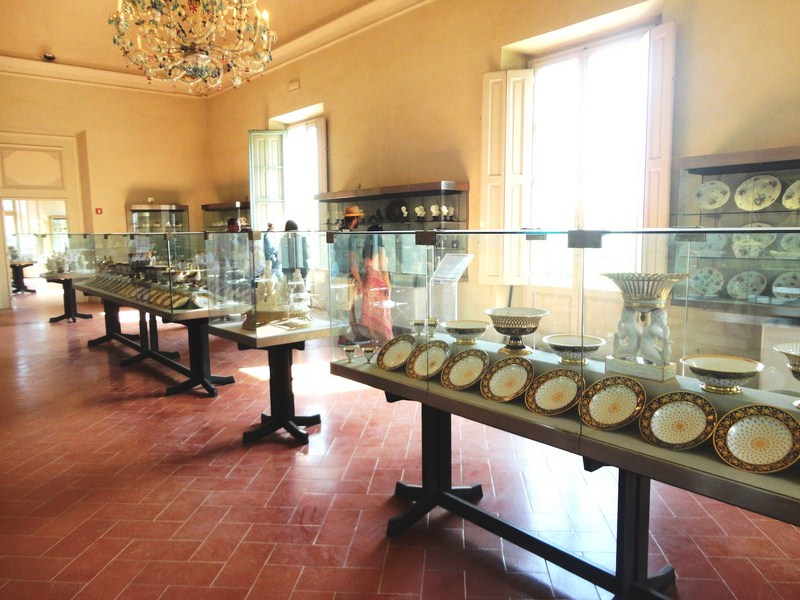
Porcelain Museum

Porcelain Museum

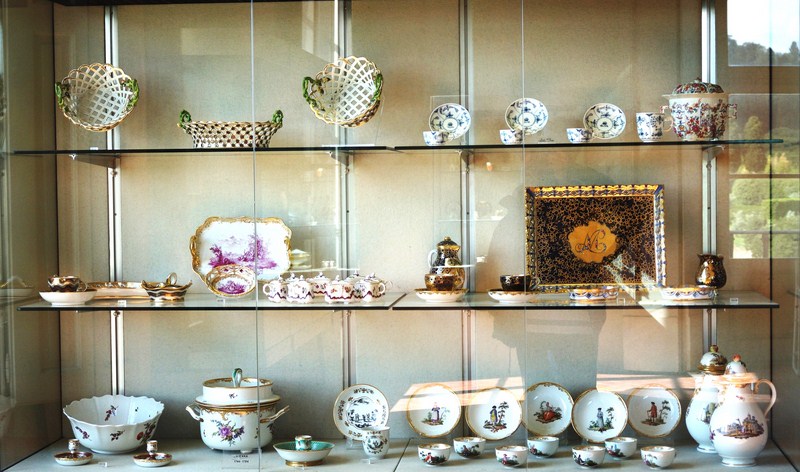
First opened in October 1973, the Porcelain Museum (Museo delle Porcellane), a section of the Silver Museum, is an internationally acclaimed institution in the field of ceramics and among the hundred most visited art museums in the world.

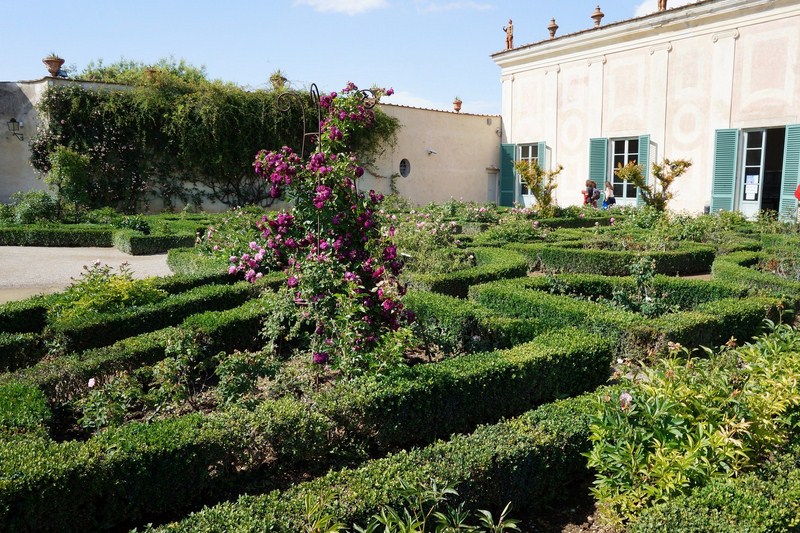
The Knight’s Building (right) beside the Giardino del Cavaliere

It is housed in the Knight’s Building (Palazzina del Cavaliere) situated on the eponymous rampart (Bastione del Cavaliere) overlooking the Boboli Gardens. Originally constructed between 1527 and 1530, the current Neo-Classical building was built at the end of the 17th century by Grand Duke Cosimo III de’ Medici for his second-born son Giangastone.

Check out “Palazzo Pitti – Boboli Gardens

Porcelain Museum (4)

If you love porcelain, then you will be impressed by its extensive collection of mainly continental porcelain, encompassing almost every famous maker. The labels were predominantly in Italian.  As it is located on one of the highest points of the Boboli Gardens, you have a gorgeous panoramic view of the city of Florence from the terrace.

Porcelain Museum (3)

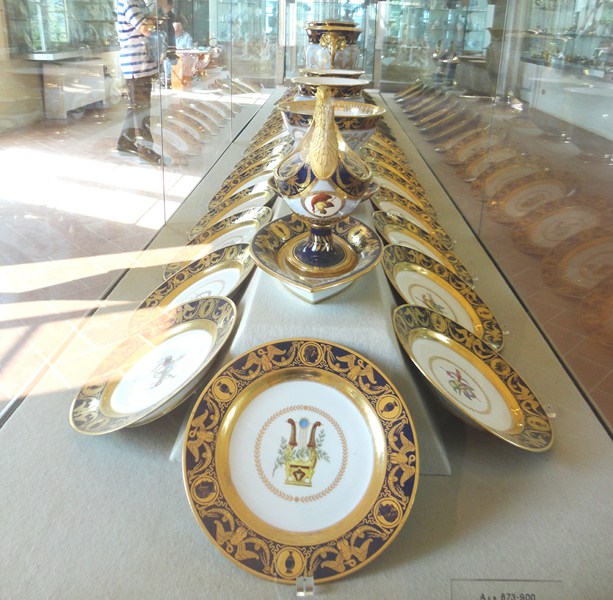
The over 2,000-piece, homogeneous collection comprises mainly porcelain tableware, from many of the most notable European porcelain factories, belonging to the royal families that ruled Tuscany and have followed one another at Pitti Palace, starting from the period of the Medici family, to the Lorraines (including the Parma-Bourbon dynasty), to the Savoys up to the unification of Italy.  One of the most important historical collections of its kind in Europe, the oldest pieces are those that once belonged to Gian Gaston de Medici (the last Medici Grand Duke, 1671-1737) produced in the Manufactory of Meissen.

Porcelain Museum (14)

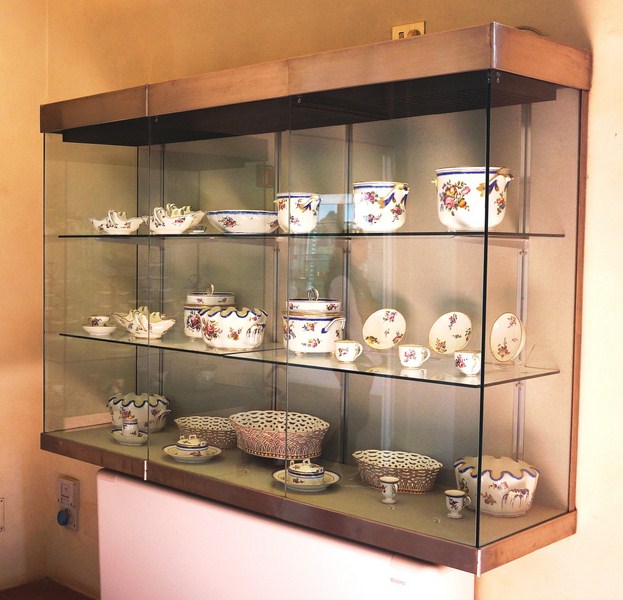
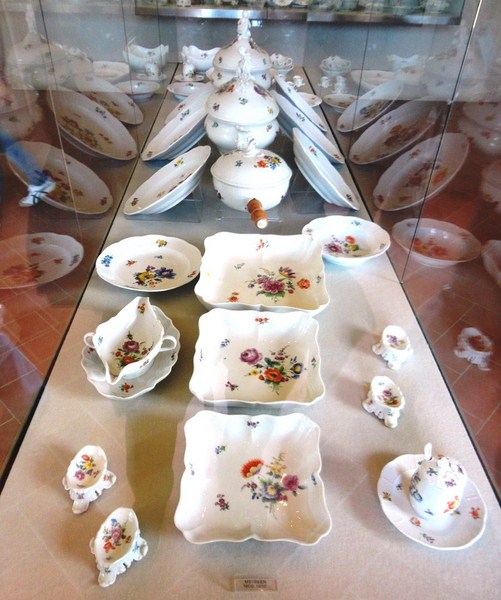
Among the well represented manufacturers of origin on display are the Royal Factory of Naples (Capodimonte); the Tuscan Carlo Ginori from Sesto FiorentinoFrench manufacturers  Vincennes (founded in 1740 and transferred to Sèvres in 1756 under the direct ownership of King Louis XV) in ParisViennese porcelain, largely collected by Ferdinand III of Tuscany; the German porcelain factory of Meissen, near Dresden.

Porcelain Museum (17)

Many items in the collection, divided into three sections by periods, nations (Austria, Germany and France) and manufacturers, were specially commissioned by the Grand Ducal court, clearly reflecting their tastes, with several outstanding examples of Italian porcelain objects produced in Doccia (near Florence, founded by the Ginori family in 1737) and at the Royal Manufactory of Naples.  These were especially used by the Grand ducal family for large services of daily use.  All are very detailed, elegant and fine works of arts.

Meissen (1800-1850)

Meissen (1800-1850)

Others were gifts to the Florentine rulers from other European sovereigns. They include fine table sets from Vienna and from the German Manufactory of Meisse.  There were also French several large porcelain dinner services from the Vincennes  (later renamed Sèvres) factory, brought to the Pitti Palace by the Savoy House from the Royal Palace of Parma.

1750 Porcelain (Sevres)

1750 Porcelain (Sevres)

Table services, for daily use, constantly supplied to the Grand Dukes of Lorraine, from Doccia Manifacture, include a flowered porcelain with bouquet or tulip motifs, taken from the so-called “famille rose” Chinese porcelain; and lovely coffee cups with view of Florentine piazzas, from the 1800’s, made using lithographs by the Frenchman Philippe Benoist as models.

Naples Royal Factory (1785)

Naples Royal Factory (1785)

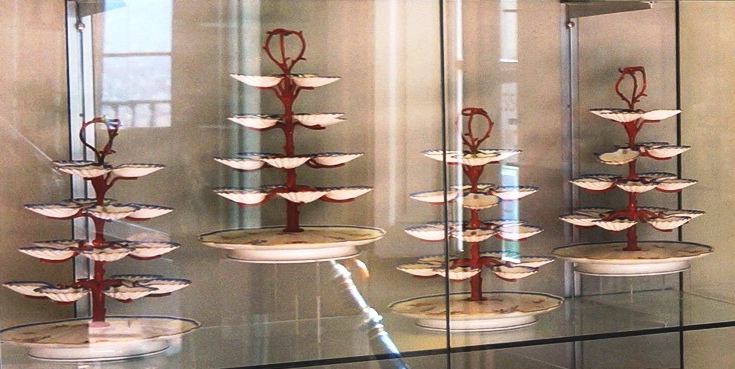
Some typical examples of French porcelain, characterized by various pastel-colored shades, includes some flower vases with scenes taken from Francois Boucher as well as 4 oysters stands from Parma, singular and unique of their kind, made up of 18 shell-shaped bowls and belonging to Louise Elisabeth de Bourbon, the Grand Duchess of Parma, who was, in fact, the daughter of Louis XV, king of France. Sèvres table services for the light first course and dessert, in two central display cases, were gifts to Elisa Bonaparte Baciocchi (Grand Duchess of Tuscany, 1809-1814) from her august brother Emperor Napoleon I.

Porcelain Museum (23)

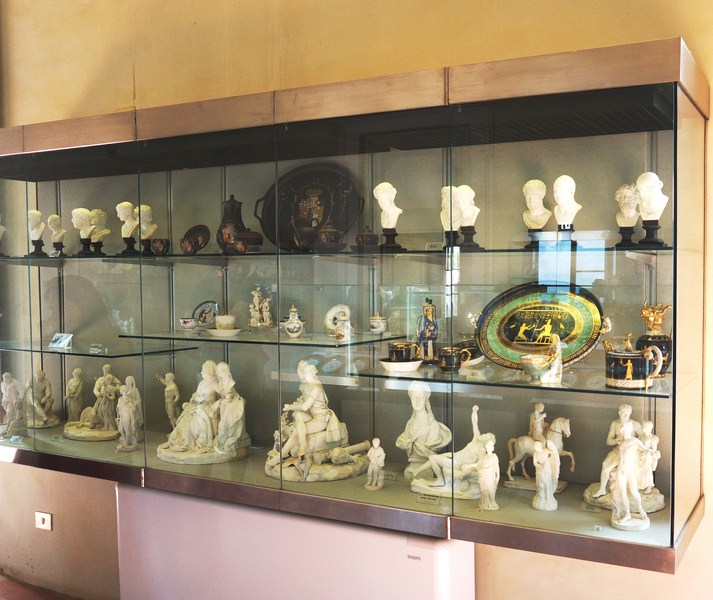
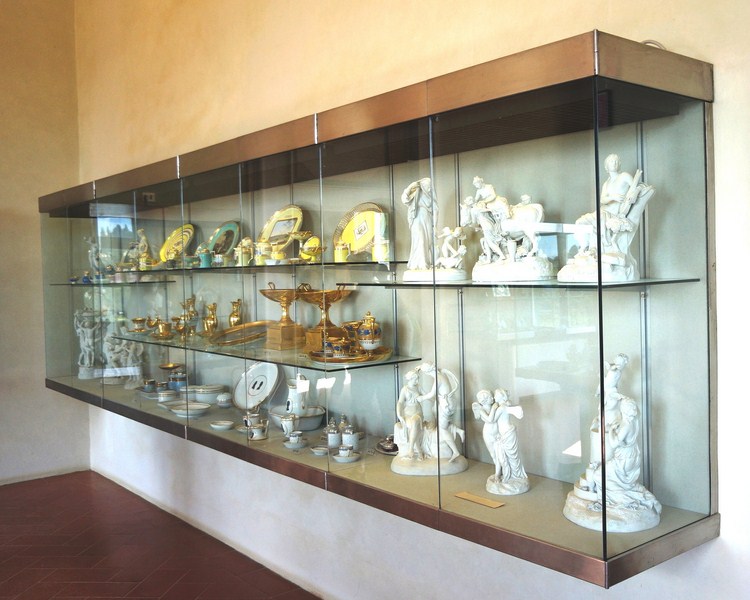
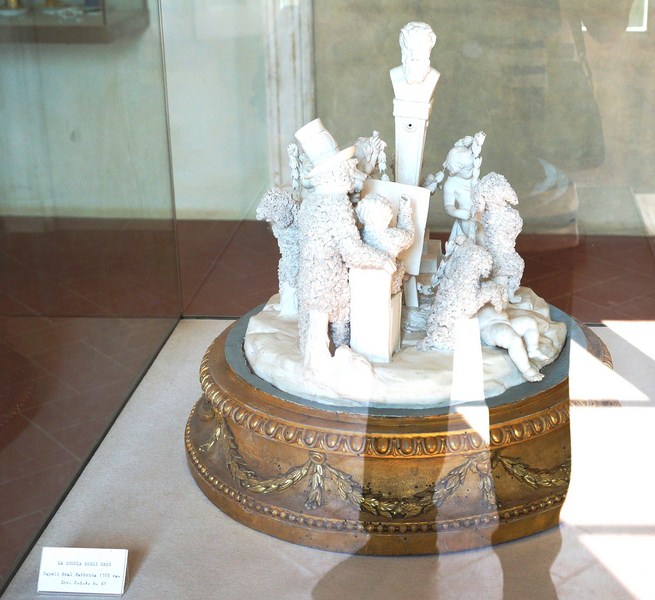
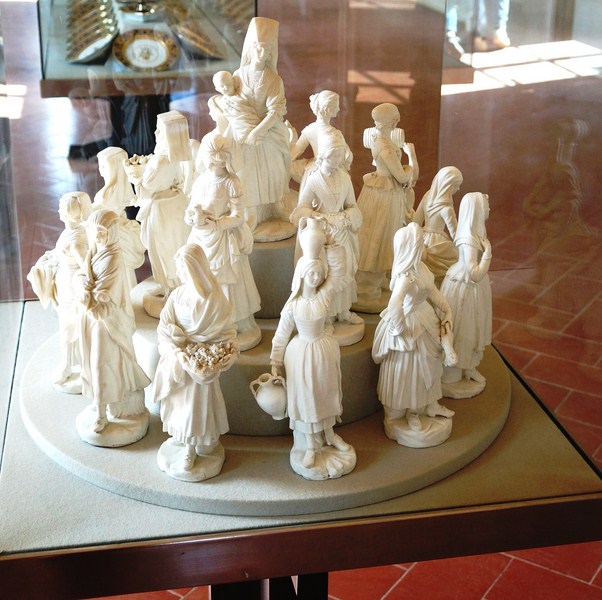
In the first room is a collection from the Real Fabbrica of Naples.  They include, of particular note, a series of small biscuit figurines depicting personages from Classical antiquity; reproductions from the excavations in Herculaneum; 18 figurines reproducing ‘garments’ from the Kingdom of Naples, two dejeuner services (one decorated with Egyptian motifs and the other with Etruscan motifs).

Biscuit figurines

Biscuit figurines

A rich assembly of Viennese porcelains, in the second room, were brought to Pitti Palace by two Lorraine grand dukes – Peter Leopold (who maintained a constant rapport with the Vienna) and Ferdinand III of Lorraine (an impassioned collector of porcelains and, particularly, of ‘solitaire’ services). Cups and trays, decorated with views of Vienna, and a coffee service, with a trompe l’oeil feigned wood decoration, stand out.

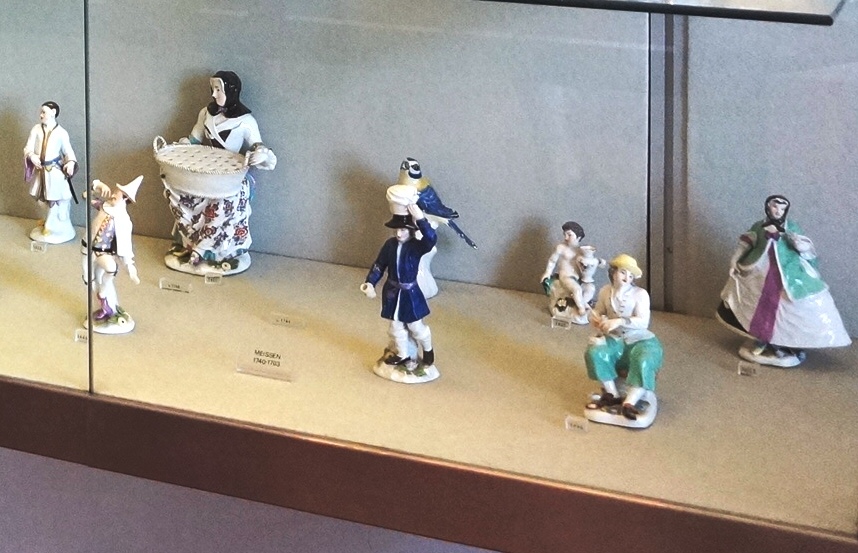
A series of small porcelain statues taken from the Commedia dell’Arte

A series of small porcelain statues taken from the Commedia dell’Arte

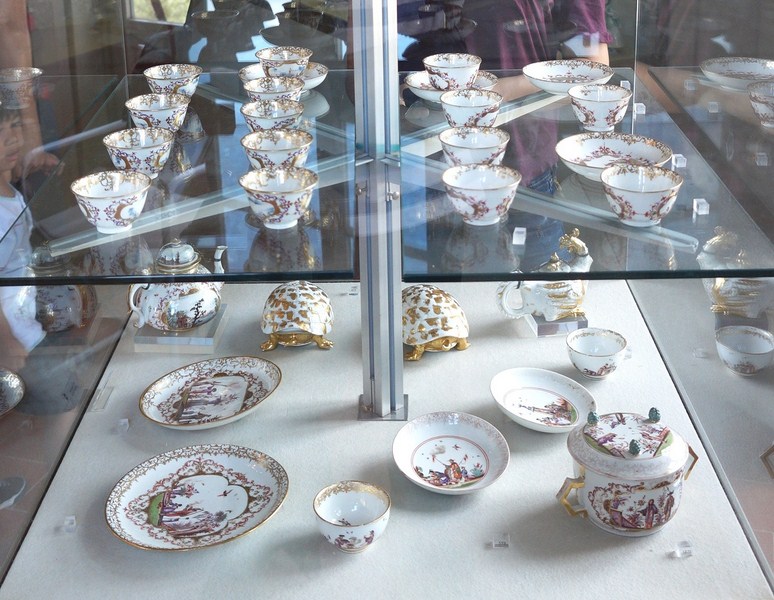
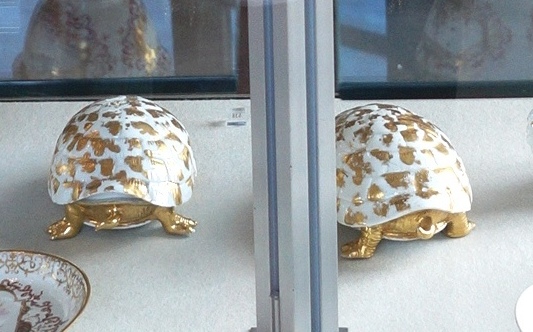
Porcelains from Meissen and from other German manufacturers are in the third room. In the display case, towards the window, are 2 turtle-shaped butter dishes, a teapot in the shape of a rooster and a broth cup with scene inspired by a play by Molière, probably belonging to the collection of Gian Gastone de Medici.

Sèvres porcelain of Elisa Baciocchi (1809–1810)

Sèvres porcelain of Elisa Baciocchi (1809–1810)

Early pieces, from the Meissen factory, such as a splendid vase, are decorated with Chinese motifs such as gilded grape leaves and vines in relief. The Harlequin, a series of small porcelain statues taken from the Commedia dell’Arte, representing people in costume (ladies, musicians, putti, gardeners, etc.), was a source of inspiration for the Capodimonte porcelain manufacture in Naples.

Turtle-shaped butter dishes

Turtle-shaped butter dishes

Porcelain Museum: Palazzo Pitti, Piazza de’ Pitti, Florence, Italy. Tel: +39 055 238 8709

Palazzo Pitti – Boboli Gardens (Florence, Italy)

Boboli Gardens

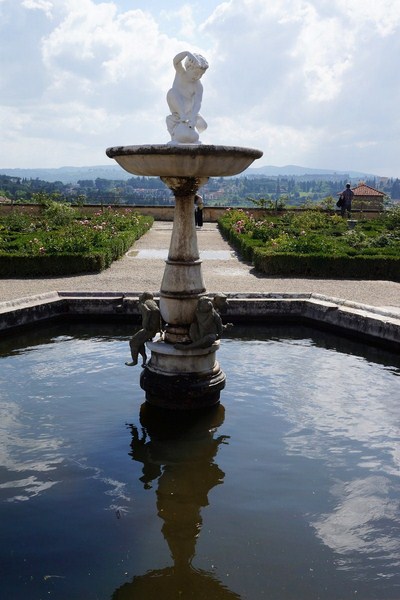
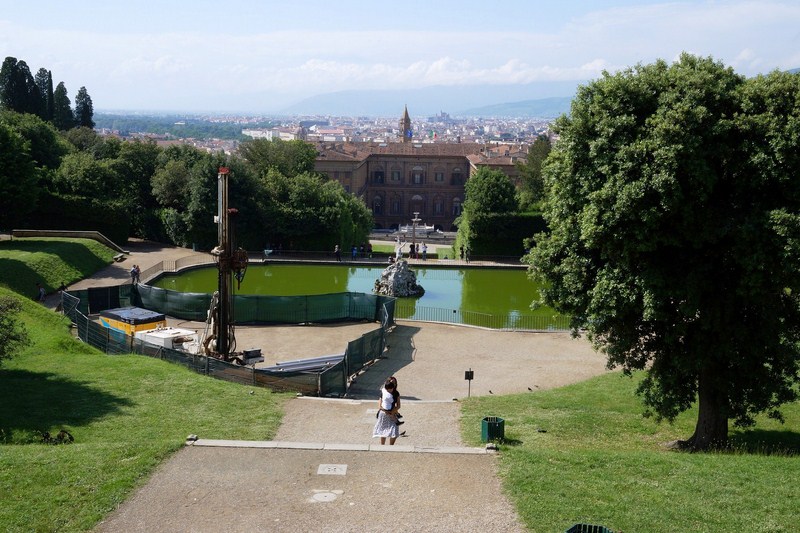
From the Pitti Palace (the main seat of the Medici grand dukes), we crossed the Cortile dell’Ammannati (the palace courtyard) and proceeded to the historical Boboli Gardens (Giardini di Boboli) via a staircase that lead to the Artichoke Fountain whose large octagonal basin, decorated with numerous statues of Tritons and Nereids, is crowned by a bronze lily. Begun in 1639 and installed between 1641 and 1642, the fountain is the work of Florentine sculptor Giovan Francesco Susini and his collaborators.

Looking out into the garden from the Artichoke Fountain

From here, the sight opened up on to the large “amphitheater” of the Boboli Gardens, a park and real outdoor museum behind the palace and the “green lung” of Florence.  Opened to the public in 1766, it is home to some of the first and most familiar formal 16th-century Italian gardens, hosting centuries-old oak trees plus a collection of sculptures dating from the 16th through the 18th centuries (with some Roman antiquities).

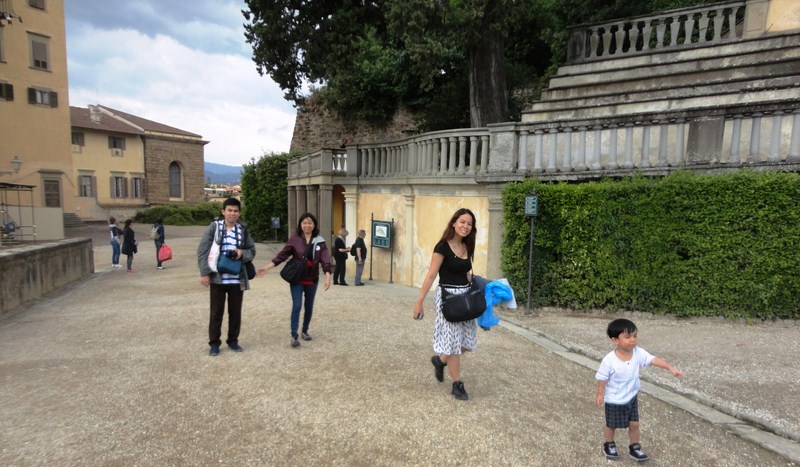
Jandy, Grace, Cheska and Kyle making their way to the garden

Representing one of the first and most important examples of the Italian garden, it later served as a prototype and inspiration for many European royal gardens (in particular, Versailles). Just a year before our visit, in 2015, the garden underwent restoration work.

Check out “Versailles Palace

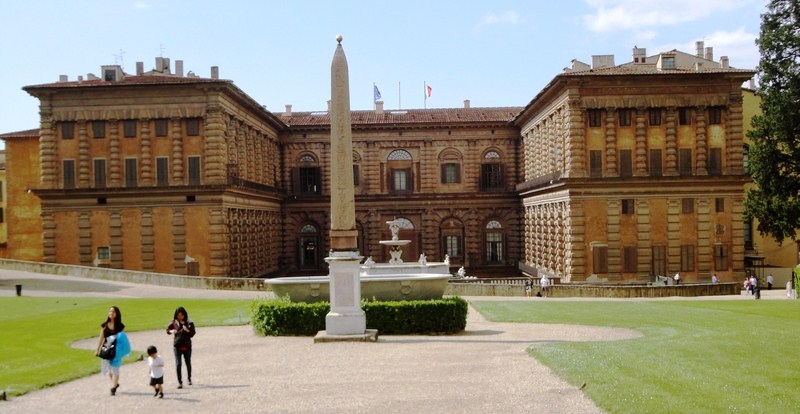
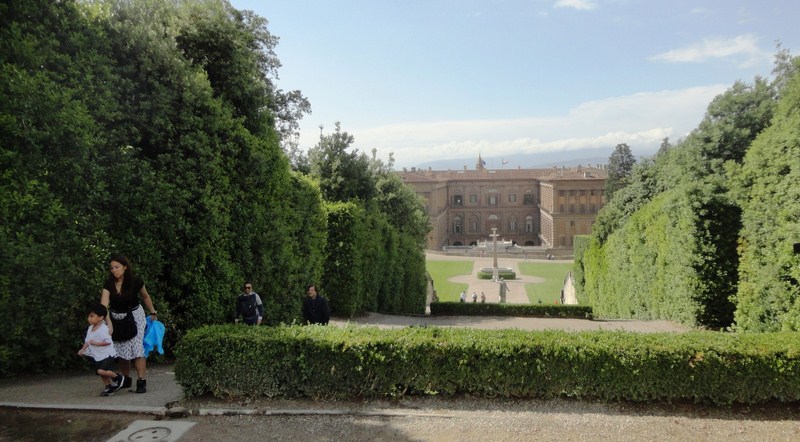
Cheska, Kyle and Grace with Palazzo Pitti in the background

Developed in the mid-16th-century garden style, it incorporated longer axial developments, wide gravel avenues and a considerable “built” element of stone. Lavishly employing statuary and fountains, its proliferation of detail was coordinated in semi-private and public spaces that were informed by Classical accents such as grottos, nympheums, garden temples and the like. Unconventional for its time, the garden, with it expansive view of the city, was very lavish, considering that no access was allowed (outside of the immediate Medici family) and no entertainment or parties ever took place in the gardens.

The name of the gardens is a corruption of “Borgoli,” the name of the family who laid out the original fields and gardens behind Santa Felicita in the Oltrarno. In 1418, Luca Pitti bought the land from them and, in 1549, the property was purchased by Eleonora di Toledo (the wife of Cosimo I de’ Medici). The land was greatly enlarged to become the Medici family‘s new city residence.

The first stage was scarcely begun by Medici court artist Niccolò Tribolo who drew the original plan before he died the next year in 1550.  Under the reign of Francesco I, who succeeded his father Cosimo I, it was continued by Bartolomeo Ammanati, Giorgio Vasari (who contributed in the planning and the laying out of the grottos from 1598 to 1561) and, in the sculpture, by the artist, architect and sculptor Bernardo Buontalenti who was also responsible for the elaborate architecture of the splendid Buontalenti grotto, built between 1536 and 1608, in the courtyard that separates the palace from its garden.

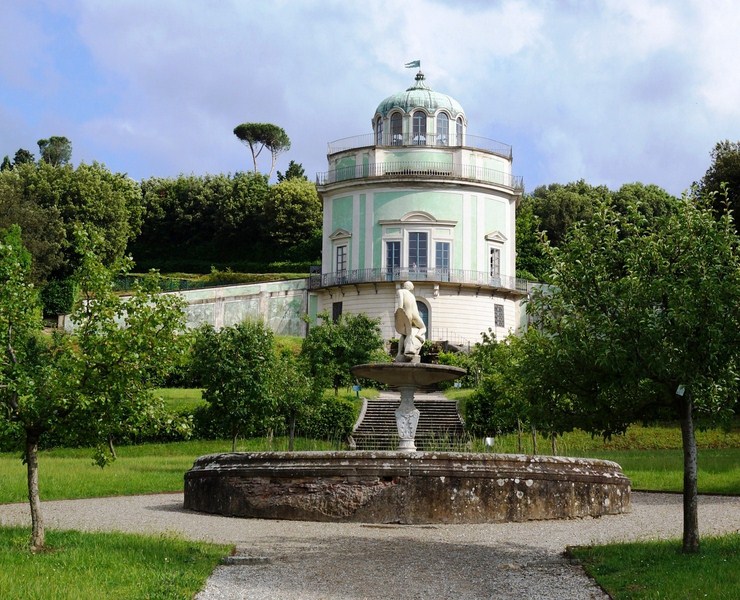
The Kaffeehaus. One of the most interesting buildings inside the Boboli Gardens, it is also one of the works carried out at the wishes of Grand Duke Peter Leopold of Lorraine, between 1774 and 1785. An airy pavilion, it is circular in shape and has an onion-shaped dome on the top. Designed by Zanobi Del Rosso, its interiors were done by Giuseppe del Moro, Giuliano Traballesi and Pasquale Micheli.

Lacking a natural water source to water the plants in the garden, a conduit was built from the nearby Arno River to feed water into an elaborate irrigation system. Passing through several stages of enlargement and restructuring work, the gardens were enlarged in the 17th century to their present extent of 45,000 sq. m. (111 acres).

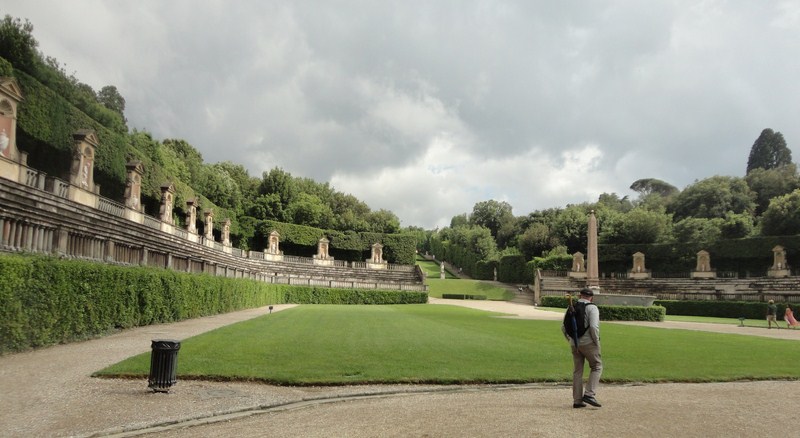
The Amphitheater

In the 17th, 18th and 19th centuries, the Medici and the Lorraine families continued to enrich and enlarge the garden, generating an outdoor museum and a scenic setting to exhibit both Roman and 16th and 17th century Renaissance statues. In the 18th century, the Lorraine family made further additions including the green Kaffeehaus (a multiple-tiered garden coffeehouse constructed from 1774 to 1785), with its glazed dome, and the “Lemon House,” both designed by Zanobi del Rosso.

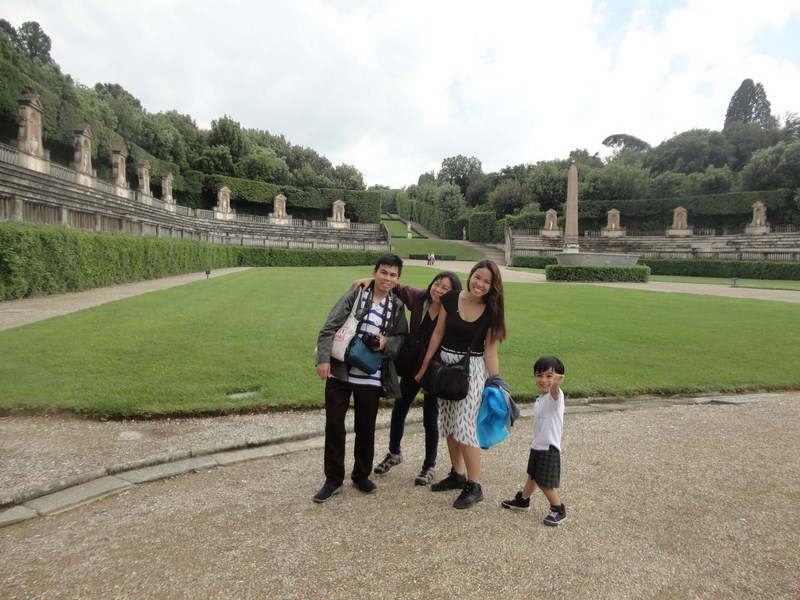
Jandy, Grace, Cheska and Kyle at the Amphitheater

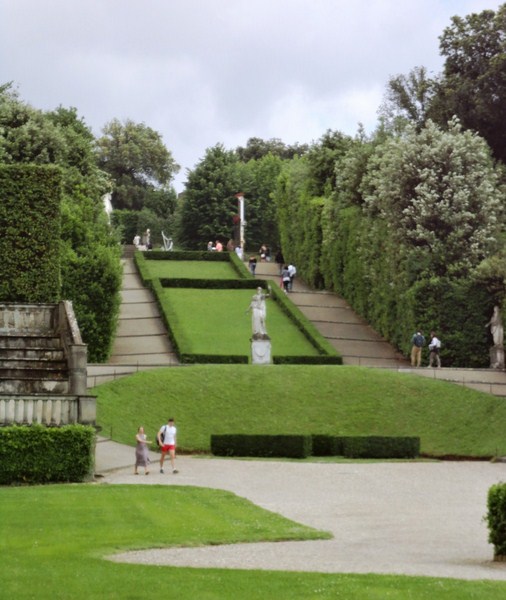
Centered on the rear façade of the Pitti Palace, the primary axis rises on Boboli Hill from a deep amphitheater, behind the corps de logis of the palazzo, that is reminiscent, in its shape, of one half of a classical hippodrome or racecourse. In the first phase of building, the amphitheater was excavated in the hillside behind the palace, initially formed with clipped edges and greens and, later, formalized by rebuilding in stone decorated with statues based on Roman myths.

In 1476, the play Andria by Terence was performed there for the amusement of the cultivated Medici court. Later, it followed by many classically inspired plays, featuring elaborate sets designed by the court architect Baldassarre Lanciof Florentine playwrights such as Giovan Battista Cini.  .

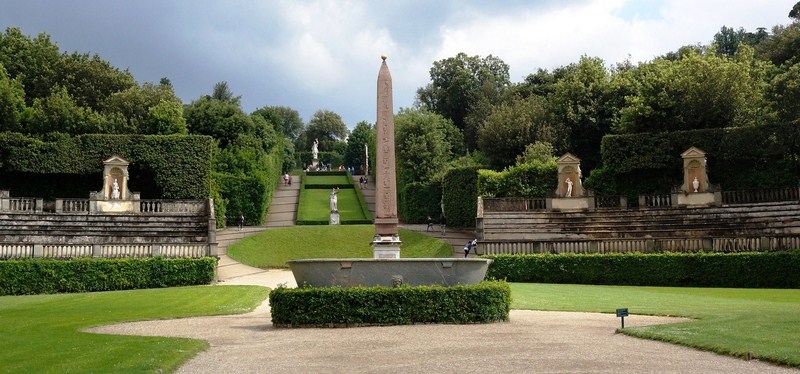
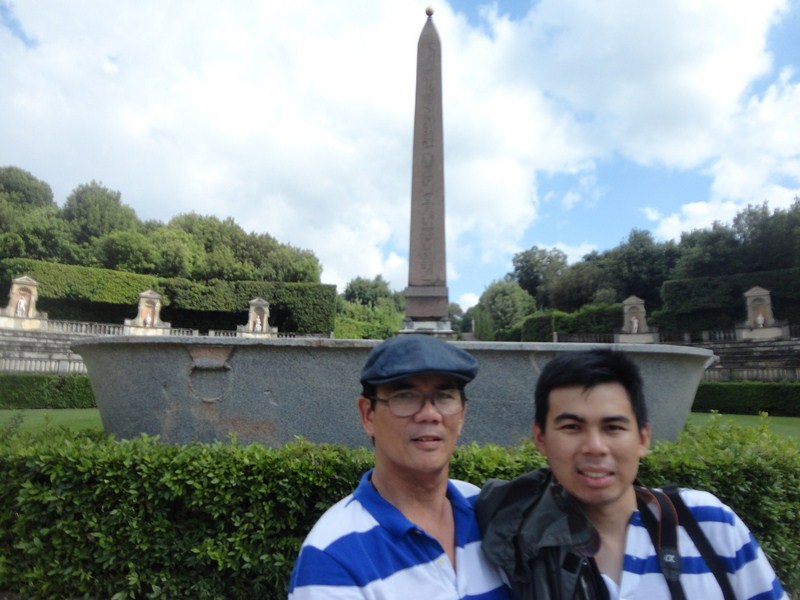
The author and Jandy with the Egyptian obelisk in the background. This obelisk is suspected to have been first erected in the city of Heliopolis during the reign of Ramesses II. In the first century AD, it was moved to Rome by Domitian and placed in the Temple of Isis in the Campus Martius, along with three other obelisks still in Rome. In the sixteenth century, Cardinal Ferdinand I de’ Medici bought the 6 m. high obelisk in Rome and placed it in the gardens of the Villa Medici.

The ancient Egyptian Boboli obelisk, brought here in 1789 from the Villa Medici (in turn, brought there from Luxor) at Rome, is at the center of the amphitheater and is rather dwarfed by its position.

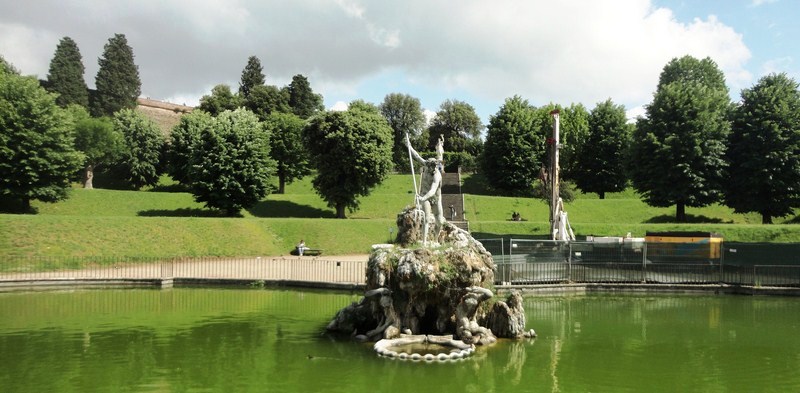
Neptune Fountain

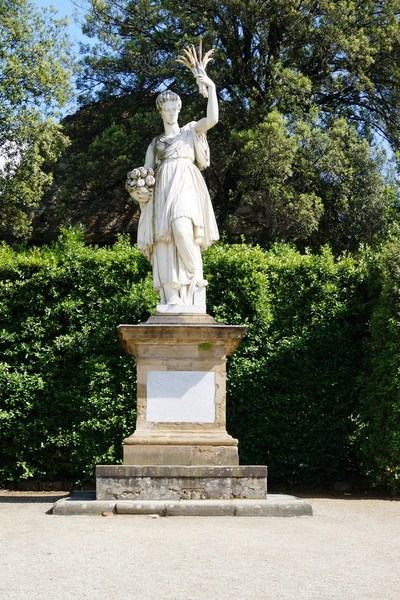
This primary axis terminates in the Neptune Fountain known, to the irreverent Florentines, as the “Fountain of the Fork” for Neptune’s large trident.  As we climbed further up the slope, at the very top of the hill, we found the large statue of Abundance, by Giambologna  (which featured the likeness of Giovanna of Austria, Francesco I’s wife) visible against the skyline.

Abundance by Giambologna

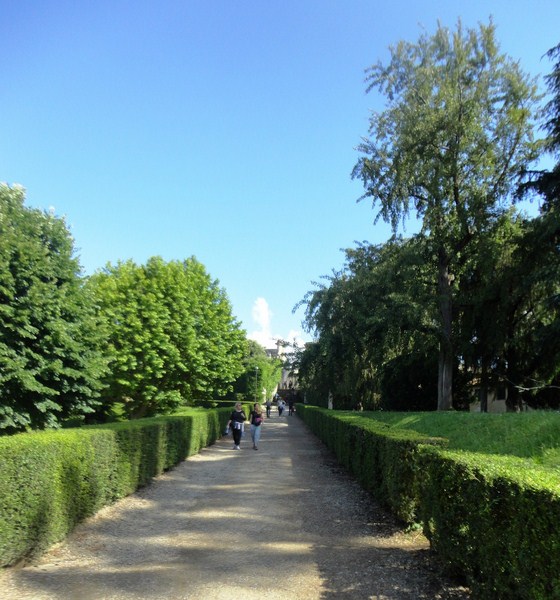
The steep, sloping Cyprus Road (or Viottolone, “large avenue”), the long secondary axis a right angle to the primary axis, was laid out by Giulio Parigi.  This road, which led up through a series of terraces, tunnels and water features (the main one being the Isolotto complex, with the bosquets on either side), is flanked by cypresses and statuettes and heads back down the hill toward at Porta Romana (Roman Gate), one of the main gates of the walled city. The Grotto of Vulcan (Grotticina di Vulcano), also along this axis, was constructed in 1617 by Parigi.

Check out “Porta Romana

The oval shaped isolotto, an island in a large, tree-enclosed pond nearly at the end of the alternative Viottolone axis, was laid out around 1618 by Giulio and Alfonso Parigi.  It has another fountain of Neptune (here as god of the oceans), known as the Fountain of the Ocean in the center, a replica of the original sculpted by Giambologna which is now in the Bargello Museum. It is surrounded by three sculptures representing the great rivers of the Nile, Ganges and Euphrates.

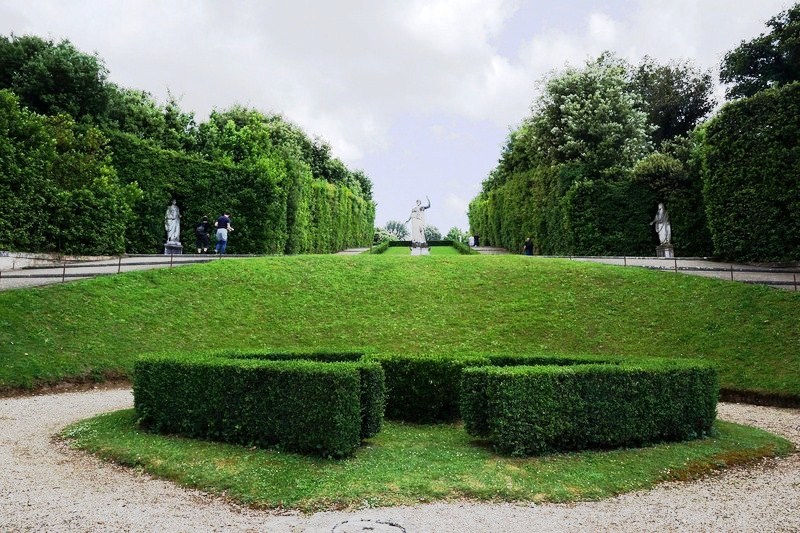
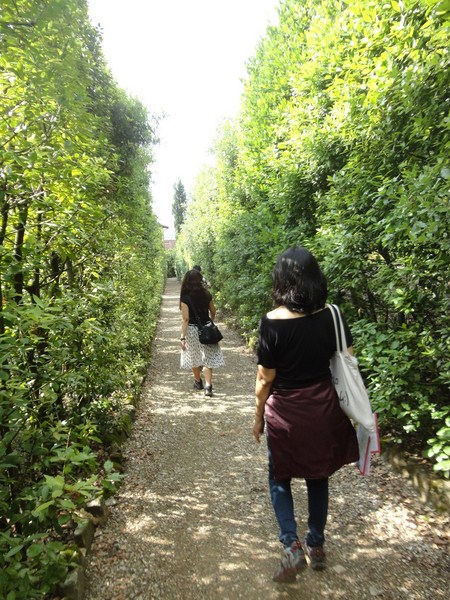
Strolling along one of the alleys of the gardens

All around are other statues based on Classic and popular subjects, belonging to the 17th and 18th centuries,  like those that shows groups of children playing traditional games. Emerging from the moat surrounding the island are the marble groups, by Giambologna and his pupil, of Perseus on horseback and of Andromeda, whose ankles are chained to the rock.

Check out “Bargello Museum

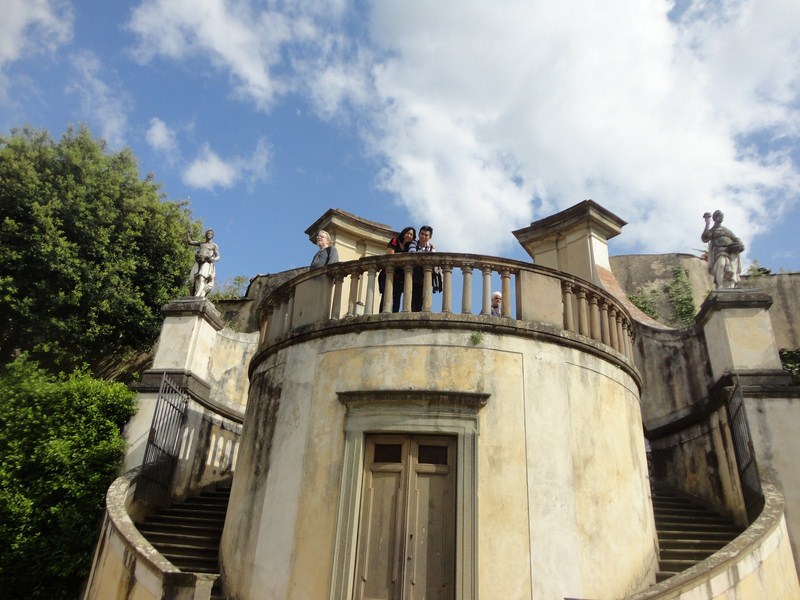
The double staircase

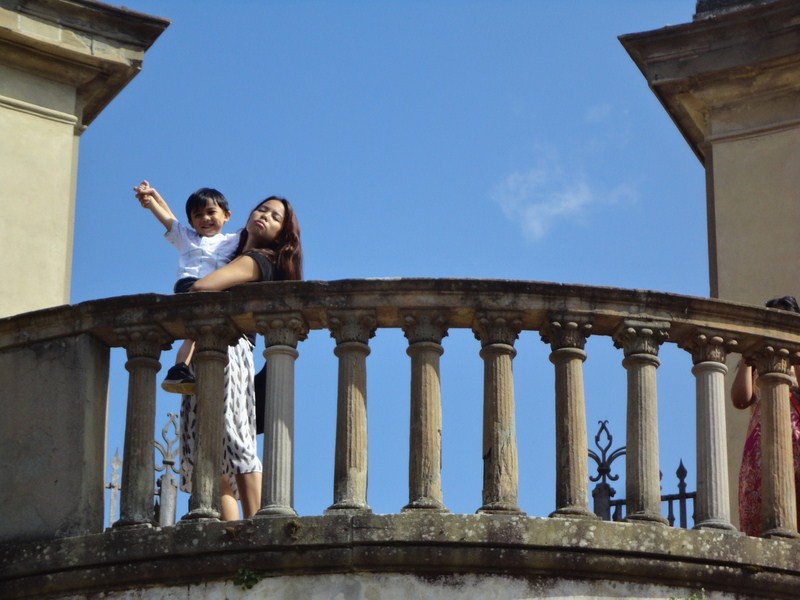
Then, we climbed a double staircase, designed in 1793, by Giuseppe del Rosso.  It curves around a cylindrical structure topped with a circular terrace, at either side of which stood two statues of the Muses.

Cheska and Kyle at the terrace of the double staircase

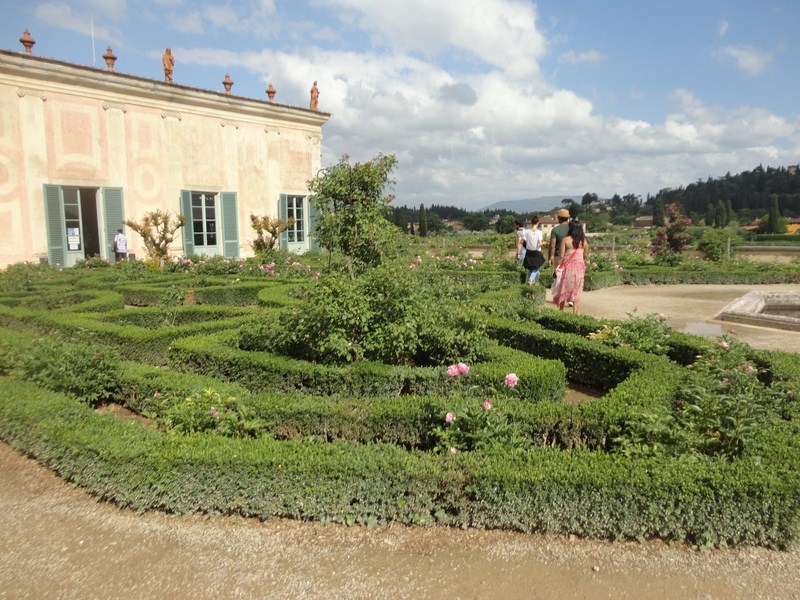
Upon reaching the top, we visited the beautiful Knight’s Garden (Giardino del Cavaliere) which stands on an eponymous rampart (Bastione del Cavaliere)  built by Michelangelo in 1529.

Giardino del Cavaliere with the Neo-Classical-style Knight’s Building (now housing the Porcelain Museum) on the left

Beside this garden is the Neo-Classical-style Knight’s Building (Palazzina del Cavaliere)  housing the Porcelain Museum of the Pitti Palace.  Underneath the building is the Trout Reservoir (Conserva delle Trote), a large water storage area, built in 1614, from which the pipes that supply water to the entire garden lead off.

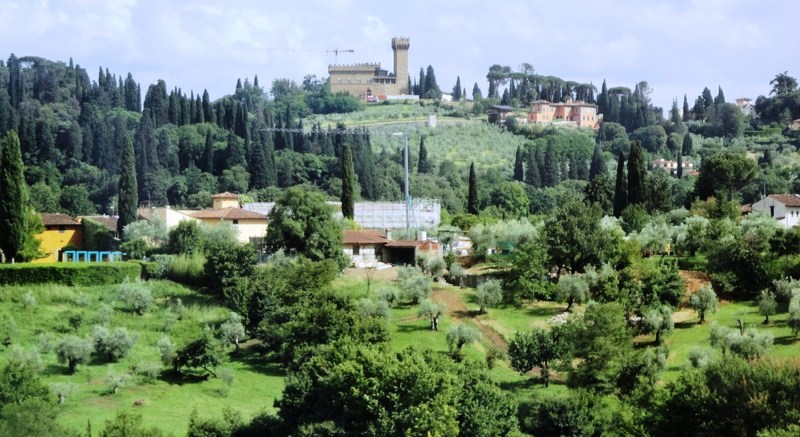
View from the Giardino del Cavaliere.  On the top of the hill is the Torre al Gallo

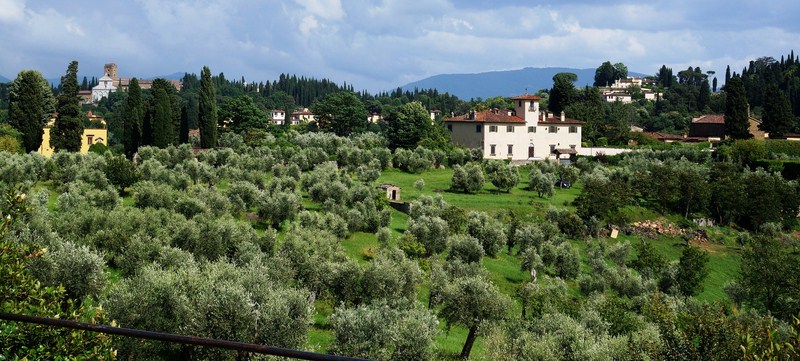
From this colorful garden rich with blossoming roses, we enjoyed a wonderful view of the Torre al Gallo as well as elegant private Florentine manors nearly hidden inside the lavish vegetation of the hills.

Check out “Palazzo Pitti – Porcelain Museum

View from Giardino del Cavaliere

The Large Grotto, decorated internally and externally with stalactites and originally equipped with waterworks and luxuriant vegetation, is divided into three main sections decorated with remarkable examples of Mannerist sculptures. The first one, frescoed to create the illusion of a natural grotto, is a natural refuge for shepherds to protect themselves from wild animals.

It originally housed The Prisoners of Michelangelo, statues that were first intended for the tomb of the Pope Julius II and are now in the Gallerie dell’ Accademia. They are now replaced by copies. The third and furthest hall in the grotto contains the famous Bathing Venus of Giambologna and the second section contains Paris Abducts Helen, an 18th-century group by Vincenzo de’ Rossi. These last two chambers were created as the perfect setting for the secretive, amorous meetings of the Duke Francesco I de’ Medici.

Check out “Gallerie dell’ Accademia

Boboli Gardens Piazza de’ Pitti, 1, 50125  FlorenceItaly.  Open from 8:15 AM to 6:30 PM (May, September and October) and 8:15 AM to 7:30 PM (July and August).  It is closed the first and last Monday of the month.  Admission: €10.

Palazzo Pitti – Palatine Chapel (Florence, Italy)

Palatine Chapel

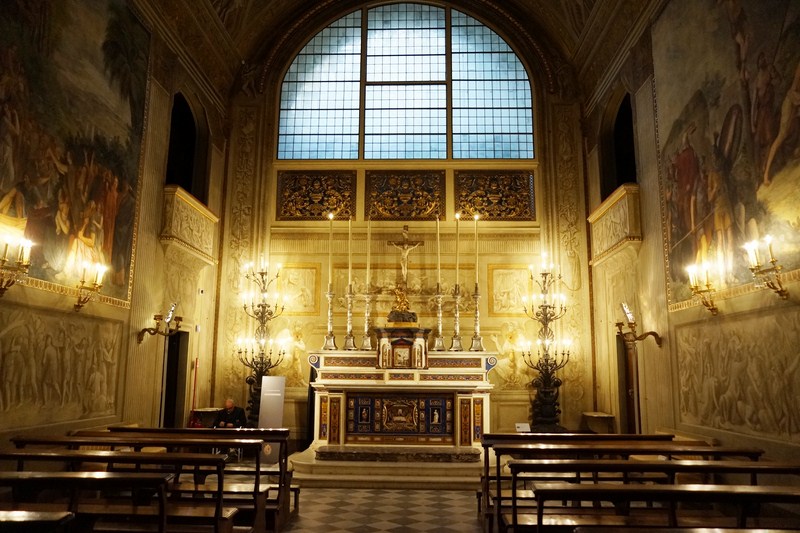
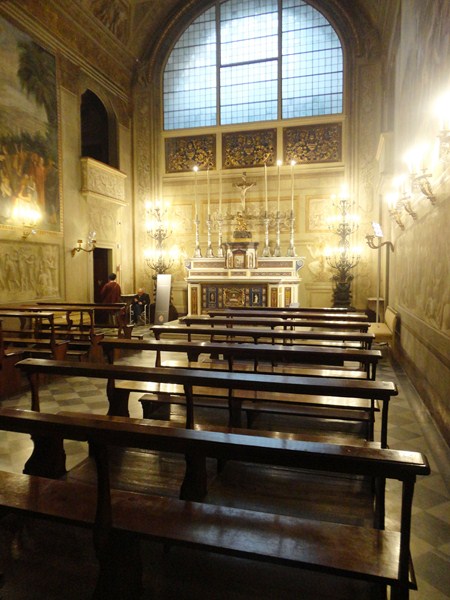
The Palatine Chapel, completed in 1575, was originally a large environment forming part of the suites used as dining rooms that Bartolomeo Ammannati created on the ground floor of the Pitti Palace. Later, it was used firstly as a reception room and enhanced by precious vestments.   In 1658, it was used as a lounge for the foreign princes and, in 1661, when Cosimo III married Marguerite Louise d’Orléans, the suite was renovated and used as a residence for the “Wedded Royals.”

For this occasion, Jacopo Chiavistelli decorated the rooms with frescoes featuring subjects and architectures we can only imagine today.  According to the descriptions of the time, they portrayed Cosimo’s challenge and Apollo’s cart, among allegories of Day and Night on the vault, the months of the year and the Zodiac signs, alternating with backgrounds of architecture on the main walls and, on the smaller walls, the weapons of the Medici and the Orleans family.

In 1765, following the arrival of Grand Duke Leopold II of Lorraine in Florence, the area was radically transformed. Deciding to convert the hall into a new palace chapel, Leopold II assigned the renovation project to architects Ruggeri and Paoletti.  They created stages for the court and musicians, opened up the great arched window that replaced the original ones and added choirs to the opposite side.

To the right of the altar, a small choir for the rulers was built while, on the wall behind the altar, a space for hosting ladies was carved out. Finally, the iconographic content of Chiavistelli’s frescoes was changed, with a few retouches, by painter Vincenzo Meucci who transformed it from the profane to sacred.

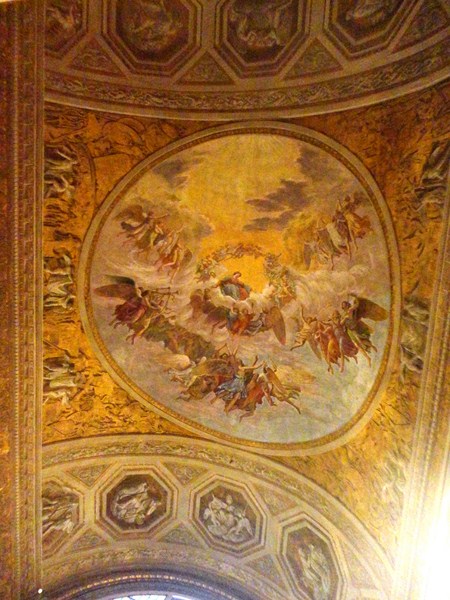
Ceiling fresco

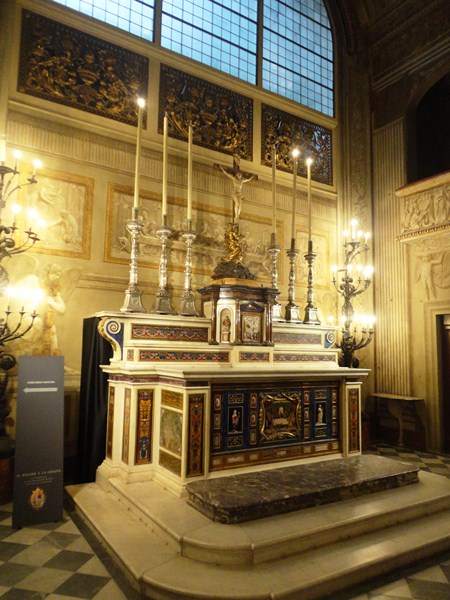
Initially, in 1766, work commenced on three wooden altars designed for the Chapel. In 1785, the three wooden altars were replaced by a new large single altar designed by painter Santi Pacini and made using parts of the altar, commissioned by Ferdinando I de’ Medici in the 16th century and destined for the Cappella dei Principi in San Lorenzo, which was never finished (the altar, over time, became a true mine of precious material to use for new works). They included two very interesting panels in bas-relief, attributed to Ludovico Cigoli, which were created using the semi-precious stone mosaic technique that dates to the early 17th century.

The first one, constituting the door of the ciborium above, represents “The Adoration of the Magi.” The second one, depicting “The Last Supper,” is positioned in the center of the frontal with allegories of Faith and Charity at the sides. It is flanked by full-relief figures, in niches, of the saints Athanasius and Giovanni Grisostomo. Both panels, set in splendid frames of white marble and golden bronze, feature jaspers, pearls, chalcedonies, quartz, amethysts and lapis lazuli.  The precious ivory Crucifix with the figure of Magdalene at the feet of Christ, a masterpiece of Baroque eburnean sculpture, was left at the top of the new altar.  Today, Lorenz Rues is credited with carving it and Antonio Raggi with creating the figure of Magdalene.

The altar of the chapel

The altar, one of the most precious treasures contained in the Pitti Palace, was definitely created under the direction of Cosimo Siriès (then Superintendent of the Opificio delle Pietre Dure), who was also an artist. He further decorated the altar with holy ornaments in silver (a so-called “residence” with a cross, statues of saints and candlesticks). Unfortunately, all traces of the holy silver elements were lost during the French dominion. However, to this day, the silver and gold wooden ‘baldachin,’ added in 1793, still stands in the same spot.

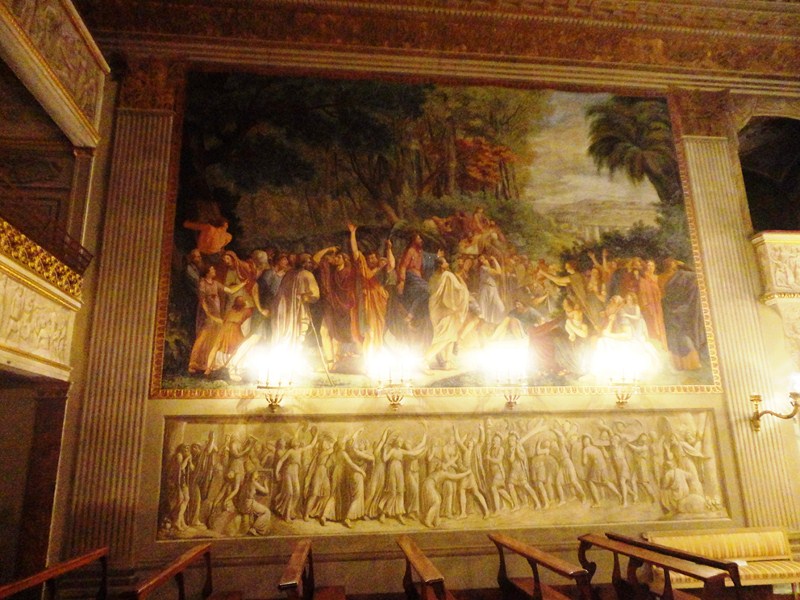
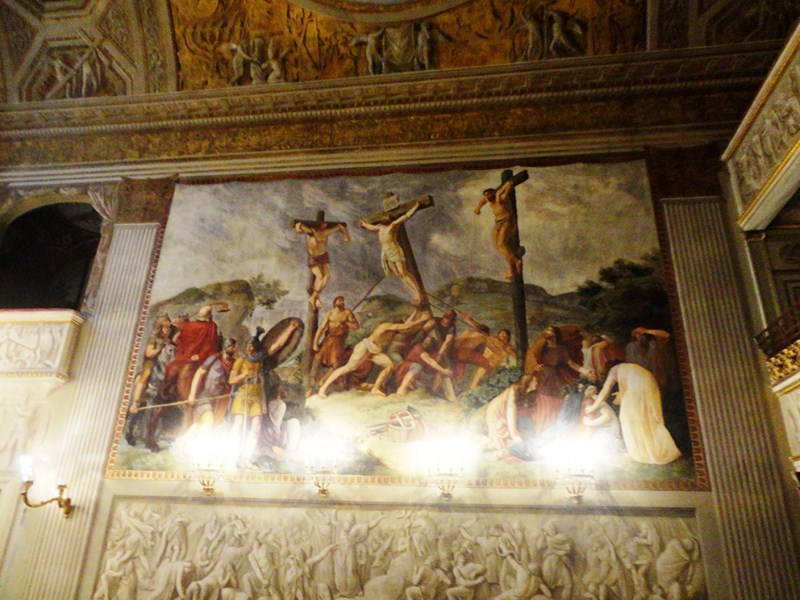
The choirs were enhanced by adding two columns of alabaster from Montalcino.  The two central doors of the main walls were closed to make space for the new fresco decorations created by Luigi Ademollo.  Ademollo also painted the frescoes on the vault and the decorations on the choirs and small choirs, portraying “various events in the life of Jesus Christ’s” with strikingly scenographic characteristics (the “Crucifixion” on the wall to the right of the altar and “Palm Sunday” on the wall to the left). When Ferdinand III returned to Florence, Ademollo completed the decoration of the Chapel by decorating the left-hand choir in the chapel, built in 1823.

Palm Sunday (Luigi Ademollo)

Between 1791 and 1792, Ferdinand III (who succeeded Leopold II) completely changed the decorative layout of the chapel in an operation that endowed the chapel with its current shapes, based on the design by Bernardo Fallani.

Although dating back to the mid 19th century, the ensemble picks up on the designs and motifs in use in the previous century, establishing a seamless dialog with the articulate decorations in white stucco and gold (carried out between 1685 and 1687 from designs by Giovan Battista Foggini), with scrolls and mottoes referring to Ferdinando and his wife, Violante di Baviera.

The Crucifixion (Luigi Ademollo)

Palatine Chapel: Ground Floor, Pitti Palace, Piazza de’ Pitti, 1, FlorenceItaly. Tel:+39 055 294883. Open Tuesdays-Sundays, 8:15 AM – 6:50 PM. Admission: Palatine Gallery (€8.50), Silver Museum (€6.00), Gallery of Modern Art (€8.50), Costume Gallery/Porcelain Museum/Boboli Gardens/Bardini Garden (€6.00).

How to Get There: Take the C3 or D bus to the Pitti stop.

Palazzo Pitti – Gallery of Modern Art (Florence, Italy)

Gallery of Modern Art

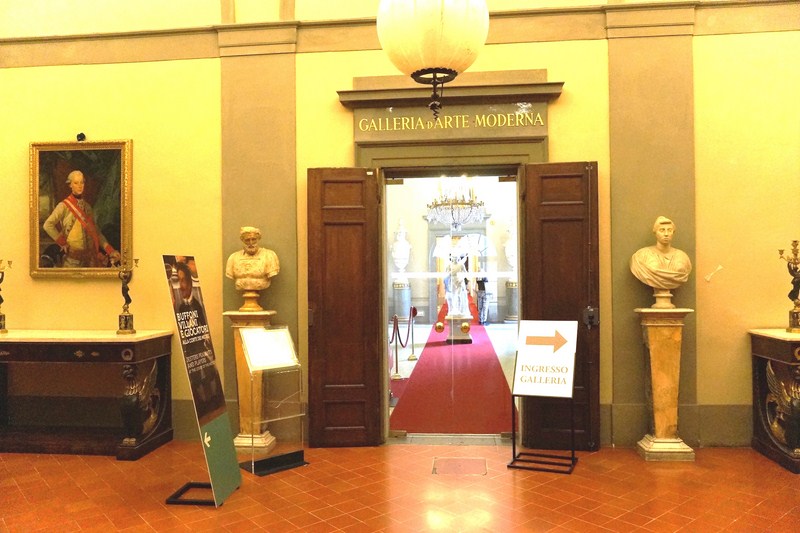
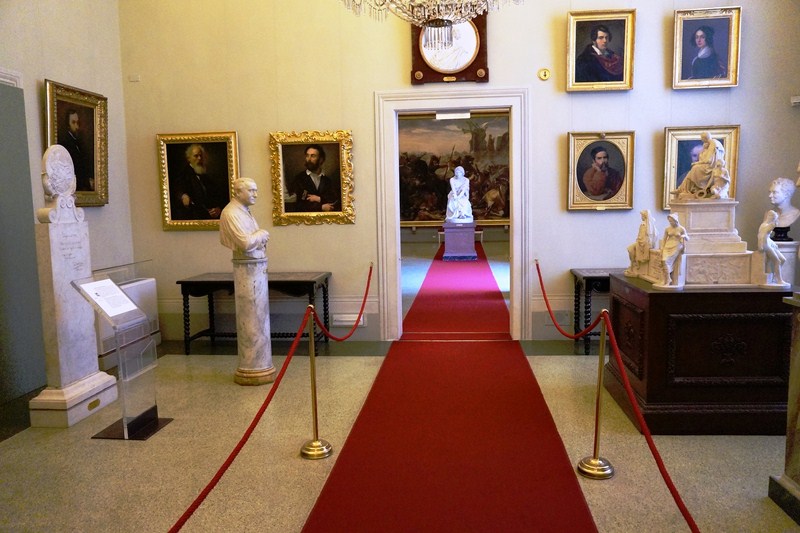
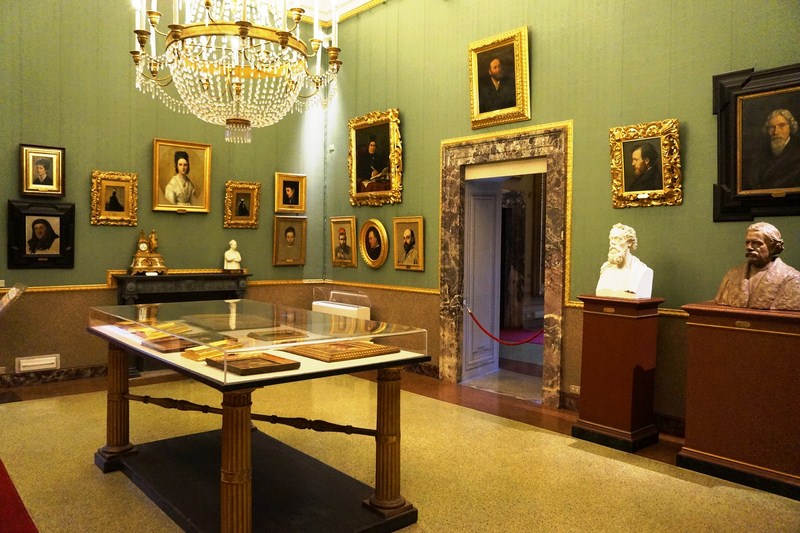
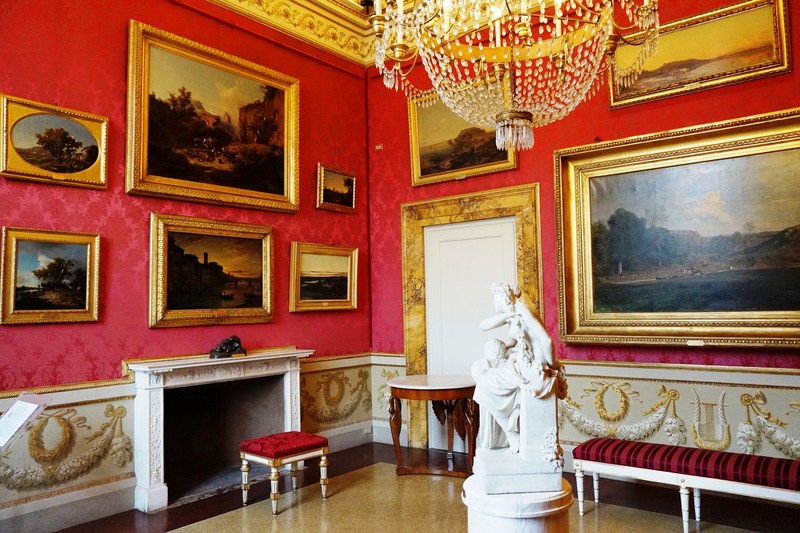
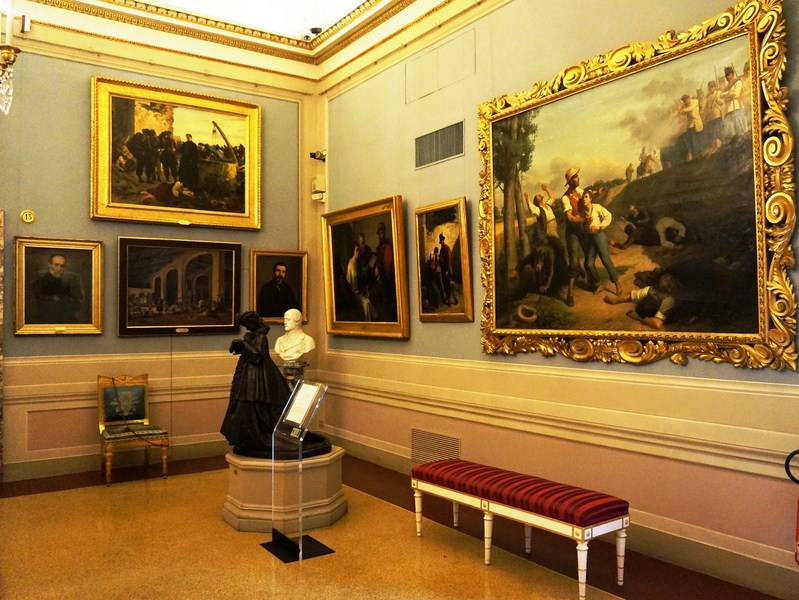
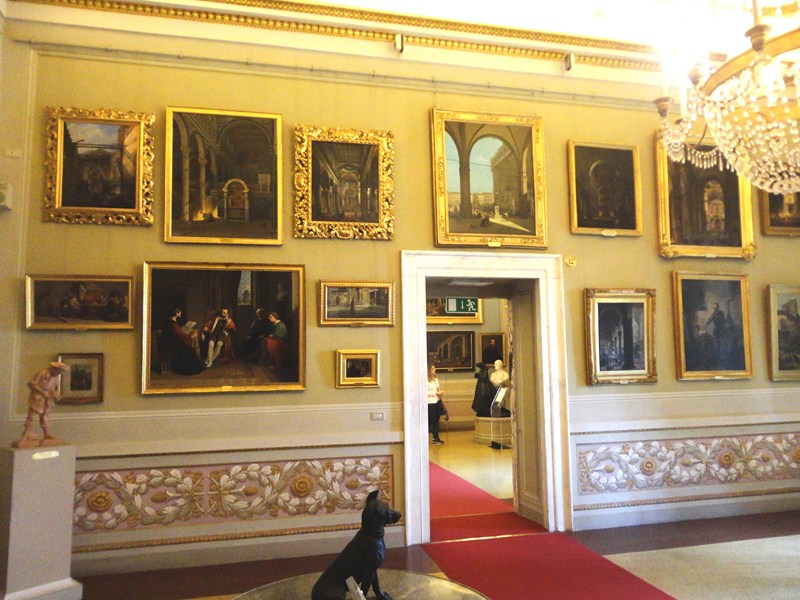
The Gallery of Modern Art, housing one of the most important and complete collections of early and late 19th century and early 20th century Italian paintings, occupies an impressive 30 rooms on the second floor (opened to public viewing since 1924) of the Palazzo Pitti once inhabited by the Habsburg-Lorraine family from which there is a magnificent view over Florence and the Boboli Gardens.  It extends as far as the rooms and the facade used by the for the palace library and the side wings used for children and retainers.

Founded in 1914, it initially comprised the Grand Ducal paintings of modern art, complemented by further modern works of art in the ownership of both the state and the municipality of Florence, brought in from the Academy of Fine Arts. The sumptuous rooms, furnished in the first half of the 19th century with frescoes, stuccoes, and period furnishings, constitute a perfect setting for the works.

Recently, these rooms have been reorganized, according to chronological criteria that trace a wide chronological arc. Though the rooms on the second floor have been restored, the decoration, upholstering and furniture of the Lorraine period have been maintained. Great informative materials are available in each room.

To some, the title “Gallery of Modern Art” may sound incorrect, as the art in the gallery covers the period of time going from Neo-Classicism (the age of Peter Leopold) up to the First World War to the 1920’s and no examples of later art are included in the collection.   In Italy, “modern art” refers to the period before World War II.  What follows is generally known as “contemporary art” (arte contemporanea) which, in Tuscany, can be found at the Centro per l’arte contemporanea Luigi Pecci at Prato, a city about 15 kms. (9 mi.) from Florence.

The tour of its current large collection, still being added to through donations and purchases, is arranged in multiple, overlapping rows and organized in chronological order and by historical-topical category.  It attempts to furnish visitors with a clear view of the history of the various core collections, enabling a correct reading of the diverse atmospheres, marked as they are by the personal tastes of the royal families alternating in their reigns.  Today, due to a convention signed by the Italian State and the Municipal Administration of Florence, it has a very special juridical nature.

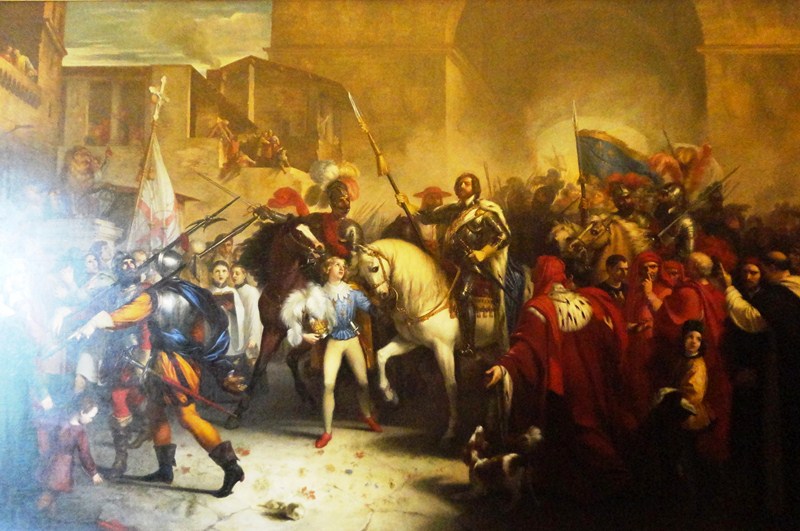
Entry of Charles VIII into Florence (Giuseppe Bezzuoli)

Our chronological journey began with the movements of the early 1800s, with artworks from the Neo-Classical (like the Oath of the Saxons to Napoleon by Pietro Benvenuti), to Purism and the Romantic (like the grandiose Entry of Charles VIII into Florence by Giuseppe Bezzuoli or The Two Foscari  by Francesco Hayez).

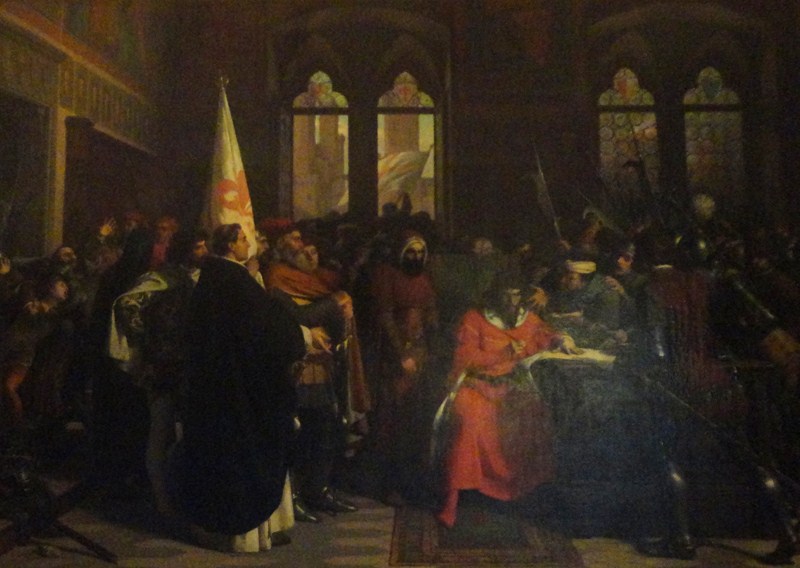
The Expulsion from Florence of the Duke of Athens (Stefano Ussi, 1861)

Also included is a vast assortment of paintings of modern Italian schools of the late 19th and early 20th centuries, based on historical subjects that document one of most significant aspects of the first half of the 19th century culture. These comprise works by Luigi Sabatelli, Enrico Pollastrini or by Stefano Ussi with his famous The Expulsion from Florence of the Duke of Athens.

The 19th-century itinerary concludes with works of Symbolist and Divionist movements. Among the various works on display include many paintings of views and interior scenes by the delicate Silvestro Lega and the vigorous landscape painter Telemaco Signorini, a series of his rapid and elegant portraits by Giovanni Boldini, plus other works by Giorgio Morandi, Francesco Hayez, Camille Pissarro, Filippo de Pisis, Carlo Carra, Giorgio de Chirico, M. Rosso and Plinio Nomellini and futurist avant-garde works.

In addition to the above-mentioned collections, the Gallery also displays a lavish collection of 19th century works arranged in the so-called Mezzanine of the Eyes (Mezzanino degli Occhi, the “eyes” being windows in the shape of a circle).

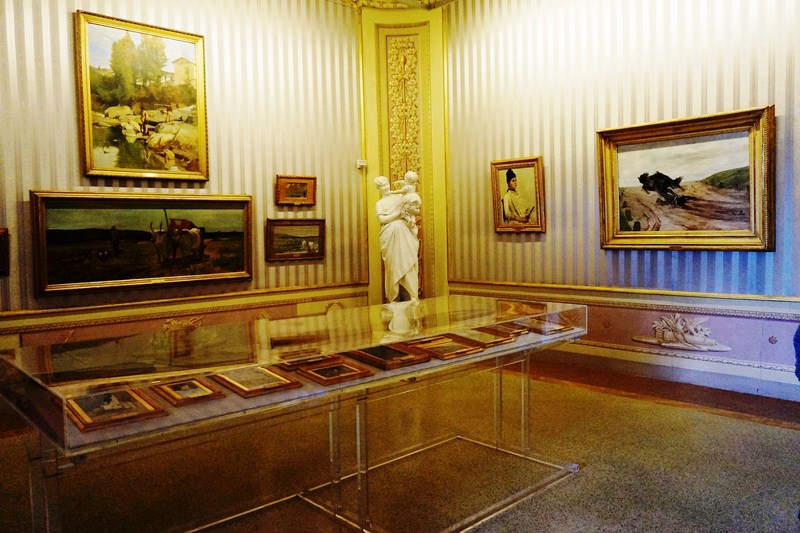
However, the paintings that most characterize the Gallery are those of the Macchiaioli movement (starting at Room 17), a school of famous Tuscan artists of the mid-19th century, led by Giovanni Fattori, who are early pioneers and the founders of the Impressionist movement that set out the premise for a wide-scale innovation at a national level. Many of the works of these artists displayed in the Gallery belong to the collection of Diego Martelli, a critic, gallery owner (who went back and forth between Florence and Impressionist Paris) and friend of the Macchiaioli who left their paintings to the museum at the end of the last century.

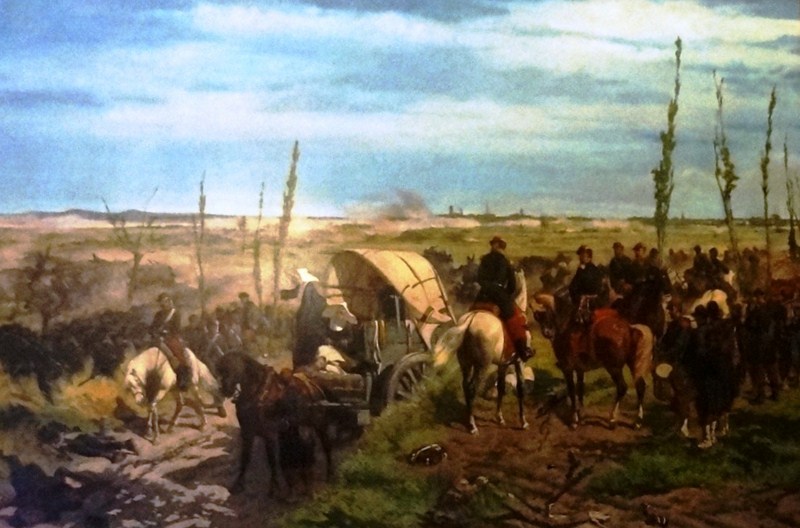
Italian Camp at the Battle of Magenta (Giovanni Fattori)

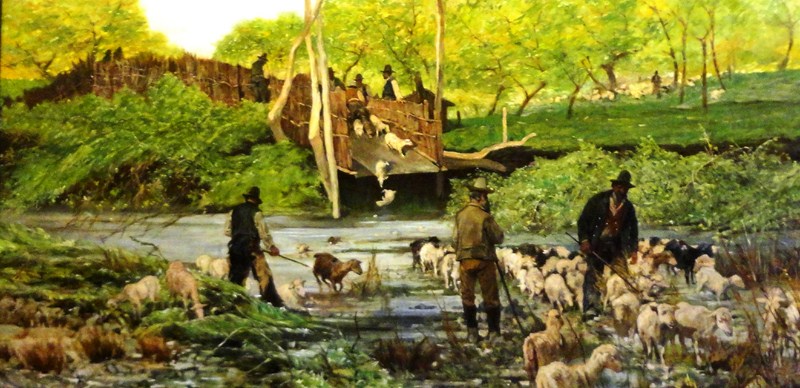
This section comprises important works by Giovanni Fattori such as the small and beautiful panel Rotonda at Palmieri, the Italian Camp at the Battle of Magenta, and the Lo Staffato plus a rich series of landscapes and scenes of life in the Maremma such as the Market San Godenzo in Maremma (1887), the Ox Cart in the Tuscan Maremma, and the Sheep’s Jump (Il Salto delle Pecore, 1887).

The Sheep’s Jump (Giovanni Fattori, 1887)

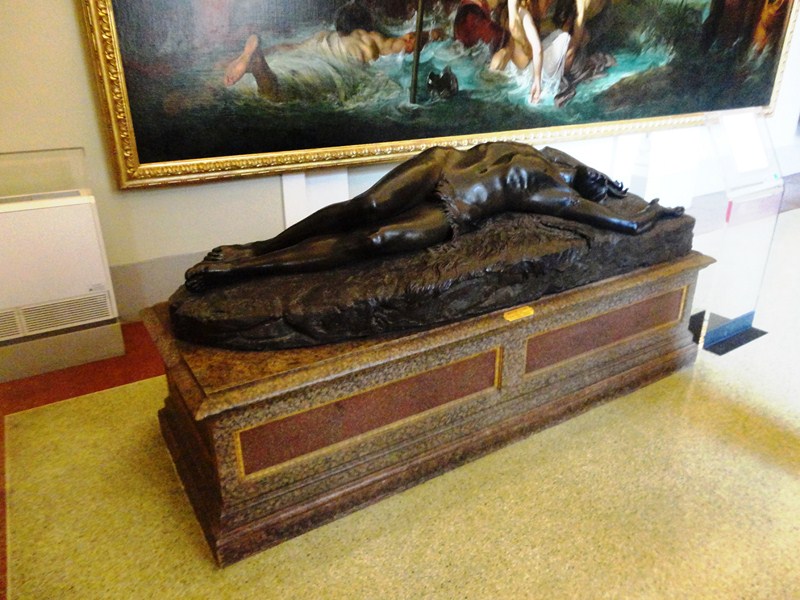
Within the same period are many fine sculptures such as the Calliope of Antonio Canova, Psyché by Pietro Tenerani and the famous Abel Defeated by Giovanni Dupré.

Abel Defeated (Giovanni Dupre)

The sculptures of Adriano Cecioni, lucidly translated and experimented with the tonal ideas prevalent to whom the touch was so important. You can also visit the apartments of the Duchess of Aosta, with the original furnishings that belonged to the Savoia family.

Apartment of the Duchess of Aosta

Gallery of Modern Art: Second Floor, Palazzo Pitti, Piazza de’ Pitti 1, 50125 Florence, Italy.  Open Tuesdays to Sundays, 8.15 AM to 6.50 PM. Closed: Mondays, New Year’s Day, May 1 and Christmas Day. Admission: € 8.50 (full price), € 4.25 (reduced).  Free admission: children under 6 years old, disabled people and their helpers, authorized tour guides and leaders, teachers accompanying school groups. The ticket is also valid for the entrance to the Palatine Gallery. The ticket office closes at 6.05 PM and closing operations begin 6.30 PM.

How to Get There: Take the C3 or D bus to the Pitti stop.

Palazzo Pitti – Imperial and Royal Apartments (Florence, Italy)

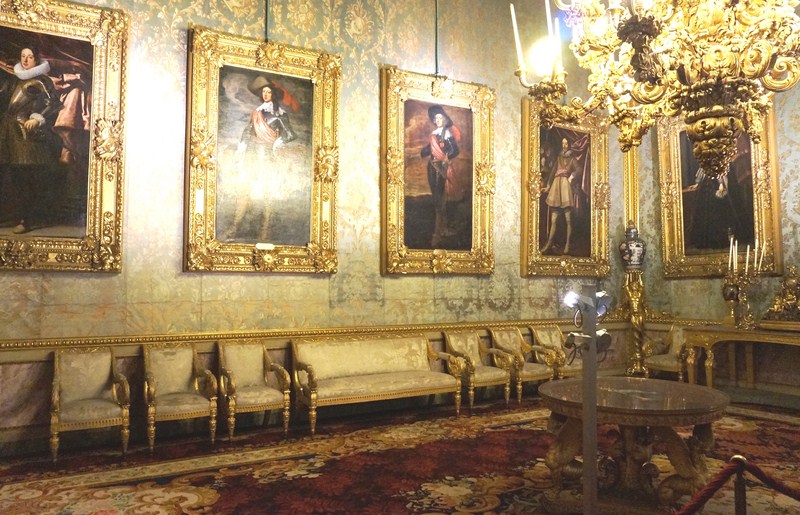
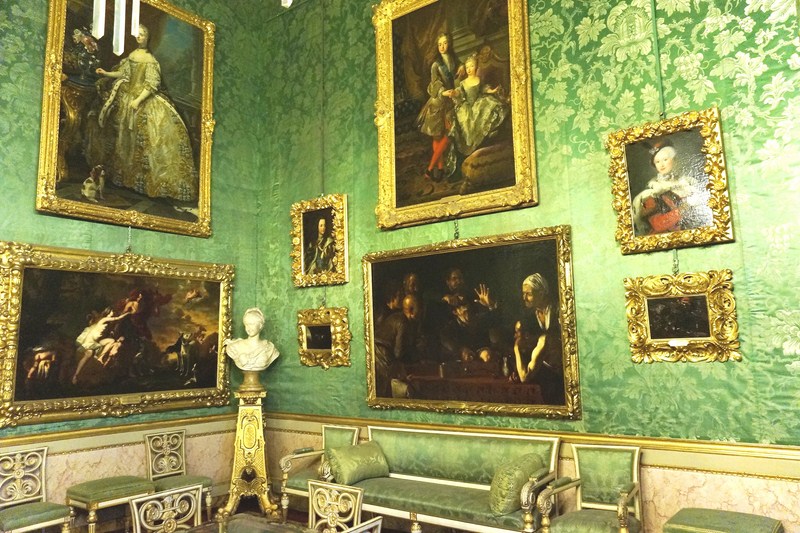
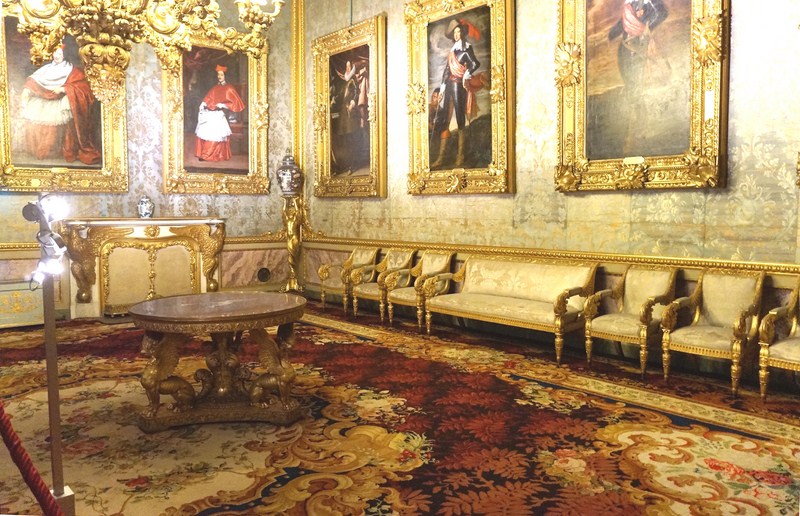
An array of Medici portraits at the Blue Room (Salotto Celeste)

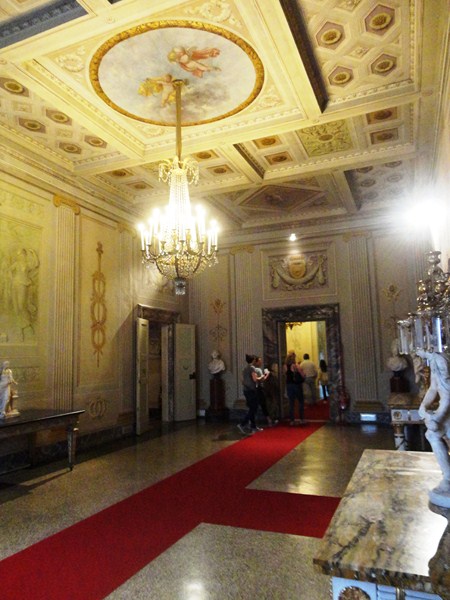
From the Palatine Gallery, our visit continued to the monumental Imperial and Royal Apartments.  Taking up 14 magnificent ceremonial rooms (now differentiated from the Palatine Gallery) at the right wing of the main floor of the Palazzo Pitti, it opened out along the south side of the Palazzo Pitti façade. Over three subsequent historical periods, they have been an important record of the history of the palace. The three different styles, corresponding to three different historical periods, are harmoniously balanced in that gives us an idea of its appearance before its transfer to the State in 1914.

Though their decoration has been changed to Empire style by the House of Savoy, there are still some rooms that maintain decorations and furniture from the age of the Medici. In 1911, restoration and general reorganization of the inventory of the paintings and furniture of the Pitti Palace was performed. After the recent refurbishing of the Apartments, started in 1987, these precious rooms were reopened to the public in 1993.

Parrot Room (Sala dei Pappagalli)

In contrast to the great salons of the Palatine Gallery, some of these rooms, while still grand and gilded, are much smaller, more intimate and are more suited to day-to-day living requirements with period furnishings including four-poster beds and other necessary furnishings not found elsewhere in the palazzo.  From the 17th century onwards, these majestic rooms were the residence of the Grand Ducal Medici family (until their extinction in 1734), then of the Lorraine (Lorenese) family and, finally, of the Savoys (when, from 1866-1870, Florence became the second capital of unified Italy and Vittoria Emanuele II chose to make the Pitti the royal residence).

Bearing traces of the changing dynasties, these rooms were sumptuously furnished with pieces from the collections of the Medici, Habsburg-Lorraine and House of Savoy such as tables with semi-precious stone inlays, consoles and mirrors, furnishings and silk tapestries on the walls.  These striking mixture of styles reflect the daily life and taste of the different periods and inhabitants.

Chapel

The apartments still retain the layout given by the Grand Prince Ferdinando dei Medici, the son of Cosimo III. The few treasures from the Medici period that remain include the precious 17th century ebony and semi-precious stone cabinet that belonged to the Grand Duchess Vittoria della Rovere (the wife of Ferdinando II) and the chapel.  The prevailing appearance of the Royal Apartments, as seen today, is that given them, in the fourth and fifth decades of the 19th century, by the Neo-Classical taste of the Lorraine-Hapsburgs.  These rooms were given its final character by the Savoys who left a strongly eclectic and distinctive stamp of their taste on the general appearance of the Royal and Imperial Apartments, which is still visible today.

The Grand Dukes of the House of Habsburg-Lorraine altered, restored and re-furnished the apartments, between the end of the 18th century and the first half of the 19th century, according to the changing taste of the period, decorating the ceilings with stucco and Neo-Classical subjects and the Oval Room (known as the Queen’s Dressing Room) with light hand-embroidered silk panels to the designs of Ignacio Pellegrini, and the ceiling with colored Rococo stucco.

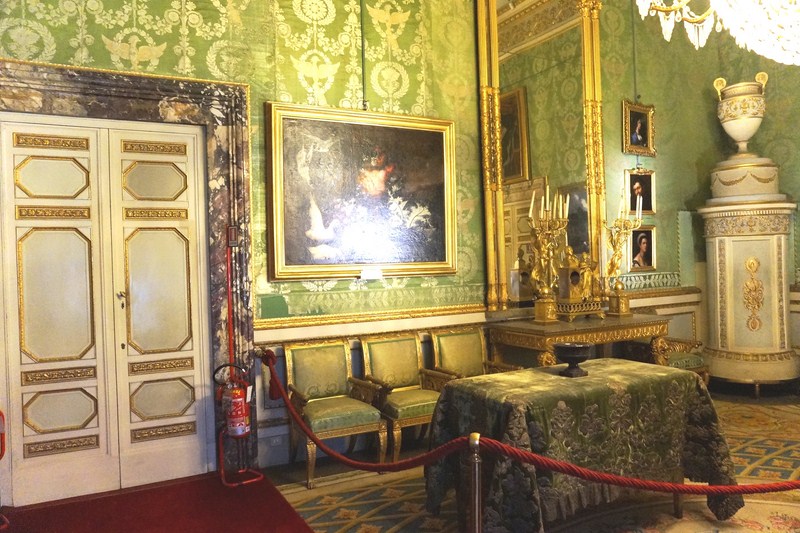
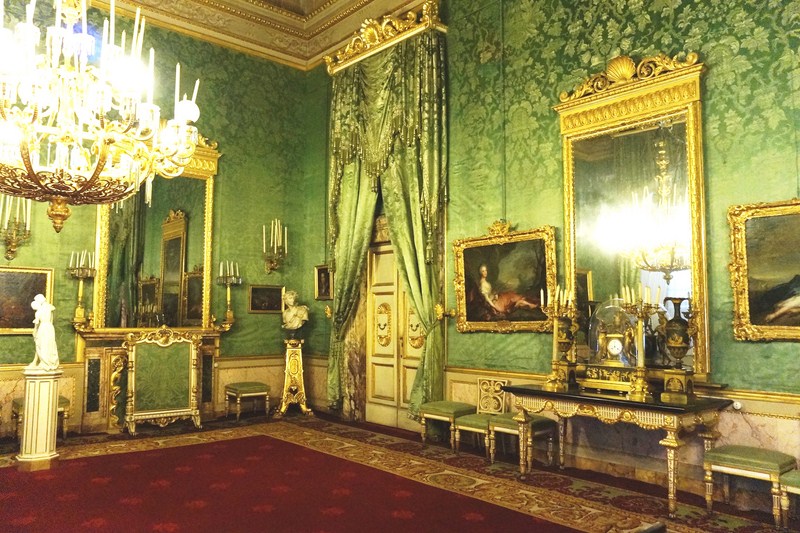
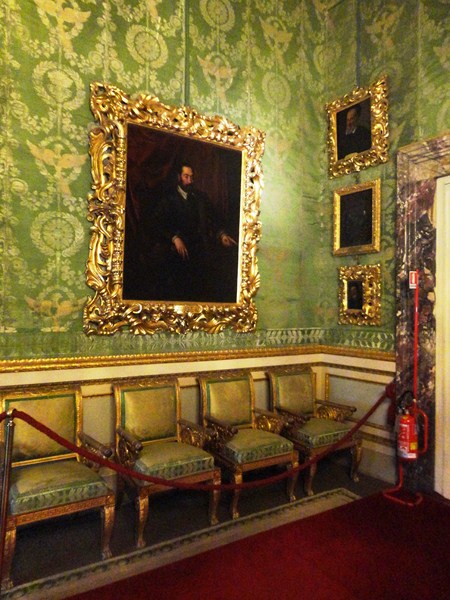
Green Room

From 1865, during the time of the sovereigns of the House of Savoy, some rooms (notably the chapel) were also entirely refurnished and carpeted, between the end of the 18th and the beginning of the 19th centuries, according to the Empire style of the period.

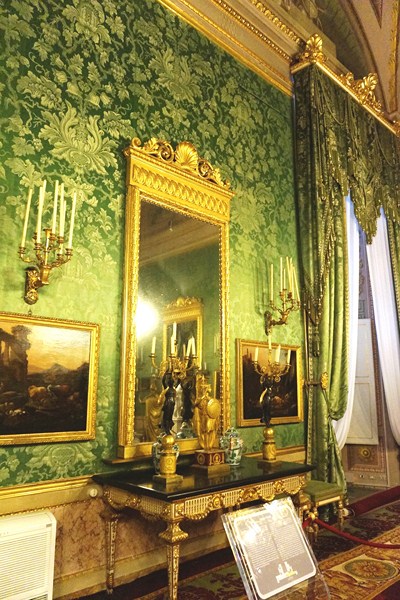
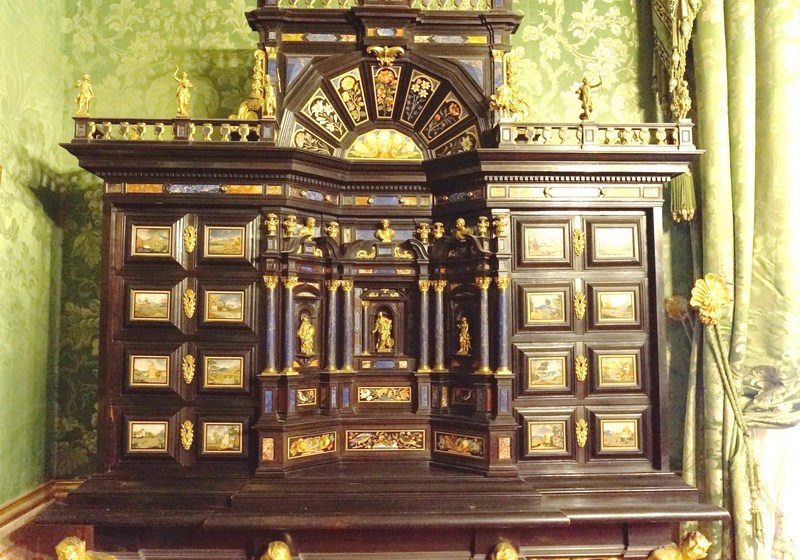
The Green Room (Salone Verde), frescoed by Giuseppe Castagnoli in early 19th century, exhibits an Intarsia Cabinet from the 17th century and a collection of gilded bronzes. The name of the room comes from the green color of the wall coverings, curtains and the upholstery on some of the furniture (which are all in silk – textured or plain) fitted, between 1854 and 1855, by Florentine manufacturers.

Green Room (Sala Verde)

In that period, the room was completely redecorated, like the Blue Room and the Throne Room that follow it, earning the name of Fabric District (Quartiere delle Stoffe).  Since the last Grand Duke, Leopold II of Lorraine had chosen the new Palazzina della Meridiana as his home, it was used first as a reception room.

Also from the same period are the carpet (made by the prestigious Royal Works of Tournai, in northern France, and decorated with late imperial motifs), a pair of lamps, the brackets for the candle holders, the fire guard and the fireplace mirror (carved in imitation of the two placed above the slightly older consoles).  Coming from different periods are the rest of the furnishings and paintings (starting with the canvas on the ceiling, the Allegory of Peace between Florence and Siena, painted by Luca Giordano in 1682 for Cosimo III.

Stipo Cabinet

The Stipo cabinet, belonging to Vittoria della Rovere, is definitely the most important piece of furniture.  This monumental work of art, from the ducal workshops of the 17th century, emulated, on a small scale,  the Historicist style of the side table from the Opificio delle Pietre Dure (delivered to the Pitti Palace in 1852 and subsequently placed in the room), with the Savoy period typical nonchalant style and tone.

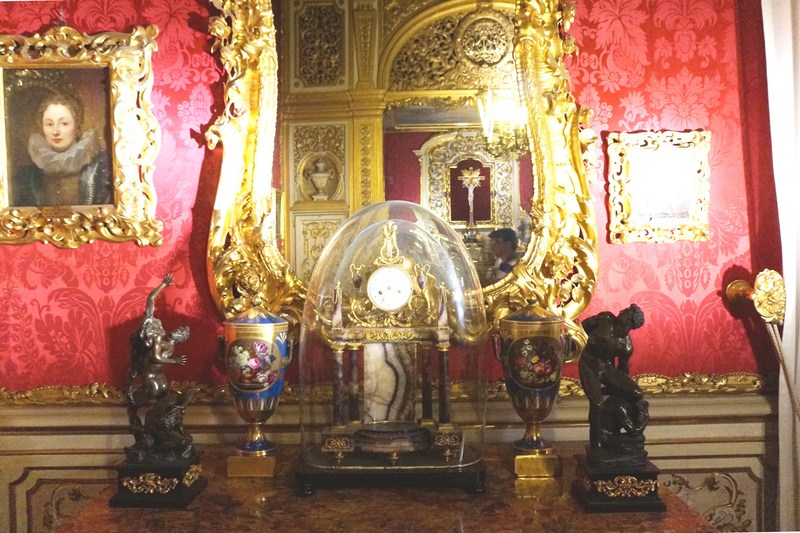
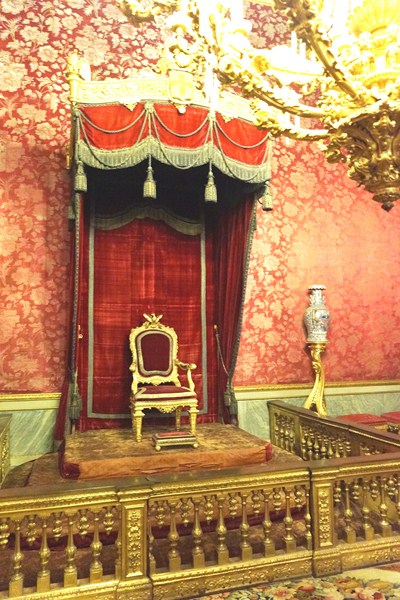
The Throne Room (Sala del Trono), decorated for King Vittoria Emanuele II  of Savoy, was used for official audiences as well as to hang some of the paintings from his famous collection.  The throne is under a canopy. The royal setting is emphasized by the large mirrors on the walls (to multiply the images of the king) as well as by the sumptuous mid 19th century Baroque red damask silk lampas ensemble on the walls.

Throne Room

The throne area was set out later, for the arrival of the Savoy monarch, and then, after 1871, changed again when the balustrade and audience chair were added with the emblem of the Savoys.  On the ceiling arch are the triumphant decorations by Giuseppe Castagnoli (1754-1832) while the image of Jupiter enthroned is framed with monochrome decorations.

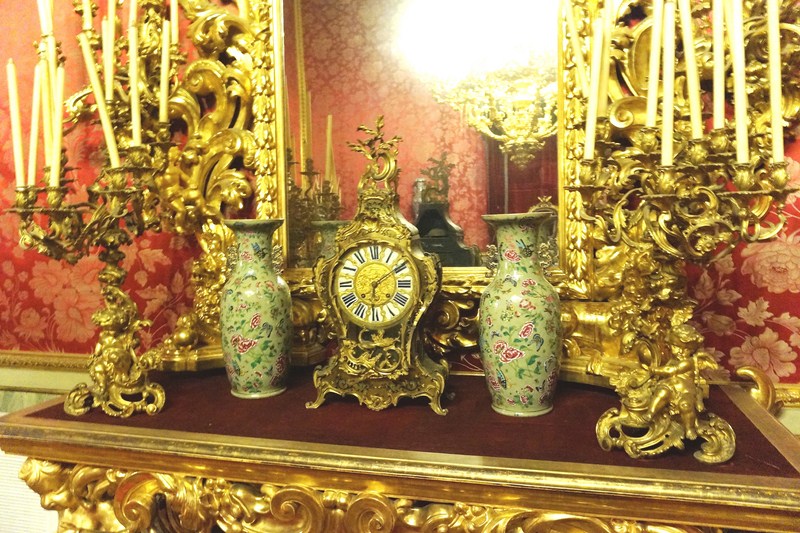
A clock flanked by Oriental vases and candelabras

The room has been further enhanced by a richly inlaid, gilded lamp while inlaid and gilded console tables are decorated with candelabras and imposing 17th-18th century Oriental Japanese and Chinese porcelain vases.

Like the Green Room and the Throne Room, the Blue Room (Salotto Celeste) was also renewed between 1854 and 1855 when this suite was known as the new Fabric District (Quartiere delle Stoffe). The room stands out for the Neo-Baroque decorative style, updated to the fashions of Paris and London in the mid-19th century. After the addition of new wallpaper (in this case, a shade of blue), the room was also given a carpet made by French weavers in Tournai. Furnishings include a small round table, with a pietre dure top on a base in porphyry, and the four candle holders.

Blue Room (Salotto Celeste)

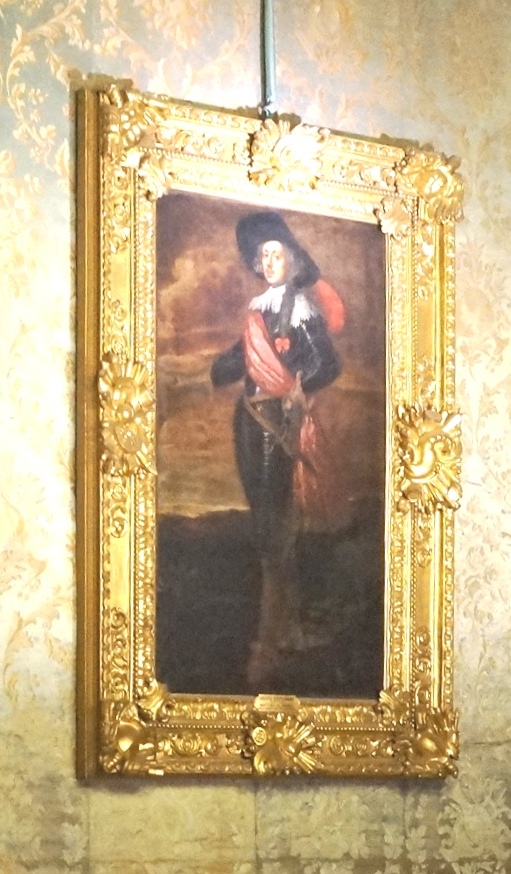
The Blue Room pays homage to some members of the Medici family or those who were joined to it by marriage (except Cardinal Camillo Francesco Maria Pamphili) who, during the course of their lives, had spent time in these spaces.  Hung on the walls are 10 of a series of 12 portraits painted between 1621 and 1645 by court painter Giusto Sustermans (1597–1681), all identical in size and given new frames in the 1720s on the wishes of Grand Duke Cosimo III.  They include a full-length portrait of Christina of Lorraine, her daughter Claudia and husband Leopold of Austria, Cosimo II’s children, Francesco and Mattias, painted a few years later, Grand Duke Ferdinand II and Cardinal Carlo de’ Medici.

One of the Medici portraits

The large chandelier, the oldest (dating back to the 17th century) still in the palace, was carved by Vittorio Crosten.  The white stucco and gold ceiling dates back to the period of Peter Leopold of Lorraine.  The “eagle” fireplace was done by Francis Harwood, an Englishman (who moved to Florence, where he ended his days in 1783) who worked as a portrait painter and copyist of Roman antiquities for travelers on the Grand Tour.  He was employed by the Grand Duke to restore the sculptures in the palace and the Boboli Gardens.

Parrot Room

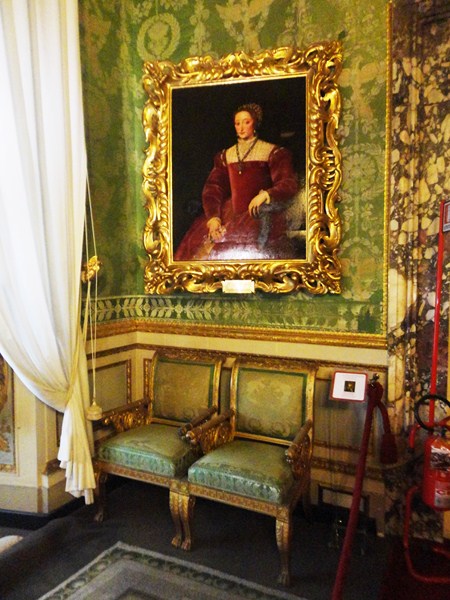
The Parrot Room (Sala dei Pappagalli), named for the bird (actually imperial eagles) motif in the beautiful silk lampas wall coverings (which have a green background and were made in the manufactory of Lyon in France and brought by Grand Duke Ferdinando III from Vienna in 1814), divides the King’s Apartment (extending along the internal courtyard) from the Queen’s Apartment, which follows the southern axis.  The Lorraine family installed the large stove.  The carpet and crystal chandelier both date from the 19th century.

Portrait of Giulia Varano, Duchess of Urbino (Titian)

In these public and private rooms, the Savoyard Period’s (1860-1919) eclectic taste (as described in the 1911 inventory) is particularly evident.  The clock, with its chased and gilded bronze shelf and black marble base, was made in 1812 by Pierre Philippe Thomire, a famous Parisian bronze maker.

The “recycling” of works of art, typical of the Restoration (c. 1815), includes the original bust of Napoleon being replaced with the bust of Ferdinando III and the imperial eagle with the allegorical figure of Tuscany.  The table cover, of silk and gilded silver, is in Louis XV styleImpruneta Fair, by Filippo Napoletano, is a depiction of the famous fair held near Florence every October 18th.

Chapel

The Chapel, intended by Grand Prince Ferdinando de’Medici (who lived there until his death in 1713) to be an alcove, or rather, an official bedroom (the real bedroom for sleeping was two doors further on) designed to receive a small group of people, shows the most obvious traces of the Medici story in the palace.

However, the echoes of the Medici style were cushioned during the Savoy rule when, with the aim of providing a seamless sequence of representation rooms, the furnishings were updated, including the table, mirror, vases and clock, and the accents that were probably considered too severe.

In the bed compartment, there is still a door that leads, by way of a spiral staircase, into a small library, closed by panels and cornices in different types of wood, decorated with plant motifs by French inlayer Riccardo Lebrun.

Mainly Late Baroque in style, the area is enhanced by a crimson silk damask ensemble which, although dating back to the mid 19th century, picks up on the designs and motifs in use in the previous century, establishing a seamless dialog with its, late 17th century character still evident in the articulate white stucco and gold decoration and in the gilded inlaid work by Giovan Battista Foggini (1652-1725), carried out between 1685 and 1687, with scrolls and mottoes referring to Ferdinando and his wife, Violante of Baviera. With the arrival of the Grand Dukes of Lorraine, the alcove was converted to a chapel.

Today, this area contains a mix of holy paintings and other highly crafted pieces.  The Virgin and Child, painted in 1675 by Carlo Dolci (1616-1686) for Vittoria della Rovere (widow of Ferdinando II de’ Medici), has a sumptuous and precious pietre dure frame, probably created from designs by Foggini on the occasion of the wedding of Prince Gian Gastone in 1697.

Other holy paintings shown here include two round works from the school of Sandro Botticelli and a 17th-century copy of Leonardo da Vinci’s Virgin on the Rocks (noted, above all, for its Baroque frame).

Royal Apartments: First Floor, South Wing, Pitti Palace, Piazza de’ Pitti, 1, FlorenceItaly. Tel:+39 055 294883. Open Tuesdays-Sundays, 8:15 AM – 6:50 PM. Admission: Palatine Gallery (€8.50), Silver Museum (€6.00), Gallery of Modern Art (€8.50), Costume Gallery/Porcelain Museum/Boboli Gardens/Bardini Garden (€6.00).

How to Get There: Take the C3 or D bus to the Pitti stop.

Palazzo Pitti – Hall of Venus (Florence, Italy)

Hall of Venus (Sala di Venere)

The Hall of Venus (Sala di Venere) starts the series of elegant rooms in the winter apartment on the first floor of Palazzo Pitti. This famous great hall, in Medici times, was the general antechamber where, before being received by the Grand Duke, the common public waited to be admitted.

On his return to Florence in 1641, Pietro da Cortona, commissioned by Ferdinando II de’ Medici (who wanted to show that he has aligned himself with the new Baroque decorative style), decorated the hall with frescoes and stuccoes from 1641 to 1642, the first of the series of so-called Planetary Rooms to which he put his hand (for this reason, it is entirely autographed).

Ceiling fresco (Pietro de Cortona)

The iconographic Medici residence celebration programme, aimed at exalting the figure of the prince and the process of preparing him to govern well, featured a decorative theme proposed by Francesco Rondinelli (the grand duke’s librarian).

Two lunettes and a tondi

It involved the constant presence of all three key players in the rooms – the prince, Hercules (a symbol of the virtues of the prince and protector of the Medici family) and the gods of Olympus (Venus, Apollo, Mars, Jupiter and Saturn representing the Ptolemaic planets) to which the room is dedicated.The lively fresco in the ceiling vault depicts, in the center, Minerva tearing the young adolescent prince from the arms of Venus (a symbol of pleasure) and then handing him over to Hercules (a symbol of virtue), his new tutor.

A lunette

Stories from antiquity, linked by the theme of the virtuous behavior of illustrious men in front of beautiful women, are frescoed at the eight lunettes, all bearing explanatory inscriptions in Latin.  Behind the lunette with the Story of Antiochus and Stratonice is a small window inserted between the stuccoes so that the Grand Duke can spy on and listen to what happened or was said in the room below.

Tondi

Standing out, from the very rich white stucco ovals (tondi), are portraits of the most illustrious of the most important members of the grand duchy, as well as the two popes of the House of Medici (Leo X and Clement VII). Their personal emblems are found at the segments of the pendentives.

Tondi

With respect to the Renaissance construction, the change of spatial organization is felt less. Although softened by the presence of the gilt stucco telamons and the white stucco medallions, the pattern of the lunettes, of the rib vaults and pendentives follow a pattern that still reflects the order of the Renaissance interior.

Venere Italica (Antonio Canova, 1810)

Standing at the center of the room, placed well after the room had taken its name, is the famous statue of the Venere Italica (Italic Venus, 1804-1811) by Antonio Canova, a compensation to Florence for the transfer of the Medici Venus (a work that was later returned) to the Louvre by Napoleon.

La Bella (Titian, 1536)

On display are four masterpieces by Titian.   Concerto (ca. 1506-1507) is an early work.  The Portrait of Julius II is a copy of the original by Raphael (now at the National Gallery in London ) but different in the results, especially linked to the masterful use of the typical color of Titian. La Bella (a painting for the Duke of Urbino, 1536 ) and the Portrait of Pietro Aretino  (1545) fully manifests the chromatic richness and stylistic complexity of the works of the master’s maturity, for example with the contrast between the reds of the beard and the blue of the robe that exhales the figure and a disturbing nuance to the character, shot shyly in profile.

Vocation of Peter and Andrew (Il Cigoli, 1607)

The Return of the Peasants from the Fields (ca. 1627) and Ulysses on the Island of the Phaeacians (ca. 1635), two grandiose and solemn landscapes, are a reference to Pieter Paul Rubens (the ideal teacher of Pietro da Cortona and the Flemish equivalent of Titian).

Marina del Faro with Vessels and Galleys (Salvator Rosa, ca. 1641)

Finally, Marina del Faro with Vessels and Galleys (ca. 1641) and Marina del Porto at Sunset (ca. 1641), two large marinas painted by the famous Neapolitan landscape painter Salvator Rosa, are noteworthy.

Other works in the Hall of Venus include:

Return of the Peasants from the Fields (Pieter Paul Rubens, ca. 1627)

Hall of Venus: First Floor, Palatine Gallery, Pitti Palace, Piazza de’ Pitti, 1, FlorenceItaly. Tel:+39 055 294883. Open Tuesdays-Sundays, 8:15 AM – 6:50 PM. Admission: Palatine Gallery (€8.50), Silver Museum (€6.00), Gallery of Modern Art (€8.50), Costume Gallery/Porcelain Museum/Boboli Gardens/Bardini Garden (€6.00).


How to Get There: Take the C3 or D bus to the Pitti stop.

Palazzo Pitti – Hall of Apollo (Florence, Italy)

Hall of Apollo (Sala di Apollo)

During the period of the Medici court, the Hall of Apollo (Sala di Apollo) was formerly the antechamber of the “ordinary nobility,” used by gentlemen who were waiting to be received by the Grand Duke inside the Throne Room.  It is dominated by a large altarpiece with the Sacred Conversation by Rosso Fiorentino (1522), the most important Florentine artist of early Mannerism together with Jacopo Pontormo, whose canvas was enlarged in the Baroque period to be adapted to the frame.

On the center of the ceiling vault is the fresco Medici Prince Brought before Apollo by Fame by Pietro da Cortona who provided the complete project (including the stuccos) and started the central figures in 1647 not long before the artist left Florence to return to Rome, delegating the rest of the assignment to his loyal pupil Ciro Ferri,

Ferri completed the decorations in the room 15 years later, between 1659-1661, after being appointed to do so by the Grand Duke, adding the frescos in the lunettes and the superb stucco cornice (a model that was then copied throughout Europe), based on the designs and cartoons left by his teacher Cortona.

The theme alludes to the ideal path of the political and moral education of the young prince, illuminated by Apollo and then guided along the path of knowledge by the laws governing the cosmos as evoked by Hercules holding the celestial globe, an obvious reference to Galileo Galilei’s recent discoveries and a symbol of the weight of the responsibilities of the future sovereign.

Ceiling fresco

Ovals and plumes, in the stucco, are examples of great ancient rulers who resorted to poetry and culture.  The stucco medallions below, showing some of the best-known feats of the Greek god, warns the future sovereign of the weight of responsibility from government and the need to be educated for the task by the Arts and by study.

Fresco of Augustus listening to the reading of the Aeneid,

The square frames show the emperors, including Augustus, intent upon listening to the reading of the Aeneid, or Alexander the Great receiving the poems of Homer, and condottieri from antiquity who favored the development of culture.  In the corbels are the Muses, Apollo’s companions.

Deposition from the Cross (Il Cigoli, 1600-1608)

The pictorial cycle and the articulated group of white stucco and gilt figures that disrupt the Renaissance style of the architectural setting, introduces a significant new element, animating the ceiling with an illusion of male sculptures holding up the heavy festoons and satyrs wrapped in vine tendrils.

Holy Family Bracci  (Andrea del Sarto, ca. 1523)

Also in the room are three works by Andrea del Sarto – the majestic and balanced Pietà di Luco (1523-1524), Holy Family Bracci  (ca. 1523) and the Holy Family Medici (1529), one of his last works.   Exhibited nearby are two other works by Titian – the Man with Glaucous Eyes  (ca. 1525) and the famous  Penitent Magdalene (ca. 1530), much copied by the artists who were able to admire her.

Portrait of the Infanta Isabella Clara Eugenia of Spain in the dress of a Clarissa  (Pieter Paul Rubens)

There are also other important works of the Venetian school here such as the Portrait of Vincenzo Zeno (ca. 1565) by Tintoretto and the Nymph and the Satyr (1508-1512) by Dosso Dossi (actually the traditional title is incorrect because it is a scene inspired by Orlando Furioso). The Hospitality of San Giuliano (ca. 1612-1618) exemplifies the monumental style of the Florentine Alessandro Allori while Saint Peter Resurrects Tabita (ca. 1618) by the young Guercino and Cleopatra (1640), a mature work of Guido Reni, shows the grandeur of the Bolognese school of the seventeenth century.

Supper at Emmaus  (Jacopo Pistoia, ca. 1570-1572)

Flemish art is also well represented here by the famous double Portrait of Charles I and Henrietta Maria of England by the school of Anton van Dyck,  Portrait of the Infanta Isabella Clara Eugenia of Spain in the dress of a Clarissa  (ca. 1625) by Pieter Paul Rubens and the Portrait of Vittoria della Rovere as the Vestal Tuccia (ca. 1640) by Justus Suttermans.

Pieta di Luco (Andrea del Sarto)

Other works in the Hall of Apollo include:

Hall of Apollo: First Floor, Palatine Gallery, Palace, Piazza de’ Pitti, 1, FlorenceItaly. Tel:+39 055 294883. Open Tuesdays-Sundays, 8:15 AM – 6:50 PM. Admission: Palatine Gallery (€8.50), Silver Museum (€6.00), Gallery of Modern Art (€8.50), Costume Gallery/Porcelain Museum/Boboli Gardens/Bardini Garden (€6.00).

How to Get There: Take the C3 or D bus to the Pitti stop.

Palazzo Pitti – Hall of Mars (Florence, Italy)

Hall of Mars (Sala di Marte)

The Hall of Mars (Sala di Marte) was, at the time of the Medici, the antechamber of the throne room where the chamberlain introduced the nobles, ambassadors and visitors in the presence of the Grand Duke. Dedicated to Mars, it forms part of the cycle of works of the so-called Planet rooms carried out in the 1640s by Pietro da Cortona.

The ceiling vault, frescoed on the theme of war by Cortona between 1643 and 1647, features the Medici coat of arms in the center, held aloft by a cluster of cherubs and topped with a crown inscribed with the name of Ferdinando II de’ Medici who commissioned the impressive decorative work.

Ceiling vault fresco

An allegorical representation of the education of the young prince, Hercules (the young prince’s alter-ego and patron god of the Medici family) is depicted in a naval battle which rages along the perimeter, watched over by Mars, the god of War, who bestows strength to the young man by lighting him with his star.

Medici coat-of-arms

With the enemy weapons spoils given to him by the Dark Gods, Hercules makes a trophy (panoply) while a parade of prisoners, their weapons discarded in the hope of a lasting peace, advances towards the female figures of Victory, Plenty and Peace, crowned with laurel. Rotating on himself, he receives the gladius of victory from Castor and Pollux, to be added to the trophy.

Victory, Plenty and Peace

More than any other room in the Pitti Palace, the Hall of Mars, perhaps due to the theatrical composition and the lively arrangement of characters on the ceiling, reaches the level of Baroque illusionism found in the famous vault in Palazzo Barberini (where Cortona had just completed his Triumph of Divine Providence fresco) in Rome.

Four Philosophers (Peter Paul Rubens, 1612)

In this room there are two Pieter Paul Rubens masterpieces. The monumental  Consequences of the War (1638 ), a grandiose allegory in harmony with the theme of Pietro da Cortona’s frescoes on the ceiling, shows Venus vainly entreating Mars not to go to war. The Four Philosophers (ca. 1612), of great intensity, has a self-portrait at the top left. Both canvases are rich in literary and philosophical citations and often figures from classical mythology appear.

Madonna and Child (Bartolomé Esteban Murillo, ca. 1650-1655)

San Sebastiano (Guercino’s Workshop)

The room is also accompanied by a series of portraits, among which the most important are by Anton van Dyck (Portrait of Cardinal Bentivoglio, 1622-1623), Titian (Portrait of Ippolito de ‘Medici, 1532), Tintoretto (Portrait of Alvise Cornaro, ca. 1665) and Paolo Veronese (Portrait of a Gentleman in Fur, ca. 1550-1560).

Saint Francis of Assisi in Ecstasy (Pieter van Mol)

Other works in the Hall of Mars include:

St. Peter in Tears (From Guido Reni

Hall of Mars: First Floor, Palatine Gallery, Palace, Piazza de’ Pitti, 1, FlorenceItaly. Tel:+39 055 294883. Open Tuesdays-Sundays, 8:15 AM – 6:50 PM. Admission: Palatine Gallery (€8.50), Silver Museum (€6.00), Gallery of Modern Art (€8.50), Costume Gallery/Porcelain Museum/Boboli Gardens/Bardini Garden (€6.00).

How to Get There: Take the C3 or D bus to the Pitti stop.