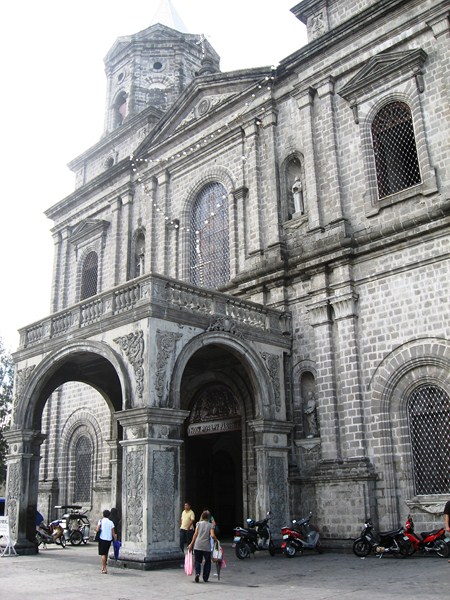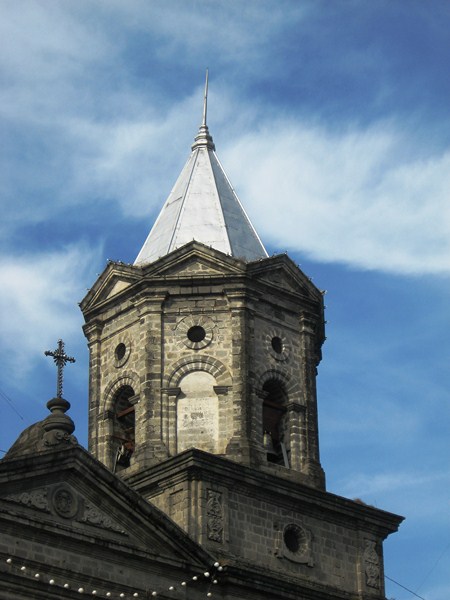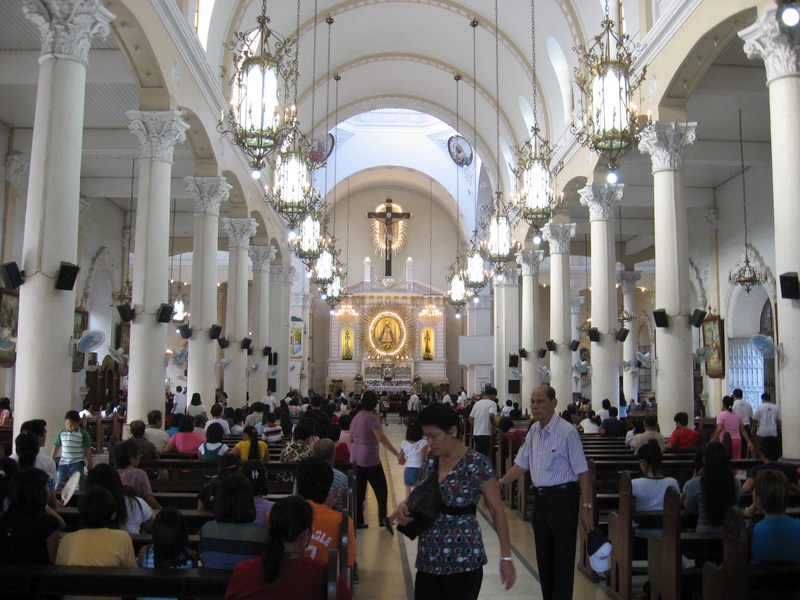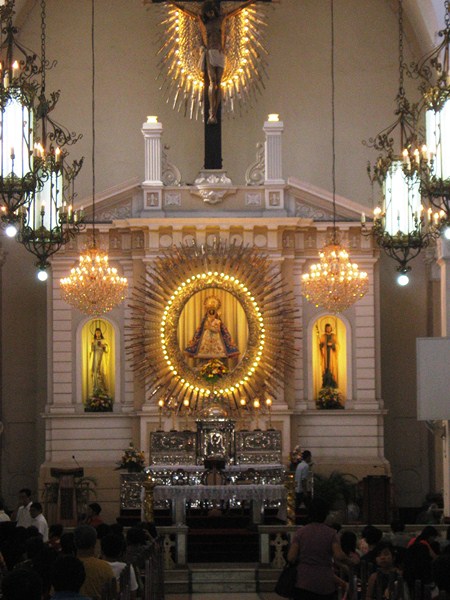
Casa Manila (Intramuros, Manila)

Casa Manila

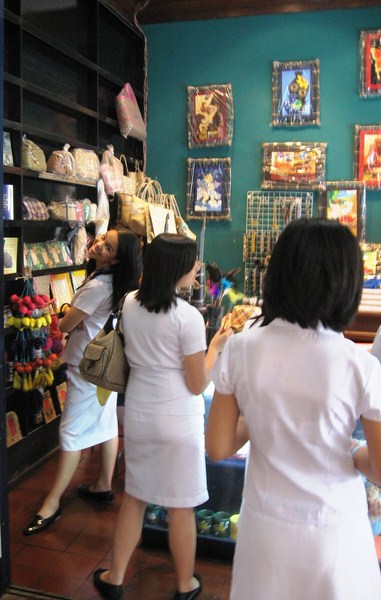
From San Agustin Church, we again boarded our calesa and made a stopover at the 3-storey, colonial lifestyle Casa Manila. This museum, built in 1981, is a faithful, beautifully-done reproduction of a typical mid-19th century Spanish bahay na bato residence of Binondo merchant Don Severino Mendoza that once stood along Calle de Jaboneros in San Nicolas, Binondo.

The courtyard

It has a façade of balconies and a overhanging wooden gallery, a beautiful inner courtyard and antique Philippine, Oriental and European furniture and furnishings. Designed by Arch. Jose Ramon Faustmann with interiors by Martin I. Tinio, Jr., it is a window to the opulent 19th century lifestyle of the gentry.

The courtyard fountain

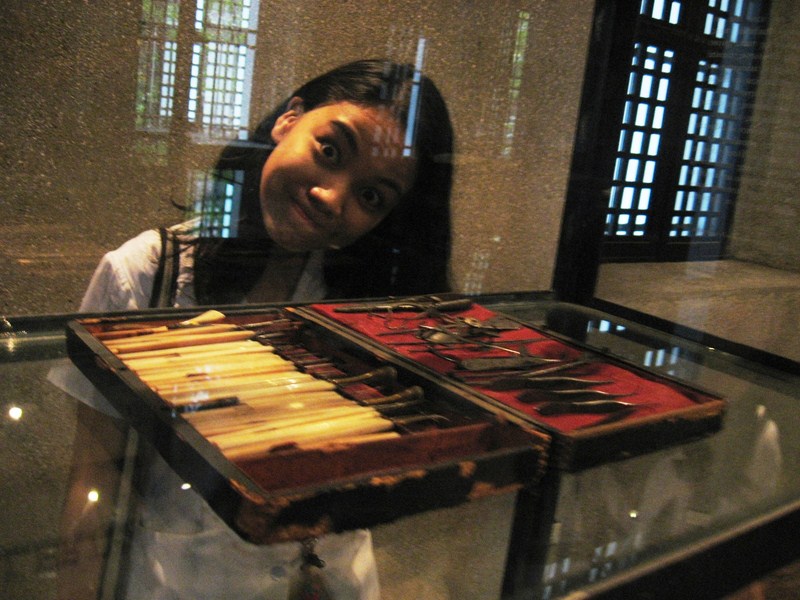
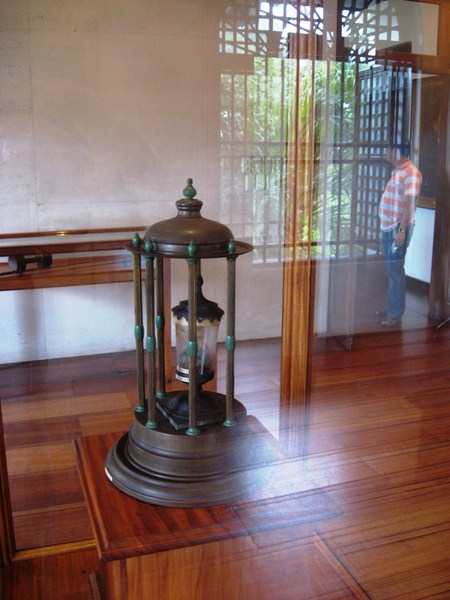
Though the house is just a reproduction, its exhibits aren’t.  No photography was allowed inside.  On display are antique 17th to the early 20th century jewelry, finely-crafted local, Chinese and European furniture and other items from the Intramuros Administration’s collection.  

L-R, Miguel, Mark, Matthew, Vicky and Francis

Casa Manila: Plaza San Luis Complex, Gen. Luna cor. Real St., Intramuros, Manila.  Tel: (632) 527-4084. Open Tuesdays to Sundays, 9 AM to 6 PM.  Admission: Php50 for children, students with valid ID and faculty members; and PhP75 for adults.

San Agustin Church (Manila)

Francis and Vicky Dionela, our balikbayan relatives, from Vienna, Austria, were in town  and my brother-in-law Mark and I toured them around Intramuros, availing of a calesa to do so.   Joining us were Mark’s sons Miguel and Matthew.  The first stop in our calesa tour was  the San Agustin Church.  I have been inside this church a couple of times, notably during the wedding of the former Susan O. Bilog, my wife’s first cousin, to Alfredo Azarcon on January 31, 2001.  However, this was my opportunity to explore it in detail.  During our visit, the church was again being prepared for another wedding.

San Agustin Church

Named after St. Augustine, Bishop of Hippo, San Agustin Church is the fifth church to be built in the country.  The mother church of the Augustinian Order, it is said to be the first mission constructed in Intramuros after the defeat of Rajah Sulayman by Miguel Lopez de Legaspi in 1571.  The first two churches were destroyed by fire on December 2, 1574 during invasion of Chinese pirate Limahong and by fire caused by a candle spark on February 28, 1583 during Gov.-Gen. Gonzalo Ronquillo de Penalosa‘s funeral.  Again fire damaged the church on the evening of March 30, 1586.  It was also damaged during the major earthquakes of 1645, 1754, 1852, June 3, 1863 and July 19, 1880.  During World War II, it was the only church in Intramuros (there are 7) to have survive the American bombardment during the liberation of Manila in 1945. Only the roof was destroyed.  However, the adjacent monastery was totally destroyed but rebuilt in 1970.  It is now the San Agustin Museum.  In 1994, the church was declared by the UNESCO as a World Heritage Site for Baroque Churches.

       
The adjacent San Agustin Museum

The present 67.15 m. long and 24.93 m. wide church, one of the most typical examples of the colonial Semi-Classical styles, was built between 1587 and 1604 by Juan Macias (said to be a Pampango builder) using hewn adobe stones quarried from Guadalupe, Meycauayan, San Mateo and Binangonan.  It has not undergone major change except for minor restorations and its being able to withstand 5 major earthquakes is attributed to its elliptical foundation (like the hull of the ship) and 1.5-m. thick walls.

       
Corridors leading to the San Agustin Museum

Its design shows Mexican influence.  The unassuming Neo-Classical façade has two levels.  The first level has 4 pairs of Ionic columns and statued niches filling the walls.  The second level has an equal number of Corinthian columns, semicircular arches and square windows.  Above it is a triangular pediment with a circular window.

       
TheProto-Baroque molave main door

The church interior is in the form of a Latin cross.  It has 14 side chapels. The original retablo, built in 1671 by Juan de los Santos, was replaced in 1681, coated with gold leaves in 1704, but was defaced in the British invasion in 1762.  The courtyard entrance and columned facade are guarded by granite lions (fu dogs) given by Chinese converts. 

       
The church interior

The church originally had two four-storey hexagonal bell towers, but the left one was dismantled after the 1863 earthquake.  It has an intricately carved, 24 ft. high and 16 ft. wide Proto-Baroque molavemain door with 4 panels depicting Augustinian symbols, an exquisite Baroque narra pulpit carved in 1627, tombstones on the floor and 12 side chapels (originally 14) dedicated to various saints. 

     
The tromp-l’oeil ceiling

Its vaulted tromp-l’oeil (from the French word meaning “deceives the eye”) ceiling, from which hang 16 crystal chandeliers from Paris (1879-80), was painted by Italian artists Giovanni Alberoni and Caesar Dibella in 1875.  Viewing it from below, the designs appear as 3-dimensional.

      
The pulpit

The magnificent choir loft, the only one of its kind in the country, has 68 beautifully handcrafted molaveseats with ivory encrustations supported by huge elliptical arches.  It was ordered by Fr. Miguel Serrano and brought in from Macao by Bishop Hernando Guerrero in 1614.   A crucifix here dates from the 17th century.  The big lectern has 16th and 17th century cantorals.

       
The main altar

Its 18th century pipe organ was newly-restored and inaugurated on November 1998.  Its classical tones, to which are attached renowned composers  Fr. Manuel Arostegui and Pakil (Laguna)-born Marcelo Adonay, echoed again during the 3-day Second International Music Festival  hosted by San Agustin Church.

       
A side altar

The remains of Miguel Lopez de Legaspi, Martin de Goiti, Juan de Salcedo and various early governors and archbishops are buried in a communal vault in a side chapel to the left of the main altar. Their bones were mixed up when the British desecrated their graves when they sacked Manila from October 6-7, 1762.  The reclining bronze statue of Legaspi was done by Spanish sculptor Juan Miguel Iriarte.  The remains of painter Juan Luna, and statesmen Pedro Paterno and Trinidad Pardo de Tavera are also housed in the church.


Another side altar

San Agustin Church: Cor. Gen. Luna St. and Calle Real, Intramuros, Manila.

Carabao Island: The Next Boracay? (San Jose, Romblon)

White sand beach


I have always been a frequent visitor to Boracay, my father-in-law being a native of Malay town which has jurisdiction over the island.  During this latest visit, for a change of scenery, my son Jandy and I opted to visit the nearby 28.9 sq. km. Carabao Island, touted as the “Next Boracay.”  This  island, part of Romblon province, was so named because of its carabao shape but is commonly called, by its natives, as Hambil.  It is 3 times bigger than Boracay and can be viewed from Boracay’s Mt. Luho View Deck. Relatively-unknown until lately, the prices of real estate in San Jose, Carabao Island’s only town, which is virtually occupied and owned by its original settlers, is also much cheaper compared to Boracay and foreign investors from the European Union, Taiwan, South Korea and Japan have shown interest in relocating to San Jose after they discovered the island’s white sand beaches and crystal-clear waters said to rival, if not equal, Boracay’s.  Reportedly, investors were also discouraged to find taxes on Boracay Island to be “quite high.” 

Carabao Island seen from Boracay


I wanted to visit this still pristine island before the onset of continuous and uncontrolled Boracay-like development spills over to the island.   This is inevitable as plans are now underway for San Jose to be the site of the Romblon Special Economic Zone and that  work on a modern PhP5 billion international airport with a 4,000 m. long runway, to accommodate large-bodied Airbuses and similar aircraft, is expected to begin.  A boat to the island leaves, once daily, around 7:30 AM, from a landing near the Caticlan Jetty Port.  My co-passengers included a French couple, with their two cute little daughters, and Lanas barangay captain Ms. Emerita Sombilon whom I chatted with along the way.  The boat trip took about an hour, passing by Boracay’s rapidly developing east coast and Puka Beach on the north, the closest part of Boracay to Hambil. We again touched ground on Hambil’s jetty around 9 AM and decided, together with the Frenchman, to walk along the beach to the first resort that came our way: Ivy Vine Beach Resort.  We were welcomed by amiable British couple Graham and Pamela “Pam” Hill who were managing the resort in the absence of owners.   We instantly fell in love with the place and decided to stay, billeting ourselves in two of its 7 fan-cooled rooms with bath.  The resort also has a 3-4 pax dorm.  

Graham Hill of Ivy Vine Resort


After lunch (ordered in advance) at the resort’s restaurant, Jandy and I decided to walk long  the coast as far as our legs would allow, surveying the wonderful and bucolic scenery and the existing tourism infrastructure such as Nipa Hauz and the currently closed Carabao Beach Resort.  There are no jeepneys or tricycles for getting to and from the island’s 5 barangays as the narrow, single-track and partially concrete (but mostly rough) road only allows for motorcycles and mountain bikes.  We bought cool, refreshing drinks and halo-halo at small stores along the road.  

A bucolic scene


Come dusk, I decide to forego going to the town proper which was celebrating its fiesta (the Feast of St. Joseph, the town’s namesake).  Instead, we opted to have a quiet dinner at the resort and chat with Graham, Pam and the guests. It was also an opportunity to view its beautiful, uncluttered sunset which I found to be much better than Boracay’s which is usually obstructed with numerous boats and swimmers.
   

A beautiful Carabao Island sunset

Unlike many foreigners who fell in love with and stayed in Boracay, Graham and Pam fell for Carabao Island.  Graham, a divemaster, manages the dive shop, the only one, so far, on the islandPam helps manage the resort.  Both left high paying but mentally draining and stressful jobs to be in this piece of Shangri-la.  However, old habits still remain as they installed a satellite disk, to watch their favorite English football games, and internet (so far, the only one on the island) to keep in touch with relatives, friends and the latest developments in England.  Still, if things go their way, they plan to make the island their permanent home.  I can see why.    

A Morning Trek to Taal Volcano (Talisay, Batangas)

Taal Volcano’s crater lake and Vulcan Point

After a delightful Filipino breakfast at Balai Isabel’s restaurant, Bernard, George (Bernard’s son), Bernard’s niece and I made ready for our scheduled hike up, via the Daang Kastila Trail, to the view point of Taal Volcano. Aside from other resort guests, we were traveling with distinguished company, as joining our trek to the volcano were members of the Mt. Everest team including the 3 Pinay ladies who conquered Mt. Everest just a year ago – Ms. Janet Belarmino, Ms. Carina Dayondon and Ms. Noelle Wenceslao – plus Mr. Fred Jamili, member of the First Philippine Mt. Everest Expedition Team’s technical and support group.  The four, together with Mr. Erwin “Pastor” Emata and Dr. Ted “Omar” Esguerra, were slated to join the 2008 6th Hillary-Tenzing Mt. Everest Marathon in Nepal, tagged as the highest marathon in the world.  This 42-km., basically downhill race starts from the Mt. Everest base camp at the Nepal or south side (altitude: 17,149 ft.), to the town of Namche Bazar (altitude: 11,300 ft.).  The volcano trek will serve as a warmup to that event.

The Welcome Center

This was to be my third visit to the volcano and my second to the viewpoint (the other was a trek to the crater lake itself).  To get to Volcano Island, we used a number of the resort’s 32 accredited motorized bancas. Our 30-min. trip again took us around the island, past the 311-m. high Mt. Binintiang Malaki, the island’s highest point seemingly featured on most Taal Volcano postcards like an island but actually connected to the real Volcano Island.  We soon arrived at the open-air Welcome Center and rested for a while prior to our hike.   

From here, it was all 45 mins. (1.7 kms.) of hiking, first along the beach, then into a shady forest and, on our last leg, up a steep, dusty and treeless trail up to the Crater Lake viewpoint.   Steam vents, emitting a sulfurous odor, can be encountered along the way.  The viewpoint, actually just a makeshift hut, was a cool welcome relief for its shade and its magnificent bird’s eye view of the beautifully azure and seemingly peaceful, 2-km. wide crater lake with its small island called Vulcan Point, a view not seen in any view point in Tagaytay City.  At the northeast edge of the lake are vents that effuse volcanic steam.  Mt. Makulot, the highest mountain in Batangas, can be seen in the distance.  The trek back, to the Welcome Center and our boats, was faster but very slippery.  Back at our boats, we were soon on our way back to the resort where a welcome lunch awaited us.

Club Balai Isabel (Talisay, Batangas)

At the spur of the moment, one summer day, I got an invitation from events organizer Bernard Supetran to join a morning trek to Taal Volcano, the world’s smallest and deadliest volcano.  Our jump-off point was to be the 10-hectare Club Balai Isabel in Brgy. Banga in Talisay, Batangas.  Joining me and Bernard was Bernard’s son George and a niece.  To get there, I brought along my ever reliable Toyota Revo.

Clubhouse and swimming pool

We all left Manila early in the morning but still got tied up at traffic at the South Luzon Expressway (SLEX).  Taking the Sta. Rosa Exit, we drove along the Sta. Rosa-Tagaytay Road, turned left along Aguinaldo Highway and drove down winding Ligaya Drive to the Talisay lakeshore road.  We still manage to get to the resort in time for a Filipino breakfast at Club Balai Isabel’s full-service restaurant at the clubhouse where we were welcomed by resort owner and Talisay native, Nelson Terrible  and his wife Cecille.   While dining, we had a magnificent view of Taal Lake and Taal Volcano. 

Restaurant

Opened in 2007, Club Balai Isabel has residential houses and two boutique style clusters: the Sampaguita Manor, with its 6 hotel-type rooms with mini-refs, hot and cold shower  and balcony, all nestled on a garden of different trees and ornamental plants.  The Ylang-Ylang Villa, on the other hand, offers 6 two-storey, kitchen-furnished studio units, all ideal for families. Since the 400-m. long lake shoreline is not recommended for swimming because of its murky and deep water, the resort has put up, aside from its free-form swimming pool, the Mobideep, an inflatable swimming pool with separate pools of different depth. Its deepest pool, measuring 21 feet, is even used for scuba diving training. 

Villas

For conferences, the resort also has 2 function halls (Kasili Hall and Kasay-Kasay Hall).  For company team building, the resort has a challenging Balikatan Course consisting of 5 different obstacles. Apart from its swimming pools, the resort also has tennis, badminton and basketball courts and guests can also rent a kayak to go around the lake.  The clubhouse also has a business center and novelty shop.

Mobideep and Taal Lake

To encourage environment protection and conservation from the community, the resort has started a Solid Waste Management project wherein Talisay residents can avail of support from the resort in the form of loans or financial backing for community projects on condition that they turn in a certain amount of recyclable waste materials to the resort. According to Nelson, this concerted effort will make people realize that nature and Taal Lake should be protected to be able to retain their livelihood, especially fishing and tourism. The resort, on the other hand, also addresses the water shortage problem, one of the biggest environmental problems that the country has to be faced in the coming years, by using filtered lake water for the swimming pool as well as in Mobideep They also make sure that they are using low energy-consumption equipment in the resort.

Obstacle course

In the near future, Club Balai Isabel will be adding more facilities, including a recreation center equipped with videoke, a movie room, billiard tables, Wifi and Play Station 3 rooms, an internet shop, Tea Lounge and a library. Wi-fi will also be made available in the public areas. The resort will also be building facilities for skim and wake boarding.  A wellness center, offering medical spa and traditional medical facility as well as non-invasive therapies and executive checkups for tourists and guests, will also be opened. Nelson is particularly excited about the opening of the Spa Suites, eight 2-8-pax huts which will have a queen-sized bed, private bathroom and a private jacuzzi in a lush garden setting. Club Balai Isabel will soon offer the Taal Lake Cruise using their 20-pax Cancun which is equipped with washroom and mini-bar. 

From the South Luzon Expressway (SLEX), you can also get to the resort by taking the Greenfield/Asia Brewery exit and heading towards Tagaytay City. Turn left at Calamba Road then turn right at Ligaya Drive and head towards Talisay. Turn left at the junction of Talisay National Road and look for the entrance of Club Balai Isabel, which will be at the right side of the road.   
 
Club Balai Isabel: Talisay National Rd., Talisay, Batangas.  Tel: (043) 728-0307.  Manila Tel: (632) 817-0572 and (632) 809-0585.  Mobile numbers: (0916) 552-4319, (0905) 301-1418, (0922) 823-5854 and (0928) 507-1093.  E-mail: craterlakeresort@yahoo.com. Website: www.balaiisabel.com.ph.

Church of St. Fabian, Pope & Martyr (San Fabian, Pangasinan)

Originally built with brick in 1768 by Dominican Fr. Francisco Ferrer, the Church of St. Fabian, Pope and Martyr, as well as the semi-claustral convent (which was constructed in 1763 by Fr. Holego Francisco Ferrer and converted into a public oratory), were destroyed by a fire in 1856 and subsequently restored.

The Church of St. Fabian, Pope & Martyr

The Church of St. Fabian, Pope & Martyr

Fr. Juan Gutiérrez, O.P. (1859-1862) rebuilt the church and the sanctuary (1857 and 1860) in cruciform (59.85 m. long and 11.40 m. wide; at the cruciform, 20 m.). In 1863, the present masonry church, convent and bell tower were built by Fr. Ramon Fernandez (parish priest from 1860 to 1870).

The restored, 5-storey octagonal bell tower

The restored, 5-storey octagonal bell tower

The massive earthquake of March 16, 1892 again damaged the church and convent which were later rehabilitated. On January 1945, during World War II, the church was damaged and bell tower and convent were destroyed by American naval shelling and, in 1952, the church and a portion of the convent were repaired by Engr. Santiago Alhambra, Fr. Francisco Posadas (1944-1952) and Fr. Emeterio Domagas.  In 2003, the bell tower was fully restored.

The church interior

The church interior

Church of St. Fabian, Pope & Martyr: Braganza St., San Fabian, 2433 Pangasinan. Tel: (075) 511-4841.

How to Get There: San Fabian is located 28 kms. east-northeast of Lingayen and about 184 kms. northwest of Manila.

Church of St. Peter & St. Paul (Calasiao, Pangasinan)

This church is one of the largest in Pangasinan.  The original church was destroyed by earthquake and burned in 1736 during the Palaris Revolt.  The present structure was built in 1753 by Fr. Dalmau, burned in 1852 and rebuilt from 1853 to 1858 by Fr. Ramon Suarez.

Church of St. Peter & St. Paul

Church of St. Peter & St. Paul

The massive March 16, 1892 earthquake damaged the church. The massive July 16, 1990 earthquake destroyed its bell tower. Msgr. Luis B. Ungson reconstructed the church, restoring the bricked front wall, antique statues and the ceiling’s original floral motif. In 2001, the church was declared as a National Cultural Treasure by the National Museum of the Philippines and the National Commission for Culture and the Arts.

The restored 5-storey bell tower

The restored 5-storey bell tower

The church is 88.3 m. long, 25 m. wide and 27.3 m. high.  The adjoining sprawling convent is 75 m. long, 25 m. wide and has two yards.  The church’s imposing Renaissance-style brick and cement facade has columns that rise from the first level to the window sill.  Its pediment has a well-defined cornice and a statued niche at the tympanum flanked by two circular windows.  Its 30-m. high, hexagonal, 5-storey bell tower, one of the best in the province, has pinnacles at each level, arched windows with columned jambs and cantons at the corners.   Its retablo mayor, ornately decorated with statues of saints, is massive and complex woodwork is seen at the back.

The church interior

The church interior

Church of St. Peter & St. Paul : Poblacion West, Calasiao, Pangasinan,

How to Get There: Calasiao is located 207 kms. from Manila.


Church of St. Dominic Guzman (San Carlos City, Pangasinan)

The town’s first church was built at the western side of the Agno River (near Zambales) where the town of Binalatongan (renamed as San Carlos in 1764) was originally located. On September 1587, the church was destroyed by fire and the church was reconstructed at Baloydaan at the eastern part of the river. On August 4, 1718, the church was again damaged by a fire. The town of Baloydaan was transferred to its present site and, after the 1763 uprising, was renamed as San Carlos in 1764.

Church of St. Dominic Guzman

Church of St. Dominic Guzman

The city’s present church, its fourth, was built with bricks (ladrillo) from 1770 to 1773 by Fr. Cristobal P. Ausina. During the late 1700s, iIt used to be the largest Catholic church in the Philippines but was heavily damaged during the 1796, 1798 and 1799 earthquakes.    Between 1802 and 1804, the church was reconstructed.

Image-03

Now measuring 89 yards (267 ft.) long and 22 yards (66 ft.), its wall height was lowered and the foundations were strengthened with buttresses.  In 1822, both the church and its convent were razed by fire and the church was rebuilt before 1864.  From 1878 up to 1890, Fr. Alvarez Carrozal initiated the rehabilitation of the church and the adjoining 4-storey bell tower was also erected during his time.

The 4-storey bell tower

The 4-storey bell tower

The church’s 4-level Baroque  facade has a huge pediment (formed from the two upper levels) painted with a picture of Saint Dominic and embellished with a raking cornice with huge, elegantly designed scrolls.  Through the designs along its wall planes, the middle segment gives contrast within the levels.

The church interior

The church interior

How to Get There: San Carlos City is located 227 kms. from Manila.

Church of St. Raymond of Penafort (Mangatarem, Pangasinan)

The town’s present one-nave church replaced a wooden church built, from 1835 to 1844, by Fr. Joaquin Perez but burned in 1862. Fr. Manuel Alvarez de Manzano laid the church’s new 6 yard thick and 6 yard deep foundation.  The construction of the church was continued by Fr. Suarez until 1875. By 1880, the façade was completed and the church was finished by Fr. Vicente Iztequi.  The church was damaged during the July 16, 1990 earthquake.

Church of St. Raymond of Penafort

Church of St. Raymond of Penafort

Formerly the largest in the country, this church has a simple Early Renaissance sandstone facade with a low pediment and upper and lower levels separated by dentil-like elements.  Niches, windows, and the doorway relieve the monotony of the simple facade. The walls used finely hewn and squared ashlar stones hewn from the stone quarries along the mountain rangesof Malabobo, located 8 kms. from the town. The church measures 82.40 m. long and 16 m. wide while the transept is 51.70 m. long and 15.40 m. wide. The sidewalls measure 2.5 yards wide while the façade and the back walls are 3.5 yards wide.

The church's simple Early Renaissance sandstone facade

The church’s simple Early Renaissance sandstone facade

Fr. Manzano also began constructing the two bell towers and was continued by his successors, including Fr. Iztequi, but the towers were never completed, reaching only 6 m. high and remains so up to this day.  Fr. Perez built the 45 yard long and 20 yard wide brick convent in 1847 but this was also burned in 1862.  The present convent was built, on the same foundation of the former, by Fr. Iztequil from 1875 to 1886.

The church's interior

The church’s interior

How to Get There: Mangatarem is located 177 kms. from Manila and 23 kms. south of Lingayen.

Zoobic Safari (Subic Freeport Zone, Zambales)


A tiger bathing in a pond

After an overnight stay at Subic Yacht Club with my son Jandy, we proceeded, after a Chowking lunch and duty-free shopping at the Freeport Exchange, for a short-haul drive to this sprawling 25-hectare Zoobic Safari theme park and zoo located deep in the old Naval Magazine at the Jungle/Forest Adventure zone.  Upon arrival, we were welcomed by Gen. Manager Ms. Delia C. De Jesus who assigned to me the affable Mr. Noel Caneda to guide me on this 2-hr., 5-part tour. He explained to us the different species that can be found inside the park, extolling their virtues as well as their deadly qualities.

Noel Caneda feeding a camel

At the reception area, we already got to see adult and baby tigers in large cages, all crossbred from Bengal and Siberian varieties in Residence Inns’ tiger cub breeding facility.  A joint venture with Subic Bay Metropolitan Authority (SBMA), the PhP80 million Zoobic Safari was opened to the public on November 2004 and is part of Residence Inn’s chain of zoo cum resort businesses. The animals here may not be all originally from the Philippines but the place was still developed with a Filipino theme in mind.

Our first stop was the Petting Zoo a path through a forest with different animals stationed on the both sides of the walkway.  Here we saw exotic animals such as deer, temperamental and territorial cassowary, bearcats, monkeys, mini horses, several rabbits, plus some farm animals such a number of goats, sheep, carabao, pigs and a pinkish albino cow, all roaming and frolicking about in their natural habitat. Jandy and I had a wonderful time petting and feeding dried leaves to a camel.  A close encounter with an Asiatic black bear (or moon bear) named Nicholas, the only one in the zoo (and thus lonely), was a highlight. Other stops include the Serpentarium, the only one of its kind in the country.  Housed in one of the former ammunition bunkers, it showcases a variety of reptiles including a Malaysian water monitor, blood pythons, a Burmese albino, reticulated python, the Philippine monitor lizard, iguanas and turtles.  The star here was “Biggy,” a 15-ft. long, 10 year old female Indian python.

An Asiatic black bear named Nicolas

The highlight of the tour was the Tiger Safari.  Here, we boarded a customized “safari” jeepney colorfully painted in tiger-inspired golden stripes and enclosed with one inch, open wire mesh which covered the windows and doors.  It was driven by a professional Aeta who drove us, through a gate, to the well-kept Ilanin forest (although a number of big trees were uprooted due to typhoon Milenyo) where four full grown, 500+ pound tigers, with their trademark rust orange and black stripes, were roaming around.  Most lazed about in a large pond, their deep-set, golden eyes staring back at us, probably wondering why we were “caged” inside our vehicle while they were roaming freely in the open.  During the ride, one of the guides inside our vehicle dangled a dressed chicken from a small window. On instinct, one of the tigers ran over to the vehicle and grabbed the chicken, an encounter so close you can really see his teeth.  Another tiger jumps on the roof.

Tiger’s Den

After the Tiger Safari, we all dropped by the “Tigers Den” where we got up close and personal, along a narrow aisle, with tigers inside their cages, barely two feet away from these awe-inspiring beasts christened with such cute names as Cynthia, Gimo, Jana, Krishna, Nasha, Nico, Sharon and George. The last named, a mammoth Alpha male and the oldest at 16 years, is the acknowledged leader of the pack and king of the harem, with all of the female tigers his for the taking. Noel explained that a tiger’s urine smell marks his territory.

A fleet-footed ostrich

Adjacent to the Tigers Den is the dusty Savannah Trail.  This we traversed via an open, red and blue Zoobic Safari train (with 20-30 seating capacity), watching 50 long-legged ostriches from Africa and Australia as well as potbellied pigs, swift mountain goats, wild boar (from the USA, Vietnam and the Philippines) and 200 guinea fowl (from Papua New Guinea) glide past our vehicle.   Next stop was the Animal MuZOOeum, housed in another former ammunition bunker.  This interesting and educational tour features a rare collection of real stuffed animals and skeletons.

Croco Loco

Our last stop was the Croco Loco section.  Here, we trekked, via the Aeta Trail, to an Aeta Village where a group of Aetas performed, to the delight of the tourists, the dragonfly dance and a war dance, both accompanied by an Aeta guitarist. Of course, we also went to the 3,000 square meter Crocodile Farm, again seeing up close and personal, in their carefully designed natural habitat, 200 of these thick-skinned, long-bodied carnivorous saltwater crocodiles from Palawan. In the future, Zoobic Safari has plans to expand with Elephant World, Honey Bee Farm, Alligator Land and the Rice Wine Brewery.

Aetas performing a war dance

Zoobic Safari: Group I, Ilanin Forest, Subic Bay Freeport Zone.  Tel: (047) 252-2272.  Fax: (047) 252-2272.  Website: www.zoobic.com.ph. Entrance fee is PhP295 (Monday-Thursday) and PhP395 (Friday-Sunday).  Manila booking office: 3/F, Yupangco Bldg., 339 Sen. Gil Puyat Ave., Makati City.  Website: www.residenceinnresorts.com.